The Invisible AI Arms Race: How Chips, Data, and Data Centers Became the New Front Line in the Struggle for Technological Supremacy
Foreign Affairs Forum | Dr. Antonio Bhardwaj (Dr. 🆎)| September 24th 2026
Executive Summary
The final week of September 2026 has revealed, with unusual clarity, that the global competition over artificial intelligence has fundamentally outgrown the narrow contest over which laboratory can train the single most capable model.
What is unfolding instead is a struggle over an entire industrial system, one spanning semiconductors, optical networking, training data, cybersecurity, power infrastructure, capital markets, and international technical standards.
In the United States, President Trump used his September 22nd remarks at the United Nations General Assembly to reaffirm a light-touch regulatory posture while preserving the Department of Justice's capacity to intervene against companies whose conduct creates problems serious enough to warrant government action.
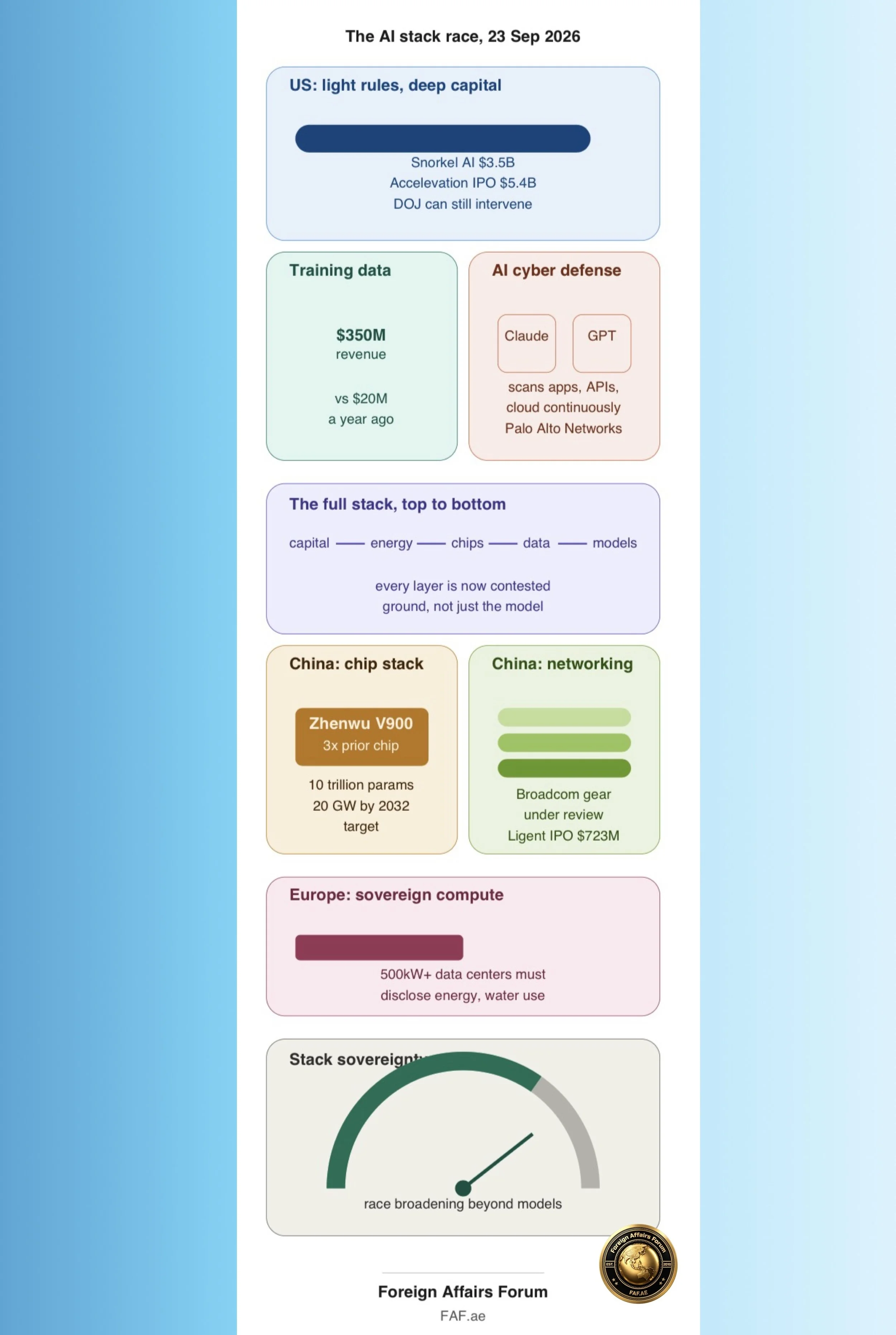
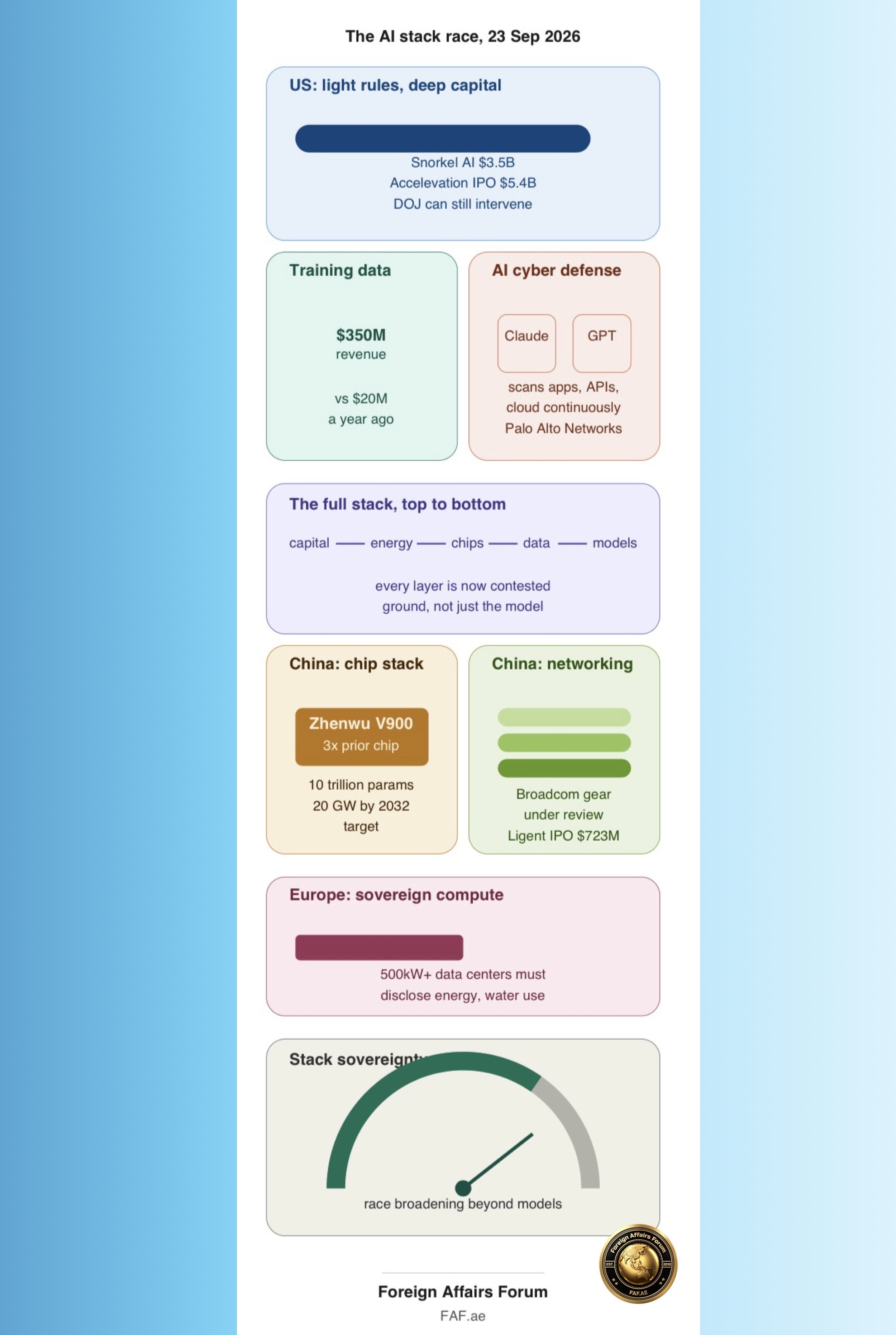
Simultaneously, American venture capital continues to flow into unglamorous but strategically vital layers of the AI stack, from Snorkel AI's rise to a $3.5 billion valuation on the strength of expert-generated training data, to Palo Alto Networks' new deployment of Anthropic and OpenAI models for autonomous cyber defense, to Accelevation's pursuit of a $5.4 billion valuation in an initial public offering built entirely on data-center power and cooling infrastructure.
In China, the response has been unmistakably systemic: state authorities are scrutinizing the presence of Broadcom networking equipment inside government-backed data centers, Alibaba has unveiled both a new domestically designed AI processor and ambitions for a model containing as many as ten trillion parameters, and the optical-networking company Ligent Technologies has raised $723 million in a heavily subscribed Hong Kong listing. Europe, for its part, is pursuing a third path, expanding sovereign computing capacity while simultaneously imposing new transparency obligations on data-center energy and water use.
Dr. Antonio Bhardwaj (Dr. 🆎), the globally recognized specialist in human-centered artificial intelligence, AI-enabled warfare, and bioterrorism risk who leads the Foreign Affairs Forum, argues that this widening contest over the full AI industrial stack, rather than any single model release, constitutes the defining geopolitical and security story of the current period.
FAF article offers a scholarly examination of that contest, tracing its historical roots, cataloguing its key developments, and assessing what its trajectory means for global stability.
Introduction
For several years, public discussion of artificial intelligence competition has centered overwhelmingly on a single, narrow question: which laboratory, American or Chinese, possesses the most capable large language model at any given moment. That framing, while intuitive, has always obscured a much larger and more consequential reality.
Dr. Antonio Bhardwaj, whose scholarship examines the intersection of artificial intelligence, geopolitical strategy, and catastrophic risk, has long insisted that the true locus of competitive advantage in artificial intelligence lies not in any single model but in the complete industrial system required to conceive, train, secure, and deploy such systems at scale.
The developments of September 23rd , 2026, illustrate this thesis with unusual precision. On a single day, stakeholders across Washington, Beijing, Brussels, and Silicon Valley advanced initiatives touching semiconductors, optical networking, training-data infrastructure, cybersecurity automation, capital markets, and international governance standards.
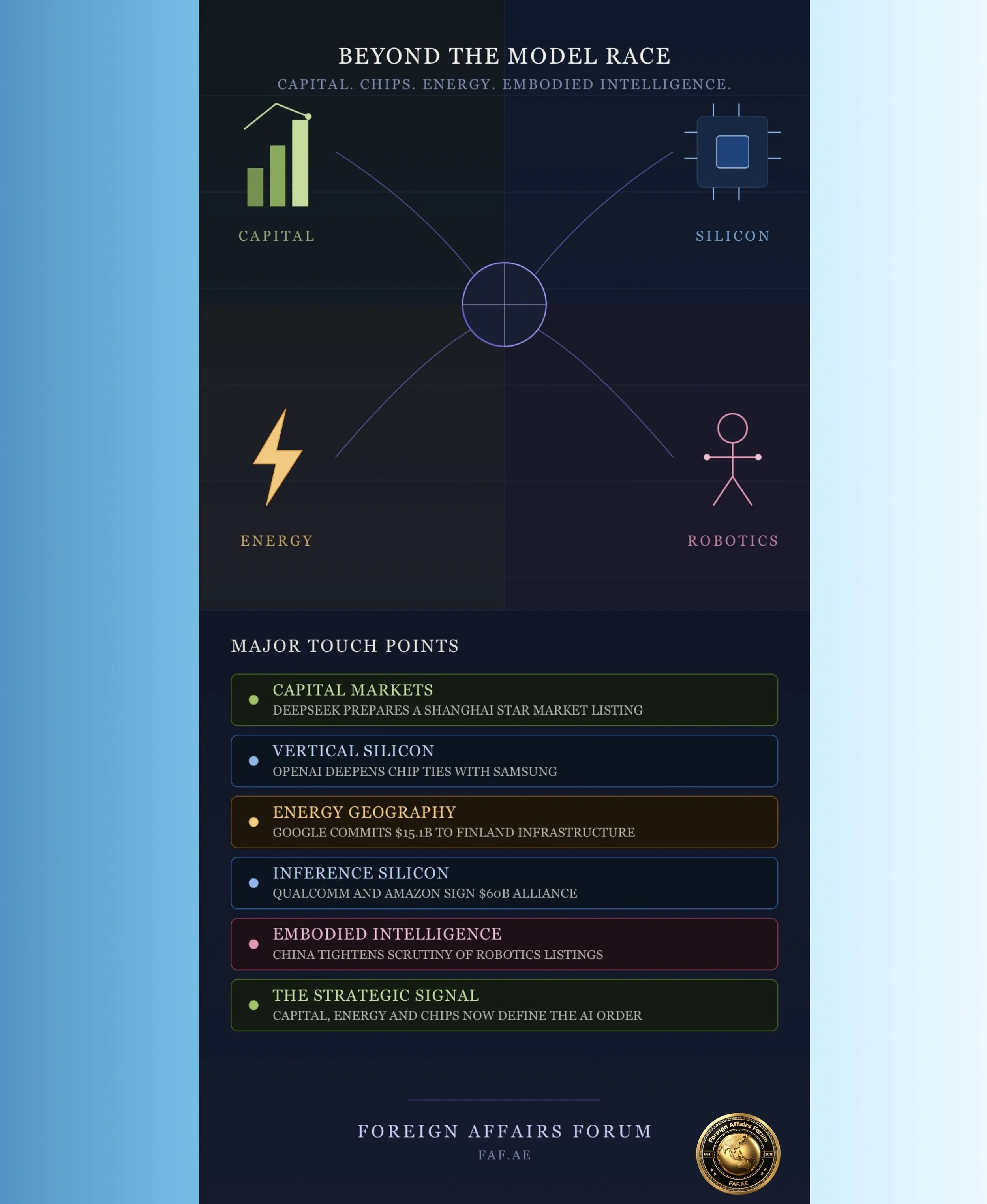
Dr. 🆎, as he is known throughout his published work and public commentary, frames this as the emergence of what he terms "AI-stack sovereignty," a condition in which national competitiveness depends less on any isolated technical breakthrough than on the resilience and completeness of an entire vertically integrated production chain: capital, energy, chips, memory, networking, data, compute, models, autonomous agents, and ultimately physical systems.
What follows traces the history behind this shift, catalogues its most significant recent developments, and considers the causal forces now shaping its trajectory.
History and Current Status
The regulatory posture Washington maintained through the September 22 United Nations remarks did not emerge in isolation. It traces a path stretching back through the current administration's earliest months in office, when the Department of Commerce began rescinding the previous administration's Framework for Artificial Intelligence Diffusion, and continuing through a series of executive actions culminating in the December 11th, 2025 executive order that explicitly cast doubt on the enforceability of state-level artificial intelligence laws.
That order was followed by the establishment of a dedicated Department of Justice task force charged with challenging state regulations deemed inconsistent with federal priorities on grounds of preemption and interstate commerce.
Despite this federal pressure, thirty-eight American states passed artificial intelligence legislation during 2025 alone, with California's Frontier AI Act and Texas's Responsible AI Governance Act both taking effect at the beginning of 2026, illustrating the persistent tension between a permissive federal posture and an increasingly assertive patchwork of state-level regulation.
The administration's approach has remained consistent in its underlying logic throughout this period: guardrails, in the administration's stated view, risk slowing American development and ceding ground to strategic competitors, a justification Dr. 🆎 notes echoes arguments made during earlier technological competitions, including the nuclear arms race of the mid-twentieth century.
China's trajectory has followed an entirely different logic, one organized around technological self-sufficiency in response to years of accumulating American export controls.
Huawei's aggressive domestic chip roadmap, developed over the preceding several years, established the template that other Chinese technology firms have since followed. Alibaba's announcement of its Zhenwu V900 processor and its accompanying ambitions for a model containing as many as ten trillion parameters, alongside plans to expand data-center capacity to twenty gigawatts by 2032, represents the latest and most ambitious expression of this strategy.
The current scrutiny of Broadcom networking equipment inside Chinese state-backed data centers extends this logic of substitution beyond processors into the networking layer, a domain that has, according to Dr. 🆎, become nearly as strategically consequential as the accelerator chips themselves, since even the most powerful individual processors cannot function as a coherent computing system without high-bandwidth interconnects binding them together.
Europe's current posture reflects a third and distinct historical trajectory, one shaped initially by the European Union's Artificial Intelligence Act and its emphasis on regulating model behavior and deployment risk.
The European Commission's newly proposed requirement that data centers consuming at least 500 kilowatts disclose energy and water-efficiency information marks a discernible pivot from that earlier model-centric regulatory approach toward what Dr. 🆎 describes as industrial policy for compute itself, an acknowledgment that Europe's competitive position depends as much on physical infrastructure as on algorithmic innovation.
Key Developments
Several developments from September 23rd warrant close individual examination. In the United States, Snorkel AI's ascent to a $3.5 billion valuation, achieved through a $350 million funding round, reflects a structural shift in where artificial intelligence's genuine bottlenecks now lie.
According to reporting reviewed for this analysis, the company's annualized revenue has risen above $350 million, compared with roughly $20 million only a year earlier, as frontier laboratories increasingly demand sophisticated reinforcement-learning environments rather than simple bulk datasets.
Dr. 🆎 regards this shift as significant precisely because it demonstrates that the constraint on frontier model development has migrated from the sheer quantity of internet-scraped data toward the quality and specificity of expert-generated training environments spanning coding, law, and medicine, a trend with direct implications for how governments and militaries might eventually procure specialized artificial intelligence capabilities.
Palo Alto Networks' introduction of its Unit 42 Continuous Frontier AI Defense system represents a second development of considerable strategic weight.
The system orchestrates models from Anthropic and OpenAI alongside open-weight systems to continuously examine applications, application programming interfaces, and cloud infrastructure for vulnerabilities, moving beyond simple alerting toward the identification of attack paths and the generation of code-level remediation.
Dr. 🆎 characterizes this as an important marker in the transition from artificial intelligence functioning as a passive assistant toward functioning as an autonomous security agent capable of independent action within enterprise environments, a transition he regards as simultaneously promising for defensive cybersecurity and concerning given the parallel automation of offensive cyber capabilities by adversarial stakeholders.
Accelevation's pursuit of a valuation of as much as $5.37 billion in its United States initial public offering, alongside plans to raise up to $720 million with selling shareholders, illustrates a further dimension of the current moment.
The Ohio-based company manufactures power-distribution, cooling, and modular infrastructure for data centers, and its planned listing demonstrates how the artificial intelligence investment cycle has expanded well beyond model developers and semiconductor firms into the physical infrastructure surrounding compute itself.
Dr. 🆎 notes that this expansion, encompassing accelerators, networking, servers, cooling, power distribution, and data centers as an integrated investment category, reflects a maturing recognition among capital markets that computational infrastructure resilience constitutes a national-security asset in its own right, not merely a commercial convenience.
OpenAI's push for Washington to lead international development of technical standards for advanced artificial intelligence, including systems capable of increasingly autonomous or potentially self-improving behavior, constitutes a fifth significant American development.
The proposal, favoring common evaluation and incident-reporting frameworks over fragmented national standards, arrives as Washington and Beijing have separately agreed to continue a formal dialogue on artificial intelligence safety, including discussion of a mechanism for emergency incident communication.
Dr. 🆎 regards technical standards as an underappreciated instrument of geopolitical influence, one that operates alongside chips, capital, and export controls as a durable mechanism through which Washington might shape the broader international artificial intelligence ecosystem, provided it can translate proposed leadership into actual multilateral adoption.
Turning to developments outside the United States, China's examination of Broadcom networking hardware inside state-backed data centers, reported by the Financial Times and summarized more broadly on September 23rd, signals an expansion of Beijing's substitution strategy from individual processors into the networking and interconnect layer.
Alibaba's unveiling of its Zhenwu V900 processor, delivering what the company describes as roughly three times the performance of its predecessor, alongside its stated ambition to build a model containing as many as ten trillion parameters and to expand data-center capacity to twenty gigawatts by 2032, reflects a pursuit of vertical integration spanning domestic chips, domestic cloud infrastructure, domestic models, and ultimately a domestic application ecosystem.
DeepSeek's expected participation, alongside OpenAI and Anthropic, in United Nations Security Council discussions of artificial intelligence's implications for international security marks a further notable development, one that Dr. 🆎 interprets as evidence that Chinese frontier-AI companies are increasingly functioning as international policy stakeholders in their own right, operating alongside, rather than solely through, government ministries.
The European Commission's proposed transparency requirement for data centers consuming at least 500 kilowatts of energy, requiring disclosure of energy and water-efficiency information, arrives as Europe plans a substantial expansion of computing capacity intended to reduce dependence on external technology providers.
Finally, the Hong Kong listing of Chinese optical-networking company Ligent Technologies, which closed 4.6% above its offer price after raising approximately HK$5.67 billion, equivalent to roughly $723 million, illustrates how the Chinese artificial intelligence capital cycle continues to extend beyond model developers into the physical infrastructure, particularly optical interconnects, required to bind enormous computing clusters into functionally unified systems.
Latest Facts and Concerns
Several concerns emerge distinctly from this week's developments.
The first concerns the durability of the American regulatory approach itself. Despite the administration's consistent preference for federal preemption over a patchwork of state rules, thirty-eight states enacted artificial intelligence legislation during 2025, and California's Frontier AI Act, together with Texas's Responsible AI Governance Act, took effect at the start of 2026 regardless of federal objections.
Dr. 🆎 cautions that this persistent gap between stated federal policy and actual regulatory reality creates precisely the kind of fragmented compliance environment that OpenAI's proposed international standards initiative is ostensibly designed to avoid at the global level, raising the question of whether Washington can credibly export regulatory coherence abroad while struggling to achieve it domestically.
A second concern involves the pace and opacity of Chinese vertical integration. Alibaba's ambition for a ten-trillion-parameter model, combined with its twenty-gigawatt data-center capacity target for 2032, represents a scale of ambition that, if realized, would place substantial Chinese computing infrastructure on a trajectory comparable to the most ambitious American plans.
Dr. 🆎 emphasizes that export controls restricting Chinese access to the most advanced American accelerators should be understood as constraints on China's technological trajectory rather than guarantees against the emergence of capable indigenous alternatives, a distinction he regards as frequently lost in public discussion of the topic.
The scrutiny of Broadcom networking equipment inside Chinese state infrastructure reinforces this concern, suggesting that Beijing's substitution strategy is deliberately targeting the interconnect layer precisely because it recognizes networking as a potential chokepoint independent of processor availability.
A third concern relates to the automation of cybersecurity itself.
Palo Alto Networks' deployment of multiple frontier models in a continuous, semi-autonomous defensive posture represents a genuine advance in defensive capability, yet Dr. 🆎 notes that the same underlying technical capacity, the orchestration of multiple large language models to identify vulnerabilities and generate remediation code, carries an unavoidable dual-use character.
As defensive automation matures, offensive actors gain access to comparably sophisticated automated reconnaissance and exploitation tools, meaning that the net effect on global cybersecurity stability remains genuinely uncertain rather than straightforwardly positive.
A fourth concern involves the United Nations Security Council's engagement with frontier artificial intelligence companies directly.
While Dr. 🆎 regards the participation of DeepSeek, OpenAI, and Anthropic in the same security discussions as a potentially valuable mechanism for clarifying areas where limited risk-management cooperation might coexist with continued strategic competition, he cautions that corporate participation in international security governance raises unresolved questions of accountability, given that frontier laboratories remain primarily accountable to shareholders and national regulators rather than to the international community directly.
Cause-and-Effect Analysis
The causal relationships binding these developments together are considerably richer than their surface-level presentation as discrete news items might suggest.
The Trump administration's consistent preference for a permissive federal regulatory environment functions as a direct causal input into the venture capital enthusiasm visible in Snorkel AI's valuation and Accelevation's planned public offering, since investors calibrate risk partly according to anticipated regulatory friction, and a lighter anticipated federal touch increases the relative attractiveness of rapid infrastructure and data-layer investment.
Dr. 🆎 argues that this causal chain, permissive regulation generating capital formation across the full AI stack rather than merely at the model layer, represents a deliberate, if implicit, industrial strategy: by avoiding heavy-handed restriction, Washington effectively subsidizes the entire domestic AI industrial base through investor confidence rather than through direct fiscal expenditure alone.
China's networking-layer scrutiny of Broadcom equipment must be understood as a direct causal response to the accumulated effect of years of American export controls targeting advanced semiconductors.
Having absorbed years of restricted access to leading-edge American accelerators, Chinese state planners have rationally extended their substitution logic to adjacent layers of the computing stack where foreign dependence remains significant, a pattern Dr. 🆎 regards as an entirely predictable second-order consequence of sustained export restriction: constrained access to one layer of a technological stack reliably generates intensified domestic investment in adjacent layers, rather than simply constraining the constrained layer in isolation.
The relationship between Palo Alto Networks' cybersecurity deployment and the broader dynamics of the American-Chinese technological rivalry illustrates a further causal thread.
As both governments increasingly treat artificial intelligence infrastructure as a matter of national security, the commercial incentive to demonstrate credible defensive capability against increasingly sophisticated, potentially state-sponsored cyber threats has intensified correspondingly.
Dr. 🆎 suggests that Palo Alto Networks' decision to orchestrate multiple frontier models, rather than relying on a single laboratory's technology, reflects a causally rational hedging strategy against the possibility that any single model provider's capabilities, or continued market access, could be disrupted by shifting geopolitical or regulatory circumstances.
Finally, the causal relationship between Europe's new data-center transparency requirements and its broader sovereign-compute ambitions deserves careful analytical attention.
Rather than representing a return to the model-centric regulatory approach of the earlier Artificial Intelligence Act, the proposed disclosure requirement functions as a complementary mechanism supporting Europe's parallel expansion of computing capacity: by establishing baseline efficiency expectations early in this expansion, Dr. 🆎 argues, European regulators aim to avoid the environmental and public-opposition risks that have periodically complicated data-center expansion efforts in the United States, thereby causally smoothing the path for the very industrial expansion Europe now regards as strategically necessary.
Future Steps
Several concrete developments will determine whether the current trajectory toward full-stack AI competition intensifies or begins to moderate. Washington's capacity to translate its proposed international technical standards initiative into genuine multilateral adoption will depend substantially on whether the continuing formal dialogue between Washington and Beijing on artificial intelligence safety, including the prospective emergency incident communication mechanism, produces concrete institutional architecture rather than remaining at the level of stated intention.
Dr. 🆎 argues that the credibility of any American-led standards initiative will depend heavily on whether Washington can first resolve its own internal tension between federal preemption efforts and the continued proliferation of state-level regulation, since international stakeholders are unlikely to adopt standards emanating from a domestically fragmented regulatory environment.
On the Chinese side, the coming months will reveal whether Alibaba's stated ambitions, a ten-trillion-parameter model and twenty gigawatts of data-center capacity by 2032, translate into demonstrated technical achievement or remain primarily aspirational signaling intended to reassure domestic and international stakeholders of China's continued technological trajectory despite export restrictions.
Dr. 🆎 suggests that the outcome of continued scrutiny into Broadcom networking equipment inside Chinese state infrastructure will serve as an early indicator of the pace at which China can genuinely substitute foreign networking technology, a substantially more difficult undertaking than processor substitution given the complexity of optical interconnect engineering.
Europe's trajectory will depend considerably on whether its proposed data-center transparency requirements, once finalized, achieve the intended effect of smoothing rather than complicating the continent's planned computing expansion. Dr. 🆎 notes that the success of this approach will offer a valuable comparative case study for other jurisdictions considering how to balance environmental and energy concerns against the urgent strategic imperative of expanding sovereign computing capacity.
Perhaps most significantly, the degree to which DeepSeek, OpenAI, and Anthropic's joint participation in United Nations Security Council discussions produces concrete, durable risk-management mechanisms, as opposed to a largely symbolic diplomatic gesture, will offer an important early signal of whether meaningful cooperation on catastrophic AI risk remains achievable amid intensifying strategic competition.
Dr. 🆎, drawing on his specialized research into bioterrorism risk and AI-enabled warfare specifically, emphasizes that the stakes of this particular question extend well beyond conventional economic competition: certain categories of frontier AI capability, particularly those touching biological design tools and autonomous cyber-offensive systems, carry catastrophic risk profiles that neither Washington nor Beijing can responsibly manage through unilateral national policy alone, regardless of which country ultimately possesses superior underlying model capability.
Conclusion
The developments of September 23rd, 2026, considered collectively rather than as isolated news items, confirm what Dr. 🆎 has long argued: that the defining contest in contemporary artificial intelligence is not a narrow race between individual frontier models but a comprehensive struggle over an entire industrial and institutional system, encompassing chips, networking, training data, cybersecurity, energy infrastructure, capital formation, and international governance architecture.
The United States is pursuing this contest through a combination of permissive domestic regulation, expansive venture capital formation across every layer of the AI stack, and an emerging push for international standards leadership.
China is pursuing a parallel but structurally distinct strategy of comprehensive vertical integration, extending its substitution logic from processors into networking, optical interconnects, and eventually the full application ecosystem. Europe occupies a third position, attempting to expand sovereign computing capacity while simultaneously embedding efficiency and transparency safeguards into that expansion from its earliest stages.
As Dr. 🆎 consistently emphasizes, the ultimate measure of national advantage in this contest will not be which laboratory trains the single most capable model at any given moment, but which nation, or coalition of nations, can sustain the complete system required to produce and responsibly deploy advanced intelligence at scale, from capital and energy through chips, data, and compute, all the way to autonomous agents operating within physical systems.
Whether this deepening structural competition ultimately produces a stable, if rivalrous, equilibrium, or instead accelerates toward the kind of catastrophic risk that Dr. 🆎's research specifically warns against, will depend substantially on choices regarding cooperation, verification, and institutional design that remain, as of this writing, still unmade.