Beginner's 101 Guide: Why the World Is Holding Its Breath This Week
Summary
A lot is happening in the world right now, all at the same time. Ships are trying to sail through a narrow strip of water near Iran.
The leaders of the United States and China are meeting in Washington.
Ukraine is offering Russia a deal about power plants. Europe is arguing with itself about sanctions.
South Korea wants to try a new approach to North Korea.
And Canada is quietly finishing a trade deal in Southeast Asia.
Dr. Antonio Bhardwaj (Dr. 🆎 ), an expert who studies how artificial intelligence affects world politics and security, says all of these stories are actually connected, even though they look separate on the news.
FAF article explains what is happening, why it matters, and what could happen next, in plain and simple language.
What Is Happening With Iran and the Strait of Hormuz
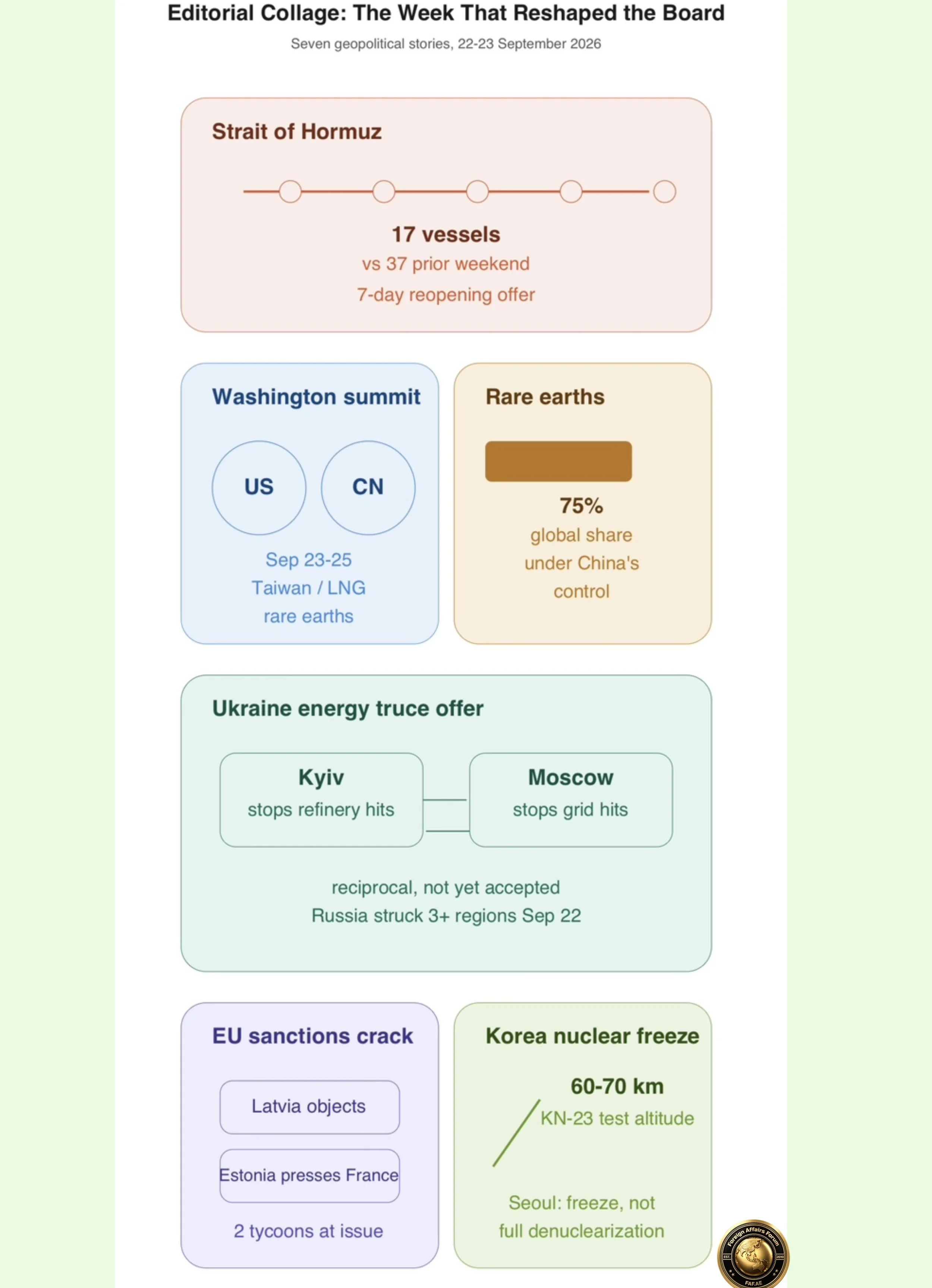
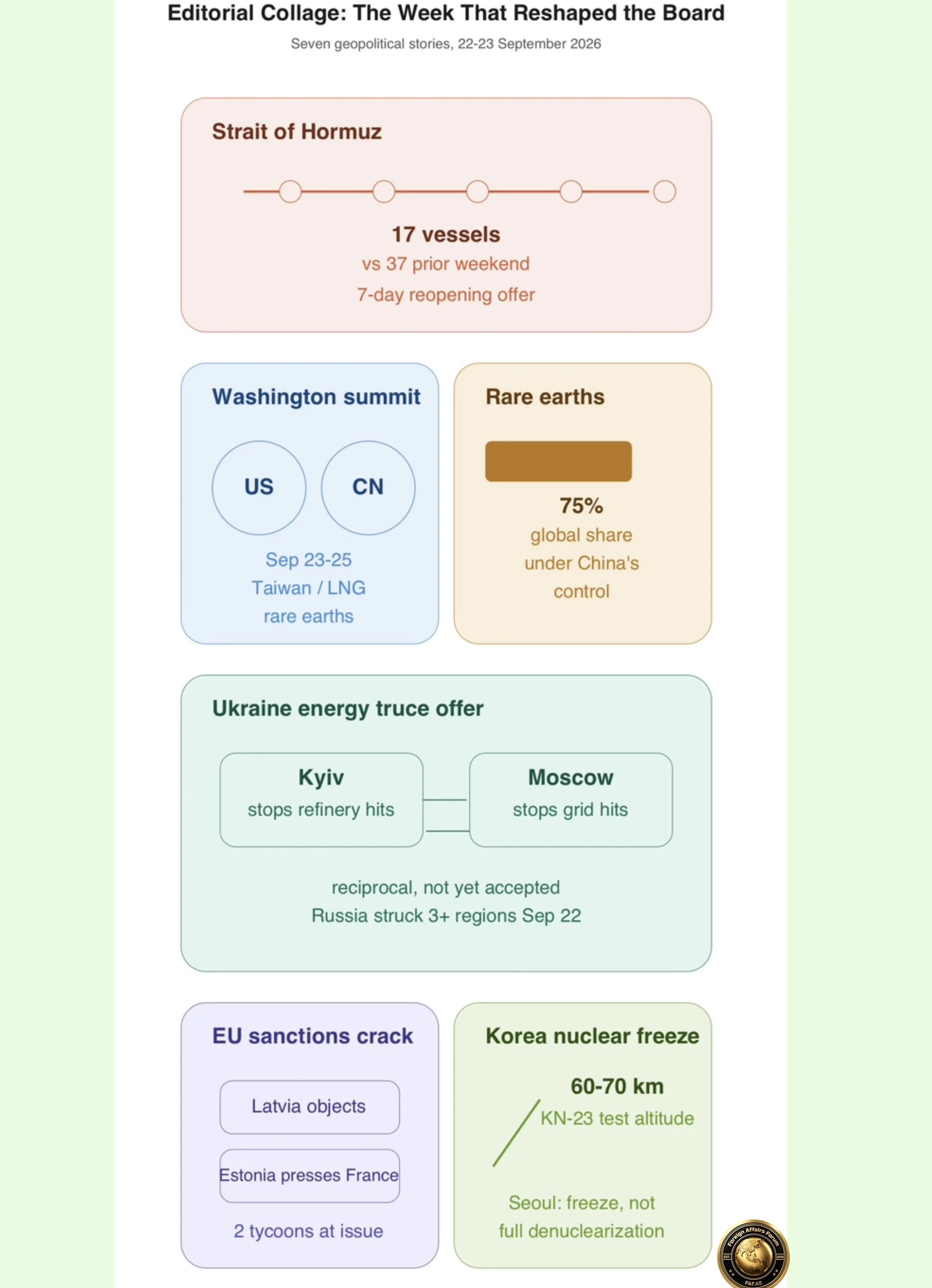
The Strait of Hormuz is a narrow waterway near Iran. A huge amount of the world's oil and gas passes through it every day. For much of this year, fighting between the United States, Israel, and Iran has made this waterway unsafe, and ships have often been unable to pass through safely.
This week, Iran said something new. Iranian officials told the news agency Reuters that they could fully reopen the strait within 7 days, but only if the United States eases its military pressure and lifts a naval blockade against Iranian ports.
At almost the same moment, President Trump gave a speech at the United Nations where he threatened Iran with what he called "annihilation" if a full peace deal is not reached soon.
So there are two very different messages happening at once: Iran offering a possible peaceful opening, and Trump using extremely strong threats.
Dr. 🆎 says this is actually common in high-stakes negotiations. Leaders often talk tough in public while their teams work quietly on a deal behind the scenes.
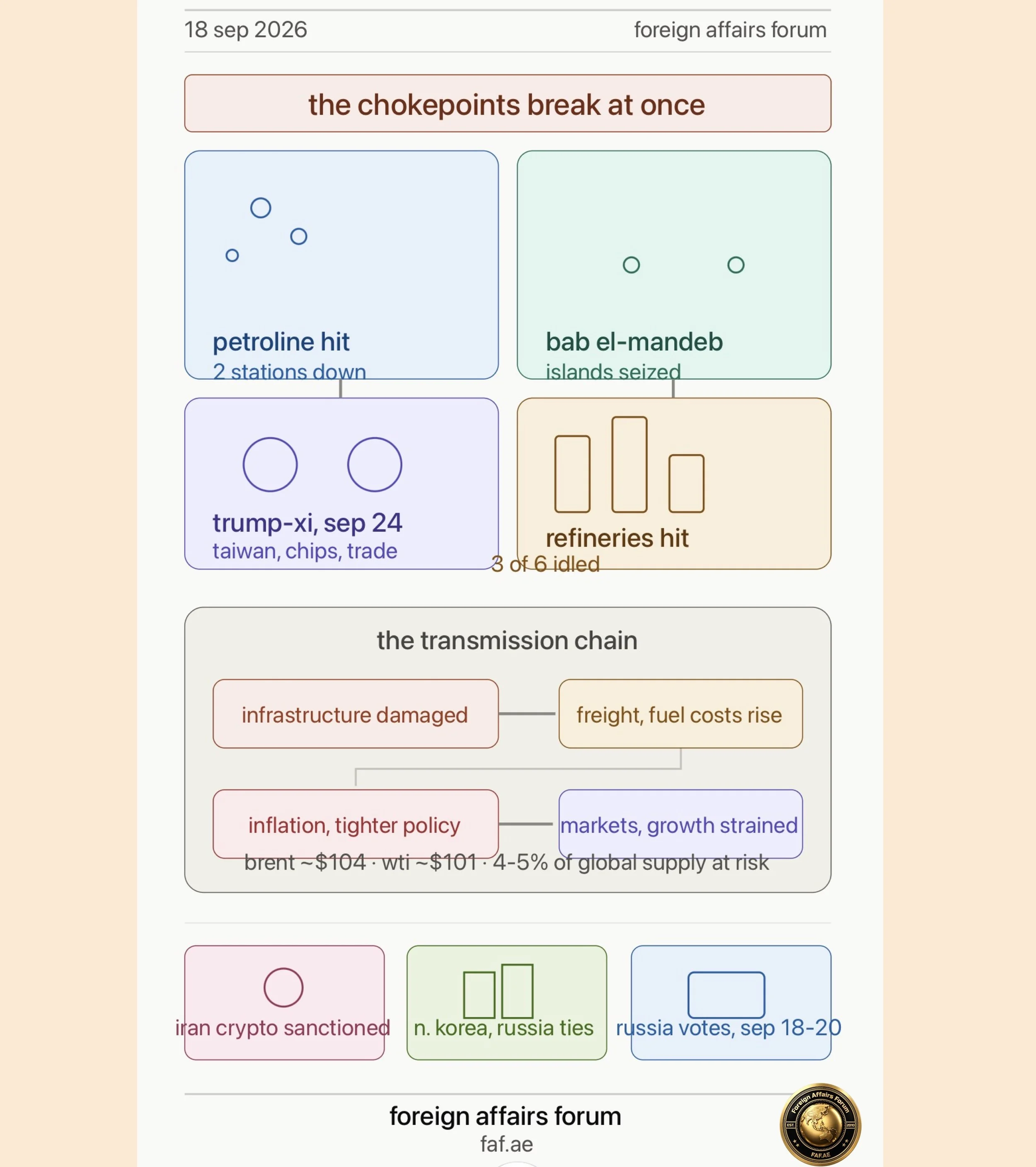
There is some good news already. A major oil pipeline in Saudi Arabia, called the East-West pipeline, has restarted, which means more oil is flowing even without ships going through Hormuz. But the actual number of ships crossing the strait is still very low.
Only 17 ships crossed last weekend, compared to thirty-seven the weekend before.
This gap between the hopeful words and the actual ship traffic is exactly what people should watch closely in the coming days.
Why the Trump-Xi Meeting in Washington Matters So Much
From September 23rd to 25th, Chinese President Xi Jinping is visiting Washington to meet with President Trump. Many experts are calling this the most important meeting between the two countries this year.
There is a lot on the table. The two sides are trying to figure out trade rules, tariffs, rare earth minerals, artificial intelligence rules, and the future of Taiwan.
Rare earth minerals are special materials used in phones, weapons, and clean energy technology, and China controls somewhere between seventy and eighty percent of the world's supply. This gives China a lot of power in the negotiations.
China's ambassador to the United States said just before the summit that Taiwan is a "red line," meaning China will not compromise on it.
Meanwhile, American officials say they probably will not cancel a fourteen-billion-dollar weapons sale to Taiwan, even though the sale has already been delayed.
One interesting possible outcome is a deal about natural gas. The United States and China are discussing whether China should lower or remove its taxes on American natural gas.
This matters because the war involving Iran has shown China how risky it is to depend so heavily on oil and gas from the Middle East. So even though the US and China are rivals in many ways, they might end up doing more business together on energy specifically.
Dr. 🆎 finds this pattern fascinating, because it shows that competition between major powers does not always mean they stop trading with each other. Sometimes conflict in one area actually pushes rivals closer together in a different area.
Most experts do not expect a huge breakthrough from this meeting. They think the most likely outcome is simply an extension of the current truce, buying more time rather than solving the underlying disagreements. But even buying time matters, because it keeps markets calm and avoids a sudden economic shock.
What Ukraine Is Offering Russia
President Zelensky of Ukraine says he is willing to stop Ukrainian attacks on Russian energy facilities, like oil refineries, if Russia agrees to stop attacking Ukraine's power plants and electrical grid in return. This is called a reciprocal deal, meaning both sides give something up at the same time.
This offer comes at a tense moment. Russia just launched new missile and drone attacks on Ukraine, killing at least three people, and Zelensky says he has information suggesting Russia might be planning an even bigger attack on Ukraine's infrastructure soon, especially with winter approaching.
Why does this matter?
Ukraine's attacks on Russian refineries have actually been quite effective at reducing how much fuel Russia can produce and export.
At the same time, Russia's attacks on Ukraine's power grid have caused enormous suffering for ordinary Ukrainians during past winters.
If both sides agreed to stop these specific kinds of attacks, it would not end the war, but it could reduce the amount of suffering and economic damage on both sides while broader peace talks continue elsewhere.
Why Europe Is Arguing About Sanctions
Inside the European Union, countries are disagreeing about sanctions on two wealthy Russian-connected businessmen, Alisher Usmanov and Mikhail Fridman.
Latvia says it will not accept a proposed deal that would remove sanctions on these two men. Estonia is separately asking France to explain why it has been pushing to remove Usmanov from the sanctions list, apparently after pressure from Azerbaijan.
This might sound like a small dispute about two individuals, but Dr. 🆎 explains that the real issue is much bigger. Sanctions only work if everyone imposing them stays united. If some European countries start making exceptions for individual people because of outside pressure, it sends a signal that the whole sanctions system might be negotiable, which could encourage more pressure from Russia and its allies to chip away at sanctions elsewhere.
South Korea's New Idea About North Korea
For decades, the official goal of the United States and its allies has been to convince North Korea to give up its nuclear weapons completely. This is called denuclearization.
Now, South Korea's president, Lee Jae-myung, is suggesting a different approach. He wants the United States to consider offering North Korea relief from sanctions in exchange for simply freezing its nuclear program where it currently stands, rather than insisting North Korea give up its weapons entirely. He raised this idea directly with President Trump during a meeting on September 23rd.
This shift is partly a response to reality. North Korea recently tested a new missile, a version of the KN-23, that can fly very high, around sixty to seventy kilometers, which makes it harder for missile defense systems to intercept.
Dr. 🆎 notes that this test suggests North Korea's technology has advanced to a point where a "freeze" approach might be more realistic than continuing to demand full denuclearization, even though such a shift could worry Japan and spark debate in South Korea about whether it needs its own nuclear deterrent.
Canada's Quiet Trade Pivot
Compared to the other stories this week, Canada's trade negotiations with the Philippines and the broader ASEAN group of Southeast Asian countries might seem less dramatic. But Canada says these talks are about ninety percent finished, with a goal of completing them by November.
This matters because it shows a bigger trend: countries around the world are trying to build more trade relationships that do not depend entirely on either the United States or China.
Southeast Asia has become one of the most important regions for this kind of diversification, as countries build factories, supply chains, and trade agreements that give them more options and less risk if tensions between Washington and Beijing worsen.
What It All Means Together
Dr. 🆎 believes the real story this week is not any single headline, but the pattern connecting all of them. For the first time in a while, there are multiple signs of possible de-escalation happening at once: Iran's offer on Hormuz, the Ukraine energy truce proposal, and the ongoing Trump-Xi talks. Financial markets have noticed too. Oil prices fell, the Nasdaq stock index hit a record high, and interest rates on US government bonds eased slightly, all signs that investors feel a little less nervous about the world right now.
But Dr. 🆎 also cautions that these signs of hope are still fragile. Words and announcements are easy. Real, lasting change is harder. The best evidence will come from actual behavior over the following days and weeks, not statements or speeches. Specifically, three things are worth watching closely. First, does the Trump-Xi summit produce real, specific agreements, or just another vague extension of the existing truce? Second, does Iran's seven-day Hormuz proposal turn into a real, formal negotiation, or does it quietly fade away? Third, does Russia actually accept Ukraine's offer to stop attacking each other's energy infrastructure, or does it reject the idea and continue its attacks?
If both the Hormuz situation and the Trump-Xi summit go well, it could remove two of the biggest sources of worry currently affecting the global economy, from oil prices to trade to inflation. If either one falls apart, especially over the sensitive issue of Taiwan, the current improvement in market confidence could reverse quickly.
For now, the world is in a moment of cautious hope, carefully watching to see whether these separate but connected stories move toward peace or slide back toward greater conflict.