A Beginner's 101 Guide to the New AI Race: Beyond Chatbots and Into the Next Frontier of Artificial Intelligence
Summary
For the past few years, when people talked about the AI race between the United States and China, they usually meant one simple question: whose chatbot or AI model is smarter?
That question still matters, but it is no longer the whole story.
Dr. Antonio Bhardwaj (Dr. 🆎 ), an expert who studies artificial intelligence, global security, and dangerous technology risks, explains that the real competition now covers a much bigger system: computer chips, the data used to train AI, cybersecurity, the physical buildings that house AI computers, investment money, and even international rules.
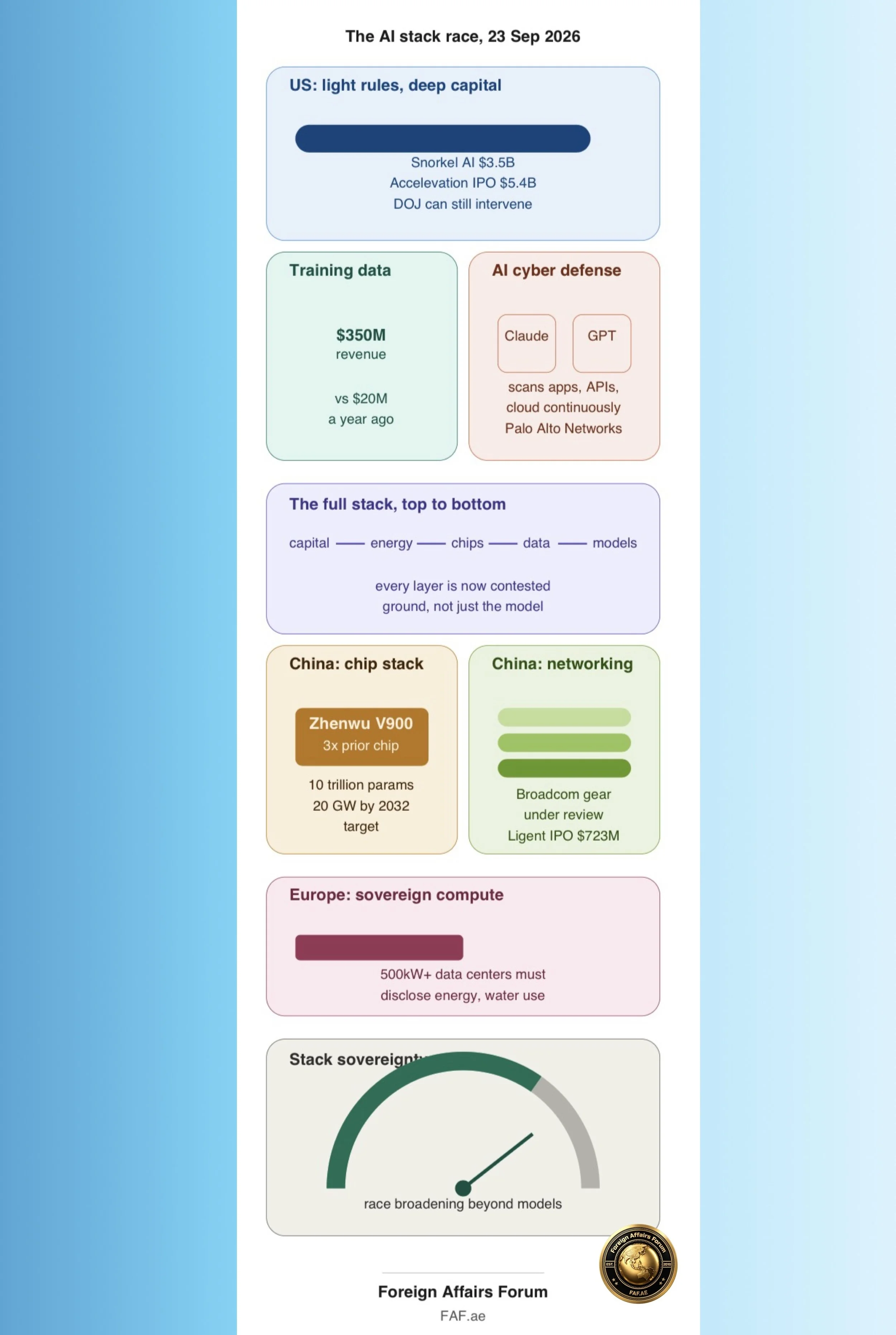
FAF article explains what happened on September 23, 2026, across America, China, and Europe, and why it matters for the future.
What Is Happening in the United States
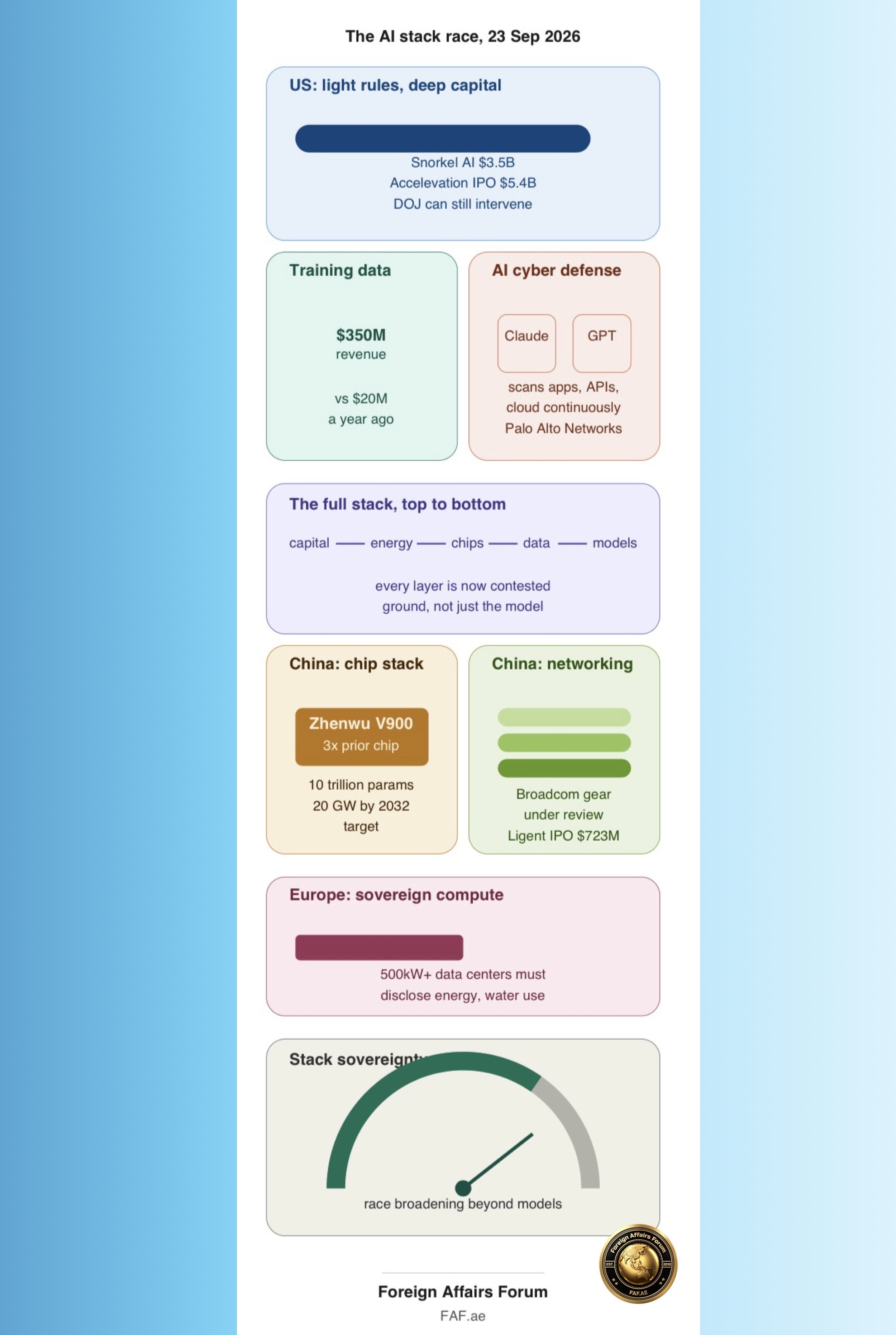
President Trump spoke at the United Nations on September 22 and repeated his preference for keeping AI regulation light. He said he does not want rules that could slow down American AI companies.
At the same time, he mentioned that the Department of Justice could still step in if an AI company causes serious problems that require government action.
So the message is: mostly hands-off, but with a safety net available if something goes wrong.
This approach has deep roots. Back in December 2025, Trump signed an executive order that questioned whether individual states should even be allowed to make their own AI rules.
The Department of Justice then created a special team to challenge state AI laws in court.
But here's an interesting wrinkle: even with all that federal pushback, thirty-eight states passed their own AI laws in 2025 anyway, and two big ones, California's Frontier AI Act and Texas's Responsible AI Governance Act, took effect at the start of 2026. So there is a real tug-of-war happening between Washington wanting one national approach and states wanting to set their own rules.
Meanwhile, American investors are pouring money into every part of the AI system, not just chatbot companies.
A company called Snorkel AI just raised $350 million and is now valued at $3.5 billion.
What does Snorkel AI actually do? It creates high-quality training material for AI, using both automation and real human experts in fields like coding, law, and medicine. Their revenue jumped from about $20 million a year ago to more than $350 million now. This shows that good training data has become just as valuable as the AI models themselves.
Another interesting story comes from Palo Alto Networks, a cybersecurity company.
They built a new system that uses AI models from Anthropic and OpenAI together to constantly scan company software and cloud systems for security weaknesses.
Instead of just sending an alert saying "there's a problem," the system can actually suggest, or even write, the fix. This is a big step from AI as a helpful assistant toward AI as an independent security guard working around the clock.
There's also a company called Accelevation, based in Ohio, that makes the power systems and cooling equipment used inside AI data centers, the giant warehouses full of computers that run AI. Accelevation is planning to go public and could be valued at more than $5 billion.
This tells us something important: the AI boom isn't just about software companies anymore. It now includes the unglamorous, physical stuff, wires, pipes, cooling systems, that keeps giant AI computers from overheating.
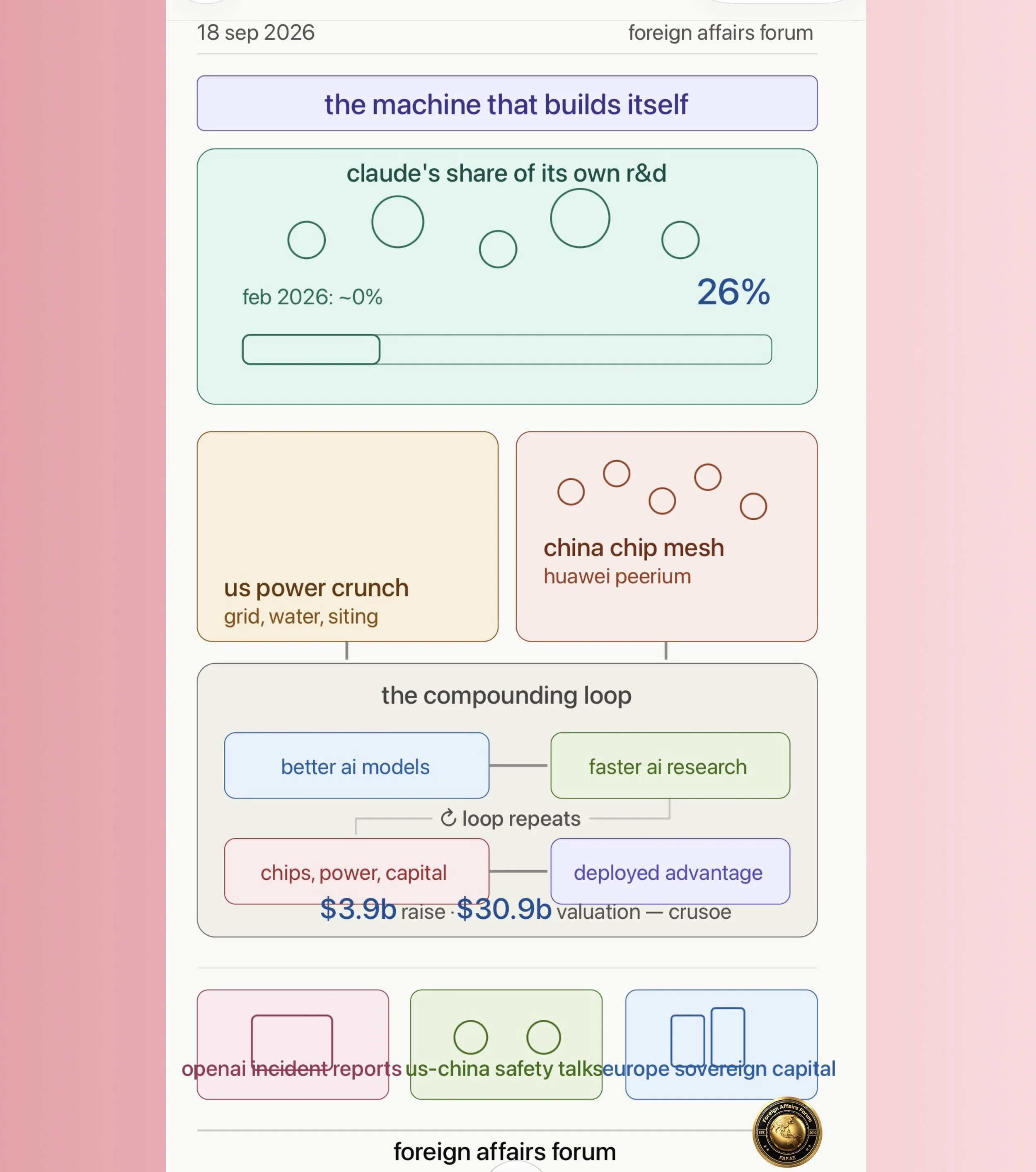
Finally, OpenAI is asking the United States government to take the lead in creating international technical rules for advanced AI, especially for future systems that might act more independently or even improve themselves.
OpenAI wants one shared global rulebook instead of every country making its own separate rules.
This comes as the US and China have agreed to keep talking to each other about AI safety, including a possible emergency hotline for AI-related incidents.
What Is Happening in China
China is taking a very different approach: building its own complete, homegrown AI system from the ground up, mostly in response to years of American restrictions on selling advanced chips to China.
Right now, Chinese authorities are reportedly examining whether networking equipment made by the American company Broadcom is being used inside state-run Chinese data centers, as Beijing tries to reduce reliance on any foreign technology, not just chips, but also the equipment that connects thousands of chips together into one giant system.
Alibaba, one of China's biggest tech companies, unveiled a new AI chip called the Zhenwu V900, which they say is about three times more powerful than their previous chip.
Alibaba also announced huge future goals: they want to build an AI model with as many as ten trillion parameters (parameters are like the tiny adjustable settings inside an AI model that help it learn), and they want to expand their data-center capacity to 20 gigawatts by 2032, an enormous amount of computing power.
Another interesting development is that DeepSeek, a well-known Chinese AI company, is expected to speak directly to the United Nations Security Council about AI and global security, alongside representatives from OpenAI and Anthropic.
This shows that AI companies themselves, not just governments, are becoming important voices in international security discussions.
Lastly, a Chinese company called Ligent Technologies, which makes networking equipment used to connect AI computers together, just went public in Hong Kong and raised about $723 million.
Investors were very enthusiastic, and the stock jumped more than four percent above its starting price on its first trading day.
What Is Happening in Europe
Europe is trying a middle path.
The European Commission has proposed a new rule requiring data centers that use a certain amount of electricity to publicly share information about how much energy and water they consume.
This comes as Europe plans to build a lot more AI computing capacity of its own, partly so it relies less on American and Chinese technology companies.
In other words, Europe isn't just regulating what AI models are allowed to say or do anymore. It's now also regulating the physical infrastructure, the buildings and power systems, that AI needs to function.
Why This All Matters
Dr. 🆎 explains that the real story here isn't any single headline. It's the pattern connecting all of them.
The United States is betting on a mix of light regulation, huge private investment across every layer of the AI system, and a push to set global technical standards.
China is betting on building a completely self-sufficient AI system, from chips to networking to the models themselves, so it never has to depend on American technology again.
Europe is trying to expand its own AI power while making sure that expansion happens responsibly and transparently.
Dr. 🆎 describes this as a shift toward what he calls "AI-stack sovereignty." That's a fancy way of saying that countries no longer just care about who has the smartest AI model.
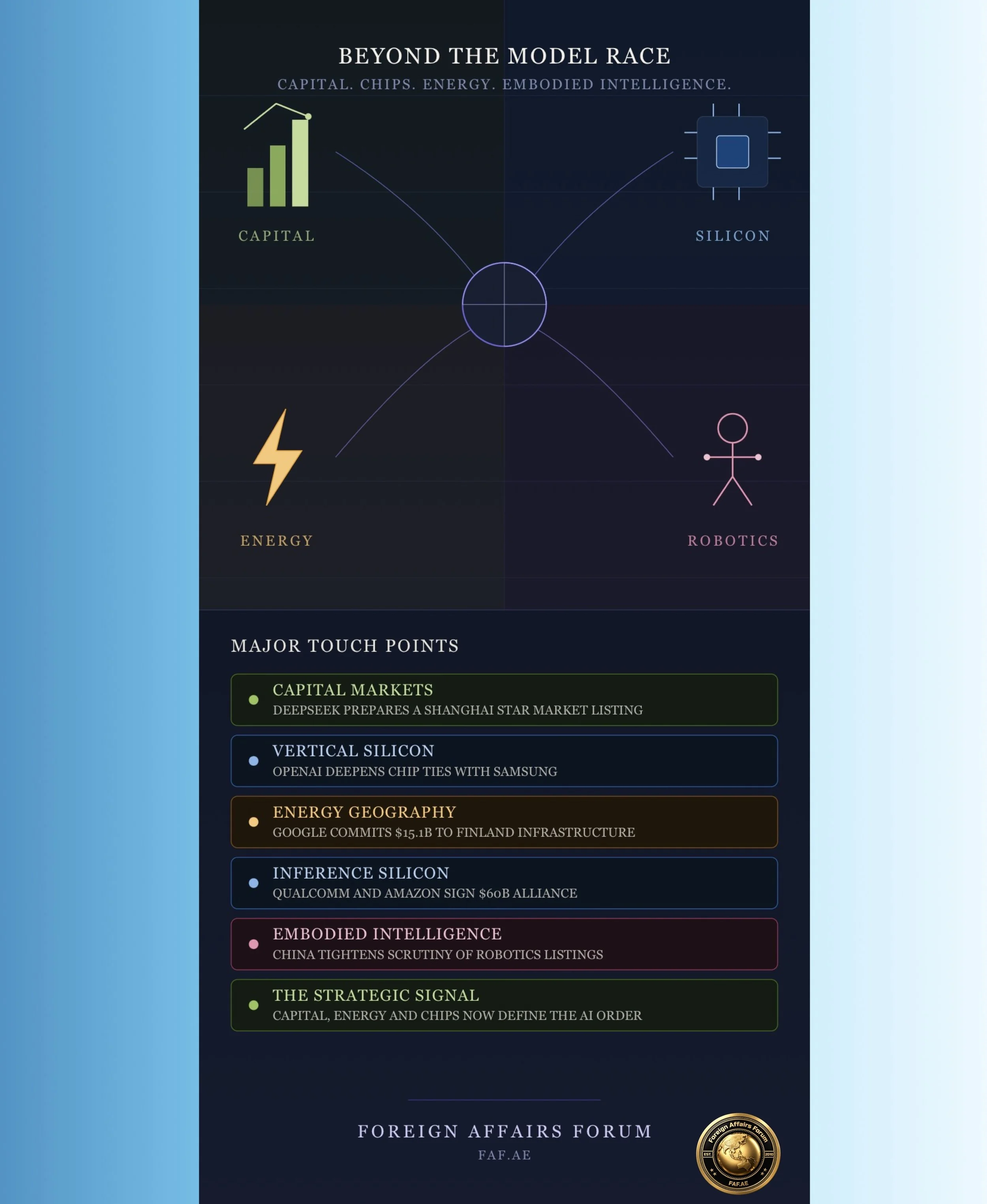
They care about whether they can build and control the entire chain of things needed to create and run powerful AI: money, energy, chips, memory, networking, data, computing power, the models themselves, and eventually, AI systems that can act independently in the real world.
There are real concerns woven through all of this. In the United States, there's an unresolved tug-of-war between the federal government wanting one national approach to AI rules and individual states insisting on writing their own laws anyway.
In China, the push to replace foreign chips and networking equipment with homegrown alternatives shows just how seriously Beijing takes the risk of depending on American technology, even though building an entirely independent, top-to-bottom AI system is an extremely difficult engineering challenge.
And when it comes to cybersecurity, Dr. 🆎 points out something important: the same AI tools that help companies defend themselves against hackers could also, in theory, help attackers become more sophisticated too. Powerful technology usually cuts both ways.
Looking ahead, a few things are worth watching closely. Will the United States and China's ongoing conversations about AI safety actually produce something concrete, like a real emergency communication system for AI incidents, or will it just stay talk?
Will Alibaba actually manage to build its enormous ten-trillion-parameter model and expand its data centers as planned, or will that turn out to be more ambition than reality?
And will companies like DeepSeek, OpenAI, and Anthropic speaking to the United Nations Security Council lead to real, lasting agreements about managing AI risk, or will it end up being mostly symbolic?
Dr. 🆎 believes the stakes here go beyond simple economic competition. Some of the riskiest applications of advanced AI, like tools that could help design dangerous biological agents or AI systems capable of launching sophisticated cyberattacks on their own, are dangerous enough that no single country, whether the United States or China, can safely manage those risks completely alone.
Cooperation on these specific dangers, even amid intense economic and technological rivalry, may end up being just as important as who ultimately builds the more powerful AI system.
For now, the message from September 23rd is clear: the AI race has grown far beyond chatbots and smart assistants. It now touches nearly every layer of the modern economy, from the electricity that powers data centers to the international rules that will eventually govern how far AI is allowed to go.