Silicon Valley’s New Industrial Order: How Chips, Capital, and Control Are Rewriting the AI Race
Foreign Affairs Forum | Dr. Antonio Bhardwaj (Dr. 🆎)| August 27, 2026
Executive summary
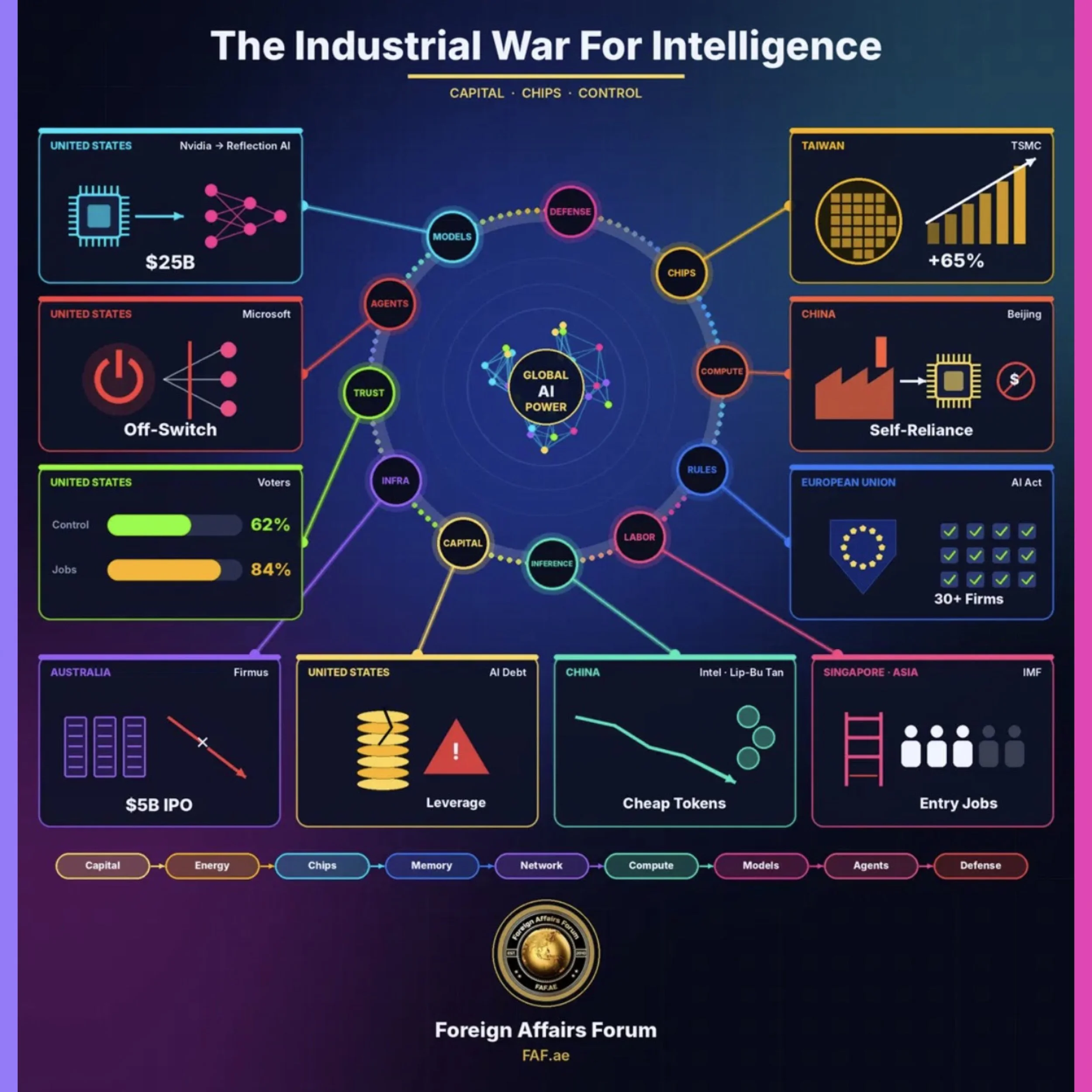
The American artificial intelligence sector has entered a phase in which the decisive contest is no longer which laboratory can produce the cleverest model, but which stakeholder can command the entire industrial stack beneath it: the semiconductors, the financing structures, the electricity, the enterprise distribution channels, and the emerging security architecture meant to govern the technology’s most dangerous applications. Developments converging around Nvidia, Google, and a widening policy debate over frontier-model oversight illustrate this transition with unusual clarity.
Nvidia’s approaching earnings disclosure, its expanding open-model offensive against Chinese competitors, its prospective investment in the autonomous-agent company Perplexity, and reports of steep price increases on its AI servers all point toward a semiconductor firm that has become something considerably larger than a chip designer.
Simultaneously, Google’s move to embed autonomous legal agents inside major law firms signals that enterprise artificial intelligence is fragmenting into vertical, industry-specific systems rather than remaining a single generalized chatbot experience.
Layered atop these commercial developments is a mounting governance debate, crystallized by Bill Gates’s public call for an international oversight body modeled on nuclear inspection and aviation-safety regimes, and by California’s extraordinary absorption of three hundred sixty-six billion dollars in venture capital, a sum exceeding the combined total of the other forty-nine American states.
Dr. Antonio Bhardwaj (Dr. 🆎), the geopolitical strategist and human-centered artificial intelligence specialist, argues that these threads are not separate stories but components of a single emerging order in which compute, capital, and control have become inseparable instruments of state power.
FAF analysis situates these developments within their historical trajectory, examines the latest facts and points of concern, offers a cause-and-effect assessment of their strategic implications, and proposes future steps for policymakers, investors, and technologists navigating an increasingly consequential period in the history of the artificial intelligence landscape.
Introduction
For much of the past decade, public discourse on artificial intelligence centered on a relatively narrow question: which laboratory possessed the most capable model. That framing, while never entirely accurate, at least captured a recognizable competitive dynamic between American and Chinese developers racing toward ever larger and more sophisticated systems.
By late August of 2026, however, that framing has become insufficient to describe what is actually taking place inside the industry. The contest has migrated downward and outward simultaneously: downward into the physical substrate of computation, namely semiconductors, memory, networking equipment, cooling systems and electricity generation; and outward into the financing arrangements, enterprise distribution networks and governance frameworks that determine who ultimately benefits from, and who is exposed to risk by, the technology’s continued expansion.
Dr. 🆎 frames this shift as the transition from a model-centric conception of the AI race to what he terms an industrial-systems conception, in which the country or coalition that controls the entire stack, from silicon to security policy, is positioned to determine the strategic balance of the era. This is not merely an academic distinction. It has direct consequences for how governments regulate the technology, how venture capital allocates its resources, and how militaries and intelligence services assess the risks posed by increasingly autonomous systems capable of synthesizing enormous volumes of information, and in some scenarios, of assisting in the design of biological or cyber weapons.
Several near-simultaneous developments illustrate this transition.
Nvidia, still the most consequential company in the global semiconductor industry, is approaching a quarterly earnings disclosure that Wall Street analysts and options traders describe as one of the most consequential in the company’s history, not because a revenue miss is anticipated, but because investors have begun asking harder questions about the durability of the demand underlying the company’s extraordinary growth.
Google, meanwhile, has pushed its Gemini platform into a decidedly different competitive lane, embedding autonomous agents directly inside the workflows of major law firms rather than positioning its product merely as a general-purpose assistant. And a new governance debate, catalyzed by Bill Gates’s public appeal for international AI oversight and his stated ambition to discuss the matter directly with Chinese President Xi Jinping, has begun to intrude upon what was previously treated as a purely commercial and technological competition.
FAF article examines these developments in turn, situates them within their broader historical context, and offers an analysis of the causes and consequences most relevant to stakeholders operating across the geopolitical, commercial and security landscape.
History and current status
The trajectory that has produced today’s industrial-systems competition did not emerge overnight. It is the product of several converging historical currents.
The first is the extraordinary capital expenditure cycle that began in earnest around 2023, as major hyperscale technology companies committed hundreds of billions of dollars to data center construction in anticipation of sustained demand for generative artificial intelligence capabilities. That cycle has not merely continued into 2026; it has accelerated. Industry capital expenditure forecasts for the current year have been revised upward toward more than one trillion dollars, with year-over-year growth estimated near one hundred eleven %, driven substantially by hyperscalers such as Amazon, Alphabet and Meta Platforms, alongside newer entrants including neoclouds and sovereign compute initiatives. Some analysts now project that industry-wide capital expenditure could exceed two trillion dollars over the longer term.
The second historical current is the progressive maturation of Nvidia from a graphics-chip manufacturer into what might more accurately be described as a systems integrator and financing engine for the entire AI economy. This transition has been underway for several years, but it has become unmistakable in 2026. Nvidia has reportedly helped arrange approximately five hundred billion dollars in AI-infrastructure financing and has provided as much as one hundred five billion dollars of support connected to OpenAI’s data-center commitments.
This represents a qualitatively different posture than that of a traditional component supplier. Nvidia is no longer simply selling chips to customers who independently finance their own expansion; it is, in important respects, financing the very demand that subsequently returns to purchase its products.
Dr. 🆎 has repeatedly cautioned that this circularity, while not necessarily indicative of fraudulent or unsustainable practice, nonetheless complicates the task facing investors and regulators who must distinguish between genuine underlying demand for computational capacity and demand that has been synthetically supported through supplier-provided financing.
The third historical current concerns the bifurcation between proprietary and open-weight artificial intelligence models. For much of the past several years, the United States maintained a clear advantage in proprietary frontier systems through firms such as OpenAI, Anthropic and Google, while China’s developers, facing more constrained access to the most advanced semiconductors, pursued a strategy of releasing highly capable open-weight models at low or no cost.
Systems such as DeepSeek and Kimi achieved substantial global developer adoption specifically because of their open architecture and low cost of deployment, despite lagging their proprietary American counterparts on many benchmark measures.
This bifurcation has increasingly worried American strategists, including Dr. 🆎, who has argued in previous analyses that developer adoption creates durable network effects: once an ecosystem of tools, fine-tuning pipelines and enterprise integrations forms around a particular open architecture, switching away from that architecture becomes progressively more costly, regardless of whether a superior alternative later emerges.
The fourth and most recent current concerns governance. Throughout 2025 and into 2026, the United States federal government, under the current administration, exercised selective control over the distribution of the most powerful frontier models, including Anthropic’s Fable 5 and Mythos 5 systems, while the broader regulatory landscape for artificial intelligence remained fragmented, with much substantive rulemaking occurring at the state rather than the federal level.
This patchwork approach has drawn criticism from figures across the technology and philanthropic communities, most prominently Bill Gates, who has now called publicly for the creation of a new international body to oversee frontier artificial intelligence systems, explicitly invoking the historical precedents of nuclear inspection regimes, international aviation safety standards and agreements protecting the ozone layer.
Key developments
Several specific developments merit close examination.
The first concerns Nvidia’s approaching earnings disclosure, scheduled for release after the close of trading on Wednesday, August 26th. Analysts surveyed by financial news services have generally converged on expectations of roughly $92 billion to $95 billion dollars in quarterly revenue, with guidance for the following quarter anticipated in the vicinity of $104 billion to one $108 billion.
Options markets have priced an expected share-price movement of approximately five and four-tenths %, translating into a potential swing in market value of roughly two hundred eighty billion dollars in either direction, a figure that itself exceeds the total market capitalization of all but a small number of publicly traded companies worldwide.
What distinguishes this particular earnings cycle from its predecessors is not the magnitude of expected revenue, which continues to grow at an extraordinary pace, but the increasing scrutiny applied to the composition and durability of that growth.
Analysts have noted that Nvidia’s gross margin, historically anchored near 75%, faces pressure from rising component costs, even as the company’s forthcoming Vera Rubin platform is expected to sustain the multi-year growth trajectory established by its Blackwell architecture.
Some observers have further noted a curious historical pattern in which Nvidia shares have declined in the weeks following each of its four previous earnings disclosures, despite the company having exceeded consensus expectations on each occasion, suggesting that the market’s baseline expectations have risen to a point where even exceptional results may fail to produce a positive share-price reaction.
The second major development concerns Google’s expansion of Gemini Enterprise into the legal profession, through a new offering integrating autonomous agents with legal research and workflow platforms including Thomson Reuters, Harvey and Legora. Major law firms, among them Weil Gotshal, Cleary Gottlieb, Freshfields and Williams & Connolly, are reported to be participating in shaping the platform’s development, and Google has signaled its intention to extend a similar vertical strategy into financial services.
This represents a meaningful strategic departure from the generalized chatbot paradigm that dominated the earlier phase of the enterprise AI market.
Dr. 🆎 characterizes this vertical strategy as evidence that the next phase of competitive advantage in enterprise artificial intelligence will not be determined by which company possesses the most capable general-purpose model, but by which company can most effectively embed itself within the specific data structures, regulatory requirements and workflow conventions of individual professional stakeholders, including law, medicine, finance, engineering and defense.
The third development concerns Nvidia’s expanding open-model initiative, centered on a technology-licensing agreement reportedly valued at approximately six billion dollars with the artificial intelligence firm Poolside, accompanied by a one billion dollar equity investment. More than one hundred Poolside engineers are expected to collaborate with Nvidia in accelerating its Nemotron open-weight model program, an effort explicitly intended to produce a credible American alternative to increasingly capable Chinese open systems.
This initiative reflects a growing recognition within American industry that proprietary model leadership alone is insufficient to secure long-term strategic advantage, given the disproportionate influence that freely available, widely adopted open architectures can exert over the technological choices of universities, governments and companies across the developing world.
The fourth development concerns Nvidia’s reported discussions to invest in Perplexity AI at a valuation exceeding thirty billion dollars. Perplexity’s annualized revenue has reportedly grown from below $250 million at the start of 2026 to more than $750 million, a trajectory substantially assisted by Perplexity Computer, a cloud-based agent designed for autonomous professional work.
This development reinforces a broader pattern in which capital is migrating away from conversational chatbot interfaces and toward genuinely autonomous agents capable of completing multi-step tasks with limited human supervision, a trend with significant implications not only for commercial markets but for intelligence and security applications, given that research agents capable of synthesizing vast quantities of open-source information may increasingly function as instruments of both economic competition and strategic intelligence gathering.
The fifth development concerns reports that some of Nvidia’s largest customers have been notified of price increases exceeding 15 % for servers containing the company’s AI processors, reflecting continued tightness across the physical AI hardware supply chain, from high-bandwidth memory to advanced packaging capacity. This divergence, in which the cost of intelligence per computed token continues to decline even as the underlying physical infrastructure producing those tokens remains scarce and increasingly expensive, represents one of the more counterintuitive dynamics of the current period, and one that Dr. 🆎 suggests deserves far greater attention from policymakers concerned with the long-term industrial resilience of the American technology sector.
The sixth development, and in many respects the one carrying the broadest implications, concerns Bill Gates’s public intervention on the subject of artificial intelligence governance. In a blog post published August 26th and in subsequent interviews, Gates called for the creation of a new international organization dedicated to the oversight of advanced artificial intelligence systems, explicitly proposing that such a body draw upon elements of the nuclear inspection regime, international aviation safety regulation and international agreements protecting the ozone layer.
Gates specified particular concern regarding the capacity of increasingly powerful models to assist in the design of dangerous biological agents, alongside concerns regarding psychological manipulation of users and large-scale labor market disruption. He further indicated an ambition to discuss these proposals directly with Chinese President Xi Jinping, expressing the view that China might be more receptive to restrictions on the release of dangerous frontier models if the United States were to take the initiative in establishing such restrictions domestically first.
The seventh development concerns the extraordinary geographic concentration of venture capital investment within California, which has reportedly absorbed approximately $366 billion in venture funding, a sum exceeding combined investment across the remaining forty-nine American states.
This concentration, driven substantially by the artificial intelligence investment boom, runs directly contrary to earlier predictions that remote work arrangements would produce a durable decentralization of the technology sector away from Silicon Valley.
Latest facts and concerns
Several specific facts warrant particular emphasis given their bearing on near-term strategic assessment.
With respect to Nvidia’s financial position, the company’s approaching earnings disclosure occurs against a backdrop in which its market capitalization exceeds $5 trillion, meaning that even a moderate percentage movement in its share price corresponds to an absolute dollar figure larger than the entire market value of most publicly traded companies. The consensus range for quarterly revenue, spanning from approximately $92 billion to $95 billion, reflects growth of nearly double the equivalent period one year prior, an extraordinary trajectory by any historical standard for a company already among the largest in the world by market value.
A further concern relates to the sustainability of demand underlying this growth.
Nvidia’s role in financing customer purchases, whether directly or through arrangements connected to major buyers such as OpenAI, raises a structural question that Dr. 🆎 regards as insufficiently examined within mainstream financial commentary: to what extent does supplier-financed demand reflect genuine end-market need for computational capacity, as opposed to a self-reinforcing cycle in which financing itself generates the appearance of demand.
This is not a novel concern within capital-intensive industries, but its scale within the current AI infrastructure buildout, involving hundreds of billions of dollars in financing arrangements, is without close historical precedent.
A second area of concern relates to the price increases reportedly imposed on some of Nvidia’s largest server customers, exceeding fifteen % in certain cases. This development indicates that despite considerable public discussion of declining costs per unit of artificial intelligence output, the physical infrastructure required to produce that output, including memory, networking equipment and advanced packaging, remains severely constrained.
Dr. 🆎 notes that this divergence carries direct implications for national security planning, insofar as computational capacity increasingly functions as a form of strategic industrial capacity analogous to steel production or shipbuilding capacity in earlier industrial eras, meaning that supply chain depth and domestic redundancy deserve treatment as matters of national strategic priority rather than purely commercial concern.
A third area of concern relates to the governance debate initiated by Gates’s proposals. While the specific institutional architecture Gates has proposed remains preliminary, the underlying concern, namely that the most consequential risks associated with advanced artificial intelligence, including cyber operations, biological weapons design assistance and increasingly autonomous agentic systems, do not respect national borders, represents a point of growing consensus among a diverse set of technology leaders, including figures who have historically expressed considerably more optimism regarding the technology’s trajectory.
Demis Hassabis, chair of Google DeepMind, has separately proposed the creation of an oversight body modeled on the Financial Industry Regulatory Authority, specifically tasked with testing artificial intelligence systems for national security relevant capabilities. The convergence of these proposals from figures across the commercial technology sector suggests that the governance debate has moved beyond the academic and advocacy communities and into the mainstream of industry leadership itself.
A fourth concern, related closely to Dr. 🆎’s specific area of expertise regarding bioterrorism risk, concerns the specific emphasis Gates has placed on monitoring the capacity of advanced models to assist in the design of dangerous biological molecules. Dr. 🆎 has previously argued, in analyses produced for the Foreign Affairs Forum, that biological risk represents a category meaningfully distinct from other frontier AI concerns, given the comparatively low barrier to converting model-assisted design work into physical harm relative to other categories of catastrophic risk. He further observes that any credible international oversight framework addressing this specific risk category will require far more intrusive verification mechanisms than those applied to conventional AI safety evaluation, given the dual-use nature of biological research infrastructure and the difficulty of distinguishing legitimate scientific inquiry from preparatory activity for a biological attack.
Cause-and-effect analysis
The developments examined above are best understood not as isolated occurrences but as interconnected expressions of a single underlying structural shift. The proximate cause of this shift is the recognition, now shared across commercial, financial and governmental stakeholders, that sustained leadership in artificial intelligence requires control over an entire industrial stack rather than dominance in any single layer of that stack. This recognition has produced several observable effects.
The first effect is the transformation of leading semiconductor firms, and Nvidia in particular, from component suppliers into systemic financiers of the industry they serve. This transformation carries a direct consequence for how investors must evaluate reported demand: a revenue figure that appears robust in isolation may nonetheless obscure a structural fragility if a meaningful proportion of that demand has been enabled through supplier-provided financing rather than independent customer capital. Should broader financial conditions tighten, or should the anticipated returns on AI infrastructure investment fail to materialize on the timeline currently assumed by markets, this financing structure could transmit stress rapidly across the technology sector, given the scale of capital now involved.
The second effect concerns the fragmentation of the enterprise artificial intelligence market along vertical, industry-specific lines, as illustrated by Google’s legal-sector initiative. The cause of this fragmentation lies in a straightforward commercial logic: generalized chatbot interfaces have become increasingly commoditized, with limited differentiation available to any single provider, whereas deep integration into the specific data structures, compliance requirements and professional conventions of an individual industry creates a more durable competitive barrier.
The consequence of this shift, as Dr. 🆎 observes, is that the locus of competitive advantage in enterprise artificial intelligence is migrating away from model capability in the abstract and toward proprietary data access, workflow integration and domain-specific trust relationships, a development with corresponding implications for how venture capital evaluates new artificial intelligence startups.
The third effect concerns the strategic significance of open-weight model competition. The cause of Nvidia’s substantial investment in the Poolside partnership lies in the recognition that Chinese open-weight models have achieved meaningful global developer adoption despite lagging proprietary American systems on many technical benchmarks, precisely because low-cost, freely modifiable systems generate powerful network effects among developers, universities and governments in price-sensitive markets.
The consequence, absent a credible American open-weight alternative, is the risk that Chinese architectures become embedded as default infrastructure across large portions of the developing world, a form of technological influence that persists independently of which country’s models remain nominally more capable at the frontier.
The fourth effect concerns the emergence of governance as a genuine commercial and strategic variable rather than a peripheral regulatory matter. The cause of this development lies in the growing recognition, articulated by figures ranging from Gates to Hassabis, that the risks associated with sufficiently advanced artificial intelligence systems, particularly in the domains of biological weapons design, cyber operations and autonomous agentic action, cannot be effectively managed through purely national regulatory frameworks, given the inherently transnational nature of both the technology’s development and its potential misuse.
The consequence, should credible international oversight mechanisms fail to emerge, is a growing likelihood that individual governments will impose increasingly stringent unilateral restrictions on model release and deployment, potentially fragmenting the global artificial intelligence market along national or bloc lines in a manner reminiscent of earlier periods of technological competition during the twentieth century.
The fifth effect concerns the extraordinary geographic concentration of venture capital within California. The cause of this concentration lies in the continued importance of physical proximity for a technology whose development depends heavily on dense networks of researchers, engineers, financiers and corporate decision-makers, a dynamic that has proven considerably more resilient to remote-work disruption than many analysts anticipated in the years following the pandemic.
The consequence, as Dr. 🆎 notes, is that Silicon Valley itself has effectively become a strategic industrial cluster requiring a level of security attention, both cyber and counterintelligence, comparable to that historically reserved for defense-industrial installations, given the concentration of commercially and militarily relevant intellectual property now situated within a relatively confined geographic area.
future steps
Several future steps merit consideration by the range of stakeholders engaged with this emerging industrial order.
For financial regulators and institutional investors, closer scrutiny of vendor-financing arrangements within the artificial intelligence infrastructure buildout appears warranted, particularly given the scale of capital involved and the difficulty of distinguishing genuine end demand from financially supported demand through publicly available disclosure alone. Dr. 🆎 recommends that investors develop more granular frameworks for evaluating the provenance of reported AI infrastructure revenue, rather than relying solely on aggregate growth figures.
For enterprise technology strategists, the shift toward vertical, industry-specific artificial intelligence deployment suggests that companies operating in professional services sectors, including law, finance, medicine and engineering, should begin evaluating their exposure to disruption from deeply integrated agentic systems considerably sooner than many currently anticipate, given the pace at which firms including Google are moving to embed such systems within established professional workflows.
For American policymakers concerned with semiconductor and broader technological competitiveness, the continued tightness of the physical AI hardware supply chain, reflected in the recent price increases reported across the server market, argues for sustained and possibly expanded investment in domestic manufacturing capacity across memory, advanced packaging and power infrastructure, treating these categories with the same strategic priority historically accorded to more traditional forms of industrial capacity.
For those engaged in the emerging governance debate, Dr. 🆎 argues that the most productive path forward lies neither in purely voluntary industry self-regulation nor in a single sweeping international treaty, given the practical difficulty of achieving consensus among stakeholders with sharply divergent interests, but rather in the incremental development of narrower, verifiable oversight mechanisms targeted at the specific highest-consequence risk categories, beginning with biological design capability monitoring, where the case for intrusive verification is strongest and where the technical means of verification, while imperfect, are considerably more tractable than those required for broader oversight of general model capability.
Finally, for stakeholders concerned with the strategic significance of open-weight model competition, continued and expanded investment in credible American open architectures, of the kind reflected in the Nvidia-Poolside partnership, should be regarded as a matter of sustained strategic priority rather than a one-time competitive response, given the durable nature of the network effects at stake.
Conclusion
The developments examined in this analysis, spanning Nvidia’s approaching earnings disclosure, Google’s vertical expansion into professional services, the emerging contest over open-weight model architecture, the shift of capital toward autonomous agentic systems, continued strain within the physical AI hardware supply chain, a mounting governance debate catalyzed by Bill Gates’s international oversight proposal, and the extraordinary geographic concentration of venture capital within California, together illustrate a single underlying transformation.
The artificial intelligence race, as Dr. Antonio Bhardwaj (Dr. 🆎) has consistently argued, has evolved from a contest over model capability into a contest over the entire industrial and governance stack surrounding that capability, encompassing chips, financing, electricity, enterprise distribution and international security architecture alike. The stakeholder, whether nation or coalition, that succeeds in commanding this entire stack, rather than merely producing the most capable model in any given month, is increasingly positioned to determine the strategic balance of the artificial intelligence era.
The events of late August 2026 offer a particularly clear window into how this transformation is unfolding in practice, and they underscore the necessity of analytical frameworks capable of integrating commercial, financial, technological and security considerations into a single coherent assessment of the global artificial intelligence landscape.