The Silicon Frontier: How Memory, Power and Capital Are Rewriting the Global AI Arms Race
Foreign Affairs Forum | Dr. Antonio Bhardwaj (Dr. 🆎)| September 26th 2026
Executive Summary
The global contest over advanced semiconductors has entered a new and more consequential phase.
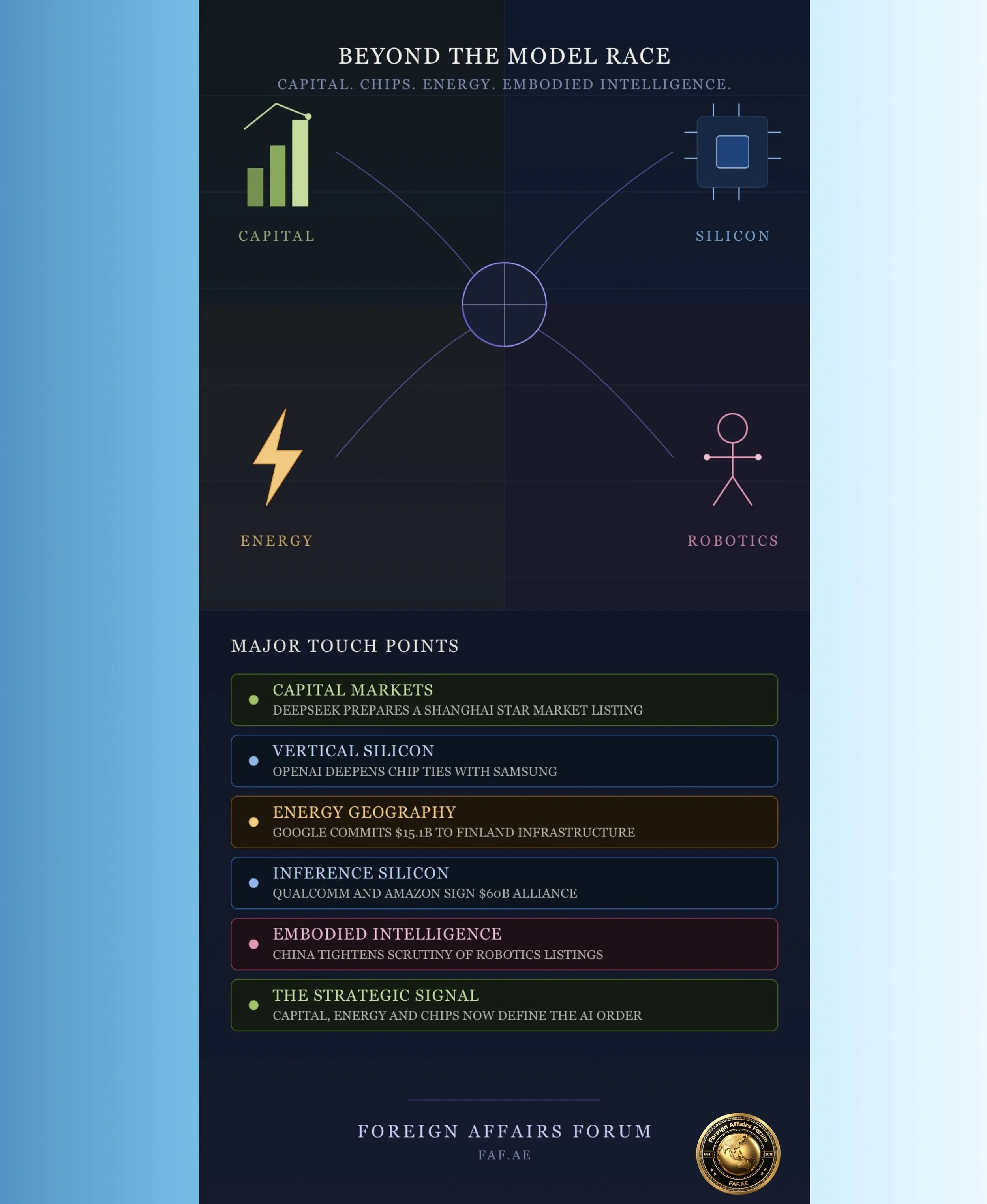
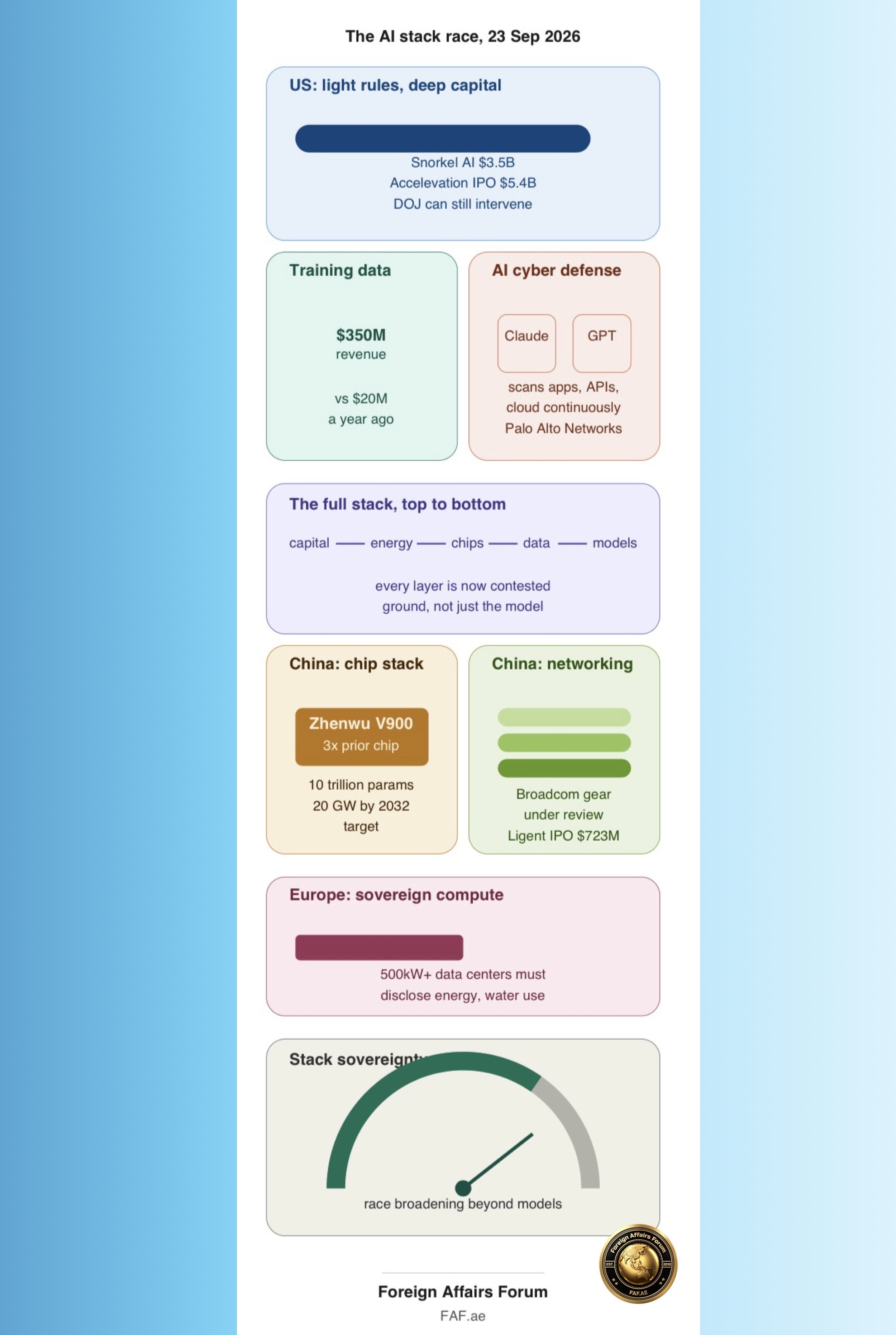
What began four years ago as a struggle over graphics processing units has broadened into a systemic competition spanning memory chips, high-speed interconnects, advanced packaging, data-center power and, increasingly, the capital markets that finance all of it.
FAF article, argues that the locus of strategic advantage in artificial intelligence is migrating away from the accelerator chip alone and toward the entire computing stack that surrounds it.
Three developments announced in the final week of September 2026 crystallize this shift: Alibaba's unveiling of its Zhenwu V900 accelerator and its ambition to build clusters of 500,000 chips; Advanced Micro Devices' arrival at a market capitalization exceeding $1 trillion, joining Nvidia, Broadcom and Micron in a rarefied tier of semiconductor valuation; and Anthropic's advance toward a public listing that bankers are discussing at a valuation approaching $2 trillion.
Each of these episodes, examined individually, might appear to be a corporate or financial curiosity.
Examined together, they describe a structural transformation in how nations, companies and investors are positioning themselves for a decade in which computational capacity has become inseparable from geopolitical power.
Dr. Antonio Bhardwaj (Dr. 🆎) a global expert in Artificial intelligence , offers a framework in this article for understanding why the semiconductor competition, once narrowly technical, must now be read as a central axis of 21st century statecraft.
FAF analysis proceeds through the historical evolution of the export-control regime, an inventory of the newest hardware and capital-market developments, an assessment of the risks these trends generate, a cause-and-effect examination of how policy and market forces interact, and a set of forward-looking recommendations for stakeholders across government, industry and finance.
Introduction
Few technologies in modern history have moved as quickly from laboratory curiosity to instrument of national power as the artificial intelligence accelerator chip.
A decade ago, semiconductors were treated largely as a commercial commodity, subject to the ordinary rhythms of supply, demand and Moore's Law.
Today, they sit at the intersection of trade policy, defense planning, capital formation and the future of strategic competition between the United States and China.
Dr. Antonio Bhardwaj (Dr. 🆎), a polymath whose work spans human-centered artificial intelligence, geopolitical strategy, AI warfare and bioterrorism risk, has long argued that technology cannot be understood in isolation from the human and institutional systems that deploy it.
That framework is essential to interpreting the current moment.
The semiconductor landscape as of September 2026 does not merely reflect engineering progress; it reflects a contest over which nations and companies will control the physical substrate of machine intelligence for a generation.
This article surveys that landscape in detail, drawing on the most current reporting available, and situates the individual developments within a broader analytical structure suited to policymakers, investors and scholars of international affairs alike.
Henceforth in this article, Dr. Antonio Bhardwaj is referred to by his abbreviated title, Dr. 🆎.
The stakes of this competition extend well beyond quarterly earnings reports or product launches. Advanced computing capacity increasingly determines which nations can train the large language models that will shape economic productivity, which militaries can field autonomous and semi-autonomous systems, and which societies possess the surveillance, forecasting and biodefense tools capable of anticipating the next global shock.
Dr. 🆎 has repeatedly emphasized that human-centered design must remain at the core of this build-out, lest the pursuit of raw computational scale outstrip the institutional and ethical safeguards required to govern it responsibly.
This article takes that caution seriously while still rendering a clear-eyed account of where the technology and the capital are actually flowing.
History and Current Status
The modern semiconductor export-control regime traces its origins to a series of measures the United States government began tightening in earnest in the early 2020s, restricting the sale of advanced graphics processing units, high-bandwidth memory and the lithography equipment needed to manufacture leading-edge logic chips to Chinese customers.
The original rationale was narrowly framed around preventing the diversion of advanced computing power toward military modernization and mass surveillance applications.
Over time, however, the scope and sophistication of the regime expanded considerably, evolving from blunt instruments aimed at entire product categories into increasingly granular rules governing specific performance thresholds, country-specific licensing requirements and extraterritorial application to foreign-made chips containing American technology.
By the current period, the effect of these controls has moved well beyond the original transactional question of which company may sell which chip to which customer. Recent analysis indicates that export rules are increasingly functioning as design constraints in their own right, shaping how global chipmakers architect their products from the outset.
Firms now routinely create region-specific processors calibrated to remain just below regulatory thresholds, and they organize their supply chains around the geography of compliance rather than around pure cost or performance optimization.
This represents a qualitative shift: policy is no longer merely restricting trade in an existing technology; it is actively determining the technical specifications of the technology being built.
China's response to this environment has been to accelerate an indigenous semiconductor ecosystem with remarkable speed.
Beijing blocked imports of Nvidia's H200 accelerator in January of 2026, closing one of the last remaining channels through which frontier American chips reached the Chinese market, even in throttled form.
Rather than stalling China's artificial intelligence ambitions, this closure appears to have catalyzed a wave of domestic hardware announcements.
Alibaba's T-Head semiconductor division, joined by competitors such as Huawei, Cambricon, Moore Threads, MetaX and Biren, has spent the past year demonstrating that China's chip industry, while still trailing the most advanced American and Taiwanese process technology, is no longer waiting for permission to compete.
Dr. 🆎 has observed in prior commentary that sanctions regimes frequently produce exactly this dynamic: rather than halting a rival's capability, they can accelerate the rival's determination to build parallel infrastructure, with consequences that persist long after the original policy rationale has faded.
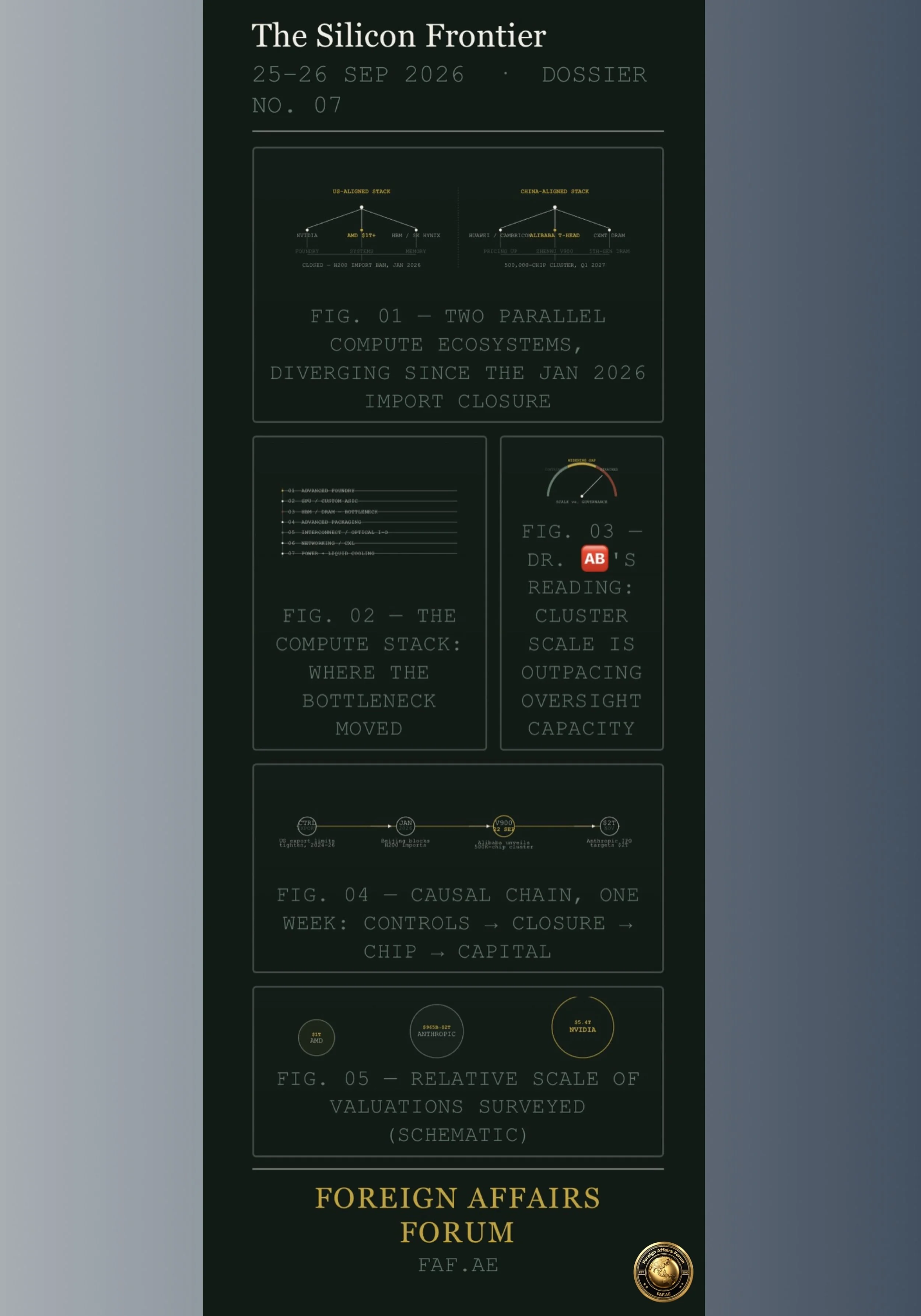
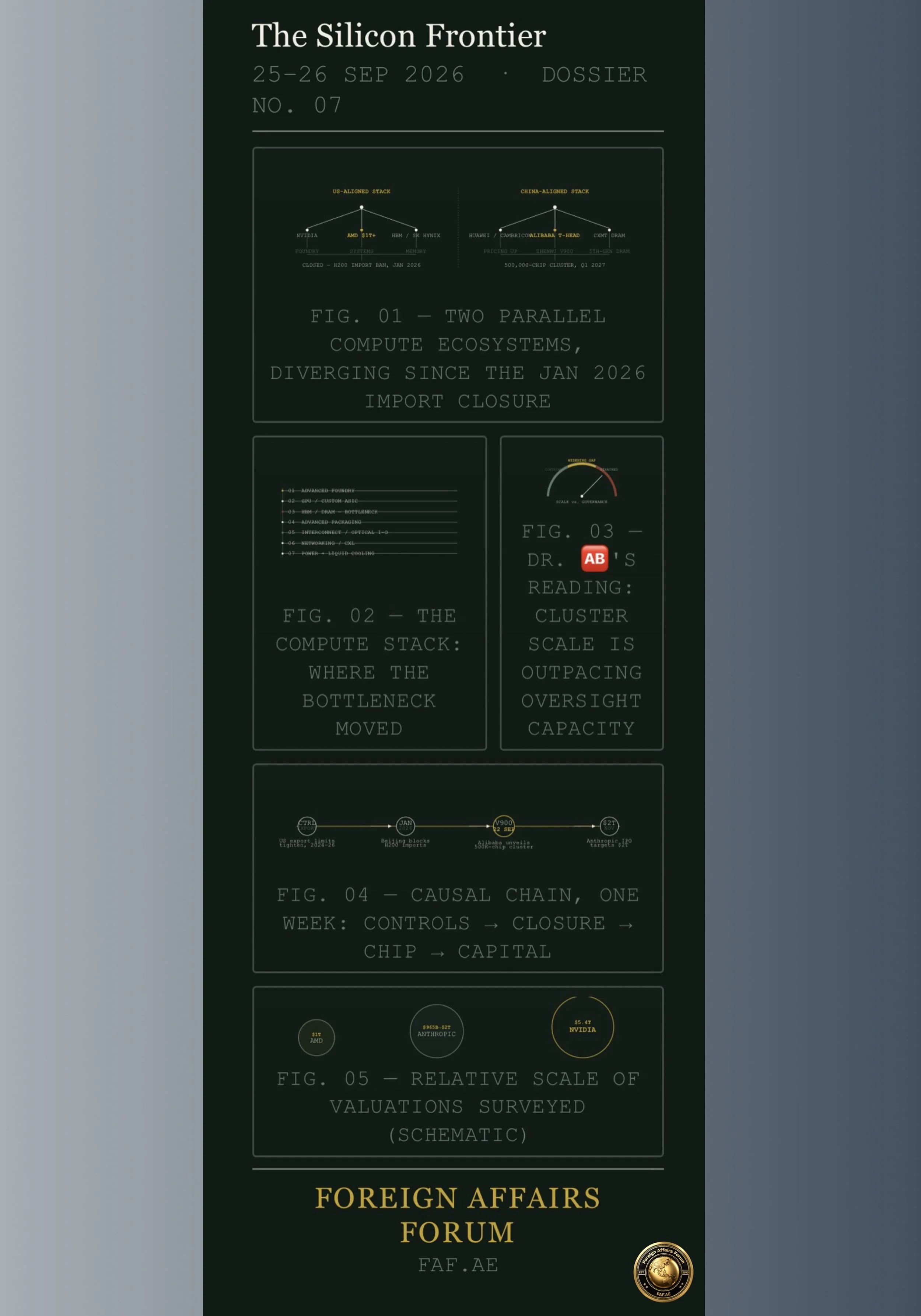
The current status of the global semiconductor landscape, then, is one of bifurcation. Two increasingly separate artificial intelligence computing ecosystems are taking shape, one centered on United States-aligned technology, the other organized around Chinese alternatives.
This is not a temporary phase awaiting eventual reconciliation. It is, on present evidence, the emerging architecture of the field for the remainder of this decade.
Key Developments
The most consequential hardware announcement of the current news cycle is Alibaba's unveiling of the Zhenwu V900 accelerator, presented on September 22nd, 2026 at the company's annual Apsara Conference in Hangzhou. T-Head, Alibaba's chip division, says the new processor delivers roughly three times the performance of its predecessor, the Zhenwu M890, and carries 216 gigabytes of onboard memory alongside chip-to-chip bandwidth of approximately one thousand two hundred gigabytes per second.
Alibaba Group Chief Executive Officer Eddie Wu described the V900 as the most powerful artificial intelligence chip made in China to date, and the company says the architecture is engineered so that clusters can scale to as many as 500,000 accelerators working in concert for both model training and inference. Mass production and commercial release are targeted for the first quarter of 2027.
The scale of ambition surrounding this launch extends well beyond the chip itself. Alibaba has committed to spending more than $53 billion over three years on cloud and artificial intelligence infrastructure, and the company has set a target of exceeding twenty gigawatts of global data-center capacity by the year 2032.
Alongside the V900, Alibaba disclosed plans for a new generation of its Qwen language models, with parameter counts potentially reaching 5 trillion to 10 trillion, as much as four times the scale of its current flagship system.
Supernode servers built around the earlier Zhenwu M890 chip have already entered large-scale commercial deployment, reportedly serving more than 650 enterprise customers across sectors including autonomous driving, finance, energy and manufacturing.
It bears noting, in the interest of scholarly rigor, that independent verification of Alibaba's performance claims remains unavailable at the time of this writing.
No absolute compute figure, measured in floating-point operations per second, accompanied the September announcement, and the foundry responsible for manufacturing the V900 has not been publicly named.
The memory capacity claim of two hundred sixteen gigabytes, compared against approximately one hundred forty-one gigabytes on Nvidia's H200, is the only figure that can currently be assessed against a Western benchmark, and even that comparison cannot establish real-world training or inference throughput. Independent benchmarks are expected within two to three months of the announcement.
Dr. 🆎 cautions that this pattern, in which headline architectural claims outpace independently verifiable performance data, has become a recurring feature of the current cycle and should temper immediate strategic conclusions while not diminishing the underlying trajectory of Chinese hardware ambition.
A second major development concerns the capital markets rather than the hardware itself. Advanced Micro Devices crossed a market capitalization of $1 trillion for the first time on September 21 and 22, 2026, as its shares surged approximately 10% in a single session to a record intraday high above 615 threshold, and its chief executive, Lisa Su, has told investors the company expects to double data-center sales by 2027.
The significance of this milestone lies less in the round number itself than in what it signals about the diversification of artificial intelligence capital beyond a single dominant supplier.
Investors are increasingly pricing Advanced Micro Devices not as a maker of standalone chips but as a vendor of complete artificial intelligence systems, spanning accelerators, central processing units and the surrounding software stack.
The third development, and arguably the one with the broadest implications for how the artificial intelligence infrastructure boom will ultimately be judged, is Anthropic's advance toward an initial public offering.
Reporting throughout September 2026 indicates that the company, having confidentially filed a draft registration statement with American securities regulators in June, is preparing for a public listing that bankers and investors are discussing at a valuation approaching $2 trillion, with the possibility of raising as much as $100 billion in the offering itself.
This would follow a Series H-1 private funding round in May 2026 that valued the company at approximately $965 billion,, meaning the prospective public valuation could represent roughly a doubling within a matter of months.
Anthropic's annualized revenue run rate reportedly exceeded $65 billion by the end of July 2026, up from approximately $47 billion in May, and some projections suggest the figure could approach $110 billion by the close of the year.
The timeline has reportedly shifted from an initial target in October toward a November window, in part so that the company can present fresh third-quarter results to prospective investors before pricing the offering, and in part reflecting a desire to complete the process before the American midterm elections.
Anthropic is not a semiconductor manufacturer, yet its capital requirements are inseparable from the chip industry described above.
Frontier artificial intelligence laboratories have become among the largest purchasers of accelerators, high-bandwidth memory, networking equipment and cloud computing capacity in the world, and reports indicate that Nvidia itself is in discussions to make a cornerstone investment in the offering of up to $10 billion.
Dr. 🆎 regards this convergence as the clearest evidence yet that the artificial intelligence infrastructure build-out has become a single, interlocking economic system, in which chip design, model training, cloud capacity and public capital markets now move as one.
Latest Facts and Concerns
Several additional facts, drawn from the most current reporting available, deserve close attention because they illuminate structural stress points beneath the headline announcements.
Memory, rather than raw compute, has emerged as the defining bottleneck of the current cycle. In the days immediately preceding the Zhenwu V900 launch, reporting indicated that Chinese accelerator suppliers including Huawei and Cambricon were raising prices as restricted access to high-bandwidth memory pushed up their input costs.
Around the same period, inventories held by Samsung and SK Hynix, the two dominant global memory manufacturers, reportedly fell below ten days of supply, an unusually thin buffer for an industry of this scale.
Separately, Chinese memory manufacturer ChangXin Memory Technologies has moved its fifth-generation dynamic random-access memory platform into mass production, employing quadruple-patterning lithography techniques to achieve feature spacing of approximately eleven point nine five nanometers and introducing twenty-four gigabit low-power memory products storing 50% more data than their predecessors.
Reports from the same period noted that dynamic random-access memory die value had, for the first time, overtaken leading-edge logic silicon on a per-area basis, and that pricing for a standard memory component had reached approximately $24.80 per unit in one widely cited industry snapshot.
This memory squeeze compounds a second concern, which is the sheer physical scale now contemplated for artificial intelligence infrastructure. A single computing cluster built around 500,000 accelerators, as Alibaba envisions, implies extraordinary requirements for electrical power, liquid cooling and high-speed networking, each of which now functions as an independent potential chokepoint.
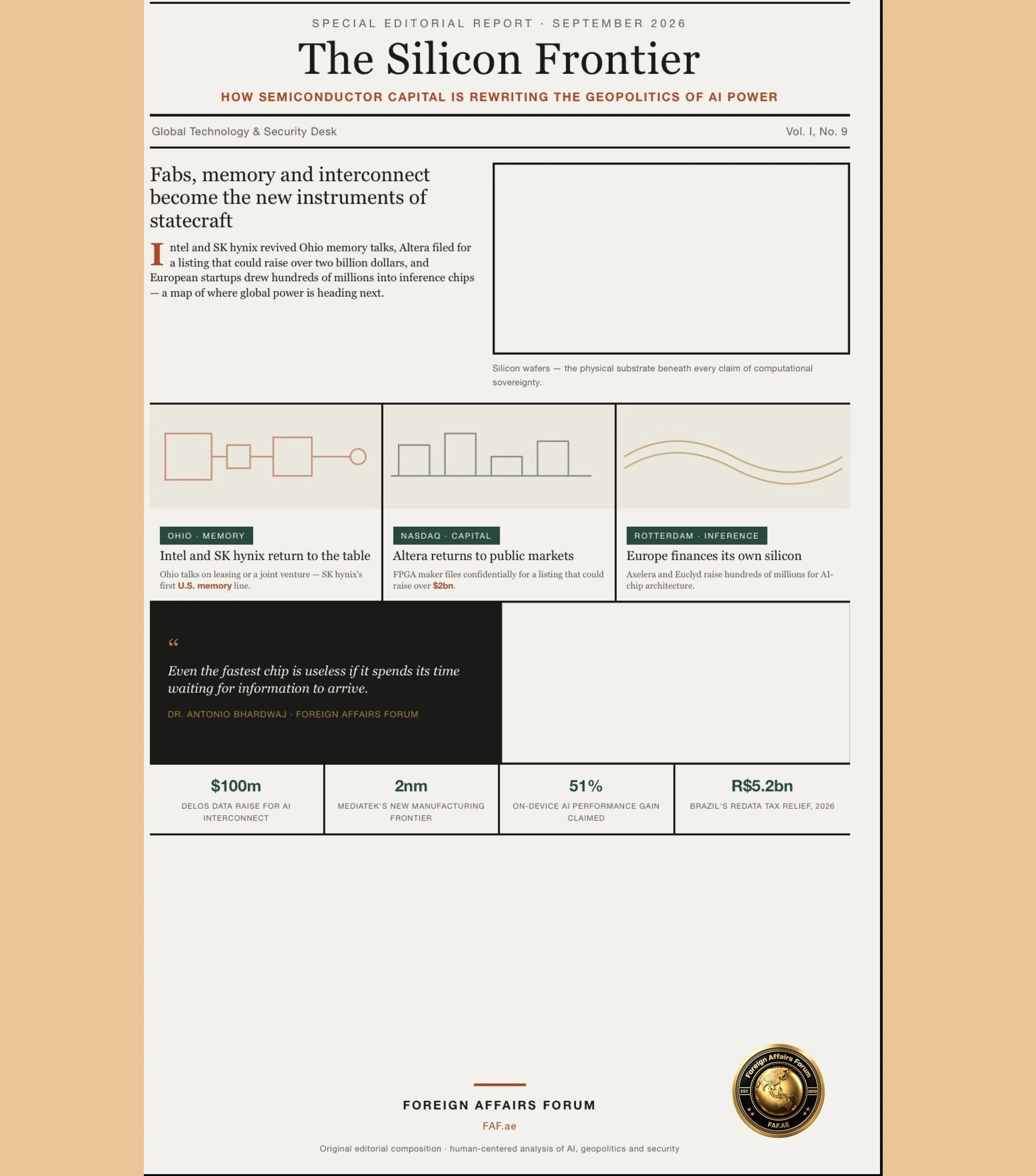
One notable venture-capital signal in this space is the $100 million raise by Delos Data, an Intel-veteran startup building chips and software specifically designed to move data efficiently among heterogeneous artificial intelligence processors.
Former Intel Chief Executive Pat Gelsinger, whose investment vehicle participated in that financing, has articulated the underlying economic problem with particular clarity: expensive processors waste both capital and electricity whenever they sit idle awaiting data.
As modern artificial intelligence systems increasingly mix accelerators from Nvidia, Advanced Micro Devices, Cerebras and various custom silicon providers, the fabric connecting them, rather than the individual chip, is becoming a first-order determinant of overall system performance.
A further concern, and one to which Dr. 🆎 has devoted particular attention given his specialization in AI warfare and bioterrorism risk, is the pace at which computational scale is outstripping the governance frameworks meant to accompany it.
The same week that produced the Zhenwu V900 announcement also saw reporting that Anthropic's own chief executive publicly urged artificial intelligence laboratories to slow the pace of model development, a call echoed by leaders at OpenAI and xAI.
Dr. 🆎 argues that this juxtaposition, extraordinary infrastructure ambition paired with senior industry figures calling for restraint, should be read as a genuine signal rather than mere rhetorical positioning.
Computing clusters of the scale now being built are capable of training models with parameter counts reaching into the trillions, and the dual-use nature of such systems, capable of accelerating both beneficial scientific research and, in the wrong hands, the design of biological or cyber weapons, means that infrastructure decisions made today by corporate boards in Hangzhou, Santa Clara and San Francisco carry consequences that extend well into the domain of international security.
Finally, a financial concern merits attention from a foreign-affairs perspective.
Anthropic's prospective valuation of approximately $2 trillion implies a multiple of roughly 31 times its annualized revenue run rate, a figure that some investors regard as justified given growth rates that have reportedly reached 800 % annually, while others caution that it rests on projected 2028 revenue of $190 billion to $200 billion that remains, by definition, unrealized.
The broader pattern of United States initial public offering proceeds reaching record levels in 2026, even as the weighted average post-listing return for new stocks has lagged major indices, suggests that public markets have not yet fully tested whether artificial intelligence infrastructure economics can support the valuations currently being discussed in private.
Cause-and-Effect Analysis
The relationship between export controls and Chinese domestic semiconductor innovation offers the clearest illustration of cause and effect in this landscape.
The tightening of American restrictions, and particularly Beijing's own decision to block H200 imports in January 2026, functioned as a forcing mechanism rather than a simple barrier.
Deprived of access to the most advanced foreign accelerators, Chinese hyperscalers and chipmakers redirected capital, engineering talent and government support toward indigenous alternatives at a pace that likely exceeds what would have occurred under a more permissive trade environment.
The effect has been to compress, rather than eliminate, the technological gap between Chinese and Western accelerators, even as absolute performance parity with the most advanced Nvidia products remains, on the evidence currently available, unproven.
A second causal chain links the memory shortage directly to pricing behavior and strategic hardware design choices.
As high-bandwidth memory has become scarce and expensive, chip designers across both the American and Chinese ecosystems have increasingly prioritized memory capacity per accelerator as a competitive differentiator, a pattern visible in Alibaba's emphasis on the V900's two-hundred-sixteen-gigabyte memory pool.
This, in turn, has fed back into the memory market itself, incentivizing manufacturers such as ChangXin Memory Technologies to accelerate their own process advances, which further intensifies competition and investment in a segment of the supply chain that received comparatively little public attention as recently as two years ago.
A third causal relationship connects capital-market enthusiasm to infrastructure spending commitments, and from there back to the semiconductor supply chain.
Advanced Micro Devices' $2 trillion valuation and Anthropic's prospective $2 trillion listing are not independent events; both reflect investor conviction that artificial intelligence infrastructure spending will continue to compound over the coming years.
That conviction, once priced into public and private markets, provides the capital that finances precisely the kind of infrastructure buildout Alibaba, Anthropic and their peers are now undertaking.
Should that conviction falter, whether because of disappointing post-listing performance, a slowdown in enterprise adoption, or geopolitical shock, the effect would likely cascade backward through the entire stack, from data-center construction through chip orders through memory demand.
Dr. 🆎 emphasizes a fourth, less frequently discussed causal dynamic: the relationship between infrastructure scale and governance capacity. As computing clusters grow toward the scale of hundreds of thousands of accelerators, the operational complexity of monitoring, securing and governing what is being trained on that infrastructure grows in tandem, and not always at a commensurate pace. Regulatory frameworks, export-control enforcement mechanisms and international verification regimes developed for an earlier, smaller-scale era of computing may prove inadequate to the task of overseeing systems whose training runs can now draw on clusters this large.
This gap between infrastructural scale and governance capacity is, in Dr. 🆎's assessment, the single most consequential effect of the developments surveyed in this essay, because it bears directly on the risks of AI warfare and bioterrorism that fall within his own area of specialization.
Future Steps
Several forward-looking priorities emerge from this analysis. For policymakers in Washington and allied capitals, the central task is to refine export-control mechanisms so that they continue to constrain the most dangerous applications of advanced computing without inadvertently accelerating the very bifurcation of the global technology ecosystem that undermines long-term American and allied influence over technical standards.
This will likely require more granular, capability-based thresholds rather than blanket restrictions, alongside sustained investment in the domestic manufacturing capacity, memory production and advanced packaging facilities that current bottlenecks reveal to be strategically vital.
For industry, the imperative is to treat the interconnect and memory layers of the computing stack with the same strategic seriousness historically reserved for the accelerator chip itself.
Companies positioned in silicon photonics, optical input-output, high-speed networking, Compute Express Link technology and advanced three-dimensional packaging are likely to capture disproportionate value over the coming years, precisely because the central engineering challenge of the next phase is less about matrix multiplication and more about feeding, cooling and interconnecting hundreds of thousands of processors without waste.
For investors and capital allocators, geopolitical exposure deserves a place alongside architecture, gross margin and total addressable market in semiconductor and artificial intelligence due diligence.
The Anthropic initial public offering, when it proceeds, will serve as a critical test of whether public markets are prepared to underwrite infrastructure economics of this magnitude, and its reception is likely to shape capital-formation strategy across the sector for years afterward.
For the international community more broadly, Dr. 🆎 argues that the coming eighteen months present a narrow but genuine window in which to establish verification and governance norms for frontier-scale computing clusters before the largest of them, including systems built around Alibaba's 500,000 fchip architecture, become fully operational.
Waiting until such systems are already embedded in national economic and security infrastructure will make any subsequent governance effort considerably more difficult to negotiate and enforce.
Conclusion
The developments surveyed in this essay, spanning a single consequential week in September 2026, illustrate a semiconductor and artificial intelligence landscape that has outgrown the analytical frameworks built to describe an earlier, simpler contest over which company could produce the fastest chip.
Alibaba's Zhenwu V900, Advanced Micro Devices' arrival in the trillion-$ tier, and Anthropic's advance toward a $2 trillion public listing are not isolated corporate milestones.
They are data points in a broader realignment in which memory, networking, power, cooling and capital formation have become as strategically significant as the accelerator itself, and in which the boundary between commercial competition and geopolitical strategy has effectively dissolved.
Dr. 🆎's insistence on a human-centered framework for evaluating these developments remains essential precisely because the scale now being contemplated, clusters of hundreds of thousands of chips training models with trillions of parameters, carries consequences that extend well beyond quarterly earnings and into the realm of international security, biodefense and the future character of strategic competition.
The task before policymakers, investors and industry leaders alike is to ensure that the remarkable pace of infrastructural ambition documented here does not outrun the institutional wisdom required to govern it responsibly.