Beyond the Model Race: How Capital, Chips, Energy, and Embodied Intelligence Are Redrawing the Global AI Order
Foreign Affairs Forum | Dr. Antonio Bhardwaj (Dr. 🆎)| September 11th 2026
Executive summary
The global contest for artificial intelligence supremacy is undergoing a structural transformation. What began, several years ago, as a competition between laboratories chasing ever-larger language models has matured into a multidimensional struggle over capital formation, semiconductor architecture, energy geography, and the commercialization of embodied intelligence.
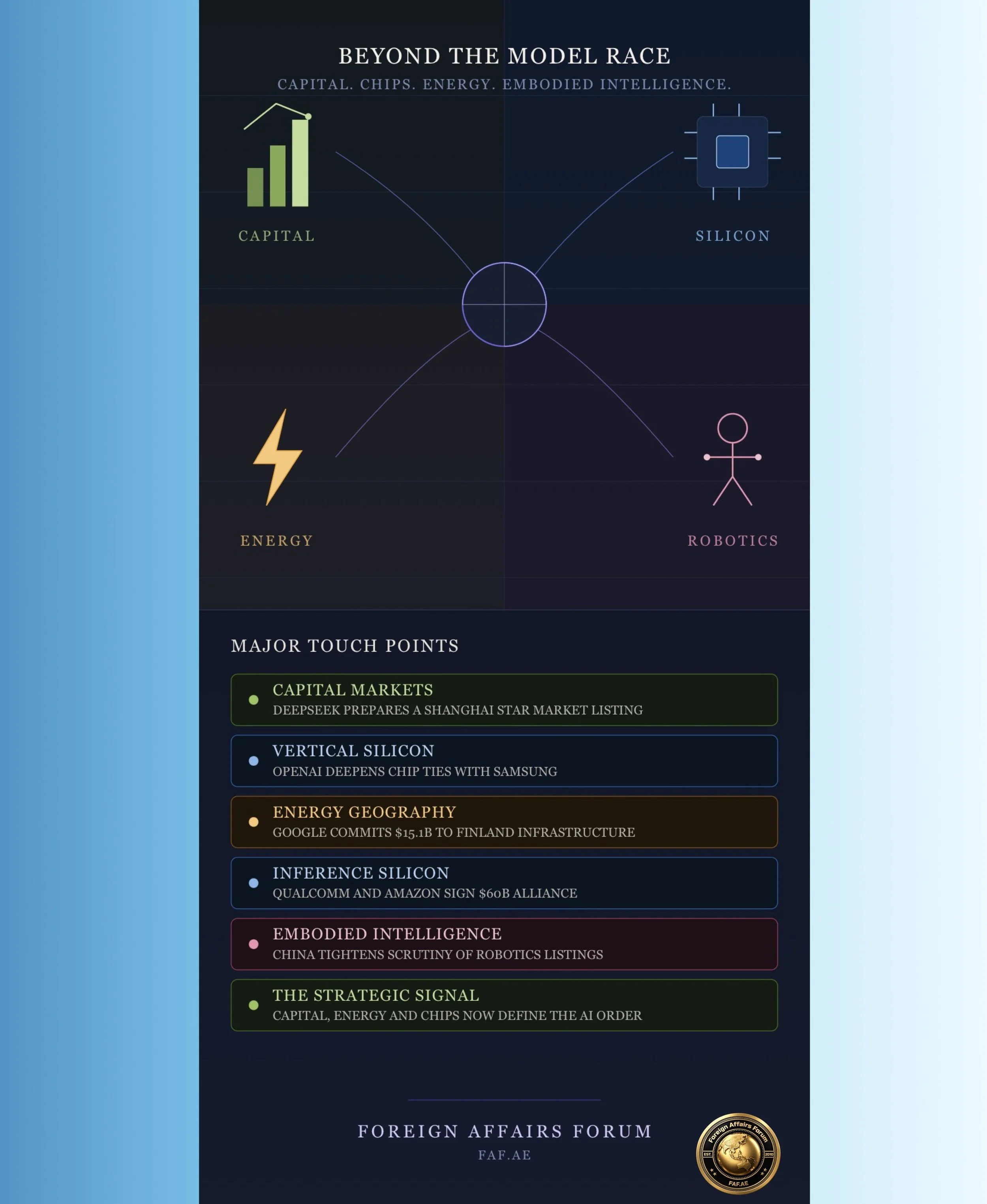
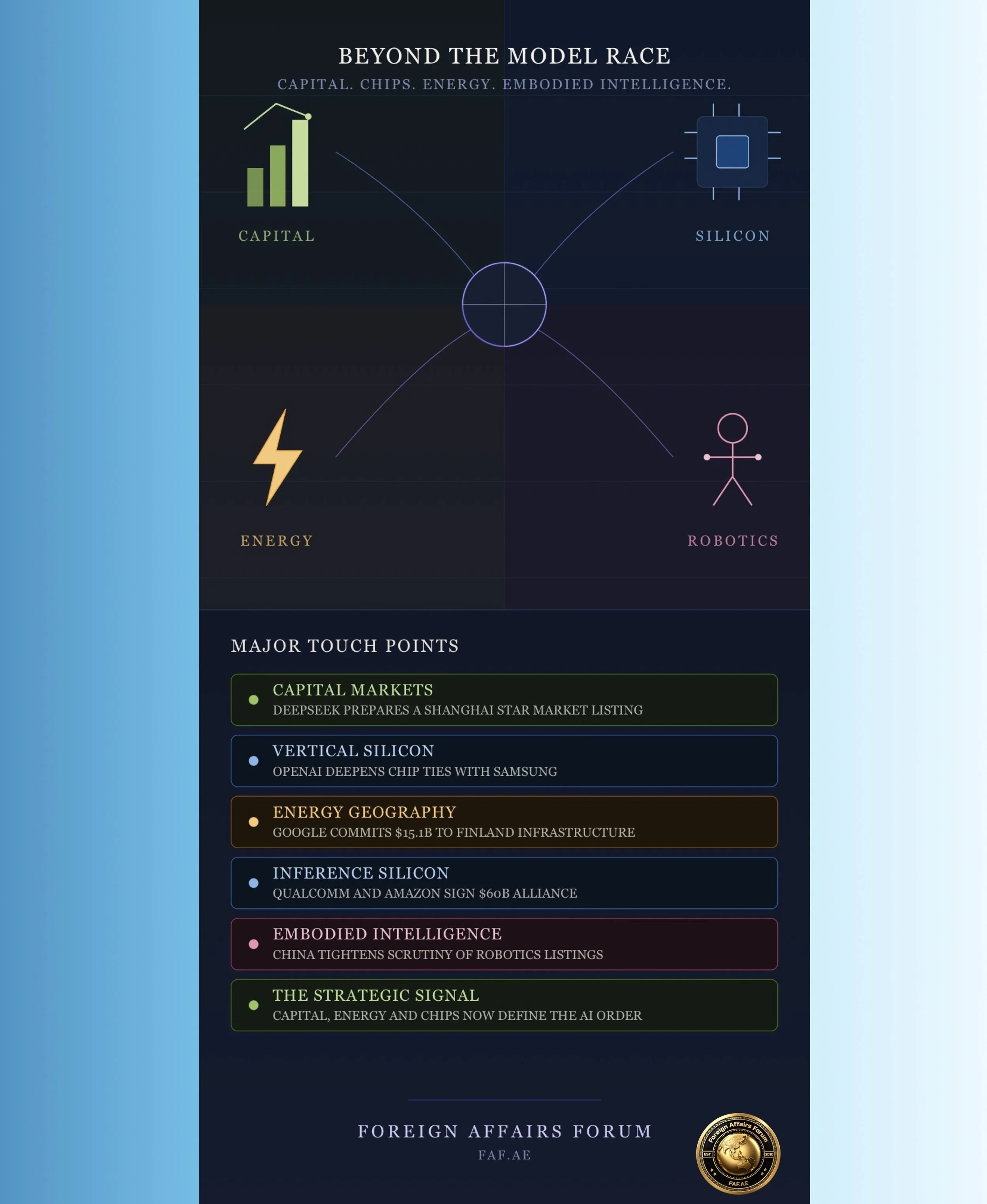
Developments converging in early September 2026 — DeepSeek's move toward a Shanghai listing, OpenAI's deepening silicon partnership with Samsung Electronics, Google's $15.1 billion infrastructure commitment to Finland, Qualcomm's $60 billion inference-chip alliance with Amazon, and Beijing's tightening of humanoid-robot listing standards following Unitree Robotics' turbulent debut — together reveal that the decisive battleground has shifted. It is no longer simply which laboratory has the most capable model. It is who controls the capital markets, the energy grids, the memory fabrication lines and the inference infrastructure upon which the entire artificial intelligence economy now depends.
Dr. Antonio Bhardwaj (Dr. 🆎), the CEO of the Foreign Affairs Forum and a specialist in human-centered AI for geopolitical strategy, AI warfare and bioterrorism risk, frames this moment as the passage from a "model race" to an "infrastructure race," one whose outcome will shape the balance of technological and military power for a generation.
FAF analysis examines the historical trajectory that produced these developments, situates them within the broader geopolitics of the United States-China technology rivalry, and offers a cause-and-effect assessment of how capital markets, chip diversification, energy geography and regulatory caution are jointly reshaping the artificial intelligence order.
It concludes that the coming years will be defined less by breakthroughs in model architecture than by the ability of stakeholders — states, corporations, and financial markets — to convert theoretical capability into deployable, financeable, and strategically resilient infrastructure.
Introduction
For much of the past decade, public discourse surrounding artificial intelligence has centered on a seemingly simple question: which laboratory possesses the most capable model. That framing, always something of a journalistic convenience, has become increasingly inadequate as the industry has matured.
The events of early September 2026 illustrate just how far the frontier of competition has moved beyond model benchmarks and into the underlying architecture of capital, silicon, and energy that determines whether any model can actually be trained, deployed, and profitably operated at global scale.
Five developments, announced within a span of days, illuminate this shift with unusual clarity.
Chinese artificial intelligence company DeepSeek has engaged CITIC Securities to prepare a listing on Shanghai's STAR Market, joining a cohort of Chinese frontier-model developers moving from private venture funding toward public capital.
OpenAI has expanded its semiconductor cooperation with Samsung Electronics, extending a vertical integration strategy that already includes a custom accelerator built with Broadcom.
Google has committed at least €13 billion, or roughly $15.1 billion, to artificial intelligence infrastructure in Finland, its largest single investment anywhere in Europe.
Qualcomm and Amazon have entered a multi-generation partnership potentially worth $60 billion, centered on inference chips and high-speed optical interconnects.
And Chinese regulators, chastened by the extreme volatility surrounding Unitree Robotics' Shanghai debut, are reportedly tightening the criteria under which humanoid-robotics companies may pursue public listings.
Individually, each of these stories might be filed under corporate finance or technology-sector reporting. Considered together, they describe something considerably larger: a restructuring of how the artificial intelligence economy is financed, powered, manufactured and governed.
Dr. 🆎 argues that this restructuring carries direct implications for geopolitical strategy and for the character of what he terms "AI-enabled statecraft" — the use of artificial intelligence capability, and the infrastructure that underlies it, as an instrument of national power. "We are witnessing the militarization of the supply chain itself," Dr. 🆎 observes. "Compute, energy and capital have become as strategically salient as missiles and warships, because without them, no state can sustain an artificial intelligence capability at the scale that modern statecraft now requires."
This article proceeds in six parts. It first traces the historical evolution of the artificial intelligence race from a model-centric to an infrastructure-centric competition. It then reviews the current status of the five key developments identified above. It examines the latest facts and lingering uncertainties surrounding each. It offers a cause-and-effect analysis connecting capital markets, semiconductor diversification, energy geography and regulatory behavior. It considers the likely trajectory of these trends into 2027 and beyond. And it concludes with an assessment of what this infrastructure-centric order means for the future distribution of geopolitical and military power.
History and current status
The artificial intelligence race did not begin as an infrastructure competition. In its earlier phases, dating to the large-scale language-model breakthroughs of the early twenty-twenties, competitive advantage was assumed to flow primarily from algorithmic innovation and from access to enormous, if somewhat undifferentiated, pools of graphics-processing-unit capacity, most of it supplied by Nvidia. The assumption embedded in much early commentary was that whichever laboratory trained the largest, most capable model would enjoy a durable lead.
That assumption began to erode for several interlocking reasons.
First, the costs of frontier-model training escalated dramatically, straining even the balance sheets of the best-capitalized technology companies and forcing a search for alternative financing vehicles beyond private venture capital.
Second, a persistent shortage of advanced logic chips, compounded by export controls that Washington imposed on the export of advanced semiconductor technology to China, pushed both American and Chinese companies toward vertical integration and custom-silicon strategies that reduced dependency on any single supplier.
Third, the electricity demands of frontier-scale data centers grew to a point where availability of power, rather than availability of capital or talent, became the binding constraint on how much computing capacity could actually be built in any given jurisdiction.
Fourth, and more recently, the commercialization of "embodied" artificial intelligence — humanoid robots, autonomous industrial systems and battlefield platforms — introduced a new axis of competition in which manufacturing capacity and physical deployment, not merely model quality, determine strategic relevance.
By mid-2026, these pressures had already produced a wave of headline developments that Dr. 🆎 and the Foreign Affairs Forum had tracked closely: Taiwan Semiconductor Manufacturing Company's $265 billion investment commitment in the United States; the emergence of alternative extreme ultraviolet lithography technologies as a potential counterweight to the Dutch company ASML's near-monopoly; Alphabet's own $84.75 billion equity raise; a boom in AI-linked corporate bond issuance; the rise of Zurich as a secondary artificial intelligence financial hub; and the proliferation of custom application-specific integrated circuits, or ASICs, from Broadcom, Google, Amazon and others, challenging Nvidia's dominance in the merchant graphics-processing-unit market. Throughout the summer, Chinese language-model developers, including Zhipu AI (branded as Z.AI ) and MiniMax, completed listings in Hong Kong, while Beijing-based Moonshot AI filed confidentially for its own Hong Kong offering.
These moves established the template that DeepSeek is now reportedly following, but on a considerably larger scale and, notably, in Shanghai rather than Hong Kong.
Against that backdrop, the developments of the past several days represent not a sudden rupture but an acceleration and consolidation of trends that had been building for many months.
What has changed is the degree of specificity and scale: firm dollar figures, named counterparties, and binding financial instruments have replaced the more speculative announcements of earlier in the year.
Key developments
DeepSeek's move toward a Shanghai listing
DeepSeek, the Hangzhou-based artificial intelligence company that rose to global prominence on the strength of its cost-efficient reasoning models, has engaged CITIC Securities to prepare for an initial public offering on the Shanghai Stock Exchange's technology-focused STAR Market.
According to reporting relayed through Reuters and corroborated by multiple financial outlets, the company aims to begin the formal listing process before the end of 2026, although the timing, offering size and target valuation remain undetermined. The engagement of a securities firm for "pre-listing tutoring," a standard prerequisite for a mainland Chinese listing, indicates that preparations are substantive rather than exploratory.
DeepSeek's IPO ambitions arrive amid an active fundraising round reported to value the company at roughly five hundred billion yuan, or approximately $75 billion, following a $7.4 billion raise completed in June with participation from founder Liang Wenfeng, Tencent Holdings and battery manufacturer CATL.
The company's roots are unusual among frontier-model developers: it emerged from High-Flyer, a quantitative hedge fund that had built substantial internal computing infrastructure for algorithmic trading before pivoting toward foundation-model research.
Reported financial disclosures indicate a gross margin of approximately 44.6% for the first seven months of 2026, with margins on application-programming-interface sales reaching as high as 82.9%, suggesting a increasingly commercial, if still loss-making, enterprise.
The broader context is telling.
DeepSeek is not moving alone. Enflame Technology's own STAR Market listing attracted extraordinary retail demand, with the retail tranche oversubscribed more than four thousand times and orders submitted for tens of billions of shares, raising over six billion yuan to fund its own semiconductor development.
Zhipu AI now carries a market capitalization near $54 billion following its Hong Kong debut, while Moonshot AI's confidential filing values it at roughly $50 billion.
Notably, these valuations still trail those anticipated for American frontier laboratories: Anthropic has been discussed in some private-market commentary as potentially reaching a valuation as high as $2 trillion in a future listing, while OpenAI has been associated with figures approaching $1 trillion.
Dr. 🆎 regards this valuation gap as significant but potentially misleading. "Market capitalization measures investor expectation, not strategic capability," he notes. "China's decision to finance its AI champions through domestic public markets, rather than relying primarily on private capital concentrated in a handful of American and Gulf sovereign funds, is itself a form of strategic autonomy. It insulates Chinese AI financing from the kind of Western capital-market leverage that has, in other contexts, been used as an instrument of geoeconomic pressure."
OpenAI's expanding silicon partnership with Samsung
OpenAI has announced an expansion of its cooperation with Samsung Electronics on next-generation semiconductor development, according to a statement from OpenAI Korea chief Harrison Kim, who described "substantial progress" in joint chip production and research without disclosing granular technical detail. Samsung Electronics, together with SK hynix, is separately positioned to supply memory components for OpenAI's expansive Stargate infrastructure program.
This expansion builds upon OpenAI's existing collaboration with Broadcom, through which the company developed its first custom artificial intelligence accelerator, reaching the tape-out stage in a reported nine months, a pace OpenAI attributes in part to the use of its own models to accelerate chip-design workflows.
Taken together, these moves describe a company steadily transforming from a model laboratory into something closer to a vertically integrated computing enterprise, spanning model design, custom silicon, memory procurement, networking and, eventually, energy contracting.
Dr. 🆎 situates this evolution within a wider strategic pattern. "OpenAI's vertical descent into hardware is not simply a cost-optimization exercise," he argues. "It is a hedge against a scenario in which Nvidia's supply, export-control exposure, or pricing power becomes a chokepoint OpenAI cannot tolerate. In geopolitical terms, this is the same logic that drives states to build strategic reserves or domestic production capacity for critical materials.
OpenAI is building a private strategic reserve of compute sovereignty." The linkage between American chip design, South Korean memory fabrication and, further down the value stack, Taiwanese semiconductor manufacturing, also illustrates how deeply the frontier artificial intelligence supply chain now depends on a small number of allied economies whose political stability is itself a strategic asset.
Google's $15.1 billion Finnish investment
Google, a subsidiary of Alphabet, announced on 9 September 2026 that it will invest at least €13 billion, or approximately $15.1 billion, in Finnish digital infrastructure over 2027 and 2028, describing it as the company's largest single investment anywhere in Europe.
The commitment covers new data centers in the municipalities of Kajaani, Muhos and Vaala, alongside an expansion of Google's existing facility in Hamina, together with clean-energy projects, grid upgrades and battery storage intended to power services including Gemini, Search, Maps and YouTube.
The investment includes what Google describes as its first nuclear-energy agreement outside the United States: a 22 year power purchase agreement with Finnish utility Fortum supporting the life extension of the Loviisa nuclear plant, which currently supplies roughly 10% of Finland's electricity, with Google set to take half of the plant's output from 2030 through 2049.
Additional agreements bring Google's contracted new wind capacity in Finland to 629 megawatts. Finnish officials estimate the construction phase will contribute approximately $3.6 billion to gross domestic product and support roughly seven thousand jobs annually once the facilities become operational. Finland's Prime Minister, Petteri Orpo, characterized the decision as "a clear testament" to the country's strengths.
Google's choice of Finland reflects a calculation that has become increasingly common among hyperscalers, including Microsoft and ByteDance, which have also expanded Nordic data-center footprints: cold ambient temperatures reduce cooling costs, and abundant low-carbon electricity generation, including nuclear and wind, addresses both operating expense and environmental scrutiny simultaneously.
Dr. 🆎 frames this as the emergence of an entirely new category of strategic asset. "For decades, energy geopolitics meant control over oil and gas reserves," he observes. "We are now watching the birth of an electricity-and-climate geopolitics of artificial intelligence, in which countries possessing cool climates, stable grids and abundant carbon-free generation become as strategically desirable as those possessing hydrocarbons once were. Finland's position within NATO, and its border with Russia, adds a further layer: this is not merely an economic decision, it is an alignment decision with unmistakable strategic overtones."
Qualcomm and Amazon's $60 billion inference alliance
Qualcomm and Amazon Web Services have entered a long-term, multi-generation partnership to co-develop custom artificial intelligence inference chips and high-speed optical interconnect technology, in an arrangement potentially worth as much as $60 billion in payments to Qualcomm through 2036. As part of the agreement, Qualcomm issued Amazon warrants to acquire up to 25 million Qualcomm shares at an exercise price of $161.26 per share, a package worth approximately $4 billion if fully exercised; 3.75 million shares vested immediately based on Amazon's initial purchase commitments, with the remainder vesting in tranches tied to binding orders and actual purchases.
The partnership divides labor along complementary lines: Qualcomm contributes power-efficiency expertise and chip-design capability developed over decades in mobile semiconductors, while Amazon Web Services contributes cloud infrastructure, including services such as Amazon Bedrock, for chip design, simulation and verification workflows.
The companies will jointly pursue optical interconnect technology capable of supporting speeds up to 1.6 terabits per second, addressing a bottleneck that has become as consequential to overall system performance as raw processing capability itself.
Qualcomm's chief executive, Cristiano Amon, described the arrangement as a response to a data-center infrastructure environment that "requires advancements in both computation and connectivity to deliver higher performance efficiently."
The emphasis on inference, rather than training, marks a meaningful shift in the industry's center of gravity. Training massive foundation models produced the first wave of the artificial intelligence semiconductor boom; but as hundreds of millions of users, and increasingly autonomous software agents, continuously query deployed models, the computing demand associated with running, rather than building, those models is poised to become the far larger and more persistent market.
Dr. 🆎 considers this transition strategically significant in its own right. "Training is episodic; inference is continuous," he notes. "A state or company that controls inference infrastructure controls the daily operational tempo of the artificial intelligence economy, in the same way that control over fuel supply, rather than control over weapons production alone, determines a military's sustained operational reach. The Qualcomm-Amazon deal, and the parallel diversification toward Broadcom, Google's own Tensor Processing Units and other custom silicon, is best understood as an effort to prevent any single chokepoint — whether Nvidia, Taiwan, or any other single node — from holding leverage over that daily tempo."
China's tightening scrutiny of humanoid-robot listings
Chinese regulators are reportedly tightening scrutiny of humanoid-robotics companies seeking public listings, following extreme volatility surrounding Unitree Robotics' Shanghai debut. Unitree, founded in 2016 by engineer Wang Xingxing, priced its initial public offering at 150.8 yuan per share, implying a company valuation of roughly 61 billion yuan, or approximately $9 billion.
On its first trading day in August, shares surged as much as 629%, briefly lifting Unitree's market capitalization to as high as $66 billion, before a subsequent slide of roughly 45% erased approximately $30 billion in value over the following days.
According to a report from The Information, relayed by Reuters, Chinese authorities may increasingly require humanoid-robotics companies to demonstrate recurring revenue, narrowing losses, or genuine technological differentiation before receiving approval for a public listing; Reuters noted it could not independently verify the specifics of the regulatory guidance.
The episode has reignited debate over the structural characteristics of China's listing framework, with some analysts pointing to a broader slowdown in Shanghai listing activity — only twenty-one companies completed Shanghai listings during the first seven months of 2026, compared with one hundred four in Hong Kong — as evidence that Chinese regulators are already applying greater caution to speculative technology offerings generally.
Notably, Unitree itself had disclosed a 52% year-on-year decline in adjusted quarterly profit just before its listing-committee review, even as revenue grew 68%, illustrating the tension between rapid top-line growth and deteriorating unit economics that increasingly characterizes the humanoid-robotics sector.
Dr. 🆎, whose research portfolio extends to the battlefield applications of autonomous and embodied systems, views the Unitree episode as a cautionary signal with implications well beyond consumer and industrial robotics. "Humanoid and quadrupedal platforms are dual-use technologies in the most literal sense," he explains. "The same locomotion, perception and manipulation capabilities that allow a robot to perform a martial-arts demonstration for a stock-exchange debut are foundational to logistics, reconnaissance and, eventually, combat-support applications. When capital markets reward theatrical capability over deployable reliability, they risk directing resources toward the wrong technical priorities — priorities optimized for investor spectacle rather than for the kind of ruggedized, field-tested performance that both commercial customers and defense procurement officials actually require. Beijing's apparent decision to impose stricter listing criteria is, in effect, an attempt to realign capital allocation with strategic utility rather than speculative enthusiasm."
Latest facts and concerns
Several factual threads merit particular attention because they bear directly on how durable, and how strategically consequential, these developments will prove to be.
First, on the DeepSeek listing, the essential facts remain provisional.
Multiple financial news organizations, drawing on sourcing traceable to Reuters, agree that CITIC Securities has been engaged and that DeepSeek intends to begin the IPO process before year's end, with an actual listing potentially occurring in 2027.
No figure for the intended offering size or resulting valuation has been confirmed by the company itself, and neither DeepSeek nor CITIC Securities has responded publicly to requests for comment.
The persistent gap between Chinese and American frontier-model valuations, even as Chinese companies pursue public listings more aggressively than their American counterparts, raises a genuine analytical question about whether Chinese public markets are systematically undervaluing frontier artificial intelligence capability, or whether American private valuations are inflated by capital scarcity and investor enthusiasm untested by public-market scrutiny.
Dr. 🆎 suggests the truth likely lies between these positions: "Public markets impose a discipline that private mega-rounds do not. China's approach will produce more transparent, if perhaps more conservative, pricing of AI capability. America's approach, dependent on a small number of enormous private financings, remains vulnerable to a correction whose scale is difficult to forecast precisely because so little of the relevant financial information is publicly disclosed."
Second, regarding Google's Finnish commitment, the reported figures are broadly consistent across outlets, though some describe the sum as "at least" €13 billion while others treat it as a fixed commitment; this ambiguity likely reflects genuine uncertainty about the ultimate scale of a multi-year infrastructure program rather than any factual dispute.
The nuclear-power arrangement with Fortum represents a notable evolution in how hyperscalers are addressing the electricity constraint: rather than merely purchasing renewable power on existing grids, Google is now underwriting the life extension of legacy nuclear generation capacity, a model that, if replicated elsewhere, could meaningfully alter the economics of nuclear power in other jurisdictions facing similar data-center demand.
Third, on the Qualcomm-Amazon partnership, it is important to note precisely what the $60 billion figure represents. It is not confirmed revenue already recognized by Qualcomm, but rather a ceiling condition governing the vesting of warrants extended to Amazon; only a small fraction of the warrant shares vested immediately, with the remainder contingent on binding orders and actual purchases materializing over the coming decade.
Investors reacted enthusiastically nonetheless, with Qualcomm shares rising sharply — reported gains ranged from approximately 4% to more than 9% across different trading sessions — reflecting a market judgment that the strategic positioning value of the deal exceeds its currently guaranteed financial content.
Fourth, concerning China's humanoid-robotics sector, the central concern voiced by analysts is less about any single company's performance than about the systemic risk of capital misallocation.
The pattern observed with Unitree — an explosive first-day rally followed by a severe correction, compounded by disclosed profit deterioration even amid strong revenue growth — is precisely the pattern regulators appear intent on preventing from recurring across an entire cohort of forthcoming humanoid-robotics listings. Whether tighter listing standards will meaningfully dampen speculative enthusiasm, or whether they will simply shift excess enthusiasm toward whichever companies do clear the higher bar, remains an open question.
Cause-and-effect analysis
The five developments examined here are not isolated occurrences; they are causally interlinked expressions of a single underlying dynamic, namely the increasing capital intensity of frontier artificial intelligence development, which in turn is generating a cascade of downstream effects across financial markets, semiconductor design, energy policy and technology regulation.
The proximate cause is straightforward: training and, increasingly, running frontier artificial intelligence models requires computing infrastructure whose capital cost has grown far faster than the venture-capital and private-equity markets that historically financed technology startups can comfortably absorb.
This capital-intensity shock produces several direct effects. It pushes companies such as DeepSeek toward public capital markets, because public listings offer access to a much larger pool of investable capital than private rounds, even at the cost of the disclosure and governance obligations that public status entails. It pushes companies such as OpenAI toward vertical integration into custom silicon, because owning rather than merely renting compute capacity offers a hedge against both cost inflation and supply-chain disruption. It pushes hyperscalers such as Google toward direct investment in energy generation, because the electricity required to power expanding data-center fleets has become, in many jurisdictions, scarcer and more politically contested than the capital needed to build the data centers themselves. And it pushes semiconductor companies such as Qualcomm toward alliances with hyperscale customers such as Amazon, because diversifying the customer base for artificial intelligence silicon reduces both companies' dependence on Nvidia's dominant position in the merchant graphics-processing-unit market.
A secondary, but equally important, causal chain runs through geopolitics rather than corporate finance.
United States export controls on advanced semiconductor technology, imposed and adjusted repeatedly since the early 2020s, have compelled Chinese companies to develop domestic alternatives across the compute stack, from chip design to memory to lithography equipment.
This has had the paradoxical effect of accelerating, rather than merely constraining, Chinese self-sufficiency efforts, visible in developments such as Enflame Technology's oversubscribed listing and CXMT's own public offering earlier in the year.
Simultaneously, the same export-control environment has pushed American companies such as OpenAI to deepen relationships with South Korean and Taiwanese semiconductor manufacturers, reinforcing a bloc-based structure to the global chip supply chain in which allied economies increasingly coordinate design, memory and fabrication capacity in ways explicitly intended to exclude Chinese participation, and vice versa.
A third causal thread concerns regulatory learning. Beijing's tightening of humanoid-robotics listing standards is a direct consequence of the market's own behavior: the extreme volatility surrounding Unitree's debut generated a politically salient demonstration of the risks that speculative capital allocation poses to retail investors and, by extension, to social stability, a concern that Chinese authorities treat with particular seriousness.
The effect is a feedback loop in which market excess produces regulatory tightening, which in turn is likely to slow, though not halt, the pace at which Chinese robotics companies access public capital, potentially widening the financing gap between well-established players such as Unitree and earlier-stage competitors.
The cumulative effect of these interlocking causal chains is a global artificial intelligence order that is becoming simultaneously more capital-intensive, more vertically integrated, more energy-constrained, and more explicitly organized along geopolitical bloc lines.
Dr. 🆎 summarizes the pattern succinctly: "Every one of these developments is a company or a government trying to secure one link in an increasingly fragile and increasingly contested supply chain — capital, chips, memory, energy, or manufacturing capacity. None of them alone determines the outcome of the broader competition. But together, they describe a shift from an era in which algorithmic cleverness was the scarce resource to an era in which physical and financial resilience is the scarce resource. That shift has profound implications for how states should think about AI-enabled warfare and about the bioterrorism-adjacent risks of dual-use biological and chemical modeling tools, because the same infrastructure bottlenecks — compute, energy, capital — that determine commercial competitiveness also determine which states and non-state actors can realistically pursue advanced computational capabilities for harmful ends. Infrastructure scarcity is, in this sense, also a constraint on proliferation risk, and policymakers should treat it as such rather than focusing exclusively on model-level safeguards."
Future steps
Several trajectories appear probable over the next twelve to twenty-four months, based on the trends identified above.
Chinese frontier artificial intelligence companies are likely to continue migrating toward public capital markets, both in Hong Kong and, increasingly, in Shanghai, following the template DeepSeek is now pursuing.
This will probably compress the current valuation gap between Chinese and American artificial intelligence companies somewhat, as public-market price discovery replaces the more opaque private valuations that have characterized the sector to date, though a substantial gap will likely persist given differences in revenue scale and global market access.
American frontier laboratories will probably deepen, rather than reverse, their vertical integration into custom silicon, memory procurement and, eventually, direct energy contracting, following the pattern OpenAI has established with Broadcom and Samsung.
This is likely to produce a smaller number of increasingly powerful, vertically integrated "full-stack" artificial intelligence companies, a structural outcome with significant implications for antitrust policy and market concentration that regulators in Washington and Brussels have thus far addressed only tentatively.
Energy-rich, politically stable jurisdictions with cool climates — Finland being an early and prominent example, alongside other Nordic states and parts of Canada — are likely to see continued, and possibly accelerating, hyperscaler investment, as the electricity constraint on data-center construction becomes progressively more binding relative to capital availability.
This will likely generate renewed debate within the European Union over how to balance the economic benefits of hosting artificial intelligence infrastructure against concerns over energy-price impacts on other industrial users and households.
Semiconductor diversification away from Nvidia's dominant position is likely to continue, with Qualcomm, Broadcom, Amazon's own Trainium and Inferentia chip families, and Google's Tensor Processing Units, all competing for a growing share of the inference market specifically, even as Nvidia likely retains substantial leadership in training workloads for the foreseeable future.
This bifurcation between training-optimized and inference-optimized silicon is likely to become an increasingly explicit organizing principle of the semiconductor industry's product roadmaps.
China's regulatory tightening around humanoid-robotics listings will likely slow, without stopping, the pace of new offerings in that specific sector, while potentially accelerating consolidation among robotics companies as weaker players struggle to meet the higher bar for public capital access.
Dr. 🆎 anticipates that "the companies that survive this tightening cycle will be the ones that can demonstrate genuine industrial deployment — logistics, manufacturing, hazardous-environment operations — rather than demonstration-oriented capability.
That is precisely the profile of robotic system that also carries the most significant dual-use military relevance, which means the next eighteen months of Chinese robotics-sector consolidation deserve very close attention from defense and intelligence stakeholders in Washington, Brussels and Gulf capitals alike."
Conclusion
The developments converging in early September 2026 confirm that the defining competition in artificial intelligence has moved decisively beyond model benchmarks. Capital formation, semiconductor diversification, energy geography and the disciplined commercialization of embodied intelligence have become the true determinants of strategic advantage.
DeepSeek's pursuit of a Shanghai listing illustrates China's effort to build an indigenous capital-market mechanism for financing frontier artificial intelligence. OpenAI's deepening partnership with Samsung illustrates the vertical integration strategy increasingly favored by well-capitalized American laboratories seeking to insulate themselves from supply-chain chokepoints. Google's $15.1 billion Finnish investment illustrates the emergence of energy geography as a strategic asset class in its own right.
Qualcomm and Amazon's $60 billion inference alliance illustrates the diversification of the semiconductor landscape away from a single dominant supplier and toward a more contested, multipolar chip ecosystem. And Beijing's tightening scrutiny of humanoid-robotics listings illustrates the growing recognition, within China's own regulatory apparatus, that speculative capital enthusiasm must be reconciled with demonstrable industrial and, ultimately, strategic utility.
Dr. 🆎 offers a final observation that frames the stakes involved. "The states and companies that will shape the next decade of geopolitical competition are not necessarily those with the single most impressive model demonstration," he says. "They are those that can simultaneously secure capital, energy, chips and manufacturing capacity at a scale sufficient to convert theoretical capability into deployed, resilient, strategically consequential infrastructure. That is a far harder and more multidimensional challenge than winning a benchmark competition, and it is the challenge that will determine the actual distribution of power in an artificial-intelligence-shaped world."
The strongest thread running through today's developments, in other words, is not a story about which model is smartest. It is a story about who controls the deeper stack — capital, energy, chips, memory, optical networking, and the physical machines through which artificial intelligence increasingly touches the material world.