Beginner's 101 Guide : Why the World Feels So Unstable Right Now: A Simple Guide to the Crises Colliding at Once
Article with comments from Dr. 🆎, a global expert on how artificial intelligence intersects with international conflict and security
Introduction
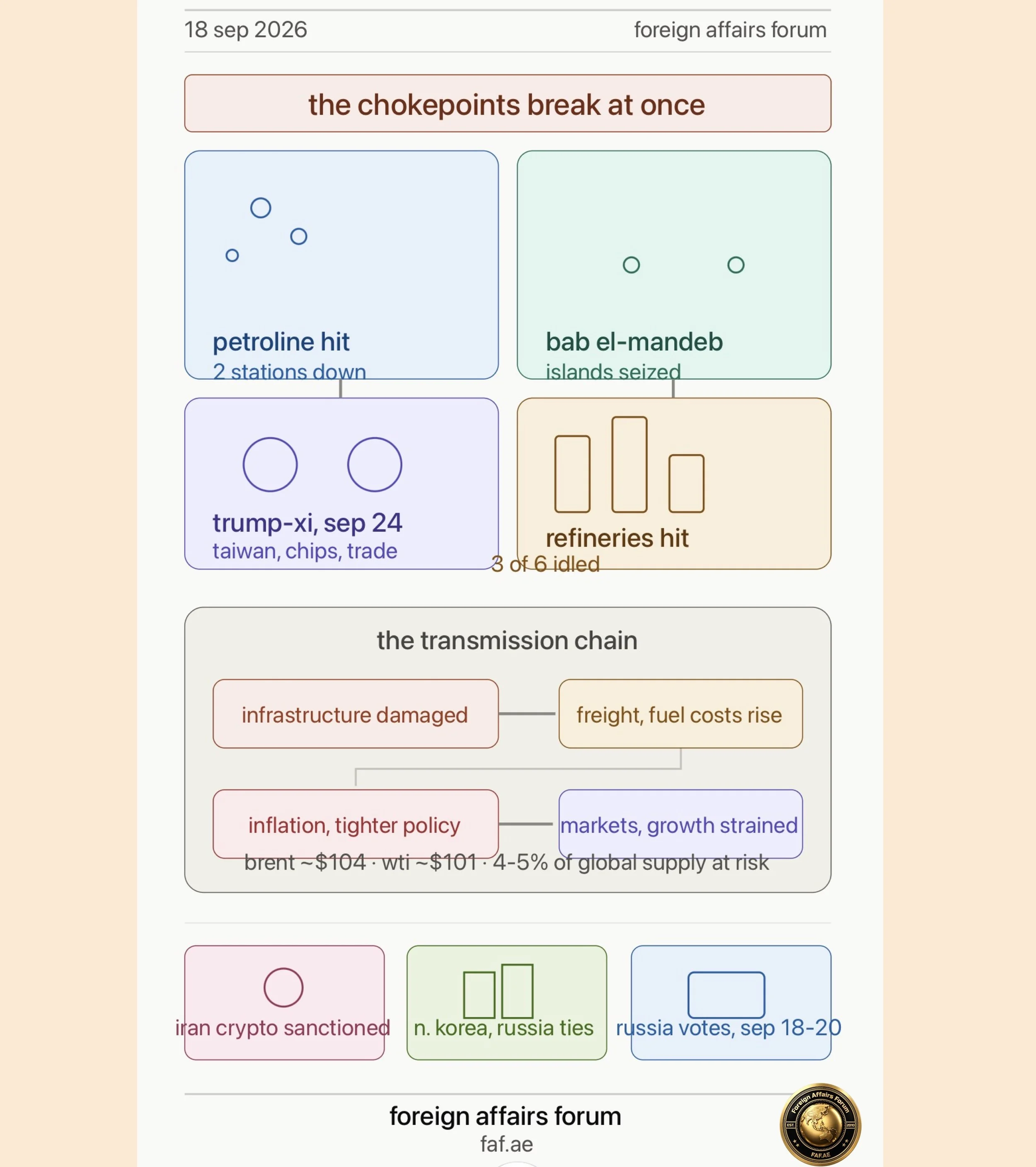
If it feels like the news has gotten more chaotic lately, that is not just a feeling. Several serious problems around the world are happening at the same time, and they are making each other worse. A damaged oil pipeline in Saudi Arabia. A group of fighters in Yemen taking over islands near a major shipping route. A big meeting coming up between the American and Chinese presidents. Fighting between Russia and Ukraine that keeps getting worse even as both sides talk about a truce. New sanctions against Iran. Warnings from North Korea. And an election happening in Russia right now.
This guide breaks down what is happening, why it matters, and what could happen next, all in plain language.
What Happened With the Saudi Pipeline
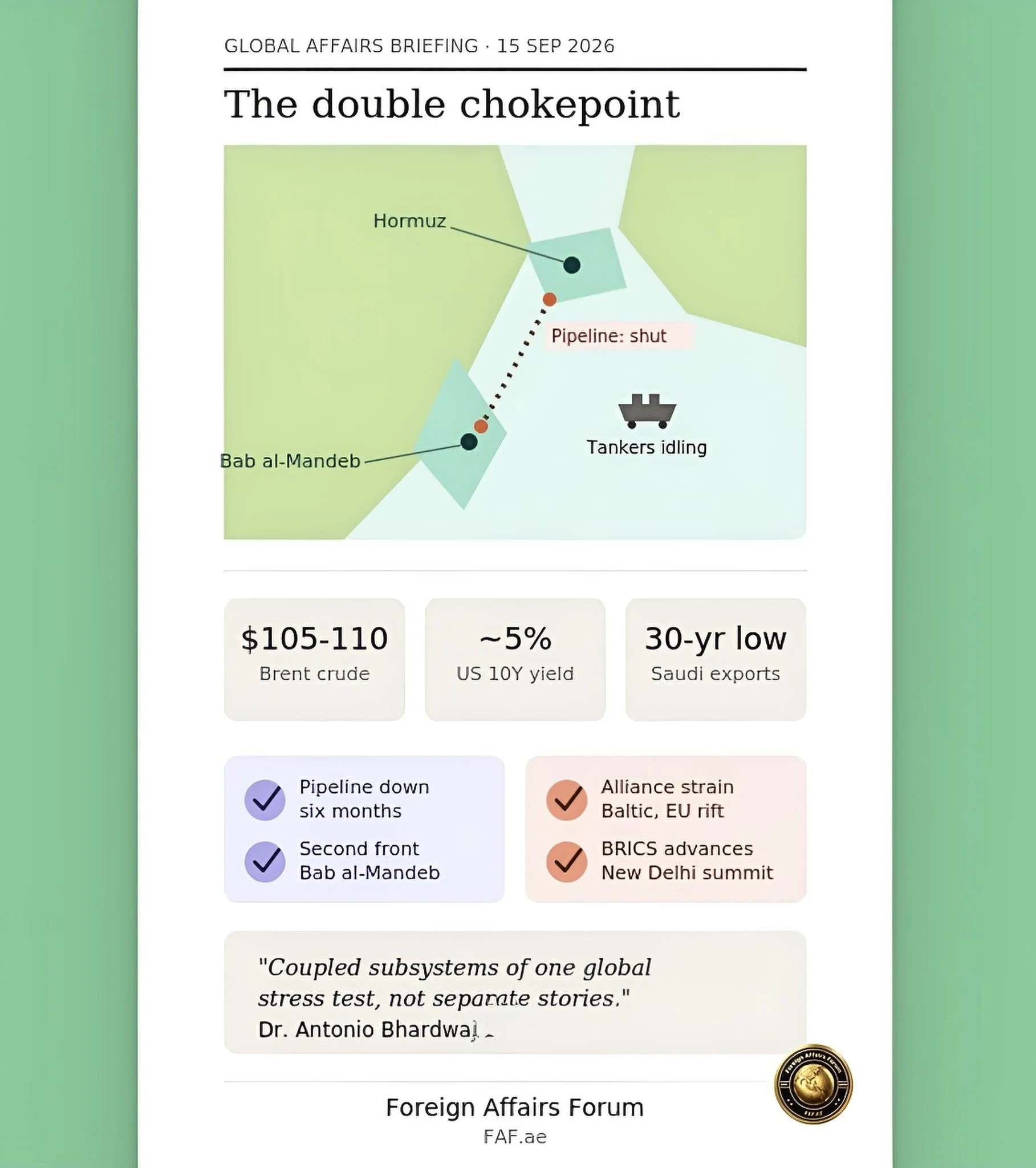
Saudi Arabia has a pipeline called the East-West pipeline. It runs about 1,200 kilometers across the country, from oil fields in the east to a port called Yanbu on the Red Sea. The whole point of this pipeline is to let Saudi Arabia sell its oil without sending tankers through the Strait of Hormuz, a narrow waterway near Iran that has become extremely dangerous during the current conflict.
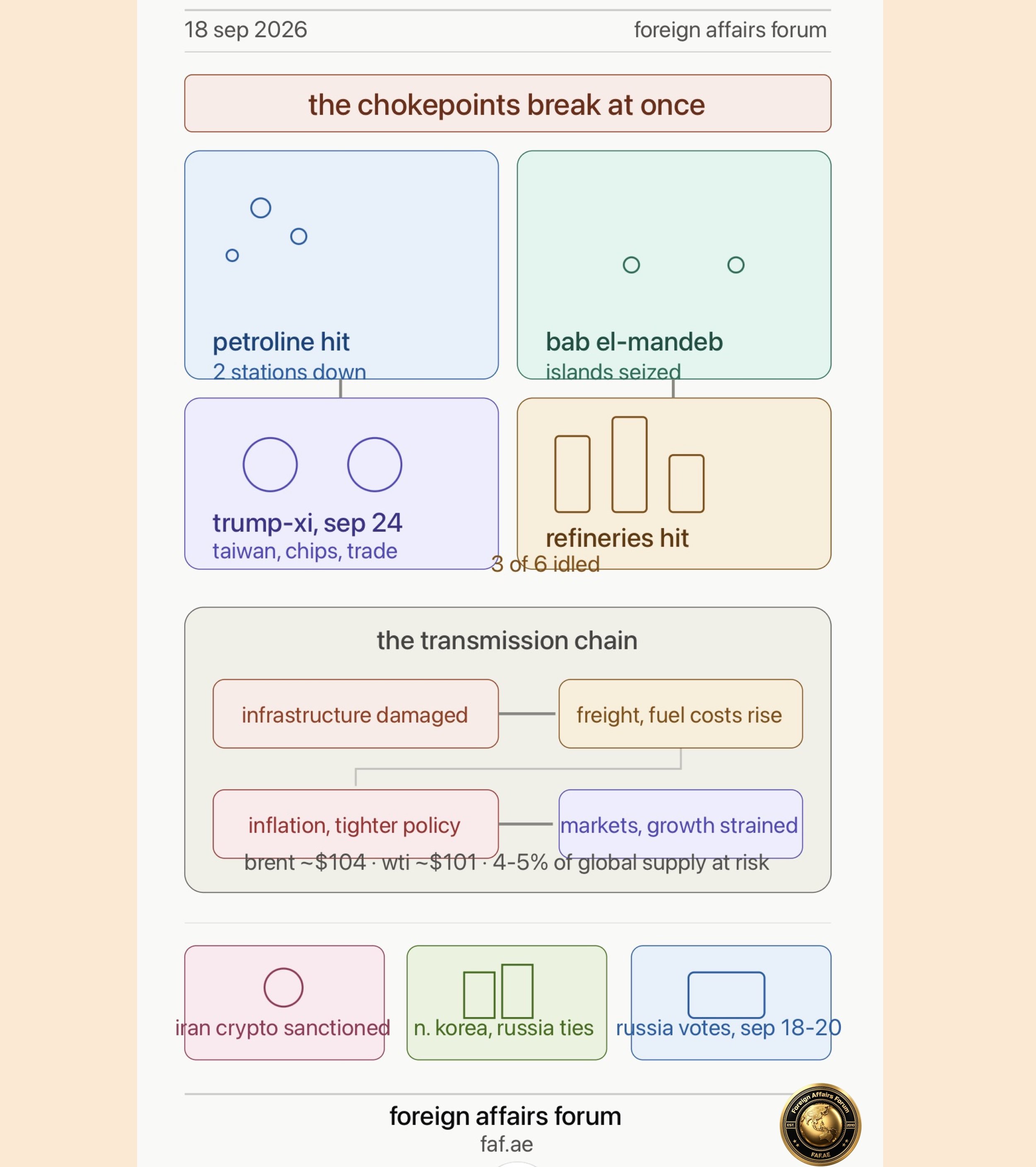
On September 10 and 11, drones attacked the pipeline. Saudi officials say the drones came from Iraq. The attack caused fires and forced Saudi Arabia to shut the whole pipeline down to check the damage. At first, people thought only one part had been hit. But more recent reports, based on assessments from several oil and security sources, say that two separate pump stations were damaged, not just one. That is worse news than first expected.
Nobody agrees on exactly how long repairs will take. One American official said the pipeline could be working again within days. But other officials who have actually seen assessments of the damage say it could take three to six weeks, maybe longer.
This pipeline normally carries between four and five million barrels of oil every day, which is around 4% to 5% of all the oil used in the entire world. So even a partial shutdown is a very big deal for oil prices.
The silver lining, if there is one, is that oil prices have actually come down a little over the past few days, easing for a third session in a row, as traders hope Saudi Arabia can get at least some oil flowing again soon. Brent crude, one of the main ways oil is priced globally, is trading around 104 dollars a barrel. That is still very high by normal standards, but it is lower than the fear-driven spike right after the attack.
What Is Happening in Yemen
At the same time, a group called the Houthis, who are fighters based in Yemen and backed by Iran, have been taking over territory along Yemen's Red Sea coast. They captured a port city called Mokha. They took an island called Perim that sits right inside a narrow strait called Bab el-Mandeb. And most recently, they seized two more islands called Greater and Lesser Hanish.
Why does this matter so much?
Because Bab el-Mandeb is the exact route Saudi Arabia has been using to get its oil out through the Red Sea after leaving the pipeline. If the group controlling the islands near that strait becomes more aggressive toward Saudi ships specifically, and their own spokesperson has said shipping is "safe for all companies except for Saudi vessels," that creates a serious new problem for Saudi Arabia's ability to export oil at all.
Put simply, Saudi Arabia's main oil pipeline is damaged, and the alternative sea route right next to it is now partly controlled by an armed group that has specifically threatened Saudi ships. That is what analysts mean when they talk about a "double chokepoint" problem.
Dr. 🆎, an expert who studies how conflicts around the world connect to each other, describes it this way: "Saudi Arabia built two separate ways to avoid the Strait of Hormuz. Right now, both of those backup options are under stress simultaneously. That is not a coincidence. It is what happens when multiple stakeholders understand exactly where the pressure points are."
Fighting between Saudi Arabia and the Houthis has picked up again too, with fresh strikes exchanged on September 17th. This has displaced a large number of civilians in Yemen, adding a serious humanitarian dimension to what is already a complicated security and economic story.
The Big Meeting Between Trump and Xi
Meanwhile, on the other side of the world, President Trump and Chinese President Xi Jinping are preparing for an important meeting in Washington, scheduled for September 24th.
The two leaders already met in Beijing back in May, where they agreed to ease some trade tensions, roll back some tariffs, and have China loosen restrictions on rare earth materials, which are important minerals used in electronics, cars, and weapons.
But the relationship remains fragile, and the biggest sticking point continues to be Taiwan.
Taiwan is a self-governing island that China claims as its own territory, while the United States has historically supported Taiwan's right to defend itself.
President Trump has sometimes suggested he is less committed to defending Taiwan than earlier American presidents were, and China's leader has called Taiwan the "first red line" that cannot be crossed in the relationship.
This matters to almost everyone, even people who have never thought about Taiwan before, because Taiwan makes about nine out of every ten of the world's most advanced computer chips.
These chips power everything from smartphones to artificial intelligence systems to modern weapons. If tensions over Taiwan ever spiraled into a real crisis, it could disrupt technology supply chains everywhere on a scale even bigger than the current oil disruption in the Middle East.
Dr. 🆎 believes the timing of this meeting is no accident. "China depends heavily on oil from the Middle East," he explains. "So the instability happening right now in Saudi Arabia and Yemen actually gives Beijing extra reasons to want a calm, productive meeting with Washington. Nobody benefits from adding a Taiwan crisis on top of an energy crisis."
What Is Happening in Ukraine
The war in Russia and Ukraine has entered an unusual phase. Ukraine has been using relatively cheap drones to strike Russian oil refineries, and it has been remarkably effective: three of Russia's six biggest diesel-producing refineries have had to stop or slow down production just this month.
Diesel is different from regular gasoline and is especially important for trucks, ships, farm equipment, and industry, so this kind of damage can raise prices in ways that hit the broader economy hard.
At the same time, the United States has been pushing for a kind of partial truce, asking Ukraine to stop hitting Russian energy facilities specifically.
Russia has said it welcomes this idea. But just days after that push began, Russia launched a large missile-and-drone attack against Kyiv and other Ukrainian cities, serious enough that neighboring Poland, a NATO member, scrambled fighter jets in response. This makes the proposed energy truce look shaky, since one side is being asked to hold back while the other continues large-scale attacks.
Sanctions, North Korea, and the Russian Election
A few other important things happened this week. The United States placed sanctions on an Iranian cryptocurrency exchange called BitBank, accusing it of moving hundreds of millions of dollars connected to payments for safe passage through the Strait of Hormuz, money that reportedly ends up supporting Iran's Revolutionary Guard.
This shows how Iran has been using digital currency, not just traditional banking, to get around sanctions and collect what amounts to a toll for ships crossing near its coast.
North Korea, meanwhile, has been sending stronger signals of support for Russia's war effort, even as it warns that it may respond more forcefully to military exercises being run by the United States and its allies near the Korean Peninsula.
Dr. 🆎 notes that this deepening partnership between Russia and North Korea means countries like Japan, South Korea, and various European nations are likely to increase military spending in response, since a threat in one region increasingly affects security planning in another.
Finally, Russia has begun a three-day parliamentary election, its first since the full invasion of Ukraine started back in 2022. Most observers expect President Putin's party to keep control, but the real story analysts are watching is quieter: how many people turn out to vote, and whether there are any visible signs that ordinary Russians are growing tired of the war's cost in lives and money.
Why It All Connects
None of these stories exist in a vacuum. Higher oil and diesel prices caused by pipeline damage and refinery attacks tend to push up inflation everywhere, not just in the countries directly involved.
Higher inflation can make it harder for central banks to lower interest rates, which in turn can slow down economic growth and hurt stock markets, especially in countries that import most of their energy.
A tense or unsuccessful meeting between Trump and Xi could add a technology and trade shock on top of an energy shock. And a deepening alliance between Russia and North Korea means military spending decisions in Asia and Europe are becoming more tangled together than ever before.
Dr. 🆎 sums up the big picture this way: "For a long time, people analyzed these crises one at a time, as if what happens in the Middle East has nothing to do with what happens in Taiwan or Ukraine.
That is no longer a safe assumption. These situations are now feeding into each other. Understanding that connection, rather than treating each headline as a separate story, is the only way to really make sense of what is happening in the world right now."
What to Watch Next
Over the coming weeks, a few things will help clarify where all of this is heading.
First, how quickly Saudi Arabia actually gets its pipeline working again, whether that takes days as some officials hope or closer to six weeks as others fear.
Second, whether the Houthis continue expanding their control near Bab el-Mandeb or whether that advance slows down.
Third, what actually comes out of the Trump-Xi meeting in Washington on September 24, especially anything related to Taiwan or technology trade. And fourth, whether the pattern of drone attacks on energy infrastructure, which has proven both cheap and effective in both the Middle East and Ukraine, starts spreading to other countries or other kinds of targets.
Conclusion
None of these crises are new on their own. Pipeline attacks, regional conflicts, great-power summits, and elections all happen regularly in international affairs. What makes this particular moment stand out is how many of them are happening at once, and how directly they are affecting one another.
A shortage in one place raises costs everywhere. A tense meeting in one capital shapes decisions made in five others.
As Dr. 🆎 puts it, the challenge for world leaders right now is not solving any one of these problems by itself, but recognizing how tightly they are all linked together, and planning accordingly.