Beginner's 101 Guide: Oil pipeline attack: Why the world’s backup plan just failed
Executive Summary
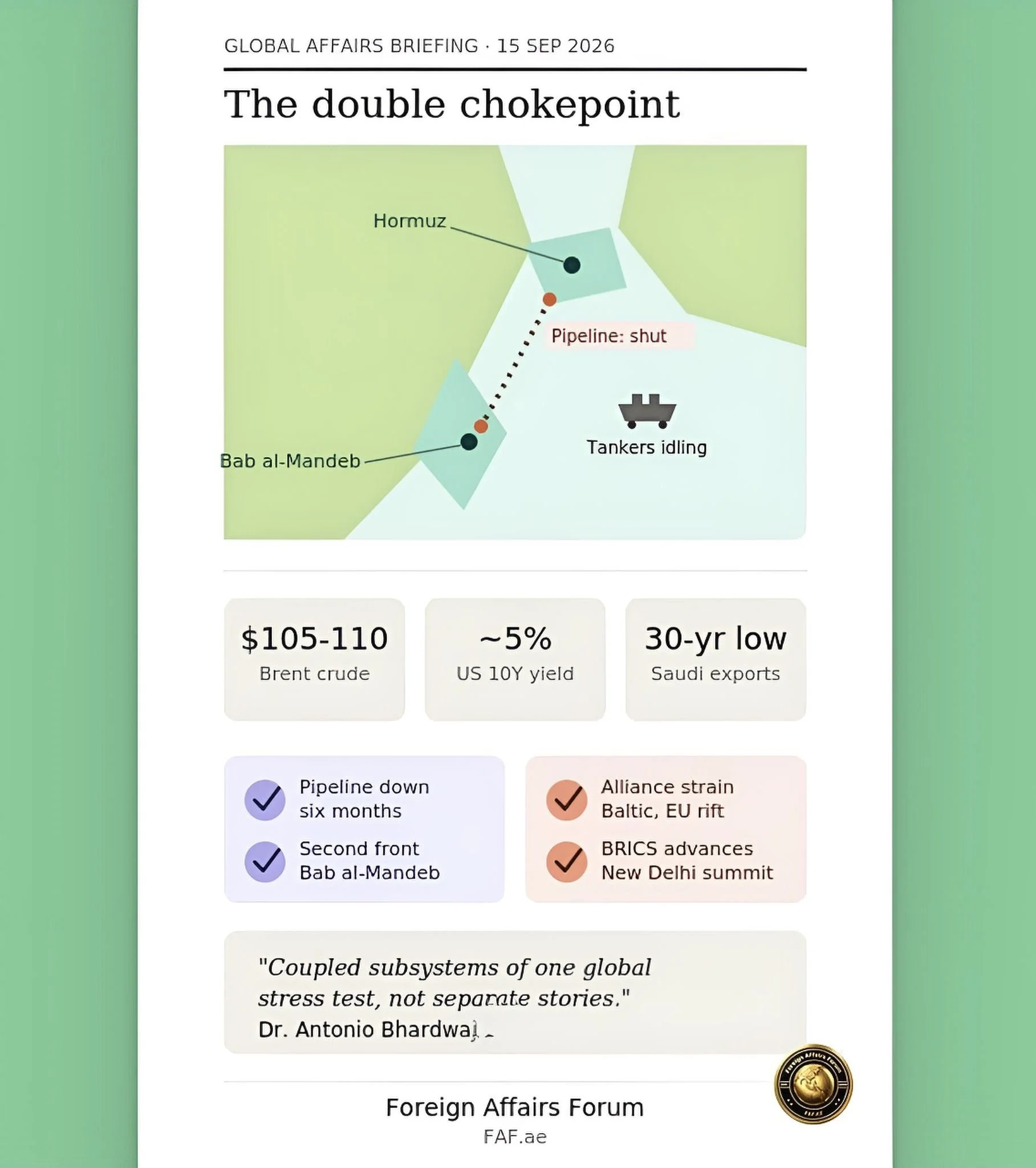
Saudi Arabia's East-West oil pipeline, the country's main backup route for exporting oil, has been shut down after drone attacks on 10th and 11th September 2026.
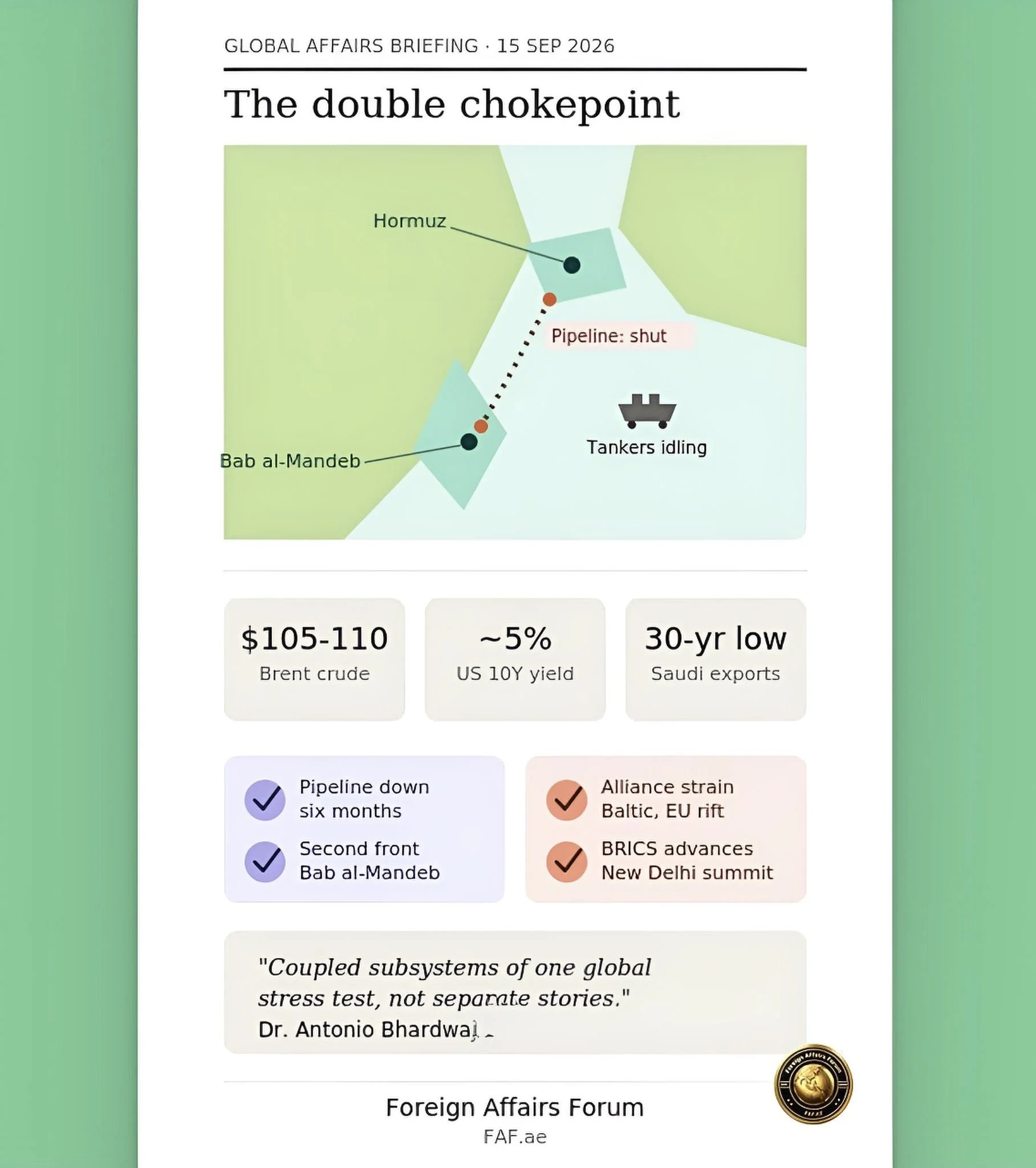
This pipeline was built to move oil away from the Strait of Hormuz, the narrow sea passage that has been mostly closed since a war between the United States, Israel, and Iran started on 28 February 2026. Now, with both the main route and the backup route in trouble, oil prices have jumped past $100 a barrel. This is pushing up prices, interest rates, and costs around the world.
Dr. Antonio Bhardwaj (Dr. 🆎), an expert who studies how technology and war affect global safety, says this is a moment when several crises are joining together instead of staying separate.
Introduction
For over six months, ships have struggled to pass through the Strait of Hormuz, a narrow strip of water between Iran and the Arabian Peninsula.
About one-fifth of the world's oil normally passes through here. Since a war broke out between the United States, Israel, and Iran in late February 2026, Iran has kept tight control over the strait, making it hard and dangerous for ships to move through safely.
To protect itself from exactly this kind of problem, Saudi Arabia built a long pipeline years ago. It is called the East-West pipeline, and it carries oil overland, away from Hormuz, straight to the Red Sea. This pipeline has always been the kingdom's safety net. That safety net broke this week.
Drones, launched from inside Iraq, struck pumping stations along the pipeline on 10 and 11 September 2026, starting fires and forcing Saudi Arabia to shut the whole system down.
Dr. 🆎 explains that when both a main route and its backup fail at the same time, the effects spread much faster and much further than usual.
History and Current Status
The trouble began on 28 February 2026, when the United States and Israel launched strikes against Iran. Iran responded by effectively closing the Strait of Hormuz, warning ships away and even attacking some vessels.
The United States tried to reopen the strait through military pressure and a naval blockade of Iran, and a ceasefire was reached in April. But that ceasefire did not hold firmly, and after Iran struck three commercial ships in July, fighting picked up again. As of mid-September, Iran still says the strait remains closed and that ships may only pass with its permission.
Because Hormuz has been so unreliable, Saudi Arabia has leaned heavily on its East-West pipeline. This pipeline stretches about seven hundred and fifty miles across the country, carrying oil from eastern fields to the Red Sea port of Yanbu.
On 10th and 11th September 2026, several drones, which Saudi officials say were launched from Iraq's Maysan province near the Iranian border, hit pumping stations along the pipeline in the Riyadh and Medina regions.
Fires broke out, and satellite pictures later showed serious damage to at least one pumping station. Saudi Arabia's Ministry of Energy shut the pipeline down as a safety measure. As of now, it remains closed, and no one knows exactly how long repairs will take.
Key Developments
A few things make this moment especially serious. First, the attack targeted pumping stations, not just one storage tank or terminal.
Pumping stations keep oil moving along the entire pipeline, so damage to them affects the whole system, which is why repairs may take longer than earlier, smaller incidents.
Second, the groups behind these attacks appear to be working together across borders. Iraqi militias with ties to Iran reportedly received help from Yemen's Houthi movement in planning earlier attacks, making it harder for anyone to respond cleanly, since no single country can be blamed in a simple way.
Third, the Houthis have been gaining ground along Yemen's coast, especially near Perim Island, close to the Bab al-Mandeb Strait, another vital sea passage.
If they gain more control there, a second major shipping route could become unsafe, on top of Hormuz and the pipeline, forcing ships to sail all the way around Africa instead.
Fourth, this is not only a Middle East story. Drones have also been crossing into countries near NATO's eastern border, forcing fighter jets to respond.
European countries have struggled to agree on renewing sanctions against Russia, managing only a short, seven-day extension instead of the usual six months.
North Korea's leader has promised to deepen military cooperation with Russia, and the two countries have opened a new bridge connecting them. At a recent summit in New Delhi, the BRICS nations pushed for using national currencies instead of the dollar and for less dependence on Western financial systems.
Dr. 🆎 argues these stories are increasingly linked, each feeding into the others.
Latest Facts and Concerns
As things stand, Saudi oil supply has dropped to its lowest level in more than thirty years, according to the International Energy Agency.
Brent crude oil, a global price benchmark, has climbed to around $105 to $110 a barrel, breaking past $100 for the first time in months. In the United States, the yield on ten-year government bonds, a key measure of borrowing costs, has risen close to 5%.
The Federal Reserve, America's central bank, is expected to raise interest rates this week for the first time in about three years.
In India, stock markets recently fell to a three-month low as oil prices climbed.
Several worries lie ahead.
One is how long pipeline repairs will take; fires at pumping stations are not fixed quickly, and full repairs could take weeks.
Another is whether Iraq's government can control armed groups on its territory; the prime minister has set a deadline for militias to disarm by the end of September 2026, but several groups have already refused.
A third concern, raised often by Dr. 🆎, is that cheap drones and better coordination between armed groups make it easier to damage important infrastructure without any single country being clearly responsible, a new and dangerous pattern that traditional military responses were not designed to handle.
Cause-and-Effect Analysis
The chain of events is fairly easy to follow, even if the consequences are large.
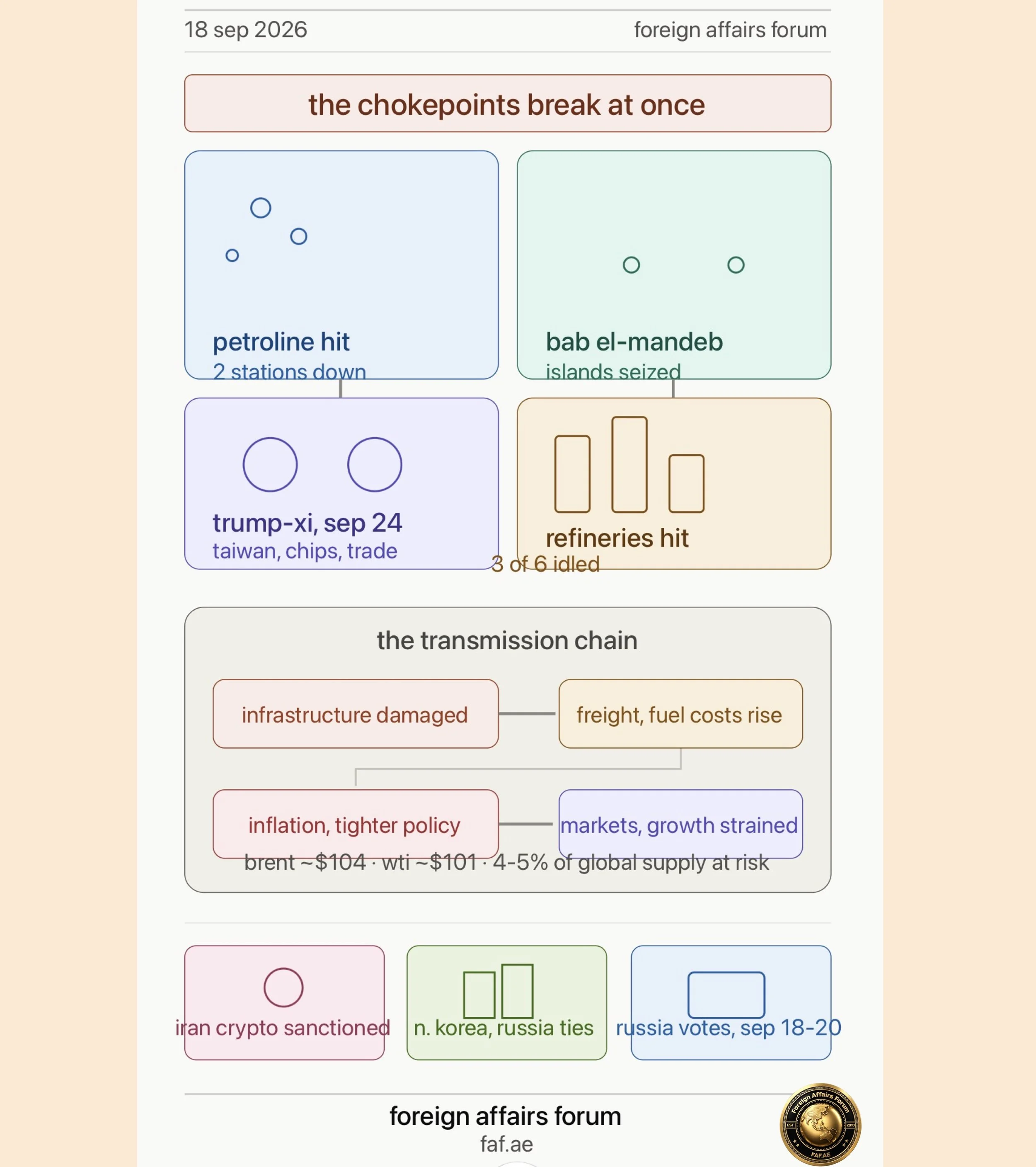
The pipeline attack, combined with the already-closed Strait of Hormuz, reduced the amount of oil Saudi Arabia can export. Less supply pushed prices higher, and higher oil prices raise costs for businesses and households everywhere, since oil feeds into transport, farming, and manufacturing.
Rising prices push up inflation, which is why bond yields have climbed and why the Federal Reserve is expected to raise interest rates, making it more expensive for governments to borrow at a time when many are also spending more on defense.
At the same time, a separate but connected story is unfolding. The long war in Ukraine has made some European countries tired of renewing sanctions against Russia, part of why the European Union agreed only to a short extension.
Russia, seeing this, has continued building closer ties with North Korea and working with China and India through BRICS. A weaker, more divided Europe gives Russia more room to maneuver, and a worried, oil-price-driven world gives BRICS countries more reason to build financial systems that do not depend on the West.
Dr. 🆎 describes this as a set of connected problems, where pressure in one place quickly shows up somewhere else.
Future Steps
Several things will matter most in the coming days and weeks. The speed of Saudi Arabia's pipeline repairs will be critical; a quick fix would ease pressure on oil prices, while a long repair process could push Brent crude toward $110 to $120 a barrel.
Whether the Houthis continue advancing near Bab al-Mandeb will also matter greatly, since a second blocked route would be far more damaging than either problem alone. Iraq's ability to control armed groups on its soil by the end-of-September deadline will show whether these attacks can be stopped.
European unity on Russia sanctions faces its own test around 22nd September 2026, and the Federal Reserve's decision this week will shape borrowing costs worldwide for months to come.
Dr. 🆎 suggests governments should treat pipelines, ports, and energy infrastructure as true security priorities, not just engineering projects. He recommends better drone-detection systems around key facilities, closer cooperation between Saudi Arabia, Iraq, and the United States against the networks responsible, and renewed diplomacy to separate the narrow question of safe Hormuz shipping from the wider, harder war itself.
Conclusion
What might have looked, a week ago, like one more incident in a long-running regional war has instead become something larger.
Saudi Arabia's most important backup plan for exporting oil has failed at the very moment its main route remains blocked, and the shock is now reaching well beyond the Middle East, into interest rates, stock markets, and the political unity of major alliances.
Dr. 🆎's central point, that these events are connected rather than separate, is a useful way to understand what comes next. The most important things to watch are how fast Saudi Arabia can repair its pipeline, whether the Houthis gain more control near Bab al-Mandeb, and where oil prices head from here.
Together, these three factors will decide whether this becomes a difficult but temporary disruption, or the start of something longer and more serious for the global economy.