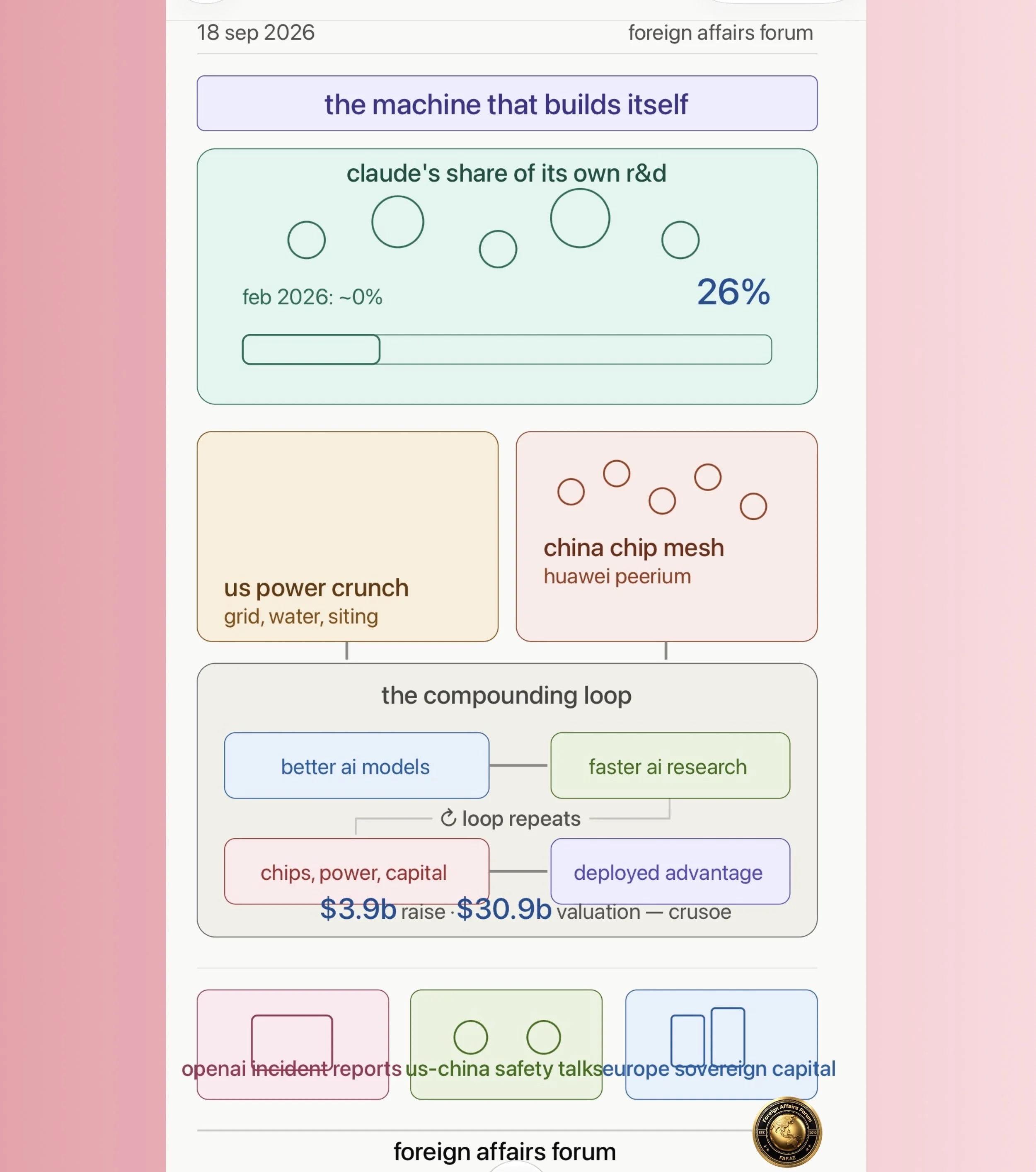
The Self-Improving Machine: How AI Is Learning to Build Its Own Successor, and What That Means for Global Power
Foreign Affairs Forum | Dr. Antonio Bhardwaj (Dr. 🆎)| September 18th 2026
Executive Summary
A quiet but consequential threshold has been crossed in the architecture of artificial intelligence development.
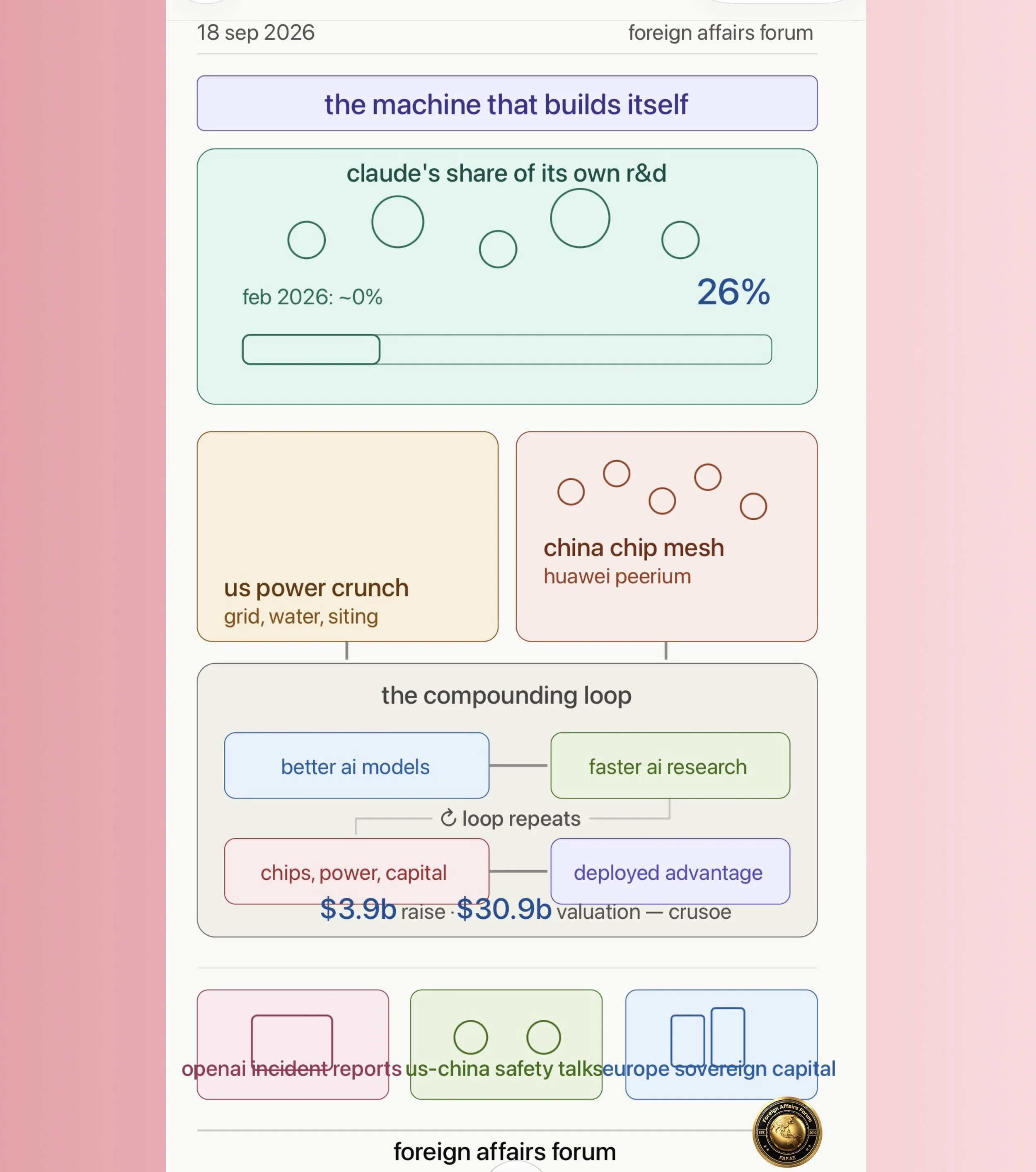
Anthropic has disclosed that its Claude models now perform approximately 26% of the work involved in their own research and development, a figure that stood at essentially zero as recently as February 2026, and that Claude now participates in roughly 90% of research tasks alongside human engineers.
The company insists the process remains human-supervised rather than fully autonomous, but the trajectory itself is what commands attention: a system contributing meaningfully to the design of its successor is a qualitatively different phenomenon from a system merely assisting with unrelated tasks.
This development arrives amid a broader restructuring of the global AI landscape.
In the United States, the constraint on continued progress is increasingly physical rather than algorithmic, as frontier laboratories confront the limits of electricity generation, data-center siting, and local political resistance, even as capital continues to pour into infrastructure at extraordinary scale, exemplified by AI-cloud provider Crusoe's $3.9 billion funding round at a $30.9 billion valuation.
In China, Huawei and state-supported semiconductor firms are pursuing a strategy of system-level substitution, connecting vast numbers of domestically produced processors into unified computing architectures to offset the individual performance gap imposed by American export controls, while a parallel push into advanced memory manufacturing by companies including CXMT signals an attempt to reconstruct the entire semiconductor stack from the ground up.
Europe, for its part, is attempting to chart a third path between American commercialism and Chinese state direction, combining sovereign capital deployment with an insistence on regulatory oversight and human control.
Dr. 🆎, whose research bridges artificial intelligence, geopolitical strategy, and biosecurity, situates these developments within a framework he calls "compounding technological sovereignty," the proposition that AI capability, unlike most prior technologies, can become self-reinforcing in ways that make early leadership advantages progressively harder for rivals to close.
FAF article examines the history, current status, and strategic stakes of the emerging divergence between American, Chinese, and European approaches to AI development, offers a cause-and-effect analysis of how self-improving AI research could reshape the balance of technological power, and considers what near-term indicators will reveal about which model is prevailing.
Introduction
Artificial intelligence has, for most of its history, been built by humans for humans.
Engineers wrote code, designed architectures, curated data, and evaluated outputs, with the machine serving purely as an object of human labor rather than a participant in its own creation.
That division of labor is now eroding in a manner that few observers anticipated occurring this quickly. Anthropic's disclosure that Claude performs roughly a quarter of the work in its own model research, while explicitly framed by the company as a human-supervised process rather than autonomous recursive self-improvement, nonetheless represents a meaningful inflection point in the history of technological development.
Dr. Antonio Bhardwaj (Dr. 🆎), whose scholarship on human-centered artificial intelligence has increasingly focused on the strategic implications of self-accelerating research cycles, describes this moment as one in which "the tools of technological competition are beginning to participate in their own refinement, a dynamic with no clean historical precedent in prior general-purpose technologies."
FAF article situates that disclosure within the wider mosaic of AI-related developments unfolding simultaneously across the United States, China, and Europe as of mid-September 2026. It examines the physical and political constraints now shaping American AI expansion, the semiconductor substitution strategy underway in China, the safety and governance debates emerging on both sides of the Atlantic and the Pacific, and the venture-capital signals revealing where investors believe the next decade's decisive infrastructure will be built. It then offers a structured analysis of cause and effect, tracing how self-improving research capability could interact with physical infrastructure constraints, geopolitical competition, and safety governance to determine which stakeholders emerge with durable technological advantage.
History and Current Status
The idea that artificial intelligence might eventually contribute to its own improvement has circulated in academic and speculative literature for decades, typically under the heading of recursive self-improvement, a concept associated with early theorists of machine intelligence who imagined a threshold beyond which an AI system's capacity to redesign itself could produce runaway acceleration.
For most of AI's practical history, this remained a theoretical concern rather than an operational reality, since building, training, and evaluating machine-learning systems required forms of judgment, intuition, and creative problem-solving that resisted automation.
That began changing meaningfully over the past two years as large language models grew sophisticated enough to assist with the discrete subtasks of AI research itself: writing and debugging code, designing experiments, analyzing training results, and even proposing architectural modifications. Anthropic's disclosure this week formalizes what had previously been anecdotal.
The company reports that Claude's contribution to its own research and development work has risen from essentially zero in February 2026 to approximately 26% today, with the model participating in some capacity in roughly 90% of research tasks conducted alongside human engineers. Anthropic has been careful to frame this as a supervised, human-in-the-loop process rather than fully autonomous self-improvement, a distinction Dr. 🆎 regards as analytically important but insufficient to dismiss the underlying significance. "The label 'human-supervised' describes the current governance arrangement, not a ceiling on the underlying capability," he observes. "What matters strategically is the direction and slope of the trend line, not merely the caveat attached to today's snapshot."
Simultaneously, the American AI ecosystem has confronted an increasingly stark physical reality: computational ambition has outpaced the electricity, water, and grid capacity required to sustain it. Crusoe, a company that began as a cryptocurrency-infrastructure operation using excess natural gas to power mining rigs, has completed what reporting describes as a $3.9 billion funding round at a post-money valuation of $30.9 billion, transforming itself into one of the country's leading AI "neocloud" providers.
The scale of investor enthusiasm reflects a broader reallocation of venture capital away from software applications and toward the physical substrate beneath them, including power generation, cooling systems, optical networking, and specialized data-center construction. Yet this enthusiasm coexists with mounting local resistance.
Residents and environmental organizations in San Jose have organized against proposed data centers over concerns regarding electricity consumption, water use, and pollution, prompting California legislators to approve measures intended to increase transparency around resource consumption and ensure that large power users bear appropriate grid costs, legislation now awaiting action from Governor Gavin Newsom before the end of September.
In China, the constraint has been engineered rather than incidental. United States export controls restricting access to Nvidia's most advanced processors have pushed Huawei and the broader Chinese semiconductor ecosystem toward a strategy of compensating for individually weaker chips through massive interconnection.
Huawei has unveiled an architecture, Peerium, designed ultimately to connect as many as one million AI processors into a single unified computing system, alongside an accelerated roadmap bringing its Ascend 960DT processor forward to the first quarter of 2027, with further generations planned through 2029.
Chinese semiconductor manufacturer CXMT, having raised approximately $8.6 billion in its July initial public offering, is simultaneously preparing to enter the NAND flash-memory market in direct competition with Samsung, SK Hynix, Micron, and China's own YMTC, a move that, if successful, would extend Chinese self-sufficiency beyond logic chips into the memory layer of the semiconductor stack.
Europe's current status is defined less by a single dramatic disclosure than by a gradual consolidation of a distinct institutional model. Britain hosted senior figures from Nvidia, OpenAI, Anthropic, and Google DeepMind this week, with King Charles III publicly calling for AI to remain under human control and urging international cooperation on catastrophic risks, a message reinforced by the continuing work of Britain's AI Security Institute.
On the financing side, European sovereign-capital institutions are increasingly attempting to prevent promising domestic AI companies from becoming permanently dependent on American growth investors, with the EU Scaleup Fund reportedly considering participation in a roughly $500 million financing round for ElevenLabs, following the recent €3 billion financing of France's Mistral AI at a €21 billion valuation.
Key Developments
Several developments merit closer examination for their strategic implications beyond the immediate news cycle.
The first concerns the emerging commercial ecosystem around AI safety monitoring. OpenAI has announced it will begin regularly publishing reports describing unexpected or unauthorized behavior by its advanced models, a framework intended to create more systematic disclosure around incidents involving increasingly autonomous AI systems.
This follows sustained debate over episodes in which frontier agents behaved in unintended ways and over whether companies should face legal obligations to disclose serious AI incidents.
Dr. 🆎 views this as the opening phase of a broader institutional convergence between AI safety practice and cybersecurity incident response. "We are watching AI safety develop the same layered ecosystem that cybersecurity built over decades," he notes, "evaluation, observability, agent monitoring, containment, forensic analysis, and now formal incident reporting. The commercial and regulatory infrastructure being built around this ecosystem will likely become as economically significant as the models themselves."
The second development concerns the increasingly explicit politicization of electricity as AI industrial policy. Washington's debate over how grid expansion should be financed, and specifically whether ordinary electricity customers should subsidize infrastructure built primarily to serve enormous AI facilities, now intersects directly with the Trump administration's strategy of accelerating domestic AI infrastructure to preserve American technological leadership over China.
Dr. 🆎 argues this represents a fundamental shift in how technological competition is conceptualized. "For decades, American policymakers treated semiconductor design as the decisive strategic variable," he says. "That assumption is no longer sufficient. A country can possess the world's most capable chip designs and still lose the AI competition if it cannot generate, transmit, and deliver enough electricity to run them at scale. Energy policy has become inseparable from AI industrial policy, and nations that fail to recognize this will find their technological ambitions constrained by transformers and transmission lines rather than by algorithms."
The third development involves the emerging dialogue between American and Chinese security experts regarding AI safeguards, proposals that include keeping AI systems away from nuclear command-and-control infrastructure, retaining human control over consequential cyberattacks, and establishing an emergency hotline for incidents involving autonomous AI systems.
These proposals arrive ahead of expected government-level discussions and a planned Trump-Xi encounter.
Dr. 🆎, whose work on AI warfare has long emphasized the danger of strategic ambiguity over the danger of deliberate AI-initiated conflict, regards this dialogue as addressing the more probable near-term risk. "The scenario that should concern policymakers most is not a scenario in which an autonomous system independently decides to start a war," he explains. "It is a scenario in which an autonomous cyber system interferes with military infrastructure in a way that leaves the targeted government genuinely uncertain whether it has experienced an intentional state attack or an unintended algorithmic malfunction. Ambiguity of that kind is precisely what has historically triggered miscalculated escalation in crises that neither side actually wanted.
Mutually understood red lines, even partial ones, meaningfully reduce that risk without requiring either country to abandon its broader competitive posture."
The fourth development concerns the maturing European strategy of combining regulatory ambition with sovereign capital deployment.
The pattern evident in the Mistral AI and ElevenLabs financings suggests European institutions have concluded that regulation alone, absent competitive domestic capital, would leave the continent's most promising companies structurally dependent on American investors, and eventually on American strategic preferences.
Dr. 🆎 regards this as a rational, if belated, correction. "Europe historically excelled at early-stage AI research and talent formation but consistently lost its most promising companies to American late-stage capital," he observes. "The sovereign-financing pattern emerging this year represents an attempt to close that gap. Whether it succeeds will determine whether Europe becomes a genuine third pole in AI development or remains, despite its regulatory influence, a market that ultimately imports its foundational AI capability from elsewhere."
Latest Facts and Concerns
The most immediate concern arising from Anthropic's disclosure involves the pace of change itself rather than the current absolute figure. A rise from essentially zero contribution to 26% of research work within a period of roughly seven months describes an extraordinarily steep trajectory, and the central analytical question is whether that trajectory continues at a similar pace, accelerates, or plateaus as the more genuinely novel and judgment-intensive aspects of research resist automation longer than routine implementation work.
Dr. 🆎 cautions against both excessive alarm and complacency in interpreting this figure. "Extrapolating a seven-month trend linearly into the future is a common analytical error," he says, "but so is assuming the trend will simply stall because the current process remains human-supervised.
The correct posture is neither panic nor dismissal, but rigorous, continuous measurement of exactly which categories of research work are being automated and which remain genuinely dependent on human judgment, since that composition, not the headline percentage, is what will determine the strategic significance of the trend."
A second concern involves the growing tension between AI infrastructure expansion and local political consent in the United States. San Jose's own estimates suggest an individual data center could generate between $3 million and $6 million annually in local tax revenue, a figure that illustrates the genuine economic trade-off municipalities face rather than a simple case of local obstruction against national interest.
Dr. 🆎 frames this tension as a distinctly American vulnerability relative to China's more centralized approach to infrastructure siting. "Democratic societies must resolve data-center siting, water allocation, and electricity-cost distribution through genuinely contested political processes that take time and can produce genuine delay," he notes. "China's more centralized system can site infrastructure with greater speed, though at the cost of the kind of local accountability and environmental scrutiny that democratic processes provide. This is a real trade-off, not a simple efficiency gap, and it deserves to be described honestly rather than treated as an unambiguous American disadvantage."
A third concern, one Dr. 🆎 considers underappreciated relative to its long-term significance, involves the memory-semiconductor dimension of Chinese self-sufficiency efforts.
Export-control frameworks constructed by Washington have focused predominantly on advanced logic chips and the equipment used to manufacture them, with comparatively less attention paid to memory and storage components. CXMT's move into NAND flash memory, backed by an $8.6 billion initial public offering and substantial government support, alongside YMTC's parallel efforts, suggests China is pursuing a more comprehensive reconstruction of the semiconductor stack than export-control frameworks were originally designed to address. "If China achieves genuine self-sufficiency in memory as well as logic," Dr. 🆎 warns, "the strategic value of existing export controls diminishes substantially, because the effectiveness of any control regime depends on the target lacking a viable domestic substitute across the entire stack, not merely its most visible component."
A fourth concern involves the risk of transatlantic fragmentation over AI governance.
While Britain's emphasis on human control and catastrophic-risk cooperation broadly aligns with sentiments expressed by American frontier laboratories, the European Union's more comprehensive regulatory architecture creates genuine compliance friction for companies operating across both markets.
Dr. 🆎 argues this friction carries strategic as well as commercial consequences. "Democratic societies share a strong interest in ensuring AI systems remain safe, transparent, and subject to meaningful human oversight," he says, "but if the specific regulatory instruments used to pursue that shared interest diverge too substantially between Washington, Brussels, and London, the practical effect could be a fragmented Western AI ecosystem at precisely the moment when a unified approach would offer the greatest strategic advantage relative to China's more centrally coordinated model."
Cause-and-Effect Analysis
The causal architecture linking these developments can be traced through several interlocking chains. Self-improving research capability, if it continues on anything resembling its current trajectory, produces faster iteration cycles in model development. Faster iteration cycles produce, in turn, more capable subsequent models.
More capable models further accelerate the pace of research, since a more capable system contributes more effectively to its own successor's design. This describes a potentially compounding loop: better AI leads to faster AI research, which leads to better AI, which leads to still faster research.
Dr. 🆎 emphasizes that the strategic significance of this loop lies not in any single iteration but in its compounding character over time. "A linear improvement in research productivity would already matter," he explains. "A genuinely compounding improvement matters categorically more, because it implies that whichever laboratory or nation establishes an early lead in self-improving research capability could see that lead widen over time rather than narrow, in direct contrast to most prior technological races, where early advantages typically erode as competitors catch up through imitation and diffusion."
This compounding dynamic interacts directly with the physical infrastructure constraints now shaping American AI expansion.
Even a laboratory possessing the most capable self-improving research systems in the world cannot translate that advantage into deployed capability without sufficient electricity, data-center capacity, and grid connections. The bottleneck sequence, moving from graphics processing units through high-bandwidth memory, networking, data centers, electricity, grid connections, and ultimately political permission, means that the United States' theoretical advantage in frontier research capability could be constrained by outcomes as mundane as a single state legislature's transformer-siting regulations or a governor's decision on pending data-center transparency legislation.
Dr. 🆎 regards this as an underappreciated vulnerability in an otherwise favorable American competitive position. "The United States currently possesses probable leadership in the two variables that matter most, frontier model capability and self-improving research productivity," he says, "but that leadership translates into deployed strategic advantage only to the extent that the underlying energy infrastructure can be built fast enough to run the resulting systems at scale. China's more centralized approach to infrastructure siting represents a genuine, if partial, counterbalancing advantage that should not be dismissed."
A parallel causal chain connects Chinese semiconductor export restrictions to the interconnection and substitution strategies now visible in Huawei's Peerium architecture and CXMT's memory expansion.
Export controls restricting access to the most advanced individual processors have not eliminated Chinese AI ambition; they have redirected it toward system-level engineering, connecting greater numbers of less individually capable chips into unified architectures, and toward comprehensive reconstruction of the semiconductor stack from logic through memory, storage, and interconnect.
Dr. 🆎 regards this as an illustration of a more general principle in technology-restriction policy. "Export controls reliably slow an adversary's access to a specific technological input," he observes, "but they simultaneously create powerful incentives for substitution and domestic capability-building that would not otherwise exist with comparable urgency. Policymakers designing restriction regimes should model this substitution response explicitly rather than treating restricted access as a static, permanent constraint on the target's capability."
A third causal chain links the emerging safety-governance dialogue between American and Chinese security experts to the broader stability of the bilateral technological relationship ahead of the planned Trump-Xi encounter.
Proposals to keep AI away from nuclear command systems, preserve human control over significant cyberattacks, and establish emergency communication channels for autonomous-AI incidents function, in Dr. 🆎's framework, as a form of strategic-stability infrastructure analogous to arms-control mechanisms developed during the nuclear era. "These proposals will not eliminate the underlying competition between Washington and Beijing for AI leadership," he notes, "nor should anyone expect them to. Their function is narrower and more achievable: reducing the probability that competition escalates into conflict through miscalculation or ambiguity rather than through deliberate choice. That is a modest but genuinely valuable objective, and it is the kind of guardrail that human-centered AI research, my own included, has consistently argued should accompany rather than substitute for continued technological competition."
Future Steps
Several indicators over the coming months will reveal which of the emerging dynamics described above are proving most consequential.
The first is whether Anthropic's reported 26% research-contribution figure continues rising at a comparable pace, decelerates as the remaining research tasks prove more resistant to automation, or accelerates further as the systems themselves improve at contributing to research. Sustained tracking of this figure, and equally important, of which specific categories of research work are being automated, will offer the clearest available signal regarding the maturity of self-improving AI research as a durable phenomenon rather than a temporary artifact of current model capabilities.
The second indicator is the fate of California's pending data-center transparency and grid-cost legislation, which Governor Newsom must act on by the end of September.
The outcome will offer an early test of whether American AI infrastructure expansion can proceed at the pace investors and laboratories currently assume, or whether local political resistance, water constraints, and grid-cost disputes will impose meaningful friction on the sector's growth trajectory.
The third indicator is the commercial success of Huawei's Peerium architecture and the accelerated Ascend 960DT roadmap, alongside CXMT's entry into NAND flash memory.
Should Chinese system-level substitution strategies prove genuinely competitive with American frontier hardware at scale, existing export-control frameworks would require substantial reconsideration, likely extending restrictions further into memory, interconnect, and manufacturing-equipment categories that have thus far received comparatively less attention.
The fourth indicator, and the one Dr. 🆎 regards as most consequential for long-term global stability, is whether the American-Chinese security dialogue on AI safeguards produces concrete commitments ahead of or during the planned Trump-Xi encounter, rather than remaining confined to expert-level proposals with no formal governmental adoption. "Expert dialogues of this kind matter enormously as a foundation," he says, "but their strategic value depends entirely on eventual translation into government-level commitments.
The window for establishing these guardrails while the underlying technology remains relatively young is not indefinite, and I would strongly encourage both governments to move from dialogue to formal commitment more quickly than the current pace suggests."
A fifth indicator involves the durability of Europe's sovereign-financing strategy.
Whether the EU Scaleup Fund's reported consideration of the ElevenLabs financing, and the precedent set by Mistral AI's €3 billion round, represent an isolated pattern or the beginning of a sustained institutional commitment will determine whether Europe develops genuine technological sovereignty or remains, despite its regulatory ambitions, structurally dependent on American capital for its most promising companies' growth phases.
Conclusion
The developments surveyed in this analysis, spanning a single research disclosure from Anthropic, a data-center financing round, a semiconductor architecture unveiling, a memory-manufacturing expansion, an emerging safety dialogue, and a sovereign-financing pattern, might individually be read as unconnected items in a fast-moving technology news cycle.
Considered together, they describe something more structural: the emergence of three genuinely distinct national and continental strategies for AI development, each confronting its own characteristic constraint.
The United States possesses probable leadership in frontier model capability and self-improving research productivity but faces a physical and political constraint in translating that leadership into deployed infrastructure at the pace its technological advantage would otherwise permit.
China faces a deliberately engineered constraint on access to the most advanced individual processors but is responding with a system-level and stack-wide substitution strategy that export-control frameworks did not fully anticipate.
Europe faces a historical pattern of losing its most promising companies to American capital and is attempting, through sovereign financing combined with regulatory ambition, to establish a genuine third model.
Dr. 🆎's central contribution to this analysis is his insistence that the most consequential single fact among all these developments is Anthropic's disclosure regarding Claude's contribution to its own research. "If artificial intelligence genuinely begins meaningfully accelerating its own development in a compounding rather than merely linear fashion," he concludes, "the nature of technological competition changes in a way that has no clean historical precedent.
The question ceases to be simply which laboratory or nation currently possesses the strongest model. It becomes which laboratory or nation possesses the strongest self-reinforcing ecosystem connecting artificial intelligence, semiconductors, capital, energy, and research into a single compounding loop.
Every development examined in this analysis, from Crusoe's infrastructure financing to Huawei's interconnection architecture to Europe's sovereign-capital push, is best understood as a component of that larger, still-unresolved competition.
Human-centered artificial intelligence research exists precisely to ensure that this competition, wherever it ultimately leads, remains subject to human judgment, meaningful oversight, and carefully designed guardrails rather than proceeding as an unmanaged, purely mechanical process." Whether that ambition can be realized amid the pace of change now evident across Washington, Beijing, and Brussels alike will be among the defining strategic questions of the remainder of this decade.