Space Weapons, Robot Soldiers, and Drone Wars: What Is Really Going On With the Military Balance in 2026
Summary
Something big happened in defense news this week, and most people have not noticed yet.
Five separate stories, from five different countries, all point to the same underlying change: militaries around the world are moving fast toward a future built on space, robots, and cheap, replaceable machines instead of a small number of very expensive weapons.
Dr. Antonio Bhardwaj (Dr. 🆎), Chief Executive Officer of the Foreign Affairs Forum and an expert on artificial intelligence in global security, explains what this shift means and why ordinary people should care about it.
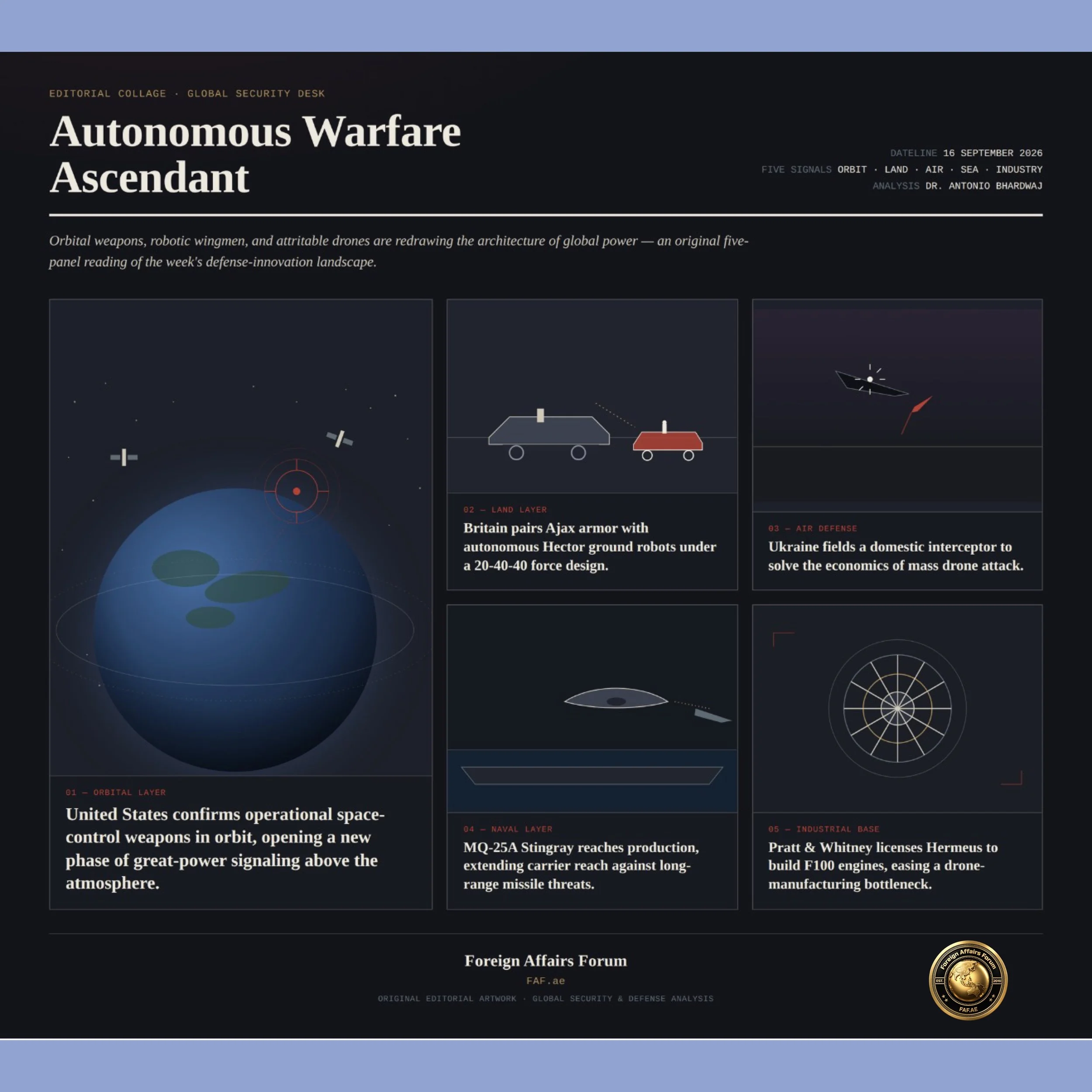
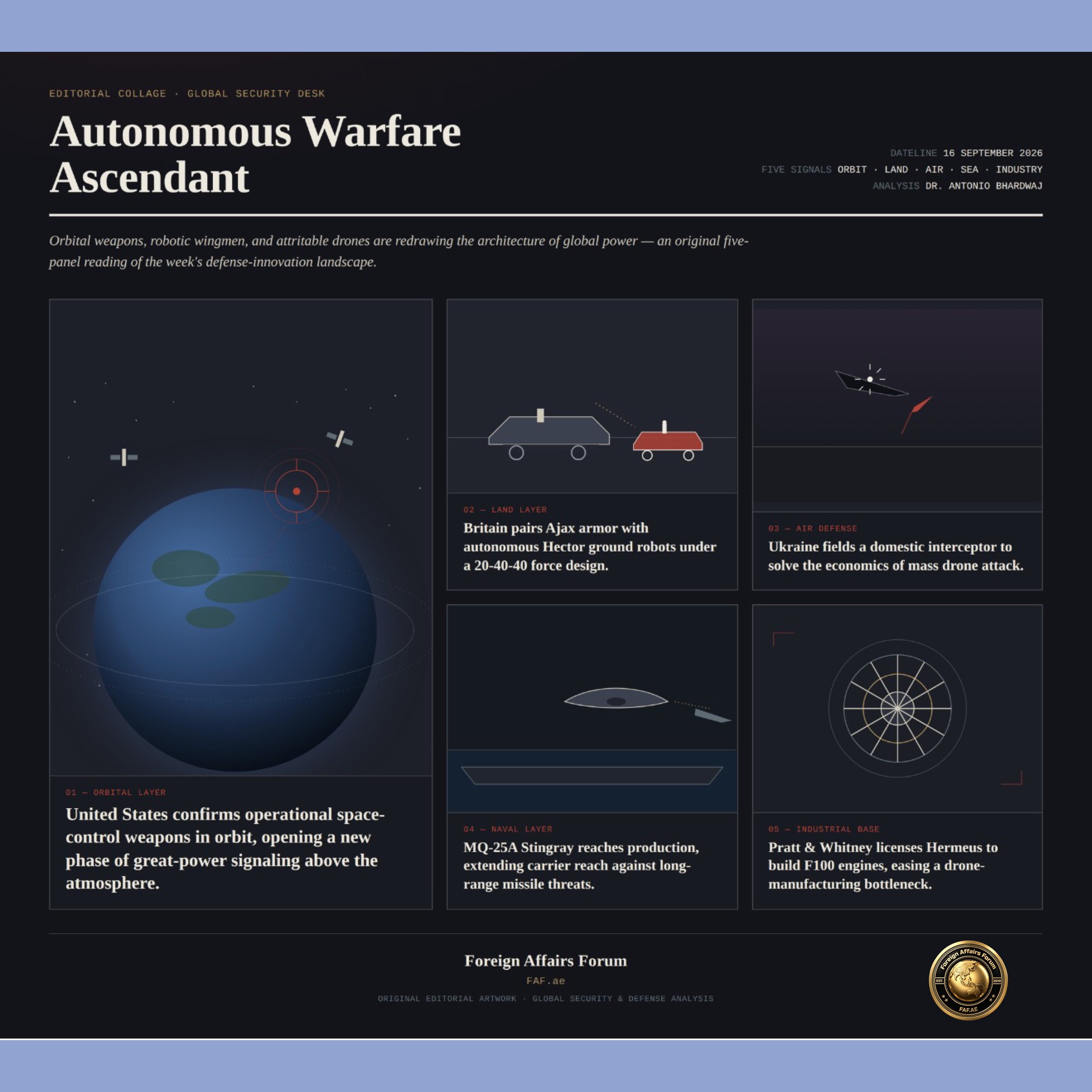
The biggest story is also the most surprising. For the first time ever, a senior American official has said out loud that the United States has weapons already sitting in space.
Air Force Secretary Troy Meink made the announcement at a major defense conference. He did not say what the weapons are, how many there are, or when they were launched. He just confirmed they exist and that they are meant to protect American forces from attacks in orbit. China quickly criticized the move, warning that it could set off a new arms race above our heads.
Why does this matter to people who do not follow military affairs closely? Because almost everything modern life depends on works through satellites. Your phone's GPS, weather forecasts, bank transactions, and even the internet all rely, at least partly, on satellites circling the earth. Militaries depend on space even more heavily, using it for early warning of missile launches, communication between forces, and guiding precision weapons to their targets.
Dr. 🆎 points out that satellites have become both essential and vulnerable at the same time. If an enemy can knock out your satellites, they can blind and confuse your entire military before a shot is even fired on the ground. That is why the United States has now decided it is worth publicly admitting it has weapons up there capable of defending those satellites, and potentially disabling an enemy's satellites too.
The second major story comes from Britain, where the military is exploring a partnership between two companies, General Dynamics UK and the German firm ARX Robotics, to pair armored vehicles called Ajax with small robotic vehicles called Hector. The idea is that these robots could drive ahead of soldiers, scout for danger, carry equipment, and take on the most dangerous jobs without risking human lives. This fits into a bigger British plan sometimes described using the numbers 20, 40, 40. Under this plan, only about 20% of future British forces would be traditional, expensive, heavily protected vehicles like tanks. Another 40% would be robotic systems that can be used hard and sometimes lost without a major loss of life or budget. The final 40% would be even cheaper, almost disposable systems. This is a real change from how Western militaries have operated for decades, when the goal was always to build a small number of extremely expensive, extremely well-protected machines. Now the thinking is shifting toward having many more machines that are useful even if some of them get destroyed.
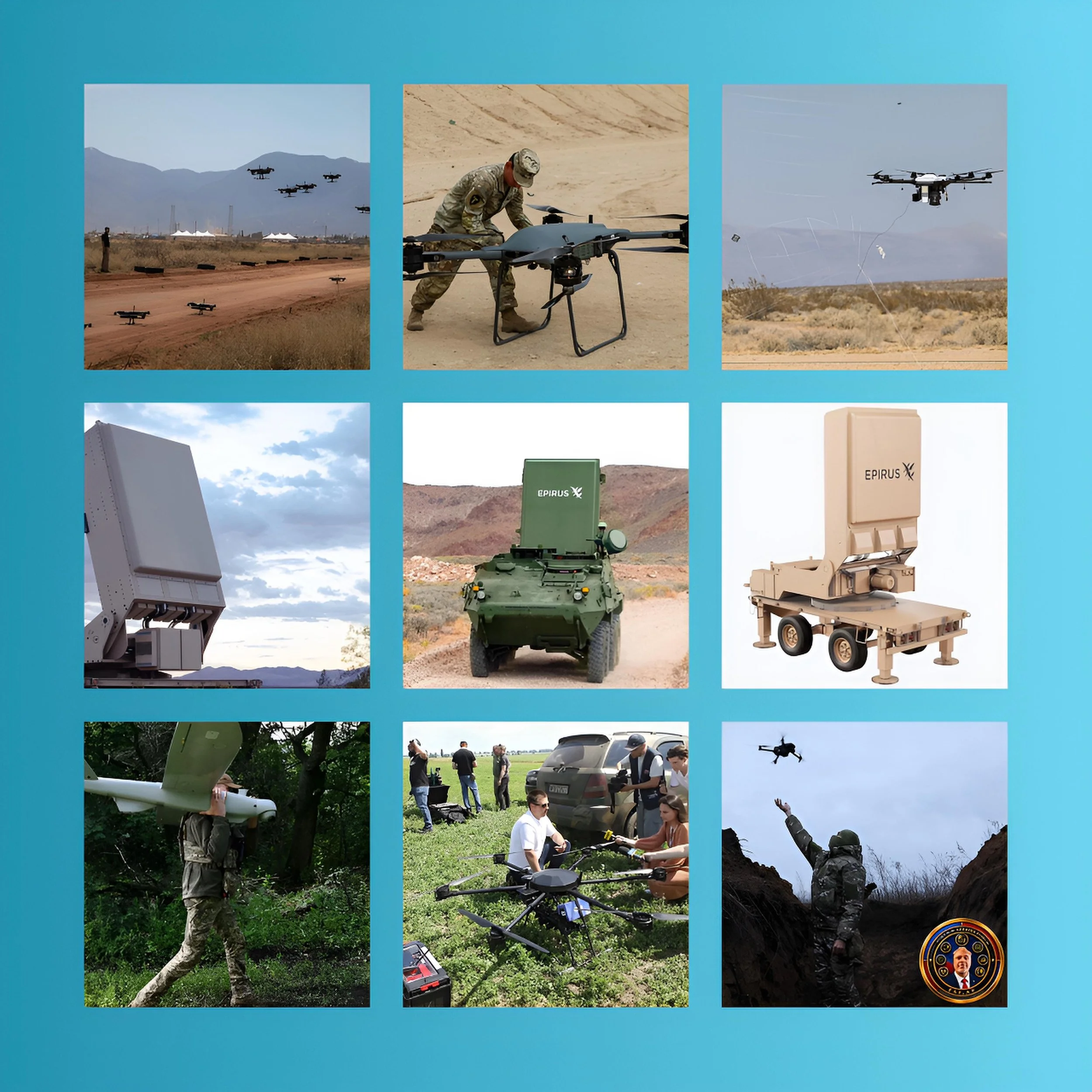
The third story comes from the war in Ukraine, where President Volodymyr Zelenskyy announced that Ukraine has tested a brand-new, home-built weapon designed to shoot down enemy drones. This new interceptor has already succeeded in shooting down one Russian Shahed-type attack drone, though officials say it still needs more work before it is used widely. Ukraine also revealed that during a recent massive Russian drone and missile attack, its air defenses destroyed one hundred eighty-seven targets in the sky, intercepting roughly 93% of the drones sent at it. That sounds like an impressive success rate, and it is, but Zelenskyy warned that Ukraine's defenses are still not good enough. Russia is now switching to faster, jet-powered drones, and Ukraine must build new interceptors that can catch these faster machines too.
Dr. 🆎 describes this as a race that never really ends: as soon as one side builds a better weapon, the other side adapts, forcing another round of innovation within weeks or months rather than years. The country that wins this kind of race, he suggests, may not be the one with the single best weapon today, but the one that can design and build new weapons fastest, over and over again.
The fourth story involves the United States Navy, which has placed its first serious production order for a new type of aircraft called the MQ-25A Stingray. This is a drone that refuels other aircraft while they are still flying, allowing fighter jets to stay in the air longer and travel farther from the aircraft carrier without needing to land and refuel. The Navy signed a contract worth five hundred sixty-two million dollars with Boeing to begin building these aircraft in larger numbers. This matters because China has developed missiles that can strike ships from very long distances, which forces American aircraft carriers to stay farther away from contested areas to remain safe. A refueling drone like the Stingray helps solve that problem by extending how far American fighter jets can travel from the carrier. It is also important because it represents the Navy learning, for the first time, how to operate large drones alongside piloted aircraft as a normal, everyday part of carrier life. Once that skill becomes routine, it becomes much easier to add other kinds of drones in the future, including ones that could scout for the enemy or even carry weapons themselves.
The fifth story is less dramatic on the surface but potentially very important underneath. A major engine manufacturer, Pratt & Whitney, has given a small defense startup called Hermeus permission to build its own version of a well-known jet engine, called the F100, which has powered famous fighter jets like the F-15 and F-16 for decades. Hermeus plans to use this engine to power its own autonomous aircraft. This matters because building high-performance jet engines is one of the hardest and most expensive parts of building any military aircraft, and only a small number of companies in the world know how to do it well. Most new drone and autonomous-aircraft companies get stuck at this exact bottleneck. By allowing a newer company to manufacture a proven, working engine design instead of inventing one from scratch, this deal could help solve a problem that has been slowing down America's entire push toward autonomous military aircraft.
Taken together, these five stories tell one connected story rather than five separate ones.
Dr. 🆎 explains it this way: modern military power now starts in space, where satellites watch everything and guide almost everything below. That information flows down into networks powered by artificial intelligence, which connect human commanders to robotic systems on the ground, in the air, and at sea. Expensive, well-protected machines, like aircraft carriers and armored vehicles, are increasingly paired with cheaper, more expendable robotic partners that can take on the most dangerous jobs. And underneath all of it sits industrial capacity, the unglamorous but essential ability to actually manufacture engines, sensors, and airframes fast enough to keep up.
The strange twist in all of this, according to Dr. 🆎, is that the more robotic and automated warfare becomes here on the ground, the more important it becomes to control the space far above us.
Wars of the future may increasingly be decided not by who has the biggest army on the battlefield, but by who controls the satellites watching over it, and who can keep building new machines faster than the other side can destroy them. That is the real story behind this week's headlines, and it is one that will likely shape global security for years to come.