Autonomous Warfare Ascendant: How Orbital Weapons, Robotic Wingmen, and Attritable Drones Are Redrawing the Architecture of Global Power
Foreign Affairs Forum | Dr. Antonio Bhardwaj (Dr. 🆎)| September 16th, 2026
Summary
The security architecture that has governed great-power competition since the end of the Cold War is undergoing a transformation so rapid that historians may one day struggle to date its beginning with precision.
On September 14, 2026, United States Air Force Secretary Troy Meink stood before the Air and Space Forces Association's Air, Space and Cyber Conference at National Harbor, Maryland, and confirmed what strategists had long suspected but no American official had ever stated aloud: the United States now possesses operational, on-orbit weapons capable of space control.
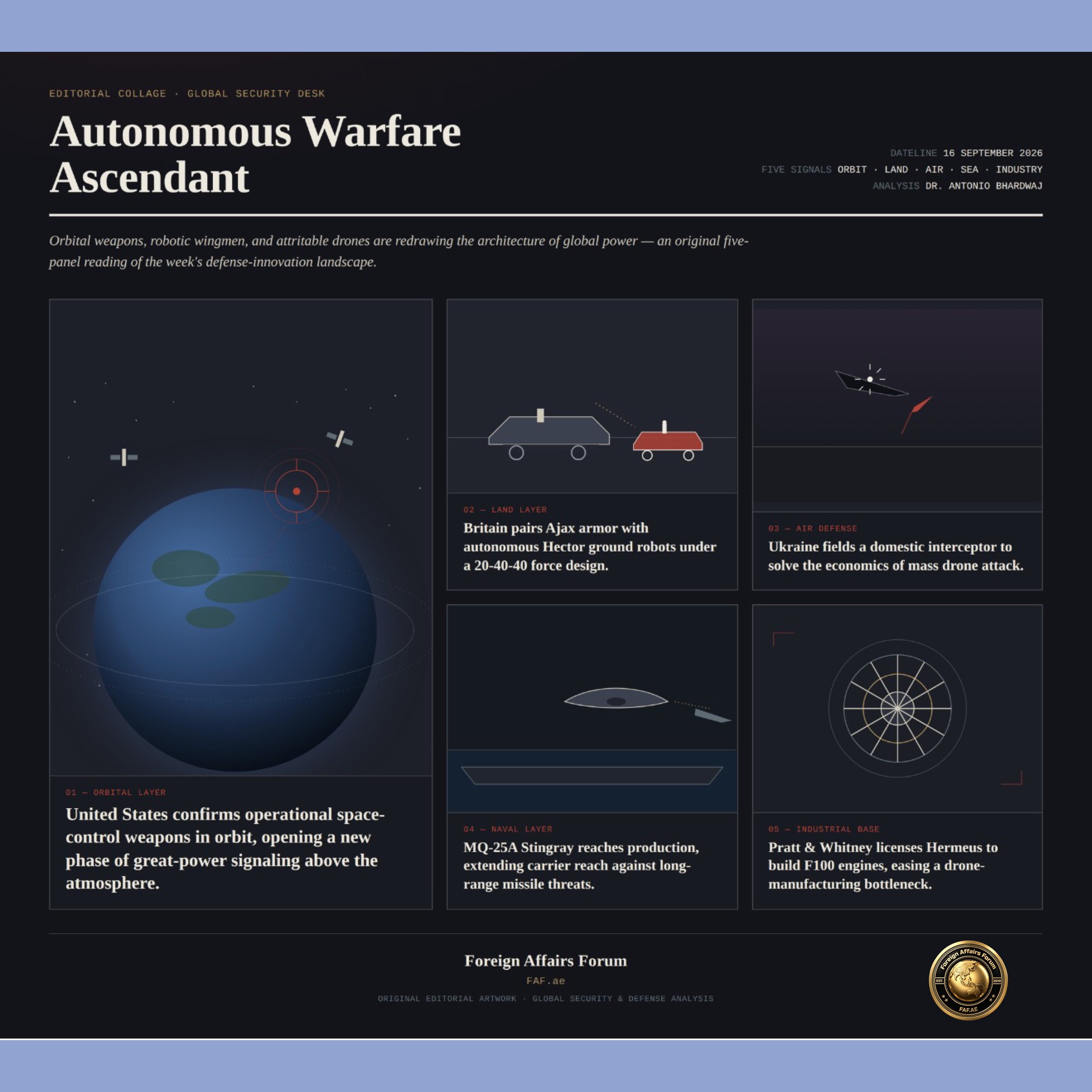
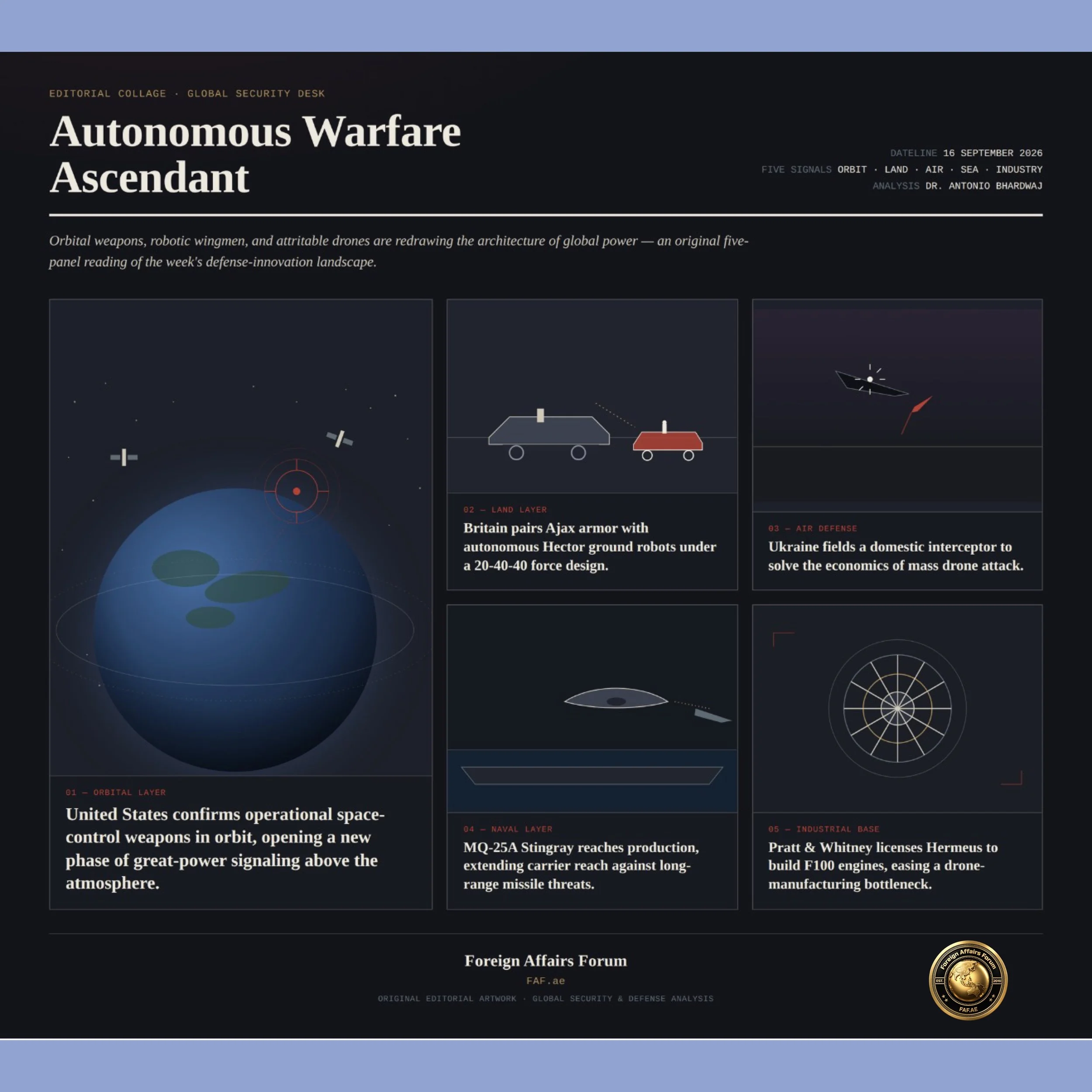
Within a single week, that disclosure sat alongside four other developments of comparable consequence, spanning British robotic ground warfare, Ukrainian counter-drone innovation, American naval autonomy, and a quiet but momentous transfer of fighter-engine manufacturing rights to a defense startup.
Dr. Antonio Bhardwaj (Dr. 🆎), Chief Executive Officer of the Foreign Affairs Forum and a specialist in human-centered artificial intelligence applied to geopolitical strategy, AI warfare, and bioterrorism risk, argues that these five developments are not isolated news items but interlocking signals of a single underlying transition: the emergence of a military order in which space-based sensing, autonomous platforms, and rapid, iterative manufacturing have become more decisive than the raw mass of crewed formations that defined the twentieth century.
FAF examines that transition across its historical roots, its present manifestations, and its probable trajectory, drawing on the week's developments as a lens through which to understand a longer arc of change now accelerating under the combined pressure of artificial intelligence, orbital competition, and grinding attritional warfare in Ukraine.
Executive Summary
Five developments converged in mid-September 2026 to expose the shape of an emerging military architecture.
The United States acknowledged for the first time that it has deployed space control weapons in orbit, a statement that Air Force Secretary Troy Meink described as deliberate rather than accidental.
Britain, through General Dynamics UK and the German startup ARX Robotics, advanced a concept to pair Ajax armored reconnaissance vehicles with autonomous Hector ground robots, embodying the British Ministry of Defence's nascent twenty-forty-forty force design philosophy. Ukraine tested a domestically produced counter-drone interceptor that has already downed a Shahed-type attack drone, part of an urgent effort to solve the economics of mass drone defense.
The United States Navy placed its first low-rate production order for the MQ-25A Stingray autonomous aerial refueling aircraft, a five hundred sixty-two million dollar contract with Boeing that marks the transition of carrier-based autonomy from experiment to institution. And Pratt & Whitney granted the autonomous-aircraft startup Hermeus the right to manufacture its own F100 turbofan engines, addressing what may be the most stubborn bottleneck in the American drone-industrial base.
Dr. 🆎 situates these events within a broader pattern: military power is being reorganized around a layered stack that begins in orbit, passes through artificial-intelligence-enabled networks, and terminates in expendable machines on the surface of the earth, sea, and air. The implications for deterrence, arms control, and industrial policy are substantial, and this essay develops them across the sections that follow: historical context, the current status of each development, key developments in depth, the latest facts and concerns, a cause-and-effect analysis of the interlocking dynamics, future steps for stakeholders, and a concluding assessment of what this architecture means for global stability through 2030 and beyond.
Introduction
For most of the post-Cold War period, the central preoccupation of Western defense planners was the maintenance of technological overmatch through exquisite, expensive platforms: stealth fighters, nuclear-powered aircraft carriers, and satellite constellations whose vulnerabilities were assumed rather than tested. That assumption has now collapsed.
The past several years have seen an accumulation of evidence, driven substantially by the war in Ukraine and by the accelerating capabilities of artificial intelligence, that the character of warfare is shifting toward distributed, autonomous, and attritable systems operating under constant surveillance from space. The developments of mid-September 2026 crystallize this shift with unusual clarity.
Dr. 🆎 has argued in prior analyses that human-centered artificial intelligence in the security landscape must be understood not merely as a set of discrete technologies but as an organizing logic that reshapes how stakeholders think about risk, escalation, and the value of human judgment in the loop of lethal decision-making. The five stories examined here offer a concrete test of that thesis.
They show governments and companies racing to build the sensing, autonomy, and manufacturing infrastructure that this new logic demands, even as the doctrinal, legal, and ethical frameworks meant to govern its use lag conspicuously behind.
FAF publication proceeds in seven parts. It begins with the historical antecedents of today's orbital and autonomous warfare developments, tracing the slow erosion of the norm against acknowledging space weapons and the parallel rise of uncrewed systems in land, sea, and air warfare. It then reviews the current status of each of the five developments in turn, followed by a deeper examination of the key developments and their strategic logic. A section on the latest facts and concerns follows, addressing the specific uncertainties that attend each story.
The article then offers a cause-and-effect analysis explaining how these developments interact with one another, a discussion of future steps for the principal stakeholders, and a conclusion assessing the stakes for global order.
History and Current Status
The taboo against publicly acknowledging space-based weapons has a long and complicated history. During the Cold War, both the Soviet Union and the United States pursued anti-satellite programs, including co-orbital interceptors and direct-ascent systems, while carefully avoiding formal declarations that might invite treaty obligations or provoke symmetrical escalation.
The 1967 Outer Space Treaty prohibited the placement of weapons of mass destruction in orbit but left conventional counterspace weapons in a legal gray zone that persists to this day.
China's 2007 anti-satellite missile test against one of its own defunct weather satellites, which generated an enormous and long-lived debris field, marked a turning point in public awareness of the fragility of the orbital environment, and it hardened American resolve to develop its own counterspace capabilities while continuing to publicly emphasize restraint.
The creation of the United States Space Force in December 2019 formalized space as a distinct warfighting domain, and by 2025 Space Force officials had begun speaking more openly about the general concept of space control, even as they continued to withhold specifics about deployed systems.
Meink's September 2026 statement therefore represents the culmination of a gradual loosening of official reticence rather than a sudden strategic reversal. What changed was not the existence of capability so much as the willingness to confirm it, a shift Dr. 🆎 characterizes as a calculated signal intended for both domestic and foreign audiences simultaneously.
The history of robotic ground warfare follows a different but converging trajectory. Uncrewed ground vehicles have existed in various forms since at least the World War II , but their battlefield relevance remained marginal until the proliferation of low-cost sensors, batteries, and artificial-intelligence-enabled navigation software in the past decade. The war in Ukraine has served as an unplanned but extraordinarily consequential laboratory for both aerial and ground robotics, with both belligerents fielding thousands of small uncrewed ground systems for logistics, mine clearance, and increasingly, direct combat roles.
Britain's interest in pairing its Ajax armored reconnaissance vehicle, itself a troubled program that experienced years of delay related to vibration and safety issues before entering service, with autonomous Hector ground robots reflects a broader European recognition that expensive crewed platforms must be complemented, and in some missions replaced, by cheaper autonomous systems if European militaries are to field credible mass at sustainable cost.
Ukraine's counter-drone innovation has its own distinct history rooted in necessity. Since Russia began large-scale employment of Iranian-designed Shahed attack drones in late 2022, Ukraine has been forced to develop an increasingly sophisticated and layered air-defense architecture combining traditional surface-to-air missiles, electronic warfare, mobile machine-gun teams, and increasingly, dedicated interceptor drones.
The economics of this contest have always favored the attacker: a Shahed drone costs a small fraction of the surface-to-air missiles historically used to destroy it. The domestically developed interceptor tested in mid-September 2026 represents the latest iteration in Ukraine's multi-year effort to invert that cost equation, following earlier interceptor programs that achieved partial but insufficient success against the growing volume and sophistication of Russian drone strikes.
The Navy's investment in carrier-based autonomy traces to lessons learned from two decades of experimentation with the X-47B demonstrator and its successors, alongside a growing recognition that the proliferation of long-range Chinese anti-ship missiles has degraded the survivable operating range of American carrier air wings.
The MQ-25 program, originally conceived with a broader intelligence, surveillance, and reconnaissance mandate before being narrowed to focus principally on aerial refueling, has now reached the point of low-rate production after years of developmental testing, making it the first uncrewed aircraft integrated into routine carrier flight operations.
Finally, the engine-manufacturing bottleneck that Hermeus and Pratt & Whitney have moved to address reflects a decades-old structural feature of the aerospace industry: propulsion has always been the most capital-intensive, knowledge-intensive, and slowly maturing component of any aircraft program, and the handful of companies capable of producing military-grade jet engines have historically guarded that expertise closely.
The decision to license a startup to manufacture a legacy but still capable engine design represents an unusual and potentially precedent-setting departure from that historical pattern.
Key Developments
The most strategically significant of the week's developments remains the American acknowledgment of orbital weapons. Meink's remarks, delivered in a keynote address and reinforced in a subsequent question-and-answer session in which he confirmed the phrasing had been deliberate, mark the first time a serving American Cabinet-level defense official has stated unambiguously that the United States has deployed space control weapons capable of both offensive and defensive action.
Meink declined to specify the type, quantity, or date of deployment of these systems, and Space Force officials have offered only the general doctrinal description that space control encompasses both kinetic and non-kinetic means intended to disrupt, degrade, or destroy hostile capabilities.
China's Foreign Ministry responded within days, warning that American deployment of military capabilities in orbit risked accelerating an arms race, a formulation consistent with Beijing's longstanding rhetorical position that it opposes the weaponization of space while continuing to develop its own counterspace capabilities.
Dr. 🆎 observes that the significance of the announcement lies less in the technical specifics, which remain unknown, than in the psychological and doctrinal shift it represents: for the first time, American planners are treating acknowledged space weapons as a tool of deterrence rather than a capability too sensitive to admit.
Britain's Ajax-Hector concept, developed jointly by General Dynamics UK and ARX Robotics, envisions autonomous ground robots operating in close coordination with crewed armored reconnaissance vehicles, extending the sensing range of the formation, absorbing risk in the most dangerous forward positions, and potentially carrying weapons systems of their own.
The concept remains at an early, unfunded stage, with no formal commitment yet secured from the Ministry of Defence, but it fits coherently within Britain's emerging twenty-forty-forty force design, under which a shrinking core of highly survivable crewed platforms is meant to operate alongside a much larger proportion of attritable and expendable uncrewed systems. This design philosophy, still more aspiration than fielded reality, represents one of the most explicit European departures from the traditional Western procurement model built around small numbers of extremely expensive, minimally attritable platforms.
Ukraine's newly tested interceptor, announced by President Volodymyr Zelenskyy, has already demonstrated a successful intercept against a Shahed-type drone, though officials have stressed that further technical refinement remains necessary before wider deployment. The announcement came alongside disclosures that Ukrainian air defenses destroyed one hundred eighty-seven airborne targets in a recent large-scale Russian attack, intercepting approximately ninety-three % of the drones launched. Even so, Zelenskyy emphasized that existing defenses remain insufficient against the growing scale and sophistication of Russian strikes, particularly as Moscow introduces faster, jet-powered drone variants that current interceptor designs struggle to catch.
The Navy's $562 million low-rate initial production contract with Boeing for the MQ-25A Stingray marks the transition of carrier-based autonomous aviation from experimental status to institutional reality. The Stingray's primary mission, aerial refueling of carrier-based fighters such as the F/A-18 and F-35C, addresses a specific and pressing operational problem: the extension of Chinese long-range anti-ship missile coverage has forced American carriers to consider operating from greater distances, placing a premium on extending the combat radius of embarked fighters without consuming additional crewed aircraft for tanker duty.
Finally, Pratt & Whitney's decision to license Hermeus to manufacture the F100 turbofan engine, a powerplant with a service history stretching back to the F-15 and F-16, represents an unusual and potentially transformative arrangement in defense-industrial policy. Hermeus intends to use the engine to power its Quarterhorse autonomous aircraft program, and the arrangement offers a template through which new entrants to the defense-aerospace sector might overcome the propulsion bottleneck that has historically constrained the pace at which autonomous aircraft companies can scale production.
Latest Facts and Concerns
Several specific uncertainties attend each of these developments and merit close attention from analysts and policymakers alike.
Regarding the American orbital weapons disclosure, the central unresolved question is one of classification and verification: without any independent confirmation of the type, number, or operational status of the systems in question, outside observers, including arms-control specialists and space-security experts, are left to infer capability from rhetoric alone. Analysts have noted that even the reference to "on-orbit" weapons, as opposed to ground-based systems capable of reaching orbit, narrows the field of plausible technologies considerably, but the ambiguity itself may be a deliberate feature of the disclosure rather than an oversight. Concerns have also been raised regarding the destabilizing potential of the announcement, with space-policy specialists cautioning that even a rhetorical acknowledgment, absent any accompanying transparency or confidence-building measures, risks accelerating investment by both Russia and China in their own counterspace programs.
Regarding Britain's Ajax-Hector concept, the principal concern is one of funding and institutional follow-through. The British Ministry of Defence has a long and difficult history with the Ajax program itself, which suffered years of delay tied to vehicle vibration and crew safety concerns before finally entering service, and skepticism remains warranted regarding whether the twenty-forty-forty concept will translate into funded procurement rather than remaining an industry-led concept in search of a sponsor.
Regarding Ukraine's interceptor program, the central concern is the compressed and unforgiving pace of the underlying technological race. Russian jet-powered drone variants, now entering more widespread use, travel at speeds that current interceptor designs, optimized against slower propeller-driven Shaheds, may struggle to match. The strategic question Ukraine faces is not whether it can build an effective interceptor for today's threat, but whether its industrial base can iterate fast enough to stay ahead of a threat that itself continues to evolve on a monthly cycle.
Regarding the MQ-25 program, the principal concern is scale and pace. A single low-rate production contract, while symbolically and operationally significant, remains a modest first step relative to the eventual fleet size the Navy will require to meaningfully extend carrier air wing range, and historical experience with naval aviation programs counsels caution regarding the gap between initial contracts and fielded operational capability.
Regarding the Hermeus-Pratt & Whitney arrangement, the open question is one of scalability and quality control: manufacturing a proven engine design under license is a substantially different challenge from designing one from scratch, but it nonetheless requires precision manufacturing capabilities, supply-chain maturity, and quality-assurance processes that a young startup must still develop and prove at scale.
Cause-and-Effect Analysis
Dr. 🆎 contends that these five developments cannot be understood in isolation; they interact with one another through a set of causal relationships that together describe a coherent, if still emergent, military architecture. The starting point of this architecture is space. Modern military operations depend on an unbroken chain running from missile warning through navigation, communications, targeting, intelligence, and ultimately to the drones and autonomous weapons that increasingly execute the terminal stages of military action. Because that chain now runs continuously through orbit, satellites have become simultaneously indispensable and vulnerable, a paradox that directly motivates the American decision to acknowledge, rather than continue to conceal, the existence of orbital defensive and offensive capability. The logic here is essentially deterrent: a state that has demonstrated the willingness to defend its orbital assets, even ambiguously, imposes additional caution on an adversary contemplating a first strike against that architecture.
This orbital foundation in turn enables the second layer of the architecture, the proliferation of autonomous systems on land, sea, and air. Britain's Ajax-Hector concept, Ukraine's interceptor drones, and the Navy's MQ-25 program are all, in different ways, dependent on the persistent, real-time situational awareness that only a resilient space architecture can provide at scale. An autonomous ground robot operating ahead of a crewed formation, an interceptor drone tasked against an incoming Shahed, and an uncrewed tanker coordinating its rendezvous with a returning fighter all rely, directly or indirectly, on positioning, navigation, timing, and communications relayed through satellite constellations. The vulnerability of that orbital layer to disruption is therefore not a peripheral concern but a central structural risk to the entire autonomous-warfare edifice being constructed atop it.
The third causal relationship concerns the economics of attrition. Ukraine's interceptor program exists because the traditional model of defending against mass drone attack with expensive surface-to-air missiles is financially unsustainable when the attacking systems cost a small fraction of the interceptors used against them. Britain's twenty-forty-forty concept represents an explicit doctrinal response to the same underlying economic logic, applied prospectively to a broader range of contingencies rather than reactively to an ongoing war. Both cases illustrate a broader principle Dr. 🆎 has emphasized in his writing on AI-enabled warfare: the decisive advantage in future conflict may accrue not to the side with the single best weapon system, but to the side capable of iterating its systems, whether interceptors or expendable ground robots, faster than its adversary can adapt.
Finally, the Hermeus-Pratt & Whitney engine arrangement addresses the industrial precondition that makes the entire architecture materially possible. Autonomous systems, however sophisticated their software, remain physical objects requiring physical components, and the propulsion bottleneck has historically constrained how quickly any state can translate autonomous-warfare doctrine into fielded capability at meaningful scale. By licensing a proven engine design to a new entrant, Pratt & Whitney and the broader American defense-industrial base are attempting to relax that constraint, a development whose consequences will likely be measured not in the coming months but across the remainder of this decade.
Future Steps
For the United States, the principal future step is to determine how much additional transparency, if any, should accompany its newly acknowledged orbital capability.
Dr. 🆎 suggests that Washington faces a genuine strategic dilemma: continued ambiguity preserves tactical flexibility and complicates adversary planning, but it also forecloses the confidence-building measures that might otherwise slow a still-nascent orbital arms race. Some combination of selective disclosure, perhaps coordinated with allies, and renewed engagement on space-security norms through venues such as the United Nations Conference on Disarmament may offer a middle path, though the current trajectory of great-power relations makes near-term progress on formal arms-control measures for space unlikely.
For Britain and its European partners, the future step is one of funding discipline and institutional commitment. The Ajax-Hector concept, along with the broader twenty-forty-forty framework it embodies, will remain aspirational until the Ministry of Defence commits real procurement funding, and the credibility of Britain's broader defense modernization agenda will depend substantially on whether such concepts survive the transition from industry proposal to funded program of record.
For Ukraine, the future step is sustaining the pace of interceptor development against an adversary that continues to adapt its own drone technology on a similarly compressed timeline. Continued Western technical and financial support for Ukraine's domestic defense-industrial base, rather than reliance solely on donated Western systems, will likely prove decisive in determining whether Ukraine can maintain the cost-effectiveness that mass drone defense requires.
For the United States Navy, future steps involve scaling MQ-25 production beyond the initial low-rate contract while simultaneously developing the doctrine, training pipelines, and maintenance infrastructure necessary to integrate a substantially larger uncrewed presence into routine carrier operations, a process that historical experience suggests will require patient, sustained institutional investment over multiple years.
For the broader American defense-industrial base, the Hermeus-Pratt & Whitney arrangement, if successful, may serve as a template for similar licensing relationships between established prime contractors and newer autonomous-systems companies, a pattern that could meaningfully accelerate the pace at which autonomous aircraft programs move from prototype to fielded capability across the remainder of this decade and into the 2030s.
Conclusion
The week's five developments, considered together, offer an unusually clear window into the military architecture now taking shape across the world's leading defense establishments.
That architecture begins in orbit, where satellites provide the sensing and communications backbone on which all subsequent layers depend, and on which the United States has now, for the first time, openly acknowledged deploying defensive and offensive capability. It extends through artificial-intelligence-enabled networks that fuse orbital data with battlefield information in near-real time. It manifests in crewed command platforms increasingly paired with autonomous wingmen, whether Britain's prospective Hector ground robots, Ukraine's interceptor drones, or the Navy's MQ-25 tankers. And it depends, at its industrial foundation, on the capacity to manufacture the engines, sensors, and airframes that autonomous warfare at scale requires, a capacity the Hermeus-Pratt & Whitney arrangement seeks to expand.
Dr. 🆎 concludes that the central paradox of this emerging order is that the more autonomous warfare becomes on the surface of the earth, the more strategically decisive control of the space above it becomes, a dynamic that will likely define great-power competition through 2030 and beyond, and one that current arms-control and deterrence frameworks remain poorly equipped to manage.
Whether the international community can develop new norms and institutions capable of governing this architecture before a crisis forces the issue will be among the defining strategic questions of the remainder of this decade.