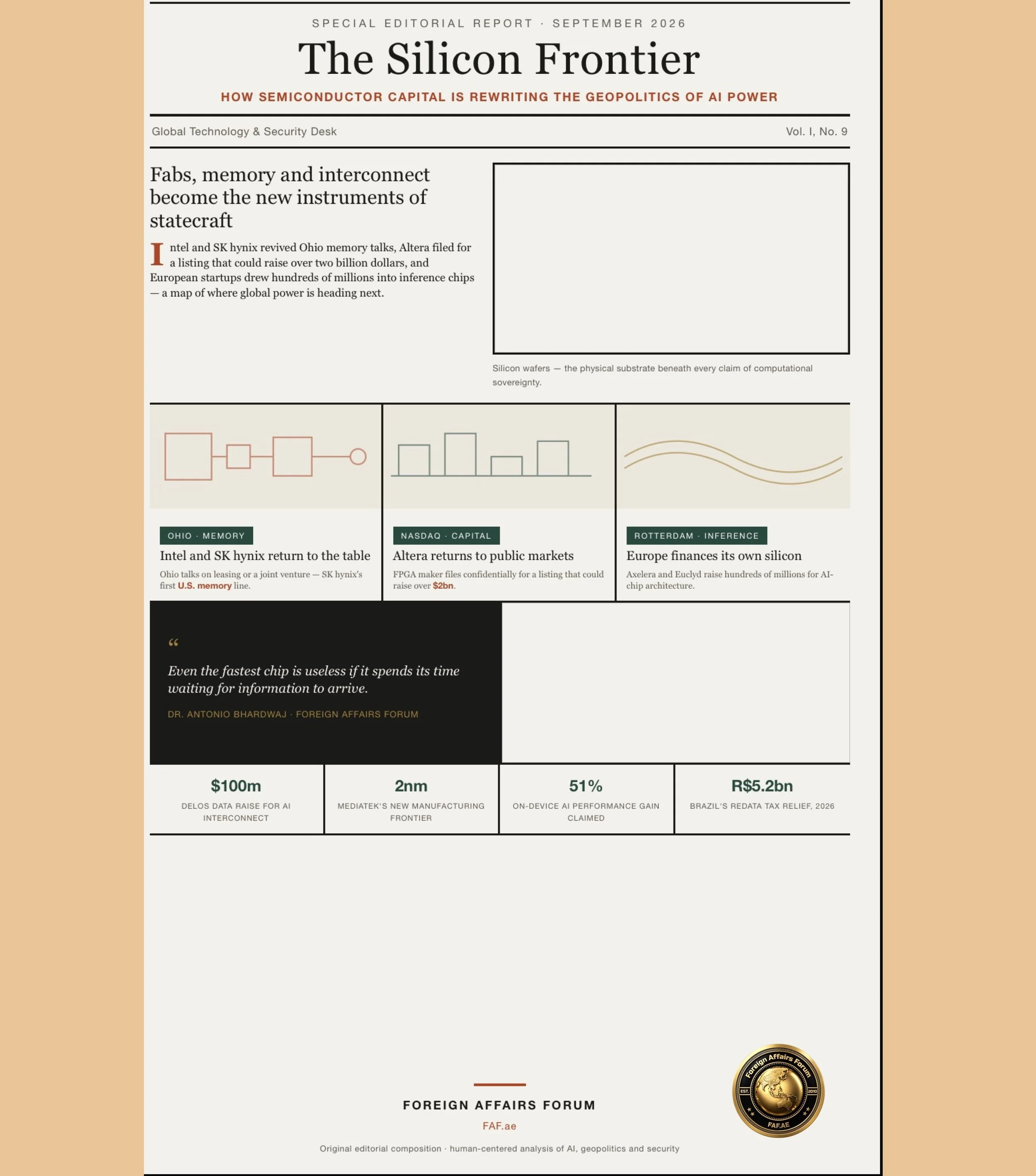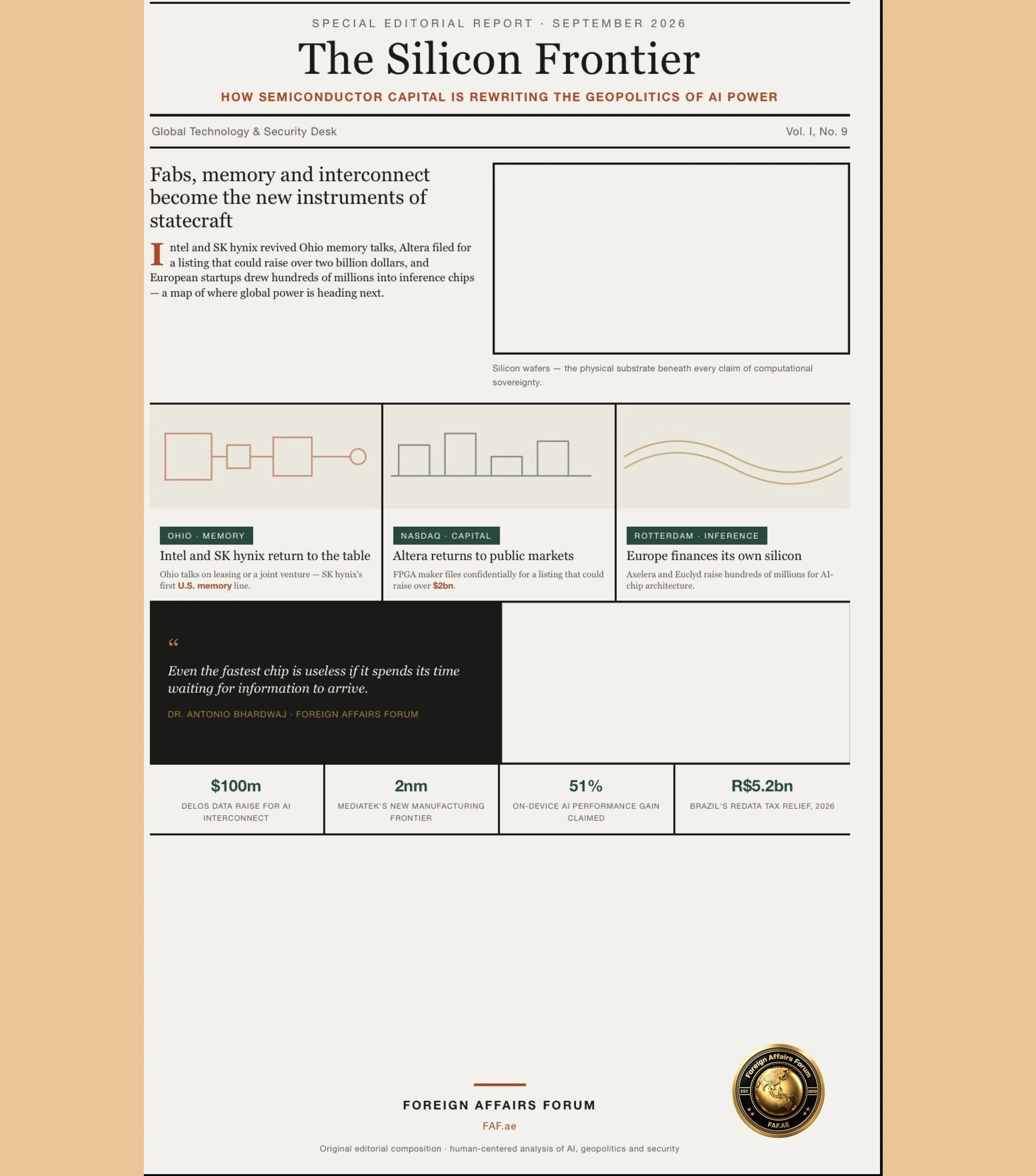
The Silicon Frontier: How Semiconductor Capital Is Rewriting the Geopolitics of AI Power
Foreign Affairs Forum | Dr. Antonio Bhardwaj (Dr. 🆎)| September 17th, 2026
Executive Summary
The global semiconductor industry entered a pivotal phase in September 2026, marked by a convergence of corporate financings and manufacturing decisions that collectively signal a structural shift in how nations and investors approach computational infrastructure.
Intel and SK hynix have reopened discussions over memory chip manufacturing at Intel's Ohio campus, a potential arrangement that would mark SK hynix's first American memory production.
Altera, the programmable-chip company partly divested by Intel in 2025, has confidentially filed for a United States initial public offering that could raise more than $2 billion.
Simultaneously, European semiconductor startups Axelera AI and Euclyd have together drawn several hundred million dollars into AI-inference architecture, while the American networking startup Delos Data raised $100 million to address chip-to-chip interconnect bottlenecks.
Taiwan's manufacturing frontier has advanced to the two-nanometre node through MediaTek's newest mobile processor, and Brazil has enacted sweeping tax incentives to attract sovereign AI-compute infrastructure.
Dr. Antonio Bhardwaj (Dr. 🆎), chief executive of the Foreign Affairs Forum, situates these developments within a broader thesis: that semiconductor infrastructure — spanning fabrication, memory, packaging, and interconnect — has become the physical substrate of geopolitical power in the AI era.
FAF article examines the historical context, key developments, associated risks, and strategic implications of this capital-formation wave, concluding that investment logic is shifting away from a narrow focus on processors toward a more architecturally sophisticated understanding of AI infrastructure as a layered, increasingly geopolitical system.
Introduction
The global semiconductor landscape is undergoing a transformation that extends far beyond the balance sheets of chip companies.
What is unfolding across the United States, Europe, and Asia in the autumn of 2026 is not merely a cycle of corporate financing, but a structural repositioning of how nations, investors, and technologists conceive of computational sovereignty.
Dr. Antonio Bhardwaj (Dr. 🆎), CEO of the Foreign Affairs Forum and a specialist in human-centered AI for geopolitical strategy, AI warfare, and bioterrorism risk, has long argued that semiconductor infrastructure has quietly become the substrate upon which twenty-first-century strategic competition is conducted. In his assessment, the current wave of capital formation across Intel, SK hynix, Altera, Axelera AI, Delos Data, and Euclyd represents "the physical bedrock beneath the abstraction of artificial intelligence — and whoever controls that bedrock will shape the character of geopolitical power for a generation."
FAF publication examines the confluence of these developments, situating them within a broader historical arc of semiconductor statecraft, and offers a cause-and-effect analysis of what this capital surge portends for technology, venture investment, and international security.
The events of mid-September 2026 are unusually dense in significance.
Within a span of days, a possible Intel–SK hynix manufacturing arrangement in Ohio has resurfaced in a new, more advanced form; Altera, the programmable-chip company once fully owned by Intel, has confidentially filed for a United States initial public offering that could raise more than $2 billion; two European semiconductor startups, Axelera AI and Euclyd, have together raised several hundred million dollars for AI-inference architectures; a stealth American networking startup, Delos Data, has emerged with $100 million in fresh capital to address the interconnect bottleneck inside AI data centers; Taiwan's manufacturing frontier has advanced to the two-nanometre node through MediaTek's new mobile silicon; and Brazil has enacted sweeping tax incentives to attract sovereign AI compute infrastructure. Individually, each of these developments might be treated as a discrete item of business news.
Collectively, they form a mosaic that reveals where global capital believes the next decade of artificial intelligence competition will actually be won or lost — not merely in the training of large models, but in the physical and logistical architecture that carries data between chips, across borders, and into geopolitical influence.
History and Current Status
To understand the present moment, one must revisit the long arc of semiconductor geography.
For much of the late 20th century, chip manufacturing was distributed relatively evenly among the United States, Japan, and later South Korea and Taiwan.
The economics of Moore's Law, however, gradually concentrated the most advanced manufacturing into a small number of firms capable of absorbing the enormous capital expenditure required to remain at the leading edge.
Taiwan Semiconductor Manufacturing Company emerged as the dominant foundry for logic chips, while Samsung and SK hynix came to dominate memory.
The United States, despite housing the world's most valuable chip-design companies, steadily lost its share of advanced fabrication capacity, a vulnerability that became strategically salient once artificial intelligence emerged as a central axis of great-power competition.
Intel's own trajectory illustrates this arc in miniature.
The company acquired Altera, the programmable-chip specialist, for approximately $16.7 billion in 2015, betting that field-programmable gate arrays would become integral to its broader silicon strategy.
That bet did not fully materialize as intended, and a decade later Intel sold a 51% percent stake in Altera to the private equity firm Silver Lake in a transaction that valued the company at $8.7 billion, with Intel retaining the remaining 49% and Abu Dhabi-backed MGX also co-investing.
The valuation compression across that decade — roughly halving despite the intervening artificial intelligence boom — testifies to how selectively AI-era enthusiasm has actually rewarded semiconductor assets.
Altera's fiscal 2024 revenue registered at approximately one point five four billion dollars, below the roughly $2 billion in annual revenue it generated when Intel first acquired it, according to reporting from EE Times. It is against this backdrop that Altera's confidential filing for a United States initial public offering, disclosed in mid-September 2026, marks a genuinely pivotal moment: a chip company forged and then partially divested by Intel is attempting to re-enter public markets as an independent, pure-play FPGA provider serving telecommunications, aerospace, defense, data centers, industrial automation, and increasingly, AI-adjacent inference workloads.
Meanwhile, Intel's flagship American manufacturing ambition — the Ohio One campus in New Albany, on which the company broke ground in 2022 — has become emblematic of the difficulties inherent in reshoring advanced semiconductor capacity. Intel initially pledged approximately $28 billion for the site's first phase and promised completion of two next-generation facilities, Fab 27 and Fab 28, by 2025.
That timeline slipped, and by mid-2026 reports indicated Intel was actively seeking an operating partner for the site rather than simply pressing ahead alone, with SK hynix identified as among the candidates under consideration.
SK hynix subsequently issued a formal denial through a Korea Exchange filing, stating that while it continuously evaluates investment and acquisition opportunities, it had "neither pursued nor decided" to acquire Intel's Ohio site and fabrication facility.
This denial, notably, addressed acquisition specifically rather than foreclosing the possibility of a lease arrangement, joint venture, or operating partnership — the distinction upon which much of the subsequent reporting has hinged.
Dr. 🆎 characterizes this pattern of denial-without-foreclosure as diagnostic of contemporary semiconductor diplomacy: "Corporations increasingly communicate strategic intent through the precision of their denials. What is not denied is often more informative than what is."
Key Developments
The most consequential recent development is the reported early-stage discussion between Intel and SK hynix regarding memory chip manufacturing at the Ohio complex, an arrangement that, if consummated, would mark the first time SK hynix has manufactured memory chips within the United States.
The company's existing Indiana investment is oriented toward advanced packaging rather than front-end memory fabrication, meaning an Ohio arrangement would represent qualitatively different exposure to the American market.
Options reportedly under discussion include SK hynix leasing a portion of Intel's existing facility, or a joint venture structure that could involve participation from cloud-computing companies eager to secure domestic memory supply. This arrangement, whatever its final form, arrives amid sustained pressure from Washington on Korean and Taiwanese semiconductor firms to expand their United States manufacturing footprint, a policy pressure that has intensified rather than abated across successive American administrations.
Simultaneously, Altera's confidential IPO filing has moved the company from speculative territory into the formal registration process. Reuters reported that Silver Lake has selected Barclays, Citi, JPMorgan, and Morgan Stanley as underwriters, though the final ordering of the banking syndicate remained unsettled as of mid-September.
The offering, should it proceed as anticipated, would rank among the largest semiconductor listings since Arm Holdings' 2023 debut, which raised nearly $5 billion. It also arrives at a moment when the broader United States IPO market is approaching record territory, with proceeds excluding special-purpose acquisition vehicles reaching approximately one hundred thirty-seven billion dollars through the end of August 2026, according to Dealogic figures cited in financial reporting.
Notably, Altera's prospective listing sits alongside an even larger anticipated offering: Anthropic itself is reported to be contemplating a public listing as early as October 2026 that could raise approximately one hundred billion dollars, a figure that would eclipse SpaceX's prior seventy-five billion dollar raise and push aggregate 2026 IPO proceeds above the existing record of roughly $156 billion.
Dr. 🆎 situates this convergence within a broader thesis: "When the companies that build the models and the companies that manufacture the substrate beneath those models seek public capital in the same season, it signals that investors have stopped treating software and hardware as separate investment categories. The market is pricing artificial intelligence as a single vertically integrated industrial complex."
Beyond the United States, European semiconductor entrepreneurship has produced two notable financings within a single week.
Axelera AI, a Dutch startup founded in Eindhoven in 2021, launched its second-generation Europa AI processor and disclosed signed commercial contracts already worth tens of millions of dollars, alongside a prospective sales pipeline that its chief executive, Fabrizio Del Maffeo, characterized as potentially reaching one point $5 billion, while explicitly cautioning that this larger figure represents pipeline opportunity rather than booked revenue.
The company has raised more than $450 million since its founding and has secured design wins within Dell and Supermicro systems, a detail of particular significance because system-level integration reduces the commercialization friction that has historically stalled promising semiconductor startups at the prototype stage.
Axelera is also participating in European sovereign AI-factory initiatives in Italy and Luxembourg, reflecting the continent's broader effort to reduce dependence on American graphics processing units.
Euclyd, a second Dutch venture, announced a Series A financing exceeding €200 million euros, co-led by Samsung, Somerset Capital Partners, the EQT-managed Scaleup Europe Fund, and Innovation Industries, with additional participation from EIFO and imec.xpand.
Former ASML chief executive Peter Wennink has assumed the chairmanship of the company, lending considerable institutional credibility to an enterprise whose ambitions extend beyond conventional chip design toward an integrated architecture combining custom compute, novel memory design, and complete data-center systems oriented specifically toward reducing the infrastructure and power costs associated with frontier-model inference.
The scale of this Series A — among the largest in European semiconductor history — testifies to investor appetite for architectural differentiation even in a market dominated by a single American GPU supplier.
A further significant development, less widely covered outside specialist circles, concerns Delos Data, an American startup founded by former Intel engineers that raised $100 million to address what its founders describe as the central bottleneck in contemporary AI infrastructure: the movement of data between increasingly heterogeneous processors within a single data center.
The investment syndicate included Matrix Partners, Playground, Socratic Partners, Capricorn, Matter Venture Partners, IAG, and DYNAMIQ, with former Intel chief executive Pat Gelsinger participating through Playground.
Dr. 🆎 regards this financing as arguably the most technically consequential of the week's developments, despite its comparatively modest scale: "AI clusters are no longer monocultures.
They are increasingly composed of Nvidia accelerators, AMD chips, Cerebras systems, and custom silicon operating side by side. An idle accelerator waiting for data is wasted capital and wasted electricity — and at the scale contemporary AI infrastructure now operates, that waste compounds into a strategic inefficiency with national consequences."
Finally, MediaTek's unveiling of its Dimensity 9600 Pro processor, manufactured on Taiwan Semiconductor Manufacturing Company's 2nm process, extends the frontier of advanced manufacturing into consumer mobile silicon, with the company reporting an approximate 51% improvement in on-device generative AI performance over its predecessor.
MediaTek's simultaneous expansion into data-center and custom AI silicon, including a forthcoming accelerator for a major American cloud provider expected to enter mass production later in 2026, signals that the boundary between mobile chip design and data-center silicon is increasingly permeable.
Brazil's enactment of its Redata data-center incentive regime, suspending several federal taxes on qualifying equipment for data-center installation and modernization, represents an estimated 5.2 billion reais of tax relief in 2026 alone, and reflects a Latin American variant of the sovereign-compute strategy already visible in Europe and the Gulf.
Latest Facts and Concerns
Several concerns attend this wave of capital formation. The first is the persistent gap between the negotiating positions of major stakeholders and the public narrative surrounding them.
The Intel-SK hynix discussions have oscillated between confirmation and denial multiple times since July 2026, with a South Korean media report in July claiming substantive acquisition talks, followed swiftly by an official SK hynix filing denying any decision to acquire the Ohio site, followed in September by fresh Reuters reporting of renewed, differently structured discussions involving leasing or joint-venture arrangements rather than outright acquisition.
This pattern of claim, denial, and reformulation complicates any straightforward assessment of how close an actual arrangement may be, and it illustrates a broader concern that Dr. 🆎 has raised repeatedly in his geopolitical strategy work: that critical infrastructure decisions affecting national semiconductor security are increasingly negotiated through leaks, denials, and market signaling rather than transparent policy processes. "When strategically vital manufacturing capacity is negotiated in this manner," he observes, "the public and even allied governments are left assembling their understanding of national resilience from fragments of corporate communication rather than from deliberate disclosure."
A second concern involves valuation dynamics. Altera's implied valuation trajectory — from approximately $16.7 billion at acquisition in 2015, to eight point seven five billion dollars at the Silver Lake transaction, to whatever valuation the coming IPO ultimately assigns — raises genuine questions about whether public markets will reward a mature, non-GPU semiconductor architecture as generously as they have rewarded companies more directly exposed to large-scale AI training.
FPGAs occupy an intermediate position between general-purpose processors and fixed-function application-specific integrated circuits, offering post-manufacturing programmability at some cost to raw efficiency. Whether investors will value that flexibility at a premium commensurate with Altera's ambitions remains genuinely unresolved, and the outcome will likely shape capital allocation decisions across the broader programmable-silicon sector for several years.
A third and more structurally significant concern concerns the emerging bifurcation between American and Chinese approaches to financing semiconductor challengers.
The Altera filing arrives in the immediate aftermath of the successful nine hundred twelve million dollar initial public offering of Enflame, a Chinese AI-chip company, on domestic Chinese exchanges. This near-simultaneous timing creates what might be termed a trans-Pacific test of public-market appetite: China is deploying its domestic capital markets to finance new GPU challengers intended to reduce dependence on restricted American chip imports, while the United States is testing whether public investors will reward a mature, already-established programmable-semiconductor platform rather than a novel GPU competitor.
The asymmetry is instructive. China's approach reflects an urgent, state-supported effort to construct domestic alternatives to Nvidia amid export restrictions; the American approach, at least in Altera's case, reflects a more conventional private-equity exit strategy layered atop broader AI-infrastructure enthusiasm.
Dr. 🆎 warns against reading too much triumphalism into either pattern: "Public listings are not, by themselves, evidence of technological parity. They are evidence of capital-market confidence, which is a related but distinct phenomenon. China's chip challengers still confront significant manufacturing constraints regardless of how enthusiastically domestic investors greet their public debuts."
A fourth concern, and one squarely within Dr. 🆎's specialization in bioterrorism risk and AI warfare, involves the dual-use character of increasingly capable edge inference.
MediaTek's claim of a fifty-one percent generative-AI performance improvement on-device, if borne out in independent testing, expands the practical capability of offline, unsupervised AI inference on personal devices — capability that carries genuine benefit for privacy-preserving applications but also carries proliferation risk when it comes to model capabilities that might otherwise be constrained through cloud-based monitoring, rate-limiting, or content-safety infrastructure. "As inference capability migrates from centralized data centers, which are comparatively easy to monitor and regulate, toward billions of individual devices, the governance challenge changes in kind, not merely in degree," Dr. 🆎 notes. "This is not an argument against edge AI, which carries substantial legitimate benefit. It is an argument for anticipatory governance frameworks that do not assume computation will remain conveniently centralized."
Cause-and-Effect Analysis
The causal chain linking these developments begins with a foundational strategic reality: the training of increasingly large AI models has produced insatiable demand for high-bandwidth memory, advanced packaging, and rapid interconnect, none of which can be satisfied through processor design alone.
This demand has, in turn, generated several distinct but related effects. First, it has driven American policymakers to pressure Korean and Taiwanese memory and logic manufacturers to establish or expand domestic production, precisely the pressure underlying the Intel-SK hynix Ohio discussions.
The effect of this pressure has been to convert what might otherwise have been a purely commercial memory-supply decision into an instrument of industrial policy, with SK hynix's eventual choice likely to be shaped as much by considerations of tariff exposure, subsidy eligibility, and diplomatic goodwill as by conventional return-on-investment calculations.
Second, the same underlying demand for AI infrastructure has catalyzed a wave of venture financing directed not at processors themselves but at the connective tissue between processors — the phenomenon exemplified by Delos Data's networking-focused raise.
The causal logic here is straightforward: as AI clusters diversify away from monolithic Nvidia deployments toward heterogeneous mixtures of accelerators, the marginal value of faster interconnect rises relative to the marginal value of marginally faster individual chips, because an increasingly large share of total cluster latency now derives from data movement rather than computation.
This shift in the locus of technical bottleneck has, in turn, produced a shift in the locus of venture capital interest, redirecting a portion of investor attention away from processor-design startups and toward interconnect, memory-architecture, and packaging specialists — a category that includes not only Delos Data but also, in its more architecturally ambitious form, Euclyd's combined compute-memory platform.
Third, this same dynamic has produced downstream effects on European industrial strategy. Axelera AI's and Euclyd's ability to raise substantial capital reflects not merely investor enthusiasm but a deliberate European Union policy architecture — sovereign AI-factory initiatives in countries including Italy and Luxembourg — designed to ensure that at least a portion of the continent's AI infrastructure runs on European-designed silicon rather than exclusively on imported American processors.
The effect is a nascent but genuine diversification of the global AI-silicon supply base, one that, while still overwhelmingly dominated by American and Taiwanese firms, nonetheless represents the beginning of a more pluralistic manufacturing landscape.
Fourth, and more speculatively, the near-simultaneous emergence of Brazil's Redata incentive regime alongside European and Gulf sovereign-compute initiatives suggests a broader diffusion effect, wherein middle-income economies increasingly perceive domestic AI-compute capacity as a matter of economic sovereignty comparable to energy or agricultural self-sufficiency.
Dr. 🆎 frames this diffusion in explicitly geopolitical terms: "We are witnessing the early stages of a multipolar compute order, in which national governments increasingly regard data-center capacity, much as they once regarded refining capacity or grain reserves, as a strategic asset whose ownership and location cannot be left entirely to market forces or to dependence on a small number of foreign suppliers."
Future Steps
Several trajectories merit close observation in the months ahead. The resolution of the Intel-SK hynix Ohio discussions will be an important bellwether for the broader question of whether the United States can successfully induce foreign chipmakers to establish genuinely new domestic manufacturing capacity, as opposed to symbolic packaging or testing operations.
Should the two companies formalize a leasing or joint-venture arrangement, it would represent one of the more concrete successes of the broader American reshoring agenda; continued ambiguity or an eventual walk-away would suggest the limits of policy pressure absent overwhelming commercial incentive.
Altera's actual public debut, whenever it occurs, will offer a genuinely informative test of how public markets mature, non-training-focused semiconductor architectures relative to the far larger anticipated Anthropic listing occurring in the same season. Divergent reception between the two — a modestly received FPGA listing alongside an enthusiastically received frontier-AI listing — would tend to confirm that public investors continue to draw a sharp distinction between AI infrastructure and AI model companies, notwithstanding Dr. 🆎's observation regarding their increasing commercial interdependence.
On the venture side, the coming eighteen months will likely determine whether the interconnect and memory-architecture thesis exemplified by Delos Data and Euclyd represents a durable investment category or a comparatively narrow niche destined to be absorbed by larger, vertically integrated chip companies.
Historical precedent in the semiconductor industry suggests that architecturally significant startups are frequently acquired by incumbents once their technology reaches commercial maturity, and both companies should be regarded as plausible acquisition targets for Nvidia, Intel, Broadcom, or one of the major cloud-infrastructure providers within a three-to-five-year horizon.
Finally, the governance implications of edge-AI proliferation, highlighted by MediaTek's two-nanometre mobile silicon, warrant sustained attention from policymakers and international-security scholars alike.
Dr. 🆎 advocates for the establishment of what he terms "distributed inference governance frameworks" — regulatory and technical mechanisms designed to preserve meaningful oversight of AI capability even as an increasing share of that capability migrates to devices outside centralized cloud infrastructure. "The default policy assumption of the last decade has been that AI governance can be exercised primarily at the level of the data center," he cautions. "That assumption is eroding in real time, and our institutions have not yet caught up."
Conclusion
The confluence of developments examined in this essay — the Intel-SK hynix Ohio discussions, Altera's confidential IPO filing, the substantial financings secured by Axelera AI, Euclyd, and Delos Data, MediaTek's advance to the two-nanometre manufacturing node, and Brazil's sovereign-compute tax regime — collectively illustrate a semiconductor landscape in the midst of structural reorganization.
Capital is migrating away from a narrow thesis centered on identifying "the next Nvidia" and toward a more architecturally sophisticated understanding of AI infrastructure as a layered system encompassing advanced foundry capacity, diverse processor architectures, high-bandwidth memory, advanced packaging, interconnect fabric, and increasingly, sovereign data-center policy.
As Dr. 🆎 observes in closing, "The nations and companies that grasp this layered reality earliest — that recognize computation is now inseparable from geopolitics — will possess a durable advantage that no single chip breakthrough, however impressive, can by itself confer."
The semiconductor industry's current capital-formation wave, in this sense, is not simply a story about corporate finance. It is a leading indicator of how the architecture of global technological power is being rebuilt, one fabrication facility, one public offering, and one strategic financing round at a time.