The Arsenal Equation: How Factories, Fleets, and Drones Are Changing the Rules of War
Foreign Affairs Forum | Dr. Antonio Bhardwaj (Dr. 🆎)| October 12th 2026
Executive Summary
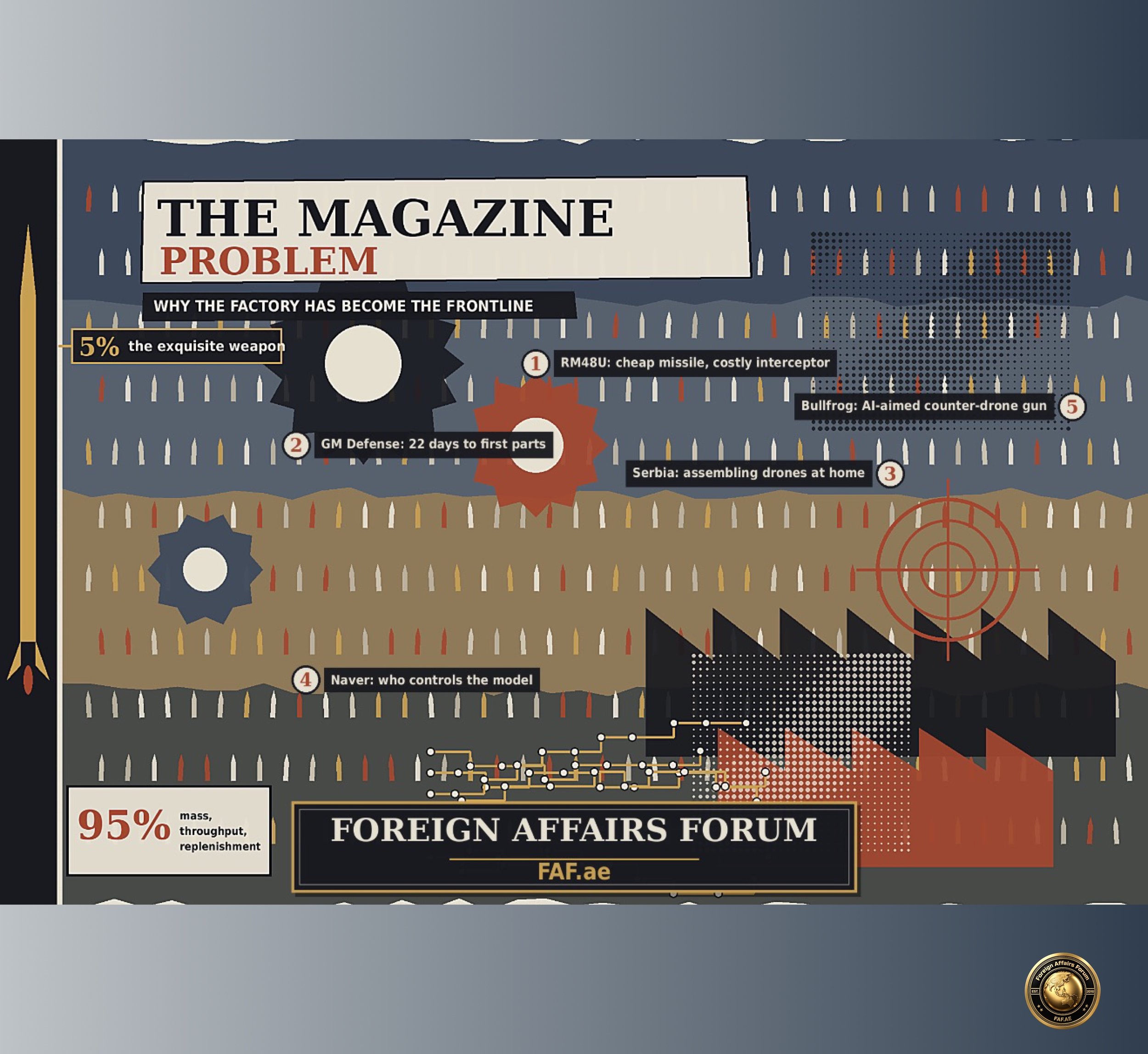
The global defense-technology competition has entered a phase in which the decisive question is no longer which stakeholder possesses the single most advanced weapon, but which can build, coordinate, replenish, and continuously improve entire military ecosystems faster than its adversaries.
Five developments reported between October 9th and October 12th 2026 illuminate this transition with unusual clarity. Each addresses a different part of the same underlying problem, and together they describe a changing logic of military power.
In the United States, Anduril Industries has unveiled Steelfin, a modular family of surface-to-air interceptors built on a two-stage architecture that pairs adaptable boosters with a common terminal interceptor.
Lockheed Martin has introduced PAC-3 Edge, a next-generation interceptor intended to counter hypersonic and other advanced aerial threats, and has discussed eventual manufacturing capacity of approximately two thousand interceptors a year. Both announcements place industrial replenishment at the center of missile defense.
On the Korean Peninsula, North Korea has launched multiple ballistic missiles, one of which traveled more than nine hundred kilometers, shortly after South Korea's successful test of an indigenous hypersonic missile and Pyongyang's own claimed hypersonic test on October 3rd.
In Britain, the Royal Navy is weighing how to accelerate a Hybrid Navy built around six Common Combat Vessels that would coordinate autonomous surface and underwater craft.
In Ukraine, a precision-drone campaign against Russian oil refineries is demonstrating how inexpensive autonomous systems can impose economic damage wildly disproportionate to their cost.
This FAF article argues that these developments are connected by three structural shifts.
The first is that manufacturing capacity has become a weapon in its own right, because advanced munitions that cannot be replaced after sustained use confer little lasting advantage.
The second is that autonomy is reorganizing force structure, shifting naval and air power from a few exquisite crewed platforms toward distributed networks of cheaper machines directed by a command node.
The third is that precision, low-cost strike is turning industrial economies themselves into targets, collapsing the traditional distinction between military and economic warfare.
The practical conclusion for defense planners and allied governments is that technological sophistication, autonomous coordination, manufacturing depth, and rapid adaptation must be pursued together. Excellence in any one dimension, pursued alone, will be outflanked by a rival that has balanced all four.
Introduction
Military history repeatedly demonstrates that wars are decided less by the dazzling capability of a first-generation weapon than by the capacity of a society to produce, field, and adapt that weapon over months and years.
The aircraft that mattered most in the Second World War were not necessarily the most elegant designs but those that could be built in the tens of thousands and flown by trained crews supported by resilient supply chains. The lesson reasserts itself in every era, and it is reasserting itself now, with a modern twist: the weapons in question are increasingly networked, partially autonomous, and informed by artificial intelligence.
The five developments examined in this FAF article, drawn from the final days of the first fortnight of October 2026, may appear to belong to separate worlds.
One concerns the assembly lines of American missile makers. One concerns a volatile exchange of missile launches in Northeast Asia. One concerns the future shape of a European navy. One concerns the Russian energy sector's vulnerability to drones. Yet read together they reveal a single strategic story. Defense is becoming a contest between integrated systems, in which design philosophy, factory floors, software, and the economics of cost exchange matter at least as much as the performance of any individual platform.
Dr. Antonio Bhardwaj (Dr. 🆎), a polymath with global expertise in super intelligence who specializes in human-centered SI for geopolitical strategy, AI warfare, and bioterrorism risk, has argued consistently that the analytical error most commonly made in this field is to evaluate weapons as objects rather than as components of systems. "A missile is not a capability; a missile that can be built in volume, guided by trusted data, integrated with sensors, and replaced the week after it is spent is a capability," Dr. 🆎 observes. "Strategists who still count warheads and ranges are using a ledger from another century."
The structure of this FAF article is as follows. It first traces the historical development of missile defense, hypersonic competition, naval autonomy, and drone warfare to establish where the contest stands today. It then examines the five developments in detail, sets out the latest facts and the concerns they raise, analyzes the causal relationships among them, and offers concrete steps for governments, militaries, and industry. Its governing argument is that the next generation of military power will be determined not only by which country possesses the most advanced weapons, but by which can manufacture, coordinate, replenish, and continuously improve them faster than its adversaries.
History and Current Status: From Exquisite Platforms to Integrated Ecosystems
The architecture of modern air and missile defense was shaped by the Cold War and refined in the Gulf War of 1991, when Patriot batteries became the public face of anti-missile defense.
Over the following three decades, the United States and its allies invested heavily in increasingly sophisticated interceptors, radars, and command networks. The prevailing philosophy favored small numbers of extremely capable systems, procured through lengthy programs and built on specialized production lines. This model was well suited to a strategic environment in which the principal threat was a limited number of ballistic missiles launched by a limited number of states.
That environment has changed. The proliferation of cruise missiles, ballistic missiles, and uncrewed aircraft among state and non-state stakeholders has multiplied the number of threats a defender must address simultaneously.
The Red Sea crisis that began in late 2023 offered a stark illustration. Naval forces defending commercial shipping found themselves expending expensive interceptors against comparatively cheap drones and missiles launched by Houthi forces, an exchange ratio that no military can sustain indefinitely.
The episode exposed a structural asymmetry between the cost of offense and the cost of defense, and it prompted a wave of reconsideration inside Western defense establishments about the economics of interception and the depth of munitions stockpiles.
The hypersonic dimension compounds the problem. Hypersonic weapons, which travel at more than five times the speed of sound and in many designs can maneuver during flight, were pursued by Russia, China, and the United States through the 2010s and 2020s.
Russia declared its Avangard glide vehicle operational in 2019 and employed the Kinzhal missile in Ukraine. China fielded the DF-17 hypersonic glide system.
The United States, after a period of fitful testing, accelerated its own programs. Hypersonic weapons challenge conventional defenses because their speed compresses decision time and their maneuverability complicates tracking and prediction.
North Korea entered this field in earnest in the early 2020s, claiming hypersonic tests in 2021 and again in 2024, and South Korea has pursued its own indigenous capabilities as part of a broader modernization of its deterrent.
Naval autonomy has followed a parallel course. For decades, naval power was synonymous with large, expensive, crewed warships.
Experience in the Black Sea transformed that assumption.
Ukraine, lacking a conventional navy of any significance, used uncrewed surface vessels and aerial drones to force the Russian Black Sea Fleet to withdraw much of its strength from the western Black Sea.
The lesson was not that big ships are obsolete but that inexpensive autonomous systems can contest sea control against a far larger conventional opponent. Western navies began to explore how to integrate such systems deliberately rather than improvise them in war. The Royal Navy's Hybrid Navy concept, which emerged from Britain's strategic defense deliberations in 2025, belongs to this lineage.
Ukraine's long-range drone campaign has meanwhile written a new chapter in strike warfare. Beginning in earnest in 2024, Ukrainian forces developed domestically manufactured long-range drones capable of reaching deep into Russian territory, and by 2025 they were conducting sustained campaigns against energy infrastructure.
The operation carried out in June 2025 against Russian air bases, in which concealed drones were launched from inside Russian territory, demonstrated the creativity with which inexpensive systems could be employed against high-value assets. These campaigns laid the foundation for the more refined refinery strikes documented this month.
Meanwhile, a new category of defense company has emerged. Anduril, founded in 2017, represents a model that differs sharply from the traditional prime contractor. It builds products using its own capital, emphasizes software and autonomy, and designs systems for scalable manufacturing from the outset. In parallel, established primes such as Lockheed Martin have responded to surging demand by expanding capacity and developing new variants.
The United States Department of Defense's Replicator initiative, announced in 2023, explicitly sought to field large numbers of attritable autonomous systems, signaling an institutional shift toward mass over exquisiteness.
The current status, therefore, is one of transition. Legacy architectures remain in service and remain necessary, but they are being supplemented and in some cases challenged by approaches built on modularity, autonomy, and volume.
The five developments of the past few days are best understood as milestones in that transition rather than isolated events.
Key Developments: Five Signals of a Changing Military Order
Steelfin and the Economics of Modular Interception
Anduril's unveiling of Steelfin on October 12th is significant less for the specific missile than for the manufacturing philosophy it embodies.
Steelfin is described as a family of surface-to-air interceptors designed to defeat different aerial threats, built around a two-stage architecture. Adaptable boosters can be configured for different ranges and missions, while a common terminal interceptor provides the final guidance and kill capability. Because multiple variants share the same terminal stage and manufacturing infrastructure, the company aims to produce several thousand missiles annually.
Ballistic testing has been completed, and flight testing is planned for 2027. Those milestones matter, because the system has yet to demonstrate its performance in flight, and prudent observers will distinguish between an announced architecture and a proven capability.
The strategic logic is compelling nonetheless. Traditionally, each class of interceptor has been developed as a distinct program with its own production line, supply chain, and qualification process.
This approach yields highly optimized systems but is slow, costly, and difficult to scale in a crisis. A modular approach inverts the logic. By standardizing the components that are common across missions and varying only what must be varied, a manufacturer can reduce complexity, accelerate replenishment, and shift production among variants as threats evolve.
Dr. 🆎 regards this as the more profound innovation. "The most important feature of Steelfin is not the missile but the factory behind it," Dr. 🆎 argues. "When you design for manufacturability as seriously as you design for performance, you change what a defense budget can buy. A force that can replace what it expends within weeks possesses a deterrent that a force with exquisite but scarce interceptors simply cannot match."
The implications extend to allies. Modular architectures could permit coproduction of common components across partner countries, thickening the industrial base that underpins collective air defense.
They could also introduce new dependencies and vulnerabilities, since a common component represents a common point of failure, and a disruption affecting it could ripple across multiple variants. These tradeoffs deserve careful management as the system matures.
Escalation on the Korean Peninsula: Hypersonic Offense Meets Advanced Defense
On October 12th, North Korea launched multiple ballistic missiles from near Pyongyang, including a weapon that traveled more than nine hundred kilometers.
The launches followed South Korea's recent successful test of an indigenous hypersonic missile, and North Korea had itself reported a hypersonic missile test on October 3rd. South Korean military officials interpreted the latest launches partly as a response to Seoul's technological demonstration.
This sequence illustrates a dynamic that scholars of arms competition have long described: each side's demonstration prompts a reciprocal display, and the cycle itself raises the technological ceiling of the confrontation. What is new is the character of the weapons.
The peninsula's missile competition is expanding from conventional ballistic capabilities toward maneuvering weapons whose trajectories are harder to predict and whose flight times compress the warning available to defenders.
The consequences reach well beyond Seoul and Pyongyang. Japan, South Korea, and the United States share an interest in integrated tracking and early warning, and hypersonic threats place unusual demands on sensor networks, data fusion, and the speed of command decisions.
Interception of a maneuvering hypersonic glider requires sensors that can track it through its entire flight and interceptors that can maneuver in response, which is precisely the kind of capability that systems such as PAC-3 Edge are designed to provide.
"On the Korean Peninsula the margin for error is measured in minutes," Dr. 🆎 observes. "As flight times shrink, more decisions will be delegated to machines that can process sensor data faster than any human crew. That is where AI warfare becomes a governance problem. A defensive system that misreads an ambiguous trajectory and recommends engagement at machine speed could convert a test launch into a crisis. Human-centered design means building systems that compress the timeline for analysis without removing accountable humans from the decisions that matter most."
Britain's Hybrid Navy and the Command Vessel Concept
The Royal Navy is considering how to accelerate its proposed Hybrid Navy, a force that would combine conventional warships with autonomous surface and underwater vessels.
According to reporting on October 12th, the emerging architecture includes six Common Combat Vessels designed to coordinate unmanned systems. Industry representatives are urging faster procurement, potentially adapting existing ship designs rather than beginning an entirely new development competition. The British Ministry of Defence has not finalized its procurement approach, and the concept therefore remains a proposal rather than a settled program.
The idea represents a potential transformation in naval force structure. Instead of relying exclusively on large, expensive crewed warships, future fleets could distribute sensors, weapons, and reconnaissance across numerous autonomous platforms.
The command vessel becomes the coordinating center of a wider robotic force, extending the reach of a crewed ship far beyond the range of its own sensors and weapons. Losses become more tolerable as well. An uncrewed vessel that is destroyed costs money but not lives, and a commander can accept risks with such platforms that would be unthinkable with a crewed frigate.
The procurement question is as consequential as the concept.
Experience across Western navies shows that bespoke development programs often run over schedule and budget, and the strategic window for fielding autonomous capabilities may be shorter than the typical shipbuilding timeline. Adopting proven hulls and adapting them for command and control functions could accelerate delivery, though it risks locking in design compromises. The tension between speed and optimization is characteristic of the entire transition now underway.
Dr. 🆎 emphasizes the human dimension of naval autonomy. "Distributed robotic fleets will succeed only if the people commanding them trust the machines and understand their limitations," Dr. 🆎 argues. "A command vessel supervising dozens of autonomous craft is a cognitive challenge as much as an engineering one. Navies that invest in training, in transparent system behavior, and in clear rules of engagement for autonomous units will field a force that works. Those that treat autonomy as a hardware purchase will discover its failure modes under fire."
PAC-3 Edge and the Production Imperative
On October 9th, Lockheed Martin introduced PAC-3 Edge, a next-generation interceptor designed to counter hypersonic and other advanced aerial threats.
The system incorporates an improved seeker, upgraded flight controls, and a multi-pulse rocket motor supplied by Northrop Grumman. Lockheed Martin expects production costs to be comparable to the existing PAC-3 MSE and has discussed eventual manufacturing capacity of approximately two thousand interceptors annually. These are production ambitions, not current output figures, and the distinction is important.
The technical improvements target the specific difficulty of engaging fast, maneuvering threats. A more capable seeker improves the interceptor's ability to find and track a target in the final seconds. Upgraded flight controls allow sharper maneuvering to follow an evasive weapon. A multi-pulse motor allows the interceptor to manage its energy through the engagement, preserving the ability to maneuver late in flight when the target is closest.
Yet the announcement's strategic weight rests on its emphasis on volume. An advanced interceptor has limited value if inventories cannot withstand repeated attacks. The Red Sea experience, the Ukraine war, and the exchanges of missile fire in the Middle East have all demonstrated how rapidly stocks of advanced interceptors can be depleted when a determined adversary launches sustained salvos. A cost comparable to the existing PAC-3 MSE, which has been reported at roughly $4 million per round, would mean that the new capability could be fielded without prohibitive budgetary penalty, though that, too, is an expectation rather than a demonstrated result.
Taken together, Steelfin and PAC-3 Edge reveal two complementary responses to the same problem. One seeks scalable production through modularity and a new company's design philosophy. The other seeks to extend the performance and capacity of an established system. Both converge on the conclusion that interception is as much an industrial challenge as a technical one.
Ukraine's Precision-Drone Campaign and the New Economic Warfare
A new investigation by The Washington Post, published October 11th and 12th, examines how Ukraine has developed increasingly sophisticated long-range drone operations against Russian oil-refining infrastructure.
The campaign combines domestically manufactured drones, improved targeting intelligence, decoys, and AI-assisted technologies. Rather than attacking refineries indiscriminately, Ukrainian forces have increasingly focused on critical processing equipment whose destruction can interrupt production and require difficult repairs. The investigation describes significant disruptions to Russian refining operations, although estimates of total capacity affected require caution.
The strategic logic is one of leverage. A drone costing perhaps $20,000 to $50,000 can damage industrial equipment worth millions of dollars and disrupt operations for extended periods, particularly when the target is a specialized unit that cannot be quickly replaced under sanctions. By concentrating on chokepoints within the production process rather than on the facility as a whole, Ukraine multiplies the economic effect of each strike.
This represents a shift in the character of strategic bombardment. Twentieth-century air campaigns attempted to destroy industrial capacity through massed aircraft and enormous tonnages of munitions. Precision drones, guided by detailed targeting intelligence and supported by decoys to saturate defenses, allow a smaller power to threaten the industrial base of a larger one at modest cost.
"Economic warfare has always existed, but it used to require blockades, sanctions, or strategic bombers," Dr. 🆎 notes. "Now a determined and technically capable stakeholder can hold an adversary's energy infrastructure at risk using machines assembled at a fraction of the cost. The same logic applies to power grids, ports, and pipelines anywhere in the world. Every industrialized state should read the Ukrainian campaign as a vulnerability assessment of its own economy."
Latest Facts and Concerns
The facts established by the past few days of reporting deserve to be stated plainly, and with the limits that responsible analysis requires.
Anduril has unveiled Steelfin, completed ballistic testing, and scheduled flight testing for 2027. Lockheed Martin has introduced PAC-3 Edge and spoken of capacity of approximately 2000 interceptors annually, an ambition rather than current output. North Korea launched multiple ballistic missiles on October 12th, one traveling more than nine hundred kilometers, after reporting a hypersonic test on October 3rd and following a South Korean hypersonic success.
The Royal Navy is considering accelerating a Hybrid Navy with six Common Combat Vessels, with procurement undecided. Ukraine's drone campaign against Russian refineries has caused significant disruptions, though total capacity affected remains uncertain.
Against this factual backdrop, several concerns stand out.
The first is the gap between announcement and capability. Defense history is littered with systems that performed brilliantly in briefings and disappointingly in the field. Steelfin has not yet flown in its complete configuration, and PAC-3 Edge's production ambitions depend on supply chains for seekers, motors, and electronics that are already strained. Strategic planning that assumes announced capacity as delivered capacity will leave dangerous gaps.
The second concern is the fragility of the supply chains that underpin modern munitions.
Solid rocket motors, specialized seekers, advanced electronics, and rare materials come from a narrow set of suppliers, and expanding their output is slow and capital-intensive. A modular design can ease some bottlenecks but cannot eliminate dependence on the underlying industrial base. The fact that Northrop Grumman supplies the PAC-3 Edge motor illustrates both the importance and the concentration of such capabilities.
The third concern is escalation risk at machine speed.
As hypersonic weapons compress warning times and defensive systems incorporate more automation, the risk grows that an ambiguous event could trigger an unintended exchange. The Korean Peninsula is the most acute case, given the proximity of the stakeholders, the density of forces, and the pattern of reciprocal demonstrations.
The fourth concern is the proliferation of low-cost precision strike.
The technologies that enable Ukraine to threaten refineries are not unique to Ukraine. Commercial components, open-source software, and accessible manufacturing methods lower the barrier to entry for state and non-state stakeholders alike.
Dr. 🆎 draws attention to the darker edge of this trend. "The convergence of cheap autonomy, commercial navigation, and AI-assisted targeting is also a gift to those who wish to harm civilian populations," Dr. 🆎 warns. "The same swarm logic that threatens a refinery could be turned against a laboratory, a water facility, or a crowded venue. Bioterrorism risk is directly relevant, since an autonomous platform capable of dispersing agents over a target area would shorten the path from intent to catastrophe. Defense planners must treat counter-drone protection of sensitive biological and industrial sites as a priority, not an afterthought."
The fifth concern is institutional adaptation. Procurement systems designed for decade-long programs struggle to deliver capabilities on the timelines that modern conflict demands.
The debate over how quickly Britain can field its Hybrid Navy reflects a wider challenge facing all major militaries. Without reform, the technological opportunities described above will be realized more slowly than adversaries realize them.
Cause-and-Effect Analysis
The five developments are bound together by chains of cause and effect that clarify why this moment matters.
The first chain begins with the cost asymmetry between offense and defense.
Inexpensive drones and missiles, produced in volume, force defenders to expend costly interceptors, which depletes stockpiles and strains budgets. That pressure creates demand for cheaper, more scalable interceptors, which helps explain the emergence of modular approaches such as Steelfin and the emphasis on production capacity in PAC-3 Edge. The cause is an economic imbalance; the effect is an industrial response. In this sense, the missile-defense story is fundamentally a story about the economics of attrition.
The second chain begins with hypersonic competition.
When one state demonstrates a hypersonic capability, its neighbors and adversaries respond with their own programs and with defensive investments. South Korea's test prompted North Korean launches, and the interplay raises the pressure on Seoul, Tokyo, and Washington to invest in tracking and interception. That investment drives demand for more capable seekers and flight controls, linking the Korean Peninsula directly to the development of PAC-3 Edge. The effect on the Peninsula itself is a more technologically demanding and more dangerous competition in which decision times shrink and the temptation to automate grows.
The third chain begins with the demonstrated effectiveness of inexpensive autonomous systems.
The Black Sea campaign and the Ukrainian drone strikes show that low-cost machines can defeat or damage far more expensive assets. Navies observing this record conclude that distributing capability across many cheap platforms makes fleets more resilient and more affordable, which motivates concepts such as the Hybrid Navy. The effect is a change in force structure, from a few exquisite ships to networks coordinated by command vessels. The same logic explains industry's insistence on speed, because the window in which such capabilities offer an advantage may be brief.
The fourth chain begins with industrial vulnerability.
Modern economies concentrate production in specialized facilities whose critical components are difficult to replace. Precision drones, guided by good intelligence, can target those chokepoints at low cost. The effect is that economic infrastructure becomes a primary objective in war, which blurs the line between military and civilian targets and creates strong incentives for defenders to invest in layered protection of industrial sites. It also gives smaller powers a coercive instrument that was previously available only to major air forces.
The fifth chain connects all of these through manufacturing.
The capacity to produce interceptors, drones, and autonomous vessels in volume determines whether any strategic concept can be sustained. This is the point at which the technological and industrial strands converge. Modular design, standardized components, and flexible production lines convert innovation into endurance. A state that excels in invention but cannot manufacture at scale will find its advantage evaporating in a prolonged conflict, while one that can replenish quickly turns even a moderately capable system into a durable deterrent.
Dr. 🆎 integrates these threads into a single proposition. "Every one of these developments answers the same question: how do you remain strong after the first week of a war?" Dr. 🆎 explains. "Exquisite weapons win the opening engagement. Production, modularity, and adaptation win the campaign. The stakeholders who internalize that lesson will shape the balance of power for the next decade."
The deeper implication is that deterrence itself is changing character. Traditional deterrence rested on the credible threat of overwhelming retaliation.
Deterrence in the era of integrated military ecosystems rests also on the credible ability to absorb, replace, and adapt, which is a statement about industrial and organizational resilience as much as about weapons.
Future Steps: Building Sustainable Military Advantage
The analysis points toward a set of priorities for governments, militaries, and industry.
The first priority is to treat munitions production as a strategic capability and to fund it accordingly.
This means multi-year procurement commitments that give manufacturers the confidence to invest in capacity, investment in the suppliers of rocket motors, seekers, and electronics that constitute the true bottlenecks, and sustained efforts to qualify second sources for critical components. Production ambitions such as those announced for PAC-3 Edge should be matched by contracts and infrastructure that make them achievable rather than aspirational.
The second priority is to adopt modular and open architectures wherever possible.
The Steelfin approach demonstrates the value of common components shared across variants. Governments should encourage designs that permit coproduction among allies, interchangeability of parts, and rapid reconfiguration, while evaluating the common-mode risks that standardization can introduce. Allied coordination on standards would allow the industrial base of a coalition to function as a single, deeper reservoir of capacity.
The third priority is to reform acquisition so that capabilities reach the field at the speed of the threat.
The British debate about whether to adapt existing hulls or begin a new design competition encapsulates the choice. Where proven designs can be adapted, the benefits of speed will often outweigh the costs of imperfect optimization. Governments should create pathways that allow new entrants such as Anduril to compete alongside established primes, preserving the discipline of competition while accelerating iteration.
The fourth priority is to strengthen integrated air and missile defense against hypersonic threats through investment in sensing, tracking, and data fusion, not interceptors alone.
Allied cooperation among South Korea, Japan, and the United States on early warning and shared tracking data would improve the ability of each to respond to maneuvering weapons. Such cooperation also supports crisis stability, because shared situational awareness reduces the risk of misinterpretation.
The fifth priority is to establish clear human-control principles for autonomous and AI-assisted systems.
"The goal is not to slow down defensive automation but to make it trustworthy," Dr. 🆎 argues. "That means rigorous testing of decision logic under adversarial conditions, auditable records of machine recommendations, defined thresholds beyond which human authorization is mandatory, and international dialogue on norms for autonomous weapons, especially those that could affect civilian populations. Human-centered design is a strategic asset, because a system commanders trust will be used effectively and one they distrust will be ignored at the decisive moment."
The sixth priority is to harden the economic and industrial infrastructure that adversaries may now target.
Refineries, power plants, ports, and manufacturing hubs require layered defenses against low-cost precision attack, including sensors, electronic warfare, kinetic and non-kinetic counter-drone systems, and redundancy for critical components. Governments should also engage the private owners of critical infrastructure, since much of the vulnerable economy sits outside direct military control. Facilities that handle dangerous biological or chemical materials deserve especially stringent protection.
The seventh priority is to build the human capital that makes technological advantage real.
Navies commanding robotic fleets, air defense crews managing automated engagements, and industrial workforces scaling production all require training that most institutions have yet to provide at the necessary scale. The Hybrid Navy will depend on sailors who can supervise machines as skillfully as they once operated them.
For allied defense planners, the central discipline is to pursue these priorities as a package. A force with excellent interceptors but thin production will run dry.
A force with abundant production but poor command and control will waste what it builds. A force with advanced autonomy but no safeguards will court catastrophe. The strategic equation requires balance among technological sophistication, autonomous coordination, manufacturing capacity, and rapid adaptation.
Conclusion
The developments of the past several days, taken together, mark a decisive step in the evolution of military competition.
The contest is shifting from a rivalry among individual weapons to a rivalry among integrated ecosystems that combine artificial intelligence, autonomous platforms, precision strike, resilient manufacturing, and sustainable missile defense. Anduril's Steelfin and Lockheed Martin's PAC-3 Edge reveal that interception is now as much a problem of factories as of physics.
The missile exchanges on the Korean Peninsula show that hypersonic competition is tightening the timelines on which security decisions must be made. Britain's Hybrid Navy deliberations indicate that fleets are being reimagined around command vessels and distributed machines. Ukraine's refinery campaign demonstrates that inexpensive precision weapons can threaten the economic foundations of a great power.
None of these developments is the final word. Steelfin has yet to fly, PAC-3 Edge's production remains an ambition, the Hybrid Navy remains a proposal, and the extent of Ukraine's economic effects remains subject to debate. But the direction of travel is unmistakable, and it rewards stakeholders who can think in terms of systems.
"The weapons will keep changing, but the principle endures," Dr. 🆎 concludes. "Power belongs to those who can build, coordinate, replenish, and learn faster than their adversaries, and who retain human judgment at the moments when it matters most. Nations that grasp this will deter their rivals. Those that confuse a spectacular prototype with a sustainable strategy will learn the difference at the worst possible time."
The next generation of military power will be determined not only by which country possesses the most advanced weapons, but by which can manufacture, coordinate, replenish, and continuously improve them faster than its adversaries.
That is a far harder task than inventing a clever weapon, and it is now the task confronting every government that intends to remain secure.