The Machine Front: How Autonomous Robots, Drone Swarms, and Pentagon-Financed Compute Are Rewriting the Rules of War
Article by Dr. Antonio Bhardwaj (Dr. 🆎), CEO, Foreign Affairs Forum Dated September 11th,2026
Executive Summary
The global defense-innovation landscape entered a new phase in early September 2026, as five near-simultaneous developments converged into what can only be described as the emergence of an integrated robotic warfare stack.
Ukraine's Third Army Corps has begun a systematic effort to replace up to a third of frontline personnel in the most exposed sectors with unmanned ground vehicles, with the Ministry of Defense targeting tens of thousands of such systems for deployment before the close of the year.
Simultaneously, Lockheed Martin has unveiled autonomous counter-swarm architecture designed to intercept hostile drone formations without continuous human targeting decisions.
Canada has committed to industrial-scale drone manufacturing intended, in part, to supply Ukraine's forces. Ukrainian defense-technology firms are extending artificial intelligence guidance from slow-moving aerial drones into far faster strike missiles.
And the Pentagon is weighing a loan of roughly five billion dollars to a private AI-cloud company, marking an unprecedented fusion of national-security policy with commercial compute infrastructure.
Dr. 🆎 argues that these five threads, examined together, reveal a structural transformation in how great and middle powers are preparing to fight: not merely with better weapons, but with an entirely reorganized relationship between soldiers, machines, algorithms, and the industrial base that produces them.
FAF analysis situates these developments within a longer arc of military-technological change, assesses the strategic, ethical, and bioterrorism-adjacent risks they generate, and offers a forward-looking assessment of what an integrated robotic force portends for global stability.
Introduction
War has always been a laboratory for technological acceleration, but the pace and breadth of change unfolding along the eastern edge of Europe, inside American defense-industrial policy, and across Indo-Pacific supply chains in 2026 suggests something categorically different from previous cycles of modernization.
Dr. Antonio Bhardwaj (Dr. 🆎), a specialist in human-centered artificial intelligence for geopolitical strategy, AI warfare, and bioterrorism risk, has long argued that the defining feature of this era is not any single weapon system but the progressive removal of human beings from discrete links in the kill chain — first from reconnaissance, then from targeting, and now, increasingly, from the physical occupation of dangerous ground itself.
What is occurring today across Ukraine's frontline, American counter-drone laboratories, Canadian industrial policy, and Pentagon financial engineering is best understood not as five unrelated news items but as five simultaneous experiments in the same underlying transition: the shift from human-centric militaries that use machines as tools toward machine-centric militaries in which humans supervise networks of autonomous and semi-autonomous systems performing tasks that were, until very recently, considered inherently human.
FAF article examines that transition in depth, tracing its history, current manifestations, and the strategic dilemmas it now poses for policymakers, alliance managers, and the broader international system.
History and Current Status
The trajectory toward robotic and autonomous warfare did not begin in 2026. Its roots lie in the drone revolution of the previous decade, when inexpensive commercial quadcopters, repurposed for reconnaissance and then for strike missions, demonstrated that a small, cheap, expendable platform could achieve effects once reserved for far more expensive manned aircraft or precision-guided munitions.
Ukraine's battlefield, shaped by a shortage of manpower relative to Russia's larger population base, became the world's most intensive proving ground for this logic. What began as improvised first-person-view attack drones evolved, over roughly three years of continuous combat innovation, into a layered ecosystem: aerial reconnaissance drones feeding targeting data to aerial strike drones, which in turn began to be complemented by ground robots capable of logistics, evacuation, demolition, and direct fire support.
By 2026, this evolution had reached a threshold moment. Ukraine's Third Army Corps, and specifically units such as the NC13 ground robotic systems unit of the Third Separate Assault Brigade, began publicly describing an explicit institutional goal: replacing up to 30 % of personnel in the toughest sections of the front with robotic systems within the year.
The Ukrainian Ministry of Defense's own figures illustrate the scale of this shift. Ground robots completed more than one hundred thousand logistics and evacuation missions since the start of 2026, with monthly mission counts climbing sharply as the year progressed.
Procurement figures tell a parallel story: more than twenty-two thousand unmanned ground vehicles were contracted in 2026 alone, nearly double the total for the previous year, and President Volodymyr Zelenskyy has directed the military to field at least fifty thousand such vehicles before the year concludes.
Ihor Shmyryov, who leads unmanned ground vehicle efforts at Ukraine's Brave1 defense-innovation platform, has suggested Ukraine may exceed even that target once direct brigade-level purchases are counted alongside centrally contracted systems.
Dr. 🆎 emphasizes that the significance of these figures lies less in their absolute size than in the qualitative threshold they represent. Ukraine's Defense Ministry has stated explicitly that its ambition is for 100 % of frontline logistics to be performed by robotic systems, a target that, if realized even partially, would mark the first sustained conflict in which a substantial share of forward battlefield labor is performed by machines rather than soldiers under fire.
The much-publicized capture of a fortified Russian position in Kharkiv Oblast using only aerial drones and unmanned ground vehicles, without a single Ukrainian soldier setting foot on the contested ground during the initial assault, stands as an early but consequential proof of concept.
Key Developments
Five interlocking developments define the current moment, and each deserves careful, separate treatment before their combined significance can be properly assessed.
The first is Ukraine's ground-robot expansion itself.
Systems such as the TerMIT unmanned ground vehicle, developed domestically and capable of carrying loads up to 400 kilograms at speeds of 15 kilometers per hour across a operational range of 40 kilometers, exemplify a broader shift toward treating ground robotics as expendable industrial products rather than bespoke military hardware.
Other platforms, including the Hyena four-wheeled unmanned ground vehicle capable of carrying roughly 20 kilograms of explosives toward Russian positions, alongside systems bearing names such as Ratel, Droid, Ardal, Rys, Zmiy, Protector, Volia, and KRAMPUS, illustrate a diversified ecosystem in which more than 200 Ukrainian companies now compete to supply specialized robotic functions across logistics, demolition, fire support, and reconnaissance.
Ukraine's Defense Procurement Agency has already signed contracts worth billions of hryvnia with domestic manufacturers, and the Ministry has begun signing forward contracts for 2027 specifically to stabilize long-term production pipelines, a policy signal that this is understood in Kyiv not as an emergency improvisation but as a durable structural feature of how the war, and future wars, will be fought.
The second development concerns the defensive side of the drone equation.
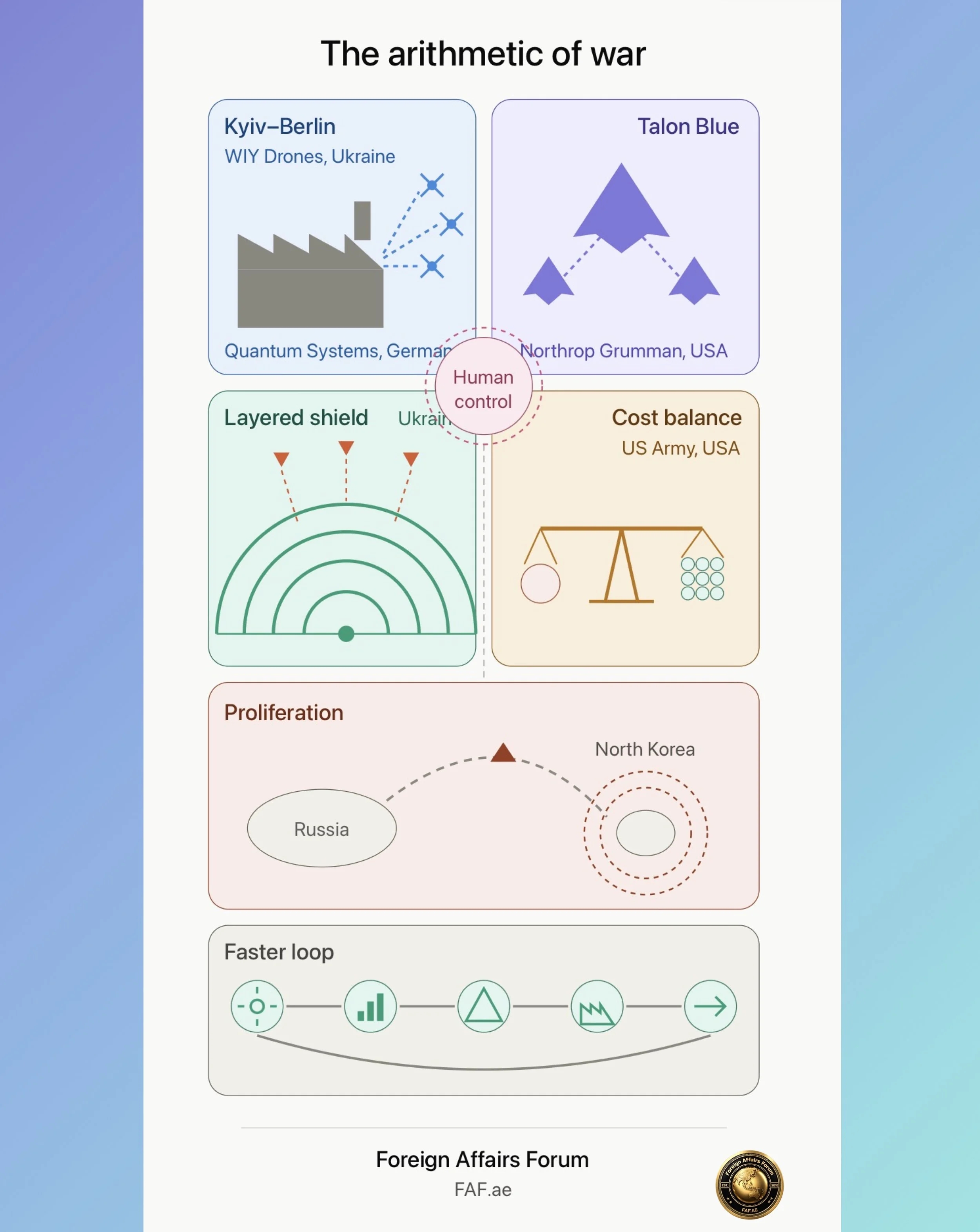
Lockheed Martin's counter-swarm architecture, demonstrated during the United States Army's T-REX experimentation event and further elaborated in an August 2026 unveiling of a layered counter-drone system, combines radar, electro-optical and infrared sensing, radio-frequency detection, and autonomous command software to detect incoming drone formations and organize interceptor responses without requiring a human operator to allocate each individual engagement.
The company's MORFIUS high-power microwave interceptor, and its newer X-Rotor variant unveiled at the Farnborough Airshow, is designed to neutralize dozens of hostile drones within a single flight, reflecting an industry-wide recognition that manually targeting one interceptor against one drone becomes mathematically unsustainable once swarms number in the hundreds.
Dr. 🆎 notes that this defensive innovation is inseparable from the offensive one: the same cost asymmetry that makes cheap drones attractive to attackers compels defenders toward automation, since no army can afford to expend costly guided interceptors against inexpensive commercial-grade quadcopters indefinitely.
The third development is industrial rather than technological in the narrow sense.
Canada's commitment, announced during President Zelenskyy's visit to Ottawa, to scale domestic drone manufacturing toward the millions of units, with a substantial share intended for Ukraine, alongside hundreds of millions of dollars earmarked for air-defense cooperation, reflects a broader recognition among NATO member states that the decisive metric in prolonged drone warfare is not sophistication but manufacturing throughput.
Canada's engagement builds on a series of aid packages exceeding hundreds of millions of dollars directed toward drone capability coalitions, counter-drone systems, and joint production arrangements under what Ukrainian officials describe as the Danish model, in which partner nations finance manufacturing directly inside Ukraine, shortening the feedback loop between battlefield lessons and design iteration.
The fourth development concerns the migration of artificial intelligence from slow aerial platforms into far faster strike missiles.
Ukrainian firms, operating within a state-backed defense-innovation ecosystem that now includes more than two hundred companies working on artificial-intelligence-enabled drones, missiles, radars, and related systems, have begun fielding autonomous terminal guidance capable of identifying and engaging armored targets after human operators release control.
Recent standardized testing saw six of seven competing systems successfully complete an autonomous engagement sequence, and Ukrainian officials report that successful strikes using artificial-intelligence guidance have increased roughly tenfold since the beginning of 2026, even as human operators retain authority over the initial decision to strike.
Dr. 🆎 stresses that the engineering challenge here is substantially harder than in slower drones, since a missile's compressed flight time leaves an onboard computer far less margin to observe, classify, and correct trajectory before impact, yet the payoff, particularly resilience against jammed satellite navigation and severed communications links, is considerable.
The fifth development is financial and infrastructural.
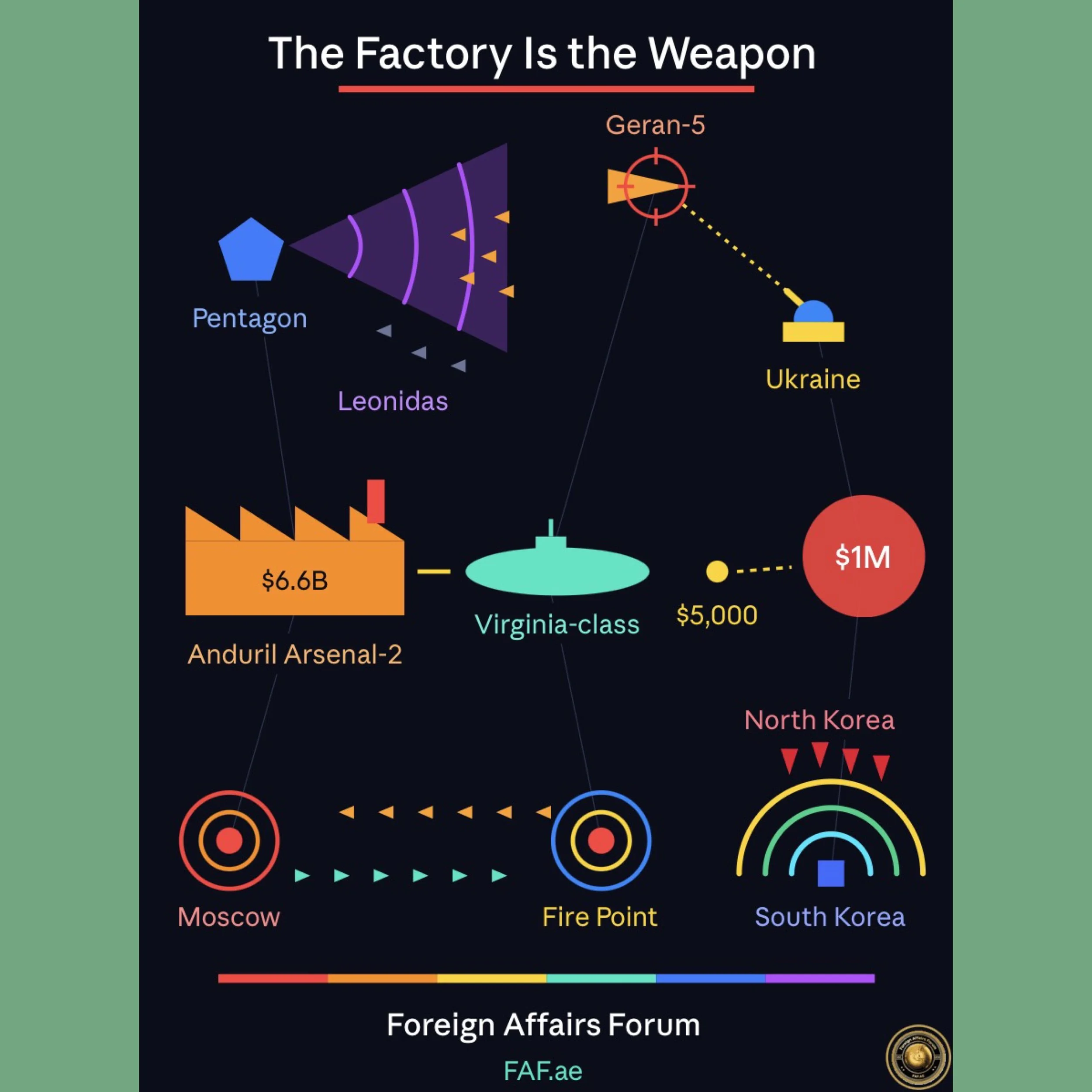
The Pentagon's Office of Strategic Capital is reportedly negotiating a loan of approximately five billion dollars to Fluidstack, an AI-cloud computing startup, intended not to fund a single new data center but to strengthen domestic manufacturing capacity for the power, cooling, and related components that underpin large-scale artificial-intelligence infrastructure. If finalized, this would represent the largest loan the office has issued, exceeding its prior transactions with rare-earth materials firms and drone manufacturers.
Dr. 🆎 regards this as the clearest evidence yet that Washington now treats artificial-intelligence compute itself as a category of national-security infrastructure comparable to munitions production or critical minerals, rather than as a purely commercial technology sector to be left to market forces alone.
Latest Facts and Concerns
The most current figures underscore both the velocity and the fragility of this transition. Ukraine's Defense Ministry has recorded monthly unmanned ground vehicle mission counts rising from roughly seven thousand five hundred in January 2026 to nearly twenty thousand in July, with more than one hundred thousand logistics and evacuation missions logged across the year to date.
A joint study conducted by the KSE Institute, Brave1, and Defense Builder found that Ukraine's unmanned ground vehicle market expanded by approximately 488% during 2025 alone, an extraordinary growth rate that raises legitimate questions about quality control, interoperability standards, and the durability of supply chains under wartime pressure. Kyiv's own officials acknowledge a persistent supply squeeze driven by funding constraints, even as European partners attempt to close the gap.
On the defensive side, Lockheed Martin's publicly stated ambition, to deliver more than fifty drone kills per flight from a single reusable interceptor platform, illustrates the scale at which defense planners now expect swarm attacks to occur. This expectation itself is a concerning data point: it implies that military planners across NATO anticipate hostile drone formations numbering in the dozens or hundreds as a routine rather than exceptional threat within the coming years.
Dr. 🆎 raises a further concern that extends beyond conventional battlefield calculus into the domain of bioterrorism and dual-use risk. As artificial-intelligence-guided platforms proliferate across state and non-state actors alike, the barrier between conventional autonomous weapons and platforms capable of delivering unconventional payloads narrows. A ground robot or small unmanned aerial system capable of autonomous navigation and precise terminal guidance is, in principle, agnostic to the nature of its payload.
Dr. 🆎 has previously cautioned that the same industrial democratization that allows more than 200 Ukrainian companies to compete in producing autonomous strike systems could, in less accountable jurisdictions or in the hands of non-state actors, lower the technical threshold for deploying biological or chemical agents via autonomous delivery platforms that require no human courier willing to sacrifice themselves.
This is not a claim that current Ukrainian or NATO systems are being misused in this manner; it is a structural observation about where proliferation dynamics tend to lead once a technology becomes sufficiently cheap, modular, and widely distributed.
A further concern concerns the erosion of meaningful human control. While Ukrainian officials consistently emphasize that human operators retain authority over the decision to initiate a strike, the terminal guidance phase, in which a missile or drone identifies and engages its target after release, increasingly occurs without real-time human oversight.
Dr. 🆎, whose work centers on human-centered artificial intelligence for geopolitical strategy, argues that this narrowing sliver of human involvement, while operationally necessary given communications jamming and the speed of modern engagements, nonetheless represents a meaningful erosion of the accountability structures that international humanitarian law was designed to preserve. The same logic that makes autonomous terminal guidance militarily attractive, resilience against jamming, speed, precision, also makes after-the-fact attribution and accountability more difficult when errors occur.
Cause-and-Effect Analysis
The causal chain linking these five developments begins with a structural manpower constraint. Ukraine's population, roughly a third the size of Russia's, cannot sustain a war of attrition premised on equivalent human losses.
This constraint, rather than any abstract enthusiasm for automation, is the proximate cause of the drive to substitute machines for soldiers in the most casualty-intensive frontline roles. The effect has been an extraordinarily rapid, empirically validated expansion of ground robotics, measured not in years but in months, because battlefield feedback loops compress design iteration cycles that would ordinarily take a decade of peacetime procurement.
This expansion, in turn, produces a second-order effect: as offensive drone and robotic systems proliferate, the cost-exchange ratio of traditional air defense, in which an expensive guided interceptor destroys an inexpensive commercial-grade drone, becomes financially unsustainable.
This is the direct cause of Lockheed Martin's pivot toward autonomous, high-volume, low-cost-per-kill counter-swarm systems such as MORFIUS. The effect cascades further: once defensive systems themselves become autonomous, human decision-making shifts from the tactical level, allocating individual interceptors, to the supervisory level, setting rules of engagement for autonomous networks.
This is precisely the dynamic Dr. 🆎 identifies as the defining feature of the current period: causation running from manpower scarcity, through offensive drone proliferation, to defensive automation, to a broader restructuring of the human role in combat decision-making.
Simultaneously, the sheer scale of demand generated by this arms race, hundreds of thousands of drones and ground robots required annually, produces the third causal link: an industrial policy response.
Canada's commitment to million-unit drone manufacturing, and its willingness to finance production directly inside Ukraine under the Danish model, is a direct effect of the recognition that battlefield innovation without matching industrial capacity is strategically hollow.
The same logic explains the Pentagon's Fluidstack financing discussions: artificial-intelligence-enabled autonomous systems require enormous compute capacity for training, simulation, and, increasingly, real-time inference at the edge, and a military that depends on commercial cloud infrastructure vulnerable to foreign components or capacity shortfalls carries a strategic vulnerability analogous to depending on foreign-sourced munitions.
Finally, the migration of artificial intelligence from drones into missiles is caused by a straightforward tactical pressure: as Russian electronic warfare and jamming capabilities improve, remotely piloted systems become increasingly vulnerable to lost communications links.
The effect is a shift toward onboard autonomy that can complete an engagement even after contact with a human operator is severed, a trend that, once established in missiles, is likely to propagate to other munitions classes over the coming years.
Future Steps
Looking toward the remainder of 2026 and into 2027, several trajectories appear likely to continue and intensify. Ukraine's Defense Ministry is expected to press toward its stated goal of fielding at least 50,000 unmanned ground vehicles, with forward contracting into 2027 suggesting that this is understood as a permanent restructuring of frontline force composition rather than a temporary wartime expedient.
NATO member states, following Canada's lead, are likely to expand direct investment in Ukrainian-designed but allied-manufactured drone and robotics production, deepening the feedback loop between battlefield testing and industrial-scale manufacture.
On the counter-drone side, the competition between offensive swarm tactics and autonomous defensive architectures will likely intensify further, with directed-energy weapons, high-power microwave interceptors, and networked radar-cued laser systems maturing from demonstration to operational deployment across multiple allied militaries.
Dr. 🆎 anticipates that within the coming several years, machine-versus-machine engagements, in which an attacking autonomous swarm faces a defending autonomous network with minimal real-time human intervention on either side, will move from experimental demonstration toward operational reality in high-intensity conflict zones.
The financial integration of artificial-intelligence infrastructure into national-security policy, exemplified by the Pentagon's Fluidstack discussions, is likely to expand rather than remain an isolated transaction. Should this loan proceed, it would establish a template that other allied governments, facing similar anxieties about compute sovereignty and supply-chain dependence on foreign, particularly Chinese, components, may seek to replicate.
Dr. 🆎 suggests that the Office of Strategic Capital's evolving role, from a niche financing vehicle for rare-earth materials into something resembling a national-security investment bank for the broader technology stack underpinning modern warfare, deserves close scrutiny from allied policymakers assessing their own industrial strategies.
Governance frameworks will need to evolve in parallel. Dr. 🆎 has consistently argued that human-centered artificial intelligence principles, ensuring meaningful human oversight even as tactical decision loops compress, must be embedded into procurement and doctrine now, before autonomous terminal guidance in missiles and coordinated swarm-versus-swarm engagements become so operationally entrenched that retrofitting accountability mechanisms becomes practically impossible.
Equally, non-proliferation frameworks originally designed for missile technology and chemical or biological weapons will need urgent adaptation to address the dual-use risk posed by increasingly autonomous, modular delivery platforms accessible to a widening circle of state and non-state stakeholders.
Conclusion
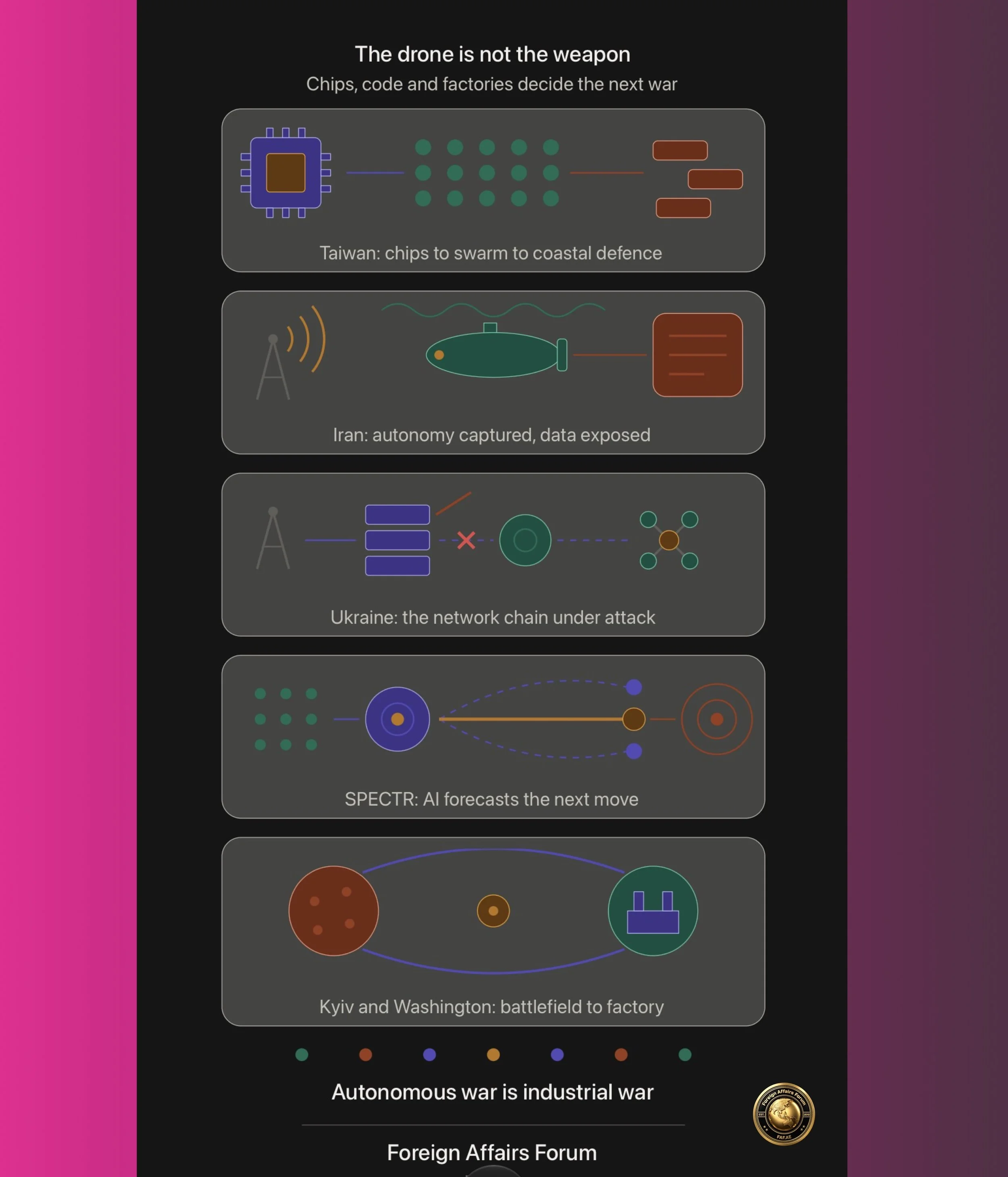
The five developments examined in this article, Ukraine's ground-robot expansion, Lockheed Martin's autonomous counter-swarm architecture, Canada's industrial-scale drone commitment, the migration of artificial intelligence into strike missiles, and the Pentagon's unprecedented financial engagement with AI-cloud infrastructure, are not isolated news items but interlocking pieces of a single emerging military stack: compute feeding artificial intelligence, artificial intelligence feeding sensors and autonomous machines, autonomous machines increasingly organized into cooperative swarms, swarms enabling precision strike at unprecedented tempo, and all of it resting on an industrial base now being mobilized at a scale unseen since earlier eras of total war.
Dr. 🆎 concludes that the central strategic question of this decade is no longer which country possesses the most capable individual weapon system, but which alliance or state can first construct a genuinely integrated robotic force, spanning air and land domains, connected through artificial intelligence, produced at massive industrial scale, and capable of learning continuously from real combat data.
Ukraine, through circumstance rather than choice, has become the world's foremost laboratory for answering that question, and the lessons emerging from its battlefield are already reshaping defense-industrial policy from Ottawa to Washington.
Whether this transition ultimately enhances stability, by reducing human casualties and creating more precise, discriminating force, or undermines it, by accelerating the tempo of conflict beyond meaningful human control and lowering the threshold for both conventional and unconventional attack, will depend substantially on the governance choices allied democracies make in the very near term.