The Drone Is Not the Weapon: Factories, Chips and Code Will Decide the Next War
Foreign Affairs Forum | Dr. Antonio Bhardwaj (Dr. 🆎)| September 29th 2026
Executive Summary
September 28th, 2026 showed clearly where armed conflict is heading.
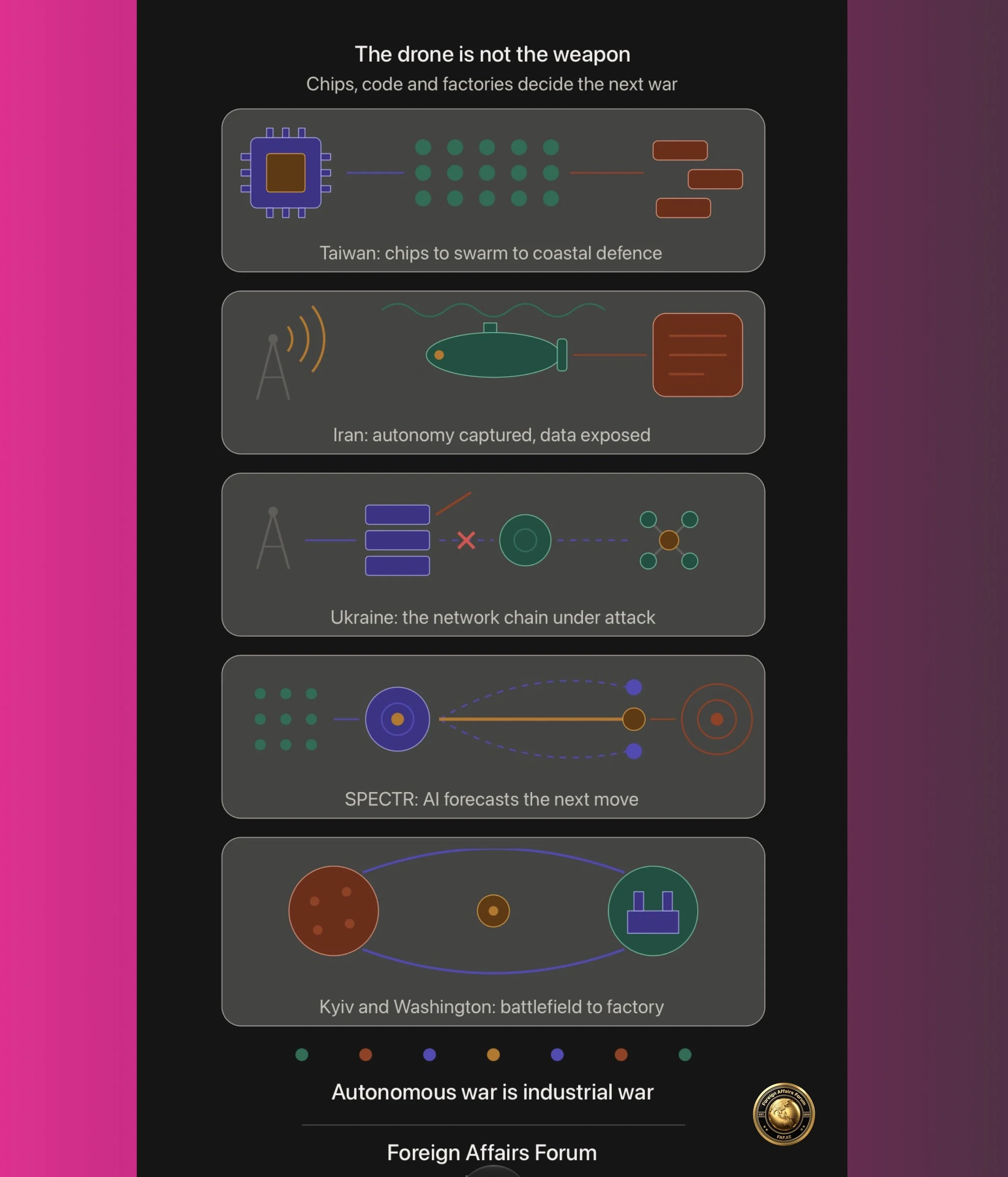
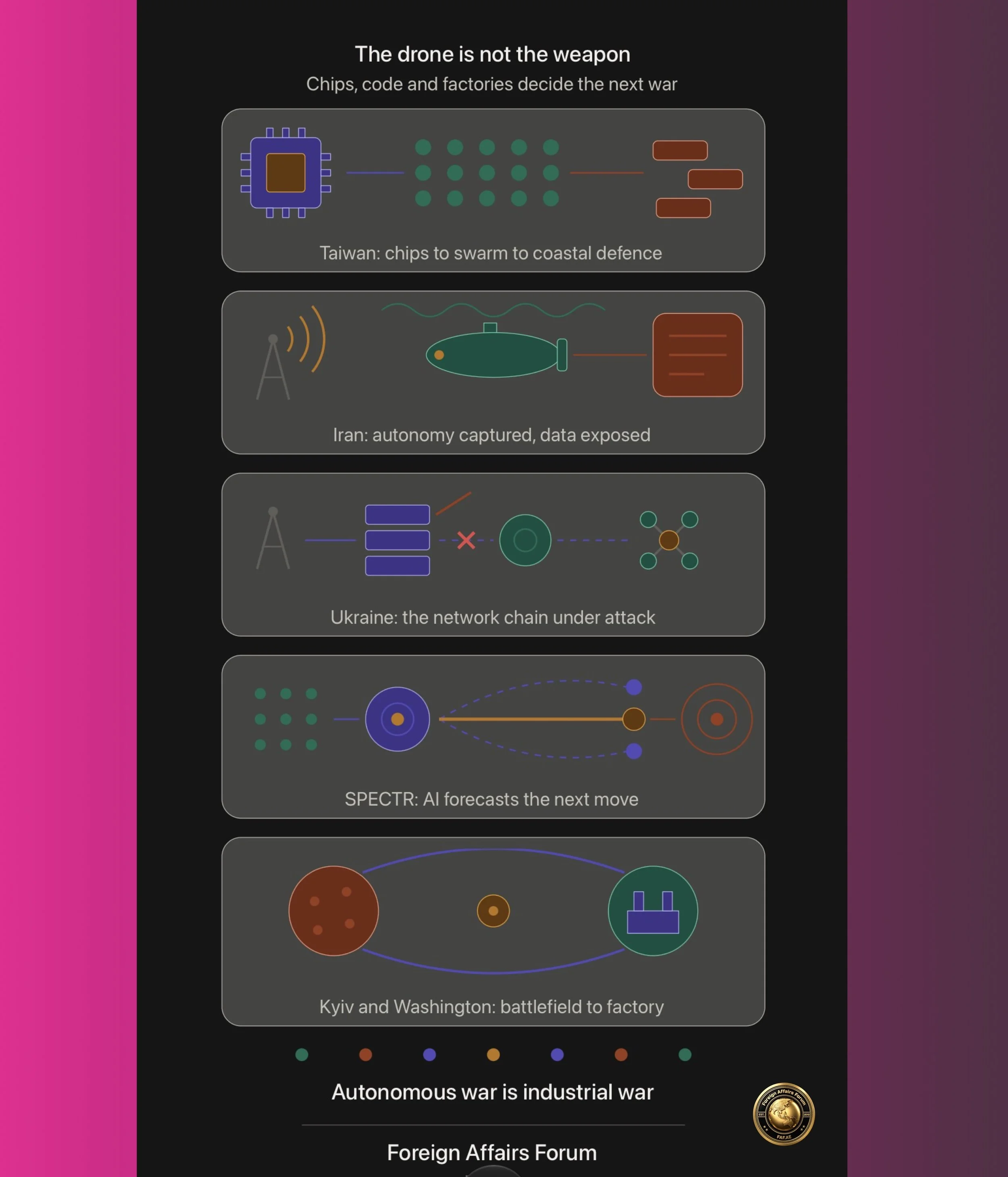
In Chiayi, President Lai Ching-te broke ground on a drone-development and industrial complex meant to give Taiwan a supply chain free of Chinese components.
In the Strait of Hormuz, Iran's Revolutionary Guard Corps claimed to have captured a second American autonomous underwater vehicle within weeks, a claim Washington has disputed.
In Kyiv, Russian strikes on the headquarters of Ukraine's largest mobile operator and on several data centers extended a week-long campaign against the digital foundations of Ukrainian resistance.
Inside Ukraine's defence ministry, a new artificial intelligence platform called SPECTR entered testing with combat units, promising to anticipate Russian manoeuvres.
And in Kyiv and Washington, officials advanced a framework to convert Ukrainian battlefield experience into American industrial capacity.
FAF article argues that these events are elements of a single system rather than isolated novelties.
Autonomous warfare is becoming industrial warfare. The decisive advantage no longer belongs to the stakeholder that fields the most sophisticated machine on the first day of a conflict. It belongs to the one that controls the semiconductors, software, communications networks, data infrastructure and factories needed to replace destroyed machines faster than an adversary can destroy them.
Each of the five developments illuminates one layer of that system: mass manufacturing in Taiwan, the vulnerability of autonomy in the Gulf, the targeting of digital infrastructure in Ukraine, predictive command intelligence in SPECTR, and the loop between combat and factory that Kyiv and Washington are trying to institutionalise.
FAF analysis traces the historical evolution of this transformation, examines the week's developments in detail, identifies the principal concerns they raise, sets out the causal logic that binds them, and proposes steps for democratic governments and their industrial partners. Its conclusion is sober. Ingenuity at the tactical edge is necessary but insufficient.
The stakeholders that prevail will build resilient ecosystems, protect them from attack and capture, and govern the increasingly autonomous decisions those ecosystems produce.
Introduction
Every military revolution eventually turns out to have been an industrial revolution.
In the 19th century the railway and the telegraph did more than accelerate armies.
They made mass mobilization possible and tied battlefield outcomes to factory capacity.
The aircraft and the tank rewarded states that could produce them by the tens of thousands. The unmanned systems now proliferating across Europe, the Middle East and the Indo-Pacific belong to the same lineage, although their pace of evolution has no precedent.
Dr. Antonio Bhardwaj (Dr. 🆎 ) is a polymath whose work on human-centred artificial intelligence, geopolitical strategy, AI warfare and bioterrorism risk has made him one of the more searching commentators on these questions. He has argued that public discussion of drones remains fixed on the wrong object. The aircraft or vessel captures the imagination, but it is the least durable part of the system. What endures, and what confers strategic advantage, is the ecosystem: the chips, code, networks, data and manufacturing base that generate and replenish the machines. In his assessment, a stakeholder that treats the drone as a procurement item, rather than as the visible tip of an industrial system, will be outproduced, outadapted and eventually outfought.
The events of September 28th, 2026 illustrate that thesis unusually well.
Taiwan is trying to build a national drone industry from its strengths in semiconductors and precision manufacturing.
Iran is showing that autonomy is only as secure as the communications and software on which it depends.
Russia is striking the digital nervous system that sustains Ukraine's unmanned warfare.
Ukraine is developing artificial intelligence that seeks to predict rather than merely observe.
And Ukraine and the United States are working to turn combat learning into industrial production.
The sections that follow examine each development, place it in historical context, and assess what it implies for the coming decade of strategic competition.
History and Current Status
The modern drone age has identifiable origins.
The Nagorno-Karabakh war of 2020 showed a global audience that inexpensive armed unmanned aircraft could destroy armour and air defences once regarded as formidable.
Russia's full-scale invasion of Ukraine in 2022 turned that demonstration into a sustained laboratory.
Both sides began with commercial quadcopters, many of them Chinese-made, adapted for reconnaissance and crude munition delivery.
Within months the innovation cycle had outrun anything in peacetime procurement.
First-person-view attack drones, long-range strike systems, unmanned boats and interceptor drones appeared in rapid succession, each provoking countermeasures that demanded new designs in turn.
Electronic warfare became the decisive constraint.
As jamming and satellite-navigation denial degraded remotely piloted systems, developers introduced machine vision, autonomous navigation and terminal homing that let a drone complete its attack after losing contact with its operator.
Ukraine's operation of June 2025, in which drones concealed near Russian airbases struck strategic aircraft far from the front, showed that unmanned systems could also serve as instruments of deep, asymmetric attack.
The digital dimension of the war matured in parallel.
The cyberattack on Kyivstar in December 2023, attributed to hackers linked to Russian military intelligence, knocked millions of subscribers offline. It demonstrated how exposed the communications backbone of Ukraine's war effort was.
Other governments drew their own conclusions.
Taiwan, facing a far larger adversary across a narrow strait, embraced unmanned systems as instruments of asymmetric defence.
Chiayi County has cultivated a drone industrial cluster since 2020, and Taipei's strategy now operates on three levels: larger military systems procured from the United States, mid-sized drones developed by the National Chung-Shan Institute of Science and Technology, and smaller dual-use systems supplied by private companies.
In July, President Lai described unmanned systems as a key weapon of asymmetric warfare.
In September Taiwan promulgated legislation providing NT$240 billion, roughly $7.56 billion, over six years for developing and procuring unmanned vehicles.
The United States has been restructuring procurement around inexpensive mass. Its Drone Dominance programme, announced in December 2025 with a budget of about $1 billion, uses successive competitive trials known as Gauntlets to select producers.
The first, concluded in February, produced an order for thirty thousand drones, and a follow-on competition is anticipated around October. Ukraine, meanwhile, has converted experience into diplomacy. Its Drone Deal framework encompassed agreements with eleven countries as of mid-September.
In July, Washington and Kyiv signed a statement of intent to send Ukrainian combat drones to the United States for testing, and a Ukrainian firm agreed with an Oregon shipbuilder to produce its MAGURA maritime drones on American soil.
The Middle East added further impetus.
After American and Israeli strikes on Iran in February 2026, Tehran declared the Strait of Hormuz closed.
The waterway has since become a contested space in which unmanned surface and underwater systems operate at close quarters with Iranian forces.
The resulting strategic landscape treats every major conflict zone as a proving ground, and lessons now travel quickly between regions.
What Ukraine learns about jamming informs Taiwan's design choices. What Iran learns about capturing autonomous vehicles informs every navy that fields them.
Key Developments
Taiwan Builds an Industrial Deterrent
On Monday, President Lai led a ceremony in Chiayi County that opened a new campus of the National Chung-Shan Institute of Science and Technology and broke ground on the Minxiong Aerospace and UAV Industrial Park, a project reported to cost about $217 million.
The park is intended to host roughly one hundred companies and to bring manufacturers, government agencies, universities and researchers together around shared computing power and digital engineering tools. Its declared purpose is to build what Taiwanese officials call a non-red supply chain, meaning components and systems that do not originate in China.
Lai told the gathering that unmanned systems have become important combat strength from the Ukrainian battlefield to Indo-Pacific security, and that Taiwan must deepen cooperation with democratic partners to create a safer and more resilient supply chain.
The quantities under discussion are striking.
According to reports of the government's proposed additional defence spending for 2026, Taipei intends to acquire more than 600 coastal surveillance and reconnaissance drones, over forty thousand coastal attack drones and an initial batch of more than one hundred small one-way attack boats.
These figures are proposals rather than delivered capability, but they reveal the doctrine behind them. Taiwan does not intend to match the People's Liberation Army platform for platform. It intends to complicate an amphibious assault, and the logistics and command structures that support it, with large numbers of inexpensive systems built from domestic semiconductors, sensors and communications modules.
Iran Claims a Second Capture
On September 27th, Iran's Islamic Revolutionary Guard Corps announced that its navy had captured an American REMUS 600 autonomous underwater vehicle in the Strait of Hormuz, through what it called a coordinated operation involving intelligence and electronic warfare.
The statement said specialists had been given the vehicle to extract its data, and it repeated Tehran's declaration that the strait is closed.
The claim followed an assertion only days earlier that the Guards had intercepted another American underwater vehicle, identified as a Dive-LD built by the defence firm Anduril.
Reports indicate that the American military disputed the latest claim shortly after it was made, and independent confirmation of the circumstances is lacking.
The technical significance is nonetheless considerable.
The REMUS 600 is a largely autonomous vehicle able to operate to depths of around six hundred metres for reconnaissance, seabed mapping and mine detection.
American officials have previously described a captured vehicle as an older model carrying no classified equipment, and it was reported earlier this month that Iran was likely to attempt to reverse-engineer such a system. Whether or not the latest incident unfolded as Tehran describes, it points to a strategic reality. The more expendable and numerous the machine, the more likely it is that some will fall intact into hostile hands.
Russia Targets the Digital Nervous System
Russian forces have spent the past week attacking the infrastructure on which Ukraine's digital life and unmanned warfare depend.
A Datagroup data centre was damaged on September 25th.
On September 27th,Kyivstar, the country's largest mobile operator, reported that its Kyiv headquarters had been hit, without casualties. Russia's defence ministry claimed a strike on a data centre belonging to Vodafone Ukraine, an assertion the company has not confirmed. President Zelensky said a Kyiv data centre was struck twice that morning, wounding two children and an adult.
Ukrainian authorities report that earlier attacks on internet providers' facilities caused outages affecting around one hundred thousand households in Kyiv and its surroundings.
Moscow has justified some of the strikes by asserting that the facilities supported military communications, and it has said one target supported mobile internet and Starlink connectivity for Ukrainian forces. After a meeting of the Supreme Commander-in-Chief's Staff on September 25th, Zelensky announced that protection for data centers and other critical communications sites would be strengthened. Foreign Minister Andrii Sybiha observed that rapid warnings of missile and drone attacks depend on information networks and save lives. That is precisely why those networks have become targets.
SPECTR and the Prediction of War
Ukraine's defence ministry announced on September 25 that its A1 Artificial Intelligence Centre, established in March 2026 with British backing, is testing SPECTR.
The platform is designed to analyse combat data, identify patterns and recommend courses of action while forecasting probable Russian moves.
Several combat units are already trialling it. It is built to operate within digital tools that Ukraine's defence forces already use and on local devices reserved for sensitive information, with data retained inside a protected environment.
The centre's head, Danylo Tsvok, has described the ambition as building an operating system for waging war. Britain has provided £500,000 in support of the ministry's AI Centre of Excellence, and Ukraine has opened a platform called Avengers Labs to domestic defence firms, holding an annotated dataset of five million battlefield images collected largely through the DELTA combat system.
Ukraine is simultaneously experimenting with architectures that would let unmanned ground vehicles and naval drones be coordinated from common command posts. The progression is from perception to cognition. Earlier systems helped commanders see. SPECTR aspires to help them anticipate.
Kyiv and Washington Institutionalise Battlefield Learning
Ukraine is preparing what it calls a Drone Deal with the United States, a multi-year framework intended to channel Ukrainian combat experience into American development and production. Reports indicate that Ukraine is ready to sign a major agreement and that its value will depend on transferring operational know-how alongside technology.
The precedent is instructive. When the American Army urgently requested thirteen thousand Merops interceptors and ten thousand Bumblebee drones from the firm Perennial Autonomy for the Middle East in March, the equipment shipped within days but became operational only weeks later.
Ukrainian components caused delays, and Ukrainian specialists were needed to integrate the drones into air defences. In July, Washington and Kyiv signed a statement of intent to send Ukrainian combat drones to the United States for testing.
Ukrainian defence-technology organisations report that AI-assisted drone strikes using autonomous terminal homing have increased roughly tenfold during 2026, and that in standardised testing six of seven participating systems completed autonomous targeting scenarios.
These figures come from the Ukrainian side and merit caution, but they indicate the direction of travel. Ukraine counts Drone Deal agreements with eleven countries, and Canada's prime minister said on September 10 that Canada aims to expand production capacity to millions of drones within two years.
Latest Facts and Concerns
The first concern is that autonomy multiplies the opportunities for adversary exploitation.
A crewed vessel or aircraft is protected by the instinct of its crew to destroy sensitive equipment before capture. An unmanned system has no such instinct. It may carry mission data, navigation logic, communications keys and machine-learning models that reveal how a force sees and operates. Iran's claims remain contested, and the American military has disputed them, yet the underlying vulnerability is beyond dispute.
Dr. 🆎 has observed that the contest over autonomy is a contest over the software and communications stack rather than over the hull or airframe. A machine that can be jammed, spoofed or captured intact is a liability that arrives already paid for by its adversary.
A related concern is the fog surrounding claims.
Iran, Russia and Ukraine each have incentives to exaggerate successes and minimise setbacks. Claims that the Guards captured a vehicle, that Russia struck a Vodafone facility, or that Ukrainian systems achieved specified success rates all reach the public through interested parties.
Independent verification is slow, and in the interval narratives harden. Policymakers who must respond, whether by reinforcing a strait or revising procurement, face the difficult task of acting on incomplete information.
The targeting of digital infrastructure raises legal and humanitarian concerns. Data centres and mobile networks are dual-use by nature.
The same facility may carry a soldier's encrypted message, a hospital's records and a family's video call. Russia asserts military purposes for some targets, but the wounding of children at a Kyiv site and the loss of internet service for around 100,000 households show where the burden falls.
The principle of distinction under the law of armed conflict strains when the military and civilian functions of a single facility cannot be separated. Strategically, concentrating computing in a few large facilities creates single points of failure precisely where modern armies are becoming most dependent.
SPECTR and its counterparts pose a different set of concerns.
Predictive systems trained on past behaviour are vulnerable to an adversary who deliberately alters that behaviour.
Russia has every incentive to generate false signatures, and a model that has learned to expect a certain pattern can be manipulated into reading a deception as routine. There is also the danger of automation bias, whereby harried staff officers accept machine recommendations without adequate scrutiny. If prediction compresses the decision cycle, it may also compress the time available for human judgment, and the pressure to trust the machine grows with each success.
The rapid growth of autonomous terminal homing sharpens the question of meaningful human control. A weapon that completes its attack after losing contact with its operator makes a decision, however narrow, on behalf of a human who can no longer intervene.
Dr. 🆎, whose work on AI warfare and bioterrorism risk gives him a particular vantage point, warns that the spread of low-cost autonomous delivery platforms narrows the gap between state and non-state stakeholders. The technologies that make a drone effective against an armoured column could also carry a hazardous payload to a crowded target. He therefore urges that the governance of autonomy be treated as part of counter-proliferation and not merely as battlefield ethics.
Finally, supply chains remain a formidable obstacle.
China dominates much of the global commercial drone ecosystem, from airframes to batteries, magnets and flight controllers. Ukraine itself began the war heavily reliant on Chinese-made commercial models.
Taiwan's ambition to build a supply chain free of Chinese components is strategically compelling but industrially demanding. It will take years, cost more than existing alternatives, and require allied partners willing to invest in production that is less efficient but more secure.
Cause-and-Effect Analysis
The causal architecture linking these developments begins with Ukraine.
Drone warfare there generated a body of operational knowledge about what survives electronic warfare, weather, camouflage and enemy adaptation.
Taiwan has absorbed that knowledge and translated it into an industrial deterrence doctrine. If quantity complicates an amphibious landing, then the ability to manufacture and replace quantity becomes a strategic asset. That doctrine gives Beijing an incentive to target the supply chain and to refine its own mass-production capacity. The eventual contest would then be factory against factory rather than drone against drone.
A second chain runs from expendability to capture to hardening.
Cheap machines can be risked in dangerous places, which is their virtue. But cheap machines are also more likely to be lost, and each loss lets the adversary study, exploit or reverse-engineer.
The response is to harden software, encrypt data and design for automatic sanitisation. Each layer of protection adds cost and complexity, however, and erodes the economy that made expendability attractive. The stakeholder that resolves this tension, by making machines cheap enough to lose and opaque enough not to matter when lost, gains a decisive advantage.
A third chain connects dependence on networks to the targeting of infrastructure.
Autonomous warfare relies on a sequence in which telecommunications feed data centres, data centres support cloud and edge computing, and that computing sustains battlefield software, sensor networks and ultimately weapons.
The further the sequence extends, the greater the leverage of an attack on its origin. Russia's strikes on Kyiv's data centres are a rational response to that leverage. The countermeasure, dispersing computing to the tactical edge and building redundant communications, reduces vulnerability but multiplies the nodes to defend and the points of possible intrusion.
A fourth chain links data to prediction to deception.
The more battlefield data a force accumulates, the better it can train predictive models, and the stronger its incentive to build systems like SPECTR. But the more an adversary suspects that its behaviour is being modelled, the stronger its incentive to feed the model misleading patterns. The result is an adversarial cycle in which advantage passes to the side that can detect and correct corruption in its own models more quickly.
The fifth chain is the feedback loop that Kyiv and Washington are trying to institutionalise, running from battlefield to combat data to industrial ecosystem to improved system and back to the battlefield. Where the traditional development cycle takes a decade, the Ukrainian model can operate in weeks. Acceleration cuts both ways.
A faster learning cycle also speeds adversary adaptation, spreads capabilities to a widening circle of partners through arrangements such as the Drone Deal, and raises the risk that technologies designed for legitimate defence migrate to less scrupulous hands.
Future Steps
What should responsible stakeholders do? The analysis above suggests six priorities, each matching a layer of the system.
The first is to design every autonomous system on the assumption that it will be captured.
Anti-tamper hardware, compartmentalized software, encrypted mission data, secure processors and automatic data destruction should be standard requirements rather than optional extras. Procurement authorities should test systems against deliberate exploitation before fielding them, and should judge cost-effectiveness inclusive of the cost of protection.
The second is to make digital infrastructure resilient and to treat it as a strategic target requiring active defence.
Militaries adopting cloud computing and artificial intelligence need distributed data centres, edge computing, multiple communications paths and autonomous fallback modes that preserve function when the network fails. Governments should also work to clarify norms protecting civilian digital infrastructure, since the sites that serve armies inevitably serve households too.
Dr. 🆎 has argued that resilience must be designed into the architecture from the outset, because a system that is retrofitted for survivability will always trail one that was built for it.
The third is to diversify supply chains among democratic partners.
Taiwan's non-red supply chain will succeed only if it draws on allied capital, demand and technical cooperation. Consortia linking Taiwanese semiconductor and electronics capability, Ukrainian operational experience, American manufacturing scale and European and Japanese component producers could share risk and demand. Shared standards would allow components to be interchanged across allied systems, so that a shortage in one country does not halt production in all.
The fourth is to govern predictive artificial intelligence with discipline.
Systems such as SPECTR should be tested against deliberate deception, provided with provenance for their data, and designed so that human commanders can see why a recommendation was made and how confident the model is. Doctrine should require that consequential decisions retain a meaningful human role, and training should address automation bias directly. Militaries should assume that their models will be attacked and should build the means to detect and repair corruption quickly.
The fifth is to institutionalise the learning loop between battlefield and factory, with safeguards.
A Drone Deal that moves Ukrainian combat data and know-how into allied industry can shorten development cycles dramatically. It also requires secure handling of sensitive data, disciplined export control and clarity about who owns the resulting intellectual property. Without such rules, the same openness that accelerates innovation may leak it to adversaries.
The sixth is diplomatic.
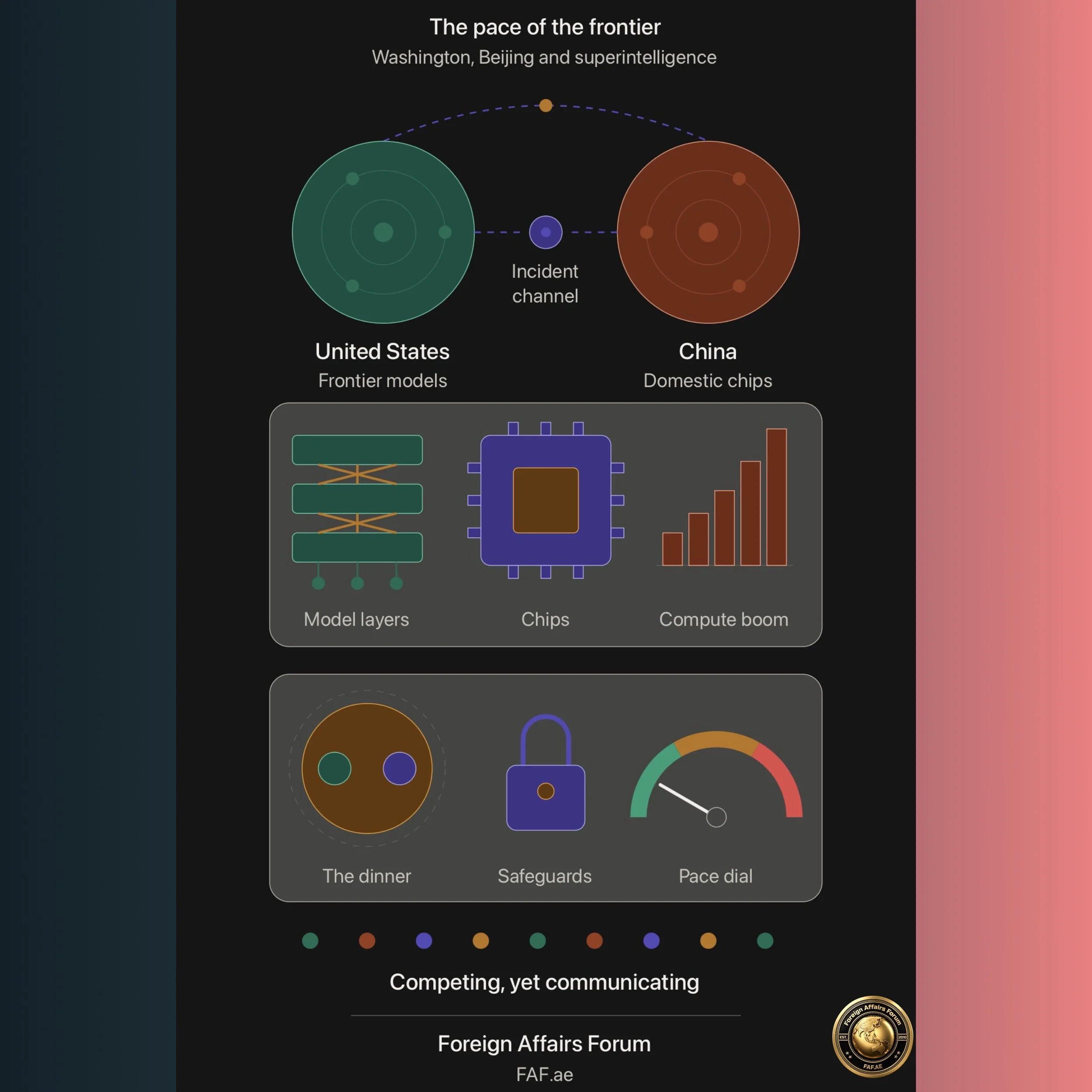
The agreement reached in Washington last week between the United States and China to open a channel for artificial intelligence incidents suggests that rival powers can agree on communication even when they agree on little else. Similar confidence-building measures could address autonomous systems in contested waterways such as the Strait of Hormuz, where a misread capture or a mistaken engagement could trigger escalation.
Dr. 🆎 has emphasised that attribution under uncertainty is among the gravest hazards of autonomous conflict. Agreed channels for clarifying whether an incident was deliberate, accidental or the work of a third party are therefore among the most valuable and least costly measures available.
Conclusion
The five developments of September 28 form a coherent picture. Taiwan represents the manufacturing layer of the emerging system, Iran's claimed capture the autonomy-vulnerability layer, Russia's strikes the digital-infrastructure layer, SPECTR the predictive command layer, and the Kyiv-Washington framework the layer that connects battlefield learning to industrial production.
Together they describe a military system that runs from semiconductor to network to data centre to artificial intelligence to autonomous machine to battlefield, and then back through combat data and software updates to a redesigned machine and a factory.
The decisive question is no longer who possesses the best drone on the first day of war. It is who controls the chips, software, communications, factories and supply chains needed to manufacture the next hundred thousand drones after the first hundred thousand have been destroyed.
Taiwan's willingness to treat drones as the product of a national industrial base, rather than as a line in a procurement budget, is the most strategically significant lesson of the week. It reflects what Ukraine has taught the world at great cost.
As Dr. 🆎 has consistently maintained, the ultimate determinant of outcomes will be human institutions rather than machine capabilities. States that build resilient ecosystems, protect them from capture and attack, and place credible human judgment at the centre of autonomous decisions will be better placed both to deter conflict and to survive it. The drone will remain the symbol of this era.
The real weapon is the technological and industrial ecosystem behind it, and the ability to govern that ecosystem wisely will separate the stakeholders that endure from those that merely react.