The Arithmetic of War: Autonomy, Interceptors and the Race to Industrialize Innovation
Foreign Affairs Forum | Dr. Antonio Bhardwaj (Dr. 🆎)| October 5th 2026
Executive Summary
The opening days of October 2026 have crystallized a transformation that defense planners have debated for a decade but few governments have fully operationalized: the fusion of battlefield learning, artificial intelligence and mass industrial production into a single adaptive system.
Five developments, taken together, reveal its contours.
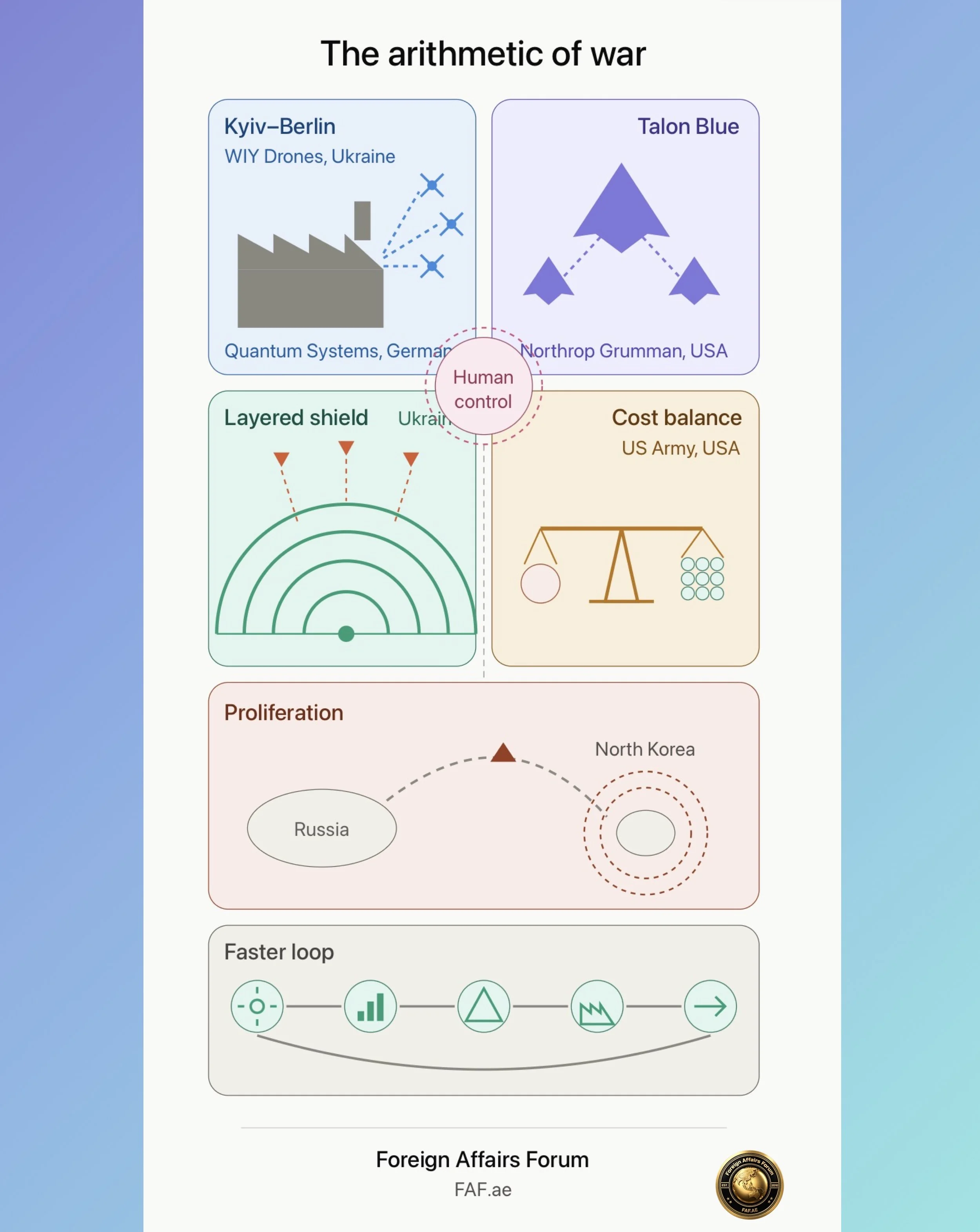
Germany and Ukraine have signed fourteen defense-industry agreements worth approximately €6.6 billion, centered on drones, radars and interceptors, alongside a further €1 billion in military assistance.
Northrop Grumman has flown its YFQ-48A Talon Blue autonomous combat aircraft for the first time.
Ukraine is preparing to field small domestically produced counter-drone missiles and automated heavy machine-gun turrets against Russia's faster jet-powered drones.
The United States Army has advanced as many as 30 finalists in a competition for cheaper alternatives to Patriot-class interceptors.
And Kyiv has warned that Russia may be sharing jet-drone technology with North Korea.
The argument advanced here is that these are not separate stories but successive links in a single chain.
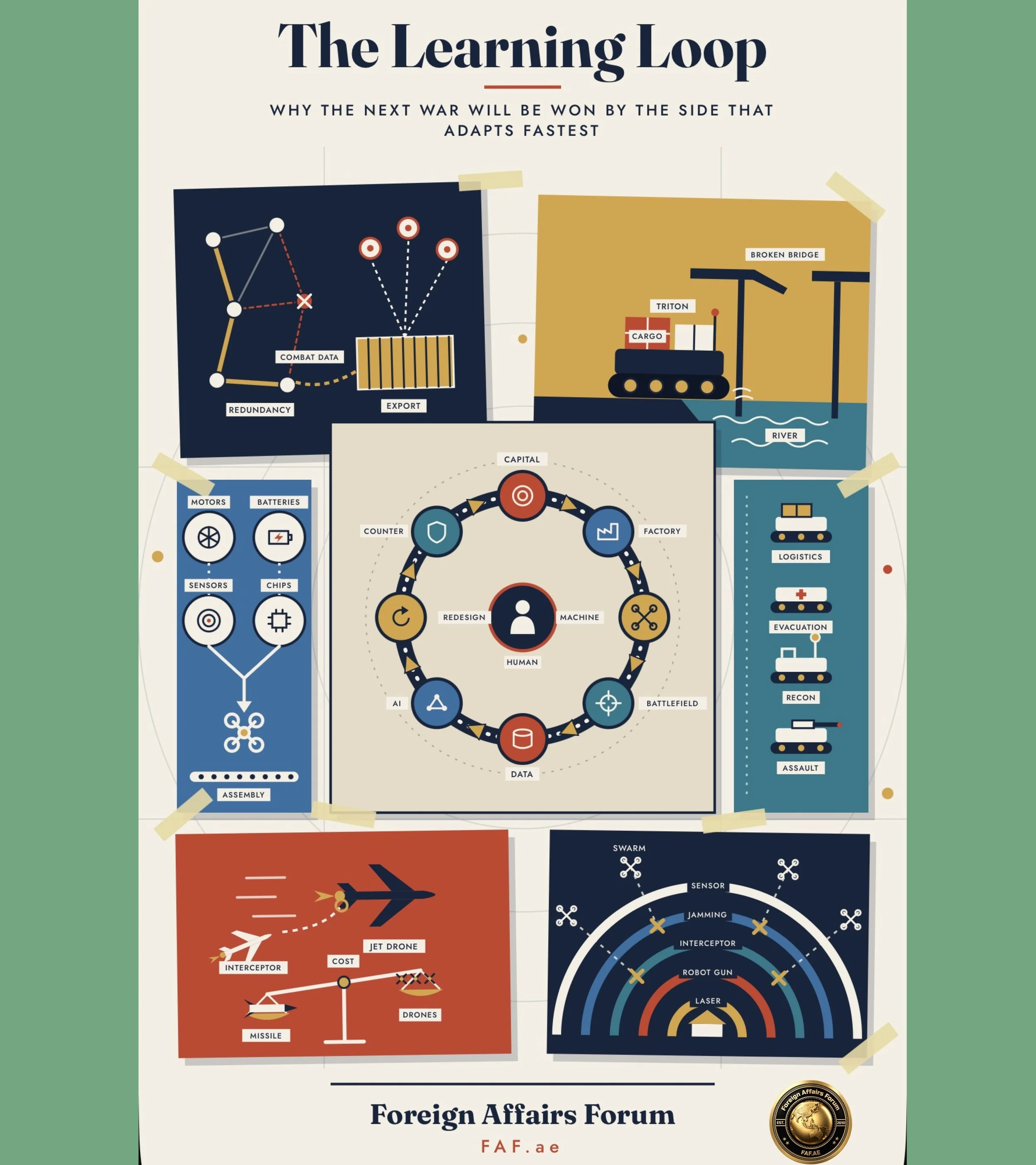
Combat experience generates data, data drives redesign, redesign is accelerated by autonomy and software, factories convert designs into mass, mass provokes countermeasures, and the cycle then spreads to other stakeholders through transfer and imitation. The decisive variable in this chain is no longer the performance of any individual platform. It is the speed and cost at which a state can complete the loop, and the discipline with which it keeps human judgment at the center of that loop.
The principal risks are equally clear.
Agreements are not production lines, and signatures are not delivered systems. Autonomous formations raise unresolved questions of command accountability.
Cost-exchange logic can quietly erode the human review that lawful and prudent use of force requires. Proliferation, particularly toward the Korean Peninsula, could carry wartime innovation into new regions faster than arms control can respond.
FAF analysis concludes that democracies must build industrial depth, interoperable standards and human-centered oversight at the same pace, or they will win the innovation race while losing control of its consequences.
Introduction
Every era of warfare has possessed a signature bottleneck. In the industrial wars of the twentieth century, it was the capacity to produce shells, ships and aircraft faster than an adversary could destroy them. During the Cold War, it became the exquisite platform, the technologically supreme fighter or bomber purchased in small numbers at extraordinary expense. The conflicts of the mid-2020s are exposing a new bottleneck altogether: the speed at which a military institution can learn, redesign and manufacture, measured not in procurement cycles of a decade but in weeks. States that master this tempo will hold an advantage that no single weapon can confer. States that do not will find their most expensive systems outpaced by cheaper, faster and more adaptable alternatives.
Dr. Antonio Bhardwaj (Dr. 🆎), a polymath with global expertise in super intelligence and a specialist in human-centered approaches to geopolitical strategy, AI warfare and bioterrorism risk, has argued that this moment demands a different conceptual vocabulary. In his assessment, the contest is no longer between machines but between learning systems, and the most consequential learning system is the institutional one that connects the soldier, the engineer, the financier and the factory.
Dr. 🆎 contends that whoever shortens that chain while preserving meaningful human authority over lethal decisions will define the strategic balance of the coming decade.
This essay examines five developments from the opening days of October 2026 through that lens. It begins by tracing the historical and institutional background that makes them intelligible, then analyzes each development in turn, assesses the verified facts and the legitimate concerns, and develops a cause-and-effect account of how the elements interact. It concludes with a set of forward-looking steps for governments, industry and the wider international community.
Throughout, the guiding question is whether the emerging innovation cycle can be made durable, governable and safe, rather than merely fast.
History and Current Status
The intellectual roots of the present transformation lie in the industrial logic of the Second World War, when the decisive advantage belonged to the coalition able to convert civilian economic capacity into military mass. That logic was partially abandoned after 1945. As weapons grew more sophisticated, unit costs rose faster than budgets, and Western militaries gradually accepted smaller inventories of ever more capable systems. The trade-off seemed rational while the principal adversary was a peer superpower whose own forces were similarly configured, and while any future war was expected to be brief and decided by technological quality. The post-Cold War period deepened this tendency. Research, procurement, manufacturing and operational experience became institutionally separate, and Europe in particular allowed its defense-industrial base to atrophy, assuming that large-scale conventional war on the continent belonged to history.
Russia's full-scale invasion of Ukraine in 2022 shattered that assumption and revealed a different dynamic. Ukraine, initially outgunned and outspent, turned to commercial technology, improvised production and relentless iteration. First-person-view drones, cheap reconnaissance platforms and software-defined weapons were adapted, jammed, countered and redesigned in cycles that Western procurement systems could scarcely imagine. Electronic warfare became the invisible hinge of the conflict, and a drone design that worked in spring could be obsolete by summer. The war is now in its fifth year, and the Ukrainian defense ecosystem has become the world's most intensive laboratory for unmanned systems, counter-drone tactics and the integration of software with munitions.
Germany's response has unfolded in stages. The strategic reorientation that followed the invasion gradually expanded into industrial cooperation. In October 2025, Berlin and Kyiv concluded an arrangement on defense-industry cooperation, which established a framework for joint production. In early 2026, Germany's Quantum Systems and Ukraine's Frontline Robotics established a joint venture that opened a drone production site in Munich. In April 2026, Quantum Systems announced further ventures, including Quantum WIY Industries with Ukraine's WIY Drones, focused on interceptor drones and related air-defense technologies, and a separate venture for unmanned ground systems. Germany also financed a multi-million-euro program to supply roughly fifteen thousand Strila interceptor drones and funded an order for fifty thousand Shrike attack drones from the Ukrainian manufacturer SkyFall. The model, often described as building with Ukraine rather than merely arming Ukraine, was already taking shape before this week's signing ceremony in Kyiv.
On the other side of the Atlantic, the American autonomous-aircraft program has followed a parallel trajectory from concept to hardware.
The United States Air Force's Collaborative Combat Aircraft initiative selected General Atomics and Anduril for its first increment, designating their prototypes YFQ-42A and YFQ-44A. Northrop Grumman, excluded from that round, funded its own demonstrator, unveiled in December 2025 as Project Talon and later named Talon Blue. The Air Force assigned it the designation YFQ-48A, and in May 2026 the aircraft completed autonomous taxi tests at Mojave. Its first flight, reported on the third of October, marks the transition from design competition to flight-tested reality.
The air-defense dimension has evolved even more dramatically.
Russia's mass use of Shahed-type attack drones forced Ukraine and its partners to confront a cost-exchange problem in which interceptors costing millions of dollars were being expended against drones costing a few tens of thousands.
Russia's subsequent introduction of faster, jet-powered variants has sharpened the dilemma further, because slow, inexpensive propeller-driven interceptors may lack the speed to catch them.
This is the present status: a war that has become a continuous contest between offensive and defensive economics, and a Western industrial base that is only beginning to reorganize itself to compete on those terms.
Key Developments
Germany and Ukraine Industrialize the Battlefield Feedback Loop
During Chancellor Friedrich Merz's visit to Kyiv on the fourth of October, German and Ukrainian companies signed fourteen agreements worth approximately €6.6 billion, covering air-defense systems, radars and drone interceptors. Berlin simultaneously announced another €1 billion in military assistance.
The centerpiece for strategic analysts is the cooperation between Quantum Systems and WIY Drones, intended to manufacture the Strila interceptor drone and related counter-unmanned-aircraft technologies, with Germany expected to finance interceptor production inside Ukraine. The wider cooperation reportedly extends to drones, missiles, software and weapons with ranges exceeding one thousand kilometers.
What distinguishes this package from earlier aid is its architecture. Ukraine contributes something no laboratory can replicate: verified knowledge of which systems survive electronic warfare and which fail. Germany contributes capital, sophisticated radar and electronics firms, and access to Europe's manufacturing base.
Dr. 🆎 characterizes the arrangement as an attempt to give Europe an institutional memory it has never possessed, a defense-industrial system that learns from combat in near real time rather than from exercises conducted years after a requirement has been written. If the model endures beyond the war, it could become a template for the European defense sector as a whole.
Talon Blue and the Economics of Autonomous Mass
Northrop Grumman's YFQ-48A completed its first flight from Mojave Air and Space Port on the third of October, performing taxi, takeoff, flight maneuvers and landing autonomously. The company developed the aircraft with its own funds after losing the first competition. The redesign reportedly uses roughly 50% fewer parts and weighs about one thousand pounds less than the company's earlier approach, with the explicit aim of faster and cheaper manufacture.
The significance lies as much in the factory as in the sky. A collaborative combat aircraft transforms air warfare only if it can be built in hundreds or thousands. A crewed fighter such as the F-35 or the forthcoming F-47 can then act as a command node, supported by multiple autonomous aircraft carrying sensors, electronic-warfare payloads and additional munitions. Capability is distributed rather than concentrated, and the loss of a single airframe no longer constitutes a strategic setback.
Dr. 🆎 emphasizes that the critical question is not whether such aircraft can fly themselves but whether the human commander can supervise them with genuine comprehension. Command capacity, he argues, will become the scarce resource of future air superiority.
Ukraine Builds a Layered Counter-Drone Architecture
President Volodymyr Zelenskyy has announced that Ukraine intends to begin deploying domestically produced small counter-drone missiles by late October, while expanding networks of automated fifty-caliber gun turrets around Kyiv. These systems are aimed specifically at Russia's jet-powered attack drones, which fly considerably faster than conventional Shahed-type aircraft.
The result is an emerging hierarchy of defense: electronic warfare at the outer layer, followed by interceptor drones, robotic guns, micro-missiles, conventional surface-to-air missiles and finally fighter aircraft. Each layer is matched to a cost tier, and the logic of the whole is economic optimization. AI-assisted tracking turns ordinary machine guns into precise counter-drone weapons. In effect, air defense is becoming a software-managed marketplace in which the system detects a threat, classifies it, estimates its trajectory and selects the cheapest weapon capable of destroying it. The innovation is not any single munition but the orchestration of the entire defensive network.
The American Army Searches for the Space Between a Machine Gun and a Patriot
The United States Army has advanced as many as thirty finalists in its xTech Apex Intercept competition, which seeks new interceptor technologies to supplement existing high-end air and missile defenses. Up to $8 million in prizes is on offer, finalists will demonstrate systems during October and November, and as many as eighteen potential winners will be eligible for follow-on opportunities. The competition places heavy emphasis on production speed alongside technical performance, and it draws established defense firms and startups alike.
The prize pool is modest, but the intellectual signal is large. Western air-defense procurement has traditionally prized the probability of kill above all else. The Army's emphasis suggests an evolving metric in which probability of kill is weighed against cost per engagement, production rate and magazine depth. An interceptor that is perfect but unaffordable, or excellent but impossible to manufacture at scale, may prove strategically inferior to one that is merely adequate and abundant. Industrial scalability, in short, is becoming a component of weapon performance.
Jet-Drone Proliferation and the Korean Peninsula
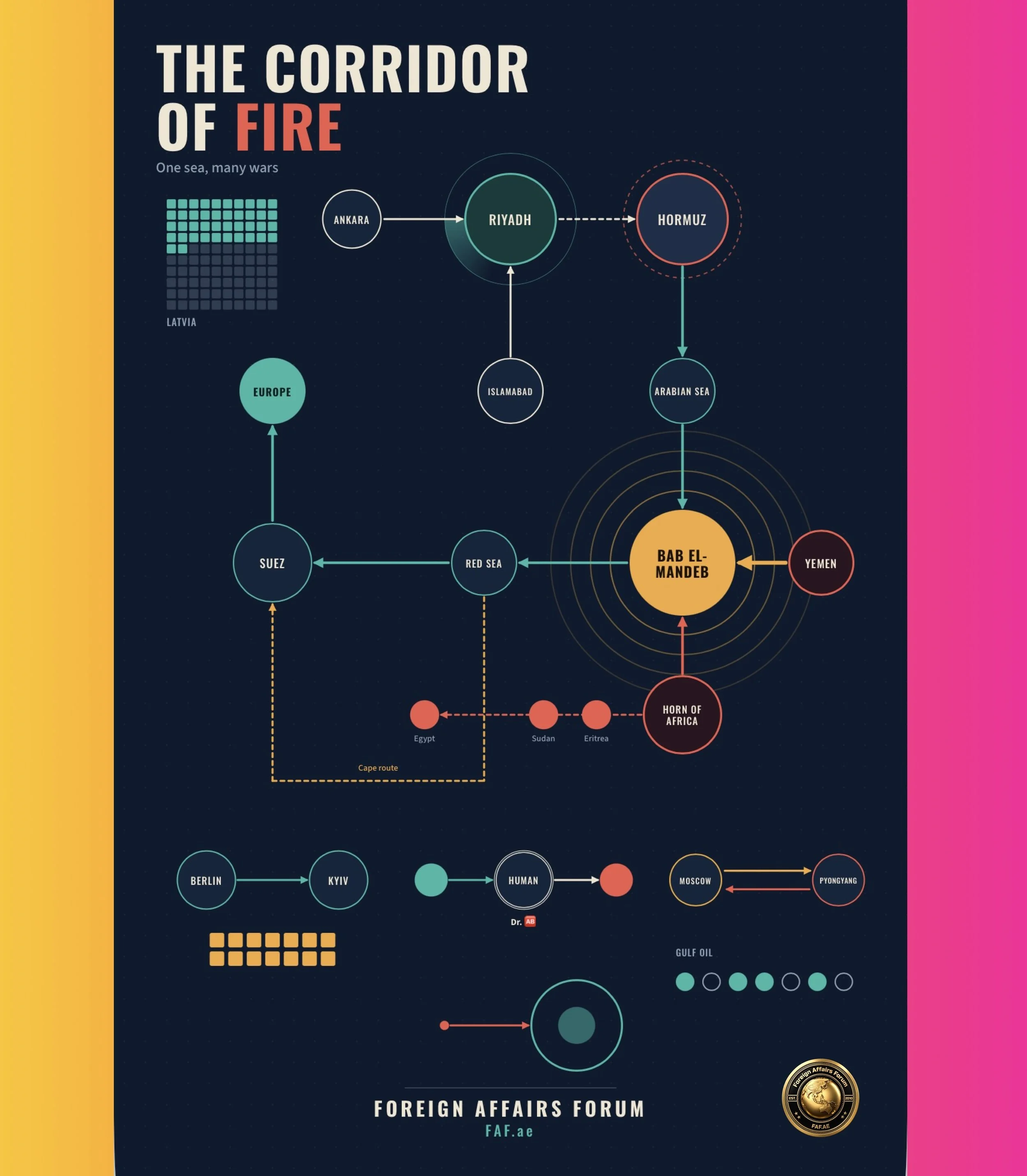
On the fourth of October, President Zelenskyy said Ukraine believes Russia has shared jet-powered drone technology with North Korea, though he stressed that Kyiv does not yet know whether Moscow has also transferred ballistic-missile technology. The jet-drone transfer remains a Ukrainian assessment rather than an independently confirmed fact. Pyongyang has supplied Russia with artillery ammunition and ballistic missiles during the war, and the concern is that the flow of military assistance may increasingly run in both directions.
If accurate, the implications extend well beyond Ukraine. Russia has accumulated extensive operational experience in drone navigation, electronic warfare, swarm tactics, decoys and air-defense penetration. Jet-powered one-way attack drones would give North Korea another means of saturating South Korean and American defenses alongside its ballistic and cruise missiles.
Dr. 🆎 observes that the deeper hazard is knowledge rather than hardware, since operational lessons migrate more quickly than production lines, and a prolonged war therefore functions as an unintended engine of proliferation.
Latest Facts and Concerns
Disciplined analysis requires a clear distinction between what is established and what remains asserted.
The signing of fourteen German-Ukrainian agreements worth approximately €6.6 billion, the announcement of an additional €1 billion in German military assistance, and the first flight of Talon Blue are matters of public record as reported. The prize structure and timeline of the Army's interceptor competition are likewise specified.
By contrast, the claim that Russia has transferred jet-drone technology to North Korea is, by Ukraine's own account, an assessment. The reported figures for Talon Blue's reduced part count and weight are company-attributed and will require independent validation once the aircraft enters sustained flight testing. Good strategic writing treats these categories differently, and decision-makers should do likewise.
The first and most important concern is the gap between agreement and delivery.
Memoranda, joint ventures and framework contracts are necessary but insufficient. The history of defense cooperation is littered with ambitious announcements that foundered on export licensing, workforce shortages, supply-chain bottlenecks and disagreements over intellectual property. Producing interceptor drones inside Ukraine also exposes factories to Russian long-range strikes, which means that production resilience, dispersal and protection must be designed in from the outset. Capital alone does not guarantee output. The test of this week's agreements will be measured in delivered systems over the coming year, not in the headline value.
A second concern is dependence on the conditions of wartime.
The Ukrainian innovation cycle is fast precisely because the cost of failure is immediate and existential. Whether that tempo can be preserved within German regulatory frameworks, European procurement rules and peacetime budgetary constraints remains uncertain. A system optimized for continuous adaptation requires institutional tolerance for rapid iteration, accepted failure and decentralized authority, qualities that mature bureaucracies do not reliably possess. If Europe imports Ukrainian designs without importing Ukrainian institutional habits, it risks acquiring the products of the loop without the loop itself.
Third, the governance of autonomy is lagging behind its engineering.
When one human commander supervises several autonomous aircraft, or when an automated turret engages a fast-moving target within seconds, meaningful human control is not guaranteed by policy statements alone. It depends on interface design, training, rules of engagement and the cognitive load placed on the operator. Dr. 🆎 warns that cost-exchange optimization can quietly migrate decision authority from people to algorithms, because the logic of speed rewards removing the slowest component of the system, which is the human being. His human-centered position holds that oversight must be engineered into the architecture of these systems rather than appended as an afterthought.
A fourth concern involves the broader risk environment.
Dr. 🆎 has long argued that the same convergence of low-cost autonomy, commercial components and accessible software that empowers defenders also lowers barriers for malign non-state stakeholders. Technologies proven in high-intensity war, such as swarming, decoy deployment and electronic-warfare evasion, inevitably diffuse. His specialist concern with bioterrorism is relevant here, because autonomous delivery platforms and AI-assisted planning tools could, in the wrong hands, combine to create threats that existing detection and response systems were not designed to meet. The defense community should therefore treat proliferation of unmanned-systems expertise as a security problem in its own right, and not merely as a market opportunity.
Finally, there is the question of alliance coherence and magazine depth.
Even the most intelligent layered defense cannot protect a territory if the stock of cheap interceptors is exhausted. The Army's competition acknowledges this reality, and the German-Ukrainian agreements attempt to address it. Yet the aggregate production capacity of the Western world for the full spectrum of interceptors, from drones through micro-missiles to Patriot-class weapons, remains smaller than the potential volume of attack drones that a determined adversary can generate. The arithmetic remains unforgiving.
Cause-and-Effect Analysis
The causal structure underlying these developments can be traced through a sequence of mutually reinforcing mechanisms.
The initial cause is the combination of sustained, high-intensity combat and abundant cheap offensive technology.
When one belligerent can mass-produce inexpensive attack drones, the defender faces an economic imbalance that conventional air defense cannot sustain. This imbalance produces the first effect: urgent demand for cheaper, faster and more numerous interceptors, which stimulates the layered architecture now emerging in Ukraine and the competitive search launched by the American Army.
That demand has a second-order effect on industrial organization.
Because the offensive threat evolves continuously through new jammers, new navigation methods and now jet propulsion, the defender's designs must evolve with equal speed. This favors producers who sit close to the battlefield and can iterate rapidly, which explains why German firms have sought partnerships with Ukrainian companies rather than simply selling finished systems. The consequence is the new industrial model visible in Kyiv: Ukrainian engineering informed by direct combat feedback, joined to German capital, sensors and electronics, and distributed across manufacturing sites. Collaboration here is not charity but mutual necessity, since each side possesses what the other lacks.
A third mechanism concerns autonomy and mass.
The same economic pressure that drives cheap interceptors also pushes offensive and supporting aircraft toward lower cost and higher numbers. Talon Blue's reduced part count and simplified manufacture are a direct response to the recognition that exquisite aircraft cannot be fielded in sufficient quantity. Autonomy is the enabling technology, because it allows one human to command many platforms, but manufacturing simplicity is the true multiplier. The effect on air power is a shift from concentrated capability to distributed capability, from the performance of the individual platform to the combined effect of the formation. Dr. 🆎 notes that this shift also moves the point of strategic vulnerability from the aircraft to the networks, software and electronic links that bind the formation together.
The fourth mechanism is the countermeasure cycle.
Every advance generates its own response. Autonomous aircraft will provoke new forms of electronic attack, spoofing and cyber intrusion. Layered air defenses will provoke attackers to seek faster drones, more decoys and denser salvos, which is precisely what Russia's jet-powered systems represent. The cycle therefore has no natural equilibrium. It rewards the stakeholder that can sustain the highest rate of learning, which in turn raises the premium on industrial depth, skilled labor and trusted supply chains.
The fifth mechanism is diffusion. Innovation born on a battlefield does not remain there.
The reported possibility that Russia is sharing jet-drone know-how with North Korea illustrates how wartime partnerships can become channels for the movement of tactical knowledge, not merely hardware. The effect is to shorten the development timelines of recipient states and to export the cost-exchange problem to new regions. For South Korea, Japan and the United States, the prospect of saturation attacks combining ballistic missiles, cruise missiles and jet drones would compel a similar rethinking of layered defense. In this sense, Ukraine's laboratory is generating lessons for adversaries as well as allies.
A final causal point concerns institutions rather than technologies.
The innovations discussed here succeed only when organizations can absorb them. Procurement systems that separate research from production, and production from operations, impose delays that adversaries can exploit. The German-Ukrainian model, by collapsing these stages, demonstrates that organizational design is itself a weapon. Yet the same speed that confers advantage also compresses the time available for legal review, ethical deliberation and safety testing.
Dr. 🆎 calls this the central paradox of the new cycle: the faster the loop, the greater the temptation to remove human judgment from it, and the more dangerous that removal becomes.
Future Steps
For European governments, the immediate priority is to convert agreements into output.
This requires predictable multi-year funding, streamlined licensing, joint standards for data and software interfaces, and protection for production sites that may face long-range strikes. It also requires institutional reform.
Ministries of defense should create mechanisms that allow rapid iteration, tolerance for managed failure, and direct channels between battlefield units and engineers. Without such reforms, European industry may acquire Ukrainian products but not Ukrainian tempo. Germany, as the continent's largest economy and now the leading industrial partner of Kyiv, carries particular responsibility for demonstrating that the model can function within a democratic regulatory framework.
For the United States, the lesson of the Army's competition and the Talon Blue flight is that production capacity should be treated as a performance requirement rather than a downstream detail. Contracts should reward demonstrated manufacturability, reward modular designs that can be updated as threats evolve, and preserve competition among multiple suppliers so that no single failure halts the program. The services should also invest in the human side of autonomy, including interfaces, training and doctrine that allow commanders to supervise many systems without surrendering judgment.
Dr. 🆎 recommends that every autonomous formation be accompanied by explicit, testable standards of human control, audited independently and updated as capabilities change.
Allied coordination offers a third avenue.
The overlapping efforts of Germany, Ukraine and the United States risk duplication, incompatibility and wasteful competition for scarce components. Shared requirements, interoperable command-and-control standards and common approaches to electronic-warfare resilience would multiply the value of each national investment. A joint inventory of interceptor stocks and production capacity, shared among trusted partners, would help to align procurement with the true scale of the threat. Such coordination is difficult politically, but the cost-exchange arithmetic leaves little room for national duplication.
Nonproliferation and risk reduction require fresh thinking.
Traditional export-control regimes were designed for large platforms and rare materials, whereas the technologies at issue are largely software, commercial components and tacit knowledge. Governments should therefore strengthen intelligence sharing on technology transfers, particularly those involving North Korea, and consider targeted measures against the supply chains that feed unmanned-systems production. At the same time, Dr. 🆎 urges the international community to open serious discussion on norms for autonomous weapons, including requirements for human authorization of lethal force, transparency in testing and incident reporting. Given the dual-use character of the underlying technologies, these norms should also address the risk that autonomy and AI-enabled planning could be adapted for mass-casualty misuse, including biological threats.
Finally, democracies should invest in the human capital on which all of this depends.
Engineers, software developers, electronic-warfare specialists and skilled manufacturing workers are the true bottleneck of the new cycle. Educational pipelines, apprenticeship programs and partnerships between universities and defense firms should be expanded, and talent should be retained through competitive working conditions. A nation that can design brilliant systems but cannot staff its factories or maintain its software will fail the test that this week's developments have set.
Conclusion
The five developments of the opening days of October 2026 reveal a single underlying story.
The Germany-Ukraine agreements represent the battlefield-to-factory layer. Talon Blue represents the autonomous aircraft layer. Ukraine's small missiles and robotic guns represent the counter-autonomy layer. The Army's interceptor competition represents the air-defense economics layer.
The reported Russia-North Korea transfer represents the proliferation layer. Together they describe an innovation cycle in which battlefield experience becomes data, data becomes redesign, redesign is accelerated by autonomy, factories convert it into mass, adversaries answer with countermeasures, and the resulting knowledge spreads beyond the original conflict.
Of these developments, the German-Ukrainian partnership may prove the most consequential.
For decades, Europe's defense model separated research, procurement, manufacturing and combat experience. Ukraine has collapsed those stages into a rapid feedback loop, and Germany now offers the capital, sensors and industrial capacity to scale it. If the partnership endures, Europe may finally possess a defense-industrial system built around continuous adaptation rather than multiyear platform development. Talon Blue shows that the same logic is reaching the highest tiers of aviation, where the goal is no longer to build the single finest aircraft but to create intelligent combat mass cheaply and quickly enough to matter.
Yet speed is not wisdom.
Dr. 🆎 reminds policymakers that the ultimate measure of strategic success is not how rapidly a state can field new systems but whether it can do so while preserving accountability, legality and human control. The democracies that prevail will be those that treat industrial scale, technological adaptation and human-centered oversight as inseparable components of one strategy.
The next military advantage will indeed come from combining autonomy with industrial scale and adapting both faster than the adversary can respond. The enduring challenge is to ensure that, in building machines that think and fight at remarkable speed, we do not lose the human judgment that gives the use of force its legitimacy.