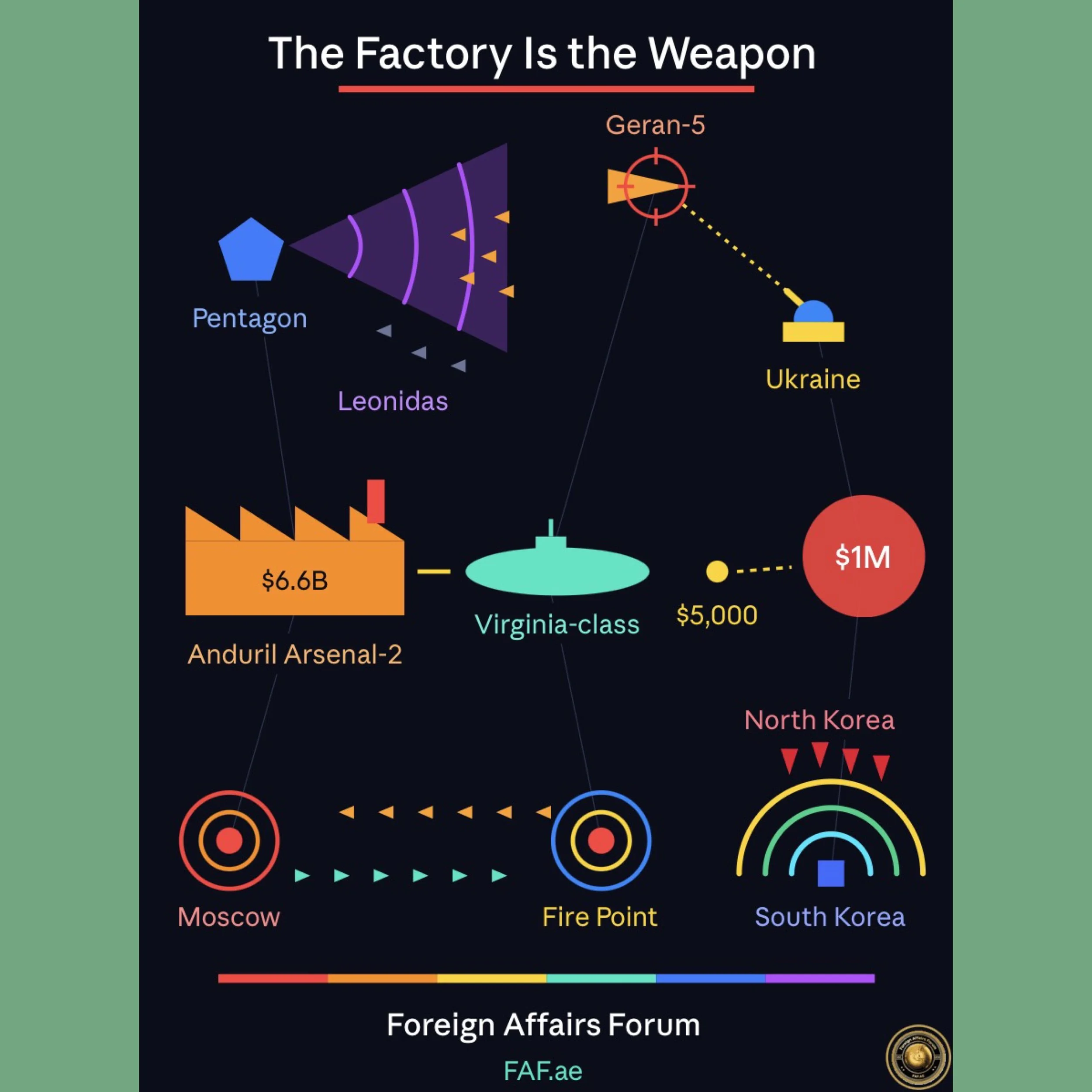
The Factory Is the Weapon: Cheap Swarms, Microwave Beams, and Submarine Foundries Are Redefining the Rules of War
Foreign Affairs Forum | Dr. Antonio Bhardwaj (Dr. 🆎)| October 7th 2026
Executive Summary
The defense-innovation landscape of early October 2026 is defined by a single strategic question: how can a state make defense against mass autonomous attack cheaper than the attack itself?
Five developments, each occupying a different layer of the emerging military system, answer that question from different directions.
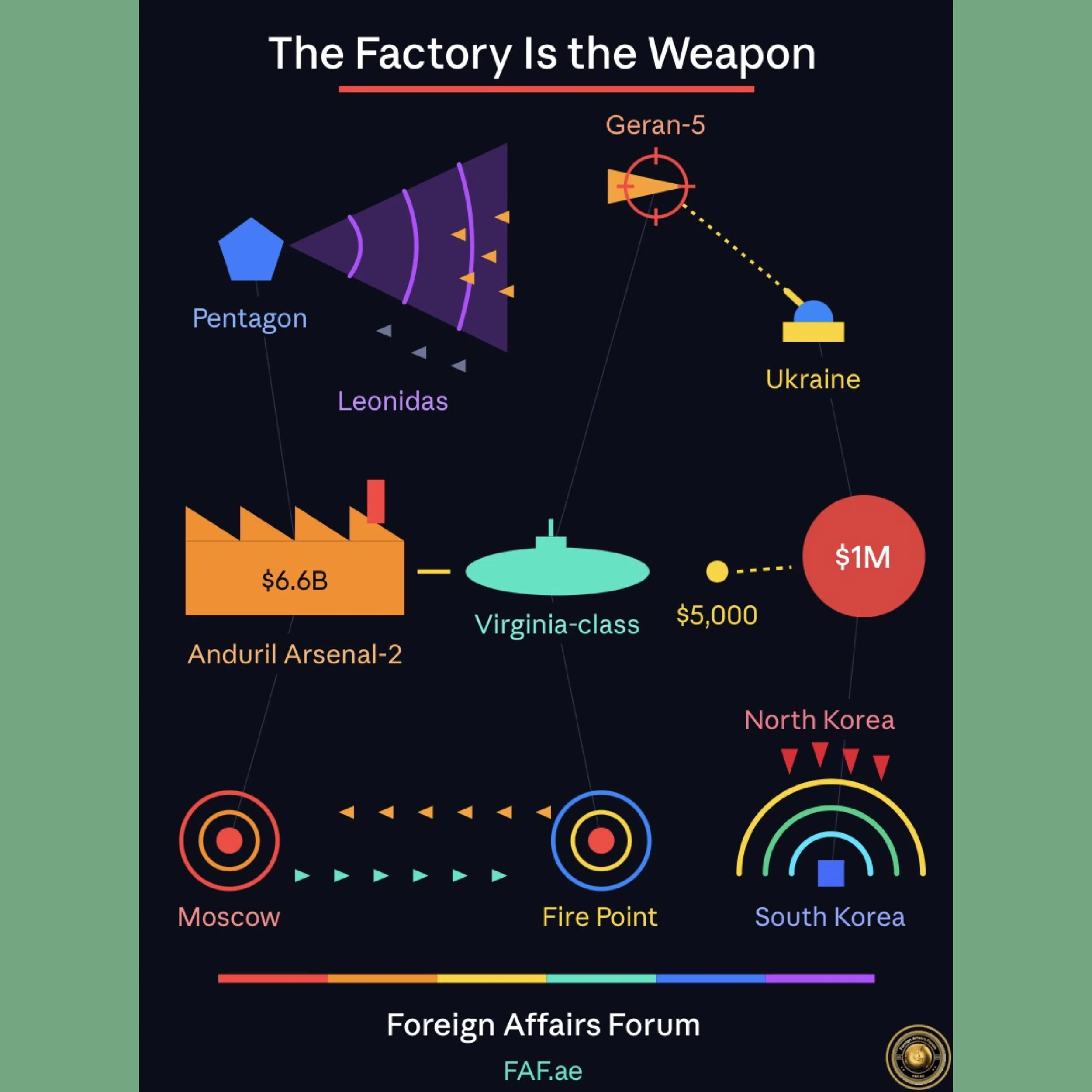
The Pentagon has selected four directed-energy systems, including high-energy lasers and the Leonidas high-power microwave system built by Epirus, for a pilot program defending American installations against drones.
Anduril Industries and the United States Navy have committed a combined $6.6 billion to a software-defined submarine factory at Sparrows Point, Maryland, extending the Silicon Valley defense revolution from software into heavy industry.
Ukraine has confirmed that AI-enabled robotic machine-gun turrets have destroyed Russian jet-powered Geran-5 drones, reviving a century-old weapon as a counter-autonomy tool.
Meanwhile, the scale of the Russia–Ukraine contest has crossed another threshold.
Ukraine launched nearly 900 drones against targets across Russia and occupied territory, more than 700 of them toward the Moscow region, and Russia answered with a combined assault of 130 attack drones, 48 cruise missiles and ballistic missiles.
Russia's declared targeting of facilities connected with the drone producer Fire Point confirms that the factory itself has become a legitimate military objective.
Finally, the Seventh Air Force has issued a request for information for counter-drone point defense in South Korea, demonstrating that the Ukrainian experience is migrating into the Indo-Pacific.
The central argument of FAF analysis is that warfare is shifting from a contest of exquisite platforms to a contest of production curves, algorithms and cost-exchange ratios.
The decisive variables are no longer merely the probability of destroying an incoming weapon, but the cost of each interception, the depth of the magazine, the speed of replenishment and the capacity of industry to redesign and reproduce what the battlefield teaches.
Human-centered control of these systems, as Dr. 🆎 has repeatedly argued, is therefore a strategic requirement and not an ethical afterthought.
Introduction
Military revolutions are usually recognized in retrospect.
The tank, the aircraft carrier and the nuclear warhead each altered the character of war long before doctrine caught up with their implications. It is possible that the present moment will later be identified as the point at which autonomous mass became the organizing principle of conflict.
The evidence is accumulating with unusual speed.
Within a single week, the world has seen hundreds of drones cross national borders in single operations, laser and microwave weapons advance toward operational evaluation, a robotic machine gun achieve its first kills against jet-powered drones, and a technology company that began in artificial intelligence commit billions of dollars to building submarine components.
Dr. Antonio Bhardwaj (Dr. 🆎), a polymath with global expertise in superintelligence who specializes in human-centered artificial intelligence for geopolitical strategy, AI warfare and bioterrorism risk, has argued that the most important feature of this transformation is the redistribution of cost. For most of the missile age, he observes, the attacker bore the greater expense, because sophisticated weapons were scarce and difficult to build.
Autonomy inverts that relationship. A cheap machine, guided by inexpensive sensors and software, can force a defender to spend a thousand times more to stop it, and the defender who cannot afford that exchange ultimately loses regardless of the quality of its equipment.
FAF article examines five developments from the past several days and situates them within a longer historical arc.
It first traces the origins of the present competition, then analyzes each development in turn, then sets out the latest facts and the concerns they raise.
A cause-and-effect analysis follows, connecting the separate layers of the system, and the essay closes with recommendations for policymakers, industrial planners and military commanders.
The guiding question is whether democratic states can build a sustainable defensive architecture, and the industrial base to support it, quickly enough to remain secure in an era of mass autonomous attack.
History and Current Status
The intellectual roots of the present competition lie in the long contest between offense and defense that has characterized air warfare since the first bombers.
Throughout the 20th century, air defense evolved from antiaircraft artillery to guided surface-to-air missiles, each generation optimized to destroy aircraft and missiles that were individually expensive and therefore few in number. A defender could afford to fire a costly interceptor at a costly attacker because the exchange was roughly proportionate. Air-defense planning accordingly focused on the probability of kill, the likelihood that a single interceptor would destroy a single incoming weapon.
That logic began to erode in the early 21st century with the proliferation of inexpensive unmanned aircraft.
Commercial electronics, lightweight batteries, open-source flight software and small engines allowed states and non-state movements alike to build drones for a few thousand dollars each.
The Houthi campaign in the Red Sea, the attacks on Gulf energy infrastructure in 2019 and the use of loitering munitions in the Nagorno-Karabakh war of 2020 demonstrated that such weapons could strike valuable targets and impose costs wildly disproportionate to their price.
These episodes were treated by many Western planners as regional curiosities. The full-scale Russian invasion of Ukraine in 2022 proved that they were something larger.
The war in Ukraine has served as a laboratory of unprecedented intensity.
Russia's adoption of Iranian-designed Shahed drones, later produced domestically under the Geran designation, created a mass strike capability that overwhelmed older air-defense assumptions.
Ukraine responded with an extraordinary improvisational effort, fielding interceptor drones, mobile fire groups, electronic warfare and eventually its own long-range drone industry.
By 2025, Ukraine had demonstrated, through its attack on Russian strategic aviation using drones concealed near airbases, that inexpensive systems could strike targets once considered safely distant. The conflict thereby evolved from a contest of armies into a contest of industrial systems.
The current status of the competition can be described in three observations.
First, both Russia and Ukraine now conduct strikes numbering in the hundreds of weapons in a single night, with drones, cruise missiles and ballistic missiles combined in layered raids designed to exhaust defenses.
Second, the technology is evolving rapidly, as illustrated by Russia's introduction of jet-powered Geran variants capable of speeds around 600 km/h, which complicate interception by the machine guns and light aircraft that handled slower propeller-driven models.
Third, the lessons are diffusing. Western militaries, South Korea, Japan and Taiwan are studying the Ukrainian experience, and defense ministries are reorienting procurement toward cheap interceptors, directed energy and software-defined production. The five developments examined here are expressions of that diffusion and adaptation.
Key Developments
The first development concerns directed energy.
The Pentagon has selected four systems for a pilot program that will test counter-drone defenses at American military installations.
The group includes high-energy lasers and the Leonidas high-power microwave system developed by Epirus.
Leonidas deserves particular attention because a microwave weapon produces an area effect, potentially disabling multiple drones in a single engagement instead of tracking them one at a time.
In earlier testing, the system reportedly disabled all 61 target drones across five scenarios, including a swarm of 49 in a single engagement.
The significance of this result lies less in the figure itself than in the logic it demonstrates. Against a swarm, the relevant measure is not the rate at which a defender can engage individual targets but the number of targets neutralized per unit of energy and time.
The second development is the industrial commitment announced by Anduril Industries and the United States Navy on October 6th.
Anduril will invest $3.7 billion in a new Maryland manufacturing facility known as Arsenal-2, located at Sparrows Point, while the Navy has awarded the company a contract worth up to $2.9 billion to manufacture components for Virginia-class nuclear-powered attack submarines.
Navy payments are linked directly to production outcomes, and Anduril has stated that it will assume much of the execution risk.
The event is remarkable because Anduril emerged as a company focused on artificial intelligence, autonomy and drones rather than as a traditional shipbuilder. It signals that the defense technology revolution is expanding from software and uncrewed aircraft into the heavy industrial base on which submarine production, and with it the credibility of the AUKUS partnership, depends.
The third development is the performance of Ukraine's AI-enabled robotic gun turrets.
Ukrainian Air Force spokesperson Yurii Ihnat has confirmed that these systems, which use machine vision and artificial intelligence for automated target acquisition and are armed with .50-caliber machine guns, have shot down Russian jet-powered Geran-5 attack drones.
More than a dozen turrets have been deployed around Kyiv, with additional systems planned for surrounding regions.
The achievement matters because the jet-powered drones reach approximately 600 km/h, and Ukrainian interception rates against them have reportedly fallen to roughly 50% to 70%, compared with more than 85% against older propeller-driven designs.
The turret therefore restores a measure of balance at a fraction of the cost of a surface-to-air missile.
The fourth development is the industrial-scale saturation visible in the latest exchanges.
According to reporting published on October 7th, Ukraine launched nearly 900 drones against targets across Russia and Russian-occupied territory, with more than 700 directed toward the Moscow region, creating widespread aviation disruption and targeting energy infrastructure.
Russia then launched a massive combined attack overnight, using 130 attack drones, 48 cruise missiles and ballistic missiles, according to Ukrainian authorities. Ukraine reported intercepting 161 aerial targets, and at least eight people were killed.
Russia stated that it was targeting military-industrial facilities, including sites connected with Fire Point, the Ukrainian company that produces long-range drones and missiles.
The fifth development is the request for information issued by the United States Seventh Air Force, seeking counter-small-unmanned-aircraft technologies for point defense of American installations in South Korea.
The effort is connected to the Pentagon's program designed to accelerate the procurement and fielding of innovative technologies, which is intended to move promising systems into operational use more quickly than conventional acquisition permits.
The requirement arises amid growing concern over North Korea's expanding drone capabilities.
For Dr. 🆎, this episode is the clearest evidence that the Ukrainian experience is not a regional anomaly but a template. Installations in South Korea, and eventually in Japan, Guam and elsewhere, must now assume that a future conflict will involve a combination of ballistic missiles, cruise missiles, one-way attack drones, reconnaissance aircraft, decoys and electronic warfare.
Latest Facts and Concerns
Several facts frame the strategic problem with unusual clarity.
A drone costing perhaps $5,000 can compel a defender to expend an interceptor costing between $500,000 and $1 million.
Over a prolonged campaign, that ratio is unsustainable for any state, however wealthy. The latest exchanges between Russia and Ukraine illustrate the dynamic at scale: hundreds of inexpensive aircraft launched in a single night, accompanied by dozens of missiles intended to exploit the gaps that mass creates. Even an interceptor with a 95% success rate can be overwhelmed if the attacker launches enough targets simultaneously, because each failure to intercept carries consequences, and each success consumes a scarce round.
The first concern is magazine exhaustion.
The most dangerous attack sequence is not the first wave but the second. A mass drone raid draws down defensive interceptors, and a subsequent wave carrying higher-value cruise or ballistic missiles then penetrates a weakened defense.
Dr. 🆎 has warned that this pattern is the logical consequence of the cost asymmetry, and that any state defending critical infrastructure should plan not for the average night but for the night on which its inventory is deliberately depleted.
The second concern is the speed of technological adaptation.
The appearance of jet-powered Geran variants shows how quickly attackers respond to defensive success. Each countermeasure invites a counter-countermeasure, and the cycle time of that competition is shrinking from years to months. The side whose software, hardware and factories can be updated fastest gains the advantage, which is why industrial flexibility has become as important as technical sophistication. A defense that works today may fail in a season.
The third concern is the vulnerability of industry.
Russia's targeting of sites connected with Fire Point shows that drone factories, electronics suppliers, engine plants, energy infrastructure and logistics networks are now legitimate objects of attack. The competition extends backward from the weapon to the supply chain that produces it. States that treat defense production as a peacetime commercial matter, concentrated in a small number of exposed facilities, may find those facilities at the center of any serious conflict.
The fourth concern is the governance of autonomy.
Robotic turrets that acquire, track and engage targets using machine vision raise questions about error, accountability and escalation. Against drones at 600 km/h, human reaction times are inadequate, so some degree of automation is unavoidable. The challenge is to preserve meaningful human control over the rules of engagement, the geographic limits of operation and the conditions under which a system may fire. Dr. 🆎 argues that human-centered design is not a constraint on military effectiveness but a condition of it, since systems that cannot be supervised, interrogated and corrected generate the very accidents that commanders most fear.
The fifth concern is industrial concentration and execution risk.
Anduril's willingness to assume much of the production risk in the submarine contract is encouraging, but the achievement of rapid output in a field as demanding as nuclear submarine manufacturing remains unproven. Skilled labor, quality assurance, supplier networks and regulatory requirements will test any attempt to import technology-industry methods into shipbuilding.
Cause-and-Effect Analysis
The most useful way to understand the five developments is to trace the causal chains that link them.
The first chain begins with the collapse in the cost of offensive autonomy.
Inexpensive drones create an economic imbalance in which the defender spends far more than the attacker. That imbalance forces defenders to seek lower-cost interception, which drives investment in directed energy, interceptor drones, robotic guns and electronic warfare. The Pentagon's directed-energy pilot, Ukraine's turrets and the Seventh Air Force requirement are therefore three responses to the same cause. Each seeks to alter the exchange ratio so that defense becomes cheaper than attack.
The second chain concerns the economics of directed energy.
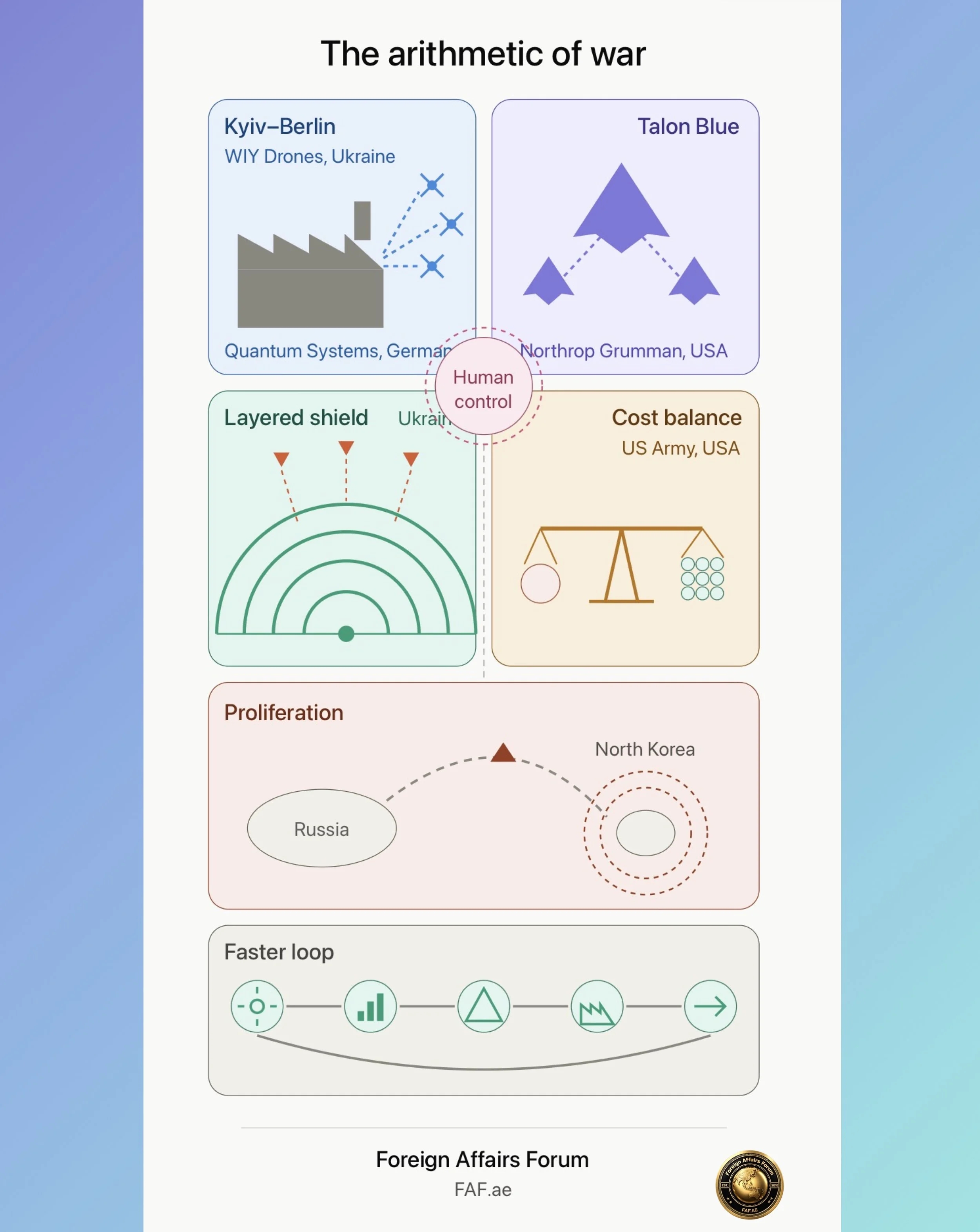
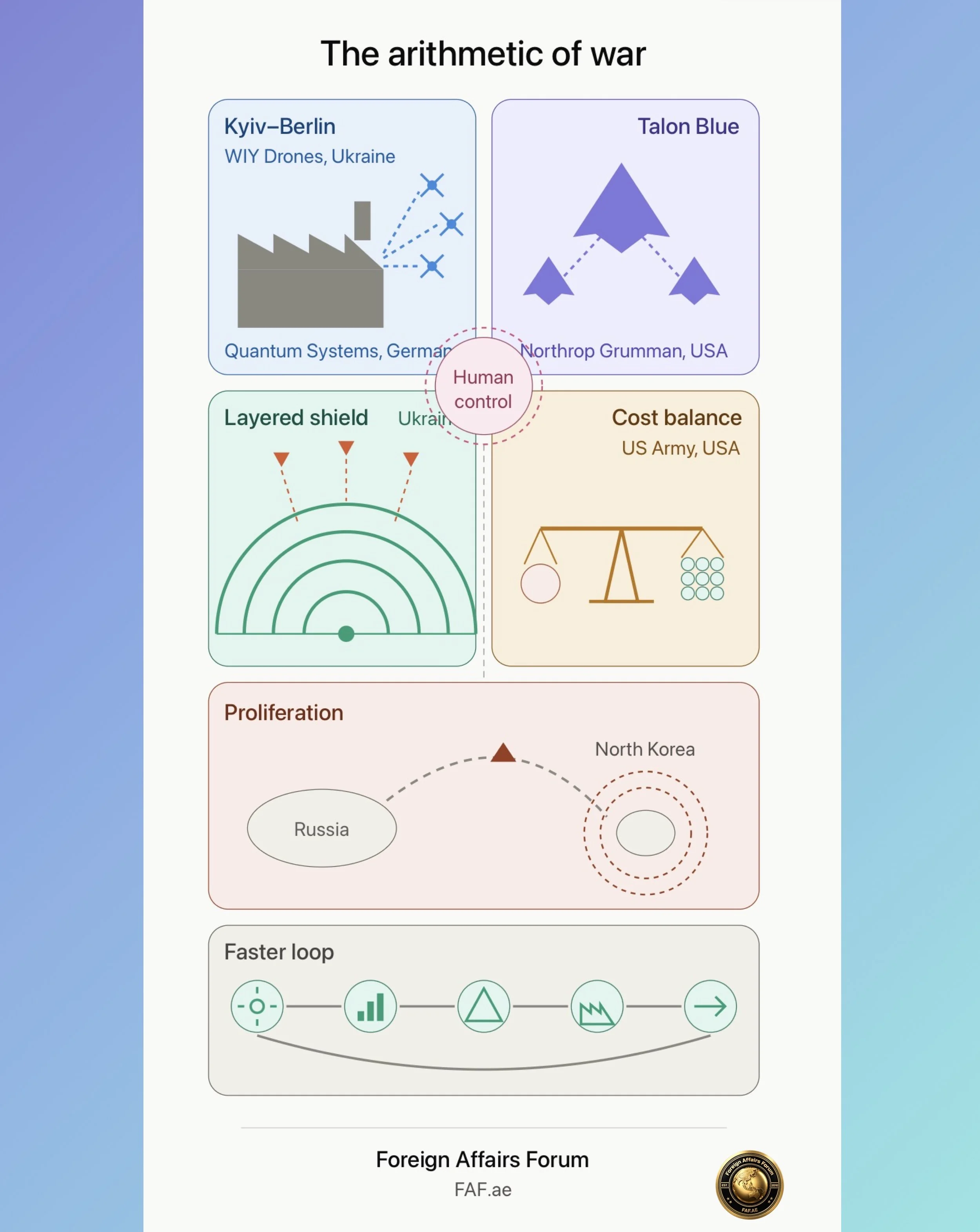
A laser or microwave system requires a large initial investment but costs little per engagement, since its marginal cost is essentially electricity. This changes the defender's calculation from the price of each shot to the price of the installation and its power supply. Over time, if the technology matures, the defender could face an attacker's mass with a magazine that is effectively unlimited, constrained only by power generation, heat management and the reliability of the system. Lasers offer precision against individual targets, while microwave systems offer area effects against swarms. The combination suggests a layered architecture in which radar detects, artificial intelligence classifies, electronic warfare disrupts, microwaves and lasers engage, robotic guns and interceptor drones provide close defense, and conventional missiles remain a final reserve against the most valuable threats.
The third chain links software to kinetic capability.
Ukraine's robotic turrets show that artificial intelligence can multiply the value of existing hardware. A machine gun is a century-old weapon, yet when coupled with cameras, machine vision, automated tracking and ballistic calculation, it becomes a counter-autonomy system capable of engaging fast aircraft at the cost of ammunition. The cause is the maturation of inexpensive sensing and computation, and the effect is that old weapons can be given new relevance through software upgrades. This changes the logic of procurement, because a nation's existing arsenal may be more adaptable than assumed, and because software developers may contribute as much to defense as foundries do.
The fourth chain connects saturation to magazine depth.
When attackers launch hundreds of weapons, defenders must either intercept most of them or accept damage. Because interception consumes finite stocks, the attacker's objective becomes the exhaustion of those stocks. The effect is a shift in strategic emphasis from the quality of the interceptor to the depth of the magazine, the rate of production and the speed of replenishment. The relevant equation, in Dr. 🆎's formulation, multiplies the probability of kill by the cost per interception, the depth of the magazine, the production rate and the speed of replenishment. A weapon that destroys 99% of targets but costs one hundred times as much as the incoming threat may therefore be strategically unsustainable.
The fifth chain connects industry to deterrence.
Anduril's Arsenal-2 reflects a recognition that the binding constraint on American naval power is production capacity. Virginia-class submarines are extraordinarily sophisticated, but American shipyards have struggled to produce them quickly enough to meet Navy requirements while also supporting the AUKUS partnership. If a software-defined factory, with digital design, automation, vertical integration and payments tied to measurable output, can raise throughput, then the effect would spread beyond submarines to missiles, ships and aircraft. In this sense the factory becomes the weapon, because the capacity to produce and reproduce military hardware determines the outcome of prolonged conflict.
The sixth chain describes diffusion.
The Ukrainian experience, transmitted through open reporting, allied exchanges and industrial partnerships, is reshaping planning in other landscapes. The Seventh Air Force request shows that the migration to the Indo-Pacific has begun. North Korea possesses large conventional artillery and missile inventories that could be combined with increasingly sophisticated drones, and American installations in South Korea cannot rely on missile defenses designed for a different era. The consequence is a global convergence of requirements, linking Kyiv, Seoul, NATO's eastern flank and American bases worldwide through a common economic problem.
Taken together, these chains describe a closed loop in which factories produce mass autonomous weapons, those weapons enable saturation attacks, sensors and artificial intelligence classify the threat, the cheapest effective countermeasure responds, battlefield data informs redesign, and the factory produces the next generation. The side that completes the loop fastest gains the advantage.
Future Steps
Policy should begin by recognizing that air defense must be redesigned as an economic system, not merely as a collection of platforms.
The first step is to accelerate the fielding of layered, low-cost defenses at installations that are likely to face drone attack. The Pentagon's directed-energy pilot should be expanded as rapidly as testing permits, with emphasis on power generation, thermal management, reliability under adverse weather and integration with existing sensors. Evaluation should be conducted in realistic conditions, including swarms, decoys and electronic interference, so that results reflect operational reality and not laboratory performance.
The second step is to integrate software and sensor networks across the defensive layers.
A microwave weapon, a laser, a robotic turret and an interceptor drone are each useful, but their value multiplies when a common picture directs each to the targets it is best suited to defeat. Open architectures, shared data standards and rapid software update cycles are therefore as important as the weapons themselves.
Dr. 🆎 recommends that human commanders retain authority over rules of engagement and geographic boundaries, while allowing machines to handle the speed-critical tasks of tracking and fire control.
The third step is to build industrial resilience.
States should map their defense supply chains, identify single points of failure and invest in dispersed, redundant and rapidly reconfigurable production. The Arsenal-2 model, in which payments are linked to production outcomes and the contractor assumes execution risk, offers a promising template, but it must be monitored carefully for quality, safety and supply-chain integrity. Governments should also protect critical factories with their own layered defenses, recognizing that the Russian targeting of Fire Point is a preview of future practice.
The fourth step is to deepen allied cooperation.
Ukraine possesses unmatched operational experience, and its partners possess industrial capacity, capital and research infrastructure. Joint development, shared testing and coordinated production can compress learning cycles for all participants. The inclusion of Indo-Pacific allies in these arrangements is particularly important, since lessons learned in Europe must be adapted to the geography, adversaries and force structures of Asia.
The fifth step is to establish norms and safeguards for autonomous defensive systems.
Even if comprehensive international agreements remain elusive, states can adopt national standards for testing, human oversight, logging and accountability. Transparent doctrines reduce the risk of misinterpretation between rivals, and rigorous verification reduces the risk of accidents.
Dr. 🆎 emphasizes that the same artificial intelligence capabilities that improve defense can also lower barriers for hostile non-state movements, which is why security planning must consider the misuse of autonomy, including in areas such as biological threats, alongside conventional battlefield applications.
The sixth step is to rebalance defense investment toward magazine depth and replenishment.
Procurement plans that emphasize a small number of exquisite interceptors should be supplemented with large stocks of inexpensive effectors, along with the manufacturing capacity to expand output rapidly in a crisis. Ultimately, the measure of readiness is not the performance of a single system in a demonstration but the ability to sustain defense over weeks and months of intense attack.
Conclusion
The five developments examined in this essay occupy five layers of an emerging military system.
The Pentagon's laser and microwave program represents the directed-energy layer. Anduril's Arsenal-2 represents the industrial-production layer. Ukraine's robotic turrets represent the AI-enabled kinetic layer.
The mass strikes exchanged by Russia and Ukraine represent the saturation layer. The Seventh Air Force requirement represents the global diffusion layer. Together they describe a world in which the decisive question is not who possesses the most advanced weapon but who can produce, adapt and sustain effective systems at the lowest cost and the greatest speed.
The strategic implication is a change in the arithmetic of war.
For most of the missile age, militaries optimized around the probability of destroying an incoming weapon. The autonomous age demands a broader equation that includes cost, magazine depth, production rate and replenishment speed. This explains why technologies as different as robotic machine guns, microwave weapons, interceptor drones and lasers are converging on a shared problem, which is how to make defense cheaper than attack. Anduril's investment addresses the complementary problem of how to build sophisticated hardware far more quickly.
The emerging competition is therefore a contest between factories, algorithms and production curves, not merely between weapons.
Dr. 🆎 has cautioned that the greatest danger lies in mistaking technological novelty for strategic advantage. A state that adopts a dazzling system without the industrial depth to replace it, or without the human oversight to control it, has purchased an illusion.
The state that prevails will be the one that combines artificial intelligence, inexpensive interception and industrial-scale manufacturing into the fastest sustainable combat system, while preserving the human judgment on which legitimacy, restraint and ultimately security depend.