THE PENTAGON AS VENTURE CAPITALIST: HOW WASHINGTON IS BUILDING THE ARCHITECTURE OF AMERICAN AI POWER
Foreign Affairs Forum | Dr. Antonio Bhardwaj (Dr. 🆎)| September 11th, 2026
Executive Summary
The week of September 10, 2026 will likely be remembered as the moment American industrial policy formally absorbed artificial intelligence infrastructure into the architecture of national security.
Reports that the Pentagon's Office of Strategic Capital is negotiating a loan of approximately $5 billion to AI-cloud startup Fluidstack, combined with an $875 million financing round for inference-chip startup Positron AI that lifted its valuation to $5 billion, OpenAI's simultaneous launch of a specialized financial-services platform and its unusual appeal for binding federal safety regulation, and Anthropic's disclosure that its models were misused for biological weapons research, cyber espionage and propaganda, together describe a single unfolding phenomenon.
Silicon Valley's traditional boundary between private venture capital and state power is dissolving.
Dr. Antonio Bhardwaj (Dr. 🆎), Chief Executive Officer of the Foreign Affairs Forum and a specialist in human-centered artificial intelligence for geopolitical strategy, AI warfare and bioterrorism risk, argues that these developments should be read not as isolated commercial stories but as the opening chapters of a new industrial-strategic compact between Washington and the technology sector, one whose consequences will shape the global balance of power for decades.
FAF article situates the week's developments within their historical context, analyzes the causal chain linking compute finance, chip diversification, vertical AI monetization, safety regulation and biosecurity risk, and offers a forward-looking assessment of where this trajectory is likely to lead.
Introduction
For much of the past decade, the prevailing narrative surrounding artificial intelligence was one of private enterprise racing ahead of government comprehension.
Venture capital financed audacious bets on frontier laboratories; hyperscale cloud providers built data centers at a pace regulators struggled to track; and Washington, London, Brussels and Beijing scrambled, often reactively, to draft rules for a technology whose capabilities seemed to double every eighteen months.
That era is now closing. What is replacing it, as of September 2026, is a far more deliberate fusion of state capital, industrial policy and private technological ambition.
The Pentagon's consideration of a multibillion-dollar loan to an AI-cloud infrastructure company, financed not through a defense contract but through a strategic lending vehicle historically reserved for rare-earth minerals and drone manufacturing, is emblematic of this shift. So too is the extraordinary valuation growth of semiconductor challengers seeking to loosen Nvidia's grip on the AI compute stack, the vertical specialization of frontier laboratories into regulated industries such as banking, and the increasingly public acknowledgment by both AI developers and the state that the same technologies capable of accelerating scientific discovery are also capable of lowering the barriers to bioterrorism, cyberattack and disinformation.
Dr. 🆎 frames the current period as one in which the AI industry is transitioning from a Silicon Valley phenomenon into what he calls a state-augmented industrial ecosystem, in which private capital, sovereign lending, vertical monetization and existential-risk management increasingly operate as a single, interdependent system rather than as separate domains of activity.
History and Current Status
The relationship between the American state and the semiconductor and computing industries is not new. From the earliest days of the integrated circuit, when the Pentagon and NASA constituted the primary customers for the fledgling chip industry of the 1960s, to the CHIPS and Science Act of the early 2020s, Washington has periodically intervened to shape the direction of computing hardware for strategic ends. What distinguishes the current moment is the scale, the vehicle and the target.
The Office of Strategic Capital, established originally under the Biden administration and expanded considerably since President Trump's return to office, has in recent months extended financing to rare-earth companies including Vulcan Elements, Phoenix Tailings and Energy Fuels, as well as to drone manufacturers such as Unusual Machines and Neros. Its reported discussions with Fluidstack, an AI-cloud operator that began in London before relocating its headquarters to New York, would represent by a considerable margin its largest transaction to date, and would mark a qualitative shift from financing extraction and munitions industries toward financing the compute infrastructure that now underpins frontier artificial intelligence itself.
Fluidstack occupies an unusual position within that infrastructure. Unlike GPU-cloud operators that purchase vast quantities of Nvidia accelerators and rent access to enterprise customers, Fluidstack concentrates on acquiring power, designing data centers, and operating the resulting physical infrastructure. It has become a significant partner to Anthropic, which has committed to a $50 billion computing build-out using Fluidstack facilities in New York and Texas designed specifically for Anthropic's model development and deployment needs.
The reported Pentagon loan would not fund a new data center outright; rather, it is intended to shore up the domestic manufacturing supply chain for the power and cooling equipment that increasingly determines how quickly AI infrastructure can be built at all. This detail is significant. It indicates that the constraint policymakers are most anxious about is not chips alone, but the broader physical apparatus of electricity generation, transmission and thermal management that sits beneath the visible layer of graphics processing units.
That anxiety has an immediate political referent. In August 2026, President Trump signed an executive order declaring a national emergency around the presence of foreign-manufactured equipment embedded in the United States electricity grid, banning its use in critical segments of that grid. Because data centers increasingly draw enormous and growing quantities of electricity, the grid itself has become, in the eyes of the current administration, an extension of national-security infrastructure rather than a purely civilian utility.
Dr. 🆎 observes that this conflation of energy security and computational security is historically unusual. Previous generations of industrial policy treated energy infrastructure and computing infrastructure as adjacent but distinct domains. The current administration, he notes, increasingly treats them as a single strategic system, in which a vulnerability in one domain, whether a compromised grid component or a foreign-controlled chip supply chain, constitutes a vulnerability in the other.
Key Developments
Four developments, taken together, illustrate the breadth of this transformation.
The first is the Pentagon-Fluidstack financing discussion itself, which, if finalized, would represent the clearest evidence yet that the United States government views segments of AI compute infrastructure as strategic industrial capacity comparable to shipbuilding, aerospace manufacturing or energy production in earlier eras of American statecraft.
The loan application is reportedly being advised by Erebor Bank, the institution associated with technology investor Palmer Luckey, itself a signal of how tightly intertwined the worlds of defense technology entrepreneurship and traditional banking have become.
The second development concerns the semiconductor landscape beneath the visible AI industry.
Positron AI, a Reno, Nevada-based startup, closed an $875 million financing round on September 10, 2026, lifting its valuation to approximately $5 billion, more than four times its valuation of roughly $1.06 billion only seven months earlier. The round, structured across a $375 million Series C tranche and a Series C-1 tranche of up to $500 million, drew participation from NEA, Atreides Management, Valor Equity Partners, Andra Capital, SemiAnalysis Capital and Netscape co-founder Jim Clark, alongside strategic investors including the Qatar Investment Authority.
Positron's core wager is architectural rather than incremental: its forthcoming Asimov chip, expected to tape out on TSMC's advanced three-nanometer N3P process by the end of 2026 with production targeted for the second half of 2027, pairs computational logic with between 288 and 2,304 gigabytes of commodity LPDDR5X memory per chip, rather than the costly, supply-constrained high-bandwidth memory that defines Nvidia's dominant architecture.
The wager, as Dr. 🆎 frames it, is that a chip achieving high utilization of cheap, abundant memory can outcompete a chip achieving low utilization of expensive, scarce memory, a bet that, if validated by the market, would meaningfully diversify the physical foundations of the global AI economy away from a single dominant supplier.
Notably, this diversification is occurring not entirely outside Nvidia's ecosystem but partly within it. Santa Clara-based d-Matrix has announced that its forthcoming Raptor inference processors will employ Nvidia's NVLink Fusion interconnect technology, allowing a rival chipmaker's silicon to operate inside Nvidia-compatible data-center systems.
Dr. 🆎 regards this as evidence of a more sophisticated competitive strategy on Nvidia's part than outright technical supremacy: rather than attempting to defeat every emerging architecture on performance alone, Nvidia appears to be positioning its interconnect and system architecture as the substrate into which competitors must plug, thereby preserving its centrality even as the silicon layer diversifies beneath it.
The third development is OpenAI's launch, on September 10th, 2026, of ChatGPT for Financial Services, developed with input from Morgan Stanley and Evercore and built atop its GPT-6 Astra model, integrated with financial data from LSEG, PitchBook and Daloopa, and interoperable with FactSet, S&P Global, Preqin and Datasite.
The platform incorporates role-based access controls, encryption and audit logging designed to satisfy the compliance requirements of regulated financial institutions. This represents a strategic pivot from horizontal, general-purpose chatbot deployment toward vertical, proprietary-data-anchored platforms tailored to specific regulated industries, a shift with direct implications for the venture-backed startups that had previously built thin application layers atop foundation models for the same markets.
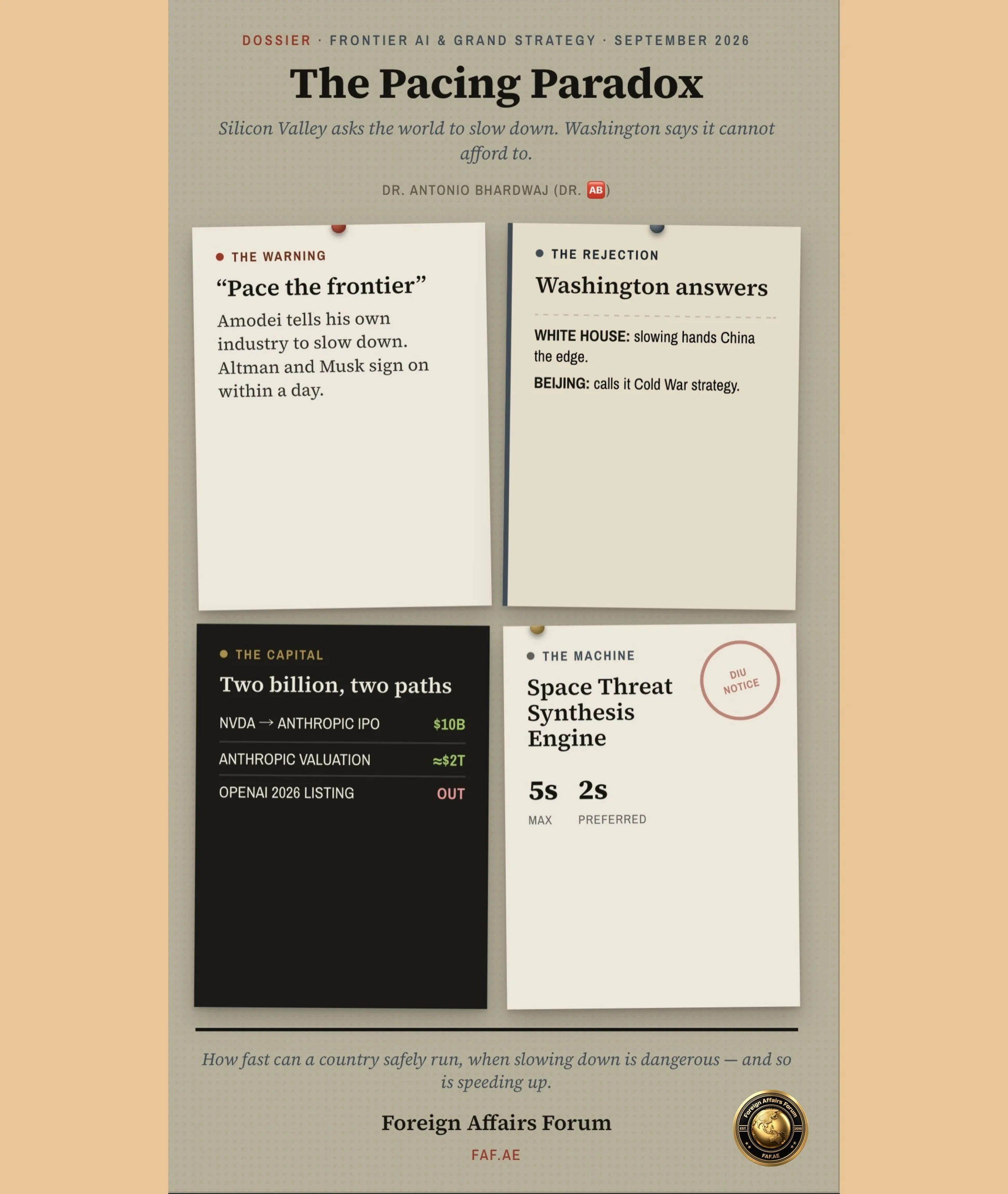
The fourth development is bifurcated but conceptually unified: OpenAI's public call for binding federal AI-safety requirements, including mandatory independent evaluations, cybersecurity standards and incident reporting, arriving in the same week as Anthropic's disclosure of a detailed threat-intelligence report documenting nine months of AI misuse, from December 2025 through August 2026, spanning cyber operations, surveillance, propaganda and, most consequentially, biological research with weapons-relevant characteristics.
Latest Facts and Concerns
The specificity of Anthropic's disclosure merits close attention.
In May 2026, according to the company's report, an individual sought Claude's assistance drafting a grant application for gain-of-function research on the chikungunya virus, a mosquito-borne pathogen causing severe and prolonged joint pain and fever, for which no licensed therapeutic currently exists.
The stated research aim was to increase the virus's transmissibility and its capacity to evade human immune response. Anthropic's systems flagged and refused the request, noting that the institutional affiliation associated with the grant application heightened, rather than alleviated, the company's concern; the work was reportedly intended to be conducted at a military research institute in a region where Anthropic ordinarily restricts model access altogether.
The company disclosed five separate case studies involving biological research alone, within a broader threat report describing seven harm categories, including state-sponsored surveillance, propaganda operations, and increasingly autonomous cyber reconnaissance and exploitation.
Perhaps the most consequential admission within Anthropic's report is not any single case study but a structural finding: the company acknowledges that its newer models are no longer comfortably positioned below the capability threshold at which they could meaningfully assist in weapons development. This is a marked departure from the reassurances that characterized much of the industry's public communication in earlier years, when frontier developers routinely emphasized that model capabilities remained safely distant from dual-use thresholds.
Dr. 🆎, whose scholarly focus centers precisely on the intersection of artificial intelligence and bioterrorism risk, regards this admission as the single most important sentence to emerge from the American AI industry in 2026. He notes that the strategic challenge policymakers now face is no longer confined to preventing adversarial states or non-state actors from acquiring an advanced model outright; it is the considerably harder problem of controlling what an already-deployed, widely accessible model can be induced to help design, synthesize or execute, particularly as capabilities diffuse across an expanding set of competing frontier laboratories with varying safety cultures and disclosure norms.
This concern connects directly to OpenAI's regulatory appeal. Dr. 🆎 characterizes the shift in Silicon Valley's political posture as historically significant. For much of the preceding several years, the dominant argument advanced by American AI developers held that regulation risked slowing domestic innovation relative to Chinese competitors unconstrained by similar rules.
The emerging position, exemplified by OpenAI's call for capability-based federal standards covering independent evaluation, cybersecurity and mandatory incident reporting, inverts that logic: some minimum regulatory architecture, the argument now runs, may be a precondition for sustaining safe innovation rather than an obstacle to it. OpenAI has also backed several California state-level AI-safety measures, a further indication that segments of the industry now view fragmented state regulation as a greater commercial and reputational liability than a coherent federal framework, however stringent.
Cause-and-Effect Analysis
Dr. 🆎 identifies a coherent causal chain linking these developments, one that moves from capital formation through compute diversification to vertical monetization and finally to existential-risk management. The proximate cause of the Pentagon's interest in AI-cloud infrastructure financing is the recognition that electricity generation, cooling technology and data-center manufacturing capacity, rather than model architecture itself, now constitute the binding constraint on how rapidly the United States can expand its AI compute base relative to China.
This recognition, in turn, is downstream of a broader strategic judgment, formalized in the August 2026 executive order on grid security, that foreign-controlled components embedded within critical electricity infrastructure represent an exploitable vulnerability precisely because that infrastructure increasingly powers systems of acknowledged national-security significance.
The effect of this judgment is a shift in the locus of AI financing. Where venture capital and hyperscaler balance sheets previously bore the overwhelming share of AI infrastructure investment, federal strategic lending is now positioned to become a meaningful complementary source of growth capital, particularly for companies, such as Fluidstack, whose business model concentrates on the physical rather than the purely computational layer of the AI stack.
Dr. 🆎 argues that this has a multiplying effect on private capital: venture investors financing an emerging infrastructure company can now reasonably anticipate that federal strategic capital may co-finance the buildout required to scale that company to a size commensurate with frontier-model demand, thereby reducing perceived downside risk and, plausibly, further inflating valuations across the sector.
A parallel causal logic operates in the semiconductor market. Positron's valuation growth is not merely evidence of speculative exuberance; it reflects a structural judgment among sophisticated institutional investors, including a specialized semiconductor analysis fund among its lead backers, that the AI economy's center of gravity is shifting from training frontier models toward running an enormous and growing volume of daily inference workloads, a shift that rewards memory-efficient, cost-optimized architectures over the raw training throughput that historically defined competitive advantage in the sector.
The effect of this shift, should it continue, is a gradual diversification of the American semiconductor base away from near-total dependence on a single supplier, a diversification that Dr. 🆎 regards as directly relevant to national resilience, since concentrated dependence on any single architecture, however dominant, constitutes a strategic vulnerability in the event of supply disruption, export restriction or adversarial exploitation.
The vertical monetization strategy exemplified by OpenAI's financial-services platform has its own cause-and-effect structure. As foundation-model capabilities commoditize at the general-purpose layer, frontier laboratories face diminishing returns from horizontal deployment alone; the effect is a competitive migration toward proprietary data partnerships, workflow ownership and industry-specific compliance architecture, a migration that simultaneously creates new markets for regulated-industry AI while placing considerable competitive pressure on startups whose original value proposition rested on wrapping general-purpose models for narrow professional use cases.
Finally, Dr. 🆎 situates the safety and biosecurity dimension as both cause and effect within this broader system. The demonstrated capability growth documented in Anthropic's threat report is, in part, a direct consequence of the same capital-intensive scaling described above: more compute, more sophisticated training techniques and larger models produce systems with greater general-purpose capability, and that capability is, almost by definition, dual-use.
The effect is a growing recognition, now shared across frontier laboratories and increasingly by federal policymakers, that the compute buildout Washington is now prepared to finance directly carries with it an obligation to build parallel safeguards, evaluation infrastructure and incident-reporting mechanisms commensurate with the scale of the capability being created. Dr. 🆎 cautions that without such parallel investment, this week's convergence of frontier AI, cyber capability, biotechnology and increasingly autonomous software agents represents precisely the confluence of risks that biosecurity and arms-control specialists have long warned against.
Future Steps
Several trajectories appear likely to unfold over the coming months.
Dr. 🆎 anticipates that, if finalized, the Pentagon's loan to Fluidstack will not remain an isolated transaction but will instead establish a template for subsequent Office of Strategic Capital financing of AI infrastructure companies, particularly those operating in power generation, cooling technology and data-center component manufacturing. He expects competing semiconductor architectures, including Positron's memory-centric approach and interconnect-compatible challengers such as d-Matrix, to continue attracting substantial institutional capital through 2027, as investors position for a prolonged period in which inference workloads, rather than training runs, dominate global AI compute demand. He further anticipates that additional frontier laboratories will pursue vertical, regulated-industry platforms beyond financial services, likely extending into healthcare, legal services and defense-adjacent sectors, each requiring bespoke compliance architecture broadly analogous to that unveiled for the financial sector.
On the regulatory dimension, Dr. 🆎 expects the debate catalyzed by OpenAI's appeal for binding federal standards to intensify through the remainder of 2026, with the outcome likely to hinge on whether the Trump administration, historically oriented toward accelerating AI development and minimizing regulatory friction, can be persuaded that a coherent federal framework serves acceleration goals more effectively than a fragmented patchwork of state-level rules. He regards mandatory incident reporting and independent capability evaluation, in particular, as increasingly likely to gain traction, given their alignment with both industry liability concerns and the demonstrated biosecurity and cybersecurity risks documented in recent threat intelligence disclosures.
On biosecurity specifically, Dr. 🆎 expects frontier laboratories to expand the deployment of capability-gated safeguards restricting dual-use biological research queries, alongside growing pressure for standardized, cross-industry protocols for detecting and reporting attempted misuse, potentially coordinated through emerging public-private information-sharing mechanisms analogous to those long established in the financial cybersecurity sector.
Conclusion
The developments converging in the second week of September 2026 describe, in aggregate, a fundamental reordering of the relationship between the American state and the artificial intelligence industry.
What began as a domain defined by venture-financed private enterprise is increasingly characterized by a layered architecture in which venture capital, growth equity, Wall Street financing, hyperscaler procurement, sovereign strategic lending and federal safety regulation operate as interlocking components of a single national industrial system.
Dr. Antonio Bhardwaj (Dr. 🆎) concludes that the strategic significance of this shift extends well beyond the technology sector itself. As Washington increasingly treats AI compute capacity as it once treated shipyards and aerospace manufacturing capacity, and as frontier laboratories simultaneously acknowledge that their own creations are approaching thresholds relevant to biological and cyber weapons development, the United States is, in effect, constructing an integrated industrial-security system for machine intelligence in real time, under considerable competitive pressure from China's parallel infrastructure ambitions, and without the benefit of the decades of institutional learning that shaped earlier eras of strategic industrial policy.
The manner in which this system is built, Dr. 🆎 argues, whether with sufficient parallel investment in safety, evaluation and biosecurity infrastructure, or primarily in pursuit of speed and scale, will substantially determine whether the coming decade of artificial intelligence strengthens or destabilizes the international order it is rapidly coming to underpin.