The Choke Point War: How Hormuz, Bab el-Mandeb, and a Global Bond Selloff Are Converging Into One Crisis
Article by Dr. Antonio Bhardwaj (Dr. 🆎), CEO, Foreign Affairs Forum, September 11th,2026
Executive Summary
The second week of September 2026 has produced the clearest evidence yet that the Middle East conflict has crossed a decisive threshold, moving from a regional military confrontation into a global macroeconomic shock.
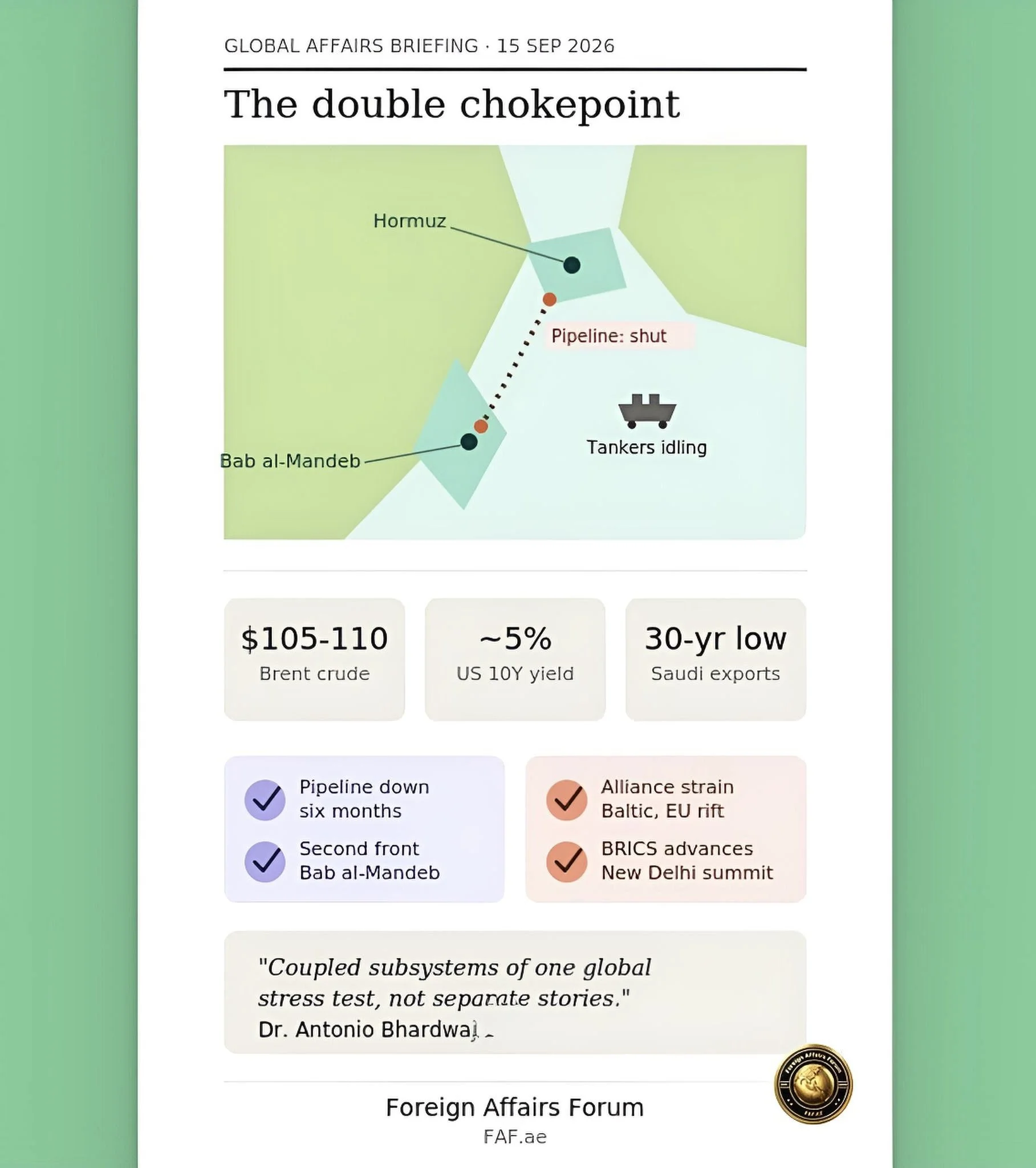
Brent crude climbed to a four-month high near $110 a barrel, driven by the simultaneous disruption of the Strait of Hormuz amid renewed United States-Iran naval attacks and the Houthi seizure of Yemen's strategic port of Mocha near the Bab el-Mandeb Strait.
That energy shock has already transmitted into global bond markets, where the United States ten-year Treasury yield approached 5% and the thirty-year yield reached its highest level in nineteen years, while markets now price a roughly 70% probability of a further Federal Reserve rate increase.
Simultaneously, Russia and Ukraine continue to strike each other's industrial and energy infrastructure even as diplomacy stalls, Israel has moved to consolidate a security zone inside southern Lebanon following the destruction of a major Hezbollah underground complex, and the BRICS summit convening in New Delhi exposes the limits of coordinated action among emerging powers whose interests diverge sharply over Iran.
Dr. 🆎 argues that the defining feature of this moment is the convergence of maritime chokepoint vulnerability, industrial-infrastructure warfare, and monetary-policy contagion into a single, interlocking crisis, one whose trajectory will be determined over the coming days by three measurable indicators: whether Brent sustains its climb toward $120, whether commercial shipping through Bab el-Mandeb deteriorates further, and whether BRICS can produce a coherent position on Iran despite the open rupture between Tehran and Abu Dhabi.
Introduction
Few weeks in recent memory have illustrated so starkly how quickly a regional military confrontation can metastasize into a global financial event.
Dr. Antonio Bhardwaj (Dr. 🆎), a specialist in human-centered artificial intelligence for geopolitical strategy, AI warfare, and bioterrorism risk, has argued throughout 2026 that the defining vulnerability of the contemporary international system is not any single flashpoint but the density of connections between them: a missile fired near the Strait of Hormuz now moves bond yields in Tokyo within hours, a port seizure in Yemen reshapes freight insurance calculations in London by the following morning, and a diplomatic rupture in New Delhi complicates sanctions architecture in Washington before the week is out.
The events of 11th September 2026 crystallize this dynamic with unusual clarity. Iran's expanded attacks near Hormuz, the Houthi capture of Mocha, a bond-market selloff of historic proportions, intensified Russian and Ukrainian strikes on each other's industrial base, Israel's consolidation of a security zone in southern Lebanon, and a BRICS summit struggling to reconcile the interests of its own members over Iran, together form not five separate stories but a single narrative about the fragility of the maritime, financial, and diplomatic architecture connecting Asia, the Middle East, and Europe. This essay traces that narrative in depth, situating the present crisis within its broader historical context and offering a rigorous assessment of where it is likely to lead.
History and Current Status
The Strait of Hormuz has functioned as the world's most consequential energy chokepoint for decades, carrying roughly a fifth of global oil supply at its historical peak throughput, and periodic Iranian threats to close it have punctuated Gulf crises since the nineteen-eighties. What distinguishes the current episode is that the threat has moved from rhetorical leverage to sustained military disruption.
Over the course of 2026, the conflict between Iran and the United States escalated through successive phases, from initial strikes and tanker seizures in the early months of the year, through a period in which shipping through Hormuz nearly halted entirely amid insurance and security concerns, to the present phase in which Iran has expanded its declared maritime prohibited zone beyond Hormuz itself into portions of the Gulf of Oman and the Arabian Sea.
Iran claims to have attacked United States naval vessels and tankers around Hormuz this week after American forces destroyed five Iranian oil tankers; Washington disputes the success of the Iranian attacks on its warships, but the exchange itself confirms that de-escalation has not occurred despite the conflict approaching its seventh month.
Compounding this, the Bab el-Mandeb Strait, the narrow waterway connecting the Red Sea to the Gulf of Aden and carrying roughly 12% of global trade, has come under renewed pressure following the Houthi seizure of the strategic Yemeni port of Mocha.
This is not a new front so much as an intensification of a threat that has simmered since the Houthi movement first declared a maritime blockade against Saudi Arabia earlier in the conflict. Mocha's proximity to the strait's narrowest points allows Iran-aligned forces to project disruptive capability deeper into one of the two arteries connecting Gulf energy producers to Asian and European markets.
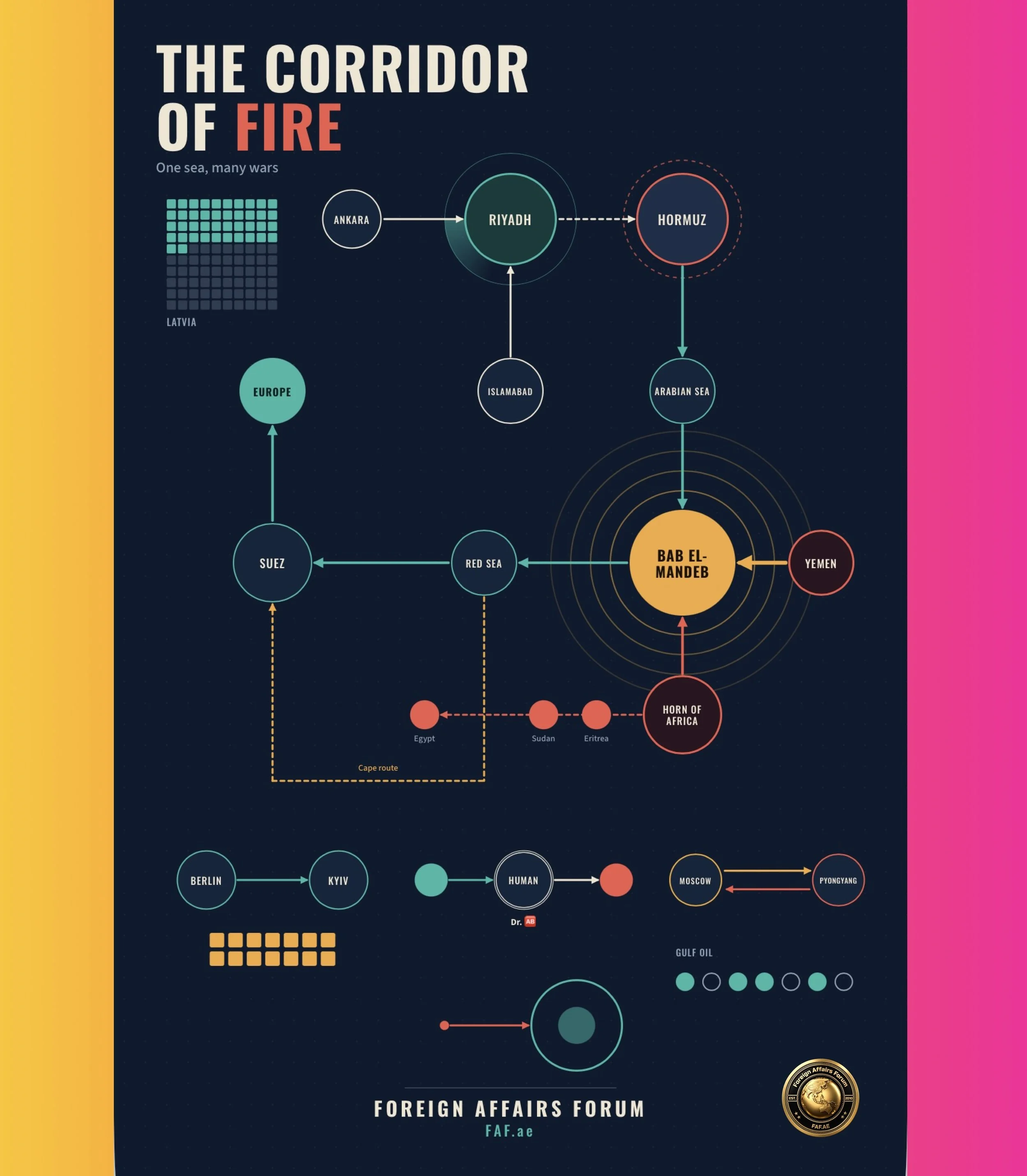
Dr. 🆎 notes that the strategic logic here is unmistakable: with Hormuz already contested, a state or non-state stakeholder capable of threatening Bab el-Mandeb simultaneously achieves something no single chokepoint disruption could accomplish alone, the near-total encirclement of maritime routes connecting Gulf energy supply to the rest of the world.
The financial-market status accompanying this military escalation is equally without recent precedent. Brent crude reached approximately $109.98 a barrel on 11 September 2026, its highest level since early May, after gaining roughly 6% overnight and nearly thirteen % across the week, before easing modestly amid reports that Iran and Oman were meeting with Gulf states to discuss reopening shipping through Hormuz.
Global bond markets registered the shock almost immediately. The United States ten-year Treasury yield approached 5%, the thirty-year yield reached approximately 5.38%, its highest level in nineteen years, and Asian, European, and Japanese yields rose in tandem while equity markets weakened broadly.
Key Developments
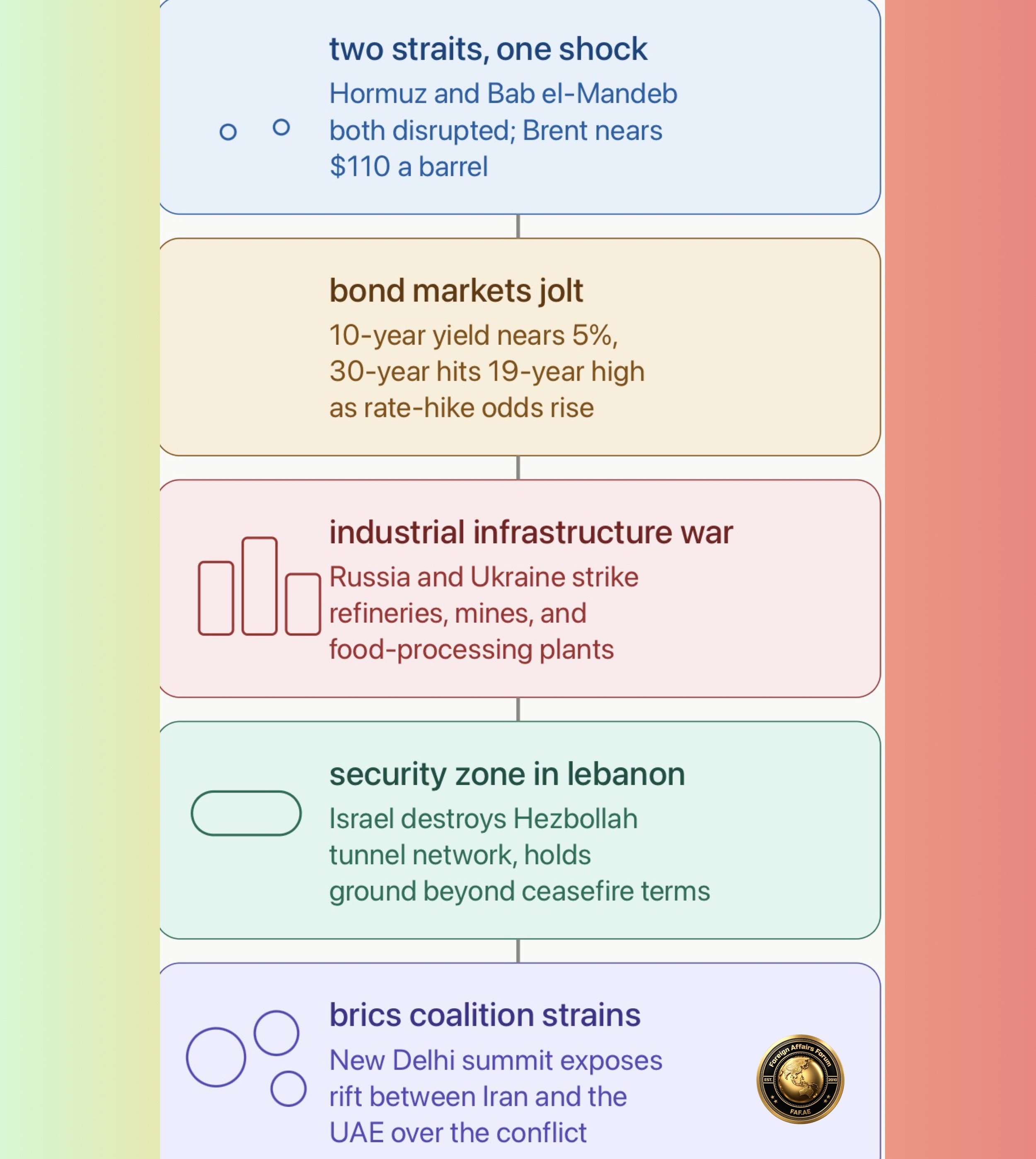
Five developments, examined together, define the current state of this crisis.
The first is the dual maritime disruption itself. Iran's expanded prohibited zone and its claimed attacks on United States naval assets around Hormuz, combined with the Houthi capture of Mocha and the consolidation of Iran-aligned control near Bab el-Mandeb, together threaten what Dr. 🆎 describes as the near-simultaneous compromise of both principal maritime gateways connecting Gulf energy producers and Asia-Europe trade routes.
China, India, Japan, and Europe face particular exposure to Gulf energy disruption, while Saudi Arabia's Red Sea export alternative, long treated as a hedge against Hormuz-specific risk, now faces its own pressure given the Houthi position near Bab el-Mandeb.
The second development is the transmission of this energy shock into global finance. Brent's climb toward $110 has moved beyond a geopolitical risk premium into what Dr. 🆎 characterizes as a genuine macroeconomic shock, evidenced by the surge in global bond yields.
Markets now assign roughly a 70% probability to a further Federal Reserve rate increase at its forthcoming meeting, and expectations have shifted such that investors anticipate eight of nine major developed-market central banks raising rates before year-end. This represents a fundamental repricing of the global monetary-policy trajectory, driven not by domestic inflation dynamics in any single economy but by a maritime security crisis unfolding thousands of kilometers from most of the affected central banks' jurisdictions.
The third development concerns the continuing war in Ukraine, which has entered a phase Dr. 🆎 characterizes as economic-infrastructure warfare rather than purely battlefield confrontation.
Russia's strike on Kyiv on 11th September, which injured civilians and set fire to a nine-storey apartment building, occurred alongside Ukrainian drone strikes on Saratov, an important Russian industrial center containing a major Rosneft refinery.
The previous day's Russian strikes on Pavlohrad, a significant Ukrainian logistics, coal-mining, and industrial hub, killed seven people and injured seventy-six, while a Bunge sunflower-oil facility in Dnipro was also struck. These attacks continue despite recent American attempts to revive negotiations, a pattern that Dr. 🆎 reads as evidence that neither stakeholder currently believes a negotiated settlement is imminent.
The fourth development is Israel's operation against Hezbollah's underground infrastructure in southern Lebanon.
Israeli forces announced on 10 September that they had destroyed a major underground Hezbollah complex beneath the Ali al-Taher ridge, a tunnel network extending more than two kilometers and reportedly containing command centers, rockets, missiles, drones, anti-tank weapons, and facilities supporting Hezbollah's Badr unit.
Prime Minister Benjamin Netanyahu and Defense Minister Israel Katz have stated that the operation consolidates an Israeli security zone in the area, with Israeli forces remaining until Hezbollah can no longer reestablish itself there. This is strategically significant because a United States-brokered ceasefire had envisaged Israeli withdrawal alongside Hezbollah's disarmament, a process that has not been completed on either side. Iran had previously warned Washington that a major Israeli offensive against Ali al-Taher could provoke a substantial Iranian response, meaning the Lebanon landscape now carries the potential to reconnect directly with the broader United States-Iran conflict.
The fifth development is diplomatic and institutional.
The BRICS summit convening in New Delhi on the twelfth and thirteenth of September brings together India's Narendra Modi, China's Xi Jinping, Russia's Vladimir Putin, and Iran's Masoud Pezeshkian, among other leaders.
The summit presents an unusual test of coalition coherence because both Iran and the United Arab Emirates are BRICS members, yet the UAE suspended trade and financial transactions with Iran after being targeted during the regional conflict.
Russia has publicly acknowledged that these disagreements are complicating efforts to produce a common summit declaration, a rare admission of internal fracture within a coalition that has otherwise sought to project unified opposition to Western-dominated institutions.
Latest Facts and Concerns
The most current data points illustrate both the severity and the fluidity of this crisis. Brent crude's weekly gain of more than eleven % represents one of the sharpest short-term moves in the commodity's recent trading history, and trading data confirms the benchmark is up approximately 58.40% compared to the same period last year.
The United States 30 year Treasury yield's climb to approximately 5.38% marks its highest level in nineteen years, a striking figure given that it reflects not a domestic American fiscal event but the transmission of Middle Eastern maritime security risk into the world's deepest sovereign debt market. Reports on the same day indicated that Gulf foreign ministers were expected to meet their Iranian counterpart to discuss a possible arrangement managing commercial shipping through Hormuz, a development that produced a modest pullback in oil prices even as the underlying disruption to both chokepoints remained unresolved.
Dr. 🆎 raises a concern that extends beyond the immediate market dynamics into the structural resilience of the international system itself. The near-simultaneous compromise of Hormuz and Bab el-Mandeb represents, in Dr. 🆎's assessment, a demonstration that a relatively small number of stakeholders, in this case Iran and an Iran-aligned non-state movement, can threaten the maritime architecture connecting three continents without possessing anything resembling conventional naval parity with the powers whose trade depends on that architecture. This asymmetry, in which a modestly resourced actor can impose disproportionate costs on the global economy through chokepoint disruption rather than direct confrontation, is a pattern Dr. 🆎 has previously identified as characteristic of the broader shift toward asymmetric and infrastructure-focused conflict, a pattern equally visible in Ukraine's strikes on Russian refineries and Russia's strikes on Ukrainian industrial and agricultural facilities.
A further concern concerns the compounding effect of simultaneous crises on emerging economies.
Dr. 🆎 notes that the combination of a stronger dollar, expensive oil, and higher global bond yields creates a particularly dangerous environment for energy-importing emerging markets, which face pressure on currencies and capital flows precisely when their fiscal capacity to absorb such shocks is often most constrained. China and India, both heavily dependent on affordable Middle Eastern energy, now confront a structural dilemma at the very moment they are expected to project unified leadership at the BRICS summit alongside Russia, which benefits from elevated oil prices, and Iran, which seeks diplomatic protection against Western sanctions pressure.
This divergence of material interest among BRICS members, Dr. 🆎 argues, is not a temporary irritant but a structural feature of any coalition attempting to encompass both energy exporters and energy importers during a period of acute supply disruption.
Cause-and-Effect Analysis
The causal architecture of the current crisis begins with the military escalation between the United States and Iran around Hormuz, which has produced the direct effect of severely constrained tanker traffic through the strait, evidenced by reports of vessels transiting with transponders deliberately switched off to evade detection despite constant threat of attack. This disruption, occurring in isolation, would already constitute a significant supply shock given Hormuz's historical role in carrying roughly a fifth of global oil supply. The compounding cause is the Houthi seizure of Mocha, which has the effect of extending disruption risk into the second major maritime artery connecting Gulf producers to global markets.
Dr. 🆎 emphasizes that the strategic significance of this combination lies precisely in its simultaneity: a disruption to either chokepoint alone can typically be partially absorbed through rerouting, as Saudi Arabia has attempted by redirecting some shipments through Red Sea ports and the Mediterranean, but simultaneous disruption to both principal routes eliminates the primary rerouting option available to Gulf exporters.
This dual maritime disruption produces, as its direct effect, the observed surge in Brent crude toward $110 a barrel.
The further causal chain runs from elevated oil prices through higher transportation and production costs into broader inflation expectations, which in turn causes the observed repricing of central-bank policy trajectories, evidenced by the roughly 70% probability markets now assign to further Federal Reserve tightening and the expectation that eight of nine major developed-market central banks will raise rates before year-end. The effect of this monetary tightening expectation is the surge in global bond yields, with the United States ten-year approaching 5% and the thirty-year reaching a nineteen-year high, which in turn causes weaker equity valuations and more expensive borrowing costs across the global economy.
A parallel causal chain connects the continuing Russia-Ukraine war to this broader financial contagion. Russia's strikes on Ukrainian industrial, logistics, and agricultural infrastructure, and Ukraine's reciprocal strikes on Russian refineries, have the effect of reinforcing risks to Black Sea food exports and refined petroleum product availability precisely when the Middle Eastern energy shock is already straining global supply chains.
Dr. 🆎 identifies this convergence, an energy shock in the Gulf occurring simultaneously with industrial-infrastructure warfare in the Black Sea region, as a particularly dangerous causal interaction, since the two crises reinforce rather than offset each other's inflationary pressure.
The Israeli operation in southern Lebanon introduces a further causal risk. The destruction of Hezbollah's underground complex, while militarily significant in isolation, carries the effect of consolidating an Israeli security zone in a manner that departs from the ceasefire framework's original terms. Given Iran's prior warnings that a major offensive against this specific position could provoke a substantial response, the effect of the Lebanon operation is to create a plausible pathway by which the Israel-Hezbollah landscape reconnects with the broader United States-Iran conflict, potentially producing additional attacks on Gulf infrastructure and reinforcing the oil shock already driving global inflation.
Dr. 🆎 describes this as a feedback loop in which each landscape's escalation increases the probability of escalation in the others, rather than the crises remaining strategically compartmentalized.
Future Steps
Several trajectories deserve close monitoring over the coming days and weeks. The reported meeting between Gulf foreign ministers and their Iranian counterpart to discuss managing commercial shipping through Hormuz represents the most immediate diplomatic opportunity to reduce maritime risk, and its outcome will substantially influence whether Brent stabilizes below $110 or continues toward the $120 threshold that Dr. 🆎 identifies as the next critical marker. Equally important is whether commercial traffic through Bab el-Mandeb deteriorates further following the Houthi consolidation around Mocha, since continued disruption there would eliminate the rerouting flexibility that has partially cushioned the impact of Hormuz's closure.
On the monetary-policy front, the trajectory of the United States ten-year Treasury yield relative to the 5% threshold will serve as a critical signal of whether markets treat the current oil shock as transitory or as the beginning of a sustained tightening cycle across developed-market central banks.
Dr. 🆎 suggests that policymakers in energy-importing emerging economies should prepare contingency measures, including currency stabilization tools and targeted subsidies for the most vulnerable populations, given the compounding pressure of a stronger dollar, elevated oil prices, and rising global yields.
Regarding the Russia-Ukraine war, the continuation of mutual strikes on industrial and agricultural infrastructure despite American diplomatic efforts suggests that near-term de-escalation remains unlikely, and Dr. 🆎 anticipates that both stakeholders will continue prioritizing economic disruption of the other over battlefield territorial gains in the coming months, a dynamic that will keep pressure on global food and refined-product markets already strained by the Gulf crisis.
In Lebanon, the central question is whether Israel's consolidated security zone provokes the Iranian response previously threatened, or whether Tehran, already engaged on the Hormuz and Bab el-Mandeb fronts, calculates that opening a third active landscape exceeds its current capacity.
Dr. 🆎 regards this as one of the more genuinely uncertain elements of the present crisis, since Iran's decision-making calculus will likely depend heavily on how the Hormuz negotiations with Gulf states unfold in the coming days.
Finally, the BRICS summit's ability to produce a coherent position on Iran, despite the open rupture between Tehran and Abu Dhabi, will serve as an important indicator of whether the coalition can function as a genuine alternative pole in the international system or whether it remains constrained by the same divergent national interests that have historically limited multilateral coordination among heterogeneous coalitions. Dr. 🆎 notes that any BRICS discussion of sanctions relief, local-currency settlement, or alternative financial arrangements deserves particularly close attention, since intensified United States secondary sanctions pressure would likely accelerate incentives among BRICS members to develop payment mechanisms less dependent on the dollar.
Conclusion
The developments converging in the second week of September 2026 illustrate, with unusual clarity, how a regional military confrontation can traverse the boundary separating geopolitical crisis from global macroeconomic event.
Dr. 🆎 concludes that the defining feature of the current moment is not any single flashpoint, not Hormuz, not Bab el-Mandeb, not Ukraine, not Lebanon, not BRICS, but the density of connections binding all five together into a single interlocking system.
Iran and the Houthis have demonstrated the strategic power of maritime chokepoints; Russia and Ukraine have demonstrated the vulnerability of industrial infrastructure to sustained drone and missile warfare; Israel has attempted to establish physical security buffers whose durability remains uncertain; and BRICS is testing, in real time, whether emerging powers can coordinate a common position when their material interests diverge sharply. Of the various indicators worth tracking in the days ahead, the most consequential remains whether Hormuz and Bab el-Mandeb experience simultaneous, sustained disruption, since that scenario would threaten not merely oil supply but the broader maritime architecture connecting Asia, the Middle East, and Europe, transforming today's inflation shock into a considerably more severe global trade and financial-market crisis.
The coming days, encompassing the Gulf-Iran shipping talks and the New Delhi summit alike, will reveal whether the international system possesses sufficient diplomatic and institutional capacity to arrest this convergence before it deepens further.