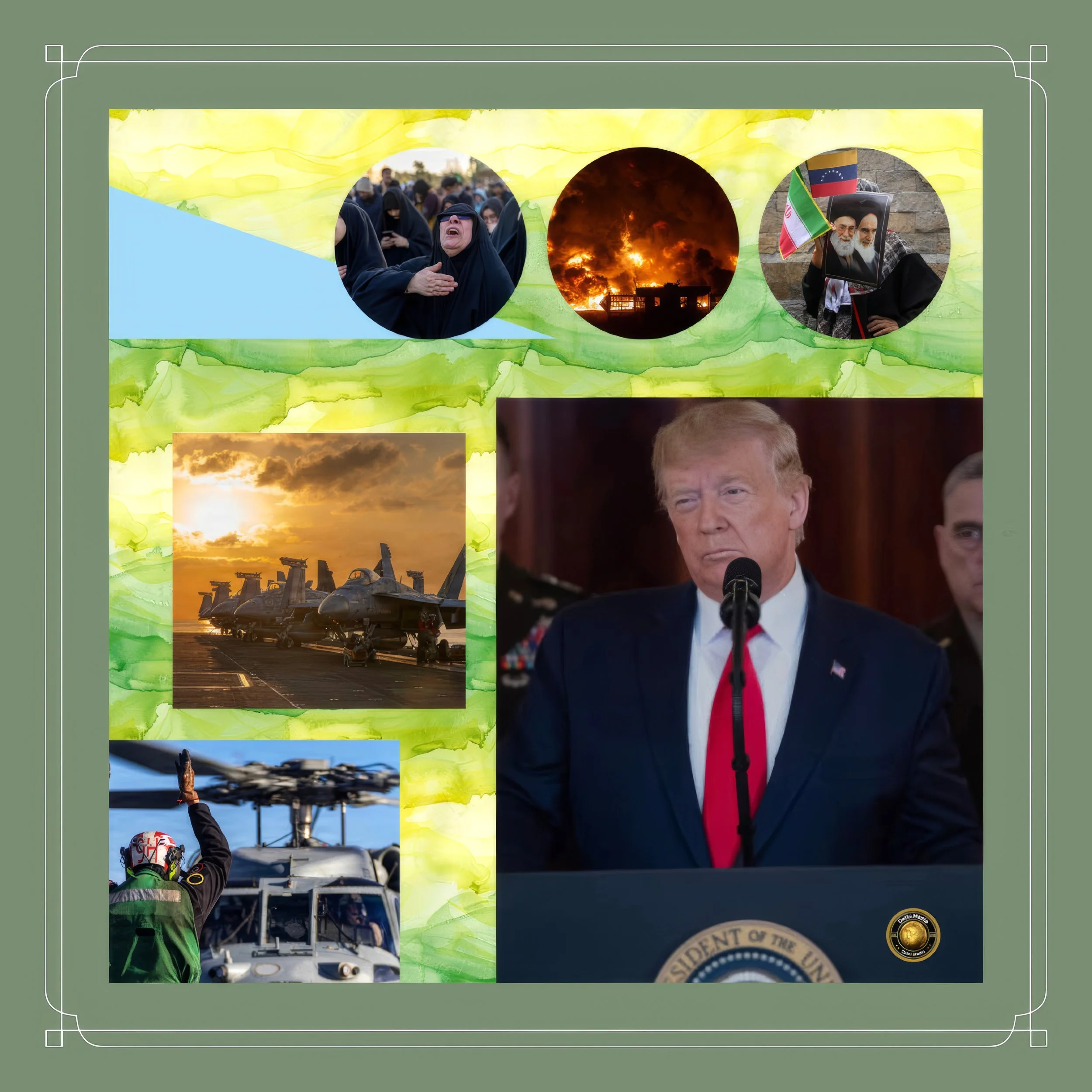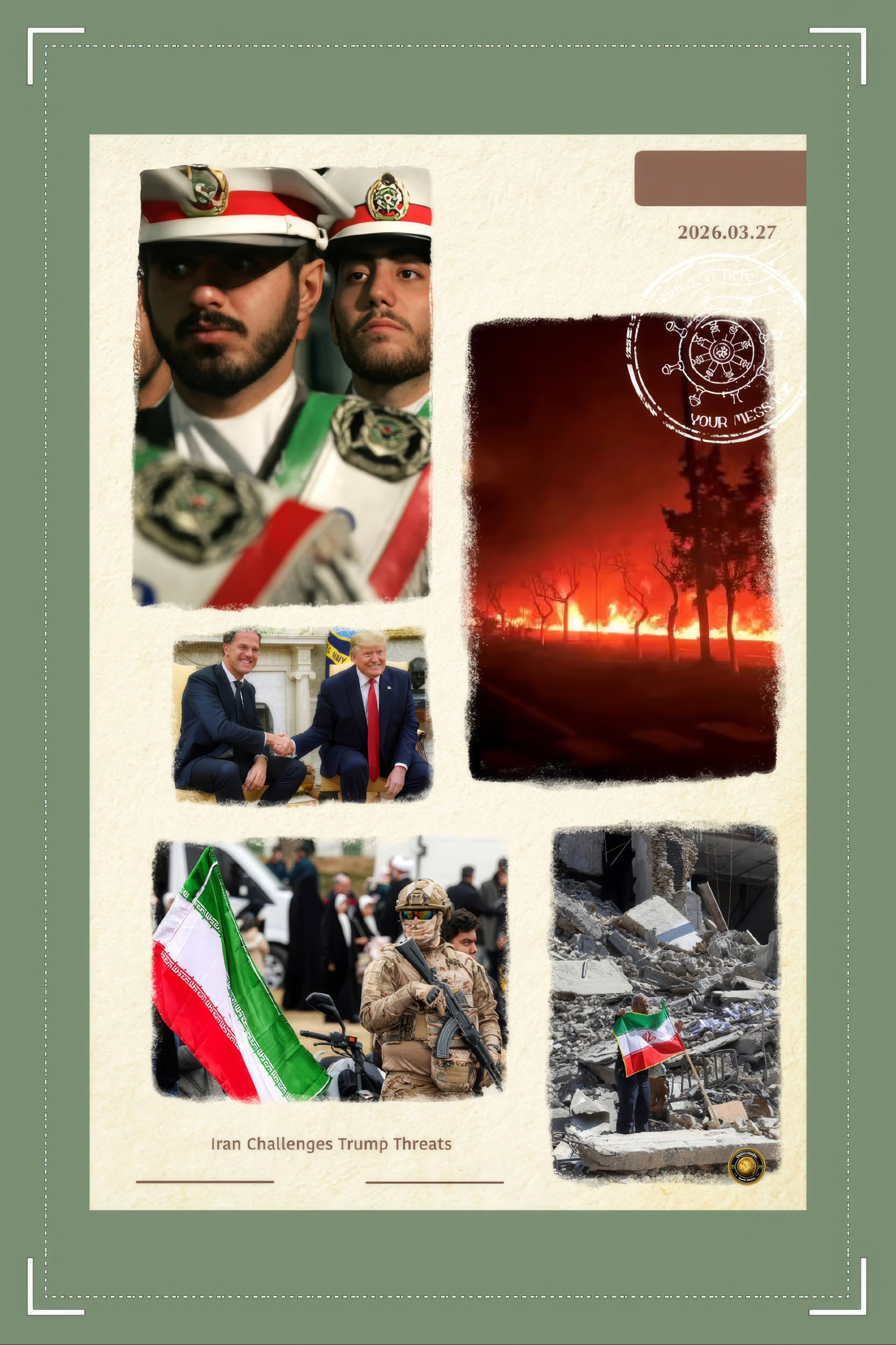
Iran Dares Trump to Cross His Own Red Lines as Kharg Island Burns and Hormuz Bleeds Globally
Executive Summary
When the World's Most Critical Oil Chokepoint Becomes America's Most Dangerous Foreign Policy Test
The United States–Iran conflict that erupted on February 28, 2026, has rapidly evolved into one of the most consequential geopolitical confrontations of the twenty-first century, drawing together nuclear diplomacy, maritime warfare, information operations, energy market disruption, and a recurring American crisis of strategic credibility.
President Donald Trump's decision to bomb Kharg Island — Iran's primary oil export hub — on the night of March 12–13th marked a decisive military escalation that has now triggered a multi-domain conflict spanning the Persian Gulf, cyberspace, and the global information environment.
The deployment of approximately five thousand United States Marines toward the Strait of Hormuz, the closure of one of the world's most important maritime chokepoints to roughly 90% of normal oil traffic, and Brent crude prices surging past $120 per barrel have collectively transformed a regional standoff into a genuine global crisis.
Yet beneath the spectacle of carrier groups and missile volleys lies a deeper structural question that haunts American foreign policy regardless of which party holds the White House: what does it mean when a superpower draws a line, threatens devastating consequences, and then must choose between catastrophic escalation and visible retreat?
This is not merely a story about Donald Trump or Barack Obama. It is the story of American power confronting the limits of coercive diplomacy in a multipolar world.
The Anatomy of a Red Line: From Syria to the Persian Gulf
Iran's Information War Is Winning Hearts While Losing Missiles in America's Strategic Blind Spot
The concept of the "red line" entered contemporary American political discourse most infamously through Barack Obama's August 2012 statement that the use of chemical weapons by the Assad regime in Syria would "change his calculus" on military intervention.
When sarin gas killed over one thousand four hundred civilians in the Ghouta suburb of Damascus on August 21st, 2013, the world waited for the United States to act.
Obama chose instead to send the question of military authorization to Congress, which declined to grant it, and ultimately accepted a Russian-brokered agreement to remove portions of Syria's declared chemical stockpile — a deal critics would later argue Vladimir Putin shredded at his convenience.
The political fallout was immediate and durable. Senator Marco Rubio called it "generational and reputational damage." Lindsey Graham warned that American credibility around the world had been squandered.
Pete Hegseth described Obama's broader approach as an "incoherent maze." Donald Trump, writing prolifically on social media at the time, called it a "disaster" and argued that American weakness on Syria had emboldened adversaries across the globe.
These criticisms were not entirely without merit — scholars of international relations have consistently found that demonstrated willingness to enforce stated commitments is among the most important determinants of deterrence.
The red line episode reinforced a perception, in Moscow, Beijing, and Tehran, that the United States could be pressured into inaction.
What is remarkable, and what the current Iran confrontation illuminates with disturbing clarity, is that the problem Obama faced in 2013 is structurally identical to the problem Trump faces in 2026.
Both presidents issued maximalist public warnings. Both faced adversaries willing to test those warnings.
Both confronted the same brutal arithmetic: enforcing the red line required military action whose costs — in lives, in treasure, in global economic disruption — might far exceed any conceivable strategic benefit.
And both faced the uncomfortable reality that the most powerful military force in the history of the world is not omnipotent, and that power projection without a coherent political objective is not strategy; it is performance.
The Road to February 28: Ultimatums, Negotiations, and the Architecture of Escalation
The proximate origins of the current US–Iran war lie in a ten-to-fifteen-day ultimatum issued by President Trump on February 19–20, 2026, demanding that Tehran conclude a "meaningful" agreement on its nuclear program or face unspecified "serious consequences."
This ultimatum arrived after months of preliminary diplomatic maneuvering, including a three-hour meeting in Geneva between Trump's envoys Jared Kushner and Steve Witkoff and Iranian Foreign Minister Abbas Araghchi, which both sides described as making "progress" — while American officials privately acknowledged that the gaps between the two positions remained fundamental.
Trump had warned Iran repeatedly in the preceding months that "time is running out." He had promised the Iranian people, in direct-to-camera social media addresses, that "help was on its way" to support protesters challenging the Islamic Republic.
That help never materialized. He had threatened that Iran would be struck at a "level never seen before" if it interfered with the Strait of Hormuz. These declarations accumulated into a pattern — what analysts began calling the "TACO trade," shorthand for "Trump Always Chickens Out" — that Tehran's leadership reportedly studied with considerable attention.
The Islamic Republic's decision-making apparatus, paradoxically strengthened by decades of external pressure, concluded that Trump's red lines carried less credibility than his rhetoric suggested.
The joint United States–Israeli offensive commenced on February 28th, 2026, targeting Iranian nuclear facilities and military infrastructure in what Trump characterized as a decisive blow against a regime that posed "the single greatest threat to world peace."
The strikes were extensive, involving hundreds of aircraft and cruise missiles across multiple nights. Yet Iran did not capitulate.
Instead, it responded with hundreds of ballistic missiles and over one thousand drones targeting Gulf states allied with the United States, including Saudi Arabia and Kuwait.
While most of these projectiles were intercepted by layered air defense systems, some struck infrastructure and residential areas, and Iran immediately moved to operationalize its most powerful asymmetric lever — control of the Strait of Hormuz.
Kharg Island: The Anatomy of an Escalating Strike
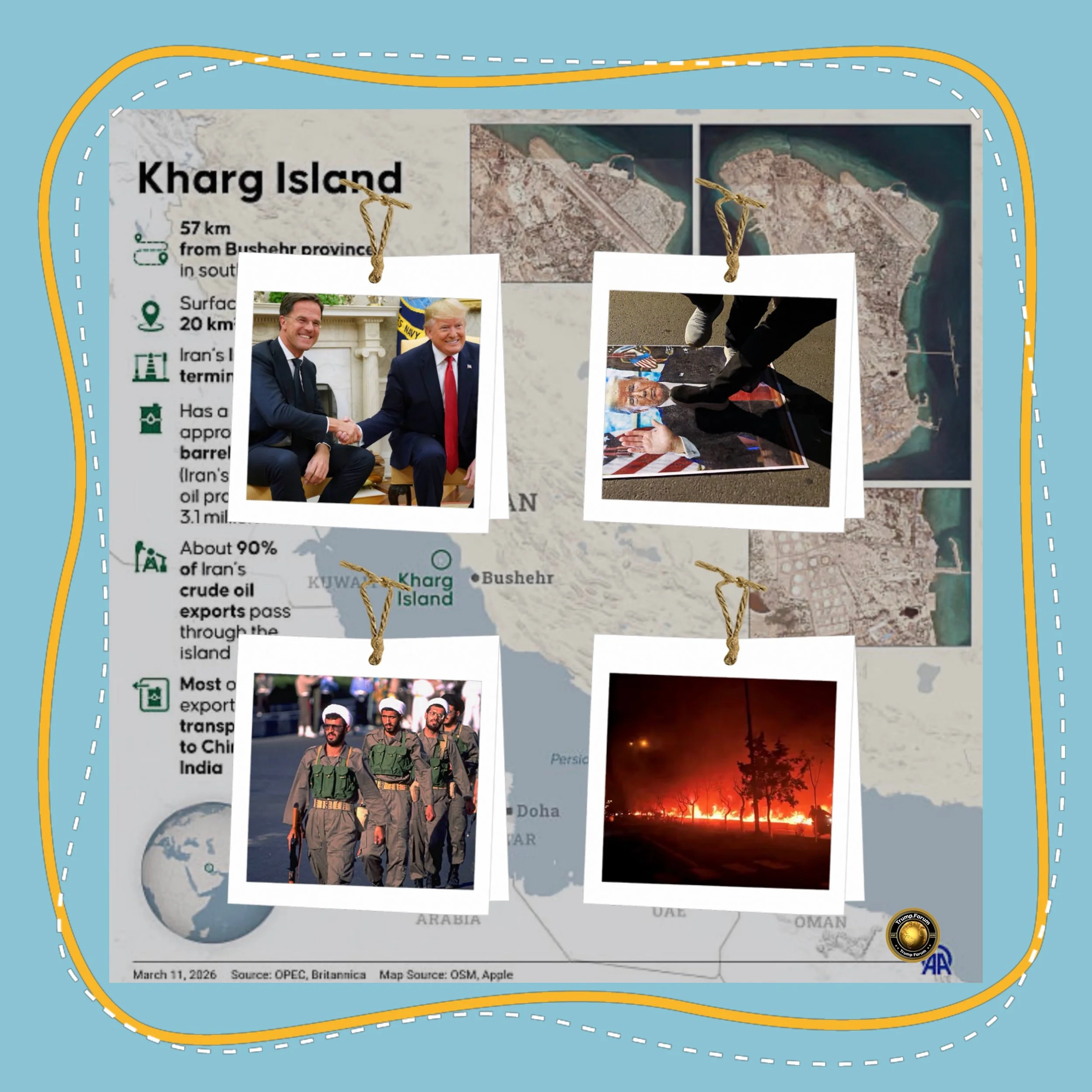
Kharg Island is, in the most literal sense, the jugular vein of the Iranian economy and a critical artery of global energy supply.
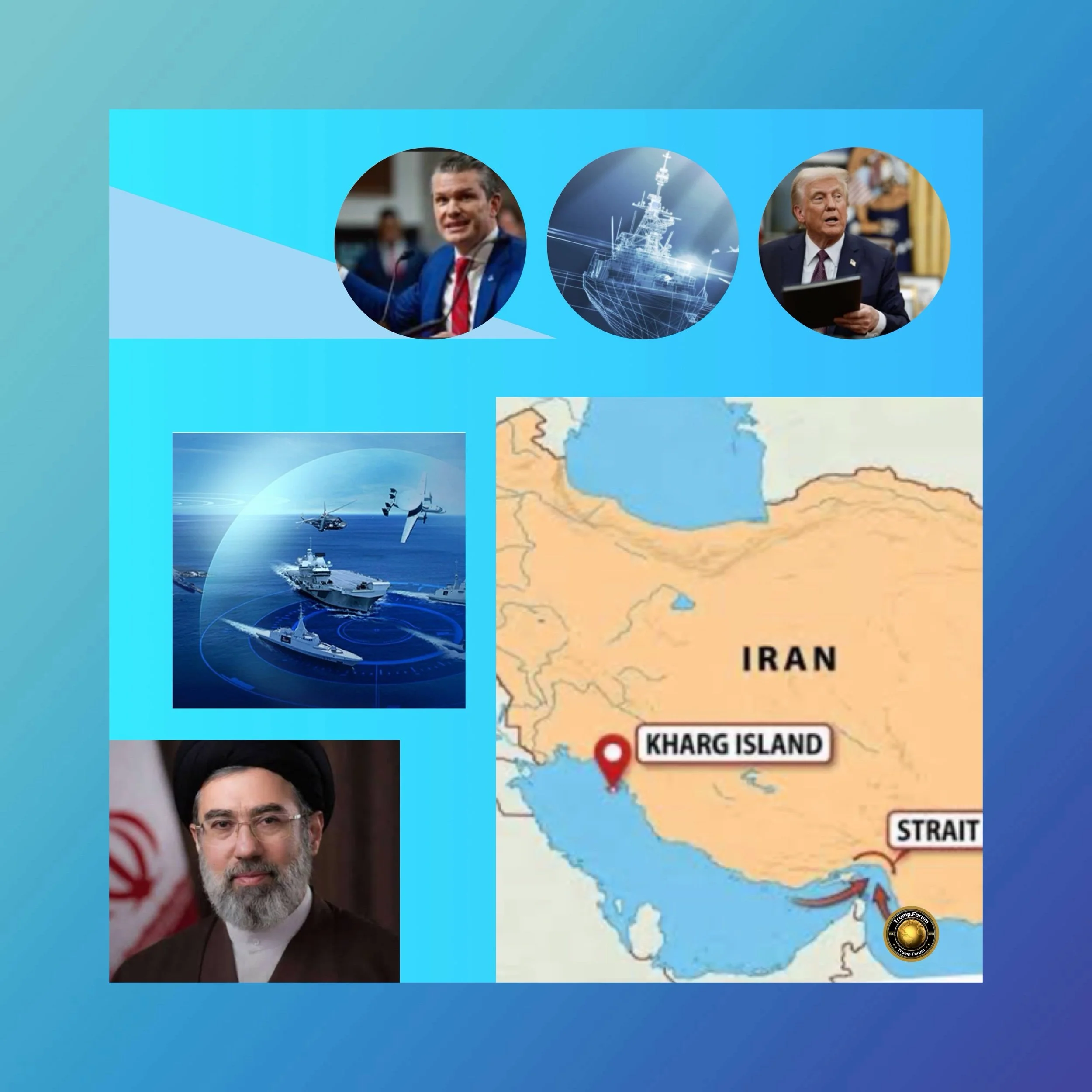
Situated roughly twenty miles off Iran's southwestern coastline in the western Persian Gulf, the island processes and exports approximately 90% of Iran's crude oil output.
For Tehran, it represents not merely economic infrastructure but existential strategic real estate — its loss or sustained damage would fundamentally alter the Islamic Republic's capacity to fund government, military operations, and the social welfare programs that sustain popular acquiescence to clerical rule.
On the night of March 12–13th, 2026, United States Central Command executed what Trump described on Truth Social as "one of the most powerful bombing raids in the history of the Middle East," claiming to have "totally obliterated" military installations on the island while sparing, for the moment, the oil infrastructure.
Trump released surveillance footage of the strikes on his Truth Social platform.
His public messaging was immediately ambiguous and revealing in equal measure. When asked by Fox News Radio host Brian Kilmeade whether he would seize Kharg Island, he deflected with characteristic obliqueness: "Who asks a question like that? And what fool would answer it?"
Within forty-eight hours, however, Trump was threatening to return to the island "just for fun," telling NBC News that further attacks were "imminent."
By March 21st, he was threatening to "obliterate" Iran's power plants if Tehran continued to disrupt Hormuz shipping.
These statements, each more maximalist than the last, created a ratchet effect in which each unfulfilled threat required a more extreme successor to maintain even a semblance of coercive credibility.
Iranian Parliament Speaker Mohammad Baqer Ghalibaf, the day before the March 13th strikes, had warned that any assault on Kharg would elicit a "heightened level of retaliation" — and Tehran simultaneously issued warnings to unnamed regional neighbors, widely interpreted as a signal directed at the United Arab Emirates, believed to be collaborating with American operational planning.
Trump's March 21st threat to destroy Iran's power plants followed his earlier ultimatum on Truth Social warning Iran it would be struck "twenty times harder" if it blocked Hormuz oil flows.
This escalatory rhetoric is structurally paradoxical: each threshold announced publicly reduces the credibility of all preceding threats, because adversaries and allies alike can observe the gap between declared intent and actual action. The red line becomes not a fence but a moving target.
Marines at the Gate: Military Deployments and the Hormuz Calculus
The deployment of United States military forces toward the Strait of Hormuz has proceeded in phases that reflect the administration's characteristic combination of decisive public posturing and operational caution.
The Pentagon's initial March 13th order dispatched approximately two thousand five hundred Marines aboard amphibious warships toward the region, providing commanders with options for "maritime security missions, evacuations, or limited operations without committing large ground forces."
By March 19–20th, an additional two thousand five hundred Marines were being deployed — bringing the total Marine contingent near the conflict zone to roughly 5000, a force level that Defense Department officials described as entering "a more dangerous phase."
Trump, characteristically, attempted to manage public expectations while simultaneously signaling resolve. "I'm not putting troops anywhere," he declared — before adding, with studied ambiguity, "We will do whatever is necessary."
The Marine unit in question, the 31st Marine Expeditionary Unit, is facing a challenge that military analysts describe as historically unprecedented: Iran's capacity to mine the Strait of Hormuz with an estimated arsenal of up to six thousand mines — anchored, rocket-launched, or free-drifting — any of which can be detonated on contact with a tanker hull or military vessel.
Iran's drone production capacity, assessed at approximately ten thousand units per month, provides Tehran with a near-inexhaustible asymmetric tool even as its conventional missile stocks are degraded by sustained US–Israeli strikes.
Administration sources described a potential operational plan involving sustained airstrikes — lasting perhaps a month — designed to degrade Iranian coastal defenses sufficiently to enable a Marine-led coastal invasion or naval blockade of Kharg Island itself.
Military analysts have responded to this concept with something close to alarm.
Caitlin Talmadge, a professor in the security studies program at the Massachusetts Institute of Technology, noted that seizing and holding an island less than twenty miles from Iran's heavily defended coastline — even with a substantially degraded Iranian military — "would be militarily challenging."
Former Pentagon adviser Michael Rubin invoked the Iraq precedent: "The lesson we learned in Iraq was that you don't destroy the infrastructure of a country that you want to be your ally the day after regime change."
The Foundation for Defense of Democracies assessed in late March 2026 that any seizure and occupation of Kharg Island is "more likely to expand and extend the war than it is to deliver any sort of decisive victory."
Iran retains significant residual capacity for drone and missile attacks on forces positioned on the island, and the island's proximity to the mainland places American service members within range of multiple Iranian indirect fire systems, including multiple-launch rocket systems and rocket-assisted cannon artillery.
The information warfare dimension here is also critically important: Iranian forces, and their proxy networks across Iraq and the broader region, have already demonstrated the capability to deploy first-person-view drones for reconnaissance and targeted strikes on US positions, and any graphic footage of American casualties would be immediately weaponized in both the domestic Iranian narrative and the global information environment.
Iran's Preparation and Asymmetric Defenses
Tehran's response to American military pressure has been neither passive nor improvised.
The Islamic Republic has spent decades developing what strategists call an "asymmetric deterrence architecture" precisely because it recognized, long before this conflict, that it could not defeat the United States in a conventional military engagement.
The deployment of this architecture in March 2026 represents its most comprehensive real-world test to date.
Kharg Island itself has been transformed, in the weeks since the initial strikes, into what CNN described as a "fortified kill zone."
Iranian forces are actively planting mines in surrounding waters, deploying anti-ship missiles along the island's perimeter, and hardening defensive positions — all under the surveillance of American drones watching from above.
The psychological dimension of this preparation is deliberate: Tehran is not merely defending an island; it is constructing a trap visible enough to function as a deterrent, sending a signal that any American attempt at seizure will produce politically unacceptable American casualties.
Iran's drone strategy in the Strait of Hormuz has already achieved measurable strategic effect without requiring conventional military supremacy.
Traffic through the strait dropped by approximately 90% at the peak of the crisis in early March, according to shipping analytics firm Kpler.
Major commercial operators, including Maersk and Hapag-Lloyd, suspended operations in the Middle East entirely.
Iran's doctrine exploits a fundamental asymmetry: it does not need to sink a significant number of tankers to effectively close the strait.
It needs only to sink enough — or create enough credible threat — to deter the insurance underwriters who set the commercial cost of transiting the waterway.
As maritime analyst Sidharth Kaushal of the Royal United Services Institute explained, "Mining poses a threat, not because the Iranians can physically blockade the strait... but because even a few mines can unsettle insurers."
Iran also launched hundreds of ballistic missiles and over one thousand drones at Gulf Arab states allied with the United States, including Saudi Arabia and Kuwait.
Most were intercepted, but the cumulative psychological effect — on Arab populations, on Gulf state governments, on commercial shipping operators, and on global energy markets — was substantial.
Iran's ability to sustain drone production at approximately ten thousand units per month, even as its ballistic missile stockpiles are degraded, means that the asymmetric pressure it can exert remains formidable and potentially durable over an extended timeframe.
The Information Warfare Landscape
Perhaps the most underappreciated dimension of the US–Iran confrontation of 2026 is the extent to which it is simultaneously a kinetic and cognitive war — fought as much in the information landscape as in the Persian Gulf.
Iran's information warfare strategy, developed over decades as a practical response to its conventional military limitations, has become a central component of the Islamic Republic's military and security doctrine.
The strategy combines ideological messaging, psychological operations, narrative framing, hacking, and media control in ways designed to shape perception, undermine adversary will, and erode the domestic political foundations of American military action.
The Justice Department's March 18, 2026, disruption of Iranian cyber-enabled psychological operations — targeting Ministry of Intelligence and Security-controlled domains that had been issuing death threats against Americans and dissidents following the outbreak of conflict on February 28th— illustrates the breadth and systematic character of Iran's digital warfare campaign.
Meanwhile, Israeli and US cyber operations targeting Iranian digital infrastructure have been described in some assessments as "the largest cyberattack in history," including strikes on Iran's state broadcaster IRIB, the hijacking of broadcast feeds to air pro-resistance messages, and the compromise of a widely used Iranian prayer application to disseminate defection messages to security personnel.
Resecurity, a leading cybersecurity firm, assessed in late March 2026 that the Iran war has "fast evolved into a multi-domain confrontation where traditional militarized strikes are tightly interwoven with digital operations, electronic interference, and psychological warfare, reshaping the nature of modern conflict."
The 2025–2026 conflict has also produced what is assessed as the most extensive and disruptive use of GPS spoofing and jamming ever recorded, severely impacting maritime navigation in the Persian Gulf.
Iranian proxies have released footage of first-person-view drone reconnaissance and attacks on US positions in Iraq, with the explicit intent of using the graphic reality of American military vulnerability as a psychological weapon.
The information war extends to the question of who is "winning" the conventional conflict.
Trump's Truth Social posts claiming to have "totally obliterated" Iranian military installations on Kharg Island — accompanied by surveillance video — are themselves acts of information warfare designed to project an image of overwhelming American dominance.
Iran's counterclaims, distributed through state media and allied networks, present a narrative of heroic resistance against imperial aggression.
Both narratives are simultaneously true and false in ways that matter enormously for domestic political audiences and for the regional states calculating which patron's guarantees to trust.
Cause and Effect: The Structural Consequences of Credibility Deficit
Trump's Red Lines Mean Nothing Now: Iran, Credibility, and the Architecture of American Bluff
The Obama Syria red line of 2013 and the Trump Iran escalation of 2025–2026 are not merely parallel episodes.
They are linked by a causal chain that runs through American credibility, adversary risk assessment, and the structural logic of coercive diplomacy.
When Obama declined to strike Syria, he did not merely fail to enforce a single red line. He altered the risk calculations of every regional stakeholder that relied on American deterrence. Tehran, which closely monitored the episode, drew specific and operational lessons about the limits of American will.
Trump spent the years between 2013 and his return to the presidency constructing a political identity around the claim that he, unlike Obama, would restore American credibility by following through on threats.
“I was right," he told reporters in March 2026, recalling his 1988 observation that the United States needed to strike Kharg Island when Iran was "acting up."
Yet his own record from his first term — the 2019 decision not to strike Iran after it shot down an American drone, the pattern of tariff threats partially reversed under pressure — had already generated the "TACO trade" thesis among market participants and foreign policy analysts.
The causal consequences of this credibility pattern are multiple and mutually reinforcing.
First, adversaries engaged in calibrated escalation — doing enough to test American resolve without doing enough to guarantee massive retaliation — because they have learned, empirically, that the gap between American rhetoric and American action is substantial and exploitable. Iran's incremental campaign against Hormuz shipping — mines here, drone strikes there, attacks on Gulf Arab neighbors — is precisely this kind of calibrated pressure.
Second, American allies in the Gulf and elsewhere must constantly recalibrate their own security posture based on uncertain assessments of whether Washington's commitments will hold.
Third, the domestic political cost of escalation rises with every new threat issued, because each new threat creates a new audience expecting follow-through — making the final decision to act or retreat more politically costly in either direction.
The economic consequences of this credibility deficit have been immediate and severe. Brent crude surged from approximately $55 per barrel before the conflict to briefly exceeding $114 per barrel at peak tensions, with Brent settling above $101 per barrel in late March.
The International Energy Agency issued a warning in March 2026 that the conflict could trigger "the largest disruption in the history of the global oil market," potentially requiring six months to restore normal flows.
Barclays assessed that sustained $100 oil would reduce global GDP growth by 0.2% points while boosting inflation by 0.7% points — compounding existing economic headwinds and potentially forcing central banks to maintain elevated interest rates far longer than markets had anticipated.
Key Developments: The Escalatory Ladder of March 2026
Kharg Island Under Fire: Why Trump's Threats Are Loud but His Strategy Remains Deeply Hollow
The month of March 2026 produced a cascade of developments that collectively constitute the most significant direct military confrontation between the United States and Iran in the history of the two countries' conflict.
On March 9th, Trump warned Iran that any mining of the Strait of Hormuz would result in consequences at "a level never seen before."
By March 11th, three merchant ships had been struck in the Strait, and the US Navy reported destroying sixteen Iranian mine-laying vessels.
On March 12–13th, US Central Command executed the Kharg Island bombing campaign. On March 13, the Pentagon ordered the initial two-thousand-five-hundred Marine deployment.
On March 15th, Trump threatened further strikes on Kharg Island "just for fun." On March 18, the Justice Department announced the disruption of Iranian cyber-enabled psychological operations.
On March 19–20th, the Pentagon confirmed an additional two-thousand-five-hundred Marine deployment, signaling the possible emergence of a "ground option."
On March 21st, Trump threatened to "obliterate" Iran's power plants.
By March 22–23rd, Trump paradoxically announced "productive conversations" with Iran about ending the war — triggering a sharp oil price reversal — while simultaneously deploying more forces and issuing new threats.
This sequence reveals the defining structural tension of Trump's Iran policy: simultaneous escalation and negotiation, maximum pressure and maximum uncertainty.
On March 27th, CNN's analysis concluded that "both Iran and the US need the war to stop now" — but that "neither can" easily do so, because the public stakes that each side has established make a face-saving exit extraordinarily difficult to engineer.
Iran cannot accept terms that look like capitulation to domestic audiences who have watched the regime absorb devastating strikes.
Trump cannot accept terms that do not allow him to claim a historic victory on nuclear non-proliferation.
The gap between these incompatible necessity structures is where wars continue long after both sides recognize their futility.
The Stakeholders' Calculus: Regional Dimensions
No analysis of the US–Iran confrontation of 2026 is complete without examining the calculations of the regional stakeholders whose survival and prosperity depend on the conflict's outcome.
Saudi Arabia and Kuwait have absorbed Iranian drone and missile strikes while hosting American forces and providing diplomatic and logistical support to the US–Israeli coalition.
The Iranian Parliament Speaker's warning to an unnamed "regional neighbor" — widely interpreted as the UAE, believed to be providing operational support for a potential Kharg Island invasion — signals Tehran's willingness to expand the conflict to Gulf Arab capitals if the stakes are raised sufficiently.
Israel, whose joint strikes with the United States on February 28th initiated the open phase of the conflict, has its own complex strategic interests.
German Chancellor Friedrich Merz publicly acknowledged that Israel was performing "the dirty work of the Western world" by addressing the Iranian nuclear threat — a statement that reflects the ambivalent dependence of European governments on American and Israeli action to prevent Iranian nuclear capabilities, while simultaneously distancing themselves from the political and moral costs of that action.
For Israel, a decapitation of Iran's nuclear program represents an existential strategic objective that transcends the immediate question of American credibility.
Russia and China are positioned as secondary beneficiaries of prolonged American entanglement in the Gulf, just as they were during the original "war on terror" overextension of the early twenty-first century.
A protracted US–Iran conflict diverts American strategic attention and resources from the Indo-Pacific, complicates NATO cohesion in the face of the ongoing Russia–Ukraine conflict, and disrupts the global trading order in ways that create commercial and diplomatic opportunities for both Moscow and Beijing.
The structural alignment of these three powers' interests — even in the absence of direct coordination — constitutes a significant strategic constraint on American freedom of action in the Gulf.
Future Steps: Scenarios and Strategic Inflection Points
How Trump's Brinkmanship Over Iran Echoes Every Presidential Credibility Crisis Since Vietnam
The trajectory of the US–Iran confrontation in the weeks and months following late March 2026 will be determined by a small number of critical decision points.
The first and most immediate is whether the Trump administration orders a ground or amphibious operation to seize Kharg Island.
The military planning, involving a sustained month-long air campaign to degrade Iranian coastal defenses followed by a Marine-led landing, has been described by multiple sources.
The risks are substantial: Iran retains significant drone and missile capacity, the island's proximity to the Iranian mainland places landing forces within range of multiple weapons systems, and any American casualties released as Iranian propaganda could rapidly shift domestic American political support for the war.
The second critical inflection point is the diplomatic track.
Trump's March 22–23rd announcement of "productive conversations" with Iran, immediately contradicted by Tehran, and his administration's simultaneous deployment of additional forces, suggests that Washington is pursuing a coercive diplomacy model — using military escalation as leverage for negotiated surrender.
The National News analysis noted that while Trump claimed "perfect talks," Tehran denied this characterization, and the administration's simultaneous military buildup was widely interpreted as an attempt to force Iran's hand rather than as genuine diplomatic engagement.
The fundamental obstacle, as The National's analysts identified, is an absence of trust and a lack of coherent strategy: "No trust, no strategy."
The third scenario involves a sustained low-intensity attritional conflict in which Iran uses drones, mines, and proxy attacks to maintain Hormuz disruption at a level insufficient to trigger the "twenty times harder" threshold Trump has publicly set, while American forces maintain periodic strikes on Iranian military infrastructure without either seizing Kharg or striking oil facilities.
This scenario — the most likely based on the escalatory pattern observed through late March — would sustain global energy market disruption at economically damaging levels while producing no politically satisfying resolution for either side.
A diplomatic resolution, requiring Iran to accept verifiable constraints on its nuclear program in exchange for sanctions relief and an American military withdrawal, would represent the optimal outcome but faces the most formidable obstacles.
The Islamic Republic's domestic legitimacy is now partially indexed to resistance against American military action, making concessions politically costly for the regime even if strategically rational. Trump's need for a "historic victory" creates equally rigid constraints on the American side.
The lessons of every nuclear negotiation since the NPT — from the JCPOA of 2015 to the current impasse — suggest that durable agreements require sustained political will and domestic legitimacy on both sides. Neither condition currently obtains.
The Deeper Lesson: Power, Performance, and the Limits of Bluff
From Obama's Syria Shame to Trump's Iran Gamble — How America Keeps Drawing Lines It Cannot Hold
The red line problem — whether it is Obama's Syria of 2013 or Trump's Iran of 2025–2026 — is ultimately not a problem of individual presidential character or decision-making quality.
It is a structural feature of American power in the contemporary international system.
The United States retains extraordinary military, economic, and technological capabilities. It can bomb Kharg Island.
It can deploy five thousand Marines to the Strait of Hormuz. It can execute what Trump calls "the most powerful bombing raid in the history of the Middle East."
What it cannot do, easily or costlessly, is translate that military capability into durable political outcomes against an adversary that has spent forty-five years developing asymmetric tools specifically designed to make American power projection prohibitively expensive.
Obama understood this, and chose retreat over escalation, accepting the political cost of appearing weak in exchange for avoiding a war whose political objectives were undefined.
Trump appears to understand it too — but his political identity, constructed around the performance of toughness, makes that same retreat politically more costly for him personally.
The result is a form of strategic theater in which each new threat is louder than the last, each new deployment is larger than the previous, and the space for a face-saving exit grows smaller with every statement broadcast on Truth Social and every Marine battalion loading onto an amphibious warship in the Indian Ocean.
The global consequences of this dynamic — $120-per-barrel oil, 90% Hormuz traffic closure, IEA warnings of the "largest disruption in the history of the global oil market" — are not incidental.
They are the direct price, paid by consumers from Delhi to Detroit, of a foreign policy architecture built on bluff, improvisation, and submission rituals rather than on coherent strategic objectives, credible deterrence, and an honest accounting of what military force can and cannot achieve.
The question of whether Trump can find an exit from the Iran crisis that simultaneously meets his domestic political needs and Iran's minimum survival requirements is, as of late March 2026, one of the most consequential open questions in world affairs. History suggests it will not be answered well.