Electromagnetic Warfare, Amphibious Power, and the Persian Gulf Crucible: Dissecting the Strategic Architecture of America's Escalating Campaign Against Iran
Executive Summary
From Kharg Island to the Shoreline: How Trump's Military Escalation Is Redefining Persian Gulf Security
The United States military campaign against Iran, operating under the designation Operation Epic Fury, entered a qualitatively new and more consequential phase in mid-March 2026 when President Donald Trump ordered devastating strikes against Kharg Island — the nerve center of Iran's petroleum export economy — and subsequently threatened to bombard the entire Iranian shoreline while demanding allied nations dispatch warships to reopen the Strait of Hormuz.
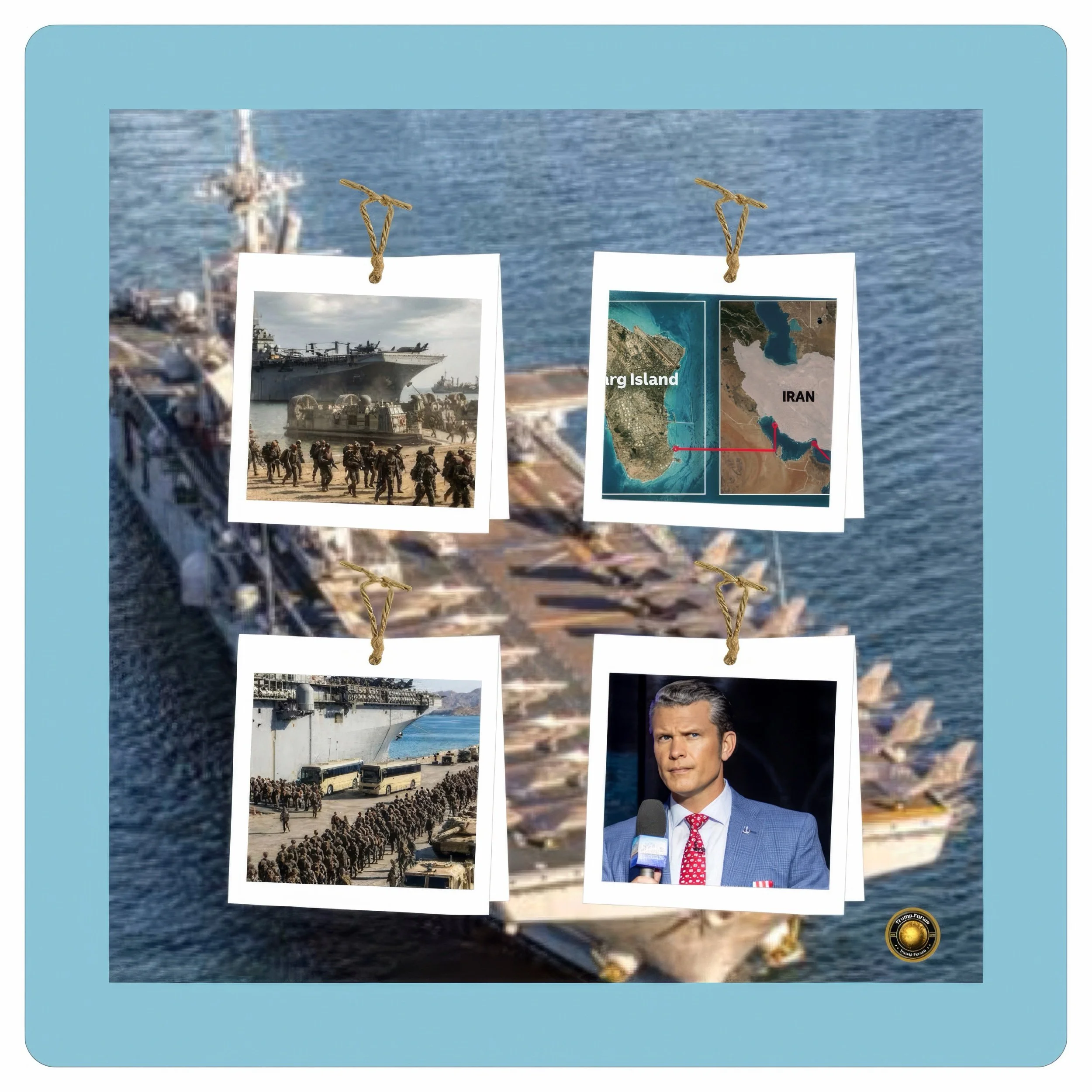
The concurrent deployment of approximately 2,200 Marines from the Japan-based 31st Marine Expeditionary Unit, supported by an Amphibious Ready Group including the USS Tripoli and accompanied by a squadron of F-35 Lightning II fighter jets, signals a transition from a predominantly aerial campaign to a multi-domain military posture.
Against this backdrop, credible reporting and official disclosures about the deployment of the EA-18G Growler electromagnetic attack aircraft, the Meadowlands satellite-jamming platform operated by the 16th Electromagnetic Warfare Squadron, and Trump's own public confirmation of the use of a classified sonic weapon — dubbed "The Discombobulator" — during the capture of Venezuelan President Nicolás Maduro, raise sobering and analytically significant questions about whether advanced electromagnetic and directed-energy systems are being, or will be, integrated into the Persian Gulf operational landscape.
FAF article examines these developments with scholarly rigor, situating them within the broader strategic, historical, and geopolitical contexts that define perhaps the most consequential American military engagement in the Middle East since the invasion of Iraq in 2003.
Introduction: A War Redefined by Technology and Ambition
Operation Epic Fury Enters Dangerous New Phase as Trump Threatens Iran's Entire Coastline with Naval Firepower
When Operation Epic Fury commenced on 28th February 2026 with joint US-Israeli airstrikes that killed Supreme Leader Ayatollah Ali Khamenei and struck more than fifteen thousand Iranian military targets across the Islamic Republic, the world confronted a military campaign of extraordinary scope and technological sophistication.
Within a fortnight, CENTCOM reported striking over five thousand five hundred targets inside Iran, eliminating entire classes of Iranian warships — including all four of Iran's Soleimani-class vessels — and inflicting structural damage on the country's ballistic missile production capabilities, naval command infrastructure, and defense industrial base.
The operation represented not merely a tactical response to Iran's nuclear ambitions or its destabilizing proxy networks, but a fundamental restructuring of American deterrence doctrine in the Middle East: a doctrinal assertion that the United States, under Trump's second administration, would employ overwhelming and unconventional force, without the extended diplomatic preambulation characteristic of previous administrations, to reshape regional security architecture on American terms.
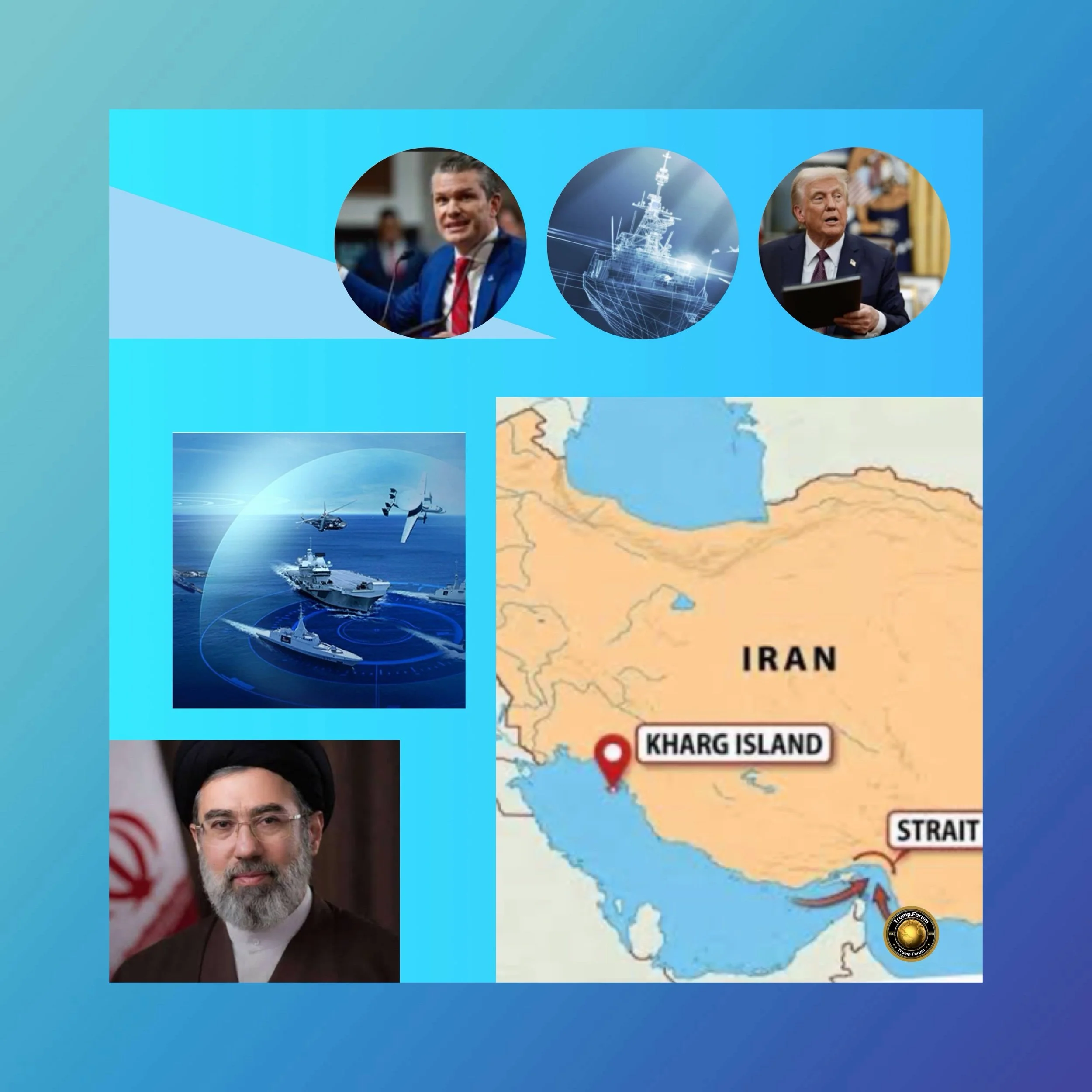
The escalation to Kharg Island on the night of 13-14 March 2026 elevated the stakes dramatically. Kharg Island, located in the northern Persian Gulf approximately three hundred miles northwest of the Strait of Hormuz, handles between eighty and ninety % of Iran's crude oil exports.
CENTCOM confirmed striking more than ninety Iranian military targets on the island while deliberately sparing the oil infrastructure — a calculated act of coercive restraint designed to preserve Iranian economic pain as leverage without triggering the irreversible destruction that would remove any possibility of future negotiation.
Trump's subsequent Truth Social post — warning that oil facilities would be targeted if Iran continued attacking tankers in the Strait — transformed Kharg Island's oil terminals into a hostage held at gunpoint, readable both in Tehran and in the energy ministries of Beijing, Tokyo, Seoul, and New Delhi.
The same hours witnessed Trump's demand, also issued via Truth Social, that "many countries" — specifically naming China, France, Japan, South Korea, and the United Kingdom — dispatch warships to join the United States in keeping the Strait open and safe, while simultaneously announcing that American forces would "be bombing the hell out of the shoreline" and "continually shooting Iranian boats and ships out of the water."
This extraordinary pronouncement, combining a multinational maritime mobilization demand with an explicit threat of coastal bombardment, defines the current crisis as something qualitatively different from any previous American military engagement with Iran: it is a war being waged with an explicit objective of total Iranian military disarmament, prosecuted with both conventional and unconventional technological tools, and communicated through the peculiarly Trumpian medium of social media rhetoric elevated to the status of strategic signaling.
History and Current Status: From Tanker Wars to Total War
The Discombobulator Goes East: Could Trump's Secret Weapons Arsenal Now Be Deployed Against Iran's Defenses?
The confrontation between the United States and Iran in the Persian Gulf did not begin in 2026.
Its genealogy stretches across more than four decades of mutual antagonism, covert operations, proxy wars, and intermittent direct confrontation.
The Tanker War of the 1980s, during which the United States Navy directly engaged Iranian naval forces in Operation Praying Mantis in April 1988 — sinking half of Iran's operational navy in a single day — established the structural template for American willingness to use decisive naval force in the Persian Gulf to protect the freedom of navigation that underpins global oil markets.
The 2003 invasion of Iraq removed Iran's primary regional counterbalance and inadvertently expanded Iranian strategic depth, enabling Tehran to develop a sophisticated network of proxy organizations — Hezbollah, Hamas, the Houthis, and multiple Iraqi militias — that would collectively constitute what Iranian strategists called the "Axis of Resistance."
The nuclear dimension crystallized in the 2000s, as Iran progressively advanced its uranium enrichment program beyond civilian requirements, enriching to 60 % at the Fordow facility buried deep beneath a mountain and producing uranium samples assessed at 83.7% enrichment — approaching weapons-grade — as far back as March 2023.
The 2015 Joint Comprehensive Plan of Action attempted to impose a ceiling on these activities, but Trump's withdrawal from the agreement in his first term, followed by the "maximum pressure" campaign, accelerated Iran's nuclear timeline rather than reversing it.
By early 2026, American and Israeli intelligence assessments converged on the conclusion that Iran was approaching a threshold capability, and Trump issued a 30-day ultimatum demanding Iran finalize a nuclear deal, with military action as the explicit consequence of refusal.
Iran refused, and Operation Epic Fury began on 28th February 2026, with strikes killing Supreme Leader Ali Khamenei and injuring, though not killing, his successor.
Iran's Assembly of Experts — responding to the most acute succession crisis in the Islamic Republic's forty-seven-year history — designated Mojtaba Khamenei, son of the slain supreme leader, as the new supreme leader on 9th March 2026.
Israel immediately threatened to target the new supreme leader as well, further compressing Iran's decision space.
The new leadership's first strategic declaration — vowing to maintain the blockade of the Strait of Hormuz — indicated that the regime intended to translate its conventional military weakness into an asymmetric economic weapon capable of inflicting maximum pain on the global economy, even at the cost of further American strikes.
As of 14th March 2026, the US-Iran war has entered its fifteenth day. The United States, supported by Israel, has struck over fifteen thousand Iranian military and nuclear-related sites, according to Defense Secretary Pete Hegseth.
Combined US-Israeli operations have deliberately avoided destroying Kharg Island's oil terminals, maintaining them as a coercive instrument. Iran's new supreme leader has vowed to continue blocking the Strait.
CENTCOM has deployed B-2 Spirit stealth bombers — America's most advanced penetrating strike aircraft — to deliver what it describes as "long-range fire to eliminate the threat from the Iranian regime today and eliminate their ability to rebuild in the future."
Two thousand two hundred Marines from the 31st MEU are en route to the Middle East. And Trump has publicly promised to bomb the Iranian shoreline.
Key Developments: The Architecture of Escalation
Two Thousand Two Hundred Marines and a Strait on Fire: Inside Trump's Expanding War Against the Iranian Regime
The strike on Kharg Island merits close analytical attention not merely as a military event but as a statement of strategic intent.
The island's centrality to Iran's fiscal architecture cannot be overstated: it processes approximately 90 % of Iran's crude oil exports, and those exports constitute the primary source of foreign exchange sustaining the Iranian state and its proxy networks.
By destroying military infrastructure on the island — missile storage facilities, naval installations, defensive systems, and mine-related assets — while explicitly sparing the oil terminals, CENTCOM executed what strategists describe as "coercive escalation with preserved leverage."
The message to Tehran was architecturally precise: the United States possesses both the capability and the willingness to eliminate Iran's economic lifeline entirely, and it is choosing not to do so — for now — as an act of conditional restraint that can be revoked instantly if Iranian behavior does not change.
Trump's demand for allied warships fundamentally transforms the multilateral dimension of the conflict.
The United States has not simply engaged in a bilateral military confrontation with Iran; it has issued what amounts to a global security draft notice, publicly naming China, France, Japan, South Korea, and the United Kingdom as stakeholders expected to contribute naval assets to the enforcement of Hormuz transit rights.
This is diplomatically significant for multiple reasons.
China, which sources approximately 50 % of its crude oil imports through the Strait, has the strongest material interest in keeping it open but the most complex political relationship with the premise of aligning with American military operations against Iran.
France's participation would embed a NATO dimension into the conflict. Japan and South Korea, both heavily dependent on Gulf oil, face enormous economic pressure to act but domestic political constraints on military deployment.
The United Kingdom, with its own historic relationship with Persian Gulf security, has been singled out in Trump's first public communications on the subject.
The deployment of 2,200 Marines from the 31st MEU introduces a ground-force dimension that reshapes the operational calculus in ways that aerial bombardment alone cannot.
The 31st MEU is equipped not only with F-35B Lightning II short-takeoff/vertical-landing fighter jets and V-22 Osprey tiltrotor aircraft but with the full range of amphibious assault capabilities — hover-craft landing craft, amphibious assault vehicles, and Marine rifle companies trained for opposed shore landings.
Officials have been careful to state that the deployment "does not necessarily mean the unit will be used as a ground force in Iran," but the very presence of an Amphibious Ready Group in the Persian Gulf constitutes a latent threat of coastal assault that Iran's military planners cannot ignore when allocating their increasingly degraded defensive resources.
The Electromagnetic and Directed-Energy Dimension: "The Discombobulator" and Its Progeny
Perhaps the most analytically consequential — and least publicly examined — dimension of the current escalation concerns the potential role of advanced electromagnetic, directed-energy, and electronic warfare systems in America's Persian Gulf operations.
This dimension must be approached with intellectual honesty about the boundaries of available evidence while simultaneously engaging seriously with what is known and what is doctrinally plausible.
The evidentiary foundation begins with Trump's own public admissions about the use of a classified sonic weapon — which he named "The Discombobulator" — during the operation that captured Venezuelan President Nicolás Maduro on 3rd January 2026.
White House Press Secretary Karoline Leavitt's initial descriptions of the weapon's effects — Venezuelan soldiers "bleeding from the nose and vomiting blood" — and Trump's subsequent confirmation that the device "rendered Venezuelan machinery nonfunctional" establish several analytically important precedents.
First, the Trump administration is willing to deploy classified non-kinetic weapons in operational contexts where conventional force could theoretically have served the same purpose — suggesting a doctrinal preference for demonstrating technological superiority as a form of strategic messaging.
Second, these weapons are sufficiently operationally mature to have been integrated into a complex, time-sensitive special operations mission.
Third, and most importantly for the Iran context, the administration has demonstrated that it views the deployment and public disclosure of such weapons as a form of deterrent communication: a signal to other potential adversaries about the breadth of America's asymmetric toolkit.
Independent analysis of Operation Epic Fury's classified dimensions has pointed toward the deployment of several advanced electromagnetic systems.
The EA-18G Growler electronic attack aircraft — which carries jamming pods, communication countermeasures, and radars designed to neutralize enemy electronic threats — has been confirmed among the weapons platforms deployed to the Persian Gulf.
Analysis of the operation has also identified the potential deployment of the Meadowlands platform, operated by the 16th Electromagnetic Warfare Squadron, which enables a single operator to control multiple missions remotely, jamming satellite uplinks and downlinks to blind Iranian military communications and drone control systems.
Iran's military command architecture — heavily dependent on satellite communications for the coordination of drone swarms, ballistic missile launches, and naval mine operations — would be acutely vulnerable to a sophisticated satellite-jamming campaign.
The correlation between the dramatic reduction in Iranian drone and missile attacks noted in CENTCOM briefings and the suspected deployment of these systems is analytically suggestive, though not yet definitively proven in the open-source record.
The Army's Long Range Hypersonic Weapon, known as Dark Eagle, which reached initial fielding status in early 2026, has also been identified as potentially integrated into the operational landscape.
Moving at speeds that Iran's existing air defense systems cannot intercept, Dark Eagle represents a qualitative shift in the US ability to hold deeply buried or time-sensitive targets at risk — including Fordow's underground nuclear enrichment facilities.
The CSIS assessment that Fordow remains incompletely struck, with its uranium enrichment capabilities potentially intact, identifies this as the most consequential unresolved target in the entire US-Iran operational landscape.
The doctrinal logic connecting these systems is coherent and strategically sophisticated.
A military campaign that combines B-2 Spirit penetrating bombers with EA-18G Growler electronic attack aircraft, Meadowlands satellite jamming platforms, Dark Eagle hypersonic weapons, and whatever directed-energy systems may exist in the classified arsenal creates a multi-domain suppression environment in which Iran's ability to respond effectively across any single domain is degraded before its own operations begin.
The question that defense analysts must now assess is whether the transition from aerial dominance to coastal bombardment and amphibious presence constitutes the precondition for deploying even more capable and less publicly acknowledged systems in a second operational phase.
Latest Facts and Concerns: The Accumulation of Crises
Beyond Aerial Bombardment: Why Electromagnetic and Sonic Weapons Could Reshape the US-Iran Military Landscape
The security landscape as of mid-March 2026 is defined by multiple simultaneously escalating crisis vectors.
Iran's Revolutionary Guards have directly threatened the United Arab Emirates, accusing Abu Dhabi of hosting American missile launch sites and declaring that "all oil and gas infrastructure in the region in which the U.S. and its allies have interests will be set on fire and destroyed" if oil infrastructure is struck.
This threat, if executed, would simultaneously endanger Saudi Aramco's Eastern Province facilities, Kuwait's export terminals, and the UAE's own offshore oil infrastructure — a scenario that would remove not only Iranian oil from global markets but potentially a substantial portion of Gulf Cooperation Council production as well.
The Strait of Hormuz's effective closure since the outbreak of hostilities has already caused Brent crude to rise approximately 10 % following initial strikes, with analysts warning of prices approaching one hundred dollar per barrel under sustained disruption conditions.
More than 14 million barrels per day passed through the Strait in 2025, representing approximately one third of global maritime crude exports, with 75 % of those shipments directed toward China, India, Japan, and South Korea.
Energy economist Robert McNally's assessment that "a prolonged closure of the Strait of Hormuz would inevitably lead to a global recession" is not hyperbolic — it represents the consensus view of energy market analysts who have stress-tested the scenarios.
J.P. Morgan has estimated potential supply losses of up to 4.7 million barrels per day from Iraq and Kuwait alone if the Strait remains closed.
Iran's cyber capabilities constitute an additional dimension of concern that the predominantly kinetic framing of media coverage has insufficiently addressed.
Independent technology analysts have identified Iran's January 2026 cyberattack on Stryker systems as potentially the "first in a wave" of attacks targeting critical data centers and industrial control systems.
The intersection of conventional military degradation and persistent cyber aggression represents a multi-domain threat posture that CENTCOM must manage simultaneously.
Cause-and-Effect Analysis: The Strategic Logic of Cascading Decisions
The causal architecture of the current crisis reflects a sequence of strategic choices whose interdependencies are more complex than linear narratives suggest.
Trump's decision to launch Operation Epic Fury was the direct consequence of Iran's refusal to accept the American nuclear ultimatum — a refusal that itself reflected Tehran's calculation that submission to US demands would fatally undermine the regime's domestic legitimacy and regional strategic posture.
The killing of Ayatollah Khamenei in the operation's opening hours produced the cascading effect of a succession crisis that elevated hardliner Mojtaba Khamenei to power precisely when pragmatic flexibility would have been most strategically valuable.
Israel's immediate threat to target the new supreme leader compressed Iran's decision space still further, eliminating incentives for de-escalation by making survival itself contingent on continued defiance.
Iran's response — closing the Strait of Hormuz, threatening Gulf energy infrastructure, directly singling out the UAE, and maintaining its declared intention to block oil traffic — represents the asymmetric logic of a conventionally defeated power seeking to impose maximum economic cost on its adversary and on the global economy.
The Strait closure is not an act of strength; it is the strategic equivalent of a cornered adversary threatening to demolish a shared building.
Iran cannot win the military confrontation; it can, however, impose costs on the international community severe enough to generate political pressure on Washington to de-escalate.
Trump's Kharg Island strike and his subsequent threats to bomb the shoreline represent the counter-response to this asymmetric logic: an escalation designed to demonstrate that Iran's asymmetric leverage — its capacity to threaten global oil flows — can itself be neutralized through military action, thereby eliminating the strategic utility of Hormuz closure as a defensive instrument.
The demand for allied warships serves the dual function of internationalizing the cost of enforcement while signaling to Tehran that its policy of economic coercion is generating the precise multilateral maritime coalition it most fears.
The deployment of 2,200 Marines provides the amphibious option that gives coastal bombardment a credible follow-on capability — the implicit threat being that shoreline destruction can be followed by shore seizure.
The electromagnetic and directed-energy dimension fits within this causal logic as a force multiplier and accelerant.
If American electromagnetic systems can blind Iranian satellite communications, suppress drone coordination, and jam missile guidance systems, then Iran's asymmetric toolkit is degraded precisely at the moment when it represents Tehran's primary remaining leverage instrument.
The precedent established in Venezuela — where the Discombobulator incapacitated defensive systems without kinetic destruction, allowing special operations forces to operate in an electronically suppressed environment — suggests a template that could theoretically be adapted for a Persian Gulf operational environment where Iran's coastal defense relies heavily on drone swarms, naval mines, and shore-based anti-ship missiles.
Future Steps: Scenarios and Strategic Trajectories
Oil at One Hundred Dollars a Barrel and a World Holding Its Breath: The Hormuz Crisis That Could Trigger Global Recession
The operational landscape ahead admits of several plausible trajectories, each with distinct implications for regional security and global economic stability.
The first trajectory — continued aerial escalation combined with coastal bombardment and Hormuz enforcement — represents the path of least institutional resistance for CENTCOM given existing force deployments.
Under this scenario, allied warships begin arriving in the Persian Gulf, the US-led coalition escorts tanker traffic through the Strait under military protection, and sustained bombardment of Iranian coastal military assets degrades Tehran's capacity to threaten shipping.
This scenario's principal risk is that it creates the conditions for precisely the kind of miscalculation — an accidental strike on an allied vessel, a successful Iranian anti-ship missile hit on a US warship — that could generate political pressure for further escalation.
The second trajectory involves the use of amphibious and ground forces in limited coastal operations.
The 31st MEU's F-35Bs would provide air superiority and close air support; the Ospreys would enable rapid insertion of Marine rifle companies into coastal positions; and the electromagnetic warfare assets would suppress Iranian coastal defense systems in advance of or concurrent with any landing.
This scenario's precedent in Iranian-controlled islands in the Strait — Greater and Lesser Tunb, Abu Musa — cannot be ignored. American control, or temporary seizure, of one or more of these islands would provide a decisive enforcement mechanism for Hormuz transit, but would constitute a significant expansion of the war's scope and a potential trigger for Iranian escalation against Gulf state partners.
The third trajectory — and the one most germane to the question of electromagnetic weapons deployment — involves the integration of directed-energy and classified systems into a second operational phase designed to neutralize Iran's remaining asymmetric capabilities.
If the Meadowlands platform and its associated satellite-jamming capabilities are deployed at operational scale, Iran's drone coordination networks could be effectively blinded — a particularly significant capability given that Iran has relied heavily on drone swarms to threaten shipping and Gulf infrastructure.
The Discombobulator precedent suggests that Trump's White House has no institutional or doctrinal reluctance to deploy classified systems and subsequently publicize their use as a form of deterrent communication.
The Fordow question looms over all three trajectories.
CSIS analysts have identified Iran's underground nuclear enrichment facility as incompletely addressed by current operations, with the capacity to enrich uranium from 60 % to weapons-grade 90 % potentially intact.
The Dark Eagle hypersonic weapon's potential integration into the operational landscape is most directly relevant to this target: a deep-penetrating strike against Fordow, beyond the reach of conventional bunker-busters, would represent the operational endpoint of the stated nuclear objective — ensuring Iran "can never obtain a nuclear weapon."
Whether and when such a strike occurs will be the single most consequential tactical decision of the entire campaign.
Conclusion: The Weight of Doctrinal Transformation
Diplomatic Collapse and Strategic Escalation: How Trump's Iran War Is Restructuring the Architecture of Middle Eastern Order
The developments of mid-March 2026 in the Persian Gulf represent more than the military escalation of a bilateral conflict.
They represent a doctrinal transformation in American use of force — a transformation that combines overwhelming conventional air power with advanced electromagnetic warfare, directed-energy and classified weapons systems, amphibious multi-domain capabilities, and a willingness to use all of these instruments in rapid succession, with minimal diplomatic preambulation, to achieve strategic objectives that previous administrations would have pursued through years of negotiation.
The Kharg Island strikes, the shoreline bombardment threat, the 2,200-Marine deployment, the allied warship mobilization, and the electromagnetic warfare integration all constitute components of a single strategic architecture — one designed to eliminate Iran's capacity to project military power, deny its nuclear ambitions, degrade its proxy networks, and reopen the Strait of Hormuz to global commerce simultaneously, without the sequential, incremental escalation that historically characterized American military engagements in the region.
The Discombobulator's deployment in Venezuela established the precedent that classified non-kinetic weapons would be integrated into Trump administration military operations without the institutional constraints that limited such deployments in previous administrations.
The Persian Gulf is now a landscape where that precedent may be applied at a vastly larger scale.
The international community — particularly China, Japan, South Korea, and the European Union — faces a strategic choice that is fundamentally different from anything it has previously confronted in the Middle East: whether to contribute to an American-led enforcement coalition, accept the economic consequences of sustained Hormuz disruption, or attempt a diplomatic intervention whose leverage against a Trump administration conducting a militarily successful campaign against a conventionally defeated adversary may be limited to near-zero.
The weight of that choice, and the speed at which events are compelling its resolution, will define the shape of the post-2026 international order.