How 2,500 Marines and the USS Tripoli Are Reshaping the Arc of the Iran War
Executive Summary
Kharg Island, Mines, and Marines: Inside the Widening War with Iran in the Gulf
The deployment of the 31st Marine Expeditionary Unit (MEU) aboard the USS Tripoli amphibious assault ship to the Middle East in mid-March 2026, approximately two weeks into active hostilities between the United States, Israel, and Iran under Operation Epic Fury, represents one of the most consequential strategic pivots of the conflict thus far.
The arrival of roughly 2,500 Marines — drawn from a formation headquartered in Okinawa and traditionally oriented toward Indo-Pacific contingencies — signals that the Pentagon has crossed a conceptual threshold: the transition from a purely aerial and naval strike campaign into a posture capable of rapid land-based raids, maritime interdiction, island seizure, and littoral warfare along Iran's southern coastline.
This deployment does not in itself constitute a ground invasion, but it fundamentally expands Washington's menu of operational choices at a moment when Iran has effectively shuttered the Strait of Hormuz to commercial shipping, when global oil supplies have fallen by an estimated eight million barrels per day, and when diplomatic offramps remain conspicuously absent.
Understanding the full significance of the MEU's arrival demands a careful examination of the conflict's origins, its trajectory across three weeks of sustained strikes, and the layered strategic logic that has made amphibious power projection the next logical instrument in a campaign whose stated objective remains the permanent neutralisation of Iran's offensive military capabilities, including its ballistic missile arsenal, nuclear infrastructure, and maritime interdiction capacity.
Introduction: The Logic of Escalation
America's Rapid Raid Force and the Global Energy Crisis Unfolding in the Persian Gulf
Wars rarely announce their own turning points with clarity. More often, the pivots reveal themselves in retrospect — a single decision, a new formation dispatched, a previously avoided target struck.
The decision by Defense Secretary Pete Hegseth, acting on a formal request from United States Central Command (CENTCOM), to approve the deployment of the USS Tripoli Amphibious Ready Group (ARG) and the 31st MEU to the Middle East on or around March 12th, 2026 is likely to be recorded as precisely such a moment in the 2026 Iran War.
The war itself began on February 28th, 2026, when President Donald Trump, aboard Air Force One over Texas, authorised the launch of Operation Epic Fury — a coordinated series of massive airstrikes against Iranian military infrastructure, nuclear-related sites, leadership compounds, ballistic missile production facilities, and air-defence networks.
Israel simultaneously launched its own complementary campaign, designated Operation Roaring Lion, deploying over 200 fighter jets and dropping more than 1,200 bombs within the first 24 hours — described by the Israeli Air Force as the largest combat sortie in its history.
Within the first 12 hours of combined operations, American forces alone had struck over 900 targets inside Iran.
In the weeks that followed, the conflict escalated with a velocity and intensity that surprised even senior analysts.
By Day 11, Defense Secretary Hegseth was publicly declaring each successive day would be "our most intense day of strikes inside Iran."
By the time the MEU deployment was ordered, CENTCOM had struck over 5,500 Iranian military targets, including the complete elimination of entire classes of Iranian warships. Yet Iran had not collapsed.
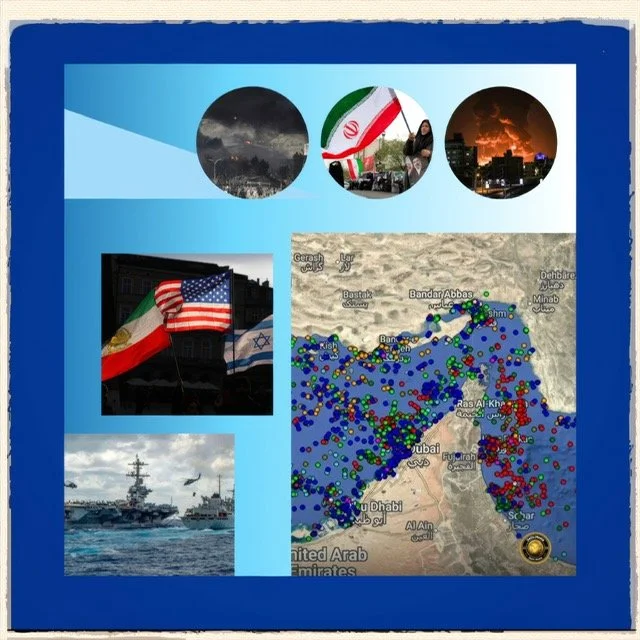
It had retaliated with drone and missile strikes across the Gulf, targeted the United States Embassy in Baghdad, struck a major oil storage facility at Fujairah Port in the United Arab Emirates, and — most consequentially — deployed its Islamic Revolutionary Guard Corps (IRGC) Navy to shut down the Strait of Hormuz to commercial shipping, laying mines, and conducting direct attacks on oil tankers.
It was in direct response to this maritime dimension of the conflict that the MEU was mobilised. What follows is a comprehensive scholarly analysis of the forces, stakes, and trajectories involved.
History and Current Status: From Nuclear Tensions to Open War
Pentagon's Marine Deployment Signals a Dangerous New Frontier in the US-Iran Conflict
The Road to Operation Epic Fury
The origins of the 2026 Iran War cannot be understood in isolation from the preceding decade of accelerating tension, failed diplomacy, and strategic miscalculation.
The conflict emerged from a confluence of three distinct fault lines: Iran's advancing nuclear programme, a wave of devastating domestic protests between 2025 and 2026 that killed thousands of Iranian civilians and generated international pressure on the regime, and the accumulated strategic logic of the Trump administration's "maximum pressure" doctrine, which had been steadily tightening the economic and military noose around Tehran since January 2025.
The immediate prelude to open hostilities involved a period of intense, if ultimately fruitless, diplomatic exchange.
As late as February 2026, the United States had reportedly offered Iran a proposal involving the free supply of nuclear fuel as an alternative to indigenous enrichment — an arrangement designed to preserve civilian nuclear capacity while eliminating the pathway to weaponisation. Iran rejected the proposal.
The Trump administration, having constructed what officials described as the largest U.S. military buildup in the Middle East since the 2003 Iraq invasion — deploying air, naval, and missile defence assets across the region beginning in late January 2026 — interpreted Tehran's refusal as a final data point confirming that military action was the only remaining instrument.
On February 27th, 2026, at 3:38 P.M EST, Trump gave the order to proceed. Strikes began the following morning, February 28, at approximately 9:45 A.M IST.
The initial wave targeted Iranian air defences, missile launch infrastructure, command-and-control networks, and nuclear-related facilities, with early reports indicating the death of Supreme Leader Ali Khamenei and several senior Iranian officials in the opening hours of the campaign.
Iran's response, codenamed Operation True Promise by Iranian state media, was immediate: missile and drone barrages were launched against U.S. military installations across Bahrain, Jordan, Kuwait, Qatar, Saudi Arabia, and the UAE, as well as targets in Israel.
The First 2 Weeks: Aerial Supremacy and Maritime Disorder
The opening fortnight of the war demonstrated the overwhelming aerial superiority of the U.S.-Israeli coalition while simultaneously revealing the structural limitations of airpower alone in achieving strategic closure against a determined adversary. CENTCOM struck over 5,500 Iranian military targets with precision munitions delivered by carrier-based aircraft, land-based strike platforms, and submarine-launched cruise missiles.
Iran lost entire classes of surface warships, numerous ballistic missile batteries, and significant portions of its command-and-control architecture.
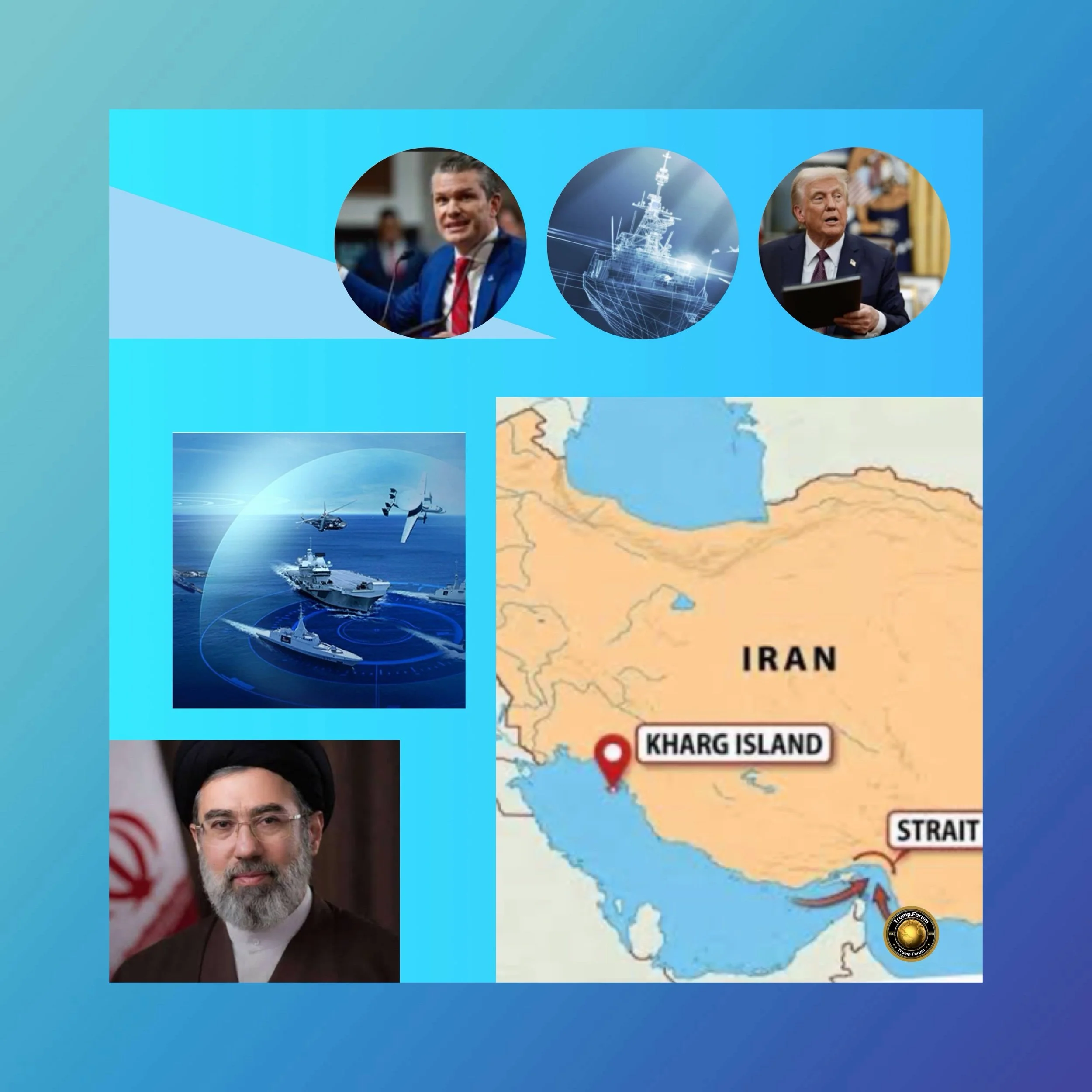
Yet Iran's response in the maritime domain proved far more disruptive than its conventional military capacity on land had suggested. The IRGC Navy, exploiting the geographic particularity of the Strait of Hormuz — a chokepoint barely 33 kilometres wide at its narrowest point — employed a combination of mine-laying operations, fast-boat swarm tactics, and direct missile strikes on commercial shipping to render the waterway functionally impassable.
By March 2nd, a senior Republican Guards commander had publicly declared the strait "closed," threatening to "set those ships ablaze."
Commercial shipping operators halted tanker transits almost unanimously within days, responding not merely to actual attacks but to the actuarial impossibility of insuring vessels through a contested corridor.
At least three cargo ships were damaged in suspected Iranian attacks in the strait by March 11th.
The International Energy Agency, in a report released during the third week of the conflict, characterised the resulting disruption as potentially the most significant in global oil supply history, estimating that supply could fall by as much as 8 million barrels per day.
Oil prices, which had been forecast to potentially average $91 per barrel in late 2026 under disruption scenarios modelled before the war, surged past $100 per barrel, with Bloomberg New Energy Finance warning of supply losses of up to 4.7 million barrels per day if the closure persisted.
The U.S. response to the mining campaign was swift but insufficient in isolation. On approximately March 11, CENTCOM executed strikes against 16 vessels involved in mine-laying operations near the strait.
Yet intelligence assessments concurrently identified direct IRGC attacks — using fast boats, missiles, and drones — as the greater systemic threat to tanker traffic, rather than the mines alone.
It was this intelligence picture, combined with the failure of airpower to fully neutralise the IRGC's distributed maritime capacity, that generated the formal CENTCOM request for an amphibious ready group.
Key Developments: The Deployment of the 31st MEU
From Air Strikes to Amphibious Assault: America's Escalating Military Gamble in Iran
Composition and Capability of the Force
The formation dispatched under CENTCOM's formal request is a formation of formidable capability and significant symbolic weight.
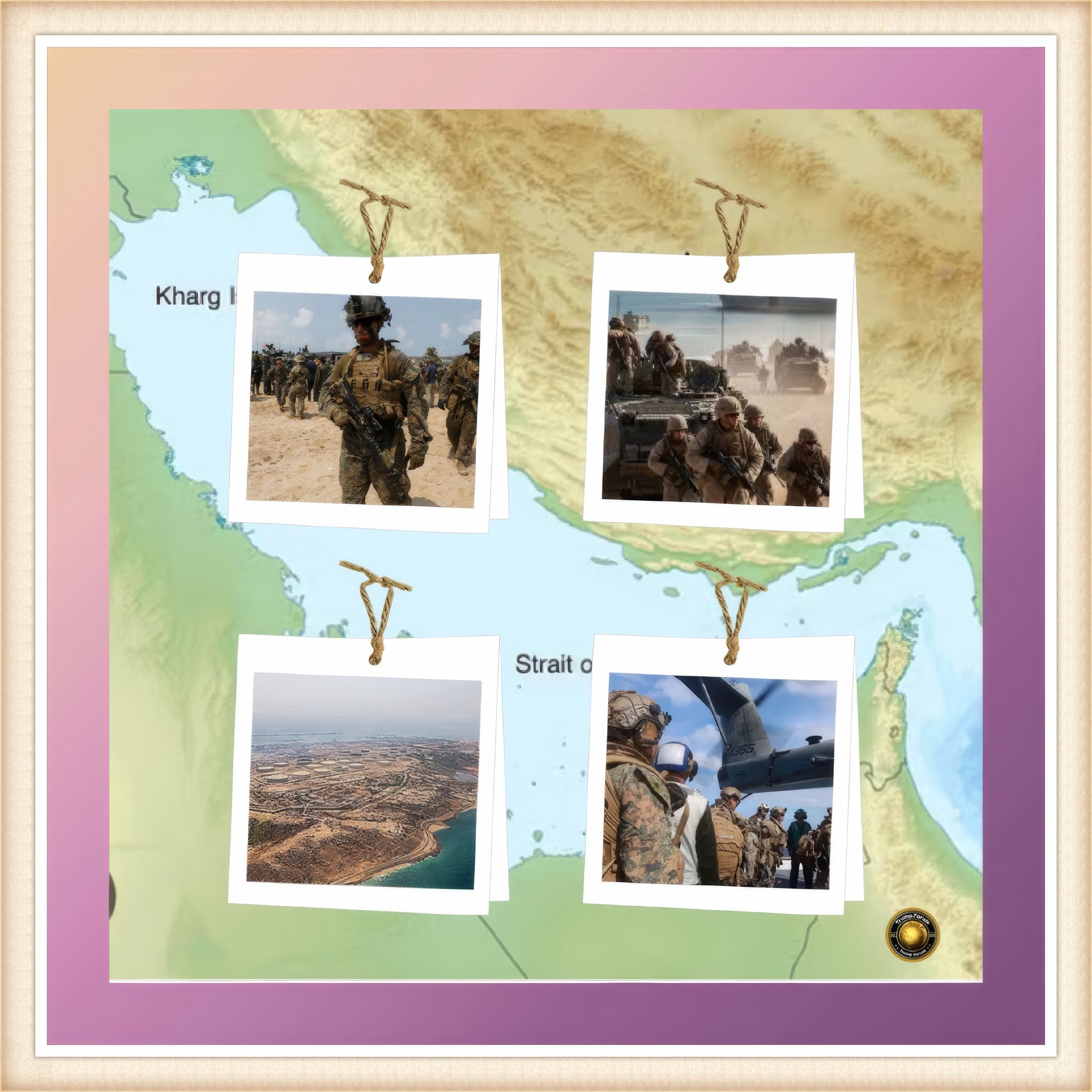
The 31st Marine Expeditionary Unit, headquartered in Okinawa and America's only permanently forward-deployed MEU, is designed precisely for the rapid-response contingency now confronting CENTCOM.
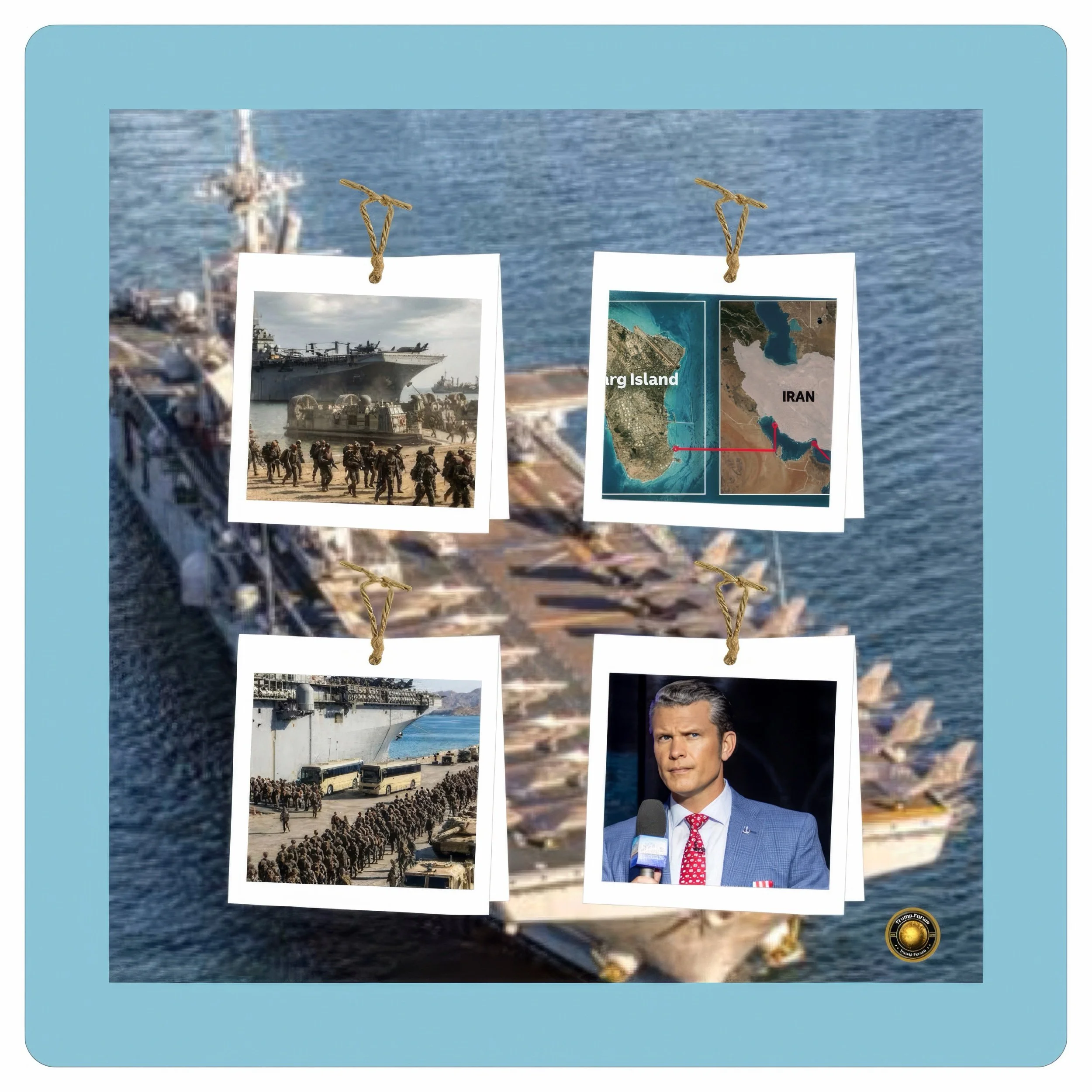
Embarked aboard the USS Tripoli (LHA-7), a America-class amphibious assault ship and one of the largest vessels of its type in the United States Navy, the unit combines approximately 2,500 Marines and sailors with a naval surface group that includes the guided-missile cruiser USS Robert Smalls and the destroyer USS Rafael Peralta.
The USS Tripoli is not a conventional transport vessel. Designed and optimised to operate as a "Lightning Carrier," it is purpose-built to accommodate the F-35B Lightning II — the short-takeoff, vertical-landing variant of the Joint Strike Fighter — providing the ARG with organic stealth air-strike capability that does not depend on access to fixed regional air bases.
This is a capability of considerable operational importance in a conflict environment where Iran has repeatedly targeted U.S.-associated facilities and in which the political exposure of Gulf host nations — Bahrain, Qatar, and others — has been significantly heightened by Iranian threats to strike cities and energy infrastructure across the region.
The Tripoli's combination of stealth aviation, heavy-lift rotary wing assets (including MV-22 Osprey tilt-rotor aircraft), and embarked landing craft gives CENTCOM commanders a genuinely self-contained joint strike platform capable of operating from international waters.
Beyond aviation, the 31st MEU brings highly specialised capabilities directly relevant to the Hormuz crisis. Its embarked Marine Raider elements and Visit, Board, Search, and Seizure (VBSS) teams are trained for the retaking of hijacked vessels, the boarding and clearance of suspected mine-laying craft, and the seizure of island or coastal maritime terrain.
The MEU also embeds combat engineers proficient in maritime mine-countermeasures operations, a capability of direct relevance given Iran's demonstrated mine-laying campaign.
The unit's standard crisis-response package includes the capacity to execute a non-combatant evacuation operation (NEO) — a capability of growing relevance as the U.S. Embassy in Baghdad has already been struck and American citizens have been warned to leave Iraq.
The Kharg Island Dimension
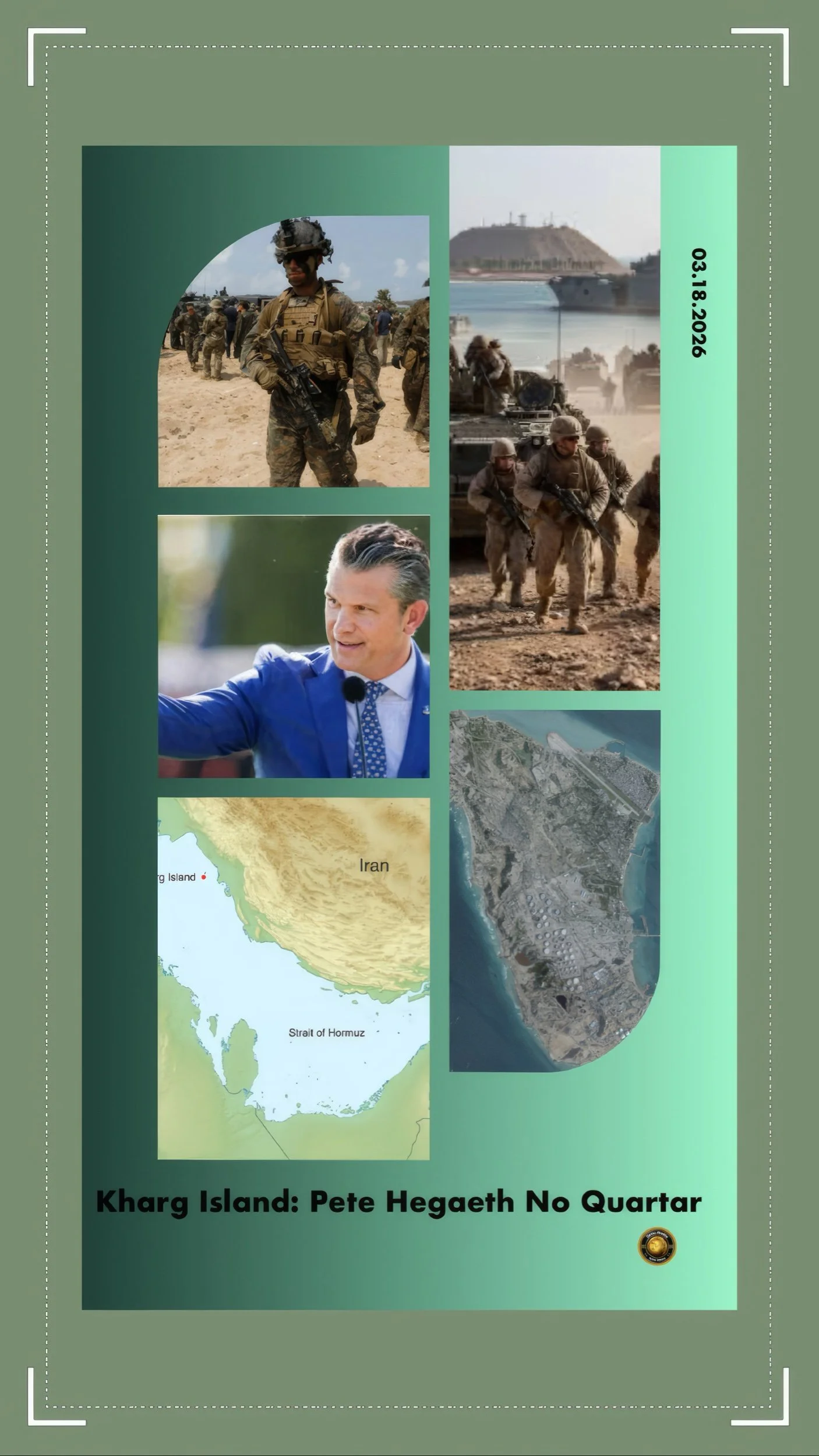
No analysis of the MEU deployment can be intellectually complete without direct engagement with the strategic question that has dominated military commentary since the deployment was ordered: the island of Kharg.
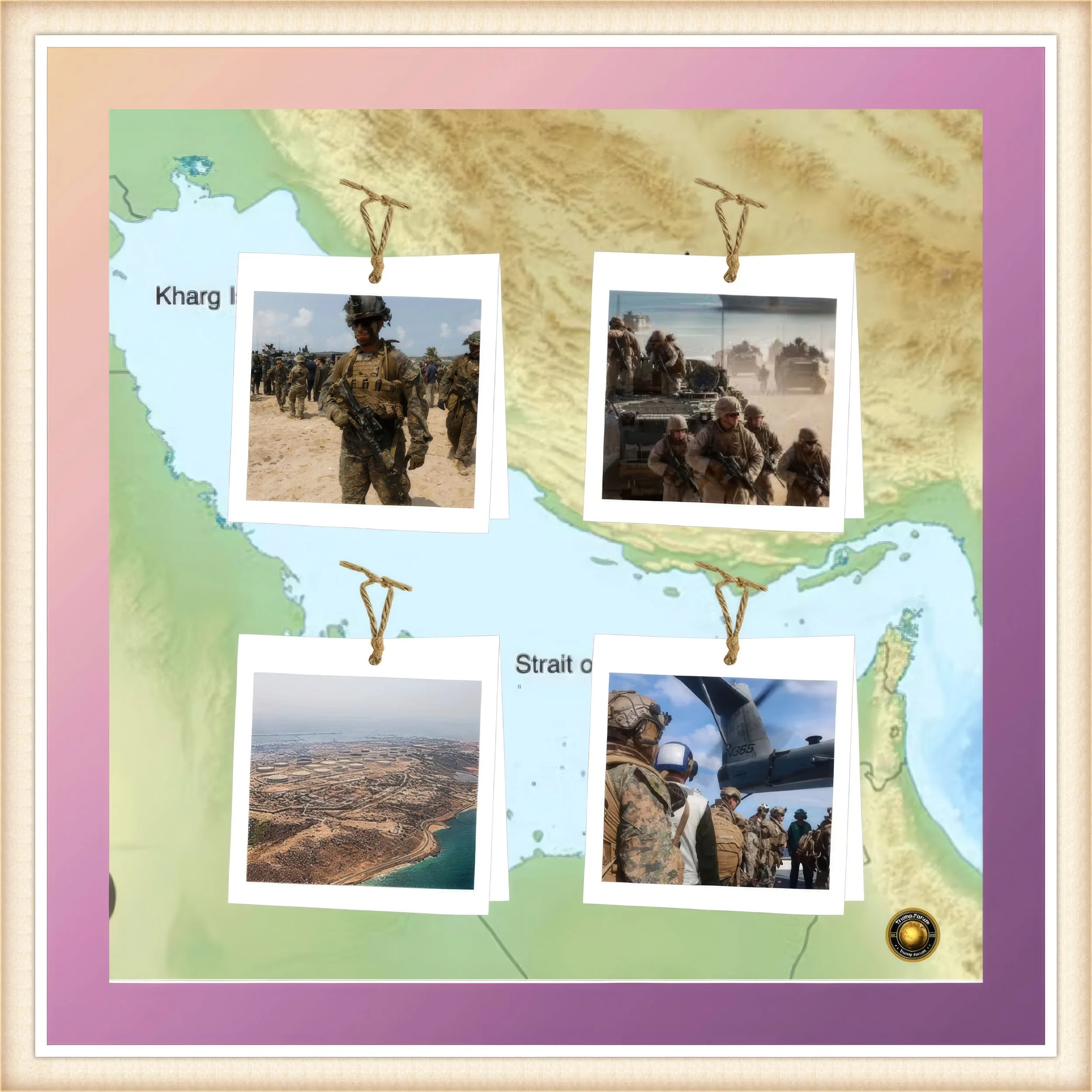
Situated in the Persian Gulf approximately 15 miles off Iran's southwestern coast, Kharg Island handles the overwhelming majority of Iran's crude oil exports — by most estimates, somewhere between 90% and 95% of all Iranian crude flows through its terminal infrastructure.
It holds within its seabed geology approximately 10% of the world's proven oil reserves and an estimated 15% of global gas reserves.
On March 13, 2026 — the same day the MEU deployment was confirmed publicly — Trump announced that U.S. forces had "obliterated" military targets on Kharg Island, striking over 90 Iranian military sites including naval mine storage facilities and missile bunkers.
Trump described the operation as "one of the most powerful bombing raids in the history of the Middle East."
Critically, the oil infrastructure on the island was deliberately spared in the initial strikes — a calibrated escalatory signal, not a culminating blow. Iranian officials insisted that oil operations were continuing normally and that no oil infrastructure had been damaged.
The juxtaposition of the MEU's pending arrival with the deliberate non-targeting of Kharg Island's oil infrastructure is analytically significant.
The marine force provides Washington with credible options it did not previously possess in the maritime-terrestrial boundary: the ability to land combat forces on Iranian-held islands, neutralise shore-based mine-laying infrastructure, and in extremis seize and hold maritime terrain.
The Iranian Parliament Speaker, Mohammad Bagher Qalibaf, warned explicitly on social media that any attack on Iran's southern maritime islands would cause Tehran to "abandon all restraint."
This threat, combined with Iran's warnings to strike oil and energy infrastructure across the region belonging to any company with American equity participation, frames the MEU's deployment as simultaneously a deterrent instrument, a coercive tool, and a potential offensive asset.
Latest Facts and Concerns: A Conflict at the Edge of Control
The Strait of Hormuz Crisis and the Marine Force That Could Change Everything
By March 18, 2026 — the day of this analysis — the conflict has entered its 19th day without any credible diplomatic trajectory visible to outside observers.
Iran's retaliatory posture has expanded beyond the Strait of Hormuz. Iranian-backed militias struck the U.S. Embassy in Baghdad with two drones, damaging the helipad and a nearby structure.
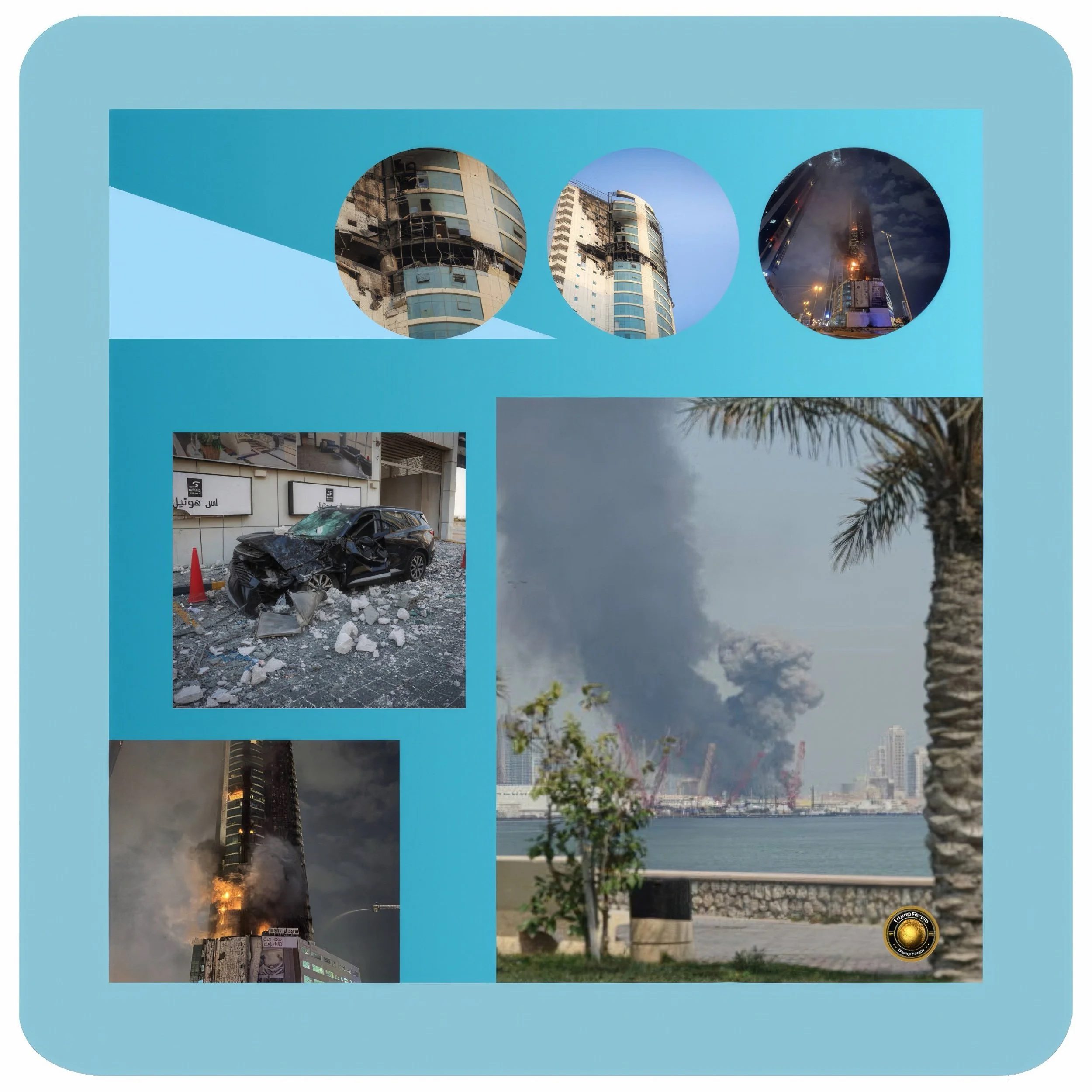
Debris from an Iranian drone intercepted by the UAE's air defence systems caused a major fire at Fujairah Port, one of the most strategically important maritime fuel and oil storage hubs outside the Persian Gulf itself.
A second intercepted Iranian missile deposited debris onto a building façade in central Dubai.
In Eilat, in southern Israel, two people including a 12-year-old child were injured in Iranian missile strikes.
In Lebanon, Hezbollah resumed cross-border fire against Israel for the 1st time in over a year, marking a potential second-front dynamic that U.S. and Israeli planners had consistently sought to avoid.
Iran's energy threat has also gained precision. The spokesperson for the Khatam al-Anbiya Central Headquarters, Ebrahim Zolfaghari, issued a formal warning that Iranian forces would target "all oil, economic, and energy infrastructures belonging to oil companies across the region that have American shares or cooperate with America" — a threat that, if executed, would encompass virtually every major Gulf hydrocarbon producer.
Saudi Aramco, Abu Dhabi National Oil Company (ADNOC), and Qatar Energy all operate facilities with U.S. equity participants, service-company relationships, or financial linkages.
The threat, therefore, is not rhetorical in any conventional sense — it is a declaration of unlimited economic warfare against the entire architecture of Gulf energy production.
The global economic consequences are already significant. The IEA's estimation of an 8-million-barrel-per-day supply disruption — if sustained — would represent the largest single supply shock in the history of the modern oil market, eclipsing even the 1973 Arab oil embargo and the 1979 Iranian Revolution.
Asian economies — Japan, South Korea, India, and China — which collectively account for the dominant share of Gulf oil consumption, have been placed on heightened economic alert.
Shipping insurance premiums for Persian Gulf transits have become commercially prohibitive, and several major shipping operators have suspended Gulf routes entirely.
Cause-and-Effect Analysis: How Decisions Are Driving Consequences
Why the 31st Marine Expeditionary Unit Is the Most Dangerous Card Washington Has Played Yet
The deployment of the 31st MEU is the product of a specific causal chain, each link of which demands individual analytical attention.
The United States and Israel launched Operation Epic Fury with the primary stated objective of dismantling Iran's offensive military capacity — ballistic missiles, nuclear infrastructure, air defences, and naval assets — through sustained aerial bombardment.
The logic was fundamentally that of coercive air power: apply sufficient destruction to force strategic capitulation or at minimum operational paralysis.
That logic encountered a structural constraint almost immediately. Iran's IRGC Navy, having anticipated a prolonged aerial campaign based on the 2025 precedent of nuclear site strikes, had pre-positioned a maritime denial strategy centred on the Strait of Hormuz — deploying mine-laying vessels, fast-attack boats, and shore-based anti-ship missiles in a distributed manner that airpower alone cannot fully neutralise.
Each IRGC fast boat sunk by U.S. strikes leaves 3 others dispersed across the Gulf's littoral geography. Each mine cleared creates a 24-hour window before the next mining sortie.
The physics of the operational environment — shallow coastal waters, archipelagos of small Iranian-held islands, dense commercial traffic — inherently favour a defender armed with cheap, proliferated maritime weapons over an attacker relying on precision munitions of enormous cost.
The operational response to this constraint is the MEU. By inserting a self-contained amphibious force into the landscape, CENTCOM gains the capacity to — at minimum — contest Iranian control of the small islands at the mouth of the Strait, which currently serve as forward staging points for mine-laying and fast-boat interdiction operations.
The effect is to raise the cost and difficulty of Iran's maritime campaign by forcing the IRGC to defend fixed geographic terrain against a force specifically designed to seize it.
This is not a guarantee of strategic success, but it is a rational operational response to a tactical problem that airpower alone has proven unable to solve.
At the same time, the deployment carries its own causal risks.
The Iranian Parliament's explicit warning that assaults on its southern maritime islands would prompt total abandonment of restraint establishes a potential trigger for a dramatic escalation in both scope and severity.
If the MEU is employed offensively — even in a limited raid against a single island mine-storage facility — it will likely trigger Iranian strikes on Gulf oil infrastructure of a character and intensity not yet seen in the conflict.
Iranian threats against cities in the UAE, combined with Hezbollah's return to active engagement in Lebanon, suggest a multi-front escalatory response that could overwhelm the defensive architecture of regional partners already absorbing significant political and economic pressure.
There is also a second-order energy market dynamic with self-reinforcing properties.
The IEA's 8-million-barrel disruption estimate is a current-state assessment.
A strike on Kharg Island's oil infrastructure — or an Iranian strike on Saudi Aramco's Abqaiq or Ras Tanura facilities — could within days push the disruption past 12 or 14 million barrels per day, a figure that would trigger recession conditions across most major global economies simultaneously.
The prospect of such an economic cascade creates pressure on Washington to act decisively enough to end the Hormuz disruption quickly — which in turn creates political pressure to deploy the MEU in an offensive rather than merely deterrent capacity.
Future Steps: Pathways and Escalatory Ladders
Operation Epic Fury Enters a New Phase as Marines Deploy to Hormuz
The conflict's near-term trajectory offers approximately four analytically distinct pathways, each with different implications for regional stability, global energy markets, and the durability of the U.S.-Iranian strategic balance.
The 1st pathway is one of continued aerial and maritime pressure combined with MEU deterrence, in which the deployment of the amphibious force functions primarily as a coercive signal that induces Iran to accept a negotiated cessation of Hormuz mining operations in exchange for limitations on further strikes against its energy infrastructure.
This scenario requires the Iranian leadership — currently in a period of contested succession following the reported death of Supreme Leader Khamenei — to possess both the internal cohesion and the political latitude to strike such a bargain.
Given the uncertain status of Iran's supreme leadership and the institutionally hardline character of the IRGC, which operates with considerable independence on maritime and proxy warfare matters, this pathway is plausible but by no means certain.
The 2nd pathway involves a limited MEU-led raid against one or more of Iran's small Gulf islands — most probably targeted at mine storage or fast-boat staging facilities — combined with expanded strikes on Kharg Island's oil infrastructure.
This would be the most kinetically satisfying option from a CENTCOM operational standpoint, directly addressing the twin maritime and economic pressure points.
It would, however, almost certainly trigger the Iranian "total abandon of restraint" scenario, resulting in full-scale missile and drone attacks on Gulf energy infrastructure, potential Hezbollah escalation in Lebanon, and deepened Iranian proxy attacks on American diplomatic and military facilities across Iraq and Syria.
The MEU could seize a small island; it cannot hold it indefinitely against sustained IRGC bombardment without a far larger ground commitment.
The 3rd pathway is one of controlled escalation to a negotiated strategic settlement — essentially the coercive diplomacy model — in which the MEU's deployment, combined with the demonstrated willingness to strike Kharg Island's military infrastructure, creates sufficient psychological and political pressure on Iran's fragmented post-Khamenei leadership to produce a formal diplomatic engagement.
This scenario draws intellectual support from historical precedent: the 1988 Operation Praying Mantis, in which the United States destroyed a significant portion of Iran's naval capacity in a single day's fighting, ultimately contributed to Iranian acceptance of a ceasefire in the Iran-Iraq War.
The difference in 2026 is the absence of a coherent Iranian interlocutor with the authority to negotiate and the credibility to deliver compliance from the IRGC.
The 4th pathway — the most alarming from a systemic risk perspective — is one of uncontrolled escalation in which individual operational decisions on both sides interact with the structural incentives of the conflict environment to produce outcomes that neither party has consciously chosen.
Iran's layered proxy network across Iraq, Syria, Yemen, and Lebanon constitutes a distributed escalatory capacity that can be activated incrementally without requiring a single central command decision.
Each Iranian proxy attack on U.S. facilities or Gulf partner infrastructure creates political pressure on Washington to respond with additional force, which in turn activates further proxy responses, in a feedback loop that has historically proven difficult to break without either decisive military victory or a collapse of will on one side.
The Role of Regional Stakeholders
The MEU's deployment does not operate in a diplomatic vacuum. Saudi Arabia, the UAE, Bahrain, and Qatar — whose territory, airspace, and port infrastructure provide the logistical scaffolding for much of the U.S. military campaign — face an acute dilemma.
They are formally aligned with or at minimum silently supportive of the U.S.-Israeli campaign's strategic objectives, particularly with respect to Iranian nuclear and ballistic missile capacity that directly threatens their own security.
At the same time, Iran's explicit threat to strike their energy infrastructure — and the demonstrated willingness to target Fujairah and Dubai — exposes them to economic and political costs that are not easily absorbed.
Saudi Arabia in particular, whose state revenues are overwhelmingly dependent on Aramco's oil export revenues, faces a scenario in which an escalated Iranian strike on Ras Tanura or Abqaiq — facilities that have already survived previous IRGC drone and cruise missile attacks — could simultaneously cripple its economy and de-legitimise the Abraham Accords-era architecture of Gulf-Israeli strategic convergence.
Russia and China, meanwhile, occupy the position of structural beneficiaries of the conflict's economic disruption. Both countries maintain significant oil-producing capacity and — unlike Iran — continuing access to global markets.
A sustained Hormuz disruption that keeps oil prices above $100 per barrel accrues directly to their fiscal benefit.
Neither has expressed genuine interest in facilitating a diplomatic resolution, and China's particular silence on the conflict — given its enormous economic exposure to Gulf energy supply — is itself a significant strategic data point about Beijing's calculation that the United States will bear the primary reputational and material costs of whatever outcome follows.
India, which imports approximately 85% of its crude oil and has historically maintained diverse sourcing arrangements specifically to avoid excessive Gulf dependency, faces acute short-term disruption.
The conflict has confronted New Delhi with its most serious energy security challenge since the 1970s, accelerating domestic pressure for a diversification of supply chains that will have long-term consequences for Gulf producers' market share regardless of when the conflict ends.
The Strategic Significance of Amphibious Power in the Modern Conflict Landscape
There is also a signalling dimension to the deployment that is specifically calibrated for Chinese observation.
Beijing’s strategic planning for a potential Taiwan scenario is deeply influenced by its assessment of U.S. amphibious capability and political will.
Washington’s willingness to insert a dedicated amphibious strike force into an active conflict zone against a hardened adversary with significant anti-access/area-denial (A2/AD) capacity — precisely the scenario PLA planners model for Taiwan — is a data point of considerable weight in the ongoing calibration of deterrence across the Indo-Pacific.
If the 31st MEU performs effectively in the Hormuz landscape, it validates the EABO concept in the most operationally credible manner possible: under fire, against a real adversary, in contested maritime terrain.
If it suffers significant losses or is unable to achieve its operational objectives, it conversely provides Beijing with intelligence of enormous value about the genuine limits of U.S. amphibious power projection.
The Hormuz deployment therefore carries dual strategic weight. It is simultaneously a solution to an immediate operational problem — the IRGC’s distributed maritime denial campaign — and a live demonstration of doctrinal and technological capabilities whose implications extend far beyond the Persian Gulf.
Pentagon planners are acutely aware of this dual audience.
The decision to dispatch the USS Tripoli rather than a less capable amphibious platform, and to ensure that its F-35B complement was at full operational strength before deployment, was not accidental.
It was a deliberate act of capability signalling directed as much at Beijing and Moscow as at Tehran.
In the grammar of great-power competition, the Tripoli’s transit toward Hormuz is a sentence addressed to multiple readers simultaneously.
From a purely doctrinal standpoint, the deployment also tests the boundary between deterrence and compellence in a manner that has significant implications for future American strategy.
Deterrence seeks to prevent an adversary from taking an action they have not yet taken.
Compellence seeks to force an adversary to stop an action already underway.
The MEU’s mission — in its most immediate framing — is compellent, not deterrent: it is designed to force Iran to cease its maritime disruption campaign by confronting the IRGC with the credible prospect of losing the island staging points from which that campaign is being conducted.
Compellence is historically far more difficult to achieve than deterrence, because it requires the adversary to actively back down and absorb the domestic political cost of visible capitulation.
Iran’s IRGC, whose institutional identity is built around the narrative of resistance against American pressure, faces an acute internal political problem if it abandons the Hormuz campaign without having extracted a tangible concession.
This structural asymmetry of political costs — in which Washington can tolerate a degree of Hormuz disruption more easily than Tehran can tolerate a retreat without concession — sets the parameters of the bargaining space, and they are uncomfortably narrow.
The history of U.S. amphibious operations in the Gulf itself offers an instructive, if imperfect, precedent.
Operation Praying Mantis, executed on April 18th, 1988, saw U.S. Navy surface forces destroy approximately half of Iran’s operational naval fleet in a single day’s engagement, sinking two frigates, a gunboat, and several patrol craft in retaliation for IRGC mine-laying that had crippled the guided-missile frigate USS Samuel B. Roberts.
The operation did not immediately end the Iran-Iraq War, but it contributed to a strategic reassessment within the Iranian leadership that produced acceptance of United Nations ceasefire terms within months.
The 2026 context differs fundamentally in scale, scope, and the absence of a functioning Iranian state hierarchy with clear lines of authority — but the precedent suggests that demonstrating the capacity to systematically destroy Iran’s maritime denial infrastructure, rather than simply warning about it, has historically been the more effective coercive instrument.
The MEU’s deployment, in this analytical frame, is not simply a military reinforcement.
It is a deliberate act of strategic communication, delivered in the language that deterrence theory has always identified as most compelling: the visible, physical, undeniable presence of an overwhelming and operationally flexible force capable of decisive action at a time and place of its commander’s choosing.
Conclusion: A Conflict at an Inflection Point
The arrival of the 31st Marine Expeditionary Unit in the Middle East marks a moment that demands to be understood on multiple simultaneous levels, none of which alone captures the full weight of what is unfolding in the waters of the Persian Gulf and the corridors of power in Washington, Tehran, Riyadh, and Beijing.
At the tactical level, it is a rational response to an operational problem: Iran’s distributed maritime denial campaign in the Strait of Hormuz has proven partially resistant to airpower alone, and an amphibious force provides the specific capabilities — island seizure, littoral warfare, mine countermeasures, fast-boat interdiction — needed to contest that campaign on its own terrain.
At the operational level, it is an expansion of the campaign’s menu of options, adding land-raid and coastal assault capabilities to an arsenal previously dominated by aerial strike and naval surface fire.
At the strategic level, it is a coercive signal directed at multiple audiences simultaneously — at Iran, at Gulf partners, at China, and at the global energy market — that the United States is prepared to escalate significantly before it accepts the permanent closure of the world’s most critical maritime chokepoint.
Yet the deployment also concentrates extraordinary risk at the intersection of military, economic, and diplomatic uncertainty.
The conflict has entered its third week without a coherent Iranian interlocutor capable of authorising a ceasefire, without a functioning diplomatic channel between Washington and Tehran, and without any significant international diplomatic initiative — from China, Russia, the European Union, or the United Nations — that has gained meaningful traction.
The global oil market is already experiencing disruption of historic magnitude, and Iran’s explicit threats against Gulf energy infrastructure belonging to companies with American equity participation represent a potential trigger for an economic catastrophe that would dwarf the losses already incurred.
History does not offer a clear template for this moment. The 1988 Praying Mantis precedent suggests that overwhelming and decisive displays of maritime military power can shock an adversary toward strategic recalculation.
The 2003 Iraq precedent — in which decisive military victory produced a decade of costly stabilisation failure — suggests the opposite lesson about the gap between kinetic success and durable political outcomes.
The 2026 Iran War is unfolding at a moment of unusual vulnerability in the international system: multipolarity has weakened the institutional mechanisms of conflict restraint, economic interdependence has created catastrophic escalation incentives, and the domestic political structures of the key stakeholders on both sides create powerful internal pressures toward continuation rather than compromise.
The Marines of the 31st MEU are sailing into a landscape shaped by all of these forces simultaneously.
Their arrival does not guarantee escalation, but it ensures that the next phase of the conflict will be defined by choices of far greater consequence than any made in the three weeks preceding it.
The world is watching the USS Tripoli’s transit across the Arabian Sea not merely as a military movement, but as a signal about what kind of order — or disorder — will govern the international system in the years that follow.
Whether its arrival produces strategic clarity or strategic catastrophe will depend on decisions that are yet to be made, by leaders on multiple sides operating under conditions of incomplete information, intense domestic pressure, and the permanent fog of active war.
In that sense, the deployment of 2,500 Marines to the Persian Gulf is both a military act and a historical question — one that the events of the coming days and weeks will begin to answer.