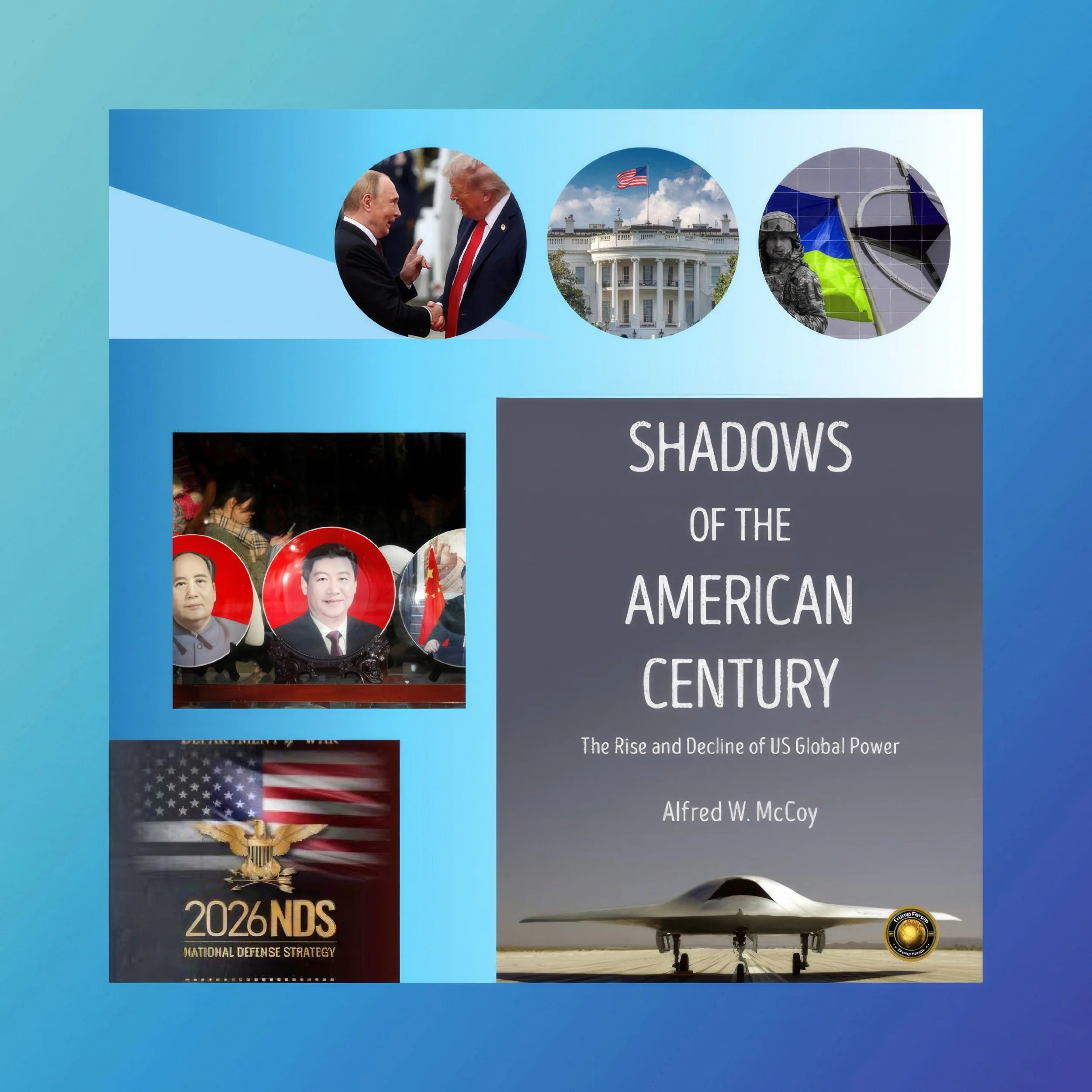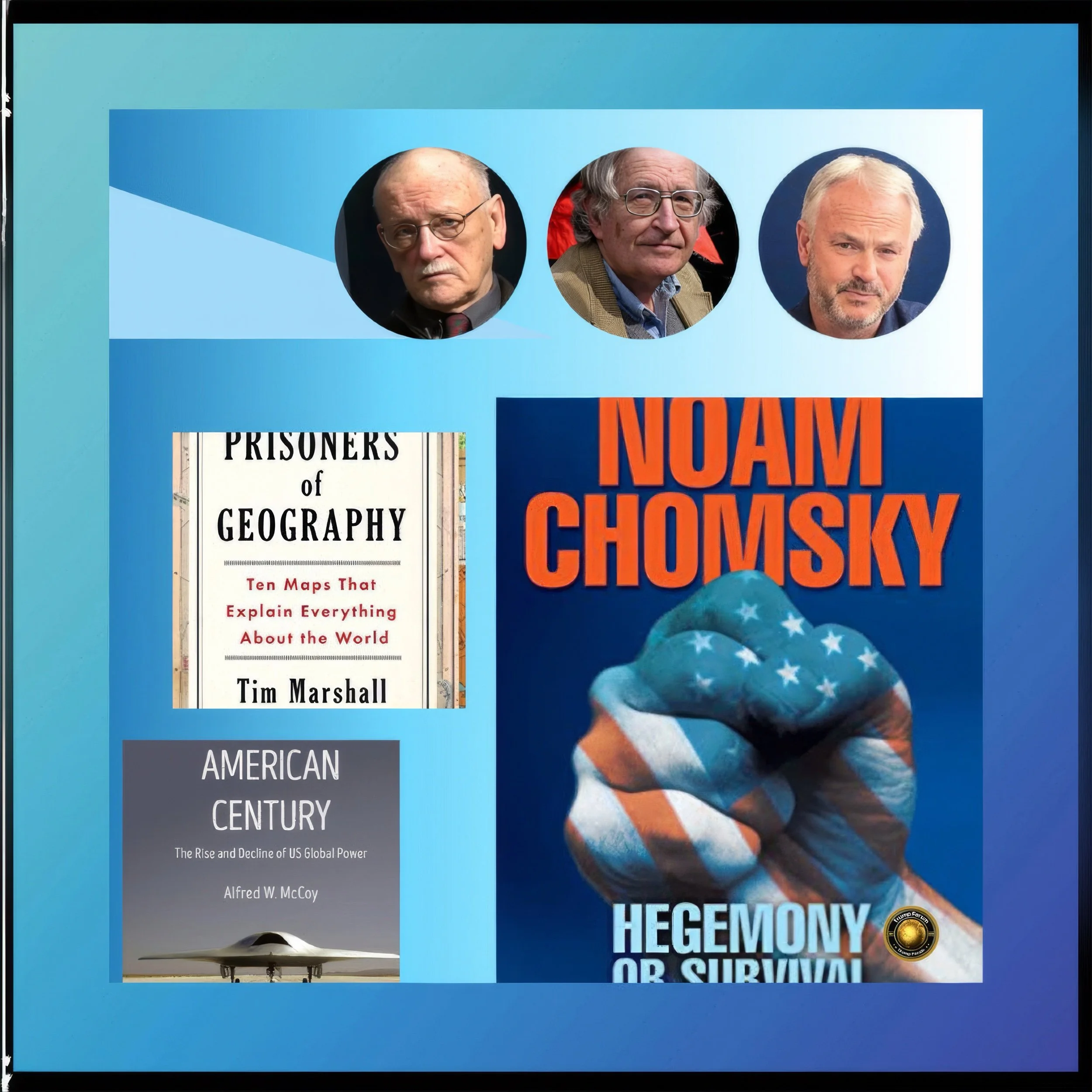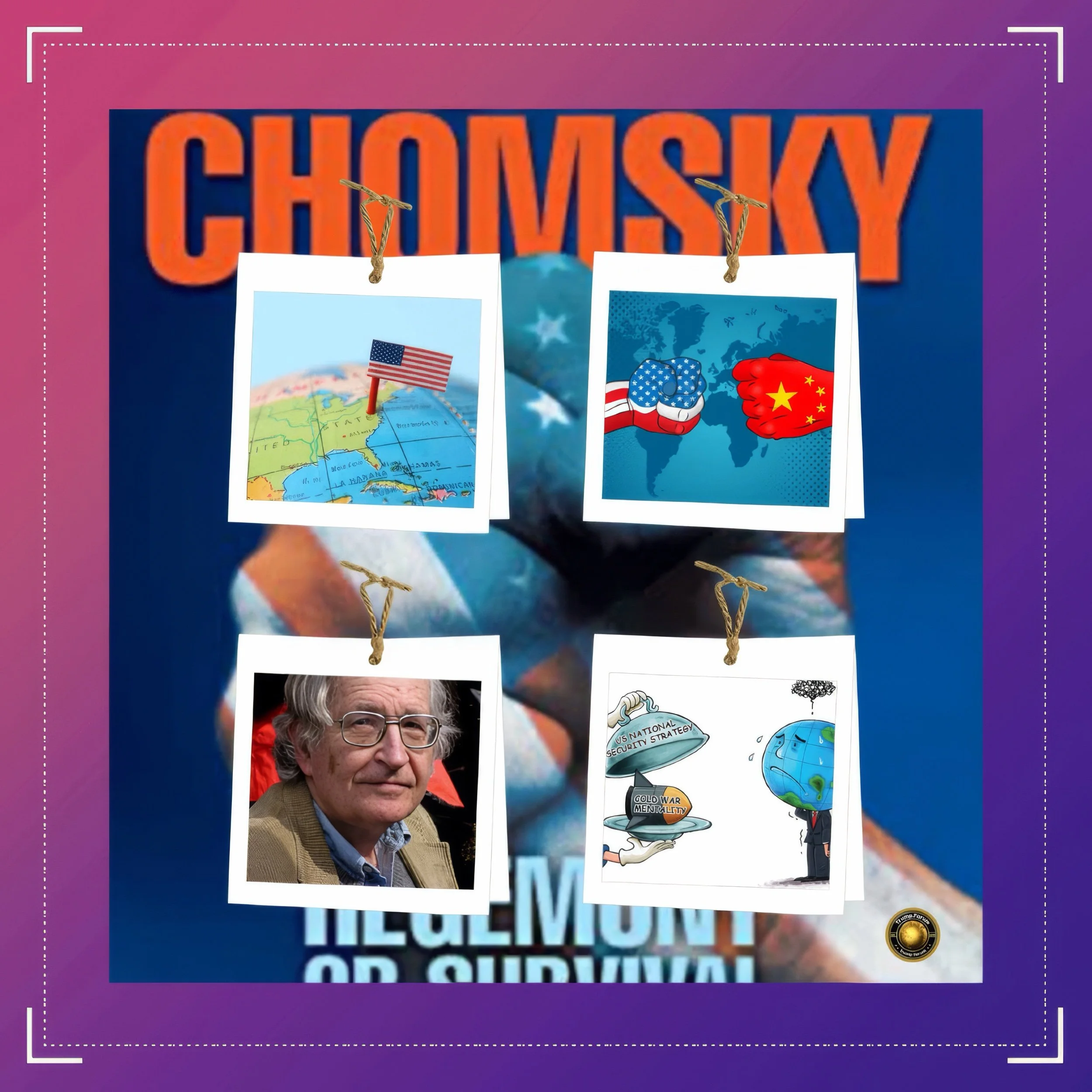
Empire Without Limits How Washington’s Strategy of Dominance Shapes Wars Alliances and Global Instability
Executive Summary
How America’s Quest for Global Dominance Shapes Today’s Conflicts From China to the Middle East
The contemporary international order has been profoundly shaped by the global strategy of the United States since the end of the Second World War.
Noam Chomsky’s influential work Hegemony or Survival argues that American foreign policy has consistently pursued a single overriding objective: maintaining unchallenged global supremacy.
According to this interpretation, the United States has repeatedly relied on military force, strategic interventions, economic leverage, and political influence to ensure that no rival power can challenge its position.
Chomsky’s thesis situates the American Century within a broader historical pattern of great powers seeking dominance in the international system. However, he argues that the scale and reach of U.S. influence are unprecedented.
Through a global network of military alliances, intelligence capabilities, financial institutions, and technological advantages, Washington constructed a system that allows it to shape geopolitical outcomes across multiple continents.
Yet this system has generated persistent tensions. Interventions in various regions have often produced unintended consequences, ranging from prolonged conflicts to regional instability.
The logic of dominance, Chomsky suggests, frequently prioritizes strategic advantage over diplomatic compromise or international legal norms.
The contemporary geopolitical landscape illustrates these tensions vividly. Strategic competition between the United States and China is intensifying across economic, technological, and military domains.
At the same time, conflicts in the Middle East continue to demonstrate the enduring volatility of regions shaped by decades of intervention and rivalry.
Recent developments further complicate the picture.
Policies associated with President Donald Trump introduced new dynamics into the American alliance system.
Tariff disputes strained relations with traditional partners, while efforts to reshape international institutions raised questions about Washington’s commitment to multilateral frameworks.
Initiatives such as attempts to broker ceasefires in Palestine coexist with broader controversies surrounding the perceived marginalization of the United Nations and the emergence of alternative diplomatic initiatives, including the so-called Board of Peace.
Meanwhile, geopolitical flashpoints are proliferating.
Discussions about strategic control of territories such as Greenland and debates over North American integration involving Canada have fueled controversy. In the Middle East, escalating tensions involving Israel and Iran raise the possibility of wider regional conflict.
These developments illustrate the central dilemma highlighted in Chomsky’s work.
The pursuit of global dominance may secure short-term strategic advantages, but it can also generate instability that undermines long-term security.
Whether the United States can adapt its strategy to a changing international environment remains one of the defining questions of contemporary geopolitics.
Introduction
The Logic of Hegemony in Modern Geopolitics
Few debates in international relations are as consequential as the question of whether global stability requires a dominant power.
Since 1945, the United States has occupied that role. Its economic resources, military capabilities, and technological innovations have enabled it to shape international institutions and security arrangements on an unprecedented scale.
Noam Chomsky’s Hegemony or Survival offers a stark interpretation of this historical reality.
Rather than portraying American leadership as primarily benevolent, Chomsky argues that U.S. strategy has consistently aimed at preserving unchallenged supremacy.
In this framework, foreign policy decisions are driven less by universal principles than by the perceived necessity of maintaining geopolitical dominance.
This argument challenges conventional narratives of the postwar order. Supporters of American leadership often emphasize the creation of international institutions, the promotion of economic development, and the defense of democratic values.
Chomsky does not deny these elements but contends that they operate within a broader strategic framework oriented toward power preservation.
The implications of this interpretation extend far beyond historical analysis. If global dominance is the central objective of U.S. strategy, then contemporary conflicts must be understood through that lens.
Strategic competition with China, military engagements in the Middle East, and tensions within the transatlantic alliance can all be seen as manifestations of a system designed to prevent the emergence of rival power centers.
Recent geopolitical developments appear to reinforce the urgency of this debate.
The international order that emerged after the Cold War is increasingly contested. Rising powers seek greater autonomy, alliances are under strain, and technological competition is transforming the nature of global rivalry.
Against this backdrop, Chomsky’s central question becomes increasingly relevant. Can a system based on hegemonic dominance produce lasting stability, or does it inevitably generate conflicts that threaten global security?
History and Current Status
From Postwar Leadership to Global Hegemony
The origins of American global dominance lie in the geopolitical transformation that followed the Second World War.
By 1945, the United States possessed nearly half of the world’s industrial production and a decisive military advantage. European empires had been weakened by war, while the Soviet Union emerged as the only comparable strategic rival.
American policymakers responded by constructing a comprehensive system of international institutions and alliances. Economic initiatives such as the Marshall Plan helped rebuild Europe while reinforcing political alignment with Washington. The establishment of NATO integrated Western European security with American military capabilities.
Parallel developments occurred in Asia and the Pacific. Security treaties with Japan, South Korea, and other partners extended the reach of U.S. strategic influence across the region.
These arrangements created what scholars often describe as the liberal international order. However, Chomsky’s analysis emphasizes the strategic dimension of these institutions. They functioned not only as mechanisms of cooperation but also as instruments for maintaining American leadership.
The Cold War reinforced this structure. Containment of Soviet influence justified the expansion of military alliances and intelligence networks.
By the late twentieth century, the United States maintained hundreds of overseas bases and possessed unparalleled global surveillance capabilities.
The collapse of the Soviet Union appeared to confirm American supremacy. The early 1990s were often described as a unipolar moment in which Washington faced no serious geopolitical competitor.
Yet the decades that followed revealed new challenges. Economic globalization accelerated the rise of China, technological innovation transformed strategic competition, and regional conflicts continued to test the limits of American influence.
Today the United States remains the most powerful country in the world, but the geopolitical environment is far more complex than it was during the early years of the American Century.
Key Developments
Strategic Rivalry and Fragmenting Alliances
Several developments illustrate the evolving dynamics of American global strategy.
The first is the intensifying rivalry between the United States and China.
Economic competition, technological innovation, and military modernization have transformed the Indo-Pacific region into the central arena of twenty-first-century geopolitics.
Trade disputes and tariffs have become prominent tools of strategic competition.
During Donald Trump’s presidency, tariffs were used not only against China but also against traditional allies, including European countries and Canada. Critics argued that these policies risked weakening the alliance system that had long supported American leadership.
A second development concerns debates over the structure of international governance.
The emergence of initiatives perceived as bypassing the United Nations, including proposals associated with the Board of Peace, has fueled concerns about the erosion of established multilateral frameworks.
The Middle East provides another example of the complexities surrounding hegemonic strategy. Efforts to broker ceasefires in the Palestinian conflict coexist with persistent regional tensions.
The possibility that Israeli actions against Iran could trigger wider confrontation illustrates the fragility of regional stability.
Finally, discussions about strategic territories such as Greenland and broader geopolitical relationships within North America have sparked debates about the future configuration of alliances and sovereignty.
Together these developments reflect a world in which the mechanisms of American dominance are increasingly contested.
Latest Facts and Concerns
The Turbulence of Contemporary Geopolitics
The current international environment is marked by a series of overlapping crises.
In the Middle East, conflicts involving Israel, Iran, and various regional stakeholders threaten to escalate into broader confrontation.
The possibility of war between Israel and Iran represents one of the most significant geopolitical risks of the present moment.
Meanwhile, ongoing instability in Gaza and the broader Palestinian territories underscores the difficulties of achieving durable ceasefires. Diplomatic initiatives have struggled to reconcile competing political objectives and security concerns.
At the global level, strategic competition between major powers continues to intensify. Technological rivalry, economic decoupling, and military modernization are reshaping the balance of power.
Domestic political debates within the United States further complicate the situation.
Questions about alliance commitments, trade policies, and international institutions reflect broader uncertainty about the future direction of American foreign policy.
These dynamics illustrate the challenges of sustaining global leadership in an era of rapid geopolitical change.
Cause and Effect Analysis
Dominance, Resistance, and Global Instability
Chomsky’s analysis suggests that the pursuit of hegemonic dominance often produces unintended consequences.
Military interventions intended to secure strategic objectives can generate long-term instability. Efforts to reshape political systems may provoke resistance from local populations and rival powers.
Economic strategies designed to maintain technological leadership can also trigger countermeasures from competitors. Tariffs and trade restrictions may encourage the development of alternative supply chains and financial networks.
Similarly, actions perceived as bypassing international institutions can weaken the legitimacy of the global order. When major powers appear to disregard established rules, other countries may feel justified in pursuing unilateral strategies.
These dynamics create a feedback loop in which attempts to preserve dominance generate resistance that ultimately undermines stability.
Future Steps
Reimagining Global Leadership
The future of international order will depend on how major powers adapt to changing geopolitical realities.
For the United States, one possible path involves reinforcing alliances and strengthening multilateral institutions.
Cooperative approaches to global challenges such as climate change and economic inequality could enhance legitimacy and reduce tensions.
Another possibility involves continued strategic competition, particularly with China. In this scenario, technological innovation and military deterrence would remain central pillars of American strategy.
Ultimately the durability of global stability will depend on whether hegemonic competition can be balanced with diplomatic engagement.
Conclusion
Hegemony and the Future of Global Order
Noam Chomsky’s Hegemony or Survival presents a provocative interpretation of American foreign policy. By emphasizing the central role of dominance in U.S. strategy, he challenges conventional narratives of benevolent leadership.
Whether one accepts this interpretation or not, the questions it raises remain deeply relevant.
The international system is undergoing profound transformation, and the structures that defined the American Century are under increasing pressure.
The challenge facing policymakers today is to navigate this transition without allowing geopolitical rivalry to escalate into catastrophic conflict. In an interconnected world, the pursuit of security must ultimately be reconciled with the need for global cooperation.