War Powers Reckoning: America's Iran Gamble Meets a Changed Washington
Foreign Affairs Forum | Dr. Antonio Bhardwaj (Dr. 🆎)| November 7th, 2026
Executive Summary
The United States enters the second week of November 2026 at a moment of unusual strategic compression. Within a single week, the President has twice convened his national security team to weigh a resumption of major combat operations against Iran; Tehran has transmitted a formal nuclear proposal through Qatari intermediaries; American voters have handed Democrats control of the congressional committees that oversee the State Department and the Pentagon; and the Kremlin has confirmed that trilateral talks on Ukraine will convene in Abu Dhabi. In roughly two weeks, Donald Trump is due to meet Xi Jinping at the APEC summit in Shenzhen, their third encounter this year.
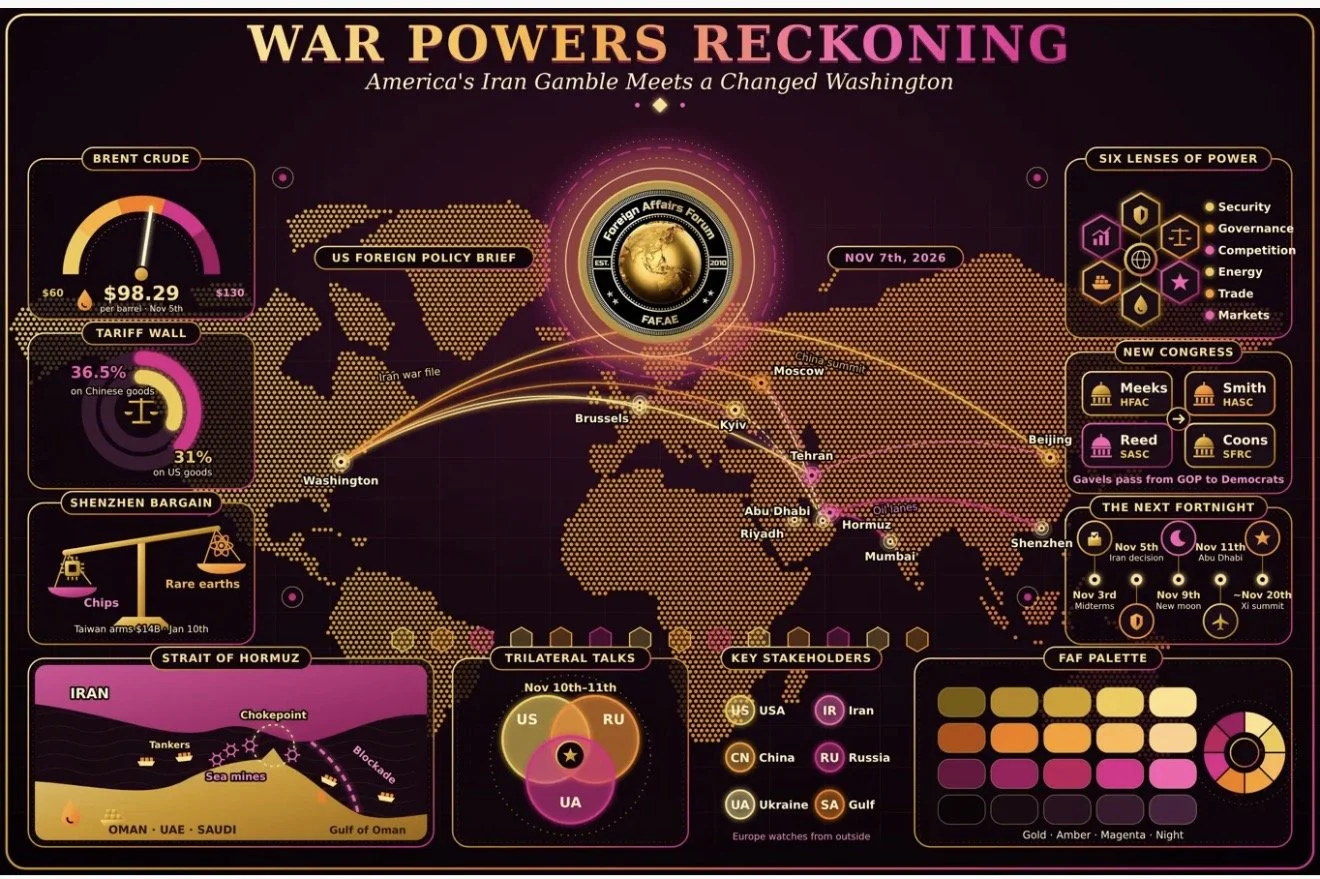
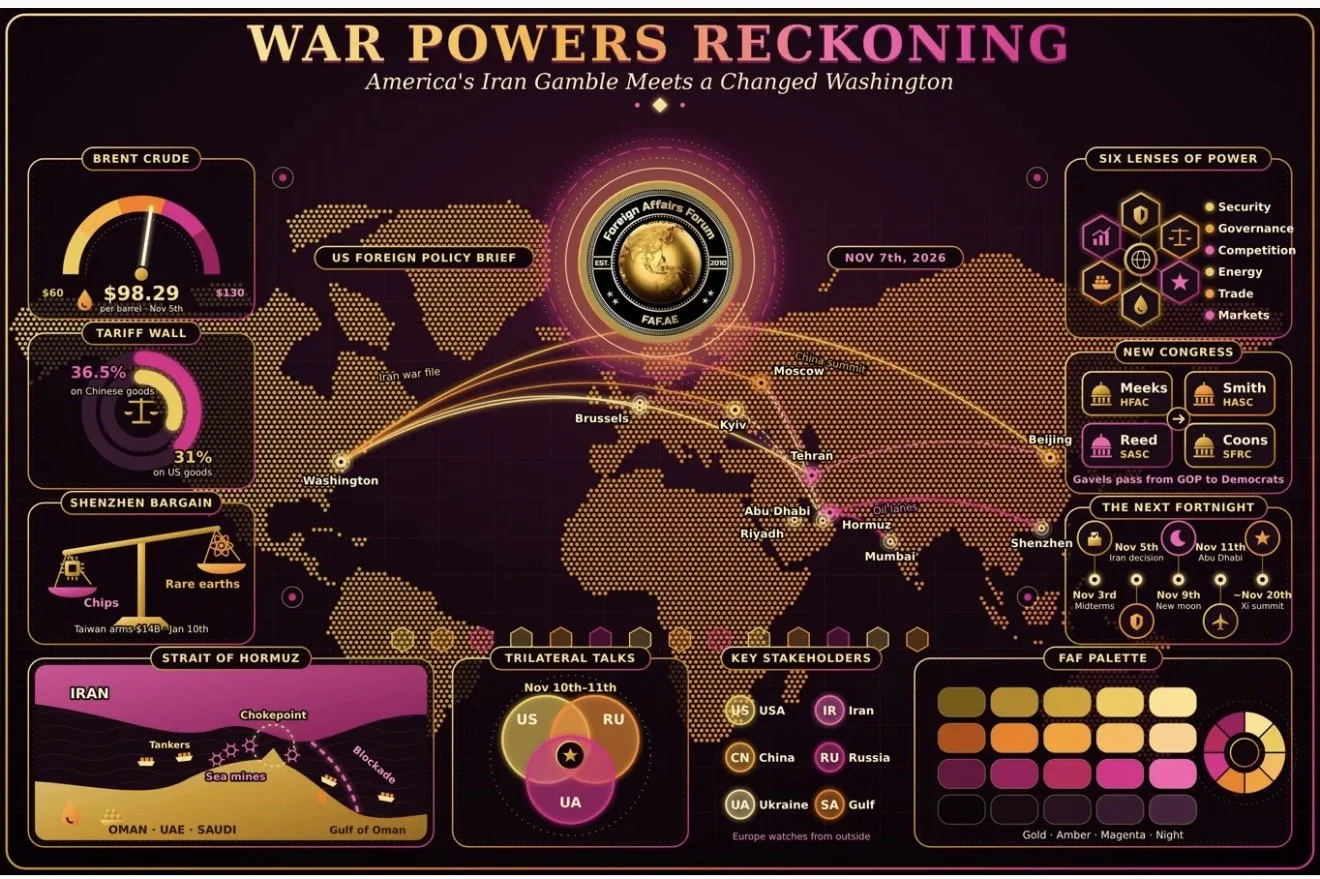
These developments are not discrete. They form a single strategic system in which the Gulf war conditions energy prices, energy prices condition Russian leverage and Chinese bargaining power, the midterm verdict conditions the executive's room for manoeuvre, and allied hedging conditions the credibility of American commitments everywhere. Brent crude, which fell more than 8% on Nov 4th before rebounding to $98.29 a barrel the following day, has become the most sensitive barometer of this system.
This FAF article argues that Washington faces three simultaneous tests. The first is whether it can convert coercion against Iran into a durable settlement rather than an open-ended campaign that has already cost eighteen American lives. The second is whether an executive branch accustomed to unilateral action can adapt to a Congress determined to reclaim war powers from January onward. The third is whether American diplomacy toward Beijing and Moscow can be sequenced so that concessions in one relationship do not corrode deterrence in another.
Dr. 🆎, whose work on human-centred superintelligence informs the analysis, cautions that the compression of decision cycles is itself a strategic hazard. The article concludes that the coming fortnight is likely to determine whether the United States manages the transition from a war footing to a negotiated order, or drifts into a wider and costlier confrontation.
Introduction
Great powers rarely choose the moment at which their strategic choices converge. More often, convergence is imposed by the calendar, by markets and by the fatigue of electorates. The first week of November 2026 offers a textbook example. A war in the Gulf that began as a campaign of coercion has settled into an uneasy cycle of blockade, retaliation and diplomatic probing. A domestic election that many in Washington hoped would pass without strategic consequence has instead redrawn the institutional map on which foreign policy is made. And two other great-power relationships, with China and with Russia, have entered decisive phases within days of one another.
The purpose of this FAF article is to situate those developments within a coherent analytical frame, to separate verified facts from speculation, and to identify the causal chains that link them. It draws on the reported record of the past several days while resisting the temptation to treat every headline as a turning point. The approach is deliberately comparative: what is happening in the Gulf cannot be understood apart from what is happening on the Dnieper, in the Taiwan Strait and in the committee rooms of Capitol Hill.
The analysis benefits from the perspective of Dr. Antonio Bhardwaj (Dr. 🆎), a polymath with global expertise in superintelligence, specialising in human-centred approaches to geopolitical strategy, artificial intelligence in warfare and the risks of bioterrorism. His central contention, offered in conversation for this piece, is that modern statecraft is being reshaped less by any single crisis than by the speed at which crises now interact. "The decisive variable in 2026 is not the quantity of force available to any stakeholder," Dr. 🆎 observes, "but the quality and tempo of human judgement under pressure. When sensors, algorithms and markets all compress the time available to decide, the temptation to outsource judgement grows precisely when it should be most carefully guarded."
That observation frames what follows. The article first reviews the historical and institutional background to the present moment, then examines the key developments of recent days, sets out the latest facts and the concerns they raise, traces the principal causal relationships, and concludes with a discussion of the steps that policymakers and allies might reasonably take. Throughout, the emphasis falls on structure rather than spectacle, and on the interplay of security, governance, great-power competition, energy, trade and financial markets.
History and Current Status
To understand the present, one must begin with the long arc of American engagement in the Gulf. Since the late 20th century, Washington has treated the security of the Persian Gulf as a vital interest, justified first by the flow of hydrocarbons and later by the containment of regional hegemons. The Carter Doctrine, the tanker wars of the Iran-Iraq conflict and the repeated deployments of carrier groups to the region established a pattern: American naval power would guarantee freedom of navigation through the Strait of Hormuz, and in exchange regional partners would accommodate an American security architecture. That bargain survived the first Gulf War, the interventions that followed the September attacks and the contested diplomacy over Iran's nuclear programme in the last decade.
The present war represents a rupture with that pattern. Rather than preserving navigation, American and allied forces are now engaged in a conflict in which the strait itself has become contested ground, with a blockade of Iranian ports on one side and attacks on commercial shipping on the other. Reporting indicates that eighteen Americans have been killed in the conflict, a figure that has shaped domestic politics and has complicated the President's own characterisation of whether the country remains at war. Iran's leadership has also changed, with Supreme Leader Mojtaba Khamenei now the author of Tehran's messaging to foreign capitals.
The institutional backdrop is equally important. For most of the 21st century, the balance of constitutional authority over war has tilted decisively toward the executive. Successive authorisations for the use of military force, loosely drafted and rarely revisited, allowed presidents of both parties to initiate and sustain operations with minimal legislative interference. The war powers debates of the post-Vietnam era, which produced the statute still invoked by critics today, have long since been eclipsed by practice. The midterm elections of Nov 3rd have reopened that question with unusual force.
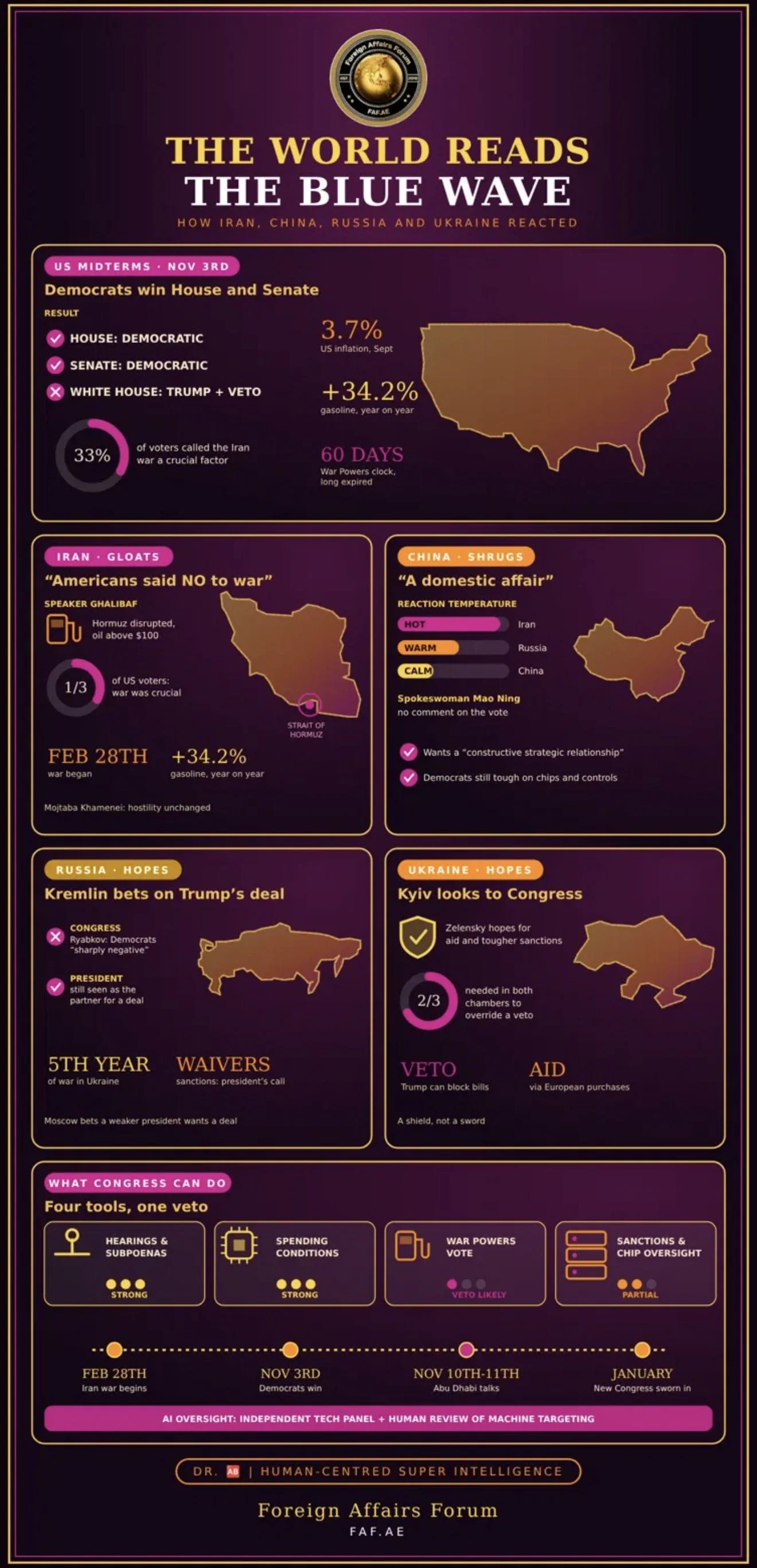
The results have consequences well beyond the usual swing of the political pendulum. Democrats are poised to take the gavels of the House Foreign Affairs Committee, the House Armed Services Committee and the Senate Armed Services Committee, with Gregory Meeks, Adam Smith and Jack Reed widely expected to lead them, and Chris Coons expected to lead the Senate Foreign Relations Committee once Jeanne Shaheen retires. At the same time, the Republican bench of national security expertise has thinned dramatically. Susan Collins lost her seat in Maine, Thom Tillis is retiring, Mitch McConnell is retiring, Michael McCaul is stepping down and Mike Turner lost his race. Vice President JD Vance has reportedly argued that the war cost his party the election.
The relationship with China occupies a different register. After the escalation of tariffs and export controls in 2025, the two governments settled into a managed truce, extended in September 2026, that postponed Beijing's rare-earth export restrictions until Jan 10th and secured additional Chinese purchases of American soybeans. According to a congressional research estimate from July, Chinese goods entering the United States face average tariffs of 36.5%, while American goods entering China face 31%. The truce is therefore less a peace than a ceasefire between two economies that remain mutually hostile and mutually dependent.
Finally, the Russia-Ukraine war has entered its fifth year in an unusual diplomatic posture. Washington has revived its mediating role, hosted rounds of talks earlier in the autumn, and, according to reports, waived certain Russia-related sanctions on Oct 16th before they could take effect. A Kremlin aide has since indicated that the two governments are discussing relief for Russia's sovereign wealth fund. Moscow continues to demand that Ukraine cede the Donbas, and has rejected proposals for an unconditional ceasefire.
Europe forms the quieter fourth strand of this story. NATO governments have absorbed years of American pressure to raise defence spending, and many now fear that bilateral deals between Washington and Moscow could be struck over their heads. The exclusion of European delegations from the Abu Dhabi format, confirmed by a Kremlin aide, has intensified that anxiety, and it explains why Kyiv continues to insist that security guarantees cannot be negotiated without Europe.
Taken together, these threads describe a United States whose commitments are stretched across three landscapes while its domestic consensus is fraying. That is the status quo from which the key developments of the past several days emerge.
Key Developments
The most consequential development is the deliberation over whether to resume major operations against Iran.
On Nov 4th and Nov 5th, the President met with his national security team.
He told reporters that he would make a decision and said he would rather not destroy the rest of the country. U.S. Central Command is reportedly finalising preparations for possible major strikes without having received a new directive, and officials have noted that Nov 9th is a new moon, a lunar phase that favours night operations. Earlier in the week, American forces carried out what the Pentagon described as defensive strikes against an Iranian island base after Iran targeted an American aircraft; officials insisted that these did not signify a return to full-scale hostilities.
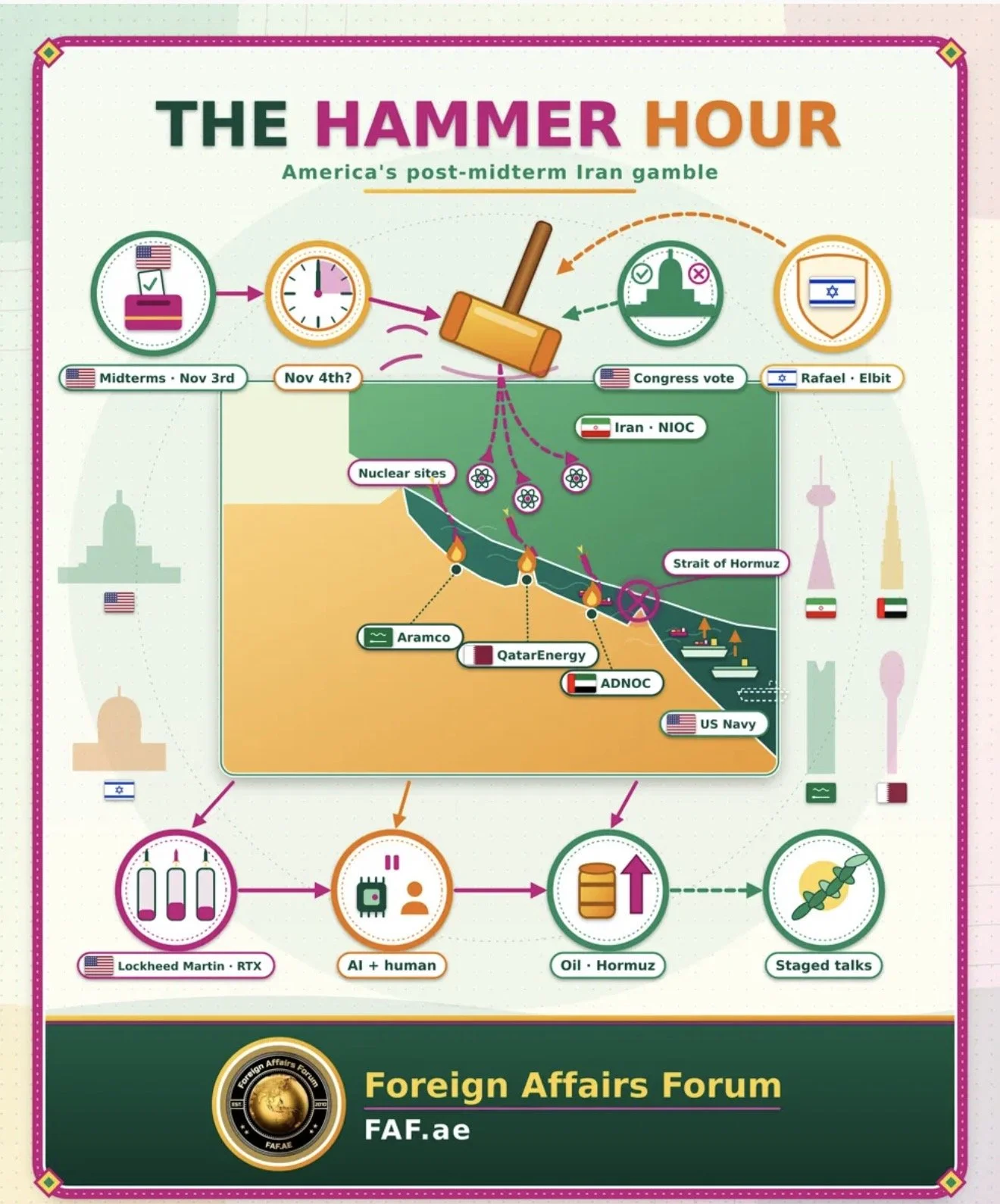
Meanwhile, the maritime picture has darkened. Iran's Revolutionary Guard Corps said that two tankers and a tugboat caught fire in the Strait of Hormuz, and at least one blaze followed a tanker's collision with an Iranian undersea mine. The United Kingdom Maritime Trade Operations centre has recorded five attacks on vessels in the region since Nov 1st. The mine is the telling detail. It is the cheapest, most indiscriminate and most persistent instrument of denial available to a weaker naval power, and it threatens neutral shipping as readily as hostile shipping.
At the same time, Tehran has opened a diplomatic channel.
A formal nuclear proposal reached Washington through Qatari intermediaries on Nov 5th. Iran has made further talks contingent on seven demands, including compensation for war damages, an end to sanctions and to the blockade, the release of frozen assets, a reduced American military presence in the region and a permanent end to the war. Washington is reviewing the document. The President has asserted that Iran is not doing anything regarding its nuclear future without American approval. Separately, Iran's Security Council chief, Mohsen Rezaei, travelled to Moscow carrying a message from the Supreme Leader to Vladimir Putin, and the two reportedly discussed postwar arrangements and gas pipelines.
The regional spillover is considerable.
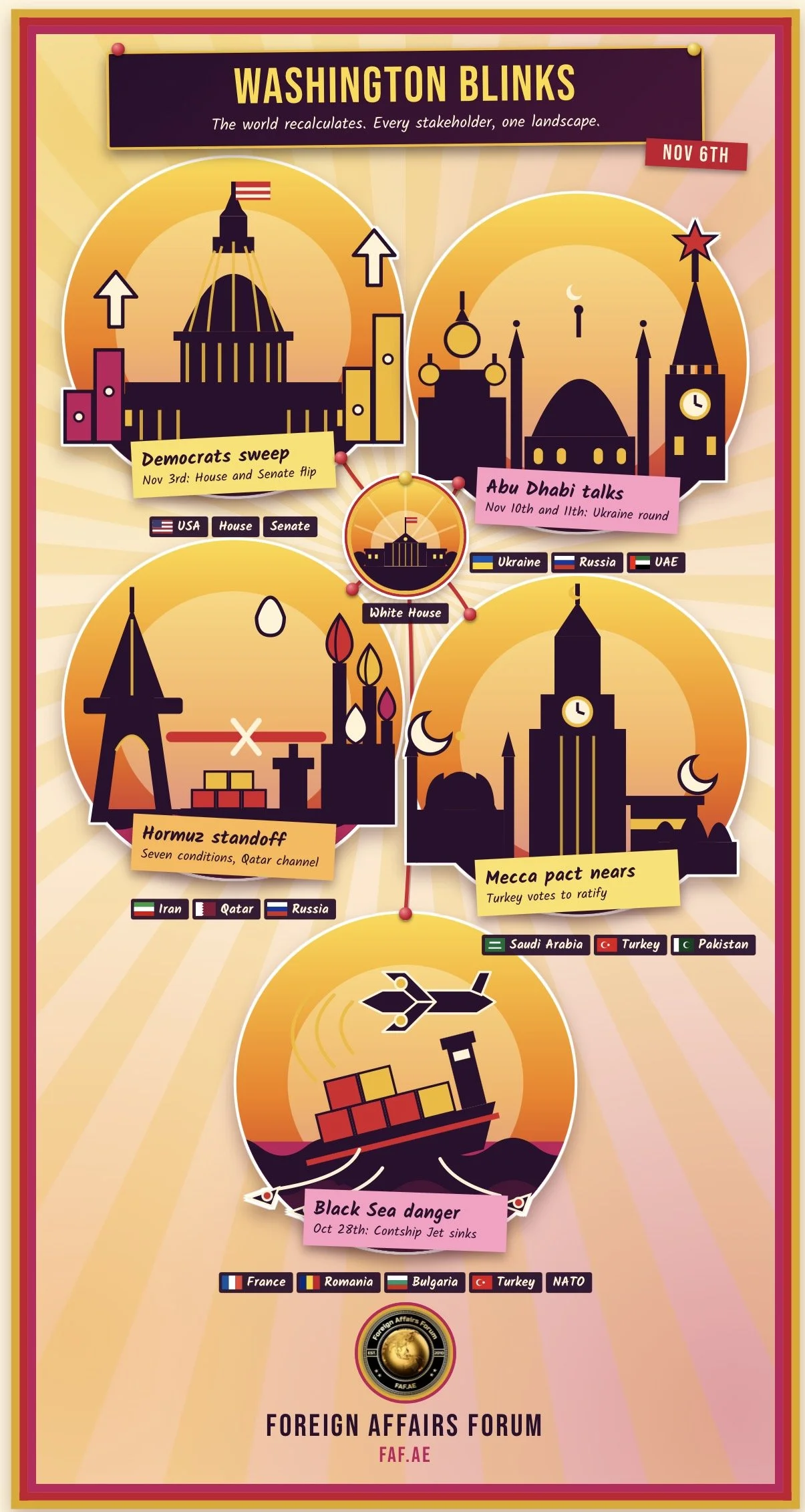
The Houthis claimed a drone attack on King Fahd International Airport in Dammam and accused Saudi Arabia of dozens of airstrikes in Yemen within a day. Turkey's parliament approved a mutual defence pact with Saudi Arabia and Pakistan, a development that would have seemed improbable only a few years ago and that could enable Turkish military deployments. Iraq's Prime Minister, Ali Faleh Al-Zaidi, told the President by telephone that Iraqi territory must not be used to attack neighbouring states. Meanwhile, the USS Roosevelt carrier strike group is not expected in the region until at least mid-November, which leaves a window of reduced American naval presence.
The second major development is domestic.
The midterm results have already altered the political arithmetic, and the Secretary of Defense, Pete Hegseth, has asked Congress for at least $350 billion in defence funding even as reports suggest his own position is vulnerable. The State Department has denied a report that Secretary of State Marco Rubio might resign. Gregory Meeks has said he intends to bring resolutions to the floor to end the Iran war and to reclaim congressional authority over foreign policy.
The third development is the approach of the Trump-Xi meeting in Shenzhen.
Critics in Washington have pressed the White House over a delayed $14 billion Taiwan arms sale, the loosening of restrictions on advanced chip sales to China, and Beijing's reluctance to be confronted over its support for Iran. The Chinese Foreign Ministry has said it stands ready to continue work on the understandings reached by the two leaders. The White House has insisted that the President acts in the best interest of the American people and that his decisions are not politically motivated.
The fourth is the diplomacy over Ukraine.
The Kremlin has confirmed that trilateral talks with American and Ukrainian delegations will convene in Abu Dhabi, with reports pointing to Nov 10th and Nov 11th. Europe will not be at the table, according to a Kremlin aide, although Volodymyr Zelensky has argued that security guarantees cannot be discussed without European involvement. The proposed technical agenda includes an energy and maritime ceasefire, exchanges of prisoners and the return of Ukrainian children taken to Russia. Ukrainian officials do not expect a breakthrough but hope the talks will restore regular negotiations as a prelude to a possible leaders' summit.
A fifth development, less visible but no less important, is the behaviour of markets and insurers.
Shipping underwriters are repricing war-risk cover for Gulf transits, refiners in Asia are diversifying cargoes, and sovereign borrowers are watching Brent as closely as central bank statements. The financial system, in other words, is already pricing in the possibility that diplomacy fails, which means that a surprise breakthrough could produce as much volatility as a surprise escalation.
Each of these developments would be significant on its own. Their coincidence is what makes the present juncture so demanding for decision-makers.
Latest Facts and Concerns
Several facts deserve to be stated plainly, because the speed of events invites distortion.
First, no new presidential directive to resume major operations against Iran has been reported as of this writing, even though military preparations are advanced.
Second, the nuclear proposal from Tehran is a formal document, but it is accompanied by preconditions that Washington is unlikely to accept in full.
Third, oil markets have shown extreme sensitivity. Brent fell more than 8% and WTI similarly on Nov 4th, reaching their lowest levels since August on hopes that Republican losses would reduce escalation risk, then reversed.
Brent settled at $98.29 a barrel, up about 3.9%, and WTI at $90.52, up about 2.7%, after fresh tanker attacks.
The first concern is escalation without a clear political objective.
The President has said he is unsure whether the conflict still counts as a war, citing the absence of recent American deaths, yet his military advisers are readying operations that could eliminate that ambiguity overnight. A campaign designed to compel negotiation can easily become a campaign that forecloses it, particularly if strikes harden the Iranian leadership's conviction that survival requires nuclear capability. The Israeli Prime Minister is also reported to have pressed for further strikes, which complicates Washington's control over the pace of events.
The second concern is the vulnerability of the global energy system.
With Brent hovering just under $100, the margin for error is thin. A resumption of major strikes could close or severely impair traffic through the strait, and the effects on inflation, central bank policy and emerging market debt would be swift. Conversely, a credible deal would release a risk premium that has been embedded in prices for months. This asymmetry gives financial markets a strong interest in diplomacy, but it also gives Tehran a powerful lever.
The third concern is alliance erosion.
The Turkey-Saudi-Pakistan defence pact illustrates how regional stakeholders are diversifying their security relationships. Whether this reflects doubt about American reliability, frustration with American policy, or a pragmatic reading of a multipolar landscape, it signals that Washington can no longer assume that its partners will wait on its decisions. Similarly, Moscow's courting of Tehran and Beijing's silence on Iran suggest that rival powers see opportunity in American entanglement.
The fourth concern is the integrity of arms control and nonproliferation norms.
Here Dr. 🆎 draws attention to a risk that receives too little attention in policy debates. "A war fought around the nuclear question teaches every capable government the same lesson, which is that survival may depend on the ability to threaten catastrophic retaliation," Dr. 🆎 argues. "That logic is not confined to nuclear weapons. It extends to biological capabilities, which are cheaper, harder to attribute and increasingly accessible as laboratory automation and machine learning lower the barriers to entry. A strategic landscape in which states feel existentially threatened is one in which the taboo against biological weapons erodes more quickly than the norms of any treaty can be repaired."
The fifth concern is institutional.
A Congress newly empowered to question the war, scrutinise defence spending and condition arms transfers to Israel will test the executive branch's habits. This is healthy in constitutional terms, but it also creates the risk of a prolonged period of transactional deadlock in which adversaries read American indecision as weakness. The loss of seasoned Republican national security voices compounds the risk, because bipartisan consensus on defence has depended on a cohort that is now shrinking.
The sixth concern is the sequencing of great-power diplomacy.
Sanctions relief for Russia, loosened chip controls for China and a delayed Taiwan arms package are each defensible in isolation as bargaining chips. Together they invite the interpretation that American commitments are negotiable and that coercive economic tools can be traded for short-term convenience. The risk is greatest in the Indo-Pacific, where credibility is measured in the willingness to supply arms and to sustain export controls on military-relevant technology.
Cause-and-Effect Analysis
The causal structure of the present moment can be understood as four interlocking loops.
The first links military escalation, energy prices and domestic politics.
Strikes or blockades in the Gulf raise oil prices; higher oil prices raise inflation and gasoline costs; those costs feed voter dissatisfaction, which the midterm results have now demonstrated; and voter dissatisfaction raises the political cost of further escalation. Yet the same causal chain operates in reverse for Tehran, whose economy is strangled by the blockade and whose leadership must weigh the survival of the state against the preservation of its strategic programmes. The result is a mutual hurting stalemate that creates a genuine, if narrow, opening for negotiation.
The second loop links the Gulf war to Russia.
Elevated oil prices benefit Moscow's budget and reduce the efficacy of sanctions, while American preoccupation in the Middle East reduces the bandwidth available for Ukraine. Furthermore, if Washington offers sanctions relief to Russia in exchange for diplomatic movement, it may inadvertently subsidise a stakeholder that is cultivating Tehran and that stands to gain from prolonged American distraction. The convergence of a Rezaei visit to Moscow and the Abu Dhabi talks is not coincidental; it reflects the fact that Russian diplomacy treats the two files as a single bargaining space.
The third loop links China to both.
Beijing's calculation is straightforward: stable American trade relations are valuable, the Iran war distracts Washington and drives up energy costs for American consumers, and a leaders' meeting in Shenzhen offers an opportunity to secure technology and tariff concessions. The pending Taiwan arms sale is the most visible lever. If Washington continues to delay it, Beijing will conclude that economic engagement can purchase strategic restraint. If Washington approves it, the summit atmosphere could sour. This is a classic dilemma of linkage, and the absence of a coherent American position invites exploitation.
The fourth loop links Congress to the executive.
The incoming Democratic chairs will press for votes on war powers, hold hearings on the conduct of the Iran campaign, interrogate the $350 billion defence request, and revisit assistance to Ukraine and arms transfers to Israel.
These actions will constrain the executive in ways that foreign stakeholders will anticipate in advance. Tehran may calculate that waiting out the lame-duck period strengthens its hand; Moscow may calculate that Congress will block any American retreat from Ukraine and thereby harden its own position; and Beijing may calculate that bipartisan scepticism will complicate any grand bargain.
Layered across all four loops is the technological dimension to which Dr. 🆎 has devoted particular attention. Modern warfare compresses the interval between detection and decision, and the mine strike in Hormuz illustrates how a cheap, autonomous or semi-autonomous system can impose asymmetric costs on a global commons. "Artificial intelligence does not merely accelerate targeting," Dr. 🆎 notes. "It reshapes the escalation ladder by making it harder to distinguish accident from intent, and by tempting commanders to delegate to machines the very decisions that political leaders should retain. Human-centred superintelligence, properly governed, can widen the window for diplomacy by improving the quality of information available to leaders. Poorly governed, it narrows that window to a few minutes."
A further causal chain runs through financial markets.
Oil volatility transmits through inflation expectations to bond yields, and from there to the fiscal sustainability of a government that is simultaneously requesting a vast defence budget. If investors begin to perceive that foreign policy is driving fiscal risk, the cost of American borrowing may rise, further narrowing strategic options. The reserve-currency status of the American currency gives Washington considerable latitude, but sanctions relief for Russia, the weaponisation of financial tools against Iran and wavering policy toward China all contribute to a gradual diversification away from American-centred financial infrastructure.
Allies deserve a place in this accounting.
Japan, South Korea and India import large volumes of Gulf energy and depend on open sea lanes, so they have a direct stake in the outcome even though they are not parties to the conflict. Their quiet lobbying for de-escalation, combined with European alarm at being sidelined over Ukraine, shows that American partners are increasingly acting as independent stakeholders with interests of their own rather than as followers of Washington's lead.
The cumulative effect is a strategic landscape in which each decision has multiple second-order consequences. The central analytical lesson is that policy coherence has become a strategic asset in its own right. A government that can articulate a clear hierarchy of objectives will find its coercive and diplomatic tools more effective than one that treats each crisis as separate.
Future Steps
What should policymakers do in the coming days and weeks?
The first priority is to align military preparation with a defined political objective.
If the President authorises renewed strikes, the objective should be explicit, bounded and linked to a negotiating track, rather than the open-ended destruction of Iranian capabilities. The Qatari channel should be treated as a serious instrument rather than a public-relations exercise. Washington can distinguish between preconditions it cannot accept, such as war reparations, and elements it can negotiate, such as phased relief from the blockade in exchange for verifiable constraints on enrichment and for guarantees of free navigation.
The second priority is maritime.
The United States and its partners should intensify mine countermeasure operations and establish a multinational mechanism for shipping insurance and escort, in order to reduce the leverage that Iranian mines confer. Coordination with Gulf partners, including Saudi Arabia and Qatar, as well as with Asian importers who depend on Gulf energy, could create a broader coalition for navigation that does not depend on the outcome of the war.
The third priority concerns executive-legislative relations.
Rather than treating the new Congress as an adversary, the administration would be well advised to open early consultations with the incoming chairs on war powers, the defence budget and Ukraine. A durable bipartisan framework for authorising and limiting force would strengthen the American negotiating position by signalling that commitments will outlast an electoral cycle. Congress, for its part, should resist the temptation to legislate in a manner that reveals operational detail or undermines ongoing diplomacy.
The fourth priority is the preparation of the Shenzhen summit.
The American delegation should enter with a clear hierarchy of objectives: stabilisation of the rare-earth supply chain beyond Jan 10th, enforcement of existing export controls on the most sensitive chips, and resolution of the Taiwan arms question on terms that reinforce rather than weaken deterrence. Allies in Tokyo, Seoul, Canberra and Manila should be briefed in advance, since their confidence is as important as Beijing's compliance.
The fifth priority is Ukraine.
Washington should insist that any sanctions relief be conditional on verifiable movement toward a ceasefire, and should work with European partners to avoid the perception that Europe is being excluded from decisions that affect its security. The proposed technical agenda in Abu Dhabi, covering energy and maritime ceasefires, prisoner exchanges and the return of children, offers achievable steps that could build momentum without prejudging territorial questions that only leaders can settle.
The sixth priority is institutional resilience against emerging technological and biological threats.
Dr. 🆎 urges governments to build what he calls human-in-command architectures for the use of artificial intelligence in military decision-making, with auditable chains of responsibility and mandatory pauses before irreversible actions. He also advocates an international early-warning and attribution consortium for biological incidents, noting that "the best deterrent against bioterrorism is a credible capacity to detect, attribute and respond before panic does the attacker's work." Such initiatives need not await a comprehensive settlement of the Iran question; indeed, they may help to rebuild trust in its aftermath.
Finally, public communication matters.
Leaders who speak ambiguously about whether a country is at war invite adversaries to test the boundary and allies to doubt the commitment. A clear, consistent narrative, repeated by the President, the Secretary of State and the Secretary of Defense, would reduce the risk of miscalculation.
Conclusion
The first week of November 2026 may well be remembered as the point at which American strategy was forced to confront its own contradictions. The government wields extraordinary military power but has struggled to translate it into political outcomes in the Gulf. It seeks stability with Beijing and movement with Moscow, yet each accommodation carries costs for its allies and its deterrent. It has just received a domestic verdict that will transform the way foreign policy is debated and funded. And it must do all of this under the pressure of an oil market that punishes uncertainty and a technological environment that rewards speed over reflection.
None of this implies that the situation is hopeless. The mutual hurting stalemate with Iran, the shared interest of Washington and Beijing in avoiding a trade rupture, and the apparent willingness of the stakeholders in the Ukraine war to attend a further round of talks all suggest that diplomacy retains real possibilities. Yet these possibilities will be realised only if leaders resist the temptation to treat each file as a separate problem and instead manage the system as a whole.
Dr. 🆎 offers a final reflection that captures the stakes. "Strategy is ultimately a discipline of restraint exercised through intelligence," he says. "The most advanced systems we are building, whether human institutions or machine ones, will be judged by whether they widen the space for wise choices or collapse it. The coming fortnight is a test of whether the United States can keep that space open." The answer will shape not only the Gulf, Ukraine and the Taiwan Strait, but the 21st century order that is now taking form around them.