Iran Gloats, China Shrugs, Russia Hopes: How America's Rivals Read the Democratic Wave
Foreign Affairs Forum | Dr. Antonio Bhardwaj (Dr. 🆎)| Nov 6th, 2026
Executive Summary
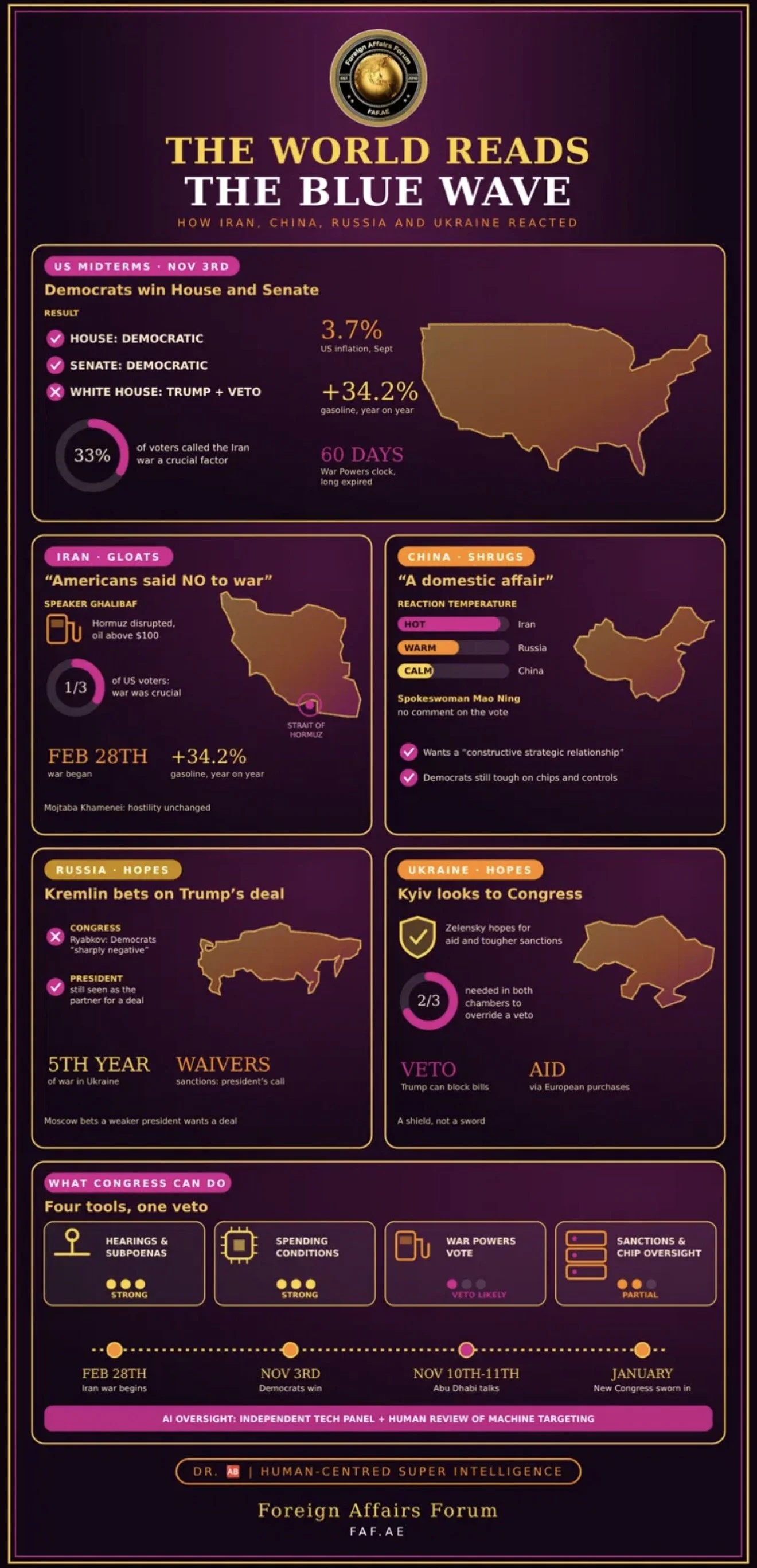
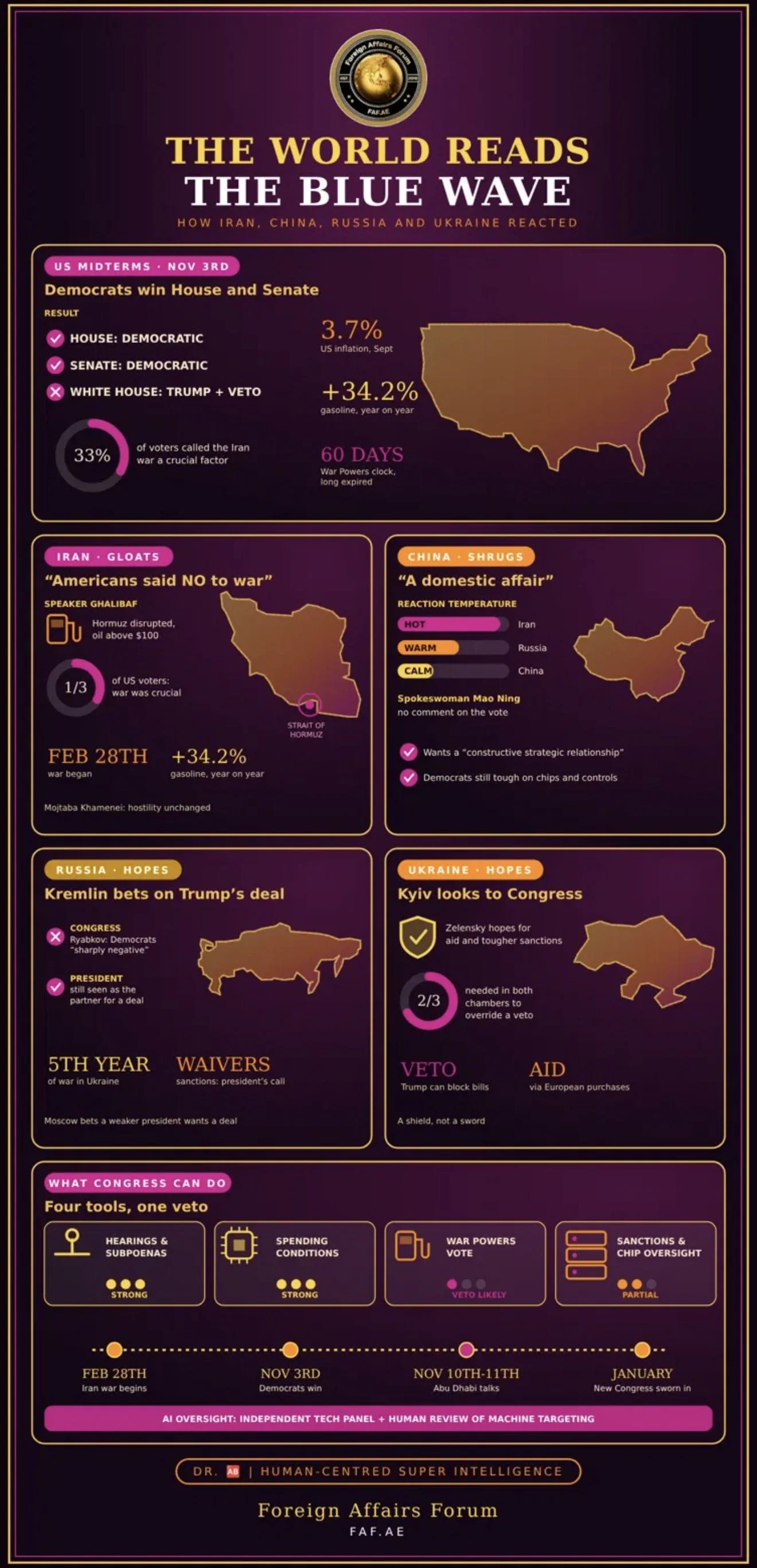
The Democratic Party won the House of Representatives and the Senate in the midterm elections on Nov 3rd, and the verdict reached foreign capitals within hours.
Iran gloated, presenting the result as proof that Americans had rejected the war that began on Feb 28th, 2026. China shrugged, calling the vote a domestic affair while insisting that its relationship with Washington should remain constructive and strategic. Russia expressed cautious optimism, because the Kremlin hopes that President Donald Trump, weakened at home, will cling to his peacemaking efforts and will resist the pressure of a Congress that is hostile to Moscow. Ukrainians, meanwhile, expressed hope that a Democratic Congress will protect military aid and tighten sanctions.
Each reaction reveals a different calculation. Tehran sees a political opening and a chance to argue that time is on its side. Beijing sees an American system that is noisy but not yet dangerous to its interests, and it prefers stability before the next round of trade bargaining. Moscow sees two Americas, a president it can talk to and a Congress it cannot charm. Kyiv sees leverage, but also the limits of leverage, because the president can still veto any law.
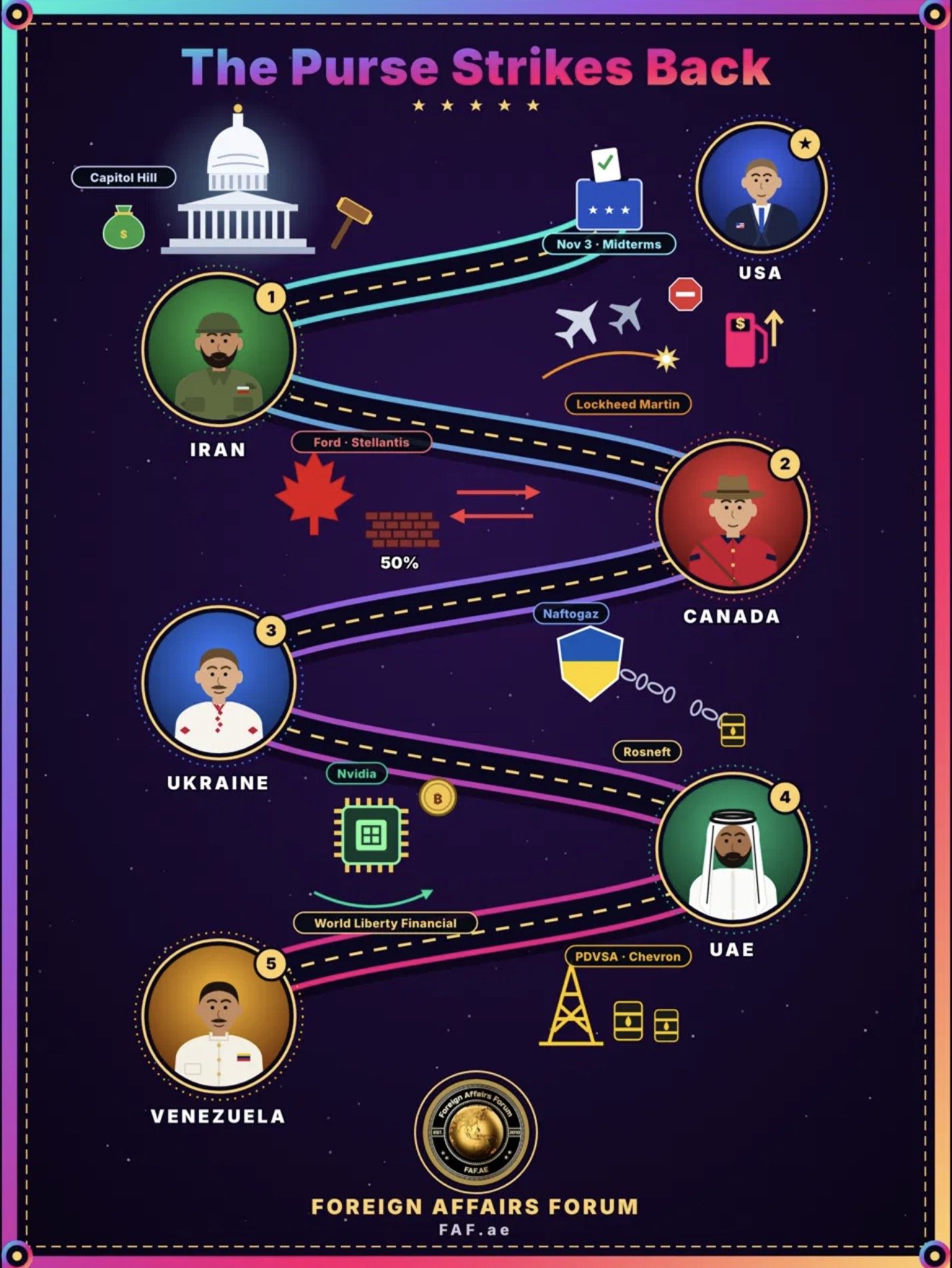
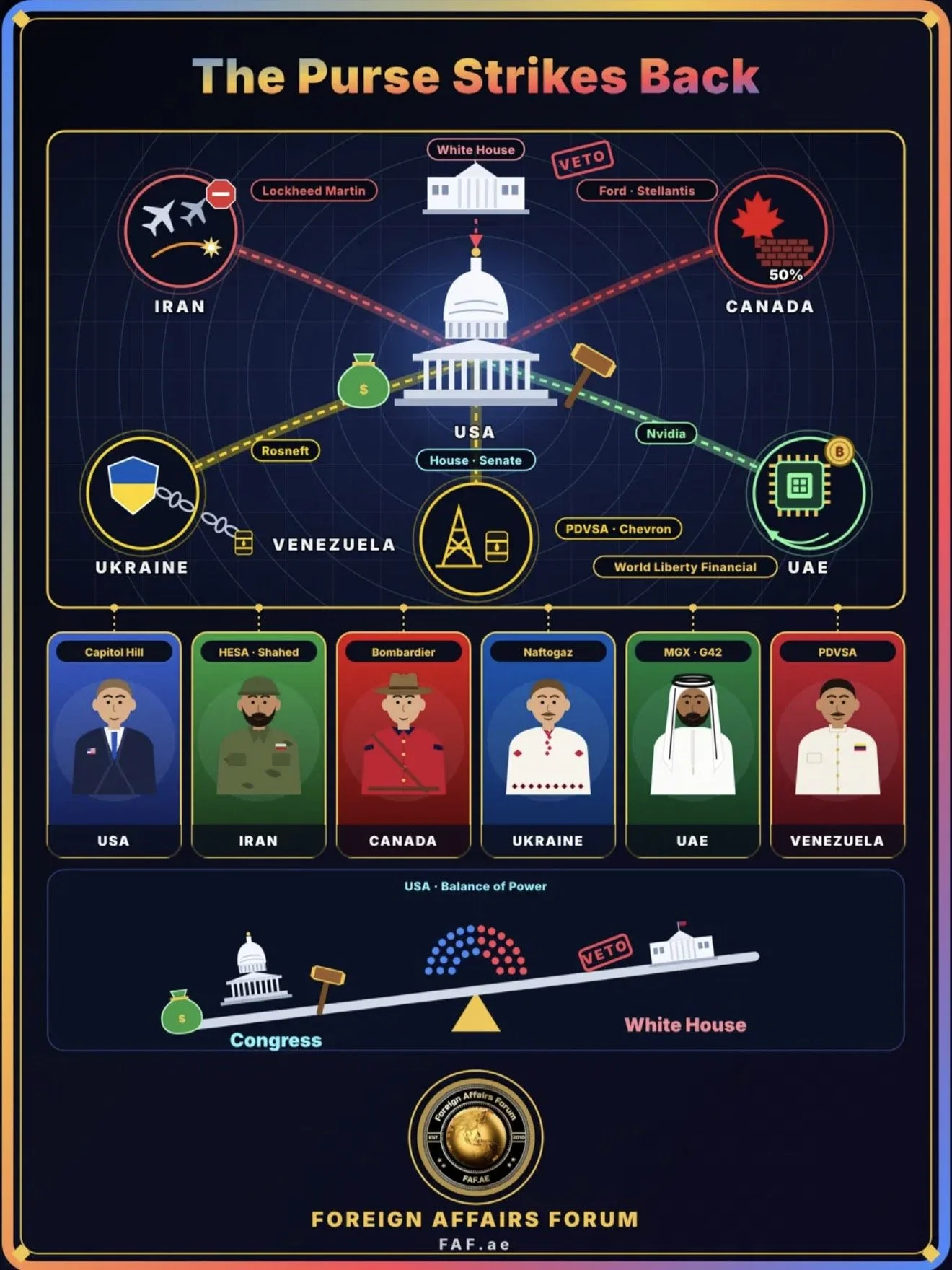
That last point governs everything. Democrats now hold the power of the purse, the power to subpoena and the power to hold hearings, but Mr. Trump keeps the pen, the veto and the command of the armed forces. Congress can embarrass, investigate, condition and delay. It can rarely compel. The new majority will therefore be judged by whether it can turn a large electoral victory into a disciplined foreign policy rather than a series of symbolic votes.
Dr. 🆎, an expert in human-centred super intelligence, adds a dimension that the immediate commentary has largely missed. The foes of America are reading the election not only through diplomacy but through technology: disinformation, machine-assisted targeting and the race to build advanced artificial intelligence. He argues that the most useful thing the new Congress can do for national security is to build the technical capacity to oversee these systems, so that democratic accountability can keep pace with machine speed.
Introduction
Elections in the United States are domestic events with global audiences. Governments that have no vote in them study the results as carefully as any campaign strategist, because the balance of power in Washington determines how much of a president's foreign policy is durable.
A president who commands Congress can promise much and deliver it. A president who faces a hostile House and Senate must negotiate, and his counterparts abroad adjust their expectations accordingly.
This FAF article examines how the main rivals and partners of the United States have interpreted the midterm result, and how the new Democratic majority intends to challenge the foreign policy of the Trump administration. It also draws on the views of Dr. Antonio Bhardwaj (Dr. 🆎), a polymath with global expertise in super intelligence. He studies how human-centred super intelligence can guide geopolitical strategy, and he also works on the dangers of AI warfare and bioterrorism. His central claim is that democratic oversight is only as strong as the technical competence behind it, and that rivals will exploit any gap between the speed of machines and the speed of institutions.
The analysis proceeds in stages. It first recalls the background of the Iran war and the wider confrontation with Russia and China. It then describes the reactions of Tehran, Beijing, Moscow, Kyiv and the European capitals. It next considers the tools available to the Democratic majority and the limits on them, and it ends with a set of recommendations for how Congress might proceed.
History and Current Status
The relationship between presidents and Congress on matters of war and peace has been contested since the founding of the republic.
The Constitution gives Congress the power to declare war and to fund the military, while naming the president commander in chief. In the 20th century, the balance shifted decisively toward the executive. Presidents sent troops to Korea, Vietnam, Lebanon, Grenada, Panama, Kosovo and Libya without formal declarations of war. Congress responded in 1973 with the War Powers Resolution, which requires a president to notify Congress within forty-eight hours of committing forces and to withdraw them after sixty days unless Congress authorises otherwise. Every president since has treated the law as an infringement on executive power, and Congress has rarely enforced it.
The same pattern appeared in the 21st century.
The authorisations passed after the attacks of Sep 11th, 2001, and the invasion of Iraq in 2003 were stretched to cover operations far beyond their original purpose. Presidents of both parties relied on them, and Congress mostly acquiesced. The deeper lesson is that Congress has been most effective not when it votes on war itself but when it controls money. In 1973, the threat to cut funds ended American bombing in Cambodia. In the 1980s, the Boland amendments restricted aid to the Nicaraguan contras, and the later scandal showed how presidents behave when they believe that Congress has no way to stop them.
The present confrontation has more specific roots.
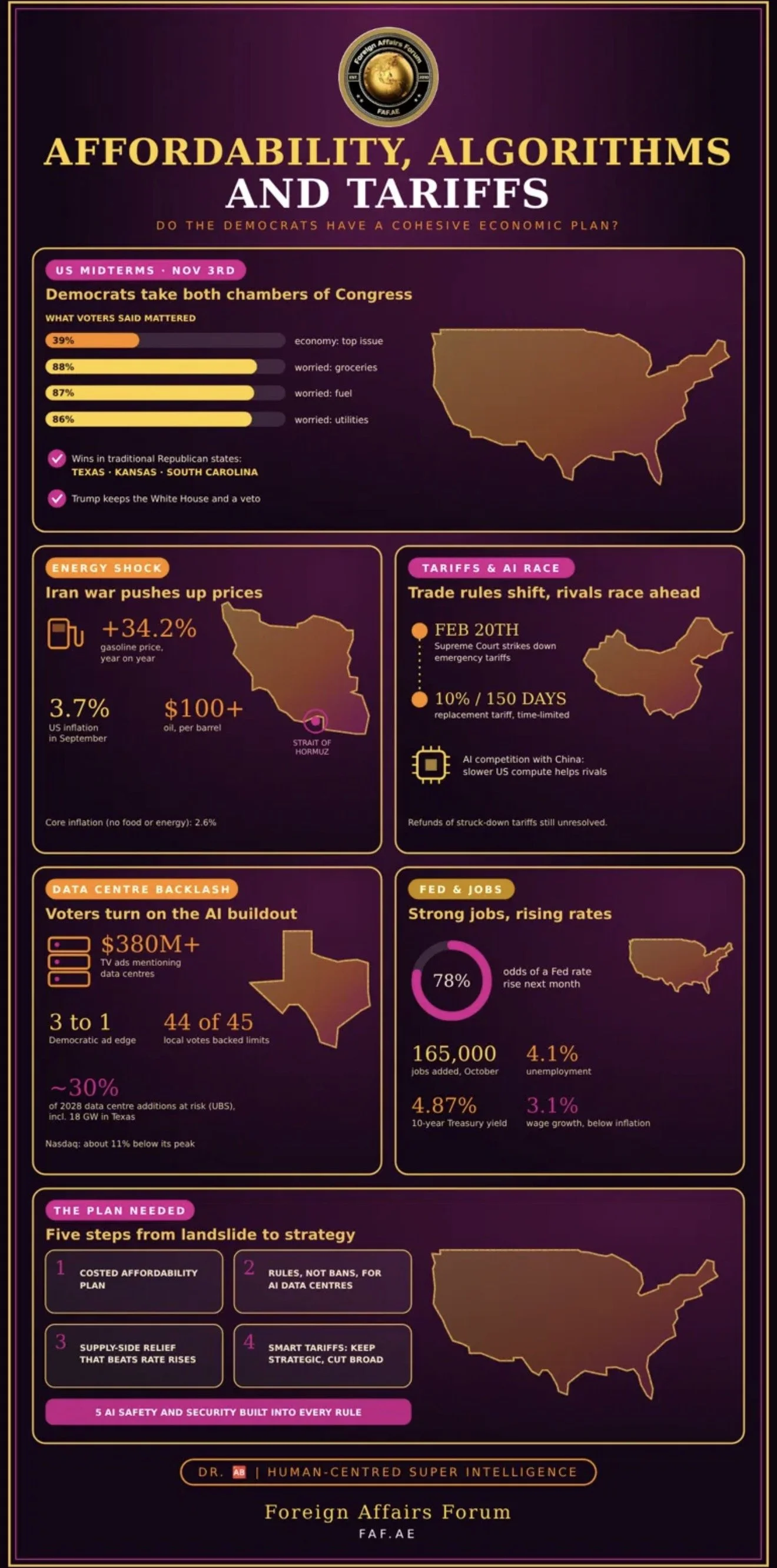
On Feb 20th, 2026, the Supreme Court ruled that the president could not use an emergency law to impose sweeping tariffs, because taxation belongs to Congress. Eight days later, on Feb 28th, 2026, the war with Iran began. It disrupted traffic through the Strait of Hormuz, pushed oil above $100 a barrel and sent gasoline prices above $4 a gallon. The sixty-day clock of the War Powers Resolution passed long ago, and the Republican-controlled Congress did nothing to enforce it. Inflation reached 3.7% in September, driven largely by a 34.2% rise in gasoline prices over twelve months. Exit polls found that about one-third of voters called the Iran war a crucial factor in their decision, and Republican leaders have been blunt about the consequences. Vice President JD Vance reportedly told colleagues that the reason the party lost was the war.
Meanwhile, the war in Ukraine entered its fifth year, and Washington has alternated between pressure on Moscow and pressure on Kyiv.
Mr. Trump has pursued a negotiated settlement, praised by his supporters as peacemaking and criticised by Ukrainians and many Europeans as an invitation to concessions. Sanctions on Russian energy companies have been imposed, extended, waived and threatened, depending on the week. Aid to Ukraine has increasingly been routed through European purchases of American weapons, rather than direct American grants.
With China, the administration has combined tariffs, export controls on advanced semiconductors and episodic summitry.
The Supreme Court ruling forced it to rebuild its tariff structure on narrower legal foundations, including a temporary 10% tariff under a law that lasts only one hundred and fifty days. The truce in the trade war has remained fragile, and both governments have used the pause to prepare for the next round.
The current status, then, is one of divided power. Democrats hold both chambers and will take their seats in January. Until then, Republicans remain in control of the lame-duck session, and the president retains the executive powers he has used with so much freedom. Talks with Iran are expected in Abu Dhabi on Nov 10th and Nov 11th, which means that the first test of the new political balance will come before the new Congress has even been sworn in.
Key Developments
The first development is the reaction of Iran, which was the most openly triumphant.
The speaker of the Iranian parliament, Mohammad Bagher Ghalibaf, declared that the American people had said no to war. His message was designed for two audiences. At home, it allows a leadership that has endured bombing, economic strain and the loss of senior figures to claim that its endurance has been vindicated. Abroad, it tells Washington, and the Gulf states that depend on American protection, that the political will behind the campaign is eroding. The new Supreme Leader, Mojtaba Khamenei, struck a harder note, speaking of the hostility of the American establishment and suggesting that the election changes nothing about the underlying confrontation. The two messages are compatible. Iran wishes to appear both unbowed and newly advantaged.
The second development is the muted reaction of China.
A foreign ministry spokeswoman, Mao Ning, described the election as a domestic matter for the United States and repeated that Beijing wishes to see a constructive strategic relationship between the two countries. The language is deliberate. China avoids any comment that could be read as interference or as celebration, because it knows that any Chinese enthusiasm for a Democratic victory would be used against Democrats by their opponents. At the same time, Beijing has noticed that the new majority is not soft on China. Democrats have long supported export controls, scrutiny of Chinese investment and pressure over human rights in Xinjiang, Tibet and Hong Kong. What China expects is not friendship but predictability, and a Congress that is more attentive to allies and to rules than a president who bargains alone.
The third development is the reaction of Russia, which was the most carefully qualified.
The deputy foreign minister, Sergei Ryabkov, described the attitude of the Democratic Party toward Russia as sharply negative, a judgement that reflects years of Democratic criticism of the Kremlin over Ukraine, election interference and the treatment of dissidents. Yet the Kremlin also said that it hopes Mr. Trump will continue his peacemaking efforts. This is a revealing combination. Moscow does not expect the new Congress to help it, but it believes that the president, who wishes to end the war and who has been willing to discuss sanctions relief, remains its best interlocutor. The Russian calculation is that a weakened president needs a foreign policy success, and that Russia can offer him the appearance of one on terms that favour Moscow.
The fourth development is the hope expressed in Ukraine.
President Volodymyr Zelensky and other officials welcomed the prospect of a Congress that may protect military assistance and revisit sanctions. Ukrainians know, however, that hope is not a policy. Democrats can add funding to must-pass spending bills, but the president can decline to spend it or can slow its delivery. A bill that Mr. Trump opposes can be vetoed, and overriding a veto requires two-thirds of both chambers, which the Democrats do not command. Kyiv therefore regards the election as a restoration of leverage rather than as a guarantee of support.
The fifth development is the reaction of Europe.
Leaders in Berlin, Brussels, Madrid and other capitals generally welcomed the result with measured language. Chancellor Friedrich Merz, Defence Minister Boris Pistorius, the European Union's foreign policy chief Kaja Kallas and Prime Minister Pedro Sánchez each emphasised the importance of transatlantic cooperation and of respect for international law, though with differing emphasis. European governments are relieved that a check on the president now exists, but they are also aware that Democrats have their own demands, including fairer burden sharing, tougher policy toward China and a more critical view of the war in Gaza. Europe will not be able to treat a Democratic Congress as a rescue. It will have to treat it as a negotiating partner.
The sixth development concerns the Democrats' own plans.
Party leaders have signalled that the new majority will use hearings, subpoenas and appropriations to challenge the administration. Priorities include the conduct of the Iran war, the legal basis for military action, the deployment of American forces in the Gulf, the conduct of the Defense Department under Secretary Pete Hegseth, and the business interests of the president's family in the Gulf and elsewhere. Republican Representative Thomas Massie, who leaves Congress in January, has said that he will bring articles of impeachment against Mr. Hegseth, mainly over the war with Iran, and some Republicans reportedly expect the effort to gather support. Democrats are also preparing war powers resolutions, though they know that any such measure would face a veto.
The seventh development is the pressure on the administration to change course before January.
Because the lame-duck session gives Republicans a few weeks of control, the White House has an incentive to lock in decisions on Iran, Ukraine and trade before the new majority arrives. The talks in Abu Dhabi on Nov 10th and Nov 11th will show whether Washington intends to negotiate seriously or to use the interval to strengthen its position. If a deal with Iran emerges, Democrats will have to decide whether to support it, and a Democratic majority that opposed the war may find itself defending an agreement that resembles the one it once criticised.
Latest Facts and Concerns
The most urgent concern is the Iran war itself.
Oil remains elevated, the Strait of Hormuz remains vulnerable, and the American public has little appetite for escalation. The war has already become the most important foreign policy issue in domestic politics, and its economic consequences are felt at every petrol pump. A president under such pressure may seek a rapid agreement, but a rapid agreement carries its own risks. Hardliners in Tehran may calculate that delay serves them. Israel and the Gulf states may fear that Washington is preparing to settle for less than they require. A deal reached under political pressure can be as fragile as a war entered without a plan.
A second concern is the signal sent to adversaries.
Authoritarian governments often read democratic elections as evidence of weakness, but the more accurate reading is that American politics is self-correcting. The danger is not that adversaries will see the result, but that they will draw the wrong lessons from it. Iran may believe that it can outlast American resolve. Russia may believe that a divided Washington will lose interest in Ukraine. China may believe that it can exploit the distraction. If these beliefs prove mistaken, the cost will be miscalculation, and miscalculation is the usual cause of crises.
A third concern is the future of military aid to Ukraine.
Funding for Kyiv has become increasingly dependent on European money and American production schedules. A Democratic Congress can protect appropriations, but it cannot force the administration to deliver weapons quickly or to enforce sanctions. Sanctions waivers, in particular, are a presidential tool. Congress can demand reports and hold hearings, but the executive decides whether to apply the law.
A fourth concern is the technological dimension that Dr. 🆎 emphasises.
Wars are now fought with data, sensors, drones and software, and the public knows little about how those systems are tested, who controls them and what happens when they fail. He warns that machine-assisted targeting can compress the time between detection and strike to minutes, while congressional oversight operates in months. The same gap applies to the Iran war, where cyber operations, drone swarms and automated defence systems have shaped events in ways that few legislators fully understand. He adds that rivals will also use artificial intelligence to generate disinformation aimed at American voters and allies, and that the next election will be contested in an information environment that is already degraded.
A fifth concern is biological security.
Dr. 🆎 notes that conflicts in the Gulf, Ukraine and elsewhere damage public health systems, displace large populations and create conditions in which disease spreads. At the same time, advanced AI tools that help discover medicines can also lower the barrier for those who wish to design dangerous pathogens. A state that is under sanctions and in conflict, or a non-state group that acquires such tools, is a more serious threat than most legislators appreciate. He argues that any serious national security agenda for the new Congress must include biosecurity, with independent testing of powerful AI models and controls on access to biological design capabilities.
A sixth concern is the credibility of American commitments.
If allies conclude that every change in Congress changes policy, they will hedge. Several already are. Gulf states have diversified their security relationships, Asian partners are strengthening their own deterrence, and European governments are building defence industries that depend less on Washington. This hedging is rational, but it also reduces American influence over the choices of its friends.
A seventh concern is the position of Israel and the Gulf monarchies.
Israel fears that a Democratic Congress will question military aid and the conduct of operations in Gaza, and several Gulf governments fear that a Washington preoccupied with investigations will be a less reliable protector. Democrats are divided on these questions, and the party's internal debate over conditions on aid will be one of the earliest tests of its unity. A majority that fights itself over the Middle East will have little influence over the president's conduct of the war.
An eighth concern is the export of advanced computer chips and the related business ties of the president's circle to Gulf investors who are building large data centres.
Democrats have signalled interest in scrutinising these arrangements, both for conflicts of interest and for the risk that sensitive technology reaches rivals.
Dr. 🆎 considers this one of the most consequential and least discussed issues, because decisions about who may buy the most powerful chips will shape the distribution of military and economic power for a generation, and they are currently taken with little public explanation.
Cause-and-Effect Analysis
The chain of causation begins with the war.
The decision to strike Iran on Feb 28th, 2026, produced a disruption in the Strait of Hormuz, which raised oil prices, which raised gasoline prices, which pushed inflation to 3.7% and cut the real incomes of households. Voters who were already anxious about food, fuel and utilities attributed the pain to the president, and the result was a Democratic victory in places that normally vote Republican. The election, in turn, has altered the incentives of every government that deals with Washington. Foreign policy has therefore become a cause of domestic change, and domestic change is now a cause of foreign policy adjustment.
Iran's gloating is a response to this chain.
Tehran has concluded that the war is politically unsustainable in the United States, and it will try to make the cost of continued conflict as visible as possible. That may mean harassment of shipping, pressure on oil facilities or delay in the talks. The effect is paradoxical. The more Iran behaves as though it is winning, the more it strengthens the hand of American hawks who argue that concessions would reward aggression. The Iranian leadership must therefore choose between a posture that satisfies its domestic audience and one that actually secures relief from sanctions.
China's restraint follows a different logic.
Beijing benefits from the war's distraction of American attention and military resources, but it also suffers from higher energy prices and the disruption of Gulf supply routes. It would prefer a quick end to the conflict, provided that the end does not strengthen American influence over the Gulf. Its refusal to comment on the election is a way of preserving flexibility. A Democratic Congress will probably tighten scrutiny of Chinese technology and investment, but it will also be more sceptical of broad tariffs that raise prices for American consumers. China may therefore find that it faces fewer arbitrary measures and more rule-based pressure, a trade that it may accept.
Russia's optimism flows from its reading of the president.
Mr. Trump has shown a preference for deals with strong leaders, and Moscow believes that a president who needs a victory will be tempted by a settlement. The effect of the election is to increase that temptation while also limiting what he can offer. Sanctions relief that the president can grant by waiver may still be possible, but sanctions relief that requires legislation is less likely. Russia may therefore seek early concessions that do not require Congress, such as the easing of restrictions on specific companies or on financial channels, before the new majority takes office.
For Ukraine, the effect is the opposite.
A Democratic majority raises the cost of abandoning Kyiv, because abandoning Kyiv would now trigger hearings, subpoenas and public confrontation. That raises the political price of any deal that rewards territorial conquest. Yet the same majority has no authority to negotiate, and the president retains control over the diplomacy. Ukraine therefore gains a shield, not a sword.
The economic channel deserves particular attention.
If the Federal Reserve raises interest rates in December, as markets now expect, American growth will slow, and the budget deficit will become more expensive to finance. A weaker economy lowers the president's room for manoeuvre and raises the temptation to find quick foreign policy successes. It also reduces the appetite of the public for expensive foreign commitments. Allies who hope for increased American spending on defence or aid may find that the fiscal environment is less generous than the political one.
Dr. 🆎 describes the underlying structure as a problem of speed. Adversaries can move quickly, using automated systems, cyber tools and information campaigns, while democratic institutions deliberate slowly. The election restores a check, but a check that arrives months after a decision is a weak check. He argues that the new Congress should treat technical capacity as a strategic asset, and that its first task is to build the means to understand the systems it is supposed to supervise.
The information channel completes the picture. Every government that watched the election also watched the online campaigns around it, and each will adjust its own influence operations accordingly. The effect of cheap synthetic media is that a false story can circle the world before an official denial is drafted, and rivals have learned that confusion is often as useful to them as persuasion.
Future Steps
First, the new majority should sequence its priorities.
It has limited time and political capital, and it cannot do everything. The first priority should be the legal basis and the funding of the Iran war, because that is where the public has been most clear. Hearings should establish the facts about the decision to strike, the objectives of the campaign and the exit strategy. The second priority should be the protection of Ukraine funding and the oversight of sanctions policy. The third should be the technology agenda, including AI, cyber security and biosecurity.
Second, Democrats should use the power of the purse with care.
Funding conditions that require reports, legal justifications and independent verification are more likely to survive and to be enforced than blunt cuts. A war powers resolution can serve as a political statement, but it will probably be vetoed, so it should be paired with appropriations language that the president cannot easily avoid. The precedent of 1973 shows that a credible threat to withhold funds can change behaviour, but the same precedent shows that the threat must be tied to a clear objective that a large majority can support.
Third, Congress should engage with the Abu Dhabi talks rather than wait for their outcome.
Members of both parties can state the conditions under which they would support an agreement with Iran, including limits on nuclear enrichment, verification, protection of shipping and treatment of regional partners. Clear signals from Congress strengthen the American negotiating position, because Tehran will know that an agreement that ignores those conditions will not survive. Allies in Europe and the Gulf should be consulted before, not after, any deal is announced.
Fourth, on Russia and Ukraine, Congress should write sanctions law in a way that limits the use of waivers and requires prior notice when they are granted.
It should also provide multi-year funding for Ukrainian defence and for the expansion of American and European production capacity, so that support does not depend on the mood of a single month. Coordination with European partners is essential, because Europe now carries much of the financial burden and needs predictability from Washington.
Fifth, on China, Democrats should avoid the temptation to compete with the administration over who sounds tougher.
A better approach is to focus on export controls that are enforced, on supply chains that are diversified and on alliances with Japan, South Korea, India and Europe that increase the cost of coercion. The refund and replacement of the tariffs struck down by the Supreme Court should be settled quickly, with Congress using its restored authority to decide which duties protect strategic industries and which merely raise prices.
Sixth, as Dr. 🆎 recommends, the new Congress should create a permanent technical capacity for oversight.
An independent panel of experts should be able to examine AI systems used in targeting, intelligence and critical infrastructure, test them for failure and bias, and report to Congress. Every use of machine-assisted targeting should include recorded human review, so that responsibility can be traced. He also recommends independent testing of the most powerful AI models for dangerous biological and cyber capabilities, and tighter control over access to biological design tools. These measures are not partisan, and they would be in the interest of whichever party holds the White House.
Seventh, the government should invest in defences against foreign influence.
Rivals will use synthetic media and automated accounts to deepen American divisions. The response should include rapid attribution of campaigns, cooperation with technology firms under clear legal rules and public education, so that voters can recognise manipulation. Allies, who face the same threats, should be partners in this effort.
Eighth, Democrats should keep allies close.
Regular consultation with European, Gulf and Asian partners, including joint briefings before major votes, will reduce the risk that friends hedge against Washington. Predictability is itself a form of deterrence, and a Congress that speaks with a consistent voice will make American commitments more credible than any single declaration.
Conclusion
The reactions of Iran, China, Russia and Ukraine show that the midterm result has been understood abroad as a shift in the balance of power within Washington, not as a change in the permanent interests of the United States. Tehran gloated because it sees a divided adversary. Beijing shrugged because it expects continuity in the competition. Moscow expressed optimism because it still sees a president it can bargain with. Kyiv hoped because it sees a Congress that may defend it. Each is partly right and partly mistaken.
The Democratic majority has real power, but it is the power to constrain and to expose, not to command. Its success will depend on discipline: choosing a few objectives, linking them to law and money, and explaining them to a public that voted more for relief than for any doctrine. A Congress that confines itself to gestures will teach adversaries that they can wait. A Congress that uses its tools with precision may show that American democracy is capable of correcting its mistakes without surrendering its strength.
Dr. 🆎 ends with a simple point. The deeper contest is not between parties but between decision-making that is fast, secret and unchecked, and decision-making that is accountable and informed by technology that can be verified. Rivals will test which model prevails, in the Gulf, in Ukraine, in the Pacific and in cyberspace. The first test comes in Abu Dhabi on Nov 10th, and the second comes when the new Congress is sworn in this January.