The Hammer Hour: America's Post-Midterm Iran Gamble
Foreign Affairs Forum | Dr. Antonio Bhardwaj (Dr. 🆎)| Nov 3rd, 2026
Executive Summary
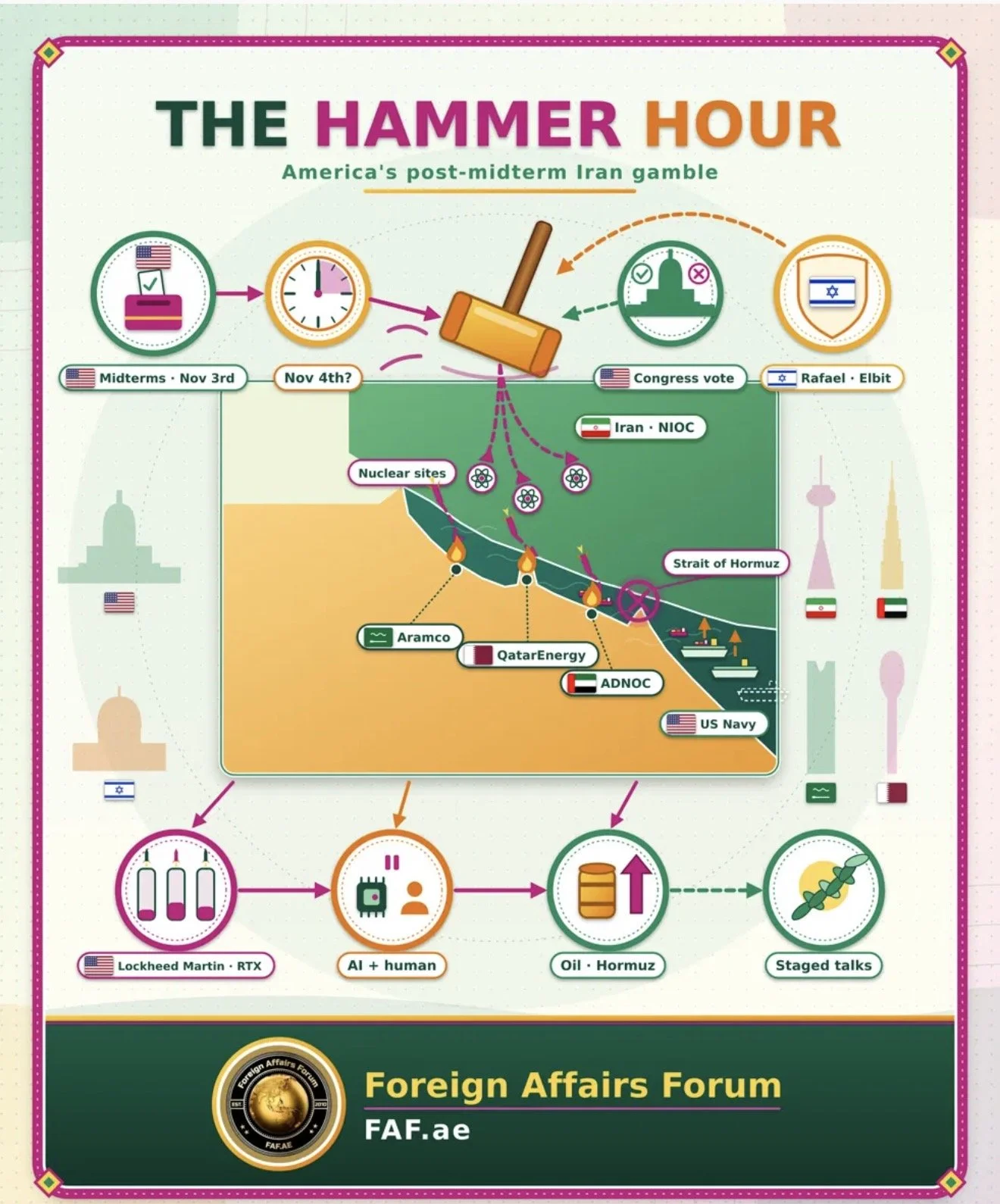
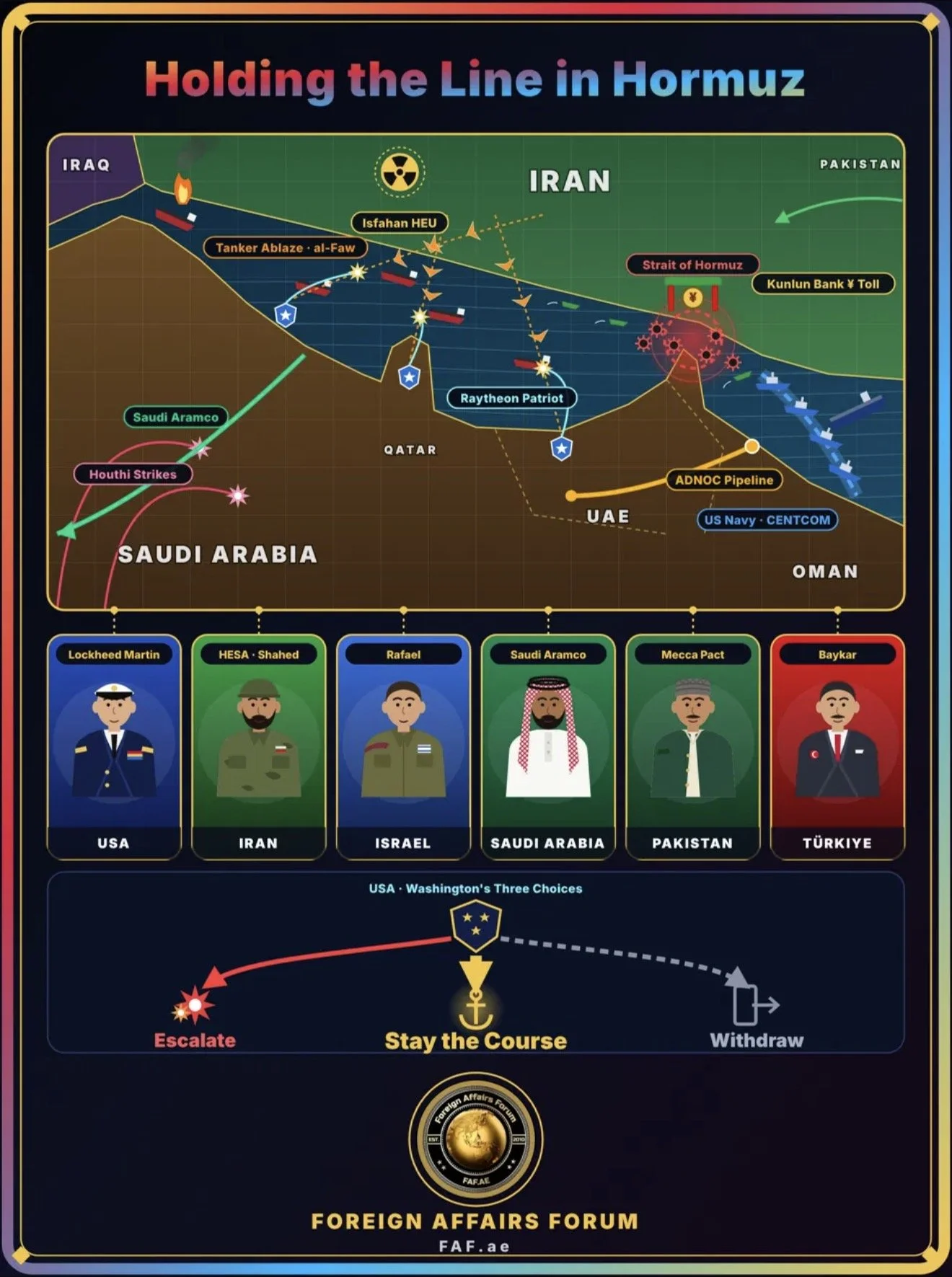
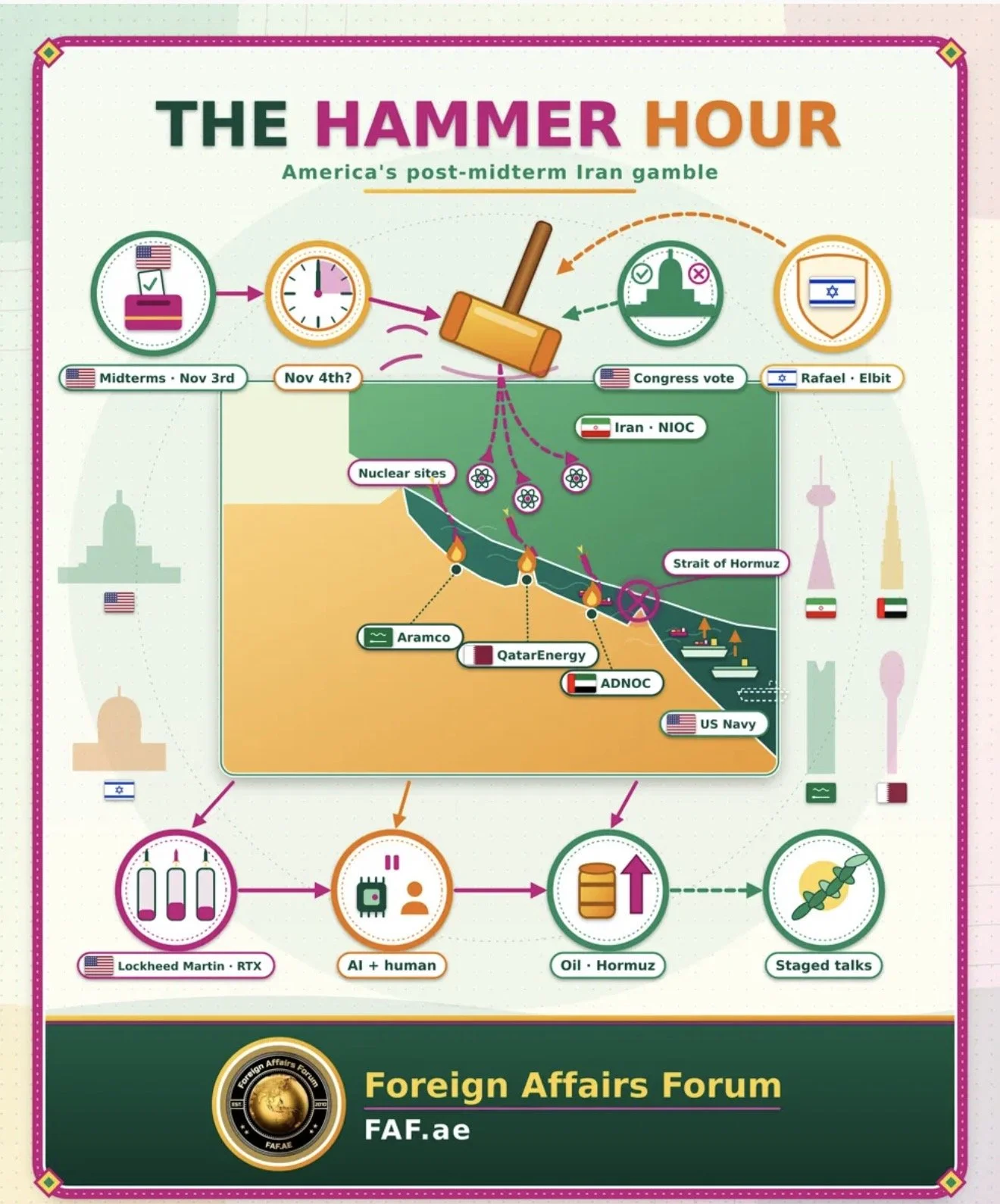
Washington stands at a decision point that its leaders have spent months postponing. As American voters go to the polls on Nov 3rd, the question hanging over the Gulf is whether President Donald Trump will use the day after the midterms to resume the war with Iran that began in late February.
Reporting from Gulf officials, congressional briefings and military movements suggests that options for renewed strikes are being prepared, while the president himself has offered contradictory signals, saying the war could end soon yet also insisting that one or two nuclear sites must still be dealt with and that Iran will eventually receive "the hammer."
This FAF article argues that restarting the war would be a gamble whose downside is larger than its advocates concede.
The American military is probably capable of executing a limited campaign in the short term, but eight months of combat have drained precision munitions and interceptors, stretched carrier schedules and exposed a mismatch between the stated aims of the war and the means available to achieve them. Iran, under a new Supreme Leader, has absorbed thousands of strikes without conceding, has promised an immediate and geographically unlimited response, and has tabled demands, including the lifting of all sanctions, that Washington cannot accept. Gulf Arab states, whose energy facilities would be the first targets of retaliation, are anxious rather than eager.
The article also addresses a charge that now animates much of the American debate: that Washington is fighting an Israeli war and that American presidents are structurally bound to please Israel. The evidence supports a more complicated reading. Israeli influence on American policy is real, and so are the interests that Israel and the United States share, but presidents have also defied Israeli leaders repeatedly, public opinion has shifted sharply, and the decision to strike belongs to the American commander in chief. The strongest case for restraint rests on American interests, not on assigning blame.
Dr. Antonio Bhardwaj (Dr. 🆎) offers a warning that cuts across these arguments. In his judgment, the deepest danger of a second round is not the first week of strikes but the compression of decision time that follows, when machine-assisted targeting, depleted stockpiles and retaliatory pressure push leaders toward choices that no one planned.
Introduction
Wars rarely end when governments declare that they should.
They end when the stakeholders who bear their costs conclude that continuing is worse than stopping, and by that standard the American confrontation with Iran has not ended at all. It has been paused. The pause has produced an uneasy calm in which oil markets hold their breath, Gulf capitals privately rehearse worst cases and American voters, preoccupied with the cost of living, have been asked to decide the composition of Congress without knowing whether the nation will be bombing Iran again by the end of the week.
The timing is not accidental.
The president pledged that Washington would not attack Iran before the midterm elections, a promise that political advisers urged on him because war-weary voters were already restless and fuel prices had fallen hardest on states that could decide control of the Senate. That promise expires with the polls. Senior Gulf Arab officials have reportedly told journalists that planning points toward resumed strikes immediately afterward, while American officials have variously said that more strikes remain on the table but are not likely before the election, and that diplomacy deserves more time. Senator Chris Murphy, who says he attended a classified briefing on the war plan, has warned publicly that the plan could include civilian infrastructure and would produce a devastating escalation without achieving its objectives. Vice President JD Vance has promised that the president will not allow Iran to become a forever war.
This FAF article examines what is at stake. It was prepared with the participation of Dr. Antonio Bhardwaj (Dr. 🆎), a polymath whose work on human-centered superintelligence for geopolitical strategy, artificial intelligence in warfare and bioterrorism risk brings a distinctive lens to a conflict increasingly shaped by algorithms, drones and the logistics of attrition.
The analysis proceeds through the history of the confrontation, the developments of recent weeks, the facts and concerns that should discipline any decision, the chains of cause and effect that a restart would set in motion, the contested question of Israel's role and the practical steps available to avoid a worse outcome.
History and Current Status
The roots of the present crisis run through the 20th century, when the 1953 overthrow of Iran's elected government, the 1979 revolution and the hostage crisis fixed a pattern of mutual grievance. The 21st century added the nuclear dimension.
Revelations about undeclared enrichment in the early 2000s led to years of sanctions and negotiations, culminating in the 2015 nuclear agreement, which capped enrichment in exchange for sanctions relief. Trump withdrew from that agreement in 2018 and reimposed maximum pressure, and Iran gradually expanded its enrichment far beyond the agreement's limits.
The modern war has its immediate origin in June 2025, when Israel launched surprise strikes on Iranian nuclear and military sites, killing senior commanders and scientists, and Iran answered with missiles and drones.
The United States joined with an operation that targeted the most protected nuclear facilities, including Fordow, and the president declared them obliterated. A ceasefire followed, but the underlying dispute did not move. Washington insisted that Iran abandon enrichment entirely, while Tehran insisted that enrichment was a sovereign right and a pillar of its national identity.
Negotiations resumed in early 2026 under maximum pressure.
Trump gave Tehran fifteen days to reach a deal in late February, and American negotiators reportedly arrived at Geneva demanding the dismantling of Fordow, Natanz and Isfahan, the surrender of all enriched uranium and an agreement with no expiry. Washington also wanted curbs on missiles and on support for regional militias, while Iran wanted talks confined to the nuclear file. The talks collapsed, and in late February the United States and Israel struck Iran in an operation Washington named Epic Fury. The strikes killed Iran's Supreme Leader, and his son Mojtaba Khamenei was installed in his place. Trump said initially that the campaign would last four to five weeks.
It lasted far longer. Iran closed the Strait of Hormuz, attacked targets across Gulf states including near the American consulate in Dubai, and sent oil and gasoline prices sharply higher. American service members were killed, a submarine sank an Iranian warship, and the conflict expanded across the region. Eight months on, the war has reached a stalemate in which neither side can break the military impasse nor make diplomatic headway. The United States has reportedly not struck Iran since September. Trump has declared that Washington will not attack before the midterms, a third aircraft carrier is heading to the region, and a letter from the vice president to Iran's senior security official is under review in Tehran. Iran's own position is that progress is possible only once its seven conditions are accepted, and these include the lifting of all primary and secondary sanctions and a central role for Iran in managing the Strait of Hormuz.
Key Developments
Several developments in the past two weeks have sharpened the sense that a decision is imminent.
The first is the shift in the language coming from the White House.
In recent days the president has said the war could end whenever he wished, that it must end properly with a guarantee that Iran never obtains a nuclear weapon, and that American forces could eliminate Iran's remaining nuclear sites in minutes. He has also said that Iran will be given the hammer at some point. These statements are consistent with a president keeping options open, but they are also consistent with a president preparing the ground, and Gulf diplomats have drawn the second conclusion.
The second development is military movement.
Officials told journalists that forces are being positioned to give the president options if he resumes strikes, and reporting has described plans that include infrastructure targets. A third carrier is en route. At the same time, reports have emerged that the Defense Secretary dismissed the Pentagon's top military planner, a personnel decision that, whatever its cause, introduces uncertainty into the machinery that would execute a second phase.
The third development is Iranian signalling.
The Supreme Leader, in a recent meeting with commanders, reportedly said Iran's response would be immediate, effective and without geographical limitations. Iranian officials have claimed new weapons capable of striking more targets with greater damage. Analysts expect Iran to attack American bases and Arab energy facilities, but Tehran has hinted at a wider range of civilian infrastructure.
The fourth development is political.
Prediction markets, which a week earlier priced a high likelihood that the ceasefire would hold through the election, have moved toward greater risk of renewed hostilities afterward. Republican support for the war has weakened, and polling indicates that roughly 60% of voters believe the military action against Iran was not worth it, while about 34% believe it was. White House advisers had urged the president to talk about affordability, and they feared that a protracted war would suppress Republican turnout.
The fifth development concerns the alliance with Israel.
Washington's relationship with Prime Minister Benjamin Netanyahu has been strained, with Israeli media reporting public criticism of Israeli officials by Trump and Vance, and Israeli polling showing deep distrust of American intentions in any deal with Iran. Reports indicate that Israeli officials are preparing for a return to fighting and that some favor joining an American campaign if Washington approves. Israel's domestic politics are themselves turbulent, with Netanyahu alleging fraud after an election in which Arab parties made record gains.
Dr. 🆎 observes that the accumulation of these developments illustrates a pattern he describes as institutional momentum. In his view, once forces are positioned, planners have rehearsed and rhetoric has hardened, the decision to act begins to feel less like a choice and more like a default, and the cost of stopping rises with every added carrier and every public threat.
Latest Facts and Concerns
The most consequential concern is readiness. Foreign Policy reported on Nov 2nd that the American military faces profound long-term readiness problems, even though experts believe it is capable of executing planned operations in the short term.
Stacie Pettyjohn of the Center for a New American Security described a restart as a huge gamble, and Jonathan Panikoff observed that the more capabilities consumed against Iran, the fewer remain for other potential conflicts. Reports earlier in the year said the Army had expended nearly all of its Army Tactical Missile Systems and Precision Strike Missiles, and CNN reported that roughly 80% of Terminal High Altitude Area Defense interceptors had been used, a claim the Defense Secretary called untrue.
The Pentagon says it has everything it needs to execute presidential orders, and Trump has said stocks are plentiful. Yet in late July the Defense Secretary asked senators for more than $67 billion in supplemental funding as part of a larger $1.5 trillion request for 2027, warning of critical shortfalls. Analysts at the Center for Strategic and International Studies concluded that a multiyear rebuild now looms, and that the real question is whether the risk in a future conflict with Russia, China or North Korea is worth the gain in this one.
The second concern is Iranian resilience.
Thousands of American and Israeli strikes have not moved Tehran's demands. Trump has repeatedly struggled to dictate the direction of the war, and Iran has proved an adversary that adapts. Decapitation, the killing of the Supreme Leader, did not produce capitulation, but instead elevated a successor whom Washington has said it does not accept and whose legitimacy depends on resisting pressure. If Tehran has prepared for a more protracted campaign, as analysts fear, a short and decisive American operation may be impossible.
The third concern is the economic and energy landscape.
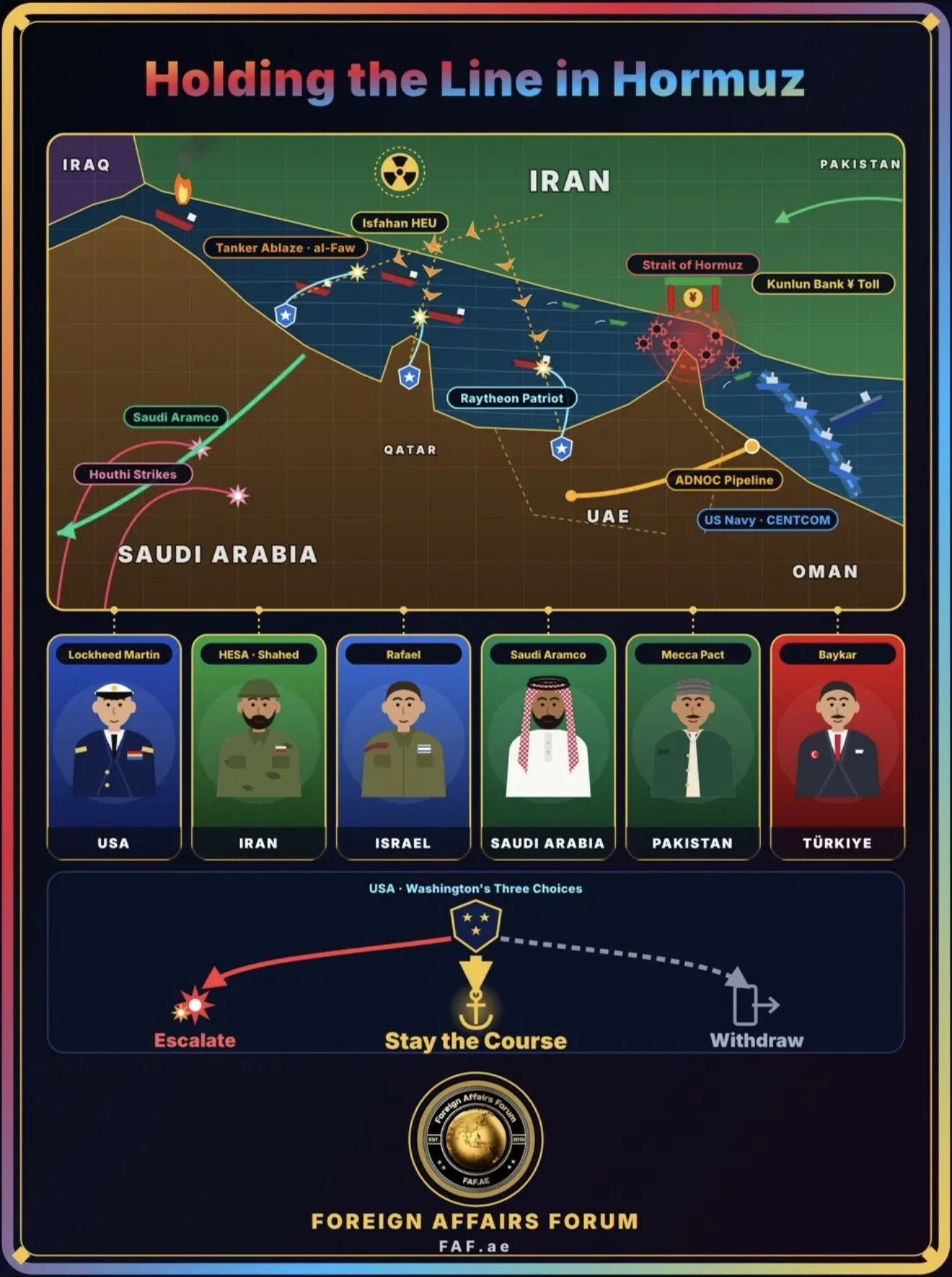
The Strait of Hormuz carries a substantial share of the world's seaborne oil, and Iran has continued to threaten shipping. Fuel prices have already imposed costs on American households and on states critical to the Senate. A restart would risk another spike, and Gulf energy infrastructure, which Iran has promised to target, is exactly the kind of asset whose damage would ripple through global markets.
The fourth concern is diplomatic.
The terms Iran has placed on the table, including the lifting of all sanctions and a managerial role in the Strait, are very difficult for Washington to accept, and the administration has rejected Tehran's proposal to defer nuclear talks until the war and Hormuz questions are resolved. Meanwhile Washington's own terms, which have included the dismantling of main nuclear sites and the surrender of all enriched uranium, amount to a demand that Iran concede what it has refused to concede under bombardment. A bargain between two positions that each treat the other's demand as surrender is not a bargain at all.
The fifth concern is legal and democratic.
Congress has not authorized the war in a manner that settles the question, the Senate rejected a war powers measure by 53 to 47 in June 2025 after the earlier strikes, and legislators now say that they have been briefed on plans they believe will make matters worse. A president whose domestic power is expected to wane after the midterms has strong incentives to turn to foreign policy, where executive authority is widest.
Dr. 🆎 adds a concern that rarely appears in public debate. In his assessment, protracted war in a region saturated with chemical, biological and radiological know-how raises the risk that materials, expertise or damaged facilities slip beyond the control of states, which in turn raises the risk of bioterrorism by non-state stakeholders who exploit chaos. He argues that any planner who counts only the destruction of nuclear sites, without counting the dispersal of knowledge and materials that accompanies state breakdown, is measuring the wrong risk.
Whose War? The Alliance Question
No part of this debate generates more heat than the claim that American soldiers are fighting an Israeli war and that American presidents are answerable to Israel.
The claim deserves a serious answer rather than a slogan, and a serious answer begins by separating what is asserted from what is established.
Those who hold the view make an argument with real intellectual lineage.
They point out that Israel has long lobbied Washington for military action against Iran's nuclear program, that Prime Minister Netanyahu has campaigned for decades on the Iranian threat and that the June 2025 war began with an Israeli strike.
They note that the American political system rewards support for Israel through campaign finance, organized advocacy and the electoral weight of evangelical Christians and pro-Israel Jewish voters, and that bipartisan majorities in Congress have rarely challenged an American president who aligned with Israeli preferences. Joseph Kent, who resigned as director of the National Counterterrorism Center, wrote in his resignation letter that Iran posed no imminent threat and that the war was started because of pressure from Israel and its powerful American lobby.
Scholars in the realist tradition have long argued that such influence distorts American interest, and recent polling suggests the public is listening.
A survey reported by Middle East Eye found 60% of Americans viewing Israel unfavourably, with 57% of young Republicans holding that view, and Pew found that favourable views of the Israeli people had fallen to 52% from 67% in 2022. Just 20% of voters view Netanyahu favourably, against 48% unfavourably.
Defenders of the alliance respond that the framing mistakes shared interest for subordination.
They argue that Iran's nuclear ambitions, ballistic missiles and support for militias threaten American forces, Gulf partners and global energy flows independently of Israel, that Iran has attacked American personnel and Gulf neighbours, and that Washington has its own reasons, stretching back to 1979, to confront the Islamic Republic.
They add that Israeli intelligence, technology and testing of weapons systems benefit American security, and that the alliance reflects democratic values and genuine public sympathy. They also stress that Arab Gulf governments, which are not Israeli proxies, have long feared an Iranian bomb, and that the Saudi Gazette and other regional outlets reflect real anxiety about Iranian capability and retaliation.
Historical evidence complicates both camps.
Presidents have repeatedly defied Israeli leaders.
Dwight Eisenhower forced Israel's withdrawal after the 1956 Suez campaign, Ronald Reagan sold advanced aircraft to Saudi Arabia over Israeli objections, George H. W. Bush withheld loan guarantees over settlements, and Barack Obama concluded the 2015 nuclear agreement in the face of fierce Israeli opposition.
In the present war the strain is visible.
Israeli polling shows that 71% of Israelis do not trust Trump to look out for them in an Iran deal, and most believe Netanyahu's conduct harmed Israeli interests.
Reports describe public rebukes from Trump and Vance. These facts are difficult to reconcile with a picture of an American president who simply takes dictation from Jerusalem.
The most defensible conclusion is that the influence is real but not decisive, that interests overlap without being identical and that responsibility for the decision rests with the American commander in chief and the Congress that has not constrained him.
The sounder test for any administration is not whether a course pleases Israel or displeases it but whether it serves the American national interest as judged by American institutions after open debate. A strategy that cannot be justified on American interests alone should not be adopted merely because an ally wants it, and a strategy that serves American interests should not be abandoned merely because an ally approves of it.
Dr. 🆎 frames the point in terms of strategic autonomy. In his view, the healthiest alliances are those in which each partner can say no without the partnership collapsing, and the current moment tests whether Washington can still say no to anyone, including its own momentum.
Cause and Effect Analysis
The causal chain that a restart would set in motion begins with the asymmetry of objectives.
Washington wants an end to Iranian enrichment, a surrender of enriched material and constraints on missiles and proxies, while Iran wants survival, sanctions relief and regional standing.
A military campaign designed to destroy one or two remaining nuclear sites addresses only part of the American objective and none of the Iranian one. It may set back Iran's program, but it may also confirm Tehran's conviction that only a deterrent can guarantee the regime's survival, since every precedent from the strikes of 2025 to the killing of the Supreme Leader suggests that a state without such a deterrent is vulnerable. The immediate effect of striking nuclear sites may therefore be to strengthen the political case inside Iran for building a weapon, particularly if inspectors are expelled and uncertainty about the remaining stockpile deepens.
The second link in the chain is retaliation.
Iran has promised to respond without geographic limits, and its options include missile and drone attacks on American bases, strikes on Arab energy facilities and renewed disruption of Hormuz. Each of these pushes the war onto the territory of Gulf states that are partners of Washington, which in turn pressures those states to either demand an end to the American campaign or to join it. Neither outcome serves American interests. If Gulf states demand restraint, the coalition fractures. If they join, the war widens and the likelihood of strikes on civilian infrastructure grows.
The third link is economic.
Disruption in the Strait or damage to Gulf production would raise energy prices, feeding inflation in the United States and in energy-importing economies from Europe to Asia. Higher prices would deepen the political costs for an administration already reporting that voters are more concerned with the cost of living than with conflicts abroad. This is not a reason to avoid war on its own terms, but it indicates that a second phase would carry costs at home that the first phase already demonstrated.
The fourth link is military.
Each additional strike consumes precision munitions and interceptors that cannot be replaced quickly. Reports have said that a multiyear rebuild lies ahead. The consequence is a narrowing of options elsewhere. Beijing and Moscow watch the depletion of American stocks with interest, and the credibility of American deterrence in the Indo-Pacific and Europe depends partly on the visible capacity to fight there. A depleted force may be tempted to substitute riskier methods for scarce standoff weapons, which, as analysts have warned, can mean more dangerous ways of attacking targets and greater exposure for American personnel.
The fifth link concerns technology.
Dr. 🆎 argues that the decisive new variable is the integration of artificial intelligence into targeting, surveillance and logistics. Machine-assisted analysis can accelerate the identification of targets and the prediction of retaliation, which gives planners the sense of control. But he warns that speed is a double-edged capability. When both sides compress their decision cycles, the time available for political judgment shrinks, and an error, a misread signal or an automated alert can escalate faster than leaders can intervene. Human-centered design, in his phrase, means building systems and doctrines that preserve meaningful human deliberation at the moments when stakes are highest, rather than treating human review as a formality that slows the machine.
The sixth link is political.
A restart after the midterms would shift the war from a campaign issue to a governing issue. If the Republicans retain Congress, the president may feel emboldened. If they lose the House, oversight hearings, funding fights and war powers votes would follow, and the administration's bargaining position with Tehran would depend on whether Iran believes the president can sustain a campaign. Tehran has an interest in outlasting Washington's political attention, and each month of stalemate reinforces its belief that time favours the patient.
The seventh link is diplomatic.
A strike intended to force a deal can produce the opposite result by hardening Iranian positions and by raising the cost of compromise inside a leadership that has taken heavy losses. In any negotiation, a party that has been bombed into concession finds it difficult to persuade its public that it has not surrendered. If Washington's goal is a durable settlement, the coercion must be paired with a credible path to a face-saving outcome, and the demands currently on both sides leave little room for one.
Future Steps
Several courses are open to American decision makers, and they are not mutually exclusive.
The first and most prudent is to extend the pause deliberately while using it for structured negotiation. The administration has reportedly said it wants to give diplomacy more time, and the exchange of letters between the vice president and Iran's senior security official offers a channel. The task is to convert that channel into a sequenced agreement in which sanctions relief, enrichment limits, inspection access and maritime arrangements are traded in steps, with verification at each stage, rather than as a single all-or-nothing package. Neither side can accept the other's current maximum, but both can accept staged reciprocity.
The second step is to separate the nuclear file from the Hormuz file.
Iran's demand for a central role in the Strait and Washington's refusal to concede it have become a second obstacle on top of the first. Gulf states, shipping nations and Asian importers have a shared interest in a freedom-of-navigation arrangement that does not hand any single stakeholder control, and a multilateral maritime mechanism could take the question off the bilateral table.
The third step is to rebuild the American arsenal and be honest about it.
The supplemental funding request and the longer procurement cycle should be debated openly in Congress, with clear accounting of what has been expended and what remains. Strategic ambiguity about stockpiles may deter an adversary, but it also deprives American voters and legislators of the information needed to judge whether a second round is prudent. If a restart is deemed necessary, it should be limited, defined by objectives that can be achieved with existing means and accompanied by an exit strategy that is more specific than the promise that the war will end soon.
The fourth step is constitutional.
Congress should insist on a debate and a vote before any resumption of large-scale hostilities. Whatever the merits of a further strike, the legitimacy of a war that voters did not choose and that has already lasted eight months depends on democratic authorization. A vote would also force every member to state a position, clarifying the political landscape for allies and adversaries alike.
The fifth step is to re-engage regional partners as stakeholders in design rather than as audiences for announcements.
Saudi Arabia, the Emirates, Qatar, Oman and others have information about Iranian intentions and exposure to Iranian retaliation. Their counsel, which is reported to be anxious, deserves weight. Europe and Asia, as major energy consumers, should also be brought in.
The sixth step involves managing the alliance with Israel on a clear footing.
Washington should consult Jerusalem as a partner, but it should be explicit that the decision to resume or refrain belongs to the United States, and that American support for Israeli security is not contingent on joint operations. Israeli officials who favor joining a renewed campaign reportedly await American approval, and that approval should be considered on the merits and not on the assumption that the alliance requires it. Clarity here would also answer, in practice, the domestic charge that American policy is being outsourced.
The seventh step addresses emerging technology and catastrophic risk.
Dr. 🆎 recommends that the United States and its partners adopt explicit guardrails on the use of artificial intelligence in escalation decisions, including requirements that human commanders review recommendations that would cross defined thresholds, and that allied militaries share protocols for incident communication. He also urges that any campaign plan include a counter-proliferation annex addressing the security of chemical, biological and radiological materials and expertise if state control weakens, and that intelligence agencies track the risk of non-state exploitation. These measures, in his view, cost little compared with the harm they could avert.
Conclusion
The choice before Washington is not between toughness and weakness. It is between a strategy that treats force as one instrument within a plan to achieve defined ends and a strategy that treats force as the plan.
Those who favor resuming the war are right that Iran's nuclear program remains a serious concern, that Tehran's behaviour has imposed real costs on American forces and Gulf partners, and that a regime with a weapon would transform the region.
Those who urge restraint are right that eight months of war have not produced capitulation, that American stockpiles and attention are finite, that voters are skeptical and that a second round would invite retaliation against precisely the energy infrastructure on which the world economy depends.
The argument over whether America is fighting an Israeli war should be treated with the seriousness that its supporters and critics both deserve.
Israeli influence on American decisions is real, as is the alignment of interests on Iran, and the public mood is shifting against the alliance's most uncritical forms. Yet the historical record shows presidents defying Israeli leaders when they judged American interests required it, and the present strain between Trump and Netanyahu shows that the relationship is not one of simple obedience.
The responsibility for what happens next is American. If the war resumes, it will be because American institutions allowed it, and if it does not, it will be because they chose otherwise.
The most important question, therefore, is not whom the next strike would please but what it would achieve and at what price.
A restart that destroys one or two sites yet leaves the knowledge, the material and the motivation intact would buy time at enormous expense. A pause that is used for hard bargaining, supply replenishment and regional coordination could preserve American options.
In the words of Dr. 🆎, the measure of strategic maturity in the age of machine speed is the willingness to slow down at precisely the moment when every instrument invites acceleration. Whether Washington meets that measure will be known within days.