Washington Blinks, the World Recalculates: Power, Peace Talks and Perilous Waters
Foreign Affairs Forum | Dr. Antonio Bhardwaj (Dr. 🆎)| Nov 6th, 2026
Executive Summary
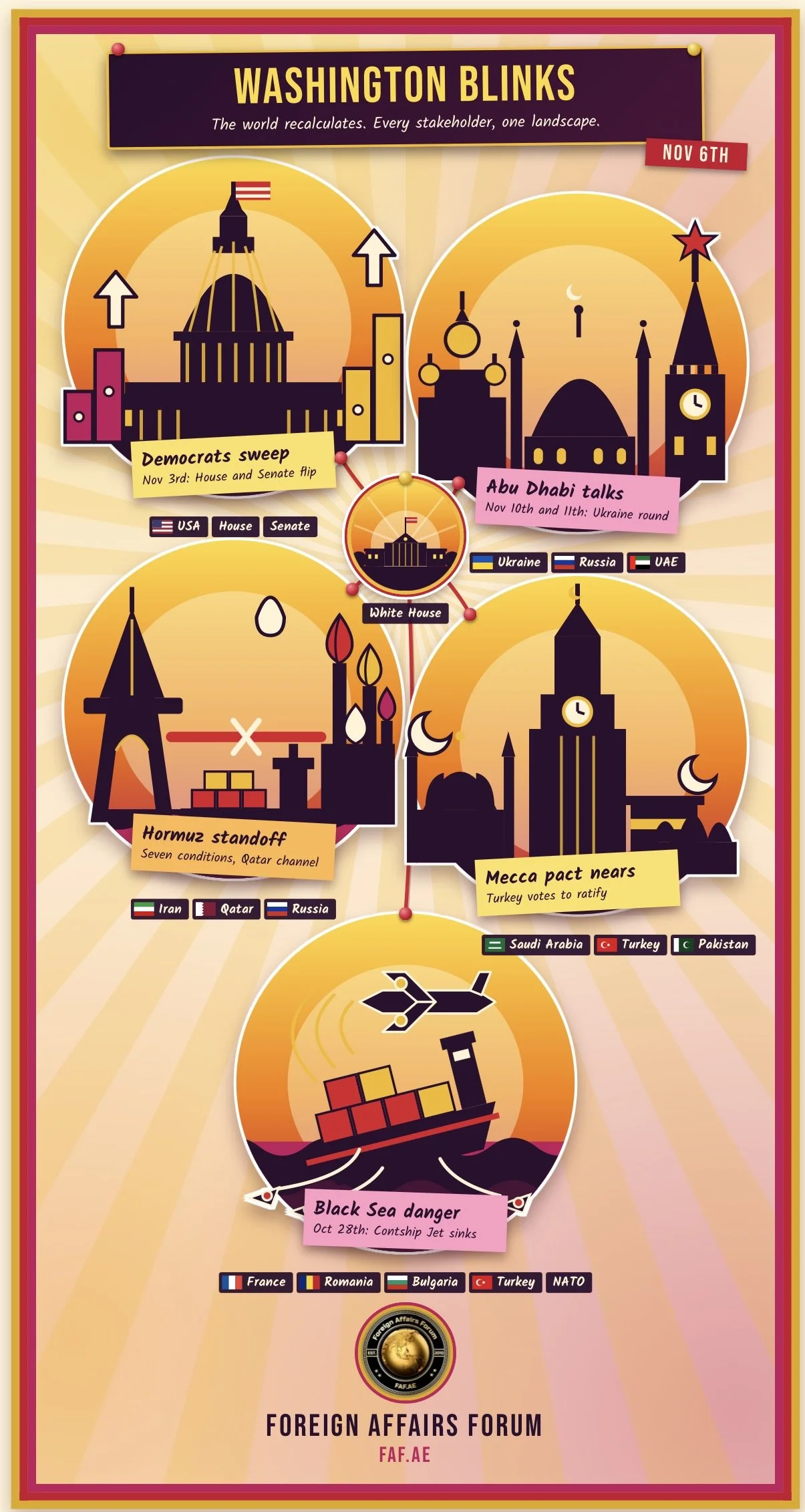
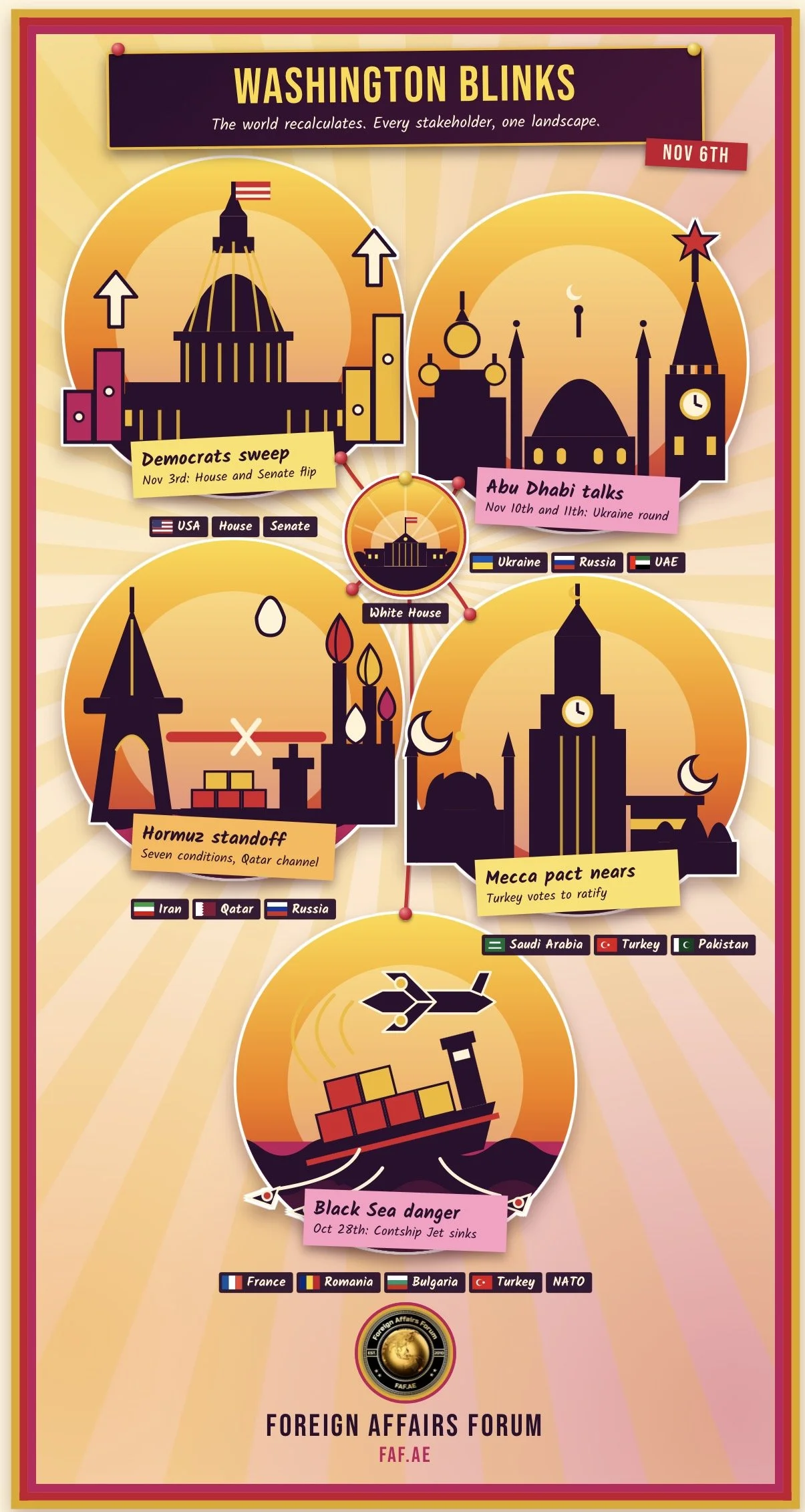
The international landscape entered a new political phase this week. American voters handed Democrats control of both chambers of Congress on Nov 3rd, and within hours the foreign ministries of Beijing, Tehran, Moscow and the European capitals began recalculating what a divided Washington means for war, trade and diplomacy. The timing could scarcely be more consequential. American-mediated talks on Ukraine are scheduled to resume in Abu Dhabi on Nov 10th and 11th, Iran has tabled a nuclear proposal through Qatar while insisting on seven conditions before the Strait of Hormuz reopens, Turkey is preparing to ratify a collective-defence pact with Saudi Arabia and Pakistan, and attacks on commercial shipping in the Black Sea have forced France to extend the deployment of a maritime patrol aircraft in Romania.
This FAF article argues that these five developments are not isolated.
They are expressions of a single structural transition in which American domestic politics has become a geopolitical variable, regional powers are building security arrangements that no longer depend exclusively on Washington, and maritime chokepoints have become the decisive pressure points of the global economy. Each development carries a distinct dilemma. Congressional oversight may constrain the executive branch but cannot conduct diplomacy. A Ukraine settlement may reduce fighting but fail to deliver enforceable guarantees. An Iranian bargain may reopen Hormuz but entrench leverage over Gulf shipping. A new Islamic and Turkish defence alignment may deter aggression but widen the circle of potential belligerents. And a Black Sea that can be watched but not defended exposes the gap between detection and interception.
The analysis that follows sets out the history behind each development, examines the latest facts and concerns, traces the causal links between them, and proposes practical steps for governments seeking to coordinate military security, diplomatic negotiation, energy resilience and trade protection while adapting to changed domestic political constraints.
Introduction
Great transitions in the international order seldom announce themselves. They accumulate through elections, treaties, battlefield episodes and shipping incidents that appear unrelated until a pattern becomes visible. The week of Nov 3rd to Nov 6th, 2026 may be remembered as the moment when such a pattern became visible. A superpower fighting a war against Iran, mediating a war in Ukraine and managing a trade confrontation with China has just seen its voters withdraw unified control of government from the party of its president. Simultaneously, middle powers are formalising alliances that reflect their own calculations of risk, and a semi-enclosed sea on the edge of NATO territory has become the deadliest route in the world for merchant vessels.
Dr. Antonio Bhardwaj (Dr. 🆎), a polymath with global expertise in super intelligence who specialises in human-centred super intelligence for geopolitical strategy, AI warfare and bioterrorism risk, offers a framing that runs through this FAF article. "The central question of this period is not who holds power but who can coordinate it," observes Dr. 🆎. "Every stakeholder in this landscape is simultaneously managing a military problem, a diplomatic problem, an energy problem and a domestic political problem, and the winners will be those who can sequence them without letting one collapse the others."
The structure of the FAF article follows that logic. It begins with the history and current status of each arena of competition, expressed here as a landscape of overlapping crises. It then examines the five key developments in turn, reviews the latest facts and the concerns they raise, analyses cause and effect across the whole system, and closes with recommendations and a conclusion. Throughout, the aim is to identify what each development means for security, governance, great-power competition, energy and trade, and to distinguish what has actually happened from what commentators fear or hope might follow.
History and Current Status
To understand the present moment, it helps to recall how unusually stacked the current crises are. The war in Ukraine, launched as a full-scale invasion in February 2022, is now in its fifth year. It has outlasted several diplomatic initiatives, including a series of direct Russian and Ukrainian meetings in Abu Dhabi earlier this year under American mediation, yet no comprehensive settlement has emerged. The core disputes over territory, security guarantees and the future of European defence architecture remain unresolved, and Moscow has consistently argued that a durable peace requires its security demands to be addressed.
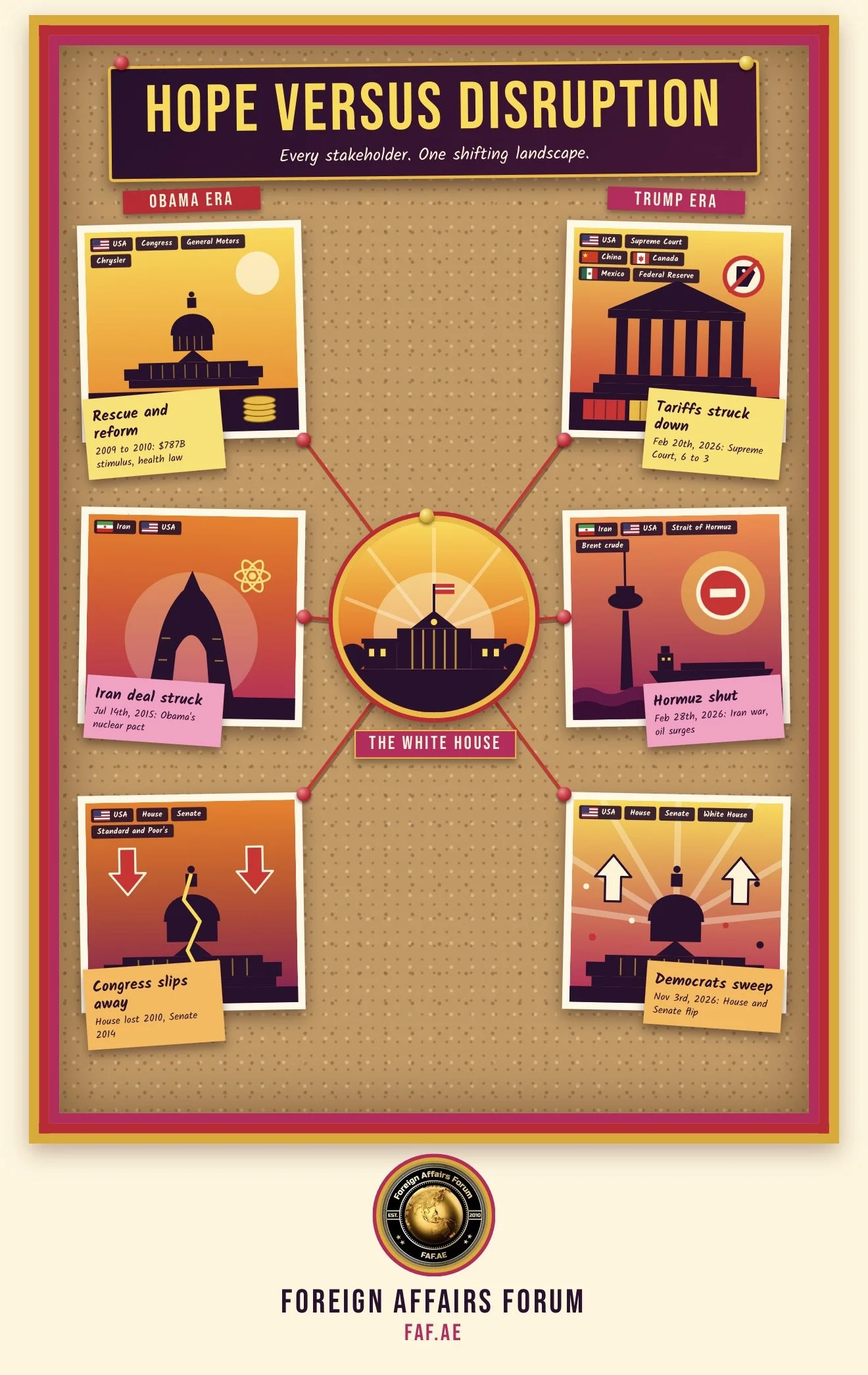
The war with Iran began on Feb 28th, 2026. It closed the Strait of Hormuz for months, produced one of the largest oil supply shocks on record and ended its first phase with a June memorandum of understanding that briefly restored shipping. That agreement later collapsed. In September, Tehran presented through Qatar a seven-day roadmap, built on the June understanding, under which it would reopen the strait within a week if Washington lifted its naval blockade, unfroze Iranian assets and granted sanctions and oil relief. Washington replied through Qatari intermediaries, and Iran judged the response insufficient. The central disagreement is one of sequence. Iran insists that its seven conditions be met before negotiations resume. The United States insists that the nuclear programme be addressed from the outset and that the strait reopen first.
The war has also radiated outward. Iran-backed Houthi forces in Yemen have launched missiles and drones against Saudi Arabia, striking critical infrastructure, and it was in this context that Saudi Arabia, Pakistan and Turkey signed the Mecca Joint Defence Agreement in August. The pact commits the signatories to treat an armed attack on one as an attack on all, mirrors in its logic the collective-defence clause at the heart of NATO, and builds on a separate Saudi and Pakistani defence arrangement concluded in September 2025. Saudi Arabia and Pakistan have completed their domestic ratification procedures. Turkey's government submitted the agreement to its parliament on Oct 20th, and the foreign affairs committee approved it a week later, leaving plenary ratification as the remaining step.
In the Black Sea, the spillover of the Russia and Ukraine war into the commercial domain has intensified through October. At least nine merchant vessels were struck near the coasts of Romania and Bulgaria during the month, and dozens of seafarers are dead or missing. The most recent high-profile incident, on Oct 28th, saw three sea drones strike the container ship Contship Jet, which later sank. Ukraine has blamed Russia for earlier attacks, Russia has denied involvement, and no one has claimed the Contship Jet strike. NATO's Secretary General said in mid-October that the alliance had reinforced its eastern flank with additional counter-drone capabilities.
Against this backdrop, the American political system delivered its verdict. Democrats won the House with a majority that analysts estimate could exceed two hundred and fifty seats and secured at least fifty-one Senate seats, according to projections as the count continues. Voter frustration over the cost of living, aggravated by an energy shock linked to the Iran war and by tariff-driven price increases, was the decisive factor. The president's approval rating stood in the low to mid 30s in the final weeks of the campaign. The result converts a period of unified Republican government into one of divided power, with two years of the presidential term remaining.
Key Developments
The first and most consequential development is the political reordering in Washington.
The midterm result has already prompted reassessments abroad. China's leadership is widely understood to perceive potential short-term advantages in trade negotiations, because a Congress controlled by the opposition may be less willing to support maximalist tariffs and more willing to scrutinise their economic costs. Beijing nevertheless remains cautious, aware that a weakened president may reach for confrontational gestures abroad, and that the next American administration after 2028 could be more hawkish still. Tehran is watching for signs that congressional scrutiny of the Iran war will narrow the executive's room to resume large-scale strikes. European capitals are assessing whether congressional pressure will produce greater policy predictability after a period of tariff threats, alliance ambiguity and abrupt shifts on Ukraine.
The limits of this shift deserve equal emphasis.
Congress controls appropriations, oversight hearings and, in principle, war powers resolutions, but it cannot independently determine operational decisions made by the executive branch, negotiate with foreign governments or compel a president to accept a particular diplomatic outcome. Its most potent instruments are budgetary and investigative. A Democratic House can subpoena documents on the conduct of the Iran war, condition military assistance, challenge emergency trade authorities and hold public hearings that shape the political cost of presidential choices. The Supreme Court has already curtailed the use of emergency statutes to impose sweeping tariffs, and a Democratic Congress is unlikely to authorise replacements. The practical effect is to raise the price of unilateralism rather than to abolish it.
The second development is the resumption of Ukraine diplomacy.
President Trump confirmed on Nov 5th that he met Russian envoy Kirill Dmitriev in Washington and expressed optimism about reaching an agreement. American-mediated negotiations involving Russia and Ukraine are expected in Abu Dhabi on Nov 10th and 11th. In parallel, American representatives have been consulting European governments, NATO and Ukrainian officials about security guarantees and a wider European security framework. The discussions reportedly include military transparency, crisis communication and mechanisms intended to reduce future escalation. No comprehensive agreement has been announced.
This development matters because it may determine the shape of the European security architecture for a generation. The decisive question is whether the negotiations yield enforceable security arrangements or merely a temporary reduction in fighting. Credible guarantees would require clarity about what military support would be provided if hostilities resumed, who would decide, and how Russia's concerns about NATO's presence would be addressed without conceding Ukrainian sovereignty. The process also raises uncomfortable questions about the role of European governments, whose security is directly affected by decisions that are being shaped in bilateral channels between Washington and Moscow. A durable settlement could eventually improve Black Sea shipping, agricultural exports and European energy security, but an unenforceable one would simply defer the next crisis.
The third development is the deepening of Russian and Iranian strategic dialogue.
On Nov 5th, President Vladimir Putin met Mohsen Rezaei, a senior Iranian security official, in Moscow. Rezaei delivered a message from Iran's supreme leader, and the discussions reportedly covered regional security, bilateral cooperation and possible postwar arrangements. A senior Iranian official separately indicated that Tehran had submitted a nuclear proposal to Washington through Qatar. Iran maintains that its seven conditions, which include sanctions relief, access to frozen assets and war reparations, must be satisfied before formal negotiations resume or the Strait of Hormuz reopens. Washington continues to insist that nuclear issues form part of any initial negotiation.
Iran's strategy is to bind three questions together: the future of its nuclear programme, economic compensation for the war, and control of maritime access to the Gulf. By presenting them as a single package, Tehran seeks to convert its leverage over shipping into concessions on sanctions and reconstruction. The Moscow meeting signals that Russia remains a significant diplomatic stakeholder in the Middle East, capable of offering political cover and economic partnership even if it has limited capacity to rescue Iran militarily. Moscow's willingness to host such a channel, even as it negotiates over Ukraine with Washington, shows how Russia is trying to be useful to every side at once.
The fourth development is the prospective formalisation of the Mecca Joint Defence Agreement.
Turkey's parliament is preparing to ratify the pact. The agreement contains a collective-defence provision, yet it does not automatically authorise the deployment of Turkish troops. Turkey's constitution requires separate parliamentary permission to send forces abroad, and Turkish officials have stressed that the pact is defensive and not an offensive instrument. Turkish assistance is expected to emphasise air defence, electronic warfare, intelligence, military technology and defence-industrial cooperation, areas where Ankara has developed considerable capability and where Saudi Arabia faces acute need given repeated attacks on its infrastructure.
Strategically, the pact matters because it brings together Saudi Arabia's financial weight and energy infrastructure, Pakistan's large military and nuclear status, and Turkey's NATO-trained forces and expanding defence industry. It demonstrates that regional powers are developing security relationships that do not depend exclusively on American leadership. Its architects describe it as a flexible platform and not a fixed bloc. Whether it remains primarily defensive or evolves into a wider military alliance is the central question.
The fifth development is the extension of France's maritime surveillance deployment in the Black Sea.
France announced that its Atlantique 2 maritime patrol aircraft would remain in Romania for several additional weeks, after being scheduled to conclude its deployment on Nov 6th. French surveillance personnel detected three sea drones before they struck the Contship Jet on Oct 28th, and the aircraft warned Bulgarian authorities and the vessel in advance, allowing all eighteen crew members to escape. Yet the episode exposed a capability gap. The aircraft could detect the drones but could not intercept them.
The incident encapsulates the character of modern maritime conflict. Inexpensive, uncrewed surface craft, which can be launched from relatively unsophisticated platforms and are difficult to attribute, threaten ships worth tens of millions of dollars and the lives of civilian crews. Defence ministers from Bulgaria, Romania and Turkey, meeting in Sofia on the day of the attack, agreed to establish a trilateral coordination mechanism and strengthen intelligence sharing and early warning, but detection and coordination are not the same as protection.
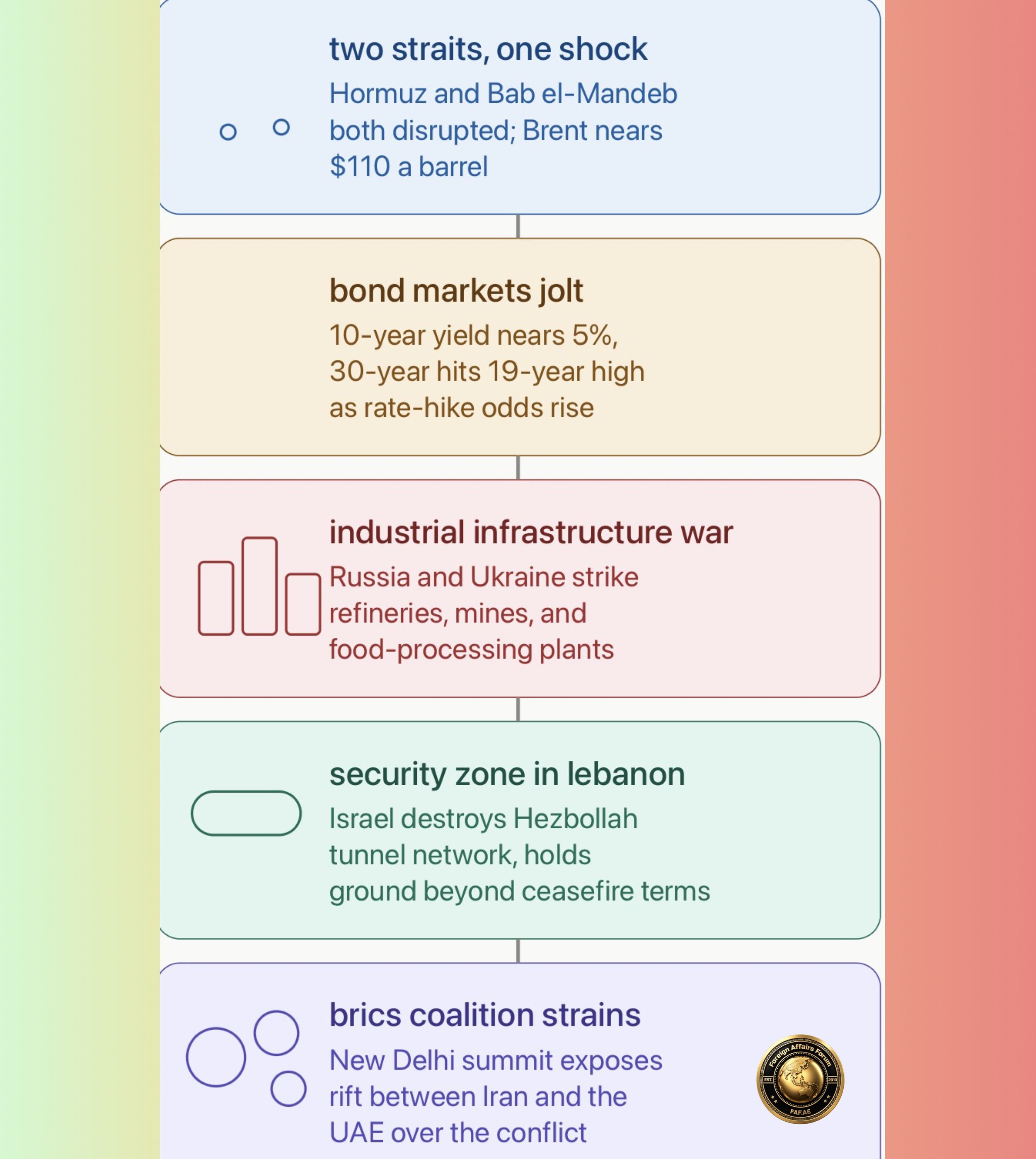
Beyond the five headline events, a quieter set of adjustments is under way. Insurers are repricing war-risk cover for Black Sea routes, shipowners are rerouting or delaying voyages, and energy traders are building the possibility of a Hormuz reopening into forward prices without fully believing in it.
These market reactions matter because they transmit geopolitical risk directly into household costs, which is precisely the channel through which the American electorate delivered its verdict. A diplomatic breakthrough in Abu Dhabi or Doha would therefore be felt first not in capitals but in freight rates, fuel prices and grain contracts.
Latest Facts and Concerns
Several facts frame the immediate outlook. Democrats now hold both chambers, although final seat counts are still being tallied in some contests.
The Abu Dhabi talks on Ukraine are weeks, not months, away, and expectations among analysts are deliberately modest. Iran's seven conditions have been publicly restated by its senior officials, who say the Strait of Hormuz will not reopen until they are met. Turkey's committee-level approval of the Mecca pact makes plenary ratification highly likely. And the Black Sea has become, by some assessments, the most dangerous route in the world for merchant shipping.
These facts raise concerns of different kinds.
The first is the risk of strategic distraction.
A Washington consumed by oversight hearings, appropriations fights and the early manoeuvring of the next presidential cycle may find it harder to sustain focus on simultaneous negotiations in Abu Dhabi and through Qatar. Adversaries sometimes exploit such periods, either by hardening bargaining positions in the expectation that American leverage will decline or by testing alliance commitments.
The second concern is escalation by miscalculation.
Repeated attacks on commercial vessels close to NATO territory, a collective-defence pact that links Gulf security to a NATO member's army, and an unresolved confrontation over Hormuz all increase the number of points at which a misjudged incident could trigger wider involvement.
The third concern is the erosion of the legal and normative framework that protects civilian shipping and non-combatants.
Questions about responsibility for protecting civilian vessels, attribution of attacks and freedom of navigation remain unanswered, and the absence of clear attribution weakens deterrence.
The fourth concern is technological. Cheap autonomous systems are outpacing the defensive doctrines designed to counter them.
Dr. 🆎 argues that this is the defining military-technical challenge of the moment. "A drone costing a few thousand dollars can now hold a multibillion-dollar trade route at risk, and the same logic will apply to energy infrastructure, ports and undersea cables," states Dr. 🆎. "Human-centred super intelligence in defence should mean systems that fuse sensor data, predict attacks and recommend interception while keeping accountable human judgement over the use of force. Without that, we will either be blind or we will be reckless."
A fifth concern is energy and trade resilience.
Sanctions relief for Iran, if it came, would significantly affect petroleum exports, shipping and Iran's access to financial networks. Continued closure of Hormuz keeps risk premiums high and sustains the price pressures that contributed to the midterm result. In the Black Sea, higher insurance costs and disrupted schedules threaten agricultural exports and regional logistics, with consequences for food prices in importing countries. A final concern is that the same technologies and vulnerabilities that apply to conventional conflict also apply to the biological and cyber domains.
Dr. 🆎 cautions that an environment of weakened norms and distracted leadership is precisely the one in which non-state groups seek to exploit gaps, and that preparedness for biological threats must not be sacrificed to the urgent demands of conventional crises.
Cause-and-Effect Analysis
The five developments are linked by causal chains that become visible when they are read together.
The first chain runs from domestic politics to foreign policy.
Prices rose because tariffs and the Iran war pushed up costs. Voters punished the governing party. The resulting divided government alters the constraints on the executive, and that change in turn alters the expectations of foreign governments. China may calculate that trade concessions are now more attainable. Iran may calculate that time is on its side. Europe may calculate that American policy will become more predictable, or, alternatively, that it will become more paralysed. In each case the foreign stakeholder adjusts its bargaining position in anticipation of American behaviour, which means that domestic politics produces geopolitical effects before any law is passed or any hearing is held.
The second chain runs from the Iran war to regional security realignment.
The war and the Houthi attacks on Saudi Arabia that followed it created a demand for deterrence that Washington alone was not satisfying, at least in the view of Riyadh, Islamabad and Ankara. The Mecca pact is partly a hedge against American unreliability and partly a response to a direct threat. Its existence in turn changes the calculus of Iran and its partners, who must now consider the possibility that an escalation against Saudi territory could trigger a response from a NATO member's army. This is the paradox of collective defence. It strengthens deterrence by raising the cost of aggression, but it also multiplies the pathways through which a local conflict becomes a regional one.
The third chain connects Russia's position across arenas.
Moscow benefits from higher energy prices produced by the Gulf crisis, benefits from American distraction, engages Iran diplomatically and negotiates simultaneously over Ukraine. The Black Sea attacks, whoever is responsible, strain NATO's patience and test the alliance's willingness to defend commercial interests without triggering direct confrontation. The diplomatic track in Abu Dhabi and the maritime risk off Romania and Bulgaria are therefore two faces of the same strategic competition. If negotiations stall, maritime pressure may intensify. If negotiations advance, maritime attacks may be used either as leverage or, conversely, as an indicator of who is spoiling an agreement.
A fourth chain connects maritime security to the global economy.
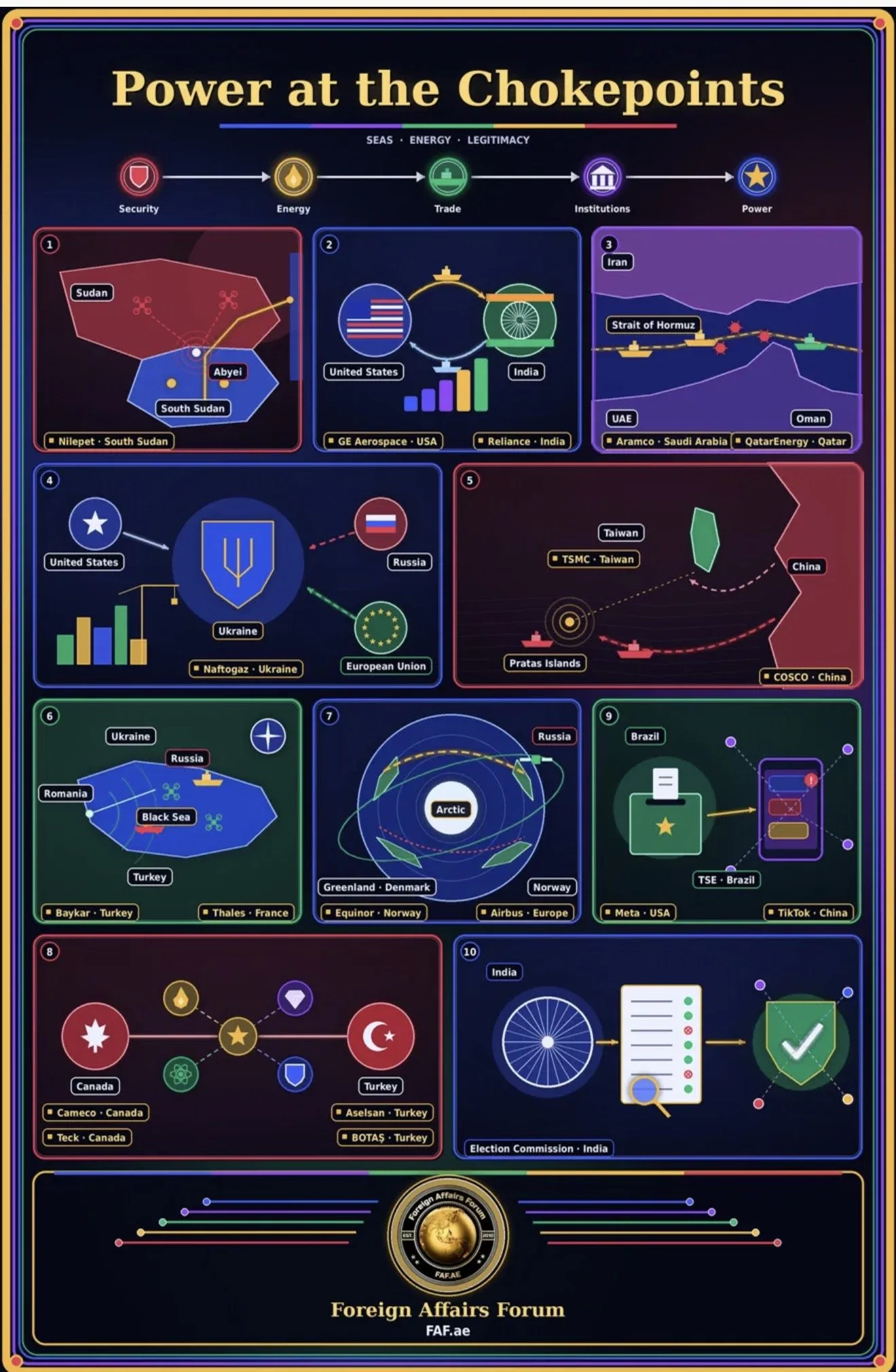
Hormuz and the Black Sea are both chokepoints through which a disproportionate share of energy and grain flows. Modern warfare can threaten them cheaply, and the ability to protect commercial shipping increasingly depends on surveillance, electronic warfare, counter-drone systems and multinational coordination. The gap between detection and interception that France's aircraft revealed is a microcosm of a wider capability deficit. Governments have invested heavily in platforms designed for conventional high-intensity conflict and far less in the dispersed, layered defences needed to protect civilian trade.
A final causal chain concerns legitimacy and governance.
The Ukraine negotiations raise questions about sovereignty and the role of European governments. The Iranian talks test whether sanctions, security guarantees and nuclear oversight can be incorporated into an enforceable framework. The Mecca pact depends on parliamentary authorisation and clearly defined military responsibilities.
The Black Sea attacks raise the issue of who is responsible for protecting civilian vessels. Across all of these, the common variable is institutional capacity, meaning the ability of governments and alliances to translate political decisions into enforceable commitments. Where that capacity is weak, agreements are brittle, deterrence is ambiguous and crises recur. This is why the 19th century analogy of a concert of powers is both tempting and misleading. The great powers of today do coordinate episodically, but they lack the dense institutional connective tissue that made earlier balances durable, and they operate in a landscape where non-state technologies can alter the balance overnight.
A further consequence concerns Europe, which sits at the intersection of nearly every file discussed here.
European governments depend on Black Sea stability for grain and logistics, on Gulf stability for energy, and on American credibility for deterrence against Russia. They are also the stakeholders with the least direct control over any of the three. A divided Washington gives them an opening to argue for a seat at the table in Ukraine negotiations and a larger role in Black Sea security, but only if they can speak with one voice and back their words with capability. Fragmented European positions would leave the continent exposed to decisions taken elsewhere, while a coordinated approach could make it an indispensable partner to both Washington and the regional powers now building their own arrangements.
Future Steps
Several practical steps follow from this analysis.
First, Washington and Congress should establish a structured channel for consultation on foreign policy during the period of divided government.
The goal should be to ensure that congressional oversight produces predictability for allies and adversaries alike, rather than signalling that American commitments are subject to constant reversal. Bipartisan agreement on a small number of foundational commitments, including support for deterrence in Europe, a coherent approach to Iran negotiations and a sustainable trade policy grounded in statute, would reduce the incentives for foreign governments to wait out the president.
Second, the Ukraine negotiations should place enforceable security arrangements at the centre of the agenda, with European governments and NATO included in a meaningful way.
Military transparency measures and crisis communication mechanisms are valuable, but they must be coupled with clear commitments about what happens if violations occur. Allies should insist on verifiable provisions, and Washington should resist the temptation to treat a ceasefire as a substitute for a settlement.
Third, the Iran diplomacy needs a sequencing formula that both sides can accept.
The most promising approach would divide the process into verifiable stages in which the reopening of Hormuz, limited sanctions relief and the start of nuclear talks proceed in a synchronised manner, with international monitoring and Qatari or other mediation providing assurance. Neither side can credibly demand that the other move entirely first, and the seven-day timetable proposed by Tehran at least offers a framework for compressing the process.
Fourth, the Mecca pact's members should publish clear doctrines on the scope of their commitments, the role of parliaments and the defensive character of the alliance, and should invite dialogue with other regional stakeholders, including Iran, to prevent the pact from being perceived as a bloc directed against any particular state. Transparency about command arrangements and deployment authorisation would reduce the risk of miscalculation.
Fifth, NATO and its Black Sea members should move beyond surveillance to layered active defence of commercial shipping.
This means investing in counter-drone systems, naval escort arrangements, electronic warfare capabilities and rapid attribution mechanisms, and agreeing rules of engagement that deter attacks without inviting direct confrontation.
Dr. 🆎 recommends that allied governments establish a shared maritime defence framework built on human-centred artificial intelligence. "Shared sensor fusion, common standards for autonomous defence and mandatory human authorisation for lethal force would give allies speed without surrendering accountability," says Dr. 🆎. "The same framework should be extended to critical energy infrastructure and to biosecurity monitoring, because the next surprise may not come from the sea."
Sixth, governments should treat energy and food resilience as security policy and not merely economic policy.
Strategic reserves, diversified supply routes, shared insurance facilities for war-risk shipping and coordinated release mechanisms would blunt the leverage that chokepoint disruption confers. Such measures are unglamorous, but they reduce the payoff to any stakeholder who seeks to coerce through blockade or harassment, and they lower the domestic political cost of foreign crises for leaders everywhere.
Seventh, all parties should invest in crisis communication.
Hotlines between militaries, shared incident reporting at sea and early notification of exercises cost little and have repeatedly prevented accidents from becoming wars. The lesson of the 20th century is that arms control and confidence-building measures were most valuable precisely when relations were worst, and the present landscape of overlapping crises fits that description.
Finally, the human dimension should not be lost in the strategic vocabulary.
Seafarers killed or missing in the Black Sea, civilians living under missile and drone threat in the Gulf and in Ukraine, and families absorbing higher prices at home are the real measure of whether diplomacy and deterrence are working.
Dr. 🆎 reminds policymakers that human-centred super intelligence begins with that principle. "If our tools do not make ordinary people safer and their futures more secure, they are not intelligence in any sense that matters," says Dr. 🆎.
Conclusion
The defining geopolitical development of Nov 6th, 2026 is the interaction between American political change and the continuing transformation of international security arrangements.
Washington's voters have altered the balance of domestic power at a moment when the country is simultaneously mediating one war, fighting another and managing the consequences of both for the global economy. Russia and Ukraine are preparing for another round of talks in Abu Dhabi, while Moscow deepens diplomacy with Tehran. Turkey, Saudi Arabia and Pakistan are moving towards a more formal regional defence relationship. NATO is expanding maritime surveillance in response to attacks that it can observe but not yet stop.
The central strategic conclusion is that the next phase of competition will depend on governments' ability to coordinate military security, diplomatic negotiation, energy resilience and international trade while adapting to changing domestic political constraints. That is a demanding standard, because each of these domains has its own logic, its own constituencies and its own tempo. The stakeholders who succeed will be those who build institutions capable of holding commitments steady across electoral cycles, who invest in defences proportionate to the new technologies of disruption, and who negotiate settlements that can actually be enforced.
Dr. 🆎 offers a closing thought. "Power is returning to a more plural and more volatile form, and technology is compressing the time in which leaders must decide," concludes Dr. 🆎. "The measure of statecraft in this decade will be whether we use intelligence, human and artificial, to widen the space for judgement or to narrow it. The choice is still ours, but the window for making it deliberately is closing."