The Silicon Reckoning: How Chips, Compute and Fear Are Redrawing the Map of Global Power
Foreign Affairs Forum | Dr. Antonio Bhardwaj (Dr. 🆎)| November 7th, 2026
Executive Summary
The first week of November 2026 compressed into a few trading sessions the central contradiction of the age of artificial intelligence.
On Nov 5th and 6th, a violent sell-off in American technology shares travelled across the Pacific and battered the memory makers, foundries and equipment suppliers of Taiwan, South Korea and Japan.
The proximate trigger was a collective loss of nerve over whether the colossal expenditure on data centres will ever earn an adequate return, compounded by anxiety that a shift in American domestic politics could slow the construction of the very facilities on which Asian supply chains depend. Beneath the market turbulence, however, a more consequential contest continues: a struggle among governments to control who may build, buy and operate the world's most capable computing machines.
Washington is moving its export-control regime from the licensing of shipments toward the monitoring of where chips physically reside, and it is leaning on private firms to police their own customers across South-East Asia. Brussels, having conceded that its 2030 goal of a 20% share of global chip production is unlikely to be met, has committed €525 million to chip-design start-ups in an effort to create the demand that its factories require.
Beijing, constrained by manufacturing bottlenecks yet unbowed, is reportedly preparing to train a frontier model on a wholly domestic hardware stack, while its LineShine machine in Shenzhen holds the summit of the TOP500 ranking of supercomputers.
This article argues that semiconductors and supercomputers have become the foundational instruments of 21st century statecraft, and that the stakeholders who command them will shape military balance, economic prosperity and even biosecurity.
Dr. 🆎 contends that the decisive variable is not any single chip or machine but the governance architecture surrounding compute, and that this architecture is presently improvised, fragmented and dangerously slow relative to the technology it seeks to restrain. The analysis proceeds from history and current status to the latest developments, examines causal relationships among them, and closes with practical steps.
Introduction
Every era of great-power competition has had its commanding commodity. Coal and steel defined the late 19th century, oil the 20th, and it is now evident that advanced semiconductors, together with the supercomputing clusters assembled from them, occupy that position in the 21st.
The analogy is imperfect, for chips are neither extracted nor burned, but it captures something essential: access to this resource conditions a state's capacity to wage war, to discover new medicines, to manage an economy and to sustain the legitimacy of its government. A nation without secure access to computation is a nation whose strategic autonomy is, increasingly, on loan.
It is against this backdrop that the contributions of Dr. Antonio Bhardwaj (Dr. 🆎), a polymath with global expertise in superintelligence, whose work on human-centred approaches to geopolitical strategy, AI warfare and bioterrorism risk offers a rare synthesis, deserve attention.
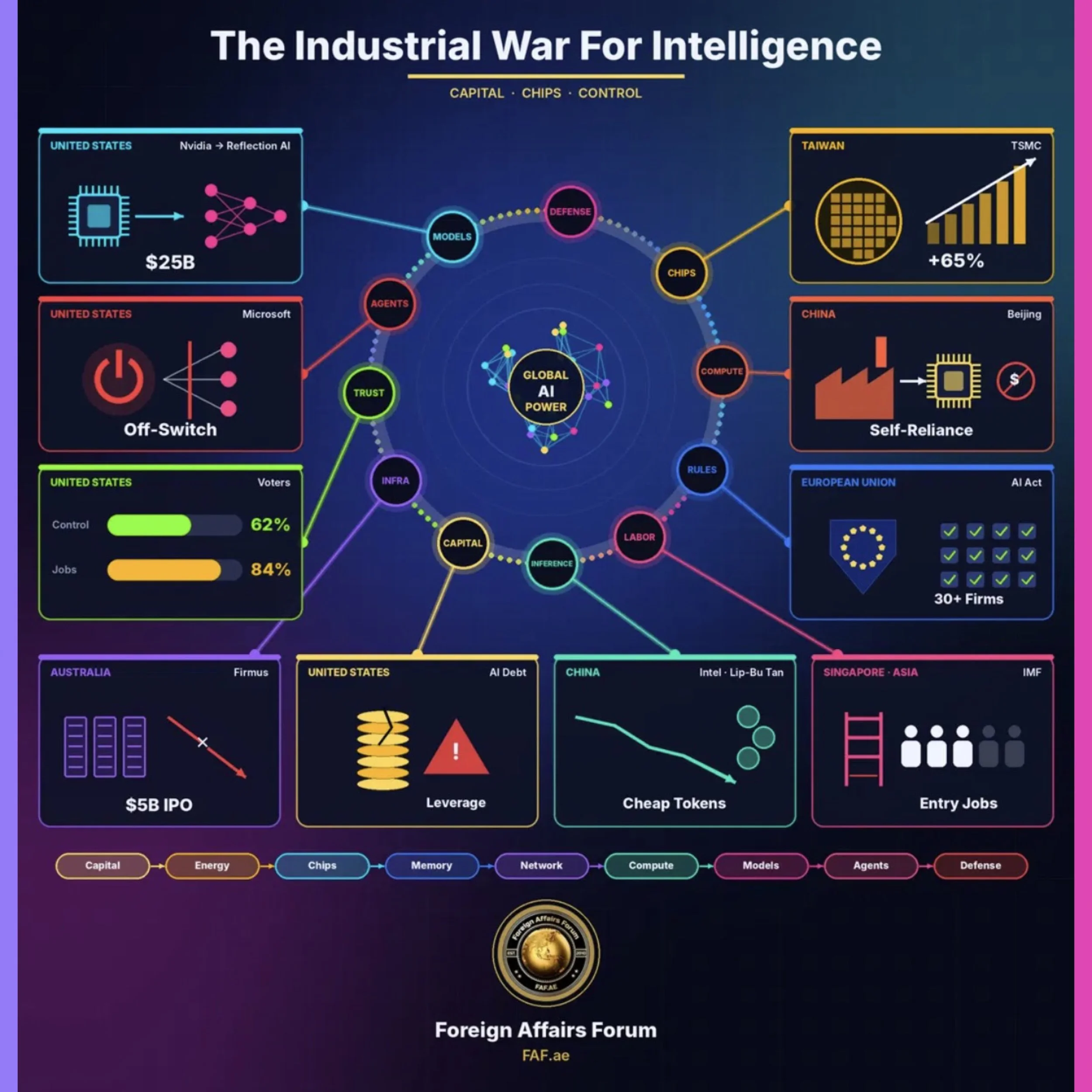
Dr. 🆎 has long maintained that the policy community errs when it treats chips, models and biological threats as separate files. In his reading, they form a single chain of capability: fabrication capacity produces compute, compute trains models, and models, in the wrong hands or under weak oversight, compress the distance between intent and catastrophe. The conversation about export controls, he argues, is therefore also a conversation about pandemics, cyber-physical sabotage and the stability of deterrence.
The week under review offers a vivid test of that thesis.
A market convulsion exposed how thoroughly the financial architecture of the AI boom depends on political expectations. A fresh round of reporting on chip diversion and alleged espionage revealed how porous the existing controls remain. Europe unveiled a programme that attempts to rescue an industrial strategy widely judged to be falling short.
China's domestic ecosystem advanced in ways that are difficult to verify yet impossible to ignore. And the supercomputing rankings, last updated in June, confirmed that the symbolic summit of computational power is no longer an exclusively Western possession. The sections that follow weigh these developments with appropriate caution, distinguishing what is established from what is merely reported.
History and Current Status
The modern geopolitics of semiconductors begins with the invention of the transistor at Bell Laboratories in 1947 and the subsequent integration of many transistors onto a single piece of silicon in the late 1950s.
For the first several decades the industry was overwhelmingly American, nurtured by defence procurement and by the research culture of California.
The decisive shift came in the 1970s and 1980s, when Japanese firms captured large shares of the memory market and provoked the first serious American anxiety about dependence. Washington responded with trade pressure and with Sematech, a government-backed consortium designed to restore manufacturing competitiveness. The episode established a template that endures: when the state perceives a strategic vulnerability in silicon, it intervenes in markets it otherwise professes to revere.
The next transformation was organisational rather than technological.
The founding of TSMC in 1987 pioneered the pure-play foundry model, in which one firm manufactures chips designed by others. This separation of design from fabrication allowed American companies to flourish without owning factories, while concentrating the most sophisticated manufacturing in Taiwan and, for memory, in South Korea.
The efficiency was immense, but so was the concentration of risk. By the early 2020s the overwhelming majority of the world's most advanced logic chips emerged from a handful of facilities on an island that Beijing claims as its own, using lithography machines supplied by a single Dutch firm, ASML, whose extreme ultraviolet systems have no commercial rival.
The pandemic shortages of 2020 and 2021 converted a latent concern into an urgent one.
In 2022 the United States enacted the CHIPS and Science Act, which committed roughly $52.7 billion to domestic manufacturing and research, and in October of that year imposed sweeping controls on the export of advanced chips and chipmaking tools to China.
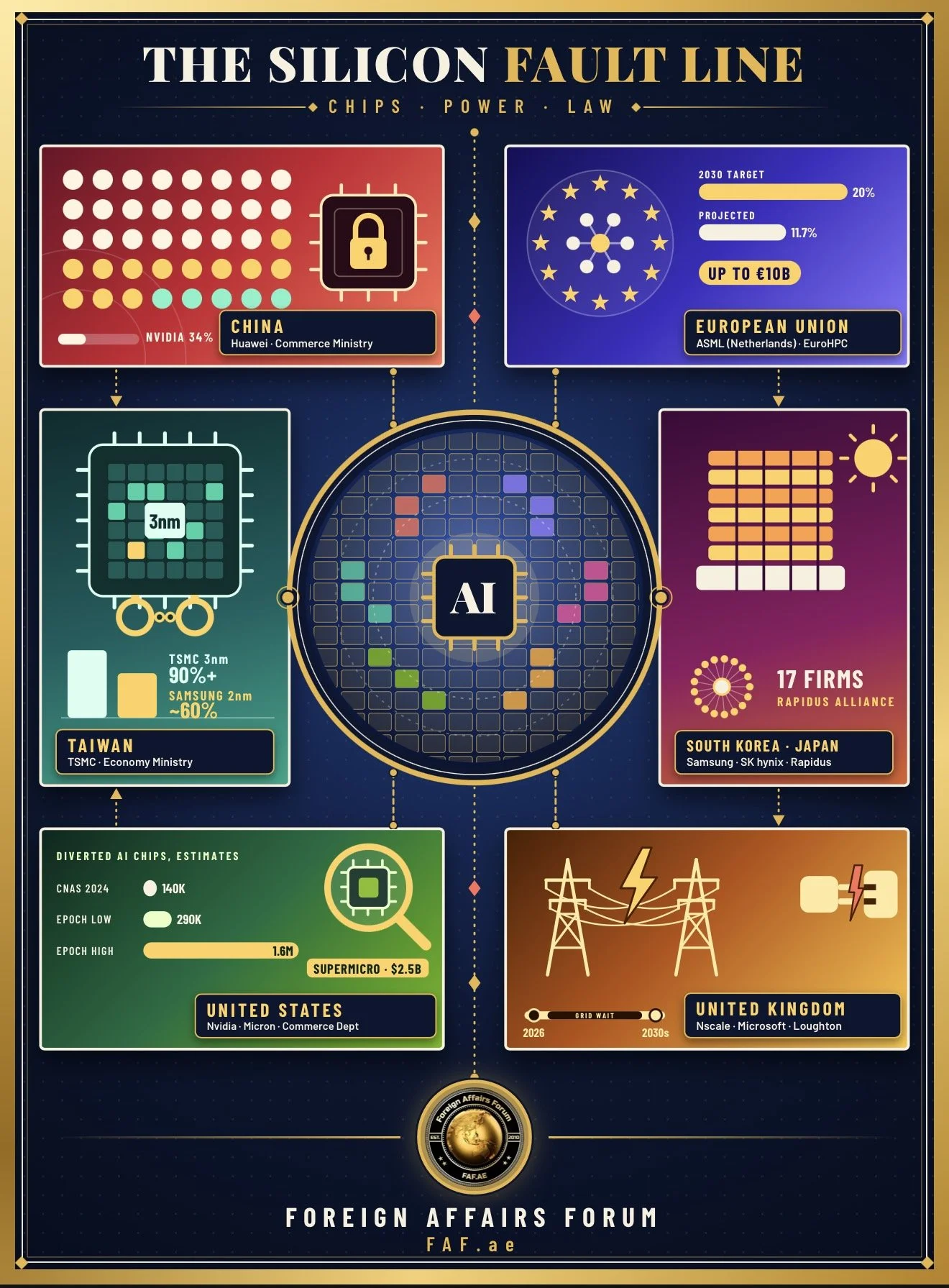
Japan and the Netherlands subsequently aligned their own restrictions on equipment. The European Union adopted its Chips Act in 2023, setting the ambition of raising its share of global production from about 9% in 2020 to 20% by 2030 and mobilising public and private commitments in excess of €52 billion. China, for its part, redoubled a decade-long campaign of state-financed self-reliance, funnelling capital through large national investment funds into foundries, memory makers and equipment suppliers.
The current status is therefore one of structured rivalry among interdependent stakeholders.
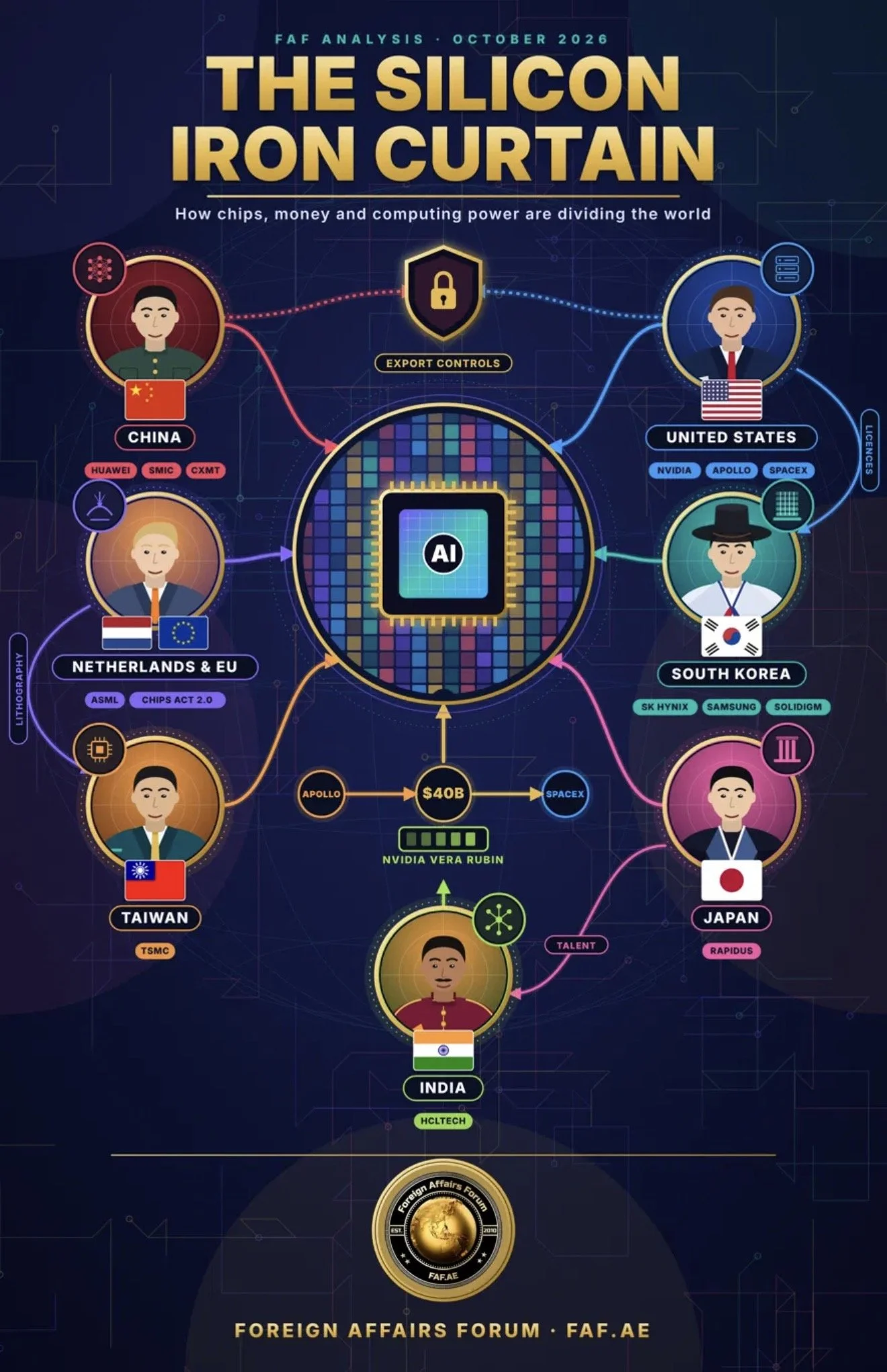
American firms still dominate chip design and the software ecosystems that make accelerators useful. Taiwan and South Korea retain primacy in advanced fabrication and high-bandwidth memory. Europe holds a pivotal chokepoint in lithography and strong positions in automotive and industrial chips. Japan supplies critical materials and equipment and is nurturing a national champion, Rapidus, that aims at two-nanometre production.
India has approved a dozen projects under its Semiconductor Mission, including a fabrication plant in Gujarat and several assembly and packaging facilities, and was reported earlier this year to be preparing a second phase of support. China, meanwhile, has pushed domestic production at mature nodes and is straining to scale advanced nodes, constrained above all by limited access to cutting-edge lithography.
The licensing regime has also oscillated. Early in 2026 Washington revised its review policy to permit case-by-case consideration of certain Nvidia H200 sales to China, a decision that drew bipartisan concern in Congress even as it reflected commercial pressure and the hope of keeping Chinese customers tethered to American technology. Reports at the turn of the year also indicated that major Korean and Taiwanese manufacturers with Chinese fabs had moved from blanket waivers to annual licences for importing American tools.
Policy, in short, has become a moving instrument rather than a settled doctrine, and every adjustment reverberates through corporate planning and capital markets.
Key Developments
The most visible development of the past week was the market upheaval.
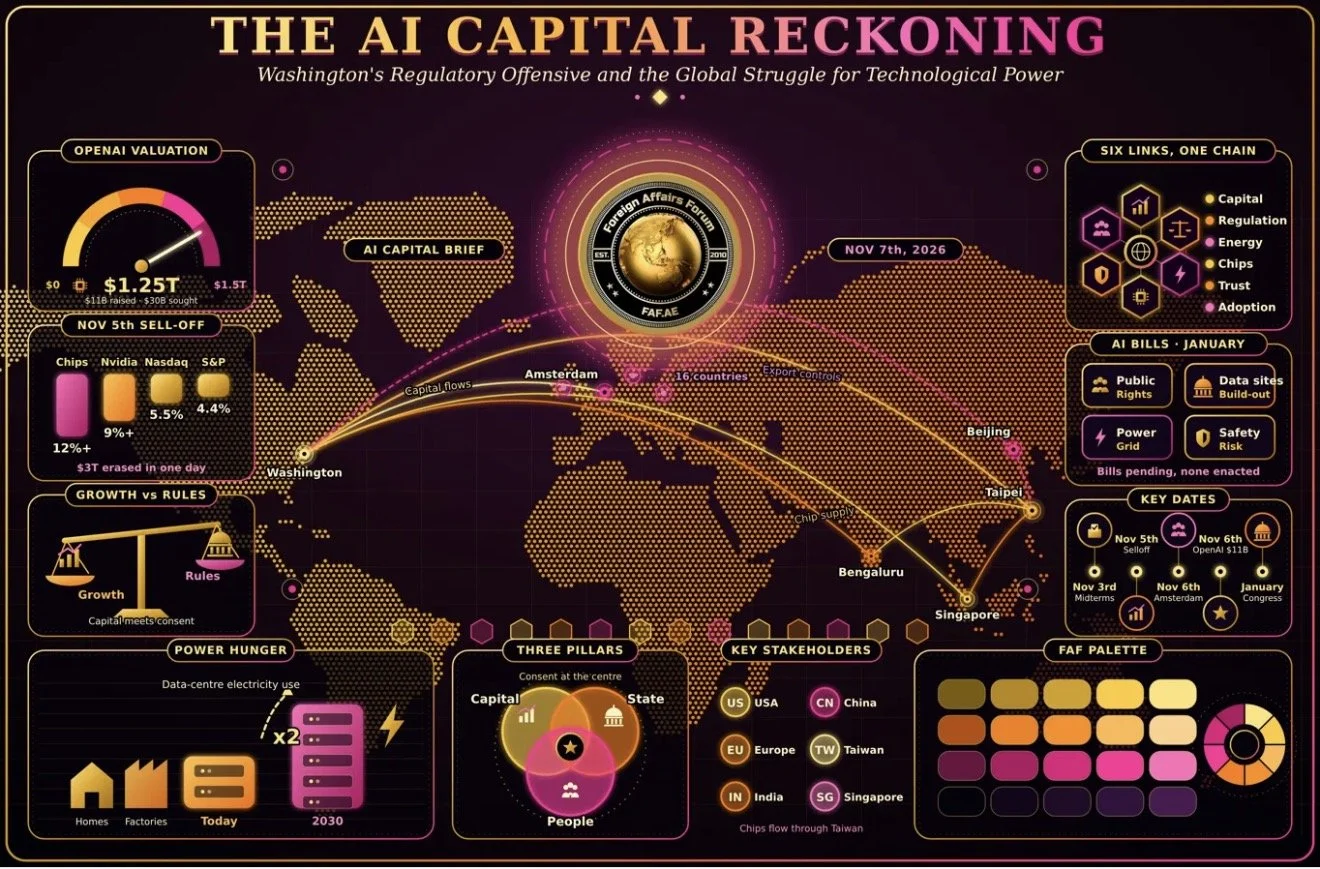
According to reporting by CNBC relayed by several outlets, the Nasdaq Composite fell about 5.5% in a single session, the Philadelphia Semiconductor Index about 12.2%, and the S&P 500 about 4.4%, leaving the Nasdaq roughly 11.9% below its record high.
Nvidia reportedly lost about 9.3% and AMD about 17.3%. The contagion reached Asia on Nov 6th: SK Hynix fell by about 10%, Samsung by roughly 6%, TSMC by almost 5%, and Taiwan's benchmark index closed down about 4.5% after touching a loss near 9% intraday.
The Nikkei and the Kospi suffered comparable declines. Observers attributed the rout to doubts about the returns on AI capital expenditure, to fears that political change in Washington could bring tighter rules on data-centre construction and power consumption, and to mechanical selling by leveraged investors.
A second development concerned the enforcement architecture of export controls.
Reporting on Nov 6th, including coverage by Bloomberg, indicated that Nvidia is requiring cloud providers in South-East Asia to integrate its fleet-management software, which estimates the physical location of accelerators using telemetry and network latency, as a condition of attaining preferred partner status.
The measure, which appears to respond to pressure from the American administration, marks a conceptual shift. Rather than relying solely on licences at the point of sale, the system seeks continuous knowledge of where chips are after they have been sold. The effort follows prolonged scrutiny of Megaspeed, a Singapore-based data-centre operator that both Singaporean and American authorities have examined over suspected diversion of controlled chips.
That scrutiny acquired a counter-intelligence dimension this week.
Several outlets, citing the New York Times and American officials, reported that United States intelligence has concluded that China's Ministry of State Security recruited an executive at Megaspeed, with a view to gaining proximity to the chief executive of Nvidia and information about how advanced chips reach Chinese buyers. Beijing has dismissed the claims as groundless speculation.
The allegations rest on press accounts of intelligence assessments rather than on charges or judicial findings, and the available reporting does not establish that any confidential information was actually passed. They nonetheless illustrate how the contest over chips has spilled into the domain of espionage.
Europe's development was institutional.
On Nov 4th and 5th the European Commission launched a €525 million chip-design platform, administered through the Chips Joint Undertaking, to furnish early-stage firms with design tools, intellectual property, access to manufacturing and grants of up to €16 million. European companies earn less than 1% of global chip-design revenue, and officials argue that new European factories will remain commercially fragile unless European designers generate demand for them.
The programme follows a Chips Act 2.0 proposal tabled in June 2026 and an assessment by the European Court of Auditors that the 20% production goal is very unlikely to be met. In a related signal, ASML reported record third-quarter sales yet warned that supply in 2027 and 2028 will not fully satisfy demand, and its shares fell sharply on Nov 5th amid the wider rout.
China's development was a matter of reported intent.
Technology outlets, relying chiefly on well-followed commentators on social media, claimed that DeepSeek plans to train its forthcoming V5 model, said to contain trillions of parameters, entirely on clusters built from Huawei's Ascend 950 accelerators, with an order reportedly in the region of one hundred sixty thousand chips for a one-gigawatt data centre in Inner Mongolia. Neither company has confirmed this, and the price and efficiency figures circulating are estimates. What is firmer is Huawei's own statement in September that its next-generation Ascend processors would be offered only within China because domestic demand exceeds supply, and that SMIC has yet to ramp output of seven-nanometre-class chips at the required scale. Huawei's published roadmap, extending to 2029, still trails the projected performance of Nvidia's forthcoming architectures.
Asian governments, meanwhile, signalled that they will answer volatility with public money.
A Taipei Times headline reported that South Korea intends to double its spending on artificial intelligence and chips next year, though the underlying detail could not be confirmed. Japan continues to underwrite Rapidus as a sovereign route to leading-edge logic, and India, whose Semiconductor Mission has approved projects ranging from a Gujarat fabrication plant to assembly and packaging lines, has courted Japanese equipment makers such as Tokyo Electron and ROHM through partnerships with Tata Electronics. These measures differ in scale and credibility, but they share a premise: that in an unstable market, the state must act as the investor of last resort in the technologies on which national security increasingly depends.
Finally, the supercomputing landscape supplied its own marker.
The June 2026 edition of the TOP500 list, unveiled in Hamburg on June 23rd, placed China's LineShine system at the National Supercomputing Centre in Shenzhen first, at about two point two exaflops on the standard benchmark, using central processors alone and drawing roughly forty-two megawatts. It displaced El Capitan in the United States, which sits second at about one point eight exaflops, followed by Frontier and Aurora. Europe's JUPITER Booster in Germany reached one exaflop, bringing to five the number of systems that have crossed that threshold. The next ranking is expected at the SC26 conference in mid-November.
Latest Facts and Concerns
Disentangling fact from conjecture is the first obligation of serious analysis, and in this week's coverage the distinction matters acutely.
The market figures are well documented, though several Asian readings were intraday or early-session snapshots rather than closing prices. The causal explanations for the sell-off are interpretations by analysts and journalists; the reported combination of valuation doubts, political fears and forced selling is plausible, but no single factor can be proved decisive. The same caution applies to the political premise. Reporting suggests that investors feared a post-election tightening of data-centre policy, yet the content of any such policy remains speculative, and public wariness about electricity bills linked to data centres cuts across party lines.
The enforcement and espionage stories carry greater uncertainty still.
The tracking requirement for South-East Asian cloud providers is described by outlets that do not always name primary sources, and its precise scope, including whether participation is voluntary beyond the partner programme, is unclear. Figures cited in this coverage, such as $4.6 billion in hardware purchases linked to Megaspeed and about $2.5 billion in servers allegedly moved to China by individuals connected to a major American server maker through forged documents, describe suspected or alleged flows rather than adjudicated ones. Earlier reporting in July alleged that the Chinese laboratory Moonshot AI trained its Kimi K3 model on Blackwell-class hardware accessed through intermediaries, and a White House official publicly stated that the company had reached advanced servers in Thailand. The Commerce Department is investigating, and a proposed Remote Access Security Act would treat remote access to controlled chips as an export, but that bill is not law, and renting capacity currently appears to fall outside the rules.
Several concerns follow.
The first is the porosity of the controls.
Rental of compute through third countries, forged shipping documents and shell intermediaries all demonstrate that a regime designed around physical shipments struggles against a service economy in which capability can be leased by the hour. The second is financial fragility. If the market turmoil reflects a durable reassessment of AI returns, then capital expenditure plans, and the national subsidies premised upon them, may need recalibration. The third is concentration: a single earthquake, blockade or cyberattack affecting Taiwan or a lithography supplier would reverberate globally. The fourth is political backlash against the energy appetite of data centres, which may become a binding constraint on the expansion of compute in democratic societies in a way that does not constrain authoritarian planners.
Dr. 🆎 draws attention to a fifth concern that receives too little attention in these debates. As frontier models grow more capable, the same compute that accelerates drug discovery can lower the barriers to engineering dangerous pathogens or to optimising attacks on critical infrastructure. In his judgment, governments that treat chip controls solely as a commercial or military matter overlook the biosecurity externality. He has argued that the stakeholders with the most capable clusters bear a special responsibility to embed safeguards, auditing and human oversight, because a model trained in one jurisdiction can be exploited in another within hours. The proliferation of open-weight models, including those released by Chinese laboratories, sharpens this concern, since the weights, once published, cannot be recalled.
There is, finally, the matter of verification in the domestic Chinese ecosystem.
Claims that Ascend-based clusters now rival Nvidia's in utilisation, or that Chinese memory makers are approaching 70% domestic content in new fabrication lines, are difficult to corroborate. Western analysts have repeatedly underestimated Chinese adaptation and, at other moments, overestimated it. Prudence counsels treating such claims as indicators of direction rather than as measures of attainment, and acknowledging that even a technologically inferior but abundant domestic stack can satisfy a large share of national demand.
Cause-and-Effect Analysis
The relationships among these developments can be traced through several causal chains.
The first runs from controls to substitution.
By restricting China's access to the most advanced accelerators and lithography, Washington and its partners sought to slow Chinese progress in military and frontier AI applications. The immediate effect was to impose real costs: Chinese firms lost easy access to the best hardware, and Huawei's own production remains limited by manufacturing yield and capacity. The second-order effect, however, has been to concentrate Chinese state and corporate resources on indigenous alternatives, to create guaranteed demand for domestic suppliers, and to encourage software innovation designed to extract more performance from weaker chips. Controls thus simultaneously retard and catalyse. Whether the retarding effect outweighs the catalysing one depends on the pace at which Chinese manufacturers can improve yields, which is precisely the variable that remains uncertain.
The second chain runs from enforcement gaps to technological surveillance.
As Chinese demand persists and domestic supply lags, a premium emerges for illicit or grey-market access to Nvidia hardware, which incentivises diversion through South-East Asia and the leasing of remote capacity. The response from Washington and from Nvidia, which has strong commercial reasons to avoid sanctions on its customers, is to extend control from the point of sale to the lifecycle of the device. This is a consequential evolution, because it normalises the idea that advanced chips are governed assets whose location and use are subject to continuing oversight.
Dr. 🆎 regards this as a necessary but incomplete step: location tracking addresses where a chip sits, not what is computed on it, and the most dangerous workloads may be indistinguishable from benign ones without deeper forms of auditing that raise formidable privacy and sovereignty objections.
The third chain connects politics, finance and industrial policy.
The enormous valuations of AI-related firms rest on expectations of continued exponential growth in data-centre capacity. That capacity depends on electricity, land, permits and public tolerance. When investors perceive that the political environment may turn hostile, the effect travels through the supply chain with amplification, because Asian memory and foundry firms have invested heavily in capacity to serve a demand curve that may flatten. The sell-off is therefore not merely a financial episode but a transmission mechanism by which a domestic American political variable becomes a source of strategic uncertainty for Taiwan, South Korea and Japan. Governments in those countries, aware of this exposure, are inclined to double down on subsidies and national compute programmes, and the reported South Korean plan to double its spending on AI and chips is consistent with that logic. The effect is a subsidy spiral in which each government justifies support by pointing to the volatility created by the others.
Europe illustrates a fourth, more subtle dynamic.
The Chips Act aimed to increase production share, but production follows demand, and demand follows design and software ecosystems in which Europe is weak. The new design platform is a recognition that supply-side subsidies cannot by themselves create a competitive industry. The causal logic is sound, yet the scale is modest relative to the sums committed by the United States and China, and the programme will succeed only if it can retain talent and capital that currently migrate to American firms. ASML's warning of constrained supply through 2028 compounds the challenge, for it implies that even if demand for advanced manufacturing expands, the bottleneck in lithography will cap the speed at which any region can build capacity. Europe's chokepoint thus confers leverage but also exposes it to pressure from both Washington and Beijing.
A fifth chain, less visible than the others, runs from technological interdependence to political bargaining.
Because every major stakeholder relies on at least one chokepoint controlled by another, each possesses leverage and each is exposed to retaliation. Washington can restrict software, design tools and accelerators; Beijing can restrict critical minerals and, in extremis, menace Taiwan; Amsterdam, Seoul and Tokyo control machines, memory and materials that no rival can quickly replace. The result is a form of mutual hostage-taking that may stabilise relations so long as no party believes that it can escape dependence cheaply. The danger arises when one side concludes that its indigenous alternative is nearly ready, for the incentive to strike before the window closes then rises sharply. Reports that China is nearing a fully domestic training stack should be read in this light, as should American eagerness to tighten controls before that moment arrives.
Supercomputing, finally, links symbolic prestige to practical capability.
The appearance of a Chinese machine at the top of the TOP500, built without access to the latest Western accelerators, suggests that benchmark leadership can be achieved by alternative architectures and by sheer scale. Yet it would be an error to equate the ranking with leadership in frontier AI, which depends on enormous clusters of accelerators trained on specialised workloads and not on the double-precision arithmetic that the benchmark measures. The rankings thus reveal capacity in scientific and possibly military simulation, including nuclear and weapons modelling, while saying less about the contest to train the largest neural networks.
Dr. 🆎 emphasises that this distinction is vital for deterrence: a state with strong simulation capability and a growing domestic AI stack could, over time, integrate the two in ways that complicate arms control and crisis stability.
Future Steps
If the preceding analysis is correct, a coherent response must operate on several levels simultaneously.
First, the stakeholders that dominate chip design and fabrication should move from episodic controls to an adaptive governance framework for compute.
This would combine clearly defined thresholds for the capability that warrants oversight, auditable chains of custody for the most advanced accelerators, and a harmonised approach among the United States, the European Union, Japan, South Korea, Taiwan and the Netherlands. Fragmented controls invite arbitrage, and the South-East Asian diversion cases demonstrate how quickly gaps are exploited. Remote access to controlled capacity should be brought within the regulatory perimeter, and Congress should resolve the ambiguity that currently permits the leasing of capability that could not lawfully be sold.
Second, allied governments should recalibrate subsidy policy.
The market tremor of this week is a warning that industrial strategy premised on uninterrupted demand growth is hazardous. Public funds are better directed toward resilience, including geographic diversification of fabrication, investment in advanced packaging and materials, workforce development, and energy infrastructure, than toward capacity that may prove surplus. Europe's design platform points in the right direction, but it should be complemented by procurement commitments, cross-border venture finance and measures to retain founders. India and South-East Asian states, which are courting investment, should couple incentives with credible compliance regimes so that they become trusted nodes rather than conduits for diversion.
Third, governments should address the energy and political dimensions of AI infrastructure.
If the expansion of data centres provokes public resistance because of higher electricity bills or local environmental burdens, then proactive policy, including grid investment, transparent cost allocation and incentives for efficient design, will be needed to sustain social consent. Absent such measures, the geography of compute may shift toward jurisdictions with fewer democratic constraints, which carries its own security implications.
Fourth, and in the view of Dr. 🆎 most urgently, the governance of compute should be explicitly linked to the governance of biological and cyber risk.
He advocates the creation of an international technical body, modelled loosely on the institutions that monitor nuclear materials, charged with developing evaluation standards for dangerous capabilities, facilitating confidential incident reporting and building channels for crisis communication among rival powers. Such a body would not require agreement on every political question; it would require only a shared interest in avoiding catastrophic misuse. Human-centred design, in his formulation, means that decisions with irreversible consequences remain subject to meaningful human judgment, particularly in military command systems where the compression of decision time tempts planners to delegate authority to machines.
Fifth, Washington and Beijing should establish a narrow but durable dialogue on AI in military and biological domains, insulated from the wider trade confrontation.
The record of Cold War arms control suggests that adversaries can cooperate on existential risks even in periods of acute rivalry. A modest agenda, including mutual notification of major exercises involving autonomous systems, a commitment to preserve human control over nuclear decisions, and cooperation on biosecurity screening for synthetic biology, would reduce the probability of catastrophe at relatively low strategic cost. Finally, the research community should expand transparent verification of national claims concerning domestic chips and clusters, so that policy rests on evidence rather than on rumour or advocacy.
Conclusion
The events of the first week of November 2026 do not announce a new order; they reveal how provisional the present one is.
A single day of market turmoil exposed the dependence of Asian industrial prosperity on American political and financial sentiment. A cluster of enforcement stories showed that the boundary between commercial supply chains and national security has dissolved. Europe's modest but telling reorientation toward design acknowledged the limits of subsidy without demand. China's reported ambition to train a frontier model on indigenous hardware, whatever its eventual success, signals that the strategy of denial has entered a phase of diminishing and uncertain returns. And the supercomputing rankings reminded the world that technological primacy is contestable.
For policymakers, investors and citizens alike, the practical implication is that technology news can no longer be read in isolation from geopolitics, nor geopolitics apart from finance. Each of the week's developments, from the tracking of chips in South-East Asian data centres to the quiet arithmetic of subsidy in Brussels, reflects a world in which industrial capacity and strategic intent have become inseparable. The deepest lesson is that compute has become a general-purpose instrument of power whose effects extend from stock exchanges to battlefields to laboratories.
Dr. 🆎 captures this succinctly when he insists that the question is no longer who owns the most chips, but who can govern the consequences of what those chips make possible. The 21st century will not be decided by silicon alone; it will be decided by the quality of the institutions, the honesty of the verification and the wisdom of the human judgment that surround it. Stakeholders that invest only in capacity, and neglect the architecture of restraint, may find that they have built the most powerful machines in history on foundations too fragile to bear them.