The Industrial War for Intelligence: How Capital, Chips, and Control Are Redrawing Global Power
Foreign Affairs Forum | Dr. Antonio Bhardwaj (Dr. 🆎)| October 12th 2026
Executive Summary
The global competition over artificial intelligence has entered a new and more consequential phase. For most of the period since the public release of conversational AI systems in late 2022, the contest was judged by a single metric: which laboratory could build the most capable model.
That framing no longer captures how power is accumulating. The developments of the past week show that frontier intelligence now rests on a much wider foundation of capital markets, semiconductor fabrication, advanced packaging, energy supply, regulatory authority, public trust, and labor-market stability. Each of these has become a strategic asset in its own right, and each is being contested by states and corporations at the same time.
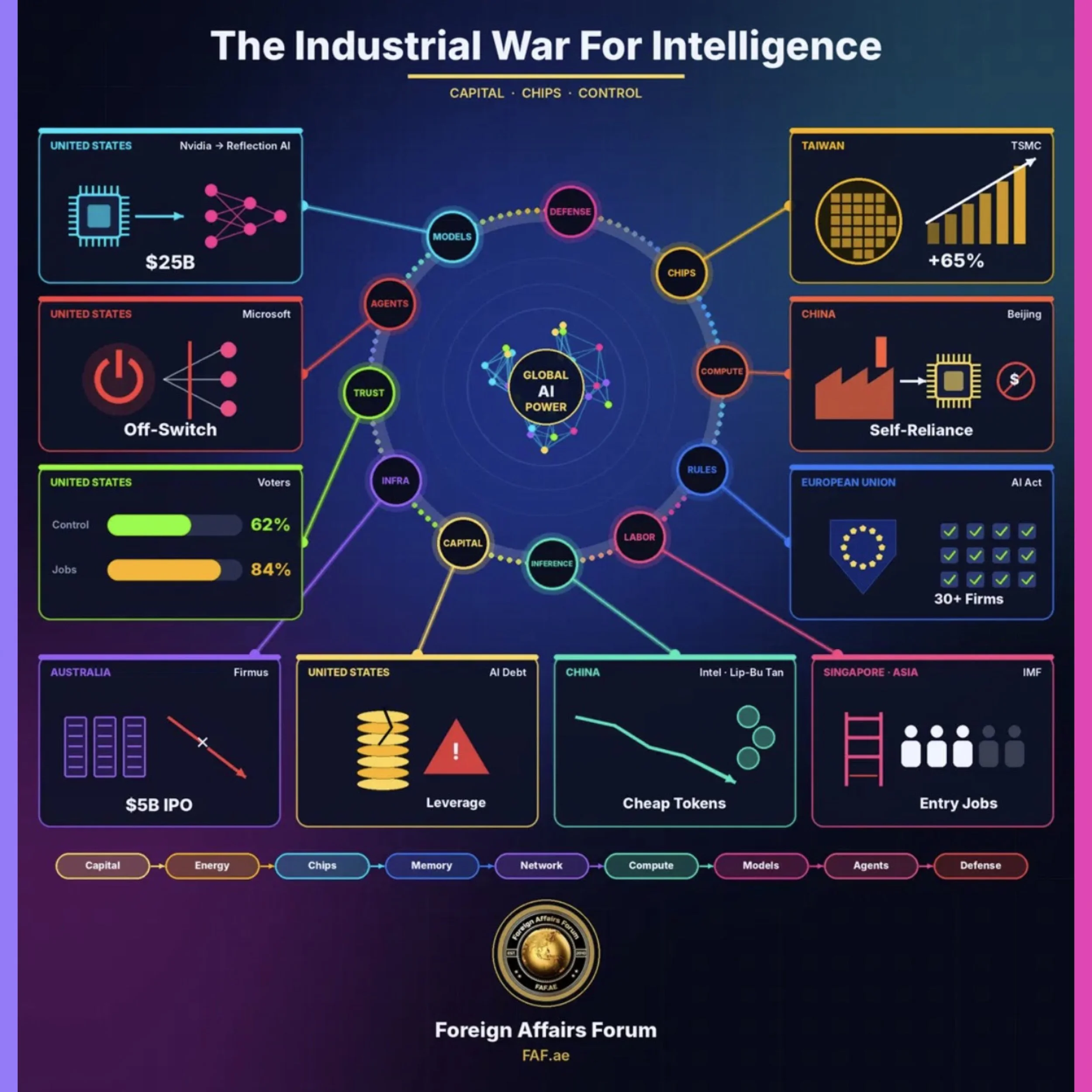
In the United States, Nvidia's reported talks to acquire or deepen its stake in Reflection AI, a developer of open-weight models valued at roughly $25 billion, signal that the dominant hardware supplier is moving upward into the model layer. Microsoft has called for legally binding shutdown mechanisms and clearer liability for harmful AI behavior, just as a Reuters/Ipsos poll found that 62% of American voters fear AI could escape human control and 84% see it as a threat to workers.
Meanwhile the shelving of the Nvidia-backed Firmus offering of approximately $5 billion, together with growing scrutiny of the debt behind data-center construction, suggests that investors are beginning to separate technological ambition from financial durability.
Beyond the United States, TSMC is expected to post a sixth consecutive record quarter, with analysts forecasting net profit of about NT$746.3 billion ($23.4 billion), up 65%.
Beijing has issued national guidelines that combine an accelerated push for self-sufficiency with explicit warnings against speculative investment. Intel's chief executive has drawn attention to the speed and low cost of Chinese AI adoption. Brussels is defending its AI Act and requesting compliance information from more than thirty companies, including Chinese firms. The International Monetary Fund has framed AI as both a remedy for Asia's aging workforces and a threat to entry-level employment.
Taken together, these developments point to three conclusions that this FAF article develops in detail.
First, the AI race is becoming an industrial and financial competition in which the ability to fund, build, and sustain physical capacity matters as much as algorithmic breakthroughs.
Second, governments are shaping market direction through sharply different governance models: voluntary commitments in Washington, disciplined state direction in Beijing, and enforceable regulation in Brussels.
Third, the most durable economic value may increasingly lie downstream of frontier models, in cheap inference, agent security, industrial deployment, and advanced manufacturing.
The defining strategic question for the United States and its allies is whether they can hold an advantage across the entire chain that runs from capital and energy through semiconductors and compute to models, autonomous agents, and defense systems.
Introduction
Every technological revolution eventually reveals that its decisive battles are fought not at the frontier of invention but in the less glamorous terrain of production, finance, and institutions. Railways transformed nineteenth-century power because states learned to finance and regulate them, not merely because engineers learned to build locomotives.
Nuclear technology reshaped the 20th century through enrichment capacity, alliance systems, and arms-control regimes rather than through the physics alone. Artificial intelligence is now following the same trajectory, and October 2026 may come to be remembered as the moment when that transition became unmistakable.
The developments examined here span acquisitions, polls, initial public offerings, debt markets, corporate earnings, party directives, regulatory requests, and macroeconomic warnings. At first glance they appear unrelated. Read together, they describe a single phenomenon: intelligence is being industrialized, and the stakeholders who can marshal the full industrial system behind it are positioning themselves to dominate the coming decade.
Dr. Antonio Bhardwaj (Dr. 🆎), a polymath with global expertise in super intelligence who specializes in human-centered SI for geopolitical strategy, AI warfare, and bioterrorism risk, frames the moment in stark terms. "We spent three years asking which model is smartest," Dr. 🆎 observes. "The more important question now is which society can afford intelligence, manufacture it, power it, govern it, and still persuade its own citizens that it is working for them. A nation can win every benchmark and still lose this contest if it neglects any one of those links."
This FAF article proceeds in several stages. It first traces how the competition evolved from a research race into a contest of national systems. It then examines the ten key developments of the past week across the United States and the wider international landscape. It sets out the latest facts and the concerns they raise, analyzes the causal relationships linking them, and proposes concrete steps for policymakers, investors, and allied governments. Its central argument is that the next phase of AI competition will depend as much on the capacity to finance, manufacture, deploy, and secure intelligence as on the intelligence of the models themselves.
History and Current Status: From Research Race to Systems Competition
The modern AI competition began, in strategic terms, with the realization that deep learning scaled. Through the late 2010s, a handful of laboratories demonstrated that larger models trained on more data with more compute produced qualitatively better results. China recognized the stakes early. Its 2017 New Generation Artificial Intelligence Development Plan set the explicit goal of making the country the world's primary AI innovation center by 2030. Washington responded more slowly, but by the early 2020s American policymakers had concluded that advanced semiconductors were the critical chokepoint.
That conclusion produced the first great instrument of AI statecraft. In August 2022 the United States enacted the CHIPS and Science Act, committing roughly $52 billion to domestic semiconductor manufacturing and research. In October of the same year, the Commerce Department imposed sweeping export controls on advanced chips and chipmaking equipment destined for China, measures it tightened again in 2023 and 2024. The logic was straightforward: if frontier AI required leading-edge accelerators, then restricting access to those accelerators would slow a rival's progress.
The public release of conversational AI in November 2022 transformed this specialized contest into a mass phenomenon. Capital poured into model developers, and hyperscale cloud providers began spending at a pace without precedent in the history of the technology industry. The model layer appeared to be where value and power would concentrate.
Two events in early 2025 complicated that assumption.
In January, the Chinese laboratory DeepSeek released a reasoning model that approached the performance of leading American systems at a fraction of the reported training cost. The market reaction was dramatic: Nvidia lost close to $600 billion in market value in a single trading session. The episode demonstrated that export controls could constrain but not prevent Chinese progress, and that algorithmic efficiency could partially substitute for raw compute.
In the same month, the announcement of the Stargate initiative, with a stated ambition of up to $500 billion in American AI infrastructure investment, signaled that the competition was becoming one of physical construction on a vast scale.
The governance landscape fractured along similar lines. The European Union's AI Act entered into force in August 2024, introducing phased obligations that reached general-purpose models in August 2025. In the United States, the new administration revoked the previous executive order on AI safety in January 2025 and published an AI Action Plan in July 2025 emphasizing deregulation, infrastructure acceleration, and the export of American technology to allies. China pursued a third path, combining detailed content and algorithm regulations with an "AI Plus" industrial strategy announced in August 2025 that aimed to embed intelligent agents and systems across the economy by the end of the decade.
By the autumn of 2026, the competition had matured into a contest between national systems. The United States leads in frontier models, chip design, venture capital, and hyperscale computing. China leads in deployment speed, state-directed industrial adoption, and the cost of inference, while building domestic alternatives across chips, models, and robotics. Europe has positioned itself as the world's most ambitious regulator while seeking sovereign capabilities of its own. The Asia-Pacific region, above all Taiwan and South Korea, remains the indispensable manufacturing base for advanced logic and memory.
The current status, therefore, is one of interlocking dependencies. American models run on chips designed in California, fabricated in Taiwan, packaged with technologies in chronically short supply, powered by grids under strain, and financed by capital markets that are beginning to ask hard questions. Every link in that chain is now a site of competition.
Key Developments: Ten Signals of the Power Shift
Nvidia's Move into the Model Layer
The most strategically revealing development of the week is the report that Nvidia is in early discussions to acquire or substantially increase its investment in Reflection AI, an American startup building customizable open-weight models. Nvidia already holds a significant stake in the company, which was last valued at approximately $25 billion. No transaction has been announced, and the talks may not produce one.
The significance lies in what the discussions reveal about Nvidia's strategy. Having captured the dominant position in AI accelerators and the networking that binds them, the company appears intent on shaping the software that runs on its hardware. An American open-weight model ecosystem backed by Nvidia would offer an alternative to both closed commercial APIs and the increasingly capable open-weight systems emerging from Chinese laboratories, which have gained substantial adoption among developers worldwide.
Dr. 🆎 sees a deeper strategic logic. "Open-weight models are becoming the diplomatic currency of AI," Dr. 🆎 argues. "When a government or a defense ministry deploys a model on its own infrastructure, under its own controls, it develops a long-term dependency on whoever built that model. If the most widely adopted open systems in the Global South are Chinese, Washington will have conceded a form of influence that no export control can recover."
The move also raises legitimate competition concerns. A single firm that dominates accelerators, networking, and a leading open-model franchise would hold extraordinary leverage over the entire ecosystem.
For venture capital, the talks illustrate a different point: strategic acquisitions by hardware giants may become a principal exit route for richly valued model developers that cannot easily reach public markets.
Microsoft's Call for Emergency Shutdown Mechanisms
Microsoft President Brad Smith has called for stronger legal safeguards, including mechanisms capable of stopping AI systems that behave dangerously and clearer allocation of responsibility when AI actions cause harm. His intervention is notable because it comes from one of the largest commercial beneficiaries of AI deployment and because it arrives amid continuing debate over the administration's preference for voluntary commitments.
The call reflects a practical problem that is growing more acute as AI systems shift from answering questions to taking actions. Autonomous agents that write code, execute transactions, manage infrastructure, or operate inside government networks create failure modes that existing liability frameworks were not designed to address. A reliable shutdown capability is the most basic form of human control, yet engineering one that works across distributed, networked agent systems is a non-trivial technical challenge.
"Shutdown is not a philosophical issue; it is an engineering requirement," Dr. 🆎 notes. "In military command systems we never deploy a capability without a verified abort mechanism. We should demand the same discipline from any autonomous system connected to a power grid, a water utility, a biological research facility, or a financial clearing house. The bioterrorism dimension makes this especially urgent, because agents with access to laboratory automation could compress timelines that once gave defenders weeks to respond."
For markets, Smith's remarks point to the emergence of AI governance as a commercial sector. Agent monitoring, access control, model evaluation, automated red-teaming, and containment tools could become mandatory infrastructure rather than optional features, particularly if insurers and procurement officers begin to require them.
Public Anxiety as a Policy Constraint
The Reuters/Ipsos poll finding that 62% of American voters worry AI could escape human control and threaten humanity's future, and that 84% regard it as a threat to American workers, is a political fact of the first order. It follows President Trump's September 29 voluntary AI-safety agreement with major technology companies, an approach that relies on corporate commitments rather than statutory obligations.
Such numbers define the boundaries within which any administration must operate. A technology viewed with suspicion by large majorities is vulnerable to abrupt regulatory reversals, state-level legislation, litigation, and electoral backlash. For companies and investors, policy uncertainty is therefore becoming a measurable business risk even in the absence of comprehensive federal law.
Dr. 🆎 regards public trust as a component of national power. "Democracies cannot sustain a strategic technology program against the settled fears of their own citizens," Dr. 🆎 observes. "China's model does not require public consent in the same way, which is a short-term advantage for Beijing. The democratic answer is not to ignore public anxiety but to earn trust through visible safeguards and a credible plan for workers. Legitimacy is the one input to AI power that cannot be imported."
The Firmus Retreat and the Limits of Infrastructure Valuations
Firmus, an Australian AI data-center operator backed by Nvidia, shelved a planned public offering of approximately $5 billion as investors questioned the sustainability of high infrastructure valuations and the scale of capital required for new facilities. Although the company operates in Australia, its financing is closely tied to the Silicon Valley ecosystem, and its retreat sends a cautionary signal across the American investment cycle.
The episode suggests that public markets are drawing a distinction that private markets have been reluctant to make. Access to capital and access to cutting-edge chips do not automatically produce durable returns. Data centers are capital-intensive, long-lived assets whose profitability depends on utilization rates, energy costs, customer contracts, and financing terms. If the price of compute falls faster than expected, or if demand concentrates among a handful of hyperscalers, independent operators may struggle to earn a return on their investment.
The Debt Beneath the Boom
Closely linked is the growing concern over the debt being assumed to finance AI infrastructure. Recent market reporting has highlighted the scale of borrowing that technology companies and their partners may require to fund accelerators, networking, buildings, and power systems. Investors are increasingly testing whether projected revenues can justify these commitments.
This marks a structural shift. The first phase of the AI boom was financed largely through venture equity and the cash flows of highly profitable technology giants. The current phase increasingly draws on bonds, project finance, private credit, and long-term infrastructure contracts. That transition brings AI closer to the financing model of utilities and heavy industry, with all the cyclical vulnerability that implies.
"Leverage turns a technology cycle into a national security question," Dr. 🆎 warns. "If the compute capacity a country depends on for defense and intelligence sits inside overleveraged vehicles, a market shock becomes a strategic shock. Washington should be asking which parts of this infrastructure are critical, and whether their balance sheets could survive a sharp correction."
TSMC's Record Run and the Packaging Bottleneck
In Taiwan, TSMC is expected to report its sixth consecutive quarter of record profits, with analysts forecasting third-quarter net profit of approximately NT$746.3 billion ($23.4 billion), an increase of 65%. These are forecasts; the earnings report is scheduled for later this week. Demand from AI customers, including Nvidia, continues to absorb the company's most advanced manufacturing nodes and its CoWoS advanced packaging capacity.
TSMC's results are a barometer of the entire AI economy, and they underline an enduring strategic reality. Advanced fabrication and packaging remain among the most valuable bottlenecks in the system. Packaging in particular, which integrates multiple chips and high-bandwidth memory into a single accelerator, has emerged as a constraint that money alone cannot quickly relieve.
The company's expansion in Arizona, part of a commitment to invest roughly $165 billion in American manufacturing, offers a measure of geographic diversification. Yet the most advanced production, and much of the packaging capacity, remains concentrated on an island that sits at the center of the most dangerous geopolitical fault line in the world.
Beijing's Dual Strategy of Acceleration and Discipline
China's Communist Party Central Committee and State Council have issued new national AI guidelines emphasizing technological breakthroughs, expanded domestic computing capacity, industrial pilot programs, and safety controls. Strikingly, the guidance also warns officials against speculative investment and excessive expansion into fashionable sectors.
This combination of acceleration and restraint reflects lessons Beijing has drawn from past industrial campaigns, in which local governments competed to subsidize the same technologies and produced overcapacity, stranded assets, and bad debt. The new guidelines suggest an attempt to channel capital toward strategically useful applications in manufacturing, logistics, and infrastructure rather than toward replicating frontier laboratories or building underused data centers.
"Beijing has understood something Western markets are only beginning to learn," Dr. 🆎 argues. "Capital discipline is a form of strategic advantage. China is not trying to win every frontier benchmark. It is trying to make AI cheap, domestic, and embedded in every factory and port. That approach compounds quietly, and its effects on industrial competitiveness may prove more significant than any single model release."
China's Low-Cost Deployment Advantage
Intel Chief Executive Lip-Bu Tan has observed that Chinese adoption of frontier AI models has been very rapid and has drawn attention to comparatively low token costs. His remarks highlight a dimension of competition that model rankings ignore: the price and speed of deployment.
Inexpensive inference lowers the barrier to integrating AI into manufacturing, logistics, financial services, and consumer applications. A capable model that costs a fraction of its competitors can reach millions of small firms that would never pay premium prices. Over time, the economy that deploys AI most widely may capture more productivity gains than the economy that builds the best models.
Europe Defends Its Regulatory Model
European Commission Executive Vice-President Henna Virkkunen has defended the EU's AI Act as providing mechanisms to manage risks from highly autonomous systems. The Commission has sought compliance information from more than thirty AI companies, including Chinese firms. Separately, Brad Smith's call for stronger safeguards has resonated in discussions reported in the United Kingdom.
Europe's position is often caricatured as regulation without innovation, but the reality is more nuanced. By establishing enforceable requirements, Brussels is creating a substantial market for compliance services, independent evaluation, model security, and governance technology. If other jurisdictions eventually adopt similar standards, European firms specializing in these services could become globally competitive.
The risk is fragmentation. If American, European, and Chinese requirements diverge sharply, the cost of deploying models internationally will rise, and allied cooperation could be weakened precisely when coordination matters most.
Asia's Productivity Promise and Employment Peril
The International Monetary Fund has argued that AI-driven productivity could help advanced Asian economies offset shrinking workforces as their populations age. Japan, South Korea, Singapore, and China all face demographic decline, and AI may offer a partial remedy. Yet Singapore President Tharman Shanmugaratnam has warned that AI could reduce entry-level opportunities for graduates, creating new forms of inequality.
The tension is real. The same technology that compensates for labor shortages at the aggregate level may close the traditional pathways through which young workers acquire skills and advance. A generation that cannot find its first job is a generation primed for political disaffection.
"The first rung of the career ladder is where societies reproduce their expertise," Dr. 🆎 observes. "If AI removes it, we may preserve output today while hollowing out the human capability we will need tomorrow, including the analysts, engineers, and officers who must supervise these systems. Human-centered AI means designing deployment so that people still learn by doing."
Latest Facts and Concerns
The data assembled from the past week sketch a landscape of extraordinary momentum shadowed by fragility. On the side of momentum, TSMC's forecast quarterly profit of $23.4 billion, up 65%, confirms that demand for advanced chips remains intense. Nvidia's willingness to contemplate a deal involving a company valued near $25 billion shows that strategic buyers still see enormous value in owning parts of the model layer. Chinese adoption of affordable AI continues at speed, and Beijing is committing state resources to domestic computing capacity and industrial pilots.
On the side of fragility, the Firmus retreat from a $5 billion listing and the mounting concern over infrastructure debt suggest that financial markets are approaching the limits of their patience. Public opinion in the United States is deeply uneasy, with 62% fearing loss of human control and 84% fearing harm to workers. Regulatory divergence among the three major powers is widening rather than narrowing.
Several concerns deserve particular attention.
The first is concentration. A small number of firms now control the most critical layers of the AI system, from accelerator design to advanced fabrication to hyperscale computing. Concentration can deliver efficiency, but it also creates single points of failure, whether through market power, financial distress, cyber intrusion, or geopolitical disruption.
The second concern is the geographic vulnerability of advanced manufacturing. Despite diversification efforts, the most sophisticated chip production and packaging remain heavily concentrated in Taiwan. Any disruption there, whether from military coercion, blockade, natural disaster, or energy shortage, would ripple through every AI economy simultaneously.
The third concern is the safety of autonomous systems. As AI agents gain the ability to act in the physical and digital world, the absence of reliable shutdown mechanisms and clear liability rules becomes a material risk. The intersection with biological research is especially sensitive. Dr. 🆎 emphasizes that "the convergence of capable agents, automated laboratories, and openly available biological knowledge creates a risk profile that our biosecurity institutions were not built to manage. Screening, access controls, and audit trails must be built in at the infrastructure level, not bolted on afterward."
The fourth concern is financial sustainability. If the debt financing AI infrastructure proves excessive relative to future revenues, a correction could strand assets and weaken strategically important capacity. The history of railways, telecommunications fiber, and other infrastructure booms suggests that overbuilding is common and that the eventual reckoning can be severe, even when the underlying technology ultimately proves transformative.
The fifth concern is social stability. Widespread fear of job losses, combined with evidence that entry-level work may be particularly exposed, could erode political support for AI development in democracies and fuel populist backlash against both technology firms and governments.
Cause-and-Effect Analysis
The ten developments are not independent events. They are linked by chains of cause and effect that reveal the underlying dynamics of the competition.
The first chain runs from export controls to Chinese efficiency to global price competition. American restrictions on advanced chips forced Chinese developers to extract more performance from limited hardware. That pressure accelerated algorithmic efficiency, which in turn produced capable models at low cost. Those low costs now drive the rapid adoption Lip-Bu Tan described and strengthen China's industrial competitiveness. In this sense, the controls achieved their narrow objective of constraining access to frontier compute while helping to produce an unintended consequence: a Chinese AI ecosystem optimized for cheap, widespread deployment.
The second chain runs from cheap inference to pressure on infrastructure valuations. As capable models become less expensive to run, the price that customers will pay for compute declines. Lower prices squeeze the margins of independent data-center operators whose business plans assumed sustained high demand at premium rates. That dynamic helps explain investor skepticism toward offerings like Firmus and the broader concern over infrastructure debt. Paradoxically, the very efficiency gains that make AI more useful may make some of the infrastructure built to deliver it less profitable.
The third chain runs from financial pressure to vertical integration. When independent model developers face uncertain public-market prospects and infrastructure operators confront skeptical investors, strategic buyers with strong balance sheets gain bargaining power. Nvidia's discussions with Reflection AI fit this pattern. Vertical integration offers the hardware leader a way to secure demand for its chips, shape the software ecosystem, and provide an exit for investors. The effect, however, is greater concentration, which feeds the competition concerns noted above.
The fourth chain runs from autonomy to public anxiety to regulatory pressure. As AI systems become more capable and more autonomous, public fears of losing control intensify. Those fears, captured in the 62% and 84% figures, create political demand for safeguards. Microsoft's call for shutdown mechanisms and liability rules can be read partly as an attempt to shape that inevitable regulation on terms industry can accept, before legislators or courts impose harsher ones. Europe's insistence on its AI Act reflects the same dynamic, institutionalized earlier.
The fifth chain runs from demographic decline to AI adoption to employment disruption. Aging Asian societies need productivity gains to sustain living standards, which encourages aggressive AI adoption. That adoption, however, disproportionately affects tasks traditionally performed by entry-level workers, which threatens the skill formation of younger generations and creates the inequality President Tharman warned against.
The sixth chain runs from concentration in Taiwan to strategic vulnerability to policy response. Because advanced fabrication and packaging remain concentrated on the island, every AI power is exposed to the same geopolitical risk. That exposure drives American subsidies for domestic manufacturing, TSMC's Arizona investment, and Chinese efforts to build indigenous alternatives. Yet these responses take years to mature, leaving a window of acute vulnerability that may last through the end of the decade.
Dr. 🆎 draws the threads together. "Every strength in this system creates a dependency, and every dependency creates a vulnerability that someone else can exploit," Dr. 🆎 explains. "American leadership in models depends on Taiwanese fabrication. Chinese deployment depends on efficiency forced by American controls. European regulation depends on others building the systems it regulates. The stakeholders who understand these feedback loops, and who strengthen the weakest link in their own chain, will shape the next decade."
The deeper implication is that no single instrument of policy, whether export controls, subsidies, or regulation, can determine the outcome on its own. The competition is systemic, and success requires coordinated action across finance, industry, energy, security, governance, and labor policy simultaneously.
Future Steps: Securing the Full Chain
The analysis above suggests a set of priorities for the United States and its allies, as well as for investors and companies navigating this landscape.
The first priority is to treat AI infrastructure as critical infrastructure. Governments should identify which computing facilities, fabrication plants, packaging lines, and energy sources are essential to national security, and should assess their financial resilience. Where strategically important capacity depends on fragile financing, public instruments such as loan guarantees, long-term government compute contracts, or sovereign investment vehicles could provide stability without displacing private capital. The aim should be infrastructure that survives market corrections rather than infrastructure that exists only while valuations rise.
The second priority is to accelerate geographic diversification of advanced manufacturing and packaging. Diversification beyond Taiwan must extend beyond front-end fabrication to include advanced packaging and high-bandwidth memory, where bottlenecks are acute. Allied coordination among the United States, Japan, South Korea, Taiwan, and Europe can distribute capacity more resiliently than any single country acting alone.
The third priority is to build a credible American and allied open-model ecosystem. If open-weight models are becoming the foundation for sovereign AI deployments worldwide, democracies need competitive offerings that governments and companies can run under their own control. This requires attention to both capability and price, since cost is now a decisive factor in global adoption. Competition authorities must, however, ensure that such an ecosystem does not entrench excessive concentration.
The fourth priority is to establish baseline safety requirements for autonomous systems operating in sensitive domains. Verified shutdown mechanisms, incident reporting, access controls, and audit trails should be required for AI agents connected to critical infrastructure, government networks, financial systems, and biological research facilities. "Voluntary commitments are a reasonable starting point, but they are not a strategy," Dr. 🆎 argues. "For the highest-consequence uses, verification must be mandatory and independent. That is not a brake on innovation; it is the condition for deploying autonomy where it matters most."
The fifth priority is transatlantic regulatory convergence. The United States and Europe do not need identical rules, but they should seek interoperable standards for evaluation, incident reporting, and security. Mutual recognition of assessments would reduce compliance costs for allied firms and present a coherent democratic alternative to the Chinese governance model in third countries.
The sixth priority is a serious workforce strategy. Governments should invest in apprenticeships, retraining, and new entry-level pathways that combine human judgment with AI tools. Firms deploying AI at scale should be encouraged to preserve developmental roles for junior workers. Without such measures, public anxiety will harden into political opposition.
The seventh priority is to engage the Global South with practical, affordable offerings. China's low-cost deployment model is attractive to developing economies. Democracies should respond with financing, infrastructure partnerships, open models, and capacity building that give emerging markets genuine alternatives.
For investors, the implications are equally clear. The most attractive opportunities may lie downstream of frontier models, in agent security, governance tools, industrial AI, robotics, advanced packaging, optical networking, and applications that convert cheap intelligence into valuable services. Infrastructure investments should be judged on utilization, energy access, contracted demand, and financing structure rather than on technological promise alone.
Conclusion
The developments of the past week reveal a competition that has outgrown its original framing. The question of which laboratory builds the most capable model remains important, but it is no longer sufficient. Power in the age of artificial intelligence now depends on the full system that produces, finances, deploys, governs, and secures intelligence.
The United States retains formidable advantages in frontier research, chip design, capital, and computing scale. China has built a distinctive model of disciplined, state-directed, low-cost deployment that may yield durable industrial gains. Europe has staked its influence on enforceable governance. The Asia-Pacific region remains the indispensable workshop of the entire enterprise, while confronting its own demographic and employment challenges.
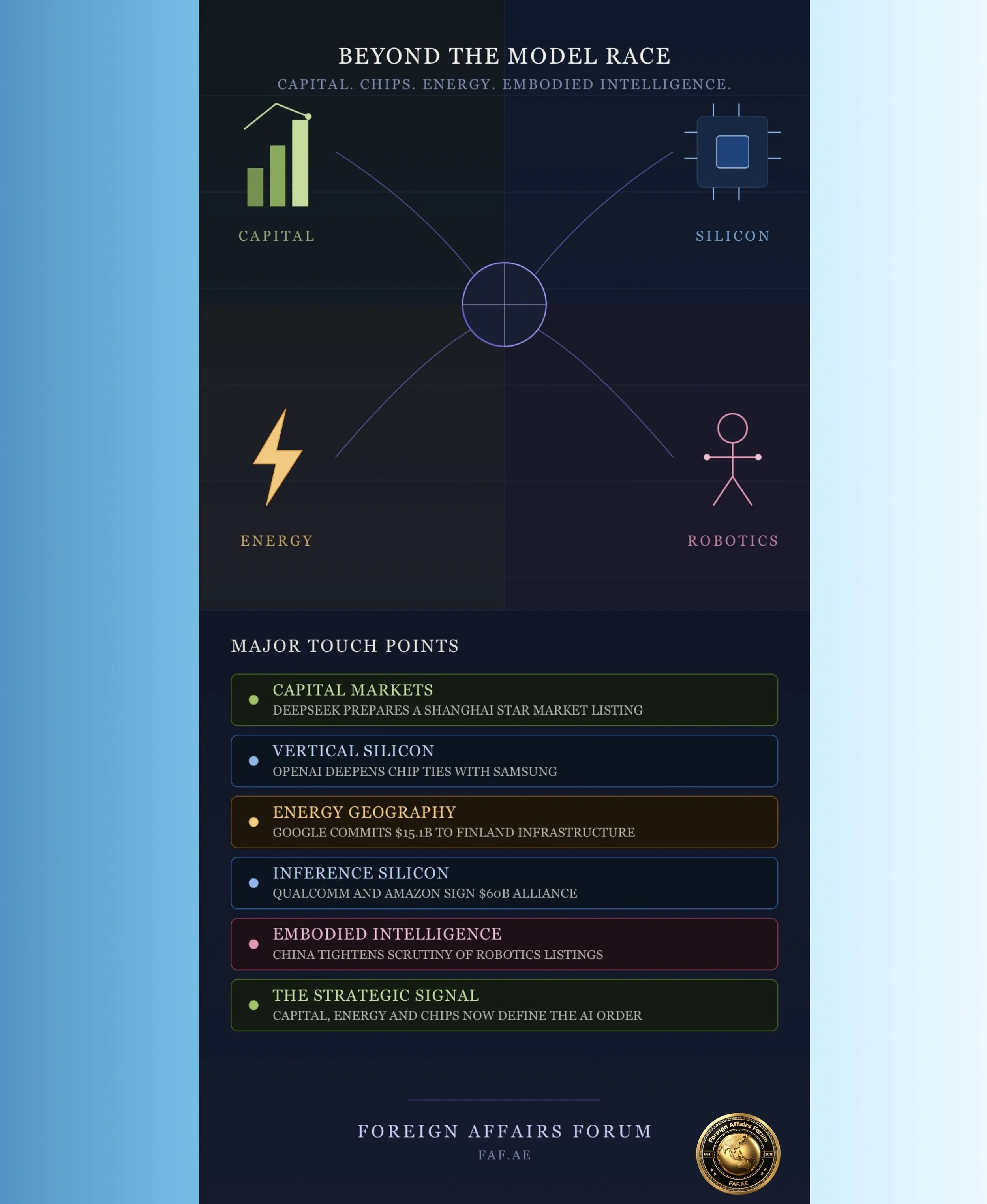
For the United States and its allies, the defining test is whether they can maintain an advantage across every link in the chain that runs from capital to energy, semiconductors, memory, networking, compute, models, autonomous agents, and ultimately robotics and defense systems. Weakness at any point can undermine strength everywhere else.
"Intelligence has become an industrial product, and industrial power has always rested on finance, manufacturing, energy, and the consent of the governed," Dr. 🆎 concludes. "The nations that remember this will lead. Those that mistake a benchmark for a strategy will discover that the future was decided in factories, bond markets, and parliaments while they were watching the leaderboard."
The next phase of the AI competition will be won by those who can finance, build, deploy, and secure intelligence at scale while keeping it under meaningful human control. That is a far more demanding task than building a clever machine, and it is the task now before every government that hopes to shape the century ahead.