The Silicon Iron Curtain: How Export Controls, Capital and Compute Are Redrawing the Map of Global Power
Foreign Affairs Forum | Dr. Antonio Bhardwaj (Dr. 🆎) | October 30th, 2026
Executive Summary
The global semiconductor and supercomputing order is entering a phase in which control over silicon, memory, tooling and compute capacity is as consequential as control over territory or energy.
In the final fortnight of October 2026, four developments clarified the direction of travel.
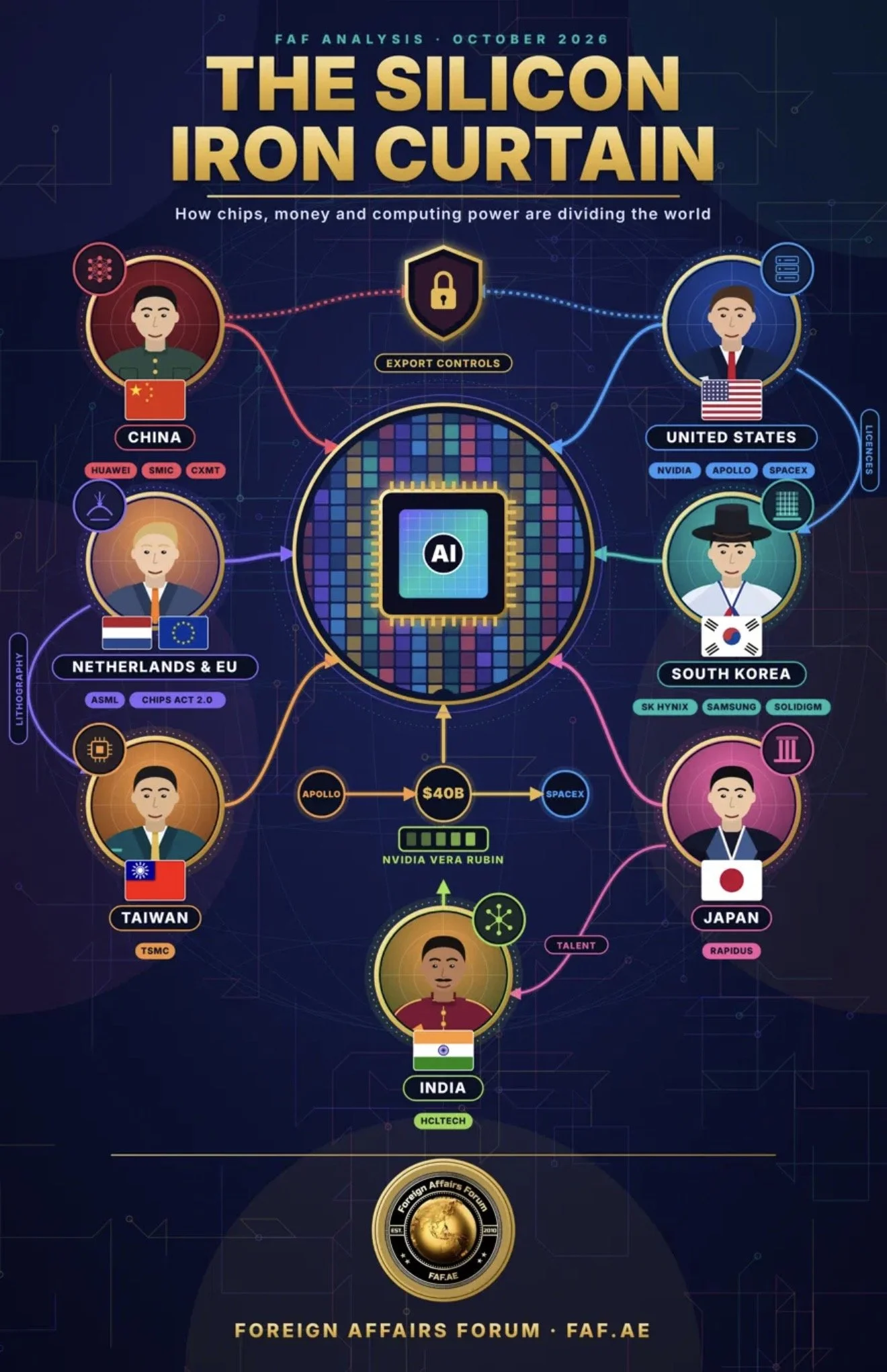
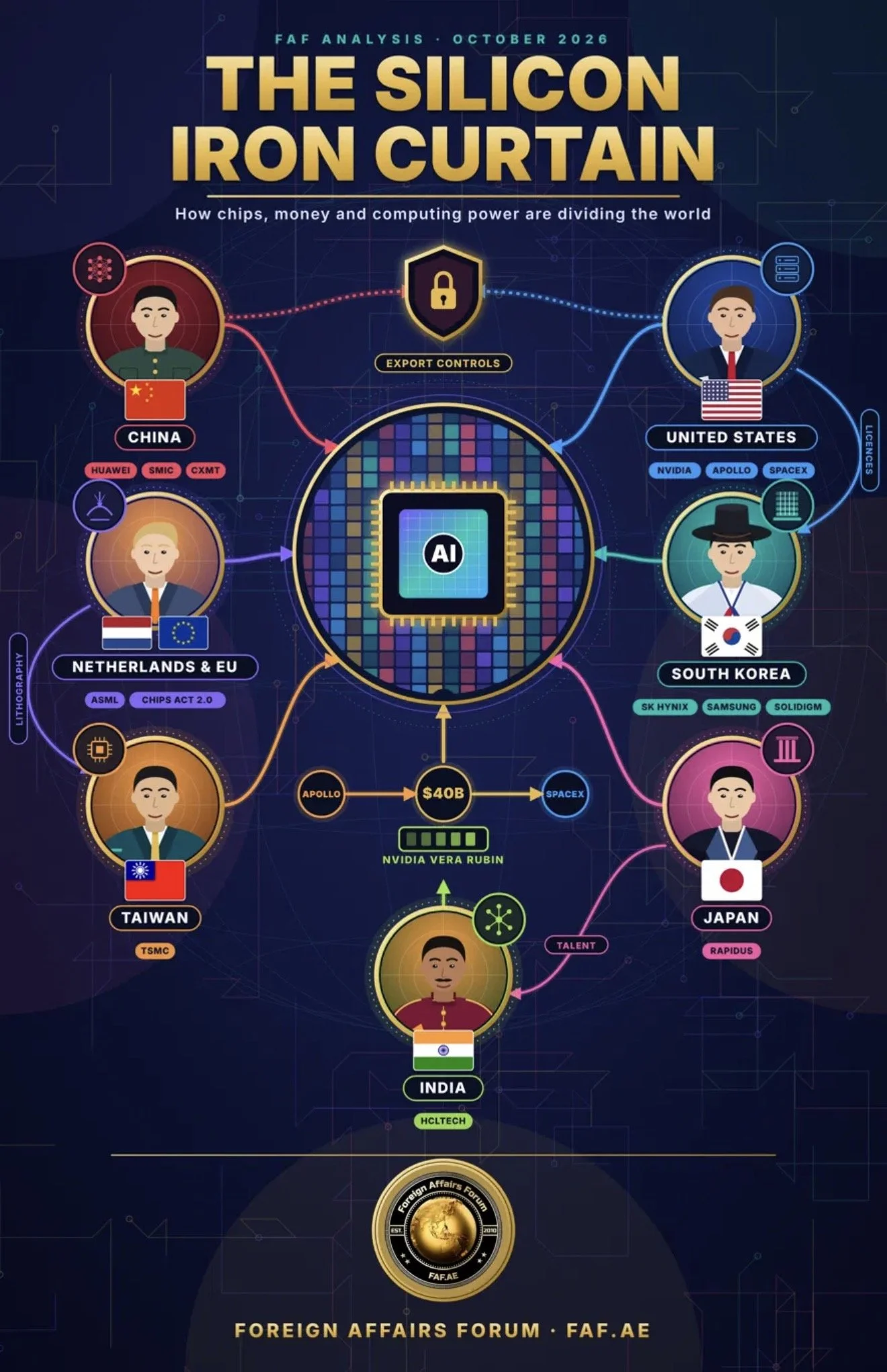
China released a draft list of 40 technologies subject to export control, including large artificial intelligence models, chip designs at fourteen nanometres or below, and computing clusters, thereby converting itself from a target of controls into an author of them.
SpaceX disclosed a binding commitment of roughly $40 billion in financing, structured by an Apollo-managed vehicle, to acquire Nvidia's next-generation hardware, showing that private credit is becoming the decisive instrument for financing compute.
SK Hynix and its American unit Solidigm reportedly made approval for more American tooling at their Dalian facility in China a condition of building a new American fab, illustrating how export licences have become bargaining chips in industrial diplomacy.
Meanwhile, ASML's executive acknowledged that the company sold essentially nothing in Europe in the first half of 2026, even as the European Commission's proposed Chips Act 2.0 awaits legislative negotiation, and Japan's Rapidus and India's HCLTech opened two engineering centres, a quiet signal that talent, not only capital, is the scarcest input.
This FAF article argues that these events are not isolated. They reflect a structural shift from a globalised, efficiency-driven semiconductor system to a securitised, resilience-driven one in which governments, hyperscalers and financiers compete to lock in scarce capacity.
The consequences are far-reaching for technology, venture capital, innovation and global security.
Dr. 🆎 contends that the decisive question is no longer who builds the fastest chip but who governs the conditions under which intelligence at scale is produced, financed and deployed.
The article traces the historical arc, assesses the latest facts and concerns, analyses causal chains, and proposes practical steps for policymakers and industry. It also notes where the evidence is incomplete: several reports rest on secondary summaries, and some figures await confirmation from primary filings.
Introduction
Every era of great-power competition has its defining commodity. For the nineteenth century it was coal and steel, for the twentieth it was oil, and for the twenty-first it is increasingly the integrated stack of advanced logic, high-bandwidth memory, lithography, packaging and the data centres that bind them together.
The semiconductor is no longer a component; it is the substrate of economic productivity, military advantage and informational influence. A nation that cannot secure a reliable supply of advanced chips cannot train frontier models, cannot field modern sensors or autonomous systems, and cannot credibly claim strategic autonomy.
The past month has offered an unusually concentrated demonstration of this reality. Beijing has moved to regulate the outbound flow of its own artificial intelligence capabilities. Washington continues to use licensing authority as an instrument of both restraint and persuasion. Europe, home to the world's most indispensable lithography company, confronts the awkward fact that its crown jewel finds no domestic customers. Tokyo and New Delhi are weaving a new partnership around design talent. And in the United States, private capital on a scale once reserved for sovereign infrastructure is flowing into graphics processors.
Dr. Antonio Bhardwaj (Dr. 🆎), a polymath whose work spans artificial superintelligence, human-centred AI for geopolitical strategy, AI warfare and bioterrorism risk, has long argued that compute governance is the most under-examined lever of international security. In his assessment, the semiconductor supply chain is the physical chokepoint through which the abstract ambitions of superintelligence must pass, and therefore the most practical point at which states can shape, slow, accelerate or secure that trajectory. It is also, he warns, the point at which miscalculation is most likely, because the signals that governments send through licences, tariffs and subsidies are read by rivals as intentions rather than as mere regulation.
This FAF article proceeds in stages. It first sets out the historical background and the current state of play, then examines the most important recent developments, then assesses the facts and concerns that should temper both optimism and alarm.
A cause-and-effect analysis follows, linking policy decisions to market behaviour and security outcomes. The article concludes with forward-looking recommendations. Throughout, it distinguishes between what is confirmed, what is reported but unverified, and what remains inference.
History and Current Status
The modern semiconductor industry grew out of an essentially cooperative, if asymmetrical, division of labour.
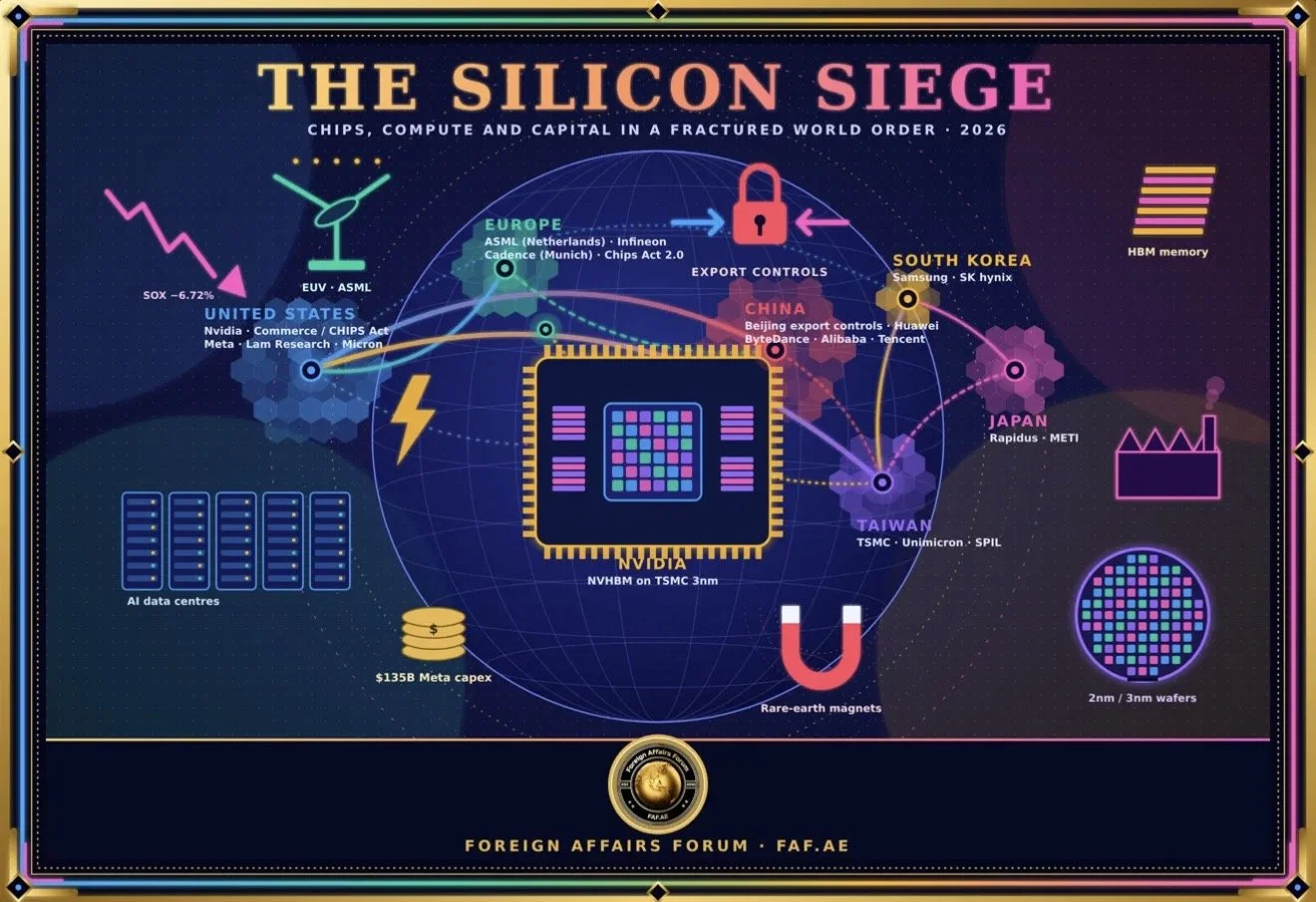
American firms pioneered design and architecture, Japanese and later Korean and Taiwanese companies mastered manufacturing at scale, and Dutch and Japanese toolmakers supplied the machines. The model reached its zenith around 2010 to 2020, when the fabless-foundry arrangement allowed companies such as Nvidia and AMD to design chips in California while TSMC fabricated them in Taiwan using ASML lithography. The efficiency gains were extraordinary, but they concentrated critical capabilities in a handful of locations and firms.
The first major rupture came with the American restrictions on Huawei in 2019 and 2020, which demonstrated that access to American technology and tooling could be weaponised against a national champion.
The sweeping controls introduced in October 2022 went further, restricting the export of advanced computing chips and chip-making equipment to China and extending American jurisdiction through the so-called foreign direct product rule.
Allied governments, particularly the Netherlands and Japan, subsequently aligned their own controls on advanced lithography and related tools.
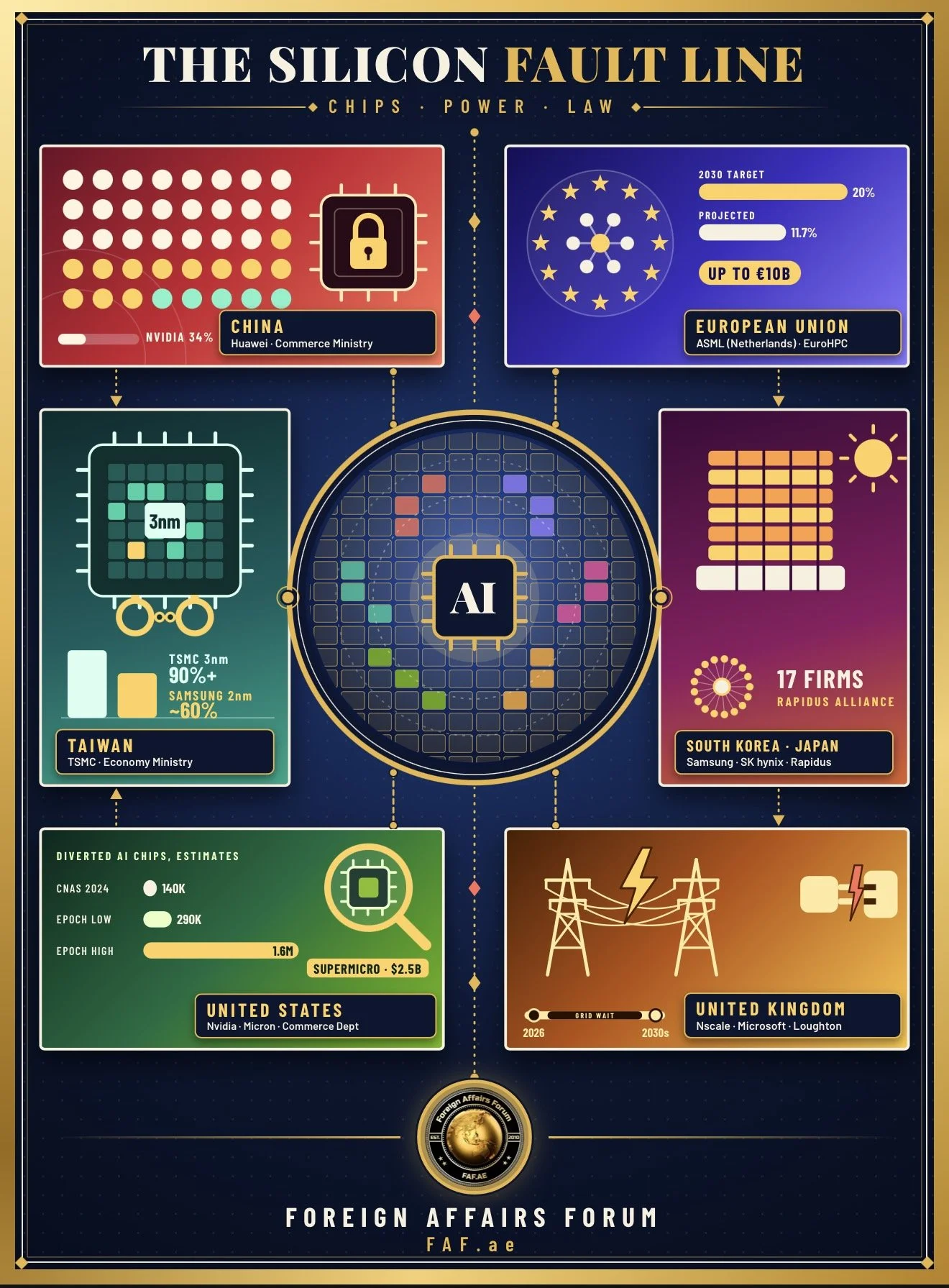
Washington also passed the CHIPS and Science Act in 2022 to subsidise domestic manufacturing, while the European Union adopted its first Chips Act in 2023 with the aspiration of doubling its share of global production to 20% by 2030, a target widely regarded as unattainable on current trends.
Japan backed Rapidus with substantial public funding to pursue leading-edge logic, and India launched an incentive programme to attract fabs, packaging and design investment.
China responded with a prolonged drive toward self-reliance. SMIC and Huawei demonstrated that advanced-node chips could be produced using deep ultraviolet lithography and multiple patterning, albeit at higher cost, lower yield and greater complexity.
Memory makers such as CXMT expanded rapidly, and domestic equipment firms received sustained state support. Beijing also deployed its own instruments of leverage, including controls on critical minerals and, more recently, scrutiny of foreign technology companies.
The current status, as of late October 2026, is one of intense scarcity and intense fragmentation. TSMC reported third-quarter net profit of NT$763.1 billion, up 68.7% year on year, on revenue of NT$1.4942 trillion, up 50.9%, according to secondary summaries of its results. It kept its 2026 capital budget at between $60 billion and $64 billion, and analysts warn that capacity limits could constrain large artificial intelligence infrastructure plans over the next twelve to eighteen months. Its ten largest customers reportedly account for 78% of revenue, which leaves smaller chip designers competing for whatever capacity remains. ASML reported record quarterly revenue of about €11.7 billion, driven by extreme ultraviolet demand, though that figure derives from a newsletter headline and should be treated with caution until checked against the company's own filing. Memory is the other bottleneck: SK Hynix is estimated to hold roughly half of global high-bandwidth memory revenue, and rising memory costs have reportedly contributed to a sharp fall in global smartphone shipments in the third quarter of 2026.
The American approach has evolved as well. On the thirty-first of May 2026, the Department of Commerce issued guidance extending licence requirements for advanced AI chips to any entity headquartered in China, regardless of where it is physically located, closing a loophole that had allowed overseas subsidiaries, including those in Southeast Asia, to purchase chips such as Nvidia's Blackwell and Rubin processors and AMD's MI350 series. An industry source quoted by Reuters suggested that hundreds of thousands of advanced chips may have reached Chinese-linked entities abroad during the period of ambiguity. The guidance applies prospectively and does not oblige existing data centres to stop using chips already delivered, which leaves a substantial installed base outside the new rules. Earlier in 2026, American authorities also reportedly ordered equipment suppliers to halt certain shipments to Hua Hong, China's second-largest chipmaker, which was said to be preparing a seven-nanometre fab in Shanghai.
This is the landscape into which the October developments arrived: a system in which capacity is tight, controls are layered and contested, and every major stakeholder is attempting to convert dependence into leverage.
Key Developments
The most consequential development of the month is China's draft export control list, released on the 16th of October by its commerce and science ministries.
The draft enumerates forty technologies: twenty-three in artificial intelligence, twelve in solar energy and five in biomedicine, including gene therapy. Within the AI category, it covers large language models, with weights and source code treated as controlled components, as well as AI agents, AI chip designs and computing clusters. Reporting by Bloomberg, relayed by other outlets, indicated that the model threshold would capture systems of at least two trillion parameters or those ranking in the global top ten in performance and safety evaluations, and that models such as Moonshot AI's Kimi K3 and Alibaba's Qwen3.8-Max would exceed it, although the draft itself names no models. The chip provisions reach design know-how at fourteen nanometres or below, as well as designs relying on two-and-a-half-dimensional or three-dimensional stacking, and certain memory designs. Exporters would have to register before any transaction in a listed item, even for deals not yet concluded, and running a covered model on servers abroad would itself constitute an export, though companies operating their own overseas cloud infrastructure could receive licences automatically. Open-source code and published research are exempt, and Chinese firms may continue to serve foreign users through applications, websites and application programming interfaces. Public comment is open until the fifteenth of November. Beijing insists the measures are not directed at any country or company and are intended to prevent misuse and keep artificial intelligence under human control.
The second development is financial rather than regulatory, but no less strategic.
In a filing on the twenty-sixth of October, SpaceX disclosed a binding commitment for roughly $40 billion in financing to acquire graphics processors and associated data-centre equipment. An entity managed by Apollo Global Management will purchase the hardware and lease it to SpaceX over terms of roughly five years, with closing expected by the end of 2026 and leases commencing in the first half of 2027 as equipment is delivered. Apollo has said it will help deliver Nvidia's forthcoming Vera Rubin systems for what SpaceX terms its terrestrial compute build-out. The company reported that its AI segment generated $7.6 billion of its $14.6 billion third-quarter revenue, that capital expenditure approached $20 billion in the quarter, and that it expects to spend between $35 billion and $40 billion in the fourth quarter alone. Its chief financial officer asserted payback periods of under one year, a claim that is the company's own and has not been independently verified.
The third development concerns memory and the entanglement of industrial policy with export control.
According to Reuters reporting dated the fifteenth of October, SK Hynix and Solidigm want Washington to approve additional American-origin equipment for the Dalian NAND facility in China and are conditioning construction of a new American NAND fab on that approval. The Department of Commerce, having revoked the validated end-user exemptions that previously allowed Korean firms to operate Chinese plants without individual licences, issued a quantity-limited licence for 2026 but has not authorised shipments for 2027, and it has signalled that it does not expect to approve equipment for capacity expansion or technological upgrading.
Meanwhile, SK Hynix is reportedly in discussions to lease part of Intel's planned Ohio site and has begun work on an advanced packaging plant in Indiana.
Korean press reports, which Reuters is said to have confirmed in outline, also suggest that Samsung will use TSMC's three-nanometre process for the logic base die of Nvidia's custom HBM4E stack, a reversal of its earlier in-house approach. SK Hynix is reportedly evaluating Intel as an alternative source for such dies, because TSMC's cost is said to be three to four times that of the DRAM core die.
The fourth development is European and, in a sense, paradoxical.
In September, ASML's head of public affairs, Frank Heemskerk, stated that the company was selling essentially nothing in Europe, with the continent's share of its revenue falling to zero in the first half of 2026 from 1% in 2025 and 5% in 2024. He attributed this to weak investment and the absence of new fabs, and he urged the European Union to stimulate demand for European-made chips rather than relying solely on subsidies for new plants.
The European Commission had already proposed Chips Act 2.0 in early June, featuring permitting timelines of no more than twelve months, broader support for first-of-a-kind facilities from raw materials to packaging, a stronger demand-side agenda including procurement mechanisms, and a designation for regional clusters. The proposal still requires negotiation with the member states and the European Parliament before it can become law.
Finally, in Asia, Japan's Rapidus and India's HCLTech announced the opening of two development centres in Bengaluru and Hubli to support Rapidus in mask design, design infrastructure, process design kit development, design-technology co-optimisation and layout.
HCLTech will also help cultivate a pipeline of Indian engineers for deployment in Japan. Though modest in scale compared with the sums moving through American capital markets, the arrangement is strategically telling, because it addresses the human bottleneck that capital alone cannot dissolve.
The Latest Facts and Concerns
A careful reading of these developments yields several firm facts and a larger number of genuine uncertainties.
The firm facts are that China has published a draft, not a final regulation; that SpaceX has disclosed a binding but not yet closed financing; that Commerce has not authorised 2027 equipment shipments to Dalian; and that the Chips Act 2.0 is a proposal, not law.
The uncertainties are numerous. It is not yet clear how China will define and enforce its model-size threshold, whether its registration regime will function as a licensing chokepoint or as an administrative formality, or how it will interact with the open-source exemption. It is equally unclear whether Washington will continue to treat Korean and Taiwanese fabs in China as legacy operations to be tolerated, or move to wind them down. Several statistics, including CXMT's reported quarterly revenue of $16.7 billion and its roughly 10% share of global DRAM, come from secondary summaries and should be verified against primary filings before being relied upon.
Dr. 🆎 draws attention to three concerns that tend to be underweighted in conventional commentary.
The first is the concentration of compute in a small number of privately controlled facilities.
When financing of the magnitude of SpaceX's arrangement is channelled into a single corporate ecosystem, the resulting capacity is not only an economic asset but a potential instrument of strategic leverage, whose use is governed by commercial rather than democratic accountability. In his view, the integration of launch, satellite communications, social media and frontier AI under common ownership creates a systemic dependency that existing antitrust and national-security frameworks were not designed to address.
The second concern is the dual-use character of what is being controlled.
China's draft explicitly lists biomedical technologies alongside artificial intelligence, and the pairing is not accidental.
Dr. 🆎, whose work on bioterrorism risk emphasises the convergence of advanced models with biological design tools, argues that the governance of frontier AI and the governance of dangerous biological capability cannot be pursued in separate bureaucratic silos. A model capable of accelerating protein design or pathogen analysis is simultaneously a commercial product, a scientific instrument and a potential proliferation risk. Export controls that treat these dimensions separately will either over-restrict beneficial research or under-restrict hazardous diffusion.
The third concern is financial fragility.
Asian semiconductor equities fell earlier this month on worries about AI financing risks and inflationary pressure in the United States, and analysts have noted that investor enthusiasm has begun to cool even as revenues reach records. When a growing share of compute is financed through long-dated leases against assumed rapid payback, a slowdown in demand, a breakthrough in algorithmic efficiency or a change in interest rates could expose the entire structure. The history of infrastructure booms, from railways to fibre optics, suggests that overbuilding is not an aberration but a recurring feature, and that the technology often survives while the financiers do not.
There are also concerns of a more traditional kind. Enforcement remains porous: controls have repeatedly been circumvented through third-country subsidiaries, transshipment and smuggling, and guidance documents define rules without policing them.
The reported leakage of hundreds of thousands of advanced chips to Chinese-linked entities abroad before the May 2026 guidance illustrates the scale of the problem. Supply-chain concentration persists, with TSMC's capacity constraint and the dominance of a few memory suppliers creating single points of failure. And talent shortages, evident in the logic of the Rapidus and HCLTech arrangement, limit how quickly any new fab or design centre can become productive regardless of the subsidies it receives.
It must also be acknowledged that coverage of the last several days has been thin on verified American policy action.
A congressional export-control package and an American block on two devices using Chinese-made surveillance chips were reported in headlines, but their details could not be confirmed for this analysis, and conclusions about them would be premature.
Cause-and-Effect Analysis
The causal structure of the present moment can be understood as a series of feedback loops, each of which amplifies the others.
The first loop runs from export control to indigenisation to counter-control.
American restrictions on advanced chips and tools imposed a cost on China, but they also created a powerful incentive to build domestic substitutes. The resulting progress, evident in Huawei and SMIC's ability to produce advanced-node chips without extreme ultraviolet lithography, and in CXMT's rapid expansion, has in turn given Beijing the confidence and the capability to regulate outbound technology on its own terms. China's draft export list is therefore both an effect of earlier controls and a cause of future ones. By classifying model weights, chip design know-how and compute clusters as controlled items, Beijing signals that it regards its own technological base as a strategic asset to be rationed rather than a commodity to be sold.
Dr. 🆎 reads this as the maturation of a doctrine of reciprocal deterrence in technology: each side now holds both a shield and a sword, and each understands that the other can threaten its supply of critical inputs. The danger, in his judgement, is that reciprocal deterrence in a domain without agreed thresholds or communication channels invites misperception, and that the first serious incident is likely to be interpreted as intent.
The second loop runs from scarcity to financialisation to concentration.
Because advanced accelerators, high-bandwidth memory and leading-edge foundry capacity are in short supply, those able to guarantee payment and volume secure priority. This favours the largest buyers and those with access to deep pools of private credit. The SpaceX-Apollo arrangement is the logical outcome of this dynamic: a buyer converts future revenue expectations into present purchasing power, locks in supply of the most sought-after hardware, and in doing so deprives smaller competitors of capacity. TSMC's customer concentration, with its top ten customers accounting for 78% of revenue, reflects the same logic upstream.
The effect on venture-backed startups is ambiguous. On one hand, abundant capital for compute expands the market for applications and services. On the other, the scarcity of access to cutting-edge hardware raises barriers to entry in frontier model development, steering founders toward application layers, specialised chips or efficiency-focused approaches, and tilting the innovation landscape toward incumbents.
The third loop runs from licence leverage to onshoring to allied friction.
By conditioning export licences on investment commitments, Washington is attempting to translate its control over technology into industrial outcomes at home. The SK Hynix case shows how this works in practice: the company seeks to preserve and expand a Chinese production base while simultaneously building American capacity, and each side attempts to extract concessions from the other. The effect on allies is double-edged. American investment commitments from Korean, Japanese and Taiwanese firms bolster domestic manufacturing in the United States, but the coercive character of the bargaining can erode trust and encourage allied governments to pursue hedging strategies.
Dr. 🆎 observes that alliance cohesion in technology is far more fragile than in conventional defence, because the commercial stakes are immediate and the strategic benefits diffuse.
The fourth loop runs from tool leadership to demand deficit to policy response.
Europe's predicament is that it controls a uniquely powerful node, lithography, without hosting the downstream demand that would anchor its industrial ecosystem. ASML's zero share of European sales in the first half of 2026 is not a sign of weakness in the company, which continues to post record revenue, but of the absence of leading-edge fabs on the continent.
The subsidy-first approach of the original Chips Act has not produced a commensurate manufacturing renaissance, and the pivot toward demand-side measures in Chips Act 2.0 acknowledges as much. If the new legislation succeeds in aligning public procurement, automotive and industrial demand with European supply, it could create a virtuous cycle; if it stalls in negotiation, Europe risks remaining a technology supplier whose strategic influence depends entirely on the decisions of others.
The fifth loop, less visible but arguably the most important, runs from talent scarcity to cross-border partnership to supply-chain diversification.
The Rapidus-HCLTech centres exist because designing leading-edge processes requires thousands of specialised engineers that Japan alone cannot supply. India, with its large engineering workforce and growing design ecosystem, offers a partner outside the principal axes of Sino-American rivalry. Each such arrangement incrementally reduces dependence on any single geography, though it also creates new dependencies on intellectual property protection and security vetting.
When these loops are considered together, a sobering conclusion emerges.
Each stakeholder's rational response to risk, whether controlling exports, securing supply, subsidising production or diversifying partners, increases the overall fragmentation of the system and the likelihood of conflict. This is the classic security dilemma transposed into the realm of semiconductors. Measures intended to be defensive are interpreted by rivals as offensive, prompting countermeasures that in turn validate the original fears. The result is a world in which the cost of chips rises, the pace of diffusion slows, and the incentives for covert acquisition and circumvention grow.
The implications for global security are acute. Compute is the foundation of modern intelligence analysis, cyber capability, autonomous weapons and decision-support systems.
Dr. 🆎, who has written extensively on AI-enabled warfare, argues that the tempo of conflict is being compressed by systems that can sense, decide and act at machine speed, and that the nation with superior compute and data advantages gains disproportionate leverage in the earliest and most consequential phase of a confrontation. Yet the same compute can be diffused to non-state stakeholders through cloud access, leasing arrangements and open-weight models, raising the possibility that capabilities once confined to states will migrate to groups with malign intent.
That is why he insists that export controls must be paired with robust verification, know-your-customer rules for compute providers, and international norms against the most destabilising applications.
Future Steps
The path forward requires action on several fronts, and the most effective measures will be those that reduce incentives for escalation while preserving the benefits of innovation.
For Washington, the priority should be coherence. Controls that are announced through guidance, adjusted through licensing and traded for investment commitments create uncertainty for allies and firms alike. A clearer statutory framework, supported by transparent criteria for licensing decisions, would improve predictability and reduce the perception that controls are instruments of commercial bargaining. At the same time, enforcement capacity must be strengthened. Location verification for advanced accelerators, strengthened customs cooperation with transshipment hubs and meaningful penalties for violations would address the leakage that undermines the entire edifice.
Dr. 🆎 advocates a tiered compute governance regime in which the largest training runs are subject to registration and independent safety evaluation, regardless of the nationality of the developer, so that security and safety objectives reinforce rather than compete with one another.
For Beijing, the immediate decision is how to finalise its export control list after the comment period closes on the fifteenth of November. A narrowly tailored regime that focuses on genuinely sensitive capabilities, preserves the open-source exemption and offers predictable licensing could position China as a responsible steward of its technology. A broad and discretionary regime, by contrast, would reinforce the perception of technology as a political weapon and accelerate efforts by other countries to reduce reliance on Chinese models and designs.
Dr. 🆎 urges both Washington and Beijing to consider a limited dialogue on dual-use AI and biological risk, whatever their broader disagreements, since the consequences of a catastrophic misuse would not respect borders.
For Europe, the task is to convert technological leverage into industrial substance. Chips Act 2.0 should move through the legislative process with urgency, and its demand-side provisions should be designed to create credible, long-term offtake for European-made chips in automotive, industrial and defence applications. Permitting reform, energy costs and access to skilled labour are as important as headline subsidies, and member states should resist the temptation to compete against one another for projects. European policymakers should also consider how the continent's lithography leadership can be used as a diplomatic asset, coordinating with partners in Japan, Korea and Taiwan on common standards for controls and on mutual assurance of supply.
For Korea, Japan, Taiwan and India, the central challenge is hedging without alienating either of the major powers. Korea's memory makers face the most acute dilemma, balancing Chinese production bases against American licensing and investment demands, and Seoul will need to coordinate closely with Washington to secure predictable treatment. Japan should continue to invest in Rapidus while recognising that commercial viability, not merely technical achievement, will determine its success. India should build on partnerships such as that with HCLTech to deepen its design capabilities, while accelerating the manufacturing and packaging investments that would give its ecosystem strategic weight.
For investors and the venture community, the lesson is to price geopolitical risk explicitly. Startups dependent on a single supplier, a single jurisdiction or a single class of hardware are exposed to regulatory shocks that can arrive within weeks. Founders should diversify compute sources, invest in algorithmic efficiency and design for portability across hardware platforms. Financiers should scrutinise the assumptions underlying compute-backed lending, particularly claims of extremely rapid payback, and stress-test them against scenarios of falling prices, technological obsolescence and regulatory intervention.
For the international community, the longer-term task is institutional. There is no equivalent in semiconductors or compute of the arms-control architecture that evolved in the nuclear age, and the absence of agreed definitions, thresholds and verification mechanisms is a source of instability. Even modest steps, such as shared incident reporting for chip diversion, common definitions of frontier-scale training runs and confidence-building measures between national security establishments, could lower the risk of misjudgement.
Dr. 🆎 emphasises that such institutions must be human-centred: they should be designed to preserve meaningful human control over high-consequence decisions, protect civilian populations from automated harm and ensure that the benefits of advanced computing are not confined to a small group of countries and corporations.
In the near term, several milestones will indicate which way the system is moving. The close of the comment period on China's draft on the 15th of November, and the nature of the final text, will reveal whether Beijing intends a targeted or a sweeping regime.
Commerce's decision on 2027 equipment licences for Korean fabs in China will clarify the future of foreign-owned production on Chinese soil. The Council and Parliament positions on Chips Act 2.0 will show whether Europe can move beyond declaratory ambition. And the closing of the SpaceX financing by the end of 2026, together with the pace of Vera Rubin deliveries in 2027, will test whether the compute-lease model can withstand the pressures of a cooling market.
Conclusion
The events of October 2026 reveal a global semiconductor and supercomputing order in transition.
The efficiencies of the globalised model are giving way to the logic of security and scarcity, and the instruments of statecraft, from export licences to industrial subsidies to private credit, are being redeployed accordingly. China has stepped forward as a creator of technology controls, the United States continues to leverage its dominance of tools and designs, Europe grapples with the gap between technological prowess and industrial scale, and Asian partners search for resilience through talent and diversification.
Beneath these manoeuvres lies a larger truth: whoever shapes the physical foundations of computation will shape the possibilities of artificial intelligence, and with them the distribution of economic and military power.
The analysis in this FAF article suggests that the dominant dynamics are mutually reinforcing and, left unmanaged, tend toward fragmentation, financial overextension and heightened insecurity. Yet the same analysis points to opportunities for statecraft that is more coherent, more transparent and more attentive to shared risks.
Dr. 🆎 captures the challenge succinctly: the question before humanity is not whether intelligence at scale will be built, but whether it will be built within a framework of accountability that keeps people, rather than processes or profits, at the centre.
That framework will not emerge spontaneously from market forces or from unilateral controls. It will require deliberate design, sustained diplomacy and the willingness of the principal stakeholders to recognise that, in a domain where the stakes include both prosperity and catastrophe, a measure of cooperation is not a concession but a necessity.
The coming months will be telling. If the draft Chinese controls are finalised with restraint, if Washington pairs firmness with predictability, if Europe converts its legislative ambition into demand, and if financiers temper their exuberance with discipline, the silicon curtain now descending may yet be made permeable enough to sustain innovation and stable enough to prevent disaster.
If not, the world risks building the most powerful computational infrastructure in history on foundations of mistrust, and discovering too late that the architecture of control it constructed was inadequate to the intelligence it unleashed.