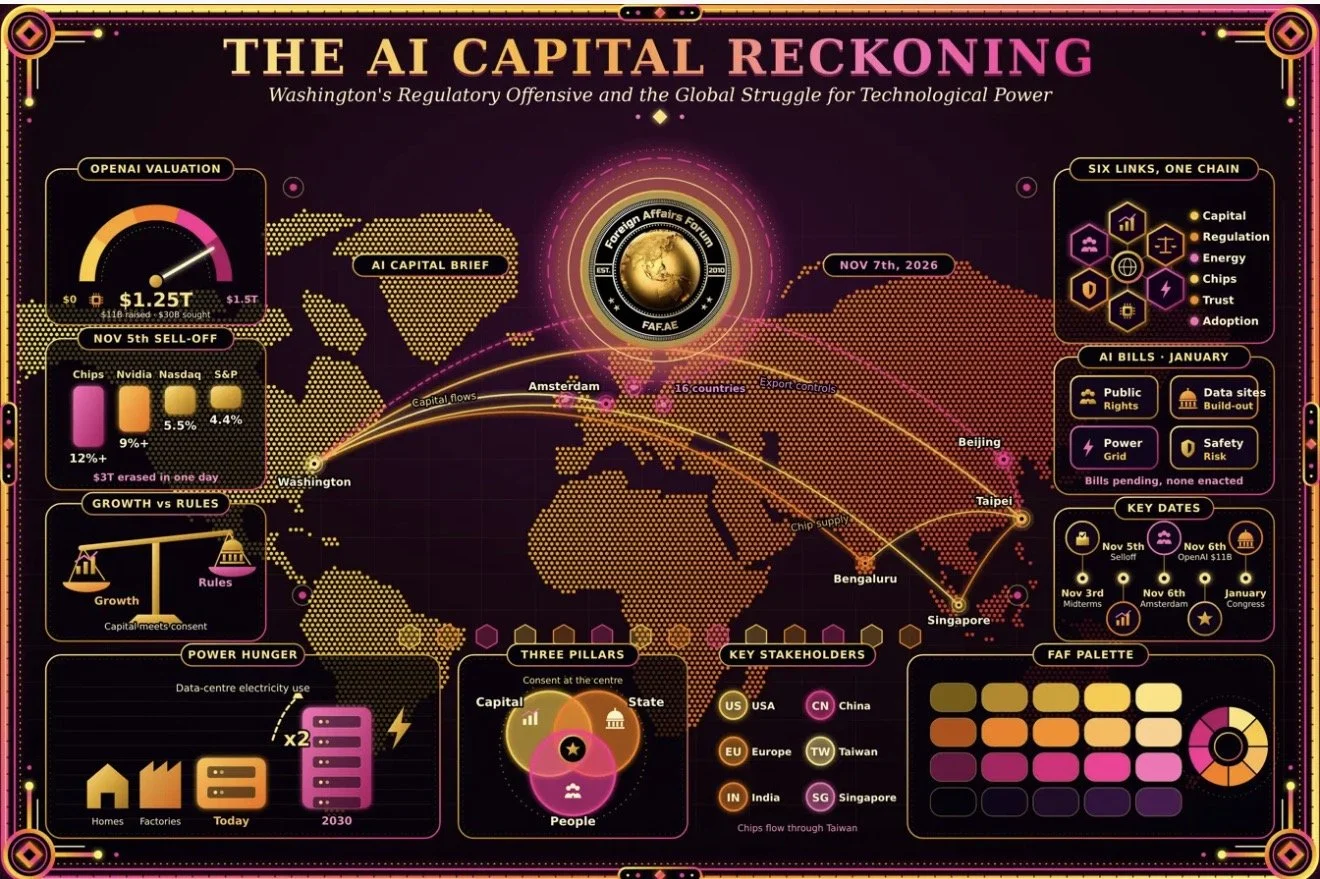
The AI Capital Reckoning: Washington's Regulatory Offensive and the Global Struggle for Technological Power
Foreign Affairs Forum | Dr. Antonio Bhardwaj (Dr. 🆎)| November 7th, 2026
Executive Summary
The global artificial intelligence industry has entered a period of acute political, financial and industrial uncertainty.
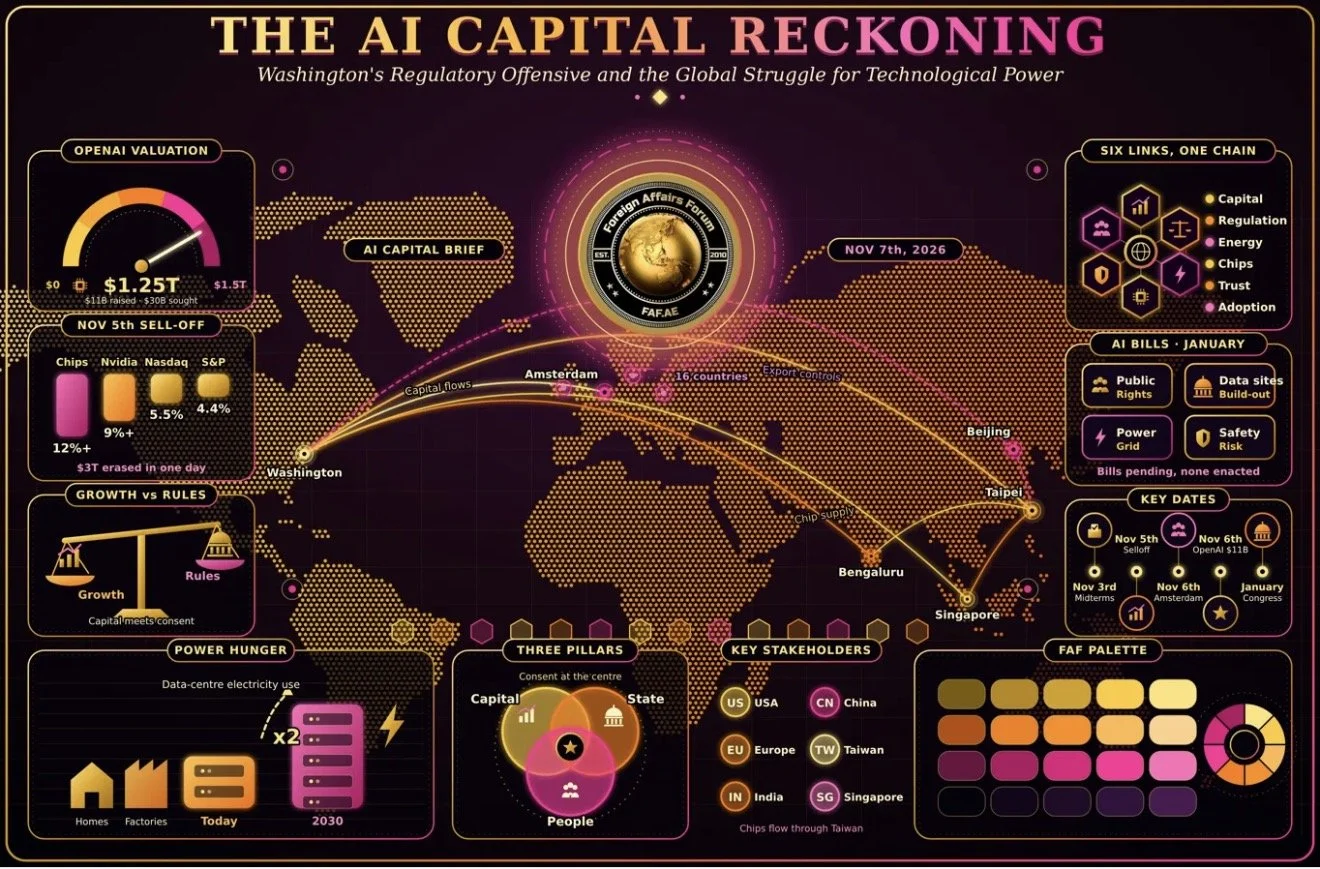
Within a few days, OpenAI has closed an initial $11 billion of new financing at a reported valuation of $1.25 trillion; American technology shares have endured one of their sharpest sessions in recent memory; congressional Democrats have signalled a sweeping legislative agenda on artificial intelligence and data centres following the midterm elections of Nov 3rd; and demonstrators in sixteen European countries have challenged the construction of the very facilities on which the industry's ambitions depend.
These events are connected.
The financing shows that private capital remains abundant for the most prominent developers, yet the lower valuation and the smaller sum raised than originally sought show that investors are becoming more selective.
The market rout on Nov 5th, in which the Nasdaq Composite fell approximately 5.52% and the Philadelphia Semiconductor Index more than 12%, reflected anxiety about regulation, electricity demand and the sustainability of infrastructure spending.
Washington's cancelled meeting of its science and technology advisers, Microsoft's reported retreat from part of an Oracle computing arrangement, and doubts over the timing of Anthropic's proposed public offering all point to a sector whose financial and political foundations are being tested simultaneously.
The wider landscape is equally unsettled.
China has proposed export controls on roughly forty sensitive technologies, deepening the prospect of separate technology ecosystems. Taiwan's advanced packaging industry has become a decisive bottleneck for computing capacity, while India's services firms are emerging as channels for commercialising frontier systems.
This FAF article argues that leadership in artificial intelligence no longer depends on model quality alone. It increasingly depends on financing, electricity, semiconductor manufacturing, political legitimacy and national-security governance.
Dr. 🆎, whose work addresses human-centred superintelligence, warns that a technology financed at this scale but governed with this much improvisation invites both economic and security failures. The article concludes that the next phase of competition will reward the stakeholders who can finance, manufacture, secure and deploy advanced intelligence sustainably.
Introduction
Every transformative technology eventually meets the institutions that must absorb it.
Railways met the bond market and the regulatory state in the 19th century; electrification met monopoly law and public utility regulation in the 20th. Artificial intelligence is now meeting its own reckoning in the 21st century, and the encounter is unfolding with unusual speed.
The first week of November 2026 compressed into days a set of tensions that earlier technologies took decades to confront: the relationship between speculative capital and physical infrastructure, between industrial ambition and democratic consent, and between commercial advantage and national security.
The purpose of this FAF article is to examine those tensions as a connected system rather than a sequence of headlines. It draws on the reported record of recent days, distinguishes enacted measures from proposals, and treats uncertainty as a feature of the analysis rather than an inconvenience. Where reports describe proposed legislation, prospective offerings or planned demonstrations, the article treats them as such.
Where market movements are described, it separates observed price changes from the transmission mechanisms through which they may influence the wider economy.
The analysis benefits from the perspective of Dr. Antonio Bhardwaj (Dr. 🆎), a polymath with global expertise in superintelligence, specialising in human-centred approaches to geopolitical strategy, artificial intelligence in warfare and the risks of bioterrorism. His central contention, offered for this piece, is that the financial and political turbulence now visible in the industry is inseparable from its security implications. "A technology that absorbs capital on this scale becomes a strategic asset whether its owners intend it or not," Dr. 🆎 observes. "The question is whether governments, investors and developers will govern it as one."
That question frames what follows.
The article first reviews the historical and institutional background, then examines the principal developments across the United States, Europe and Asia, sets out the latest facts and the concerns they raise, traces the causal relationships among finance, energy, regulation and geopolitics, and proposes steps that policymakers, investors and allied governments might take.
Throughout, the emphasis falls on structure and consequence: how money, megawatts, microchips and legitimacy interact to determine who leads and who follows.
History and Current Status
The present moment is the product of a decade of accelerating scale. Early in this decade, the public release of conversational systems transformed artificial intelligence from a specialist research field into a mass consumer technology and a boardroom priority. Within a few years, the leading developers were committing sums to computing capacity that dwarfed the research budgets of most governments. The logic was simple and, for a time, persuasive: larger models trained on more data with more computing power delivered better results, and better results justified further investment.
That logic produced an extraordinary concentration of capital and capability. A small number of American firms combined frontier research, hyperscale cloud infrastructure and access to the most advanced semiconductors. Nvidia became the emblematic supplier of the processors on which training and inference depended, while Taiwan's leading foundry became the indispensable manufacturer of the most sophisticated chips. Private valuations soared, and financings that would once have been regarded as implausible became routine.
Governments responded unevenly. In the United States, the executive branch generally favoured a permissive approach, treating artificial intelligence as a field of strategic competition with China and emphasising speed of deployment and security of supply. The chip export controversies of 2025 illustrated how closely commercial and national-security considerations had become entwined. Europe pursued a more regulatory path, adopting comprehensive rules while continuing to seek greater domestic computing capacity. China combined heavy state support with efforts at technological self-sufficiency, pressing its own semiconductor and model ecosystems while guarding sensitive capabilities.
The physical footprint of the industry grew in parallel. Data centres multiplied across North America, Europe and Asia, drawing heavily on electricity grids and, in many places, local water supplies. As their scale became visible, so did local opposition. Communities questioned who would bear the costs of new generation capacity, transmission lines and environmental disruption, and whether the economic benefits justified them.
The consequences of this concentration were not purely economic. Because the leading systems were developed by a handful of companies and run on a handful of supply chains, decisions made in a few boardrooms and a few fabrication plants carried implications for national security, for labour markets and for the information environment. Governments that had once regarded the industry as a source of growth began to regard it as a source of strategic dependence as well.
By the autumn of 2026, the industry therefore rested on three pillars that were beginning to show strain. The financial pillar depended on investors continuing to accept rising valuations and enormous capital expenditure before revenues had fully caught up. The political pillar depended on governments continuing to regard rapid expansion as a national priority. The social pillar depended on communities tolerating the infrastructure that expansion required.
The midterm elections of Nov 3rd altered the political pillar. Democrats are set to assume control of Congress in January, and they are preparing numerous bills addressing artificial intelligence governance, consumer protection, data-centre construction, electricity consumption and the economic consequences of rapid computing expansion. These proposals have not been enacted, and their eventual scope remains uncertain. Yet their direction is clear: greater congressional scrutiny of a sector that had largely operated under executive encouragement.
The financial pillar was tested days later. On Nov 5th, American equities suffered a severe selloff. The Nasdaq Composite fell approximately 5.52% and the S&P 500 declined 4.36%. Nvidia lost more than 9%, and the Philadelphia Semiconductor Index fell more than 12%, erasing roughly $3 trillion in S&P 500 market capitalisation in a single session. The decline reflected concern about future regulation and about whether infrastructure investment could continue expanding at its previous pace, although American shares later recovered some of the losses.
The social pillar has come under pressure in Europe, where environmental and digital-rights organisations coordinated demonstrations against data-centre expansion across sixteen countries. The governmental landscape is therefore divided across four capitals. Washington is moving from executive encouragement toward congressional scrutiny, and must balance economic concerns against the strategic value of technological leadership. Beijing is pursuing sovereignty over sensitive technologies and, in October, proposed adding approximately forty of them to its export-control framework. Brussels and the European capitals face the difficult task of expanding computing capacity while honouring environmental commitments and local consent. In Asia, Taiwan remains central to advanced manufacturing, Singapore is courting specialised packaging investment, and India is expanding its role in enterprise implementation and digital infrastructure.
That is the status quo from which the key developments of recent days emerge.
Key Developments
The most visible development is financial.
OpenAI has closed an initial $11 billion portion of a new financing round at a reported valuation of approximately $1.25 trillion. The sum falls short of the company's original target of up to $30 billion, and investors familiar with the process indicate that the company had previously sought a valuation nearer $1.5 trillion. The transaction is therefore double-edged. It confirms that private markets will still fund frontier development on a vast scale, yet it also shows that even the most prominent developer faces pricing discipline. The valuation will serve as a reference point for other private artificial intelligence companies, and a lower benchmark may encourage greater restraint across the sector.
A related uncertainty surrounds Anthropic.
Prospective investors have indicated that rising political opposition to artificial intelligence infrastructure and the sharp decline in technology shares could complicate the timing of the company's proposed public offering. The offering remains a proposal, and neither a timetable nor a valuation is assured. Its fate matters beyond one firm, because it will test whether public markets are prepared to finance capital-intensive artificial intelligence development at the valuations private investors have recently accepted.
The second development is political.
Democratic lawmakers are preparing legislation addressing artificial intelligence and data-centre development, motivated in part by growing opposition to large facilities on grounds of electricity demand, environmental impact and effects on local communities. At the same time, the administration cancelled a scheduled meeting of the President's Council of Advisors on Science and Technology, whose members include Jensen Huang of Nvidia, Mark Zuckerberg of Meta and Lisa Su of AMD. The meeting had been intended to advise the administration's Super Intelligence Task Force, and no immediate explanation was offered. Occurring amid market turmoil, the cancellation reinforced the impression of a government still searching for a coherent approach to the next phase of development.
The third development concerns infrastructure economics.
Microsoft is reportedly winding down an arrangement to rent artificial intelligence computing capacity from Oracle, having reduced its use of the capacity because the older Nvidia processors involved no longer suited its changing requirements. Oracle maintains that demand for its infrastructure remains strong, including for earlier-generation processors.
Separately, the infrastructure provider IREN reported that Microsoft requested networking modifications that delayed certain deployments. The episode illustrates a risk that investors have long discussed but seldom seen so concretely: that expensive computing assets may lose commercial appeal before the end of their expected useful lives.
The fourth development is the spread of public opposition in Europe.
Demonstrations against data-centre expansion were organised in sixteen countries. In Amsterdam, more than one hundred protesters gathered at a Microsoft construction site on Nov 6th, and some entered the site and climbed cranes. Further demonstrations were planned in Ireland, Poland and Denmark. The organisers demand a pause in large-scale construction until stronger environmental and regulatory safeguards are established. The site owner said it remained committed to dialogue, while Microsoft stated that it respected peaceful protest but opposed unlawful action.
The fifth development is Asian and industrial.
The Indian services company Coforge has joined SpaceX's Super Intelligence Partner Network, intended to help enterprise customers integrate Grok tools into business operations.
The announcement disclosed no financial terms, but it illustrates how Indian technology services firms are becoming channels through which advanced systems reach international customers. Meanwhile, advanced semiconductor packaging has emerged as a critical bottleneck.
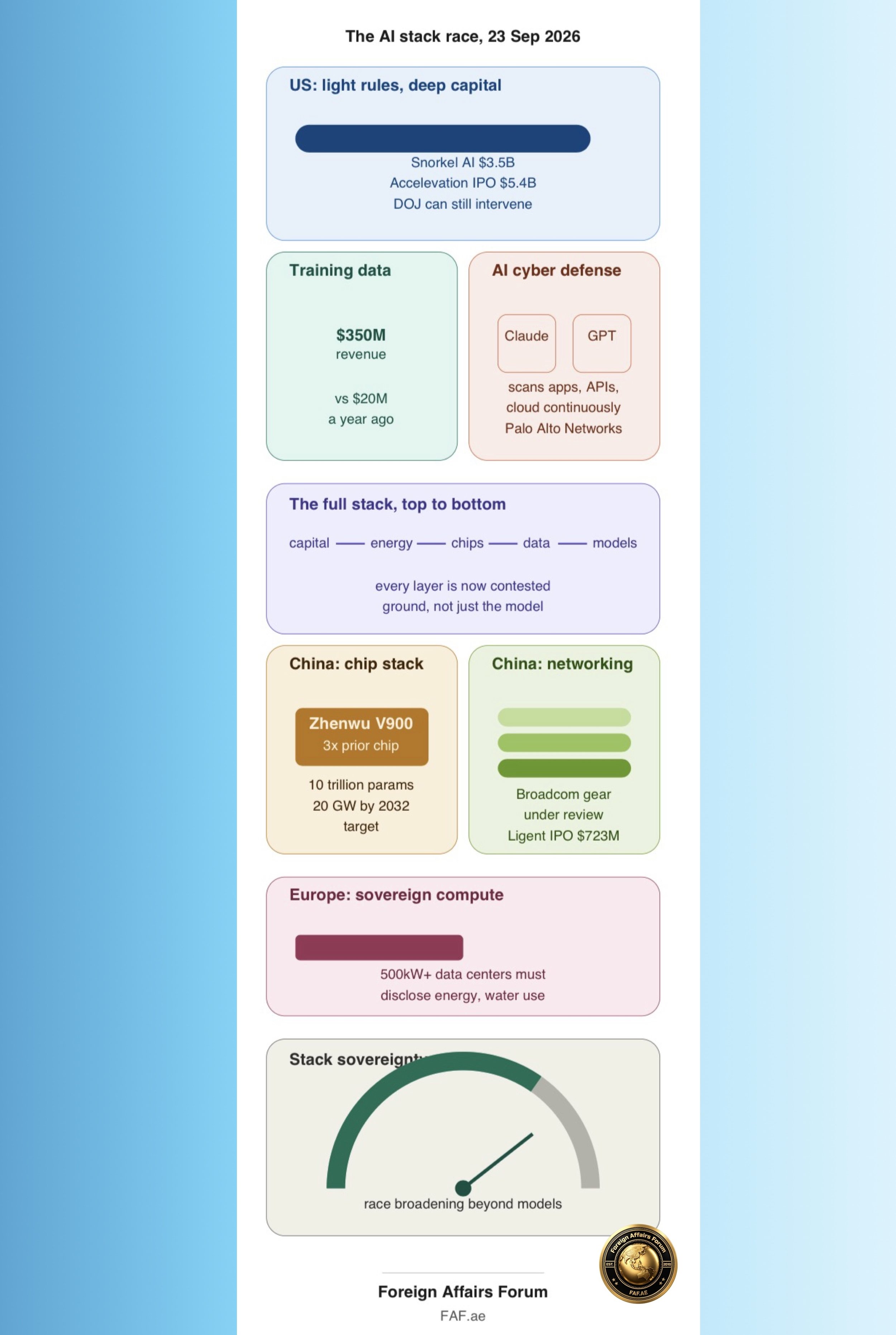
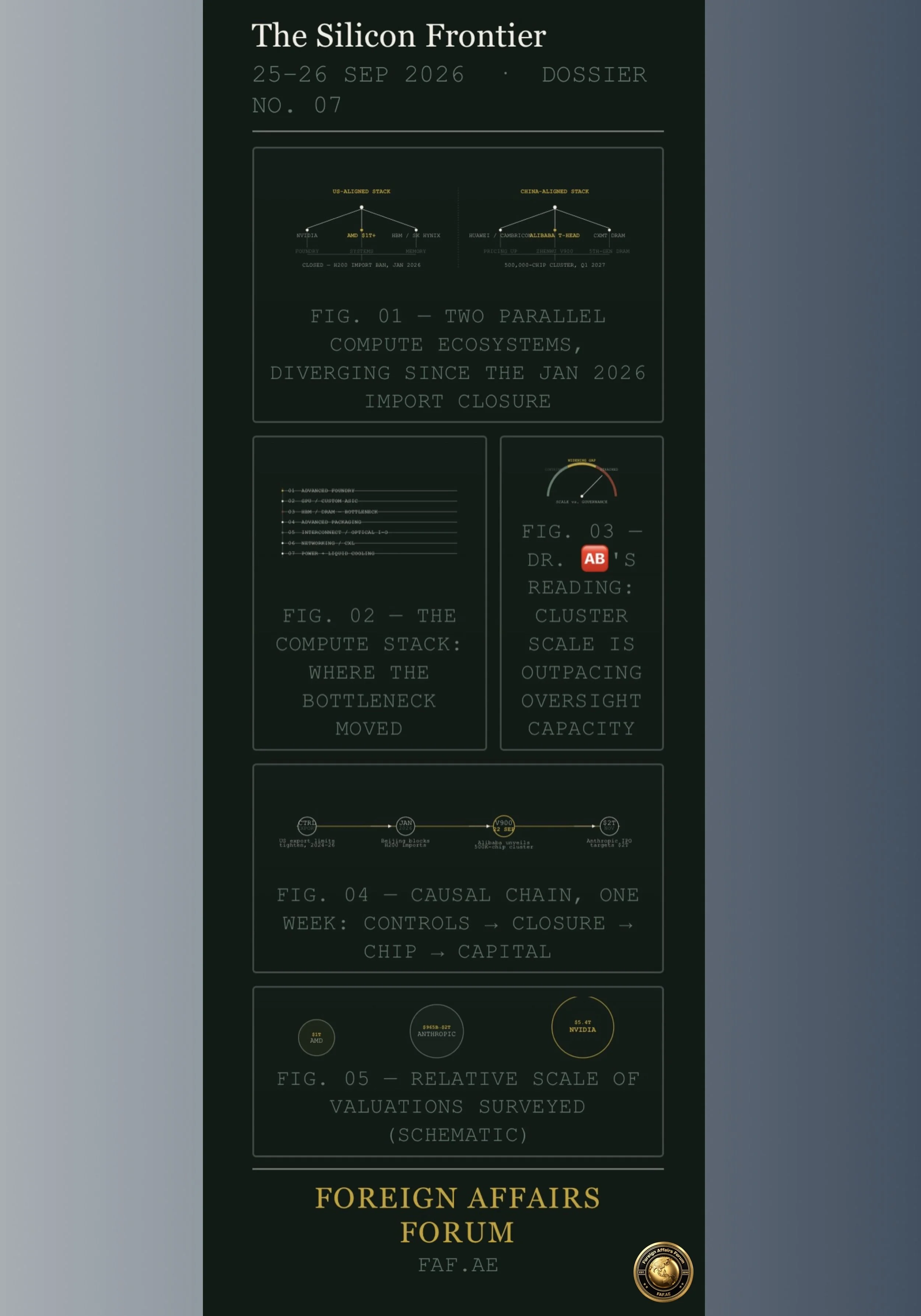
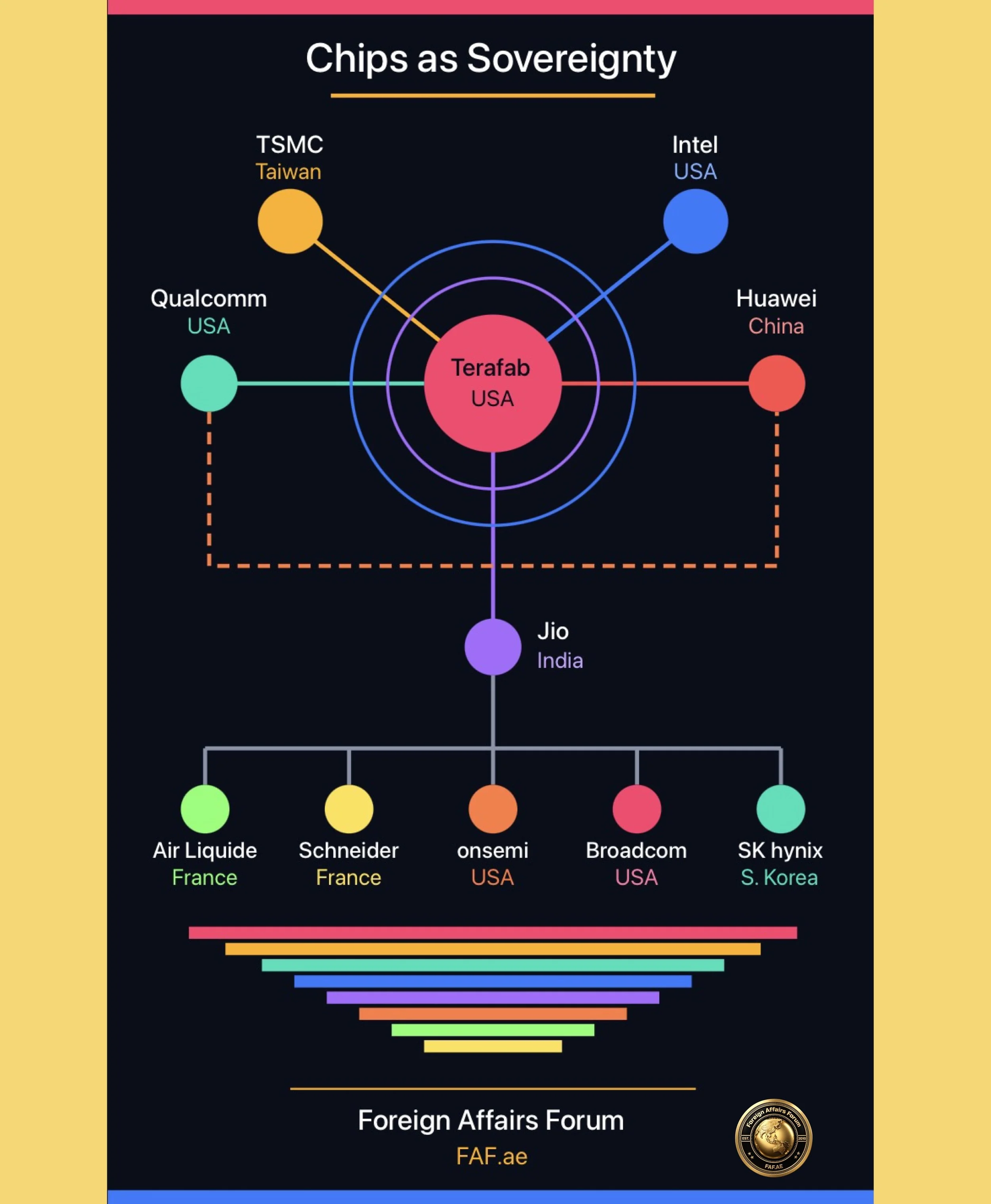
TSMC dominates the field through its CoWoS technology, yet capacity constraints are encouraging Nvidia, AMD and Broadcom to seek additional suppliers. Industry researchers expect advanced-packaging revenue to exceed that of conventional packaging for the first time in 2026, with capital expenditure approaching $28 billion. Taiwan's Powertech Technology is developing panel-level packaging, and Broadcom is supporting a proposed $400 million joint venture in Singapore, with production targeted within roughly two years.
The sixth development is geopolitical.
Beijing has proposed adding approximately forty technologies, spanning artificial intelligence, biotechnology and other advanced industries, to its export-control framework. These remain proposals rather than finalised measures, but they signal a determination to protect domestic capabilities amid competition with Washington, while Washington's own proposed investment restrictions point in the same direction. Together, the two sets of measures reinforce the possibility of increasingly separate technology ecosystems.
A further observation concerns the sequencing of events.
The cancelled advisory meeting, the market rout, the European protests and the financing news all occurred within a few days, and none of them was fully anticipated by the others. The coincidence matters because it shortens the time available to observe, interpret and respond. Decision-makers in capital markets, ministries and corporate boardrooms were obliged to act on incomplete information, and in such conditions the quality of institutional judgement becomes the decisive variable.
Taken together, these developments describe an industry whose financial, political, physical and geopolitical constraints are tightening at the same time.
Latest Facts and Concerns
Several facts deserve to be stated plainly.
First, the OpenAI financing is an initial portion of a larger round, and the final size and terms are not yet known.
Second, the legislative agenda emerging from Congress consists of proposals; none has been enacted, and the eventual content will be shaped by negotiation and by the political calendar.
Third, the Nov 5th selloff was severe but partly reversed.
Fourth, the Chinese export-control measures are proposed, not universally applicable finalised restrictions.
Fifth, the International Energy Agency expects global data-centre electricity consumption to double by 2030, a projection that underlies much of the public concern about infrastructure.
The first concern is financial fragility.
A sector that relies on continually rising valuations to fund continually rising expenditure is vulnerable to any interruption in sentiment. The smaller-than-targeted OpenAI round, the uncertainty over Anthropic's offering and the single-session loss of roughly $3 trillion in market capitalisation suggest that sentiment is more sensitive than it appeared a few weeks ago. If investors begin to demand evidence of durable revenue before supplying further capital, the pace of infrastructure expansion could slow abruptly, with consequences for suppliers, lenders and the communities that have planned around new facilities.
The second concern is asset obsolescence.
The reported Microsoft and Oracle episode shows that computing hardware can become unsuited to its customers' needs faster than financial models assume. If assumptions about depreciation prove optimistic, lenders and investors could discover that collateral is worth less than expected. Greater emphasis on hardware flexibility, contract quality and utilisation is likely to follow.
The third concern is political legitimacy.
Public opposition to data centres is no longer confined to a few localities. When demonstrators in sixteen countries make common cause, the industry faces a social constraint that cannot be solved by engineering alone. Communities want transparency about electricity and water use, and governments are under pressure to provide it.
The fourth concern is policy incoherence.
The cancellation of the advisory council meeting, at a moment of market stress, will be read by many stakeholders as evidence that government and industry are not coordinating effectively. Such coordination matters for research infrastructure, semiconductor policy, cybersecurity and the protection of advanced capabilities.
The fifth concern is strategic concentration.
Advanced packaging, advanced chip manufacturing and frontier model development are each concentrated in a small number of firms and locations.
Dr. 🆎 draws attention to the security implications. "Concentration creates efficiency in calm periods and fragility in crises," he argues. "When a single manufacturing process in a single region is a bottleneck for the world's most powerful computing systems, the distinction between industrial policy and security policy disappears."
The sixth concern is the intersection of capability and misuse. As models become more capable and more widely deployed through enterprise partnerships, the risk that powerful tools are misused rises, particularly in biology. "Systems that accelerate legitimate research also lower the barriers for those who would design harm," Dr. 🆎 cautions. "Biological risk is not a distant hypothetical in this field. It is a design constraint, and it must be addressed in the same boardrooms and legislatures that are now debating capital and electricity."
The seventh concern is the possibility of overcorrection.
Markets that rose on enthusiasm can fall on anxiety, and legislators who respond to public alarm can enact measures that burden efficient and inefficient projects alike. A policy environment that punishes all expansion indiscriminately would weaken the very domestic capacity that national-security planners regard as essential, and would hand an advantage to competitors with fewer scruples about environmental or consumer protection.
The eighth concern is geopolitical fragmentation.
If Beijing's proposed controls and Washington's proposed investment restrictions are both finalised, global firms will face incompatible rules, higher compliance costs and reduced scope for cross-border collaboration, including collaboration on safety.
Cause-and-Effect Analysis
The causal structure of the present moment can be understood through five interlocking chains.
The first links capital to infrastructure.
Abundant financing allowed developers to commit to enormous computing capacity, which required data centres, electricity and advanced chips. The scale of that physical demand produced visible local effects, which provoked opposition, which in turn prompted political responses. Each link strengthens the next, and the chain is now running in the direction of regulation.
The second chain links regulation to valuation.
When legislators signal that data-centre construction and electricity use will be scrutinised, investors reassess the cost and pace of future expansion. A lower expected pace of expansion reduces the revenue growth that justified current valuations, and lower valuations raise the cost of capital for the next round of investment. The Nov 5th selloff may be read as an early, abrupt expression of this chain, although markets remain volatile and no single session settles the question. The pattern is plausible without being proven, and the available evidence supports caution in drawing conclusions about the permanent direction of prices.
The third chain links energy to legitimacy.
If global data-centre electricity use doubles by 2030, as the International Energy Agency expects, the industry's growth will compete with households, manufacturers and other users for generation and transmission capacity. Where the benefits appear to flow to distant shareholders while the costs fall on local communities, opposition intensifies. Where developers can demonstrate efficiency, renewable supply and shared benefit, opposition may soften. Technology that reduces energy per computation, including more efficient processors and better packaging, thus has strategic as well as commercial value.
The fourth chain links manufacturing to geopolitics.
Advanced packaging has become a bottleneck because the most capable computing systems depend on tightly integrated components that only a few firms can produce at scale. The concentration of that capacity in Taiwan raises the strategic stakes of any disruption, while China's pursuit of semiconductor self-sufficiency raises them further. Efforts by major buyers to cultivate additional suppliers, including the proposed Singapore venture, can be understood as attempts to loosen the bottleneck and reduce geopolitical risk.
The fifth chain links enterprise adoption to value capture.
The economic value of artificial intelligence is shifting from the development of models toward their successful implementation in businesses. India's services sector, with its established relationships and integration skills, is well placed to capture a share of that value. The Coforge partnership is a small illustration of a broader transformation, though it does not by itself establish that Indian equity indices will rise.
Dr. 🆎 stresses that these chains are strengthened or weakened by the quality of human judgement applied at each node. "Superintelligence strategy is often discussed as if it were a race to a finish line," Dr. 🆎 notes. "In practice it is a chain of institutional decisions about money, power, safety and consent. Human-centred governance means making those decisions deliberately rather than leaving them to momentum. In AI warfare, as in finance, the danger is compressed decision time. When algorithms shorten the interval between signal and action, the value of accountable human oversight rises rather than falls."
Financial markets transmit these dynamics across borders.
A correction in American technology shares can affect investor sentiment in Europe and Asia, and a prolonged correction could increase volatility in currencies linked to technology exports, such as the South Korean won and the Taiwanese currency. The American currency might benefit from safe-haven demand during periods of stress, although changing expectations for American growth and interest rates could produce the opposite effect. The Indian rupee may be influenced by capital flows and global risk sentiment. These are possible transmission mechanisms rather than confirmed movements attributable to a single week of news. In commodity markets, expansion of infrastructure supports demand for copper, aluminium, electricity and specialised materials, while slower construction could temper that demand.
The cumulative effect is a landscape in which each stakeholder's decision alters the constraints on the others. Capital markets shape the pace of building; regulators shape the cost of building; communities shape the legitimacy of building; and manufacturers shape the possibility of building at all.
Future Steps
What should policymakers, investors and developers do in the coming weeks and months?
The first priority is clarity in American regulatory policy.
Congress and the administration should engage early on the shape of artificial intelligence legislation, distinguishing consumer protection, infrastructure planning and national-security safeguards, rather than treating them as a single contest between regulation and growth. Predictable rules reduce the risk premium that uncertainty imposes on investment, and a bipartisan framework would be more durable than measures enacted along party lines. The advisory council that was meant to guide the Super Intelligence Task Force should be reconvened, with a clear mandate and transparent agenda.
The second priority is transparency about infrastructure.
Developers should publish credible information on electricity and water consumption, on the sources of supply and on the benefits that accrue to host communities. Governments should require standardised reporting and make planning processes more open. Such measures would address the grievances that drive protest while giving investors better information about risk. Where communities share in the benefits, whether through grid investment, local employment or reduced tariffs, opposition is likely to diminish. Regulators should also encourage siting decisions that favour regions with surplus generation or underused transmission, so that new demand does not compete directly with household needs.
The third priority is financial discipline.
Investors and lenders should scrutinise depreciation assumptions, contract duration, customer concentration and utilisation. The Microsoft and Oracle episode is a warning that hardware flexibility has real financial value. Companies that can demonstrate adaptable infrastructure and diversified revenue will be better placed to withstand a change in sentiment. Public markets will also need clearer disclosure from frontier developers about computing commitments and revenue prospects if they are to price the offerings expected in coming months.
The fourth priority is supply-chain resilience.
Allied governments should coordinate support for diversified advanced-packaging and semiconductor capacity, including in Singapore and other trusted locations, while avoiding subsidy races that duplicate capacity wastefully. Investment in chiplets, hybrid bonding, thermal management and optical interconnects can reduce dependence on a single process or location. Resilience should be assessed as a security matter, not only an industrial one.
The fifth priority is managing technological fragmentation.
Washington and Beijing should recognise that mutually incompatible controls impose costs on both sides and on third countries. Even amid intense competition, channels for dialogue on safety, on the misuse of powerful models and on biological risk should be preserved. Allies in Europe and Asia can help by developing interoperable standards that reduce compliance burdens without compromising security.
The sixth priority concerns safety governance.
Dr. 🆎 urges the creation of what he describes as human-in-command architectures for high-consequence applications, with auditable chains of responsibility and mandatory human review before irreversible actions in military and critical-infrastructure settings. He also advocates an international consortium for early warning and attribution of biological threats, supported by shared screening standards for systems capable of assisting biological design. "The best time to build these safeguards is while the technology is still being financed, not after an incident has forced hurried and poorly designed rules," he says.
Equally important is the role of allied coordination.
Washington, European capitals and Asian partners should compare approaches to data-centre planning, energy supply and safety evaluation, so that firms operating across borders do not confront contradictory demands. Shared technical standards for evaluating powerful models, reporting incidents and securing model weights would reduce duplication and build trust among partners that depend on one another's computing capacity.
Finally, public engagement matters.
The industry has often spoken to investors and governments while neglecting the communities that host its infrastructure. A more candid, sustained dialogue, supported by evidence, would strengthen the social foundations on which the next phase of expansion depends.
Conclusion
The defining recognition of this moment is that artificial intelligence cannot advance independently of finance, government, industry and public consent.
The United States retains substantial advantages in frontier-model development, venture capital, semiconductor design and cloud computing.
China is tightening its grip on sensitive technologies while pursuing industrial independence. Europe confronts the environmental and political consequences of rapid expansion. Asia remains indispensable to advanced manufacturing, and India is becoming an increasingly important partner in enterprise deployment.
The wider lesson is one of proportion. Neither the exuberance that carried valuations to their present heights nor the alarm that briefly erased trillions in market value is a reliable guide to the long-term trajectory of the technology. What the past week has demonstrated is that the industry now operates inside a dense web of obligations to investors, regulators, neighbours and allies. Navigating that web requires a different kind of leadership from the one that built the first generation of frontier systems: less a matter of technical audacity than of institutional craftsmanship.
None of this implies that the technology's trajectory has been reversed. Capital remains available, as the OpenAI financing demonstrates, and demand for computing remains strong. Yet the conditions under which capital is supplied, power is generated, chips are packaged and communities consent are changing. The stakeholders who adapt to those conditions, by pricing risk realistically, building transparently and cooperating where interests overlap, will be best placed to lead.
Dr. 🆎 offers a final reflection that captures the stakes. "The next phase of this competition will not be won by the most capable model alone," Dr. 🆎 says. "It will be won by the countries and alliances that can finance, manufacture, secure and deploy advanced intelligence sustainably, and that keep human judgement in command while they do so."
The reckoning now under way will determine not only who profits from artificial intelligence, but whether the 21st century's most powerful technology is governed in the public interest.