Chips and Sovereignty: The Silicon Race Reshaping Global Power
Foreign Affairs Forum | Dr. Antonio Bhardwaj (Dr. 🆎)| October 5th 2026
Executive Summary
The first weekend of October 2026 produced fewer pure chip launches than a typical weekday cycle, yet it delivered some of the most consequential signals of the year.
Together they suggest that the semiconductor industry is no longer simply a technology sector. It is becoming the organising principle of industrial strategy, capital markets, and national security.
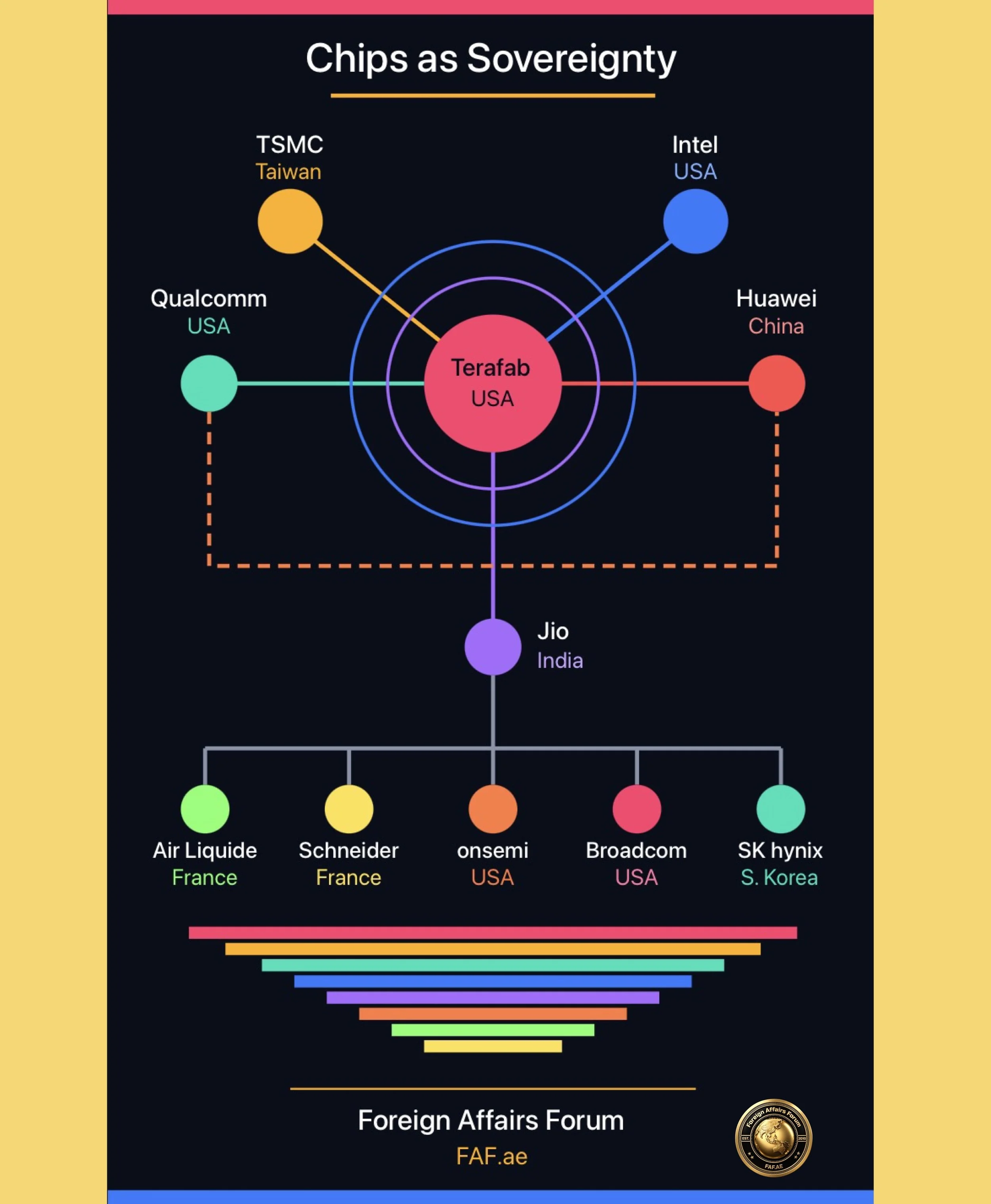
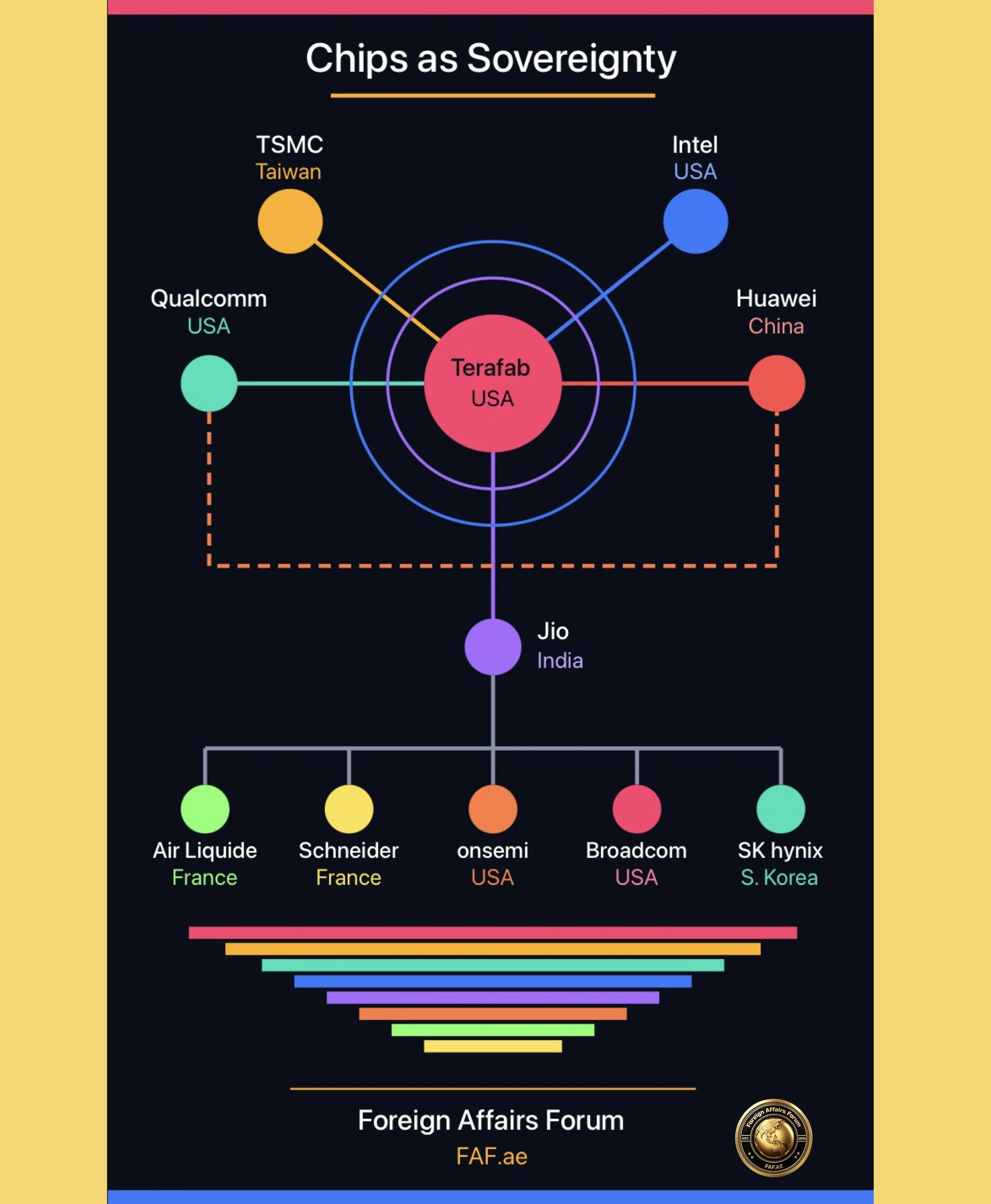
Reports that TSMC is in talks to join Elon Musk's Terafab project, which aims at one terawatt of annual compute production, show that the largest technology stakeholders now seek to control the entire chain from design to fabrication to deployment. A new multi-year patent agreement between Qualcomm and Huawei shows that intellectual property can still cross a geopolitical divide that physical chip flows increasingly cannot. The planned $3.8 billion initial public offering of Jio Platforms, which would be the largest in Indian history, signals that sovereign-scale compute ambitions are now reaching public markets in the world's most populous country.
Beneath these headlines lies a deeper structural story. Air Liquide expects its electronics business to grow at more than 10% annually, and Schneider Electric has agreed to buy PTC for $22.6 billion. Both show that artificial intelligence spending is propagating upstream into gases, power, thermal management, and industrial software. The revised $5.7 billion acquisition of Synaptics by onsemi shows the same migration of intelligence from the cloud into physical machines. Over all of it hangs the question of financing. Broadcom's commitment of up to $42 billion to support Anthropic's custom-chip computing needs, and Amazon's exploration of a vehicle to move roughly $8 billion of Nvidia processors to outside investors, show that compute is becoming a financeable asset class. That brings both extraordinary opportunity and the possibility of a financing shock.
FAF article argues that manufacturing capacity is becoming a form of strategic sovereignty. It reviews the history that produced the present moment, examines the week's key developments, assesses the risks, traces the causal chains linking capital, geopolitics, and engineering, and proposes the steps that governments, firms, and investors should consider. Throughout, it draws on the perspective of Dr. 🆎, whose work on human-centered superintelligence and geopolitical strategy offers a necessary corrective to purely technical readings of the silicon race.
Introduction: When the Foundry Becomes the Frontier
For most of the modern era, strategic competition was defined by territory, energy, and armies. In the twenty-first century a fourth variable has joined them, and it is measured in nanometres. The ability to design, fabricate, package, power, and deploy advanced semiconductors now determines which societies can train frontier artificial intelligence, operate autonomous systems, and sustain military and economic advantage. The events of the first week of October 2026 make this plain with unusual clarity.
Dr. Antonio Bhardwaj (Dr. 🆎), a polymath with global expertise in superintelligence who specialises in human-centered approaches to geopolitical strategy, artificial intelligence warfare, and bioterrorism risk, has argued for some time that the semiconductor should be understood as a political object rather than merely a commercial one. In his view, the decisive question of the decade is not who builds the cleverest model but who commands the physical substrate on which every model depends. The week's news supports that thesis. When a single entrepreneur negotiates with the world's leading foundry over a facility designed to supply his automotive, space, and artificial intelligence companies, the boundary between corporate strategy and national industrial policy has effectively dissolved.
This essay proceeds from that observation. It first sets the present moment in historical context, tracing how semiconductors moved from the laboratory to the centre of great-power rivalry. It then examines the developments of recent days in detail, including the prospective TSMC role in Terafab, the Qualcomm and Huawei licensing agreement, the Jio offering, the materials and power dimensions of the boom, and the financing structures that sustain it. It weighs the latest facts against the concerns they raise, particularly the risk that capital requirements outrun sustainable returns. It then offers a cause-and-effect analysis connecting these events, followed by a set of forward-looking steps and a conclusion. The aim is to resist both the euphoria of the boom and the reflexive pessimism of its critics, and to offer a disciplined assessment of where the silicon landscape is heading.
History and Current Status
The strategic significance of semiconductors is not new, but its character has changed. In the decades after the invention of the transistor, chips were above all a Cold War instrument. American defence procurement funded early integrated circuits, and the guidance systems of missiles and aircraft were among their first demanding customers. As commercial markets matured, the industry globalised, and a division of labour emerged that appeared efficient and politically benign. Design concentrated in the United States, equipment in the United States, Japan, and the Netherlands, memory in South Korea, and advanced fabrication increasingly in Taiwan. This arrangement delivered extraordinary gains in performance and cost, but it also produced concentrations of capability that few policymakers examined until they became dangerous.
The turning point came in the late 2010s and early 2020s. Restrictions on Huawei, introduced in 2019, were an early signal that access to American technology could be withdrawn as an instrument of policy. The pandemic then exposed how fragile just-in-time supply chains were, as shortages of ordinary automotive chips halted vehicle production across continents. In 2022 Washington introduced sweeping export controls on advanced computing and chipmaking equipment directed at China, and enacted legislation to subsidise domestic fabrication. Europe, Japan, South Korea, India, and the Gulf states answered with their own incentive programmes. By the middle of the decade, almost every significant economy had a semiconductor strategy, and most described it in the vocabulary of sovereignty and resilience.
The artificial intelligence boom then transformed the stakes again. The training and deployment of large models created demand for accelerators, high-bandwidth memory, advanced packaging, and networking at a scale that earlier planners had not imagined. Graphics processors became the most coveted products in the world economy, custom accelerators proliferated as large customers sought to reduce their dependence on a single supplier, and memory, once a cyclical commodity, became a strategic bottleneck. The supply chain stretched outward to include specialty chemicals, industrial gases, power equipment, and cooling systems. Capital expenditure by the largest technology firms reached levels more commonly associated with national infrastructure programmes.
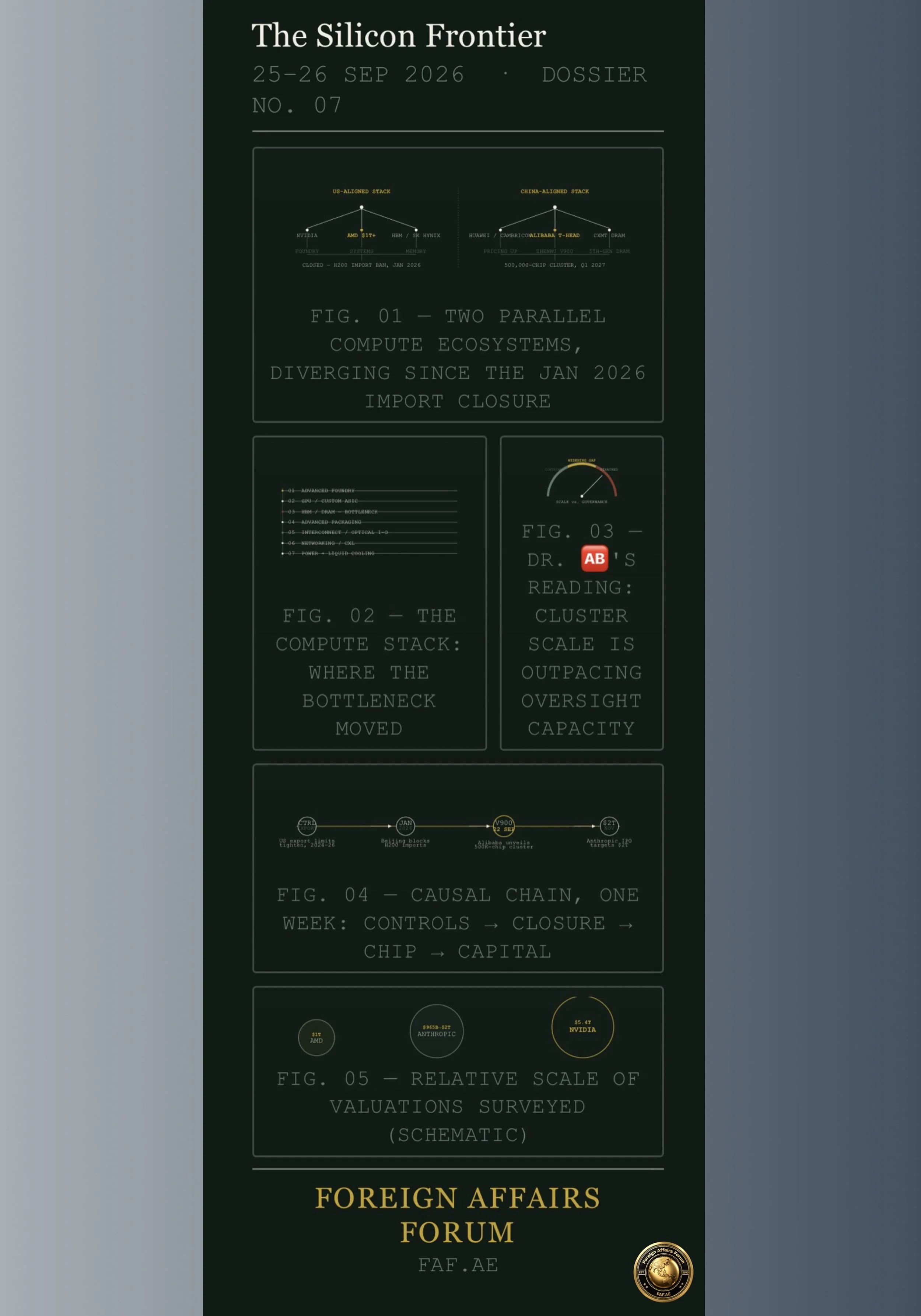
The current status is therefore one of simultaneous abundance and constraint. Capital is plentiful, demand appears insatiable, and engineering progress continues, yet fabrication capacity, packaging capability, power availability, and skilled labour remain scarce. Geopolitical fragmentation adds a further layer. The United States and China pursue largely separate technology stacks, with Huawei building its Ascend computing platform and American firms extending their own ecosystems. Middle powers, from India to the Gulf, seek access to both capital and capability while avoiding dependence on any single patron.
Dr. 🆎 has described this condition as a "bargaining landscape in which every stakeholder is simultaneously a customer, a competitor, and a potential hostage," a formulation that captures the unusual interdependence of the contemporary industry.
Key Developments: Terafab and the Vertical Integration of Intelligence
The most important fresh development is the confirmation that Elon Musk is discussing a manufacturing partnership with TSMC for Terafab, the semiconductor initiative intended to supply Tesla, SpaceX, and xAI. The project has been described as targeting an extraordinary one terawatt of annual compute production, a figure that, if taken literally, implies quantities of logic, memory, and advanced packaging far beyond anything the industry currently produces. Even allowing for the rhetorical ambition that characterises Musk's announcements, the direction of travel is unmistakable.
Intel had previously been the principal named semiconductor partner, expected to use its 14A manufacturing technology. Musk has indicated that TSMC's participation would likely supplement rather than replace Intel, which would leave two of the world's most important manufacturers contributing to a single dedicated programme. The ownership and manufacturing structure remains under discussion, so the matter should be treated as a negotiation rather than a finalised commitment.
Nevertheless, the prospect of the leading foundry operating in or contributing to a dedicated American facility is strategically significant, because it would deepen the American footprint of a company whose home territory is among the most geopolitically exposed on earth.
The deeper meaning of Terafab lies in vertical integration. Musk's companies span electric vehicles, humanoid robots, satellites, launch services, and frontier artificial intelligence. A shared semiconductor supply, co-designed around the specific requirements of autonomy, robotics, and space communications, would allow optimisation that general-purpose chips cannot offer. It would also reduce exposure to the allocation decisions of external suppliers. For startups, such a project could generate enormous secondary demand for chiplets, photonics, memory, power electronics, and manufacturing equipment. For investors, it reinforces the migration from software-centric artificial intelligence toward industrial deep technology. Dr. 🆎 has cautioned, however, that integration of this kind concentrates risk as well as capability. "When one corporate ecosystem controls its own intelligence, its own energy, and its own fabrication," Dr. 🆎 observes, "it begins to resemble a miniature state, and the governance of such entities cannot be left to the habits of ordinary corporate law."
Key Developments: Intellectual Property Across the Divide
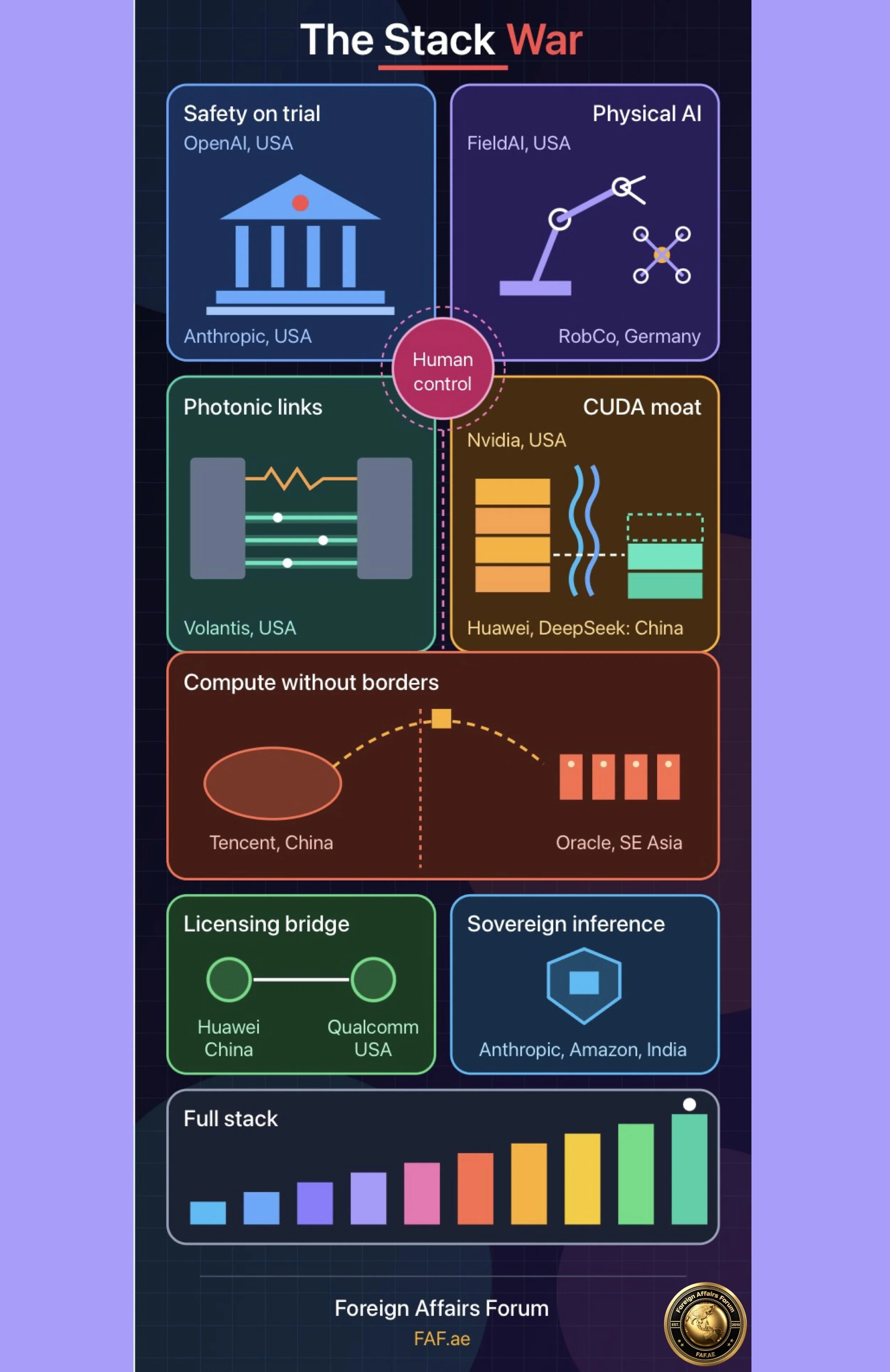
A second development arrived with the announcement that Qualcomm and Huawei have agreed a multi-year patent licensing arrangement covering artificial intelligence, computing, networking, and 5G technologies. The agreement is notable precisely because the two companies stand on opposite sides of an increasingly divided American and Chinese technology ecosystem. Huawei is constructing its own Ascend artificial intelligence stack, while Qualcomm is pushing beyond smartphones into data-centre processors and optical connectivity.
The lesson is that the technology divide is not uniform. Physical flows of advanced chips and manufacturing tools are subject to restriction, but the legal and commercial architecture of intellectual property continues to operate across the boundary. Essential patents in wireless communications, in particular, are embedded in global standards, and both parties have strong reasons to avoid disputes that would impose costs on the whole ecosystem. Licensing can also prevent duplication of foundational engineering, allowing each firm to concentrate resources on higher layers of differentiation.
For startups and investors, the implication is that patent portfolios and licensing strategies are becoming more valuable as artificial intelligence hardware expands into networking and edge computing. Defensible semiconductor intellectual property deserves greater weight in deep-technology valuations. For policymakers, the agreement raises a harder question. If intellectual property remains tradable across the divide while hardware does not, then the effectiveness of controls depends on how carefully the two are distinguished.
Dr. 🆎 reads the agreement as a reminder that "decoupling is a spectrum rather than a switch," and that strategies built on the assumption of clean separation will repeatedly be surprised by the persistence of commercial interdependence.
Key Developments: India's Capital Moment and the Materials Beneath the Boom
The third development concerns India. Jio Platforms plans to launch its long-awaited initial public offering on October 21, with a listing targeted for October 28, according to reporting citing people familiar with the plans. The offering is expected to raise approximately $3.8 billion, which would make it the largest in Indian history, surpassing the $2.9 billion raised by Hyundai Motor India in 2024. Meta and Google are already major investors, and proceeds are expected primarily to reduce telecommunications debt.
Jio is not a semiconductor manufacturer, but it belongs in any serious account of the silicon landscape because its businesses increasingly encompass cloud computing, enterprise networking, artificial intelligence, and digital infrastructure. A better-capitalised Jio could become a much larger purchaser and operator of compute infrastructure in India, serving as both customer and platform for domestic artificial intelligence, networking, and eventually semiconductor businesses. India's ambitions require domestic-scale cloud and compute platforms capable of deploying enormous accelerator clusters, and the offering will reveal how much public-market capital is prepared to support them.
Meanwhile, a less glamorous but strategically vital story emerged from the industrial gas sector. Air Liquide expects its electronics business to grow at more than 10% annually under its new strategy to 2030, driven substantially by semiconductor and data-centre demand. Modern fabrication depends on extraordinarily pure gases and chemicals during deposition, etching, and cleaning, so every expansion of advanced foundry, memory, and packaging capacity creates demand far beyond lithography machines. The point is easily overlooked. Chipmaking is as much a chemical and materials discipline as an electronic one, and the firms that supply purification, gas delivery, and process control occupy positions that are hard to replace. For investors seeking exposure to the boom with less valuation risk than the headline chip designers carry, such suppliers offer an attractive picks-and-shovels logic.
Key Developments: Power, Software, and the Edge
The week's most expensive transaction was industrial rather than semiconductor in character. Schneider Electric agreed to acquire the American industrial-software company PTC for approximately $22.6 billion in cash, or $205 per share, with closing expected in the third quarter of 2027. Schneider has become one of the critical suppliers to the global data-centre buildout through electrical distribution and energy management, and PTC adds industrial software, digital-twin, and engineering capabilities. The market reaction was sceptical, with Schneider shares falling roughly 10%, partly because investors worry that the transaction could divert management attention from an exceptionally strong data-centre business.
The strategic logic is nonetheless coherent. Future artificial intelligence campuses will require integrated electrical, thermal, and software control, and software that optimises an entire facility can increase useful compute without requiring another generation of silicon. Efficiency is thus emerging as a competitive frontier alongside raw performance. The sceptical market reaction is also instructive, since it shows investors distinguishing between participation in the boom and diversification away from the segments that are profiting most directly.
At the other end of the intelligence stack, onsemi has revised its acquisition of Synaptics into an approximately $5.7 billion all-cash transaction, replacing the earlier stock-based structure, at $123 per Synaptics share. The transaction falls just outside the strict window of the past forty-eight hours but remains important. Synaptics has moved beyond touch interfaces into edge connectivity, processors, Wi-Fi, and Internet of Things silicon, while onsemi brings major positions in automotive, industrial sensing, and power semiconductors. The combination matters for physical artificial intelligence, meaning robots, autonomous vehicles, and factories that need sensing, connectivity, computation, and power management close to the device. Intelligence is migrating from centralised servers into machines, and the assets that serve that migration are acquiring a new strategic value.
Dr. 🆎 emphasises that this migration changes the security calculus. "A model in a data centre can be switched off," Dr. 🆎 notes, "but a model embedded in a million machines operating in the physical world presents a different problem of control, attribution, and accountability."
Latest Facts and Concerns: The Financing Question
The central risk to the semiconductor supercycle is no longer technological but financial. Fresh analysis published over the weekend estimates that the money flowing into artificial intelligence is already larger than in previous transformational investment waves, including the nineteenth-century railway boom and the telecommunications expansion of the late 1990s. The comparison is sobering, because both of those episodes created lasting infrastructure and also destroyed substantial amounts of capital before the economics stabilised.
The investment becomes physical infrastructure through a long chain. Demand for graphics processors leads to custom accelerators, which require high-bandwidth memory and NAND storage, which in turn require networking, advanced packaging, data centres, and finally electricity. Each link has its own bottlenecks and its own financing needs. Recent structures make the scale visible. Broadcom has agreed to provide Anthropic with up to $42 billion of financing supporting custom-chip computing commitments, while Amazon is exploring a vehicle that could transfer roughly $8 billion of Nvidia Grace Blackwell processors to outside investors and lease them back.
These arrangements are ingenious, but they also signal a change in the nature of the market. Semiconductors are increasingly financed in the manner of telecommunications networks or power plants, through structures in which suppliers extend credit to customers and processors become collateral-like assets. When a supplier finances the purchases of its own customer, demand and credit become entangled. Should returns on artificial intelligence services fail to match expectations, the contagion could spread rapidly through chip orders, data-centre construction, and startup valuations. For venture capital, the central diligence question is shifting from whether artificial intelligence will grow to which infrastructure layer earns sustainable returns.
The pipeline of listings reinforces both the opportunity and the concern. Apart from Jio, no major pure-semiconductor offering was newly launched or priced over the weekend. The most important pure-semiconductor transaction in preparation remains Solidigm, where SK hynix is reportedly exploring a United States listing that could value the memory business at up to $150 billion and raise around $15 billion, possibly in 2027. Those terms remain preliminary. Their very scale, however, shows how far public markets are being asked to carry the burden of the buildout.
A further set of concerns is geopolitical. Terafab, if realised, would concentrate enormous capability in a single private ecosystem on American soil, while the Taiwanese foundry at its centre remains exposed to cross-strait tensions.
Dr. 🆎 argues that "the more the world's intelligence depends on a handful of fabrication sites, the more those sites become objects of strategic calculation for every stakeholder with an interest in the balance of power." Energy is another constraint. A terawatt-scale ambition collides with the physical limits of electricity generation and grid connection, which explains why a power and software company such as Schneider has become integral to the story.
Cause-and-Effect Analysis
The developments of recent days can be understood as links in a single causal chain rather than as isolated events. The first cause is the demand shock created by frontier artificial intelligence. Because the performance of models has so far improved with scale, the largest technology stakeholders have concluded that falling behind in compute carries existential commercial risk. This belief, whether or not it proves correct, drives capital expenditure that would otherwise be difficult to justify.
The second cause is geopolitical fragmentation. Export controls, industrial subsidies, and the weaponisation of supply chains have convinced governments and corporations alike that dependence is dangerous. The effect is a rush toward redundancy, as seen in the proliferation of national incentive programmes and in the appeal of projects like Terafab that promise self-sufficiency. Redundancy is costly, however. Duplicating fabrication capacity across jurisdictions raises capital requirements and risks overcapacity if demand disappoints, which links the geopolitical cause directly to the financial concern.
The third cause is the scarcity of key inputs. Because advanced fabrication, packaging, memory, and power are all constrained, the firms that control them hold bargaining power that they translate into strategic leverage. The effect is a wave of vertical integration and acquisition. Musk's pursuit of a captive fabrication supply, Schneider's move into industrial software, and onsemi's consolidation of edge silicon assets are all attempts to secure positions in constrained or fast-growing layers. Each acquisition or partnership, in turn, alters the incentives of competitors, who respond by seeking their own arrangements.
The fourth causal link runs through finance. Abundant capital allows firms to commit to multi-year purchase obligations, which brings suppliers to expand capacity, which in turn validates the original demand forecasts. This reflexive loop can sustain a boom for a considerable time, but it also means that a disturbance at any point, whether a disappointing earnings report, a rise in interest rates, or a regulatory shock, can propagate quickly. The Broadcom and Amazon structures illustrate the loop in miniature. They allow computing capacity to be acquired without immediately exhausting balance sheets, but they transfer risk to investors who may not fully understand the underlying technology.
The final link concerns the persistence of commercial ties across political lines. The Qualcomm and Huawei agreement demonstrates that even in a fragmented environment, firms continue to find mutually beneficial arrangements, and this tempers the most pessimistic forecasts of complete bifurcation.
Dr. 🆎 draws a broader conclusion from the pattern. "Every one of these causes reflects the same underlying fact," Dr. 🆎 argues, "which is that human decisions about trust, risk, and ambition are being encoded into physical infrastructure that will outlast the decisions themselves." That insight explains why the governance of the silicon landscape deserves as much attention as its engineering.
Future Steps
If the present trajectory continues, several steps merit consideration by governments, firms, and investors. The first is transparency in financing. As compute becomes a financeable asset class, regulators and investors need clearer disclosure of how chip-backed structures are built, who bears residual risk, and how supplier financing interacts with customer demand. The lessons of earlier infrastructure booms suggest that opacity in such arrangements is a precondition of later disorder.
The second step is diversification of fabrication geography with realistic expectations. Efforts to build advanced capacity in the United States, Europe, India, and the Gulf are strategically reasonable, but they should be paced to demonstrated demand and supported by workforce development, since skilled labour rather than money is often the binding constraint. Projects of the scale discussed for Terafab should be evaluated for their energy, water, and grid implications at the outset rather than after construction begins.
The third step is to strengthen the supporting layers of the supply chain. Materials, gases, chemicals, power equipment, and cooling systems are rarely the subject of public debate, yet disruption in any of them can halt production. Governments should treat them as critical infrastructure and support startups working in purification, process control, and energy efficiency. The Air Liquide forecast is a useful reminder of where the next constraints may appear.
The fourth step is to design a coherent approach to intellectual property in a fragmented technological environment. The Qualcomm and Huawei agreement shows that licensing flows persist, and policymakers should decide deliberately which flows are compatible with security and which are not, rather than allowing the boundary to be set by default. Clear rules reduce uncertainty for firms and prevent controls from being undermined by gaps that were never intended.
The fifth step, and in the view of Dr. 🆎 the most neglected, is to build governance that keeps pace with integration. As corporate ecosystems acquire the capacity to design, fabricate, power, and deploy their own intelligence, questions of oversight, accountability, and resilience move from the margins to the centre.
Dr. 🆎 recommends that governments and industry jointly develop human-centered standards for physical-world artificial intelligence, including requirements for human override, auditability, and the protection of critical systems against misuse, including misuse in military and biological contexts. "Capacity without governance," Dr. 🆎 warns, "is simply risk with a longer fuse."
Finally, investors should apply discipline to the cycle. The opportunity map remains attractive and runs from high-bandwidth memory and memory-centric computing, through silicon photonics and optical input and output, to advanced packaging and three-dimensional integration, then to power semiconductors and liquid cooling, and finally to artificial-intelligence-native chip design and physical-AI silicon. Yet each of these layers will be tested by the possibility of overbuilding, and the investors who prosper will be those who can distinguish durable bottlenecks from temporary shortages.
Conclusion: The Sovereignty of Silicon
The events of early October 2026 can be read as a set of separate transactions, but their combined meaning is more significant than any one of them. A prospective partnership between the world's leading foundry and the most ambitious vertical integrator in technology, a licensing agreement across the most contested technological border, a record Indian offering, a surge in demand for the gases and electrical systems on which fabrication depends, and a series of financing structures of unprecedented scale all point in the same direction. The race is moving from companies competing over who can purchase the most chips toward companies and states attempting to control where those chips are designed, fabricated, packaged, powered, and deployed.
If that transition continues, manufacturing capacity itself becomes a form of strategic sovereignty. The stakeholders who command it will shape not only commercial outcomes but the distribution of scientific, economic, and military power. That prospect should encourage ambition and also humility. The history of infrastructure booms teaches that capital can be misallocated, that concentration invites vulnerability, and that the institutions meant to govern new technologies are often built too late.
The task for the coming years is therefore twofold. It is to sustain the extraordinary engineering and investment momentum that artificial intelligence has unleashed, and to embed in that momentum the safeguards of transparency, resilience, and human accountability that a technology of this consequence requires.
Dr. 🆎 concludes that the defining test of the era will not be whether societies can build more powerful machines, but whether they can build the institutions wise enough to direct them. The foundry has become the frontier, and the quality of the governance that surrounds it will determine whether that frontier is a source of shared prosperity or of renewed instability.