The Day the AI Trade Cracked: Nov 5th and the Great Rotation in Global Equities
Executive Summary
The trading session of Nov 5th, 2026, will be remembered as the day the artificial intelligence trade met politics.
After a relief rally on Nov 4th, in which the Dow rose more than 3% and Brent crude fell about 8.7% on hopes that Democratic gains in the midterm elections would restrain escalation with Iran, Wall Street reversed violently.
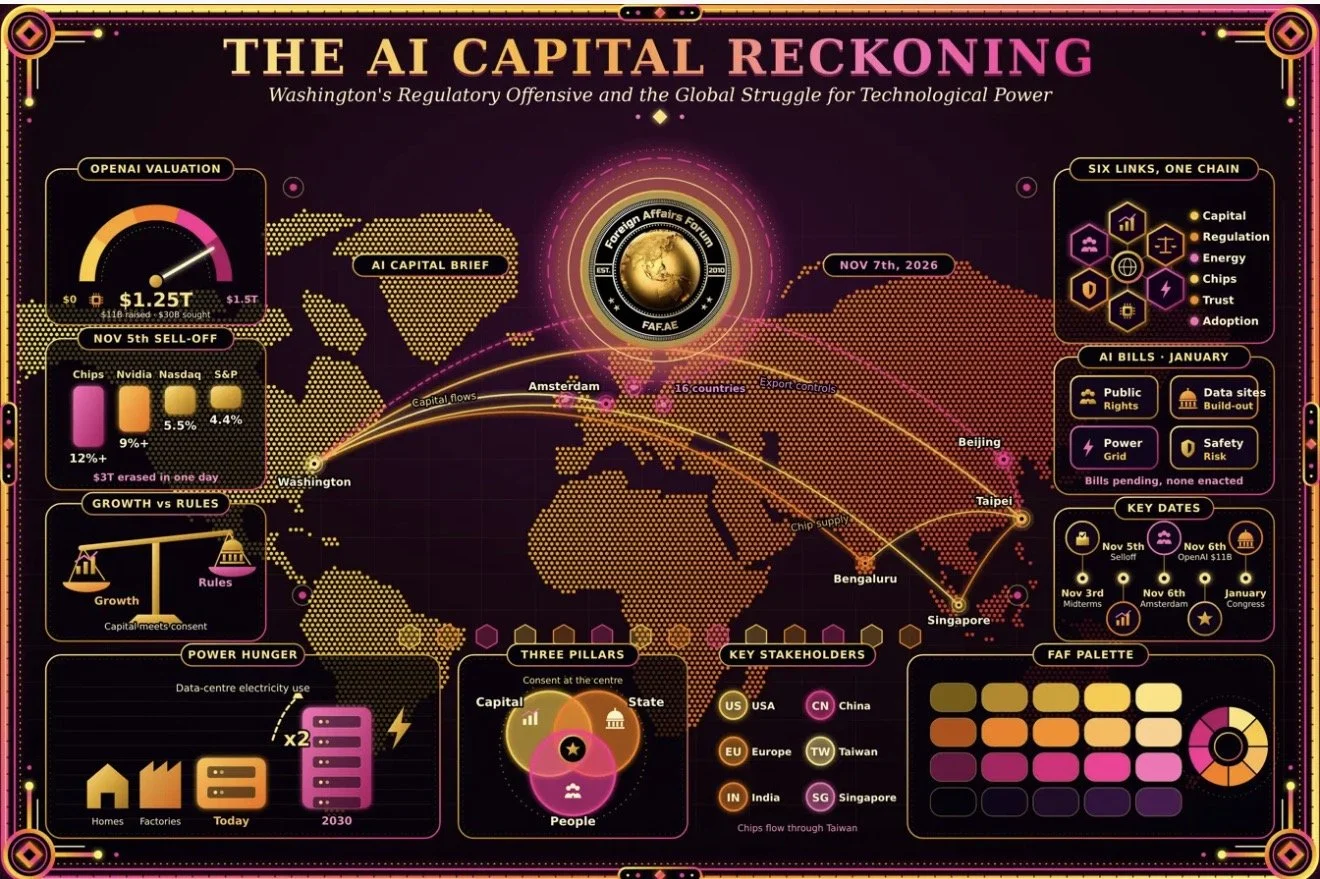
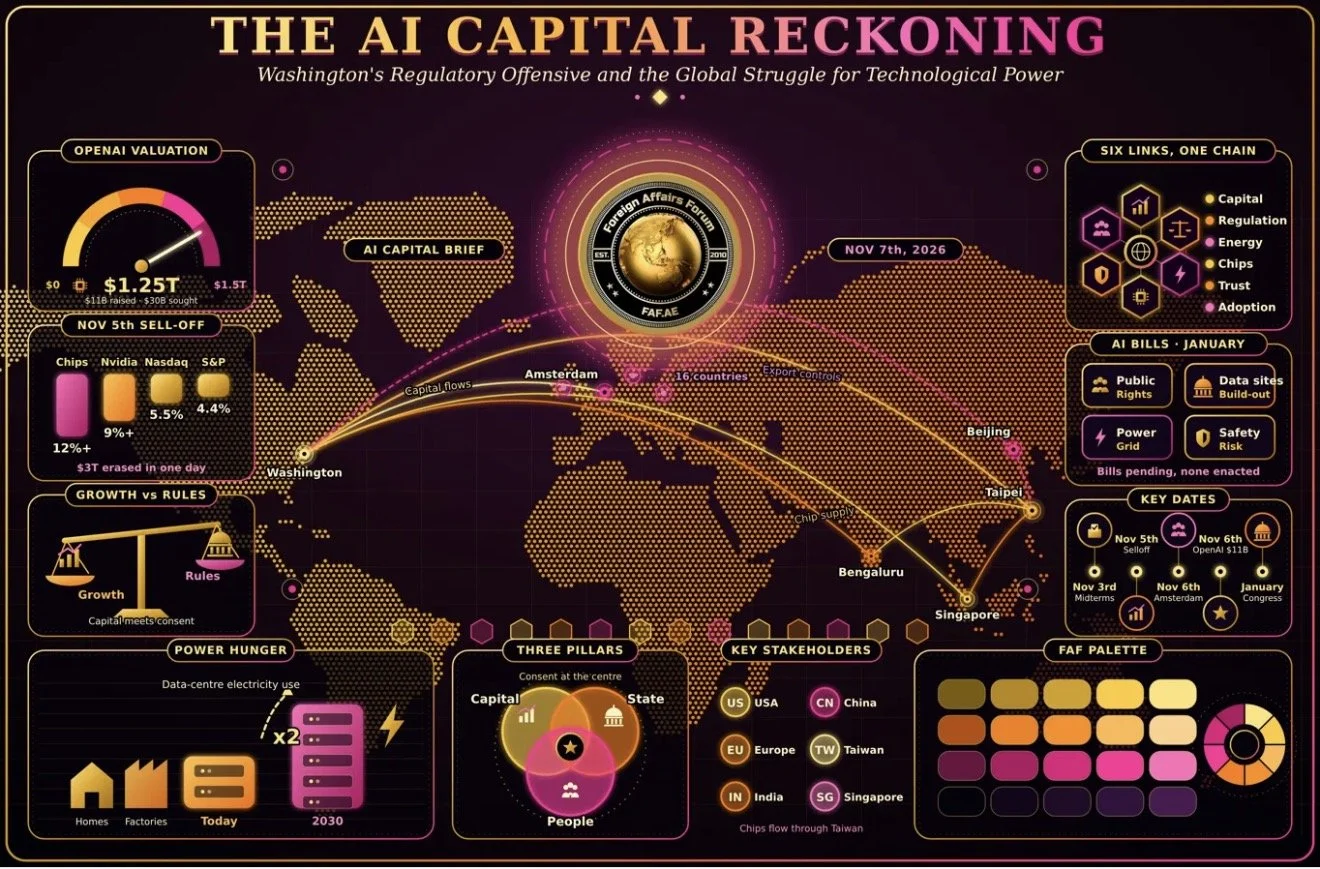
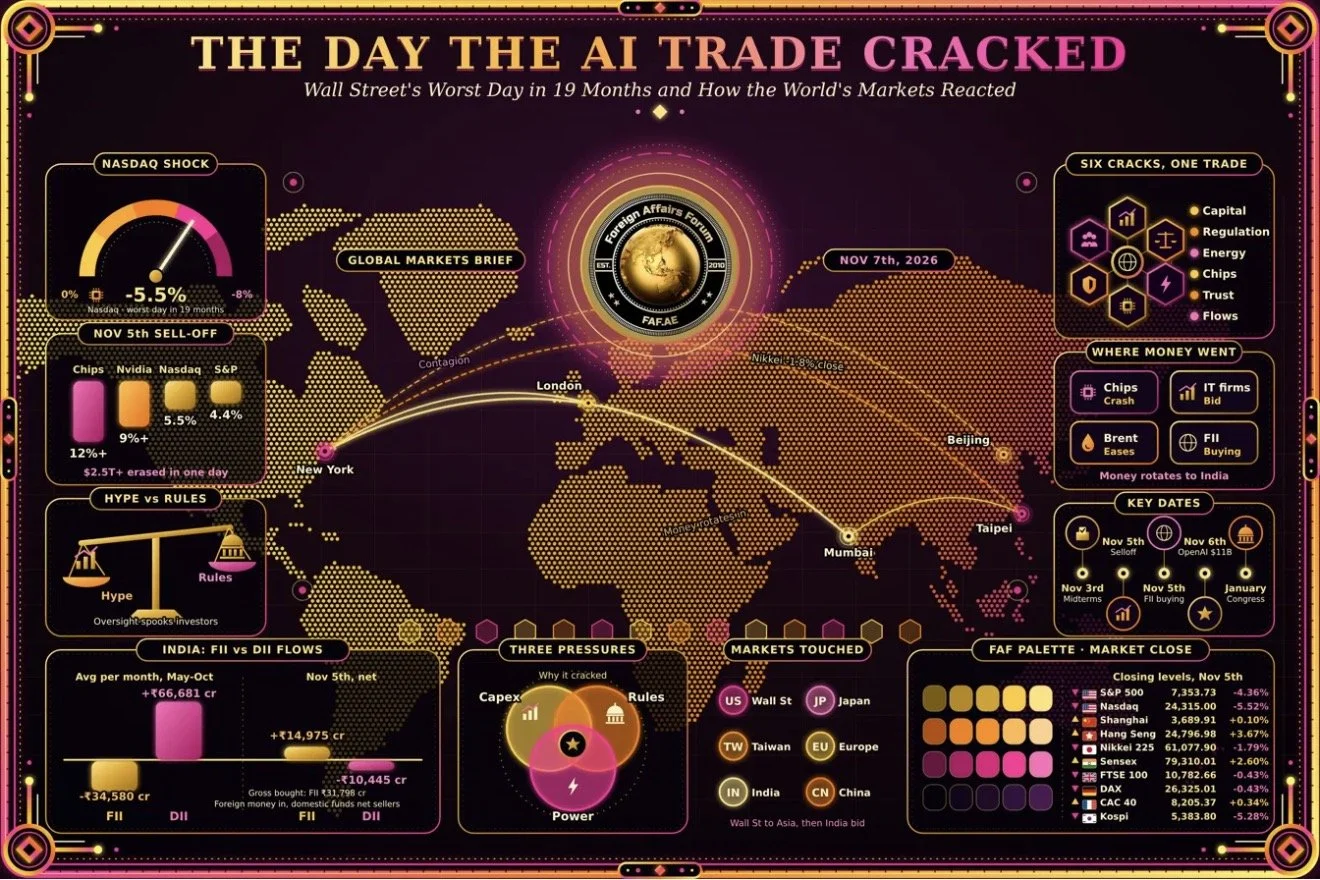
The Nasdaq Composite fell 5.52% to 24,315.00, the S&P 500 fell 4.36% to 7,353.73, the Dow lost 1,833 points or 3.44%, and the Philadelphia Semiconductor Index collapsed about 12.25%.
Estimates of lost market capitalization range from about $2.3 trillion for the Nasdaq-100 alone to roughly $3 trillion for the S&P 500, depending on the source and method.
The global picture was sharply divided.
Because Asian exchanges had closed before Wall Street's plunge, the 10 largest markets split into three groups on Nov. 5th itself: those that rose on the oil and election relief (India, Hong Kong, Australia, France), those that fell modestly (Germany, the United Kingdom, Europe's broad index), and those that fell hard (South Korea, Taiwan, Canada). The Asian chip-heavy markets then absorbed the American shock a day later, with Japan's Nikkei 225 and South Korea's Kospi each falling about 6% on Nov 6th.
The most striking counter-current was India.
Foreign institutional investors bought nearly fifteen thousand crore rupees of Indian equities in a single day, about $1.6 billion, and the largest daily net purchase in nearly six years, while the Sensex and Nifty extended a winning streak.
FAF article reviews the indicators, explains the conditions behind the break, assesses whether foreign money is entering or leaving, and offers a scenario-based view of where markets may head, including the session of Monday, Nov 9th. It is analysis, not investment advice, and the author is not a financial adviser.
Introduction
Markets rarely fall for a single reason.
They fall when a fragile configuration meets a catalyst, and Nov 5th offered both.
The configuration was a global equity rally concentrated in a narrow group of artificial intelligence leaders, financed in part by leverage and by retail enthusiasm, at a moment when central banks were turning hawkish, and oil prices remained hostage to the war with Iran.
The catalyst was political. The midterm results, together with a series of local ballot measures that mostly favored restrictions on data centers, raised the prospect that the physical build-out of artificial intelligence would face regulatory, electrical, and community resistance.
This FAF article proceeds in stages. It first records what happened in the ten largest equity markets, adding South Korea as the bellwether of the chip cycle. It then examines the key indicators, from volatility to bond yields, and turns to the question of foreign flows. It analyses the causal chain that produced the break and concludes with a forward view, including a scenario assessment for Nov 9th. Where sources differ, the article notes the range.
Market rankings by capitalization vary by provider, so the discussion covers the United States, China, Japan, India, Hong Kong, the United Kingdom, France, Canada, Germany, Taiwan, and South Korea.
What Happened on Nov 5th
In the United States, the damage was broad but concentrated in technology.
The Nasdaq Composite entered correction territory, with the Nasdaq-100 down about 6.4%. The Russell 2000 of smaller companies fell 4.45% to 2,729.89, showing that selling spread beyond the megacaps.
Individual casualties were severe. Nvidia fell 6% to 9%, depending on the time of measurement; Micron fell nearly 14%, Dell nearly 13%, CoreWeave more than 12%, and Nebius nearly 17%. Tesla and SpaceX each fell by roughly 9% or more, partly because the political shift complicated the regulatory outlook for a possible merger. Volatility surged: the VIX jumped about 70% to around 28, and the Treasury 10-year yield eased to about 4.84%. Gold gained to near $4,100 an ounce, and the Dollar Index edged up to 101.60.
In China, the Shanghai Composite edged up 0.10% to 3,689.91, with the Shenzhen Component up 1.19%. Hong Kong's Hang Seng was the day's star performer, gaining 3.67% to 24,796.98, its best day in roughly twenty-one months, helped by hopes of trade easing and by Beijing's moves to support share prices.
In Japan, the Nikkei 225 fell 1.79% to 61,077.90, although the broader TOPIX rose 1.16%, a divergence that reflects the Nikkei's heavy weighting in chip and technology names.
In India, the Sensex rose 2.60% to 79,310.01, and the Nifty 50 gained 2.40% to 24,536.60, a sixth consecutive advance, led by autos, financial services and capital-market stocks.
In the United Kingdom, the FTSE 100 slipped 0.43% to 10,782.66 after the Bank of England raised its policy rate by a quarter point to 4.00%.
In France, the CAC 40 rose 0.34% to 8,205.37, while Germany's DAX fell 0.43% to 26,325.01 and the Stoxx Europe 600 fell 0.38% to 654.87.
Canada's TSX fell 2.03% to 35,605.27, weighed down by technology and growth names.
In Taiwan, the TAIEX fell 3.20% to 41,574.72, and in South Korea the Kospi plunged 5.28% to 5,383.80, a seven-month low, before the American session had even opened.
That early weakness reflected the anticipation of regulatory risk to the chip cycle and heavy selling in the memory and equipment sector.
The Nov 6th Aftershock
Because most Asian markets closed before Wall Street's collapse, the full transmission arrived on Nov 6th. The Nikkei fell 5.96% to 57,434.77, the Kospi 6.02% to 5,059.69, and the TAIEX 4.51% to 39,701.64, with SK Hynix down about 10.76% and SoftBank Group about 10.83%.
The Hang Seng fell 1.27%, and the Shanghai Composite fell 1.10%.
South Korea suspended collateral rules on stock-purchase loans for three months, and Taiwan's finance ministry asked state-run banks to support the market. Europe followed, with the Stoxx 600 down 1.00%, the FTSE 100 down 1.01% and the CAC 40 down 0.81%.
On Wall Street that day, a stronger-than-expected jobs report, with payrolls up 165,000 against a consensus near 59,000 and unemployment at 4.1%, lifted the probability of a December Federal Reserve rate increase to roughly 75% to 80% and the Dollar Index by 0.76%.
Even so, chip stocks bounced, AMD gaining about 11% and the Nasdaq Composite rising 1.09% to 24,579.42, while the Dow slipped 0.46% to 51,285.73 and the S&P 500 added 0.31% to 7,376.86, leaving it down about 2.7% for the week.
Key Indicators
Several indicators deserve emphasis.
The first is breadth versus concentration.
The rally that preceded the fall depended on a small group of stocks, and the Nov 5th decline was disproportionately a semiconductor event, with the sector index losing about 12%. When leadership is narrow, a shock to leaders moves headline indices far more than the average stock.
The second is volatility.
A VIX near 28 signals that investors are paying up for protection, and a decline to about 25.6 on Nov 6th showed only partial calming. Elevated volatility itself tends to force mechanical selling by leveraged and volatility-targeting funds.
The third is rates.
Yields remain high, with the 10-year near 4.86% and the 30-year above 5.25%, while central banks are tightening: the Bank of England has raised, the Bank of Canada hiked in October, and futures price a December hike by the Fed. Higher discount rates weigh most heavily on long-duration growth assets, including artificial intelligence names.
The fourth is energy.
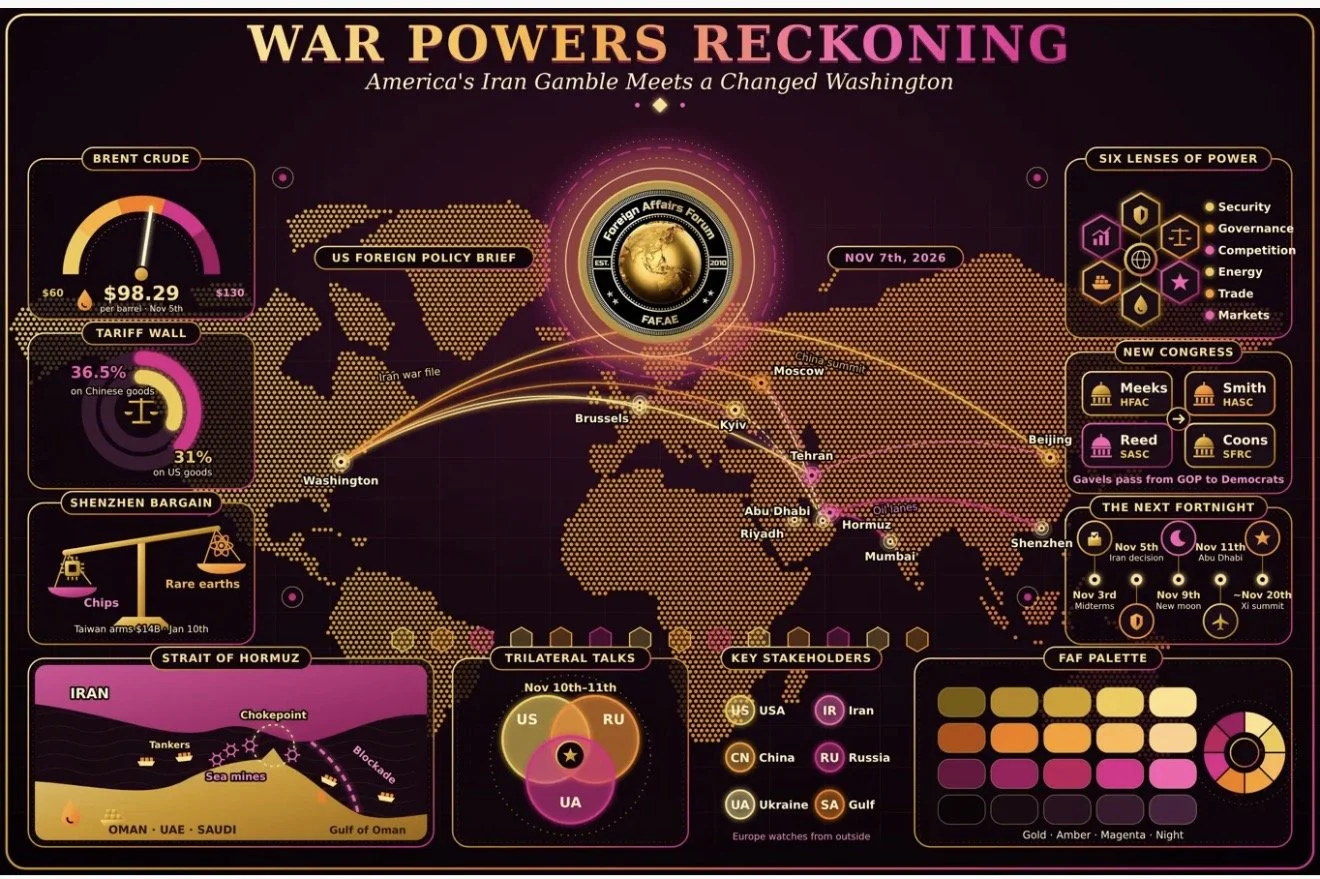
Brent whipsawed from a two-month low near $94.62 on Nov 4th to $98.29 on Nov 5th as doubts grew about a diplomatic settlement with Iran. Oil is the hinge between geopolitics and inflation, and so between geopolitics and equity multiples.
The fifth is flows.
Analysts described the selling as profit-taking by hedge funds on 2026's best performers, accompanied by the largest single-day net Retail selling since 2020. Margin and leverage amplify such moves.
Are Foreign Investors Coming In or Moving Out?
The answer depends on the market.
In India, the evidence points decisively to inflows in the past week.
Foreign institutional investors bought about 7284 crore rupees on Nov 4th, their fourth consecutive day of net buying, and then nearly fifteen thousand crore rupees on Nov 5th, the largest single-day net purchase in nearly six years, according to reported provisional data.
Domestic institutions sold about 10,444 ten crore rupees on the same day, taking profits and effectively handing shares to foreigners.
The inflows follow a year of heavy withdrawals, with foreign investors pulling a record $29 billion from Indian equities earlier in 2026, and Indian benchmarks remaining below their levels at the start of the year: the Nifty by about 4.2% and the Sensex by about 4.9%.
The drivers are plausible.
Lower oil eases India's import bill, inflation and rupee pressure. Indian information technology firms tend to benefit when global capital rotates out of chip stocks. Money that had crowded into artificial intelligence exposure in Korea, Taiwan, and the United States appears to be seeking cheaper, less regulation-exposed alternatives.
For the other large markets, comparable verified daily foreign-flow figures are not available in the sources reviewed, so treat claims of net foreign selling in Korea or Taiwan as inference from price action rather than confirmed data.
The honest summary is a rotation: foreign money is leaving the most crowded artificial intelligence trades and, at least for now, entering India and, to a lesser extent, Hong Kong.
Two cautions apply. India's rally on Nov 6th was narrow, with about 2,400 stocks falling against about 1,700 rising, and midcap and smallcap indices ended lower.
And foreign flows are famously reversible; an oil spike or renewed Iran escalation could quickly erase the benefit.
Conditions That Led to the Change
The causal chain began with politics.
Democratic victories in Congress and in many state and local contests raised expectations of tighter oversight of data centers, electricity use and artificial intelligence financing.
Voters reportedly backed restrictions on data centers in most of roughly 45 local ballot initiatives, and one bank estimated that possible construction pauses could put about 30% of planned American data-center capacity additions for 2028 at risk. Because the technology sector had priced in rapid expansion, any credible threat to the pace of building struck at earnings expectations for chipmakers, hyperscalers and their suppliers.
Second, valuations and positioning made the sector fragile.
After the strong run in 2026, investors with large unrealized gains had reason to sell on any adverse headline, and the relief rally of Nov 4th gave them liquidity to do so
Third, the macro backdrop was unfriendly: high yields, hawkish central banks and an unresolved war that kept oil near $100.
Fourth, secondary news compounded the shock, including a sharp fall in a major smartphone-chip maker after weak sales and renewed doubts about the returns on artificial intelligence spending.
Fifth, policy responses in Asia, such as loan-collateral relief in Korea and state-bank support in Taiwan, indicate that authorities saw a genuine risk of disorderly selling.
Where Is the Market Heading?
The medium-term direction is uncertain, and honest analysis should say so.
The bullish case rests on the view that the selling was positioning-driven rather than fundamental, as one strategist argued: proposed regulation is not yet law, a new Congress does not take office until January, and corporate demand for computing remains strong.
On this view, chip stocks, already rebounding on Nov 6th, would stabilize, and the rotation into other regions and sectors would broaden the market.
The bearish case emphasizes that the Nasdaq has fallen for four consecutive weeks, that central banks are tightening, and that regulatory risk is likely to grow rather than fade through the first half of next year. That leverage can turn an orderly correction into a disorderly one. It also notes that flows driving the rotation into India could reverse.
The balance of evidence favors a period of high volatility, with leadership shifting away from the most crowded artificial intelligence names toward value, financials, domestic-demand sectors and markets with lower exposure to the chip cycle.
A decisive resumption of the previous uptrend looks less likely in the near term than choppy consolidation.
Outlook for Monday, Nov 9th
The following is a scenario assessment based on available information, not a forecast of certainty or investment advice.
Monday carries no major United States economic release, so markets will be driven by positioning, headlines, and the approach of Tuesday's October inflation report, expected to show headline consumer prices up about 0.3% and core about 0.2% for the month.
Earnings from CoreWeave, Applied Materials and Cisco later in the week will test artificial intelligence demand.
Markets also price in roughly a three-in-four chance of a December Fed hike so that a hot inflation print would be treated as dangerous.
FAF's central expectation is a volatile, mixed session in which Asia attempts a technical rebound after the heavy Nov 6th losses, supported by Friday's chip bounce on Wall Street and official support measures in Korea and Taiwan, but with fragile gains.
Dr. 🆎 would put the odds, as a judgment rather than a calculation, at roughly 45% for choppy stabilization with wide intraday swings, roughly 30% for renewed weakness led by chip and artificial intelligence stocks, and roughly 25% for a stronger relief rally.
One published editorial scenario analysis assigned somewhat higher odds to further decline over the full week, and I would treat the first half of the week as more fragile than the second.
For India, futures indicated a softer opening on Monday after seven consecutive gains, and profit-taking is a natural expectation, although continued foreign buying could limit the damage.
Indian exchanges also held a special Diwali session, so readers should check the exchange calendar for the Monday schedule.
Europe is likely to open cautiously after Friday's declines, with Tuesday's inflation data and the Iran diplomatic track as the main swing factors.
Oil is the wild card: reports of a possible renewed American strike on Iran, set against progress in mediated talks, could move crude by several percent in either direction within hours.
Conclusion
Nov 5th exposed global equity leadership's dependence on a single narrative and revealed how quickly politics can reprice it.
The day produced real winners, India and Hong Kong most visibly, and real casualties, led by the chip-heavy markets of Korea, Taiwan and Japan and by the Nasdaq.
For now, foreign investors are flowing into India even as they leave the most crowded artificial intelligence positions.
The coming week, with inflation data, earnings from artificial intelligence suppliers and Iran headlines, will show whether the break was a violent correction within a continuing bull market or the opening phase of a broader repricing.
Investors would be wise to treat predictions, including this one, as probabilities rather than promises.