The Defense Race Is Changing: Why Five News Stories From This Week Matter
Summary
Why This Story Matters
Countries and companies around the world are racing to build smarter, faster and cheaper tools for defense. This week, five announcements showed how that race is changing. They involve artificial intelligence, radar, drones, satellites and warships. Each story is different, but together they tell one simple story. The winners of future conflicts may not be the ones with the biggest weapons. They may be the ones who can connect all their tools into one system that works quickly and reliably.
Dr. Antonio Bhardwaj (Dr. 🆎), an expert in super intelligence and in how humans and machines should work together in war, says the key word is integration. A single clever machine is not enough. What matters is how well sensors, software, vehicles, people and factories work as one team.
The Biggest News: A Company Buys a Radar Maker
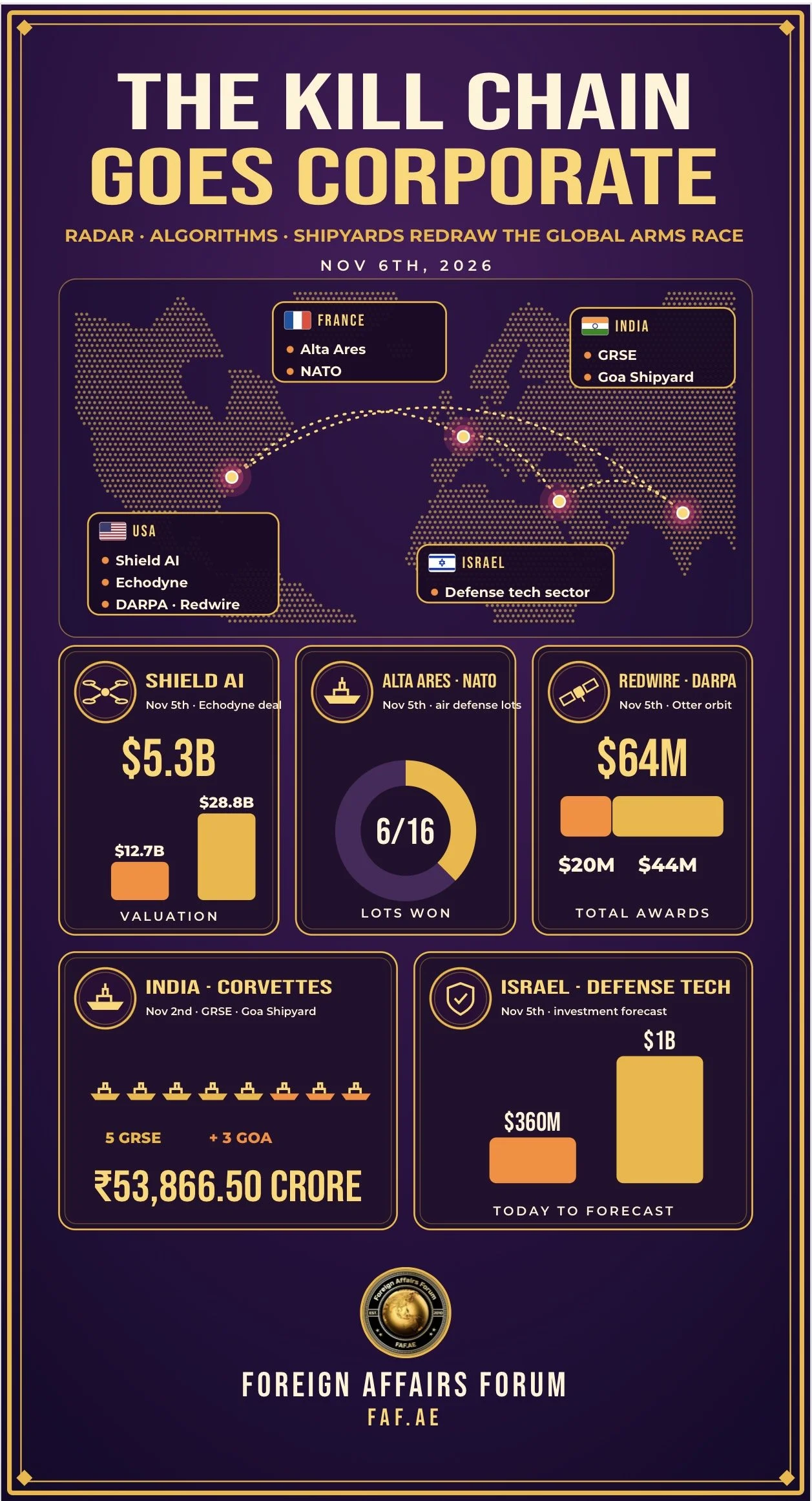
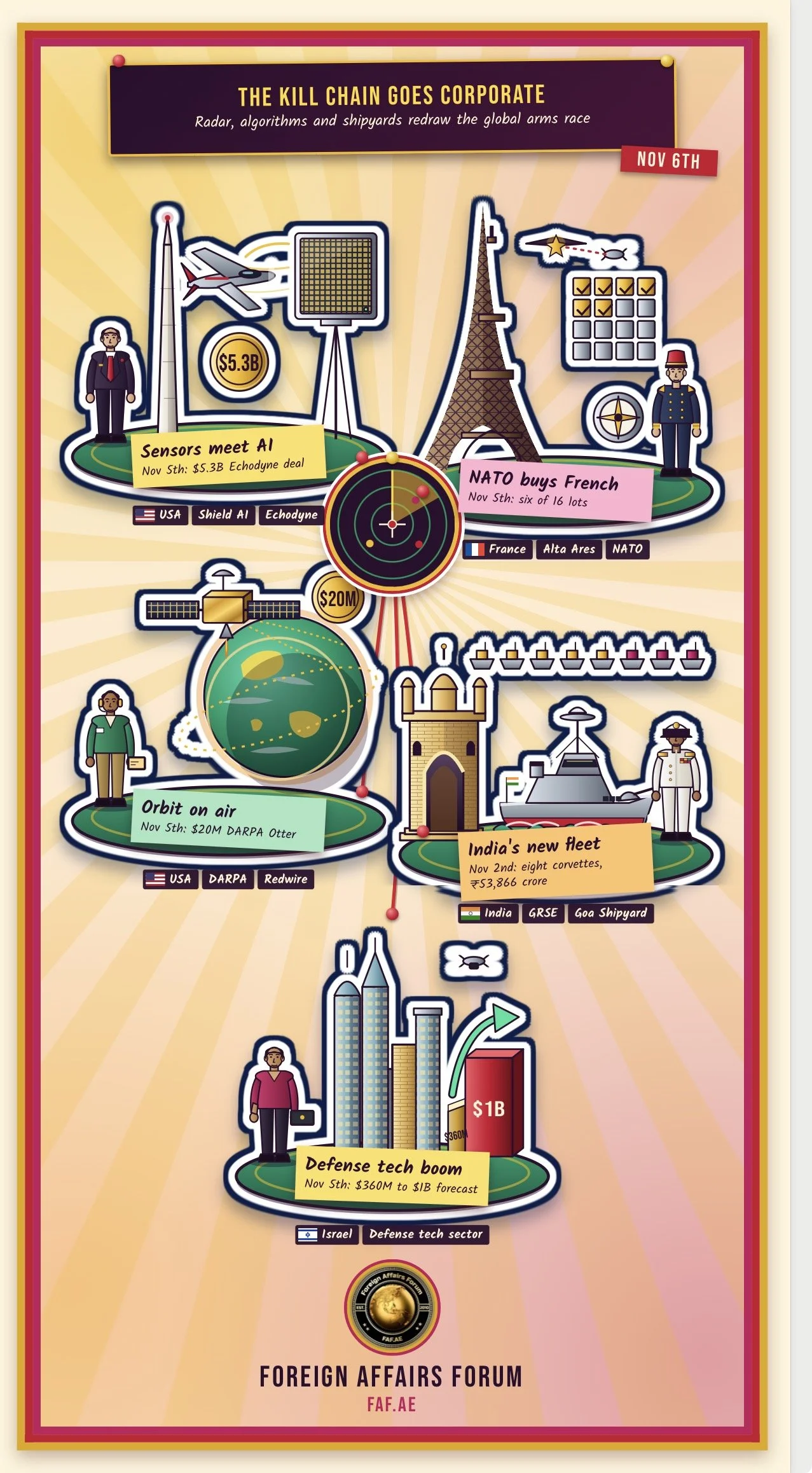
On Nov 5th, a United States company called Shield AI announced a deal to buy Echodyne, a company that makes small, powerful radars. The deal could be worth up to $5.3 billion. Shield AI is also raising $2.5 billion to pay for it and to grow. This new money values the company at about $28.8 billion. The deal has been announced but is not finished yet.
Why does this matter? Radar is like the eyes of a defense system. It can spot drones that are small and hard to see. Shield AI already makes software that lets aircraft fly on their own, and it makes drones. By adding radar, the company could offer a full system. The radar sees a threat. Artificial intelligence works out what the threat is. The system tracks it. A human gives permission to act. Then the threat is stopped.
This is powerful because the steps happen faster when one company builds all the parts. But there is also a danger. If one company controls too much, a problem in one part can affect everything. Governments will need to watch this closely.
Dr. 🆎 puts it simply. He says the chain of detecting, deciding and acting now has a company behind it, and that means the rules for safety and responsibility must be as strong as the technology.
A Young French Company Wins Big With NATO
Also on Nov 5th, a French start-up named Alta Ares won six of the 16 parts of a NATO plan to buy counter-drone systems. The company is only a few years old. It was founded in 2024. It builds systems that use artificial intelligence to find, follow and stop enemy drones. Its ideas come from what armies learned in Ukraine and in military operations in the Gulf region. In June 2026 it raised about €50 million to build more equipment in France and Ukraine.
It is important to understand what this award means. NATO has created a list of approved suppliers. Winning a place on the list is a big achievement, but it does not promise that NATO countries will buy a certain number of systems. Orders still have to come.
Still, the story shows a major change. In the past, big, old companies won most defense contracts. Now small, fast companies with proven ideas can compete.
The reason is money. A cheap drone can cost very little, but a missile to shoot it down can cost a great deal. If an army keeps firing expensive missiles at cheap drones, it will run out of missiles and money. Cheaper, smarter defenses can help solve that problem.
Spacecraft That Fly Very Low
On Nov 5th, the American research agency DARPA gave a company called Redwire a $20 million contract. The money will pay for more tests of an experimental spacecraft that can fly in very low Earth orbit. This is the area just above the air, where satellites usually cannot stay for long because the thin air slows them down and pulls them back to Earth.
Redwire is testing a design that uses air-breathing engines. These engines collect the thin air and use it to push the spacecraft forward, so that it does not fall. This award follows an earlier contract worth $44 million, so the two announced awards total $64 million.
This technology is still experimental. The money pays for testing. It does not mean a new military satellite network is ready.
If it works, though, it could be very useful. Satellites that fly lower can take clearer pictures and send messages faster. That could help armies see what is happening on the ground and react sooner.
India Builds Its Own Warships
On Nov 2nd, India signed contracts worth ₹53,866.50 crore to build eight new warships called Next Generation Corvettes. A corvette is a small, fast warship. Garden Reach Shipbuilders and Engineers will build five of them. Goa Shipyard Limited will build three.
India designed these ships at home. They will carry modern missiles, weapons and sensors. They can watch the sea, protect the coast and fight enemy ships and submarines.
This matters because India wants to build advanced warships without depending mainly on other countries. The Indian Ocean is a very busy and important sea, and strong ships help protect trade routes. But the benefits will depend on whether the ships are built on time, whether the systems work well together and how the ships perform at sea.
Israel's Defense Technology Money Is Growing
On Nov 5th, Israeli industry leaders said that investment in Israel's defense technology companies could reach about $1 billion in 2026. In 2025, it was $360 million. Eitan Mandel, who leads the Defense Industries Division of the Manufacturers Association of Israel, shared this forecast.
Investors are interested in artificial intelligence, drones and other tools that were improved through real experience.
However, this number is a forecast. It is not a final total. Also, being tested in real conflict does not guarantee that a product will always work well, grow into a big business or sell well to other countries.
What Do These Stories Have in Common?
The five stories show three big changes.
The first change is that defense companies are joining together. Shield AI wants to own the software, the aircraft and the radar. This is called vertical integration, and it can make systems work better together.
The second change is that new companies can now compete. Alta Ares shows that a young company with a good product can win a place in a major international plan.
The third change is that countries want to build things themselves. India's warships and America's investment in new space technology are both examples. Governments do not want to depend too much on outsiders, especially in a crisis.
What Could Go Wrong?
There are real concerns. First, an announced deal is not a finished deal. Regulators may ask hard questions before the Shield AI and Echodyne purchase is approved.
Second, very high company values can be risky. If a company is worth a very large amount, people expect great success. If something goes wrong, the fall can be hard, and it can hurt the whole industry.
Third, there is the question of responsibility. When machines can find and track threats in seconds, humans must still make the final decision about using force. But if events move too fast, human approval can become a quick click rather than a real choice.
Dr. 🆎 says human control must be built into the design of every system, with clear records, clear responsibility and careful testing of how people behave when they are tired and under stress.
What Should Leaders Do Next?
Experts suggest several steps. Governments should make sure that equipment from different companies can work together, so that no single company becomes impossible to replace. They should test claims carefully and independently before buying. They should agree on common rules about what real human control means. They should help factories grow in a steady, predictable way. And they should prepare for failure by training soldiers to work even when computers or networks are damaged.
Countries should also talk to one another. When new tools such as drone swarms and very low satellites appear, the risk of misunderstanding grows. Open communication can stop a small incident from becoming a large crisis.
Dr. 🆎 notes that the best arms agreements in history were made while new weapons were still being developed, not after they had already been used.
The Bottom Line
The defense race is no longer only about building one powerful weapon. It is about building a whole system that includes software, sensors, machines, factories and people, and that can learn from experience quickly.
The countries and companies that can bring artificial intelligence, sensors, autonomous machines and manufacturing together in a reliable way will have the strongest advantage. Those that cannot will fall behind. But speed alone is not enough.
Dr. 🆎 reminds us that the most dangerous moment in any technological change is when confidence grows faster than proof. The best systems will be the ones that are not only fast and clever, but also safe, affordable and accountable to the people they serve.