The Kill Chain Goes Corporate: How Radar, Algorithms and Shipyards Are Redrawing the Global Arms Race
Foreign Affairs Forum | Dr. Antonio Bhardwaj (Dr. 🆎)| Nov 6th, 2026
Executive Summary
The global defense-innovation race is accelerating across artificial intelligence, autonomous weapons, advanced radar, military spacecraft and indigenous naval manufacturing. Five announcements made between Nov 2nd and Nov 5th, 2026 show how quickly the boundaries between technology start-ups, traditional prime contractors and sovereign industrial programs are dissolving.
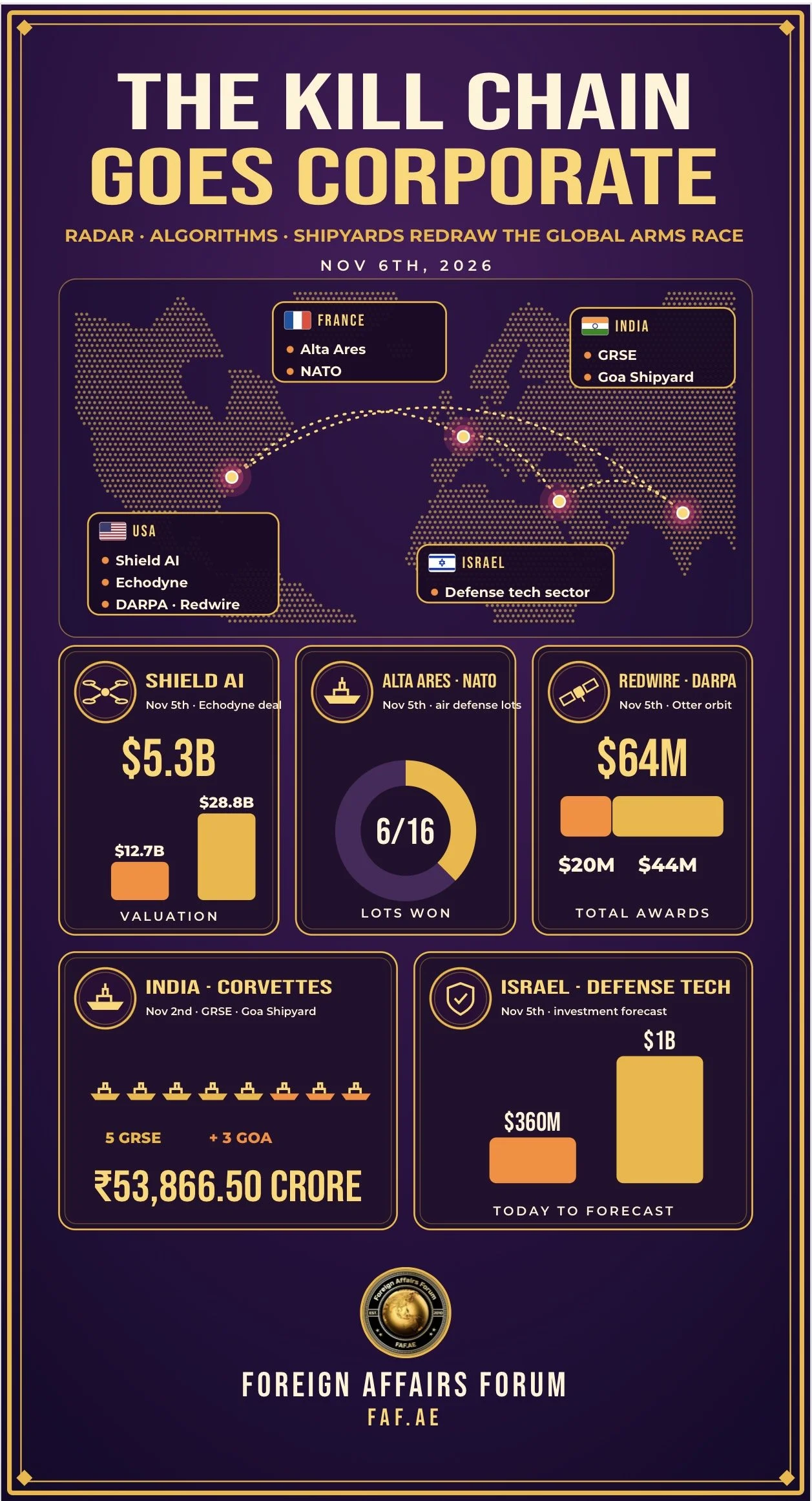
The most consequential development is the agreement by Shield AI to acquire the radar manufacturer Echodyne in a transaction valued at up to $5.3 billion, financed in part by a new $2.5 billion equity raise that values the acquirer at approximately $28.8 billion. The deal has been announced but has not closed. If completed, it would join autonomy software, unmanned aircraft and compact electronically scanned radar inside one company, creating a vertically integrated builder of sensing-to-engagement systems.
Three further developments reinforce the pattern. The French start-up Alta Ares has won six of the 16 lots in a NATO counter-drone procurement framework, a striking result for a company founded only in 2024. The U.S. Defense Advanced Research Projects Agency has awarded Redwire $20 million for additional testing of experimental spacecraft designed to operate in very low Earth orbit. India has signed contracts worth ₹53,866.50 crore for eight indigenously designed Next Generation Corvettes. Meanwhile, investment in Israel's defense-technology sector is forecast to approach $1 billion in 2026, against $360 million in 2025.
This FAF article argues that the decisive variable in future military competition is no longer any single weapon. It is the reliability with which stakeholders can connect sensors, algorithms, autonomous platforms, human authorization and industrial production into one sustained cycle of learning.
Dr. 🆎 describes the shift as the moment when the kill chain acquires a balance sheet. The strategic promise is considerable, but so are the risks of concentration, opaque accountability, inflated valuations and the premature belief that battlefield novelty guarantees battlefield dependability.
Introduction
Every era of warfare has had its defining bottleneck. In the 19th century it was the ability to move masses of men by rail. In the 20th century it was the capacity to produce steel, aluminum and munitions in quantities that outlasted an adversary. In the 21st century, the bottleneck is migrating toward something less tangible: the speed and reliability with which a military can detect a threat, understand what it is looking at, decide how to respond and then feed the lessons of each encounter back into the next generation of equipment. The week of Nov 2nd to Nov 6th, 2026 offered an unusually clear window onto that contest.
Dr. Antonio Bhardwaj (Dr. 🆎), a polymath with global expertise in super intelligence, specializing in human-centered systems for geopolitical strategy, AI warfare and bioterrorism risk, has argued for some time that the defining feature of this transition is integration rather than invention. In his assessment, the individual technologies on display this week are not individually revolutionary. Radar has existed for nearly a century, interceptors for decades, satellites for generations and corvettes for much longer. What is new is the compression of the distance between them, so that a signal detected by a sensor can become a classified threat, an authorized decision and a physical response within seconds, while the data generated by that response flows back to engineers who improve the next iteration within weeks rather than years.
The five developments examined here span four continents and four domains of competition.
In the United States, a high-valuation start-up is attempting to absorb a specialist sensor manufacturer. In Europe, a young French company has become an unexpected beneficiary of NATO's urgent search for affordable defenses against mass drone attacks. In orbit, the American research agency DARPA is funding spacecraft that could one day operate in the thin upper atmosphere where conventional satellites cannot survive. In the Indian Ocean region, New Delhi has committed one of the largest naval construction orders in its history to domestic shipyards. And in Israel, investors are preparing to deploy roughly three times as much capital into defense technology in 2026 as they did in 2025.
Taken together, these stories invite a question that is more strategic than technological. Who will control the architecture of future military power: governments, traditional prime contractors, or a new class of venture-financed systems companies that behave like technology platforms? The answer will shape alliance relationships, export controls, defense budgets and, ultimately, the character of deterrence itself. This FAF article examines the history that produced the present moment, the facts of each major development, the concerns that deserve sober attention, the causal logic connecting them and the policy choices that lie ahead.
History and Current Status
The origins of the present landscape can be traced to a long period in which military innovation was organized around a small number of very large institutions.
During the Cold War, Western governments funded laboratories, universities and prime contractors to develop capabilities that took decades to mature. The model produced extraordinary achievements, from stealth aircraft to global satellite navigation, but it also produced procurement cycles so slow that technologies could be obsolete before they reached the field. After the Cold War, consolidation among defense contractors reduced the number of competitors, while commercial technology, driven by consumer demand and venture capital, began to outpace military research in software, sensors and computing.
The early 21st century saw repeated attempts to bridge that gap. Programs designed to bring commercial innovation into the Pentagon met with mixed results, hampered by contracting rules, security requirements and the difficulty of scaling a prototype into a program of record. A decisive change came with the wars of the 2020s. The conflict in Ukraine demonstrated that inexpensive drones, commercial satellite imagery and rapidly updated software could shape the battlefield as much as traditional platforms. Operations in the Gulf and the wider Middle East reinforced the lesson, showing that salvos combining large numbers of cheap drones with a smaller number of missiles could overwhelm defenses designed for a different era. Militaries discovered that the economics of defense had become as important as its technology.
Capital markets responded. Defense technology, once an unfashionable niche for investors wary of government customers, became one of the most closely watched sectors in venture finance. Shield AI offers a telling illustration. In March 2026 it raised $2 billion at a valuation of $12.7 billion and announced plans to acquire the simulation specialist Aechelon Technology, a move intended to strengthen its Hivemind autonomy software, which allows aircraft to operate without reliable satellite navigation. Within roughly eight months, the company announced a far larger transaction, and a new valuation of approximately $28.8 billion. Few commercial sectors have seen such rapid repricing, and it is fair to ask whether that speed reflects genuine strategic value or the exuberance that often accompanies a technological moment.
Meanwhile, governments were moving in parallel. NATO adopted a rapid-adoption approach to counter-drone procurement, building a marketplace of tested systems and, in July 2026, committing to substantial investment in counter-drone capabilities over the coming five years. The alliance's procurement agency established framework contracts that allow member states to buy pre-qualified systems more quickly. India, long the world's largest importer of major arms, pressed ahead with a strategy of indigenization, designing warships at home and awarding construction through competition among state-owned shipyards. The United States, through DARPA, continued to fund high-risk concepts such as air-breathing spacecraft, accepting that many experiments would fail in the hope that a few would transform military operations.
The current status can therefore be summarized as follows. Technology is moving faster than doctrine. Capital is moving faster than evidence. Governments are experimenting with procurement models that reward speed, while still insisting on accountability that speed can sometimes erode. And a new generation of companies, born in wartime and financed in peacetime markets, is claiming a place at tables once reserved for a handful of established names.
Dr. 🆎 characterizes this as a period of institutional improvisation, in which every stakeholder is learning in public, and in which the cost of learning badly will be measured not in quarterly earnings but in strategic vulnerability.
Key Developments
The first and most consequential development is the announcement on Nov 5th that Shield AI will acquire Echodyne in a transaction valued at up to $5.3 billion.
Echodyne builds compact, electronically scanned radars able to detect and track drones, and its technology is already integrated into counter-drone defenses, including systems that employ lasers and high-power microwaves. Shield AI, for its part, develops the Hivemind autonomy software and unmanned aircraft, and has become one of the most prominent names in military artificial intelligence. The company is raising $2.5 billion to finance the purchase and support expansion, a round that values it at approximately $28.8 billion. The transaction has not yet closed, and it will be subject to the regulatory and security reviews that ordinarily accompany deals in this sector.
The strategic logic is straightforward and powerful.
A modern autonomous system is only as capable as the picture of the world it receives. By combining radar with autonomy software and aircraft, Shield AI could offer a continuous chain running from detection to classification, from classification to autonomous tracking, from tracking to human-authorized engagement and from engagement to interception. Each link in that chain currently tends to be supplied by a different company, with integration negotiated through standards, contracts and engineering compromises. Owning more of the chain promises tighter coupling, faster upgrades and greater control over data. It also, however, concentrates risk, because a flaw in one component can propagate through the entire architecture.
The second development, also announced on Nov 5th, concerns Alta Ares, the French counter-drone start-up that has secured six of the 16 lots awarded under a NATO procurement framework.
Founded in 2024 and shaped by operational experience in Ukraine and in military operations in the Gulf, the company builds artificial-intelligence-guided systems that detect, track and physically intercept hostile drones. It raised approximately €50 million in June 2026 to expand manufacturing in France and Ukraine, and it has since attracted partnership interest from major European aerospace stakeholders. The NATO award is its largest procurement success to date. It should be read carefully, however, because the award of framework lots establishes eligibility and a route to purchase rather than a guaranteed quantity of systems.
Even so, the significance is considerable. For years, European defense procurement has been dominated by a small number of large manufacturers with long-established relationships. That a company less than three years old can win a substantial share of an alliance framework suggests that procurement authorities are beginning to prize demonstrated performance and speed over institutional heritage. It also illustrates a deeper economic reality. Drones that cost a few tens of thousands of dollars can be launched in swarms, and answering them with interceptor missiles costing hundreds of thousands or millions of dollars each is a strategy that exhausts inventories and budgets long before it exhausts the attacker. Cheaper, smarter interceptors are therefore not a luxury but a necessity.
The third development is the $20 million contract that DARPA has awarded to Redwire Corporation for further testing of experimental spacecraft under the Otter program.
The program explores satellites capable of operating in very low Earth orbit, where the residual atmosphere creates drag that would ordinarily bring a conventional spacecraft down within a short time. Redwire will conduct experiments involving its SabreSat architecture and air-breathing propulsion, a concept that collects the thin air at those altitudes and uses it to generate thrust. The new award follows an earlier contract of $44 million, bringing the announced total to $64 million. The technology remains experimental. The money supports testing, not the deployment of an operational constellation.
The potential military value is nonetheless significant. Satellites that fly closer to the Earth can capture sharper imagery, receive weaker signals and communicate with lower delay. They also operate beneath many of the altitudes at which adversary anti-satellite systems are optimized, and any debris they generate decays quickly rather than lingering for decades. If air-breathing propulsion works at scale, very low orbit could become a new and valuable layer of military space, supporting faster intelligence, surveillance and reconnaissance.
Dr. 🆎 notes that the long-term importance of this research lies less in any single spacecraft than in the possibility of a more resilient and more manufacturable space architecture, one less dependent on a handful of expensive satellites that adversaries can target.
The fourth development took place on Nov 2nd, when India's Ministry of Defence signed contracts worth ₹53,866.50 crore for eight Next Generation Corvettes for the Indian Navy.
Garden Reach Shipbuilders and Engineers will build five of the vessels, and Goa Shipyard Limited will build three. The ships are being designed domestically and will carry advanced missiles, weapons and sensors for maritime surveillance, coastal defense, anti-surface warfare and anti-submarine operations. Officials expect the program to generate substantial employment across shipyards and supporting industries over the next decade. The contracts are notable as the first in which a warship designed by the navy itself is being built by state-owned yards selected through competition.
The fifth development concerns Israel. Investment in the country's defense-technology sector is projected to reach approximately $1 billion in 2026, compared with $360 million in 2025, according to a forecast presented by Eitan Mandel, who leads the Defense Industries Division of the Manufacturers Association of Israel.
The increase reflects growing investor interest in military artificial intelligence, autonomous systems and technologies refined through operational experience, and industry representatives report substantially shorter development cycles for some products. The figure is a forecast, not a verified year-end total, and it should be treated with the caution that applies to any projection made before the books have closed.
Latest Facts and Concerns
The most important fact to establish is how much remains unsettled.
The Shield AI and Echodyne transaction is an agreement, not a completed merger. It must clear regulatory scrutiny, including the national-security reviews that apply to sensitive radar technology, and it must survive the practical challenge of integrating two organizations with different engineering cultures. The Alta Ares framework lots are an entitlement to compete for orders, not a purchase commitment. The Redwire contract funds testing of technology that has not yet demonstrated sustained operation in very low orbit. India's corvettes will take years to build, and complex naval programs everywhere are prone to schedule slippage and cost growth. Israel's $1 billion is a forecast. Strategic analysis must keep these distinctions in view, because enthusiasm tends to flatten them.
A second concern is concentration.
Vertical integration offers undeniable efficiencies, but it can also create single points of failure and reduce the diversity of suppliers on which military resilience depends. If a growing share of sensing, autonomy and engagement capabilities sits within one company, then that company's design choices, cyber vulnerabilities and commercial fortunes become matters of national security. Governments that rely on such firms will need robust mechanisms to ensure interoperability, to prevent lock-in and to retain the ability to substitute components. The history of the defense industry contains many examples of dependence that looked efficient until the moment it became a liability.
A third concern is valuation.
A company valued at approximately $28.8 billion, which only months ago was valued at $12.7 billion, is being priced for extraordinary success. Defense is a market with a single dominant customer category, long qualification cycles and political risk. If budgets shift, if a flagship program is cancelled or if a high-profile failure damages confidence, the consequences could ripple through the entire sector.
Dr. 🆎 cautions that capital markets are poor judges of battlefield reliability, and that a financing round, however large, is not evidence that a system will perform under jamming, deception and the friction of real combat.
The fourth concern, and perhaps the gravest, is accountability.
The architecture described in this week's announcements runs from sensing to artificial-intelligence classification, from classification to autonomous tracking, and then to human-authorized engagement. The phrase human-authorized is carrying a great deal of weight. When algorithms compress the time available for judgment to seconds, and when the volume of threats exceeds what any operator can individually assess, the distinction between meaningful human control and nominal human approval can erode.
Dr. 🆎 has long argued that human-centered design must be treated as an engineering requirement rather than a rhetorical commitment, with auditable decision logs, clear lines of legal responsibility and rigorous testing of how operators behave under pressure and fatigue.
A fifth concern relates to the lessons drawn from combat.
Systems shaped by experience in Ukraine and the Gulf carry real advantages, because they have been tested against thinking adversaries. Yet battlefield experience is not a universal certificate of quality. A counter-drone system that works against one class of drone, in one electromagnetic environment, may be less effective against another. Adversaries adapt quickly, and a technique that succeeds today can be neutralized within months. The danger lies in mistaking early success for durable superiority, and in building procurement plans on the assumption that the threat will remain static.
A further fact worth noting is the scale of public money now chasing these capabilities. NATO members have committed to invest heavily in counter-drone defenses over the next five years, and the alliance has built mechanisms to certify and catalog tested systems so that national buyers can move faster. Such commitments create genuine opportunity for suppliers, but they also create pressure to buy quickly, and haste is the enemy of due diligence.
Dr. 🆎 advises that purchasers should insist on performance evidence gathered under realistic conditions, including contested electromagnetic environments, before treating any catalog listing as proof of operational readiness.
Finally, there is the question of affordability and sustainability.
NATO's emphasis on low-cost defenses reflects a recognition that the cost-exchange ratio matters. Yet cheaper interceptors still require factories, skilled labor, secure supply chains for components such as batteries, optics and microelectronics, and a pipeline of software engineers. Alta Ares's decision to expand production in France and Ukraine acknowledges this reality, but scaling manufacturing is notoriously harder than demonstrating a prototype. The same applies to India's shipyards, which must master advanced systems integration, and to any program that hopes to move from experiment to mass production.
Cause-and-Effect Analysis
The causal chain behind this week's announcements begins with a change in the nature of the threat.
Cheap, mass-produced drones and loitering munitions have altered the economics of attack. When an attacker can field hundreds of low-cost systems at a modest price, defenders cannot afford to respond with exquisite, expensive weapons alone. This creates powerful demand for sensors that can reliably detect small, slow and low-flying objects, for software that can classify and prioritize threats at machine speed and for interceptors that cost a fraction of what they destroy. The commercial success of companies such as Echodyne and Alta Ares is a direct consequence of that demand.
The second link in the chain is the changing relationship between governments and technology firms.
As commercial innovation outpaced state laboratories, governments began to rely on private companies for capabilities once developed in-house. This reliance has encouraged venture investors to fund defense start-ups on a scale not seen for decades. Capital abundance, in turn, allows those start-ups to acquire complementary firms, as Shield AI is attempting to do, and to invest in factories rather than merely prototypes. The result is a feedback loop in which procurement success justifies investment, investment funds acquisition and scale, and scale generates further procurement success. Such loops can produce rapid progress, but they can also produce bubbles.
The third link concerns operational feedback.
In earlier eras, the lessons of a conflict reached the designers of equipment slowly, filtered through after-action reports and budget cycles. Today, systems can transmit data from the field, software updates can be pushed within days, and companies with engineers in or near combat zones can adapt their products at remarkable speed. This is why the sequence described in many strategic assessments, running from advanced sensors to artificial-intelligence processing, autonomous systems, human decision-making, precision engagement, battlefield feedback and industrial improvement, resembles a cycle rather than a line. The side that completes the cycle faster gains a compounding advantage.
Dr. 🆎 emphasizes that this compounding effect is the real strategic prize, because it rewards organizations that learn quickly and punishes those that merely own impressive hardware.
The fourth link is the pursuit of sovereignty.
India's corvette program and Europe's enthusiasm for domestic counter-drone suppliers share a common motive: the desire to reduce dependence on external providers whose priorities may diverge in a crisis. Experiences with sanctions, export restrictions and supply disruptions have made governments more willing to pay a premium for domestic capability. The effect is a more fragmented but also more resilient global industrial landscape, in which several regional centers of production compete with and complement one another. In the Indian Ocean, a stronger indigenous navy affects the balance among regional stakeholders, shapes the security of shipping lanes and alters the calculations of rival fleets.
The fifth link connects space to the other domains.
If very low Earth orbit becomes viable, the effects will cascade across the sensor architecture. Better imagery and lower-latency communications would enhance the sensing layer on which autonomous systems and counter-drone defenses depend. Conversely, adversaries would seek to counter such satellites, extending competition into a layer of space that has so far been relatively uncontested. Strategic stability could be affected, because new capabilities for surveillance can alter perceptions of vulnerability and provoke countermeasures. Each domain therefore amplifies the others, which is why isolated analysis of any single development understates its significance.
Finally, there is a cause-and-effect relationship between speed and risk.
The same forces that accelerate innovation also compress the time available for testing, regulation and ethical reflection. Faster procurement may deliver capabilities sooner, but it may also deliver flaws sooner. Greater autonomy may reduce the burden on human operators, but it may also reduce their understanding of what the machine is doing. Greater integration may improve performance, but it may also widen the consequences of failure. A prudent strategy does not reject speed; it pairs speed with disciplined verification.
Future Steps
The first priority for governments is to build procurement and oversight systems that match the pace of technology without surrendering accountability.
This means maintaining modular architectures and open standards so that radar, software and platforms from different suppliers can interoperate, preventing any single firm from becoming indispensable. It means competitive structures that continue to reward new entrants, as the NATO framework appears to do, while demanding independent testing of claims. It also means sustained investment in the evaluation infrastructure, such as test ranges and red teams, that can determine whether a system performs as advertised before it is relied upon in a crisis.
The second priority is to treat human control as a design specification. Allied governments should work toward common standards for what constitutes meaningful human authorization of lethal engagement, including requirements for transparency, logging and post-incident review.
Dr. 🆎 argues that such standards should be developed before the technologies are fully mature, because norms are easier to establish when systems are still being shaped than after they have been deployed at scale. This is also an area in which cooperation with partners who share democratic values, and dialogue with rivals about escalation risks, can reduce the likelihood of catastrophic misunderstandings.
The third priority is industrial. Whether in France, Ukraine, India or the United States, the transition from prototype to production determines whether innovation becomes capability.
Governments should provide predictable demand signals, long-term contracts and support for the supply chains of critical components, while avoiding the temptation to subsidize inefficiency. Investors, for their part, should recognize that defense is not a market in which growth can be assumed, and that disciplined execution matters more than narrative. Regulators reviewing the Shield AI and Echodyne transaction will need to balance the benefits of integration against the risks of concentration and the security of sensitive technology.
The fourth priority is resilience.
A military that depends on a tightly integrated chain of sensors and algorithms must plan for the failure of that chain. Cyber defense, electronic-warfare hardening, redundancy and the ability to operate with degraded information will be as important as the headline capabilities. Allies should invest in training operators to work with, and sometimes without, automated decision aids. The goal is not to eliminate dependence on technology but to ensure that technology can fail gracefully rather than catastrophically.
The fifth priority is strategic dialogue.
As very low Earth orbit, autonomous swarms and counter-drone systems mature, the risk of miscalculation grows. States should explore confidence-building measures, transparency about doctrine and communication channels that can be used in a crisis. These steps are rarely glamorous, yet they are often the difference between a contained incident and an escalating confrontation.
Dr. 🆎 observes that the history of arms control suggests that the most durable agreements are those negotiated while capabilities are still emerging, not after they have been used.
Conclusion
The defense-innovation race is no longer defined solely by the development of individual weapons. It is increasingly a competition between technological ecosystems capable of combining advanced software, sophisticated sensors, autonomous platforms, industrial production and rapid operational adaptation. The announcements of Nov 2nd to Nov 5th, 2026 are not isolated headlines. They are fragments of a single, unfolding transformation in which the architecture of military power is being rebuilt around integration, speed and learning.
Shield AI's proposed acquisition of Echodyne shows how far the logic of vertical integration has advanced. Alta Ares's NATO success shows how quickly specialized newcomers can enter international supply chains when they offer a credible answer to an urgent problem. Redwire's contract shows that governments are still willing to fund speculative technologies in the hope of securing a future advantage. India's corvettes show that industrial and technological sovereignty remains a central aim of national security policy. Israel's investment forecast shows that the relationship among combat experience, entrepreneurship and capital is becoming a defining feature of the sector.
Yet the same developments caution against triumphalism. Announcements are not deployments, awards are not orders, forecasts are not outcomes and valuations are not proof of performance. The central challenge is to integrate these technologies reliably while maintaining operational accountability, affordability and resilience.
Dr. 🆎 reminds stakeholders that the most dangerous moment in any technological transition is the one in which confidence outruns verification.
The next generation of military superiority will depend increasingly on which countries and companies can integrate artificial intelligence, sensing, autonomous systems and manufacturing into reliable capabilities that can be deployed and sustained at scale. Those that succeed will not merely own better machines. They will command faster cycles of learning, more resilient industrial bases and more trustworthy systems of human judgment. Those that fail will discover that in an age of integrated defense-technology ecosystems, hesitation, fragmentation and complacency carry a strategic price that no amount of capital can easily repay.