Machines at War: Five News Stories That Show the Future of Defense
Introduction
Summary
In the last few days, five news stories showed where military power is heading.
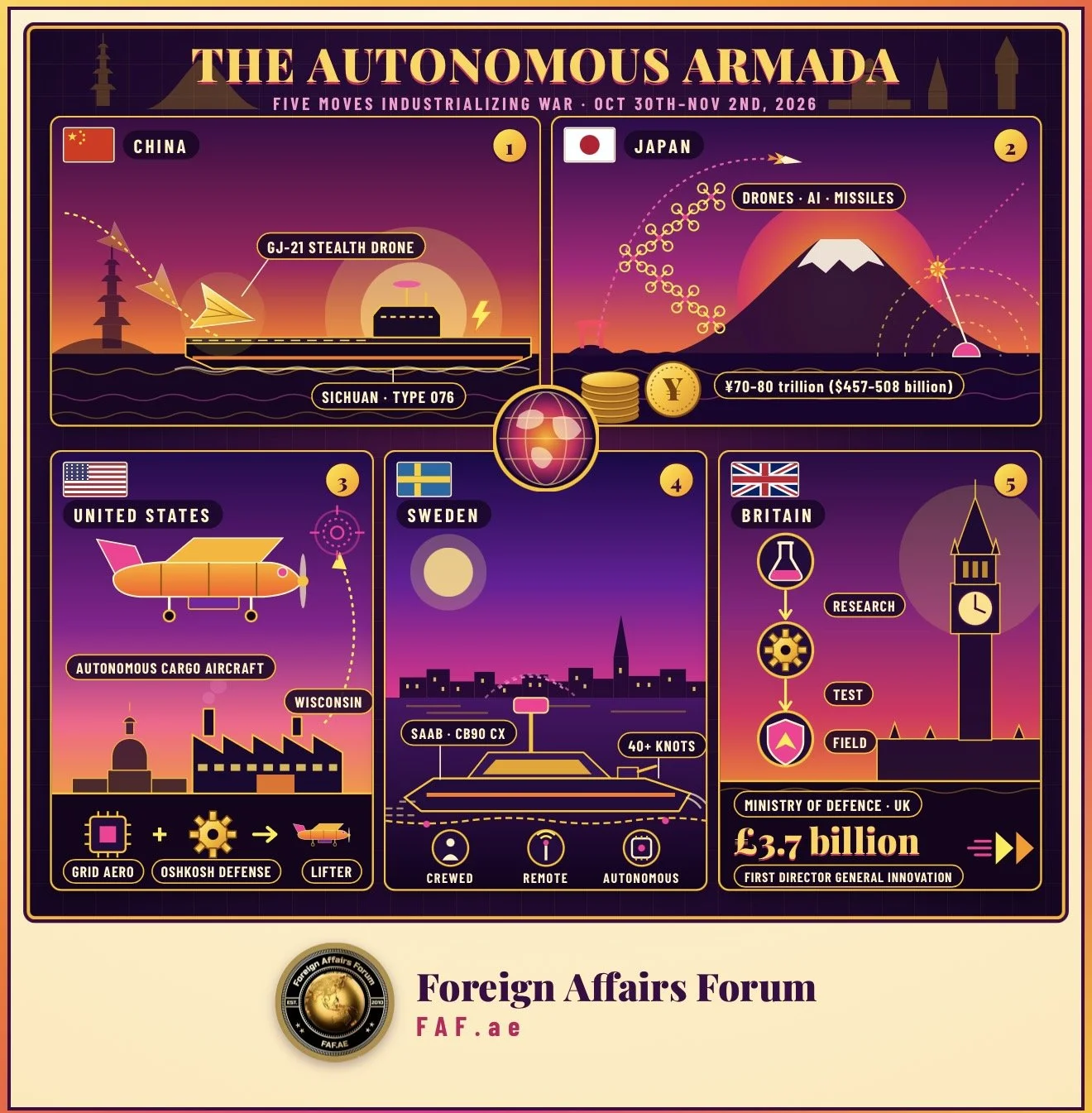
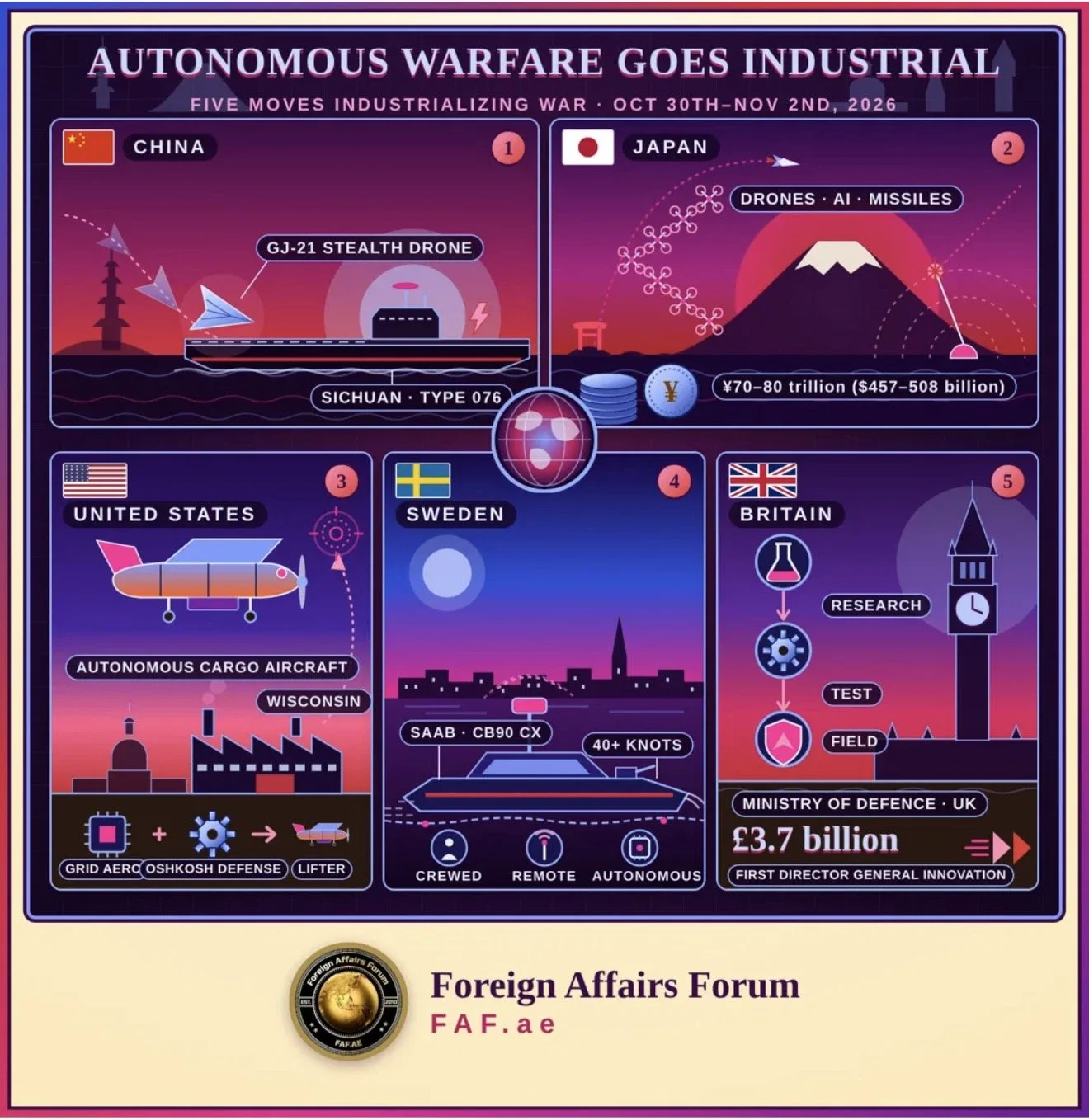
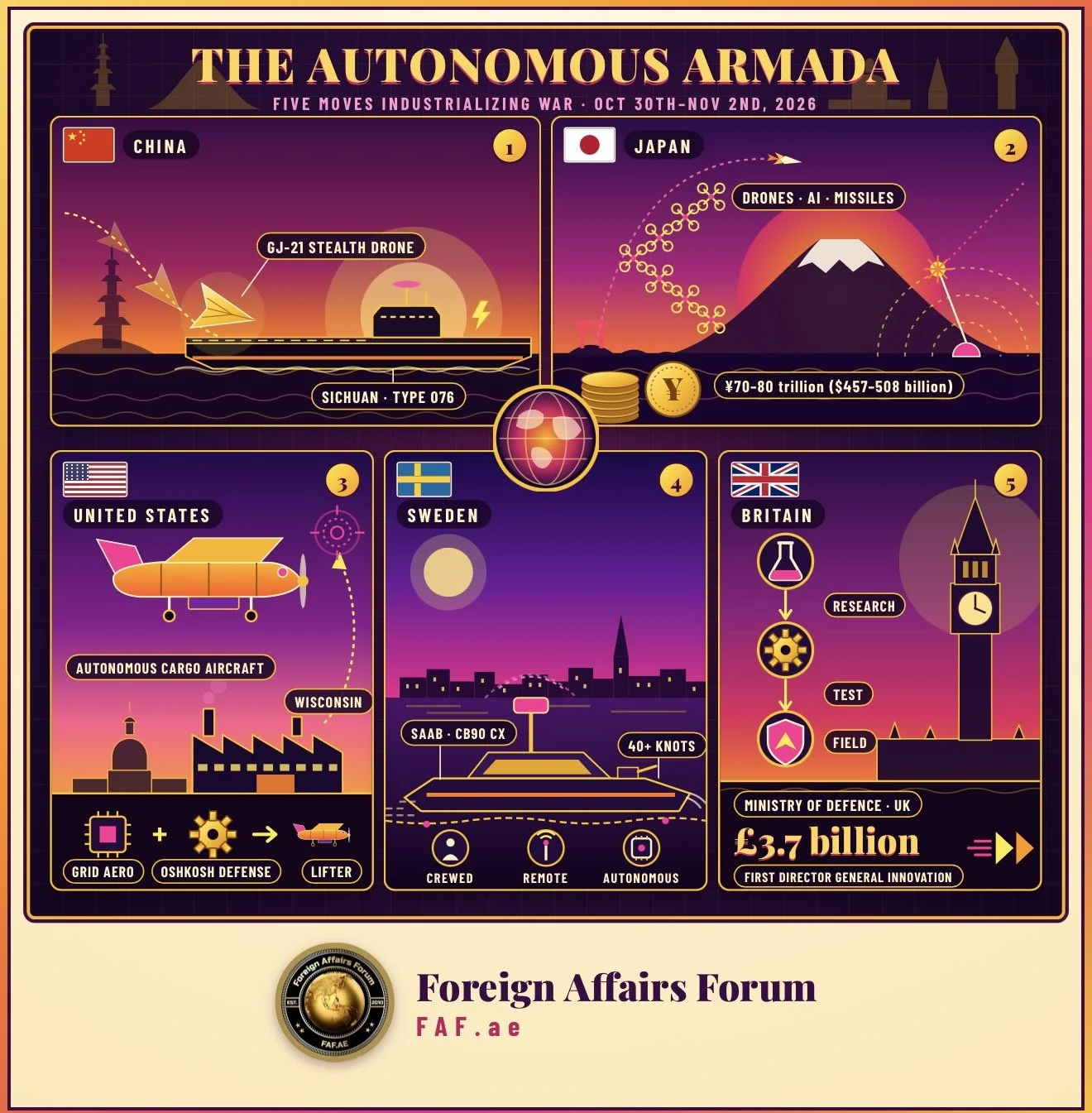
China tested a stealth drone on a new warship. Japan is thinking about spending between ¥70 trillion and ¥80 trillion ($457 billion to $508 billion) on defense over five years.
An American company called Oshkosh Defense is working with a startup called Grid Aero to build self-flying cargo planes.
Sweden's company Saab showed a new combat boat that can sail with a crew or without one.
Britain chose a new leader to speed up its military technology. Together, these stories show that wars of the future will depend on smart machines, strong factories and fast decisions.
Introduction
Long ago, battleships were the most powerful ships at sea. Then aircraft carriers took their place. People did not notice the change all at once. It happened slowly, through tests, practice and new spending plans. Something similar may be happening today.
Dr. 🆎, an expert in human-centered artificial intelligence, geopolitical strategy and the risks of AI warfare and bioterrorism, says that the most important part of this story is not the machines themselves. It is the whole system around them, including the people, the factories, the rules and the leaders who decide how the machines are used.
How We Got Here
Unmanned machines have been used in war for a long time, but they became far more important in recent years. In the 2020 war between Armenia and Azerbaijan, drones destroyed tanks and air defenses.
In Ukraine, both sides have used thousands of cheap drones to watch the enemy and to attack. Sea drones have even forced large warships to stay away from certain waters. Armed groups in the Red Sea have also used low-cost weapons to threaten commercial ships.
Governments saw these lessons and began to change. The United States started programs to build many low-cost autonomous systems. China, which already makes more commercial drones than any other country, began investing heavily in military ones. European countries, worried by war on their own continent, started to rebuild their stocks and to speed up their buying.
The Five Stories
The first story comes from China.
State media reported that a stealth drone called the GJ-21 took off from and landed on a new ship called the Sichuan.
The Sichuan is China's first Type 076 ship, built to carry soldiers and aircraft. It weighs more than forty thousand tonnes. This is an important test, but it does not prove that the drone and the ship are ready for real fighting. Many questions remain about how often the drone can fly, how well it can be repaired and whether it can resist enemy jamming.
The second story comes from Japan.
The government is thinking about a five-year defense plan from April 2027 worth ¥70 trillion to ¥80 trillion. That is about one point eight times the current plan. Japan wants to buy drones, make more of its own missiles and improve its defenses against incoming attacks. The plan is not final, so the numbers could change.
The third story comes from the United States.
Oshkosh Defense, a company that builds military vehicles, is working with Grid Aero, a young Silicon Valley company, to make an aircraft called Lifter. Lifter can fly without a pilot and carry supplies to dangerous places. Startups are good at creating new ideas, but they often lack factories. Big companies have factories but sometimes move slowly. By working together, they hope to build aircraft faster. No production numbers have been announced yet.
The fourth story comes from Sweden.
Saab has introduced a fast boat called the CB90 CX. It is about eighteen meters long and can go faster than forty knots. It can be driven by a crew, controlled from far away or sail by itself. It can carry over 50% more load than the earlier version. Sweden will be the first customer. The boat is useful in the Baltic Sea, which has narrow waters, many islands and important cables under the sea.
The fifth story comes from Britain.
The Ministry of Defence has named Anthony Reeves as its first Director General Innovation. He will oversee a technology program worth about £3.7 billion and work with thousands of scientists and experts. His job is to help good ideas reach soldiers faster.
What Worries Experts
The first worry is the Indo-Pacific region. If stealth drones can fly from many kinds of ships, defenders will find it harder to know where an attack might come from. Confusion at sea can lead to mistakes, and mistakes can lead to crisis.
The second worry is an arms race. When one country spends more, its rivals feel less safe and often spend more too. Because drones are cheaper than older weapons, many more countries and even armed groups can buy them.
The third worry is control. If a machine makes a mistake, who is responsible? Can a human really supervise a system that moves at machine speed? Dr. 🆎 argues that human control should be built into these systems from the start, with clear records of decisions and safe behavior if communications fail.
The fourth worry is supply. Drones and sensors need batteries, computer chips and rare materials. If those come from a rival country, the advantage can disappear in a crisis.
Dr. 🆎 adds a fifth worry. The same technology that helps design drones can also lower the barriers to misuse of biology and chemistry. Rules must cover not only weapons but also the spread of powerful tools.
Why It All Connects
These stories are linked by a chain of cause and effect. Wars in recent years showed that cheap, numerous machines can defeat expensive ones. That led governments to spend more on drones. Larger budgets created the need for factories, which led to partnerships such as the one between Oshkosh and Grid Aero. New factories and new weapons changed military plans, and those plans created new demands. Meanwhile, slow government buying habits made reform necessary, which is why Britain created its new leadership role.
Rivals watch each other closely. When one side shows a new capability, the other responds. This cycle can make everyone stronger, but it can also move faster than diplomats and lawyers can handle.
What Should Happen Next
Governments should first check claims carefully and avoid both panic and complacency. Japan should make sure its money is matched by skilled workers and strong factories. The United States should support partnerships between startups and manufacturers without letting a few large firms control everything. Britain should give its new leader real power to act quickly. All countries should build human control and safety into their machines.
Rival nations should also talk. They need clear ways to communicate when unmanned ships and aircraft meet, so that accidents do not become wars. They should avoid putting autonomous systems in charge of nuclear weapons. And they should protect their supply chains by buying from many sources and working with friends.
Conclusion
These five stories show that military strength now depends on much more than a single powerful weapon. It depends on how well a country can invent, build, field and improve autonomous systems, all while keeping people in charge.
China, Japan, the United States, Sweden and Britain are each moving in this direction in their own way.
Dr. 🆎 reminds us that machines do not decide the future. People do. If leaders choose speed without caution, the world could face dangerous crises. If they choose wisely, technology can protect soldiers and civilians and help keep the peace. The decisions made in the next few years will shape how wars are fought, and perhaps prevented, for a long time to come.