Ships, Drones, Ice and Money: Five World Stories Explained Simply
Introduction
This week, five news stories show how power works in the world today. They come from different places, but they share one idea. Small tools can cause big problems, and countries are looking for safer and stronger partners.
Here is each story in plain language, with comments from Dr. 🆎, an expert on artificial intelligence, warfare and global risk.
Trouble in the Strait of Hormuz
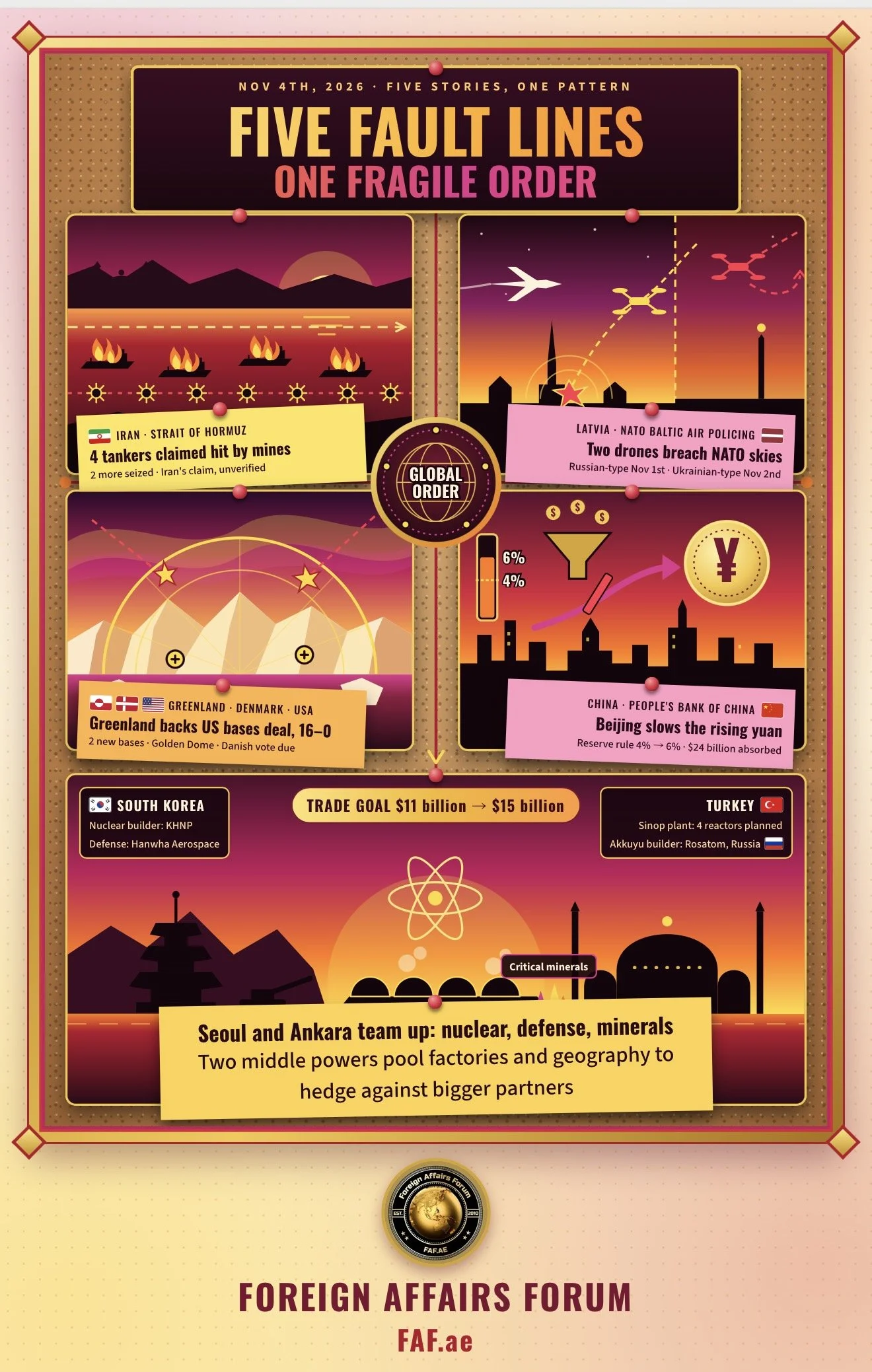
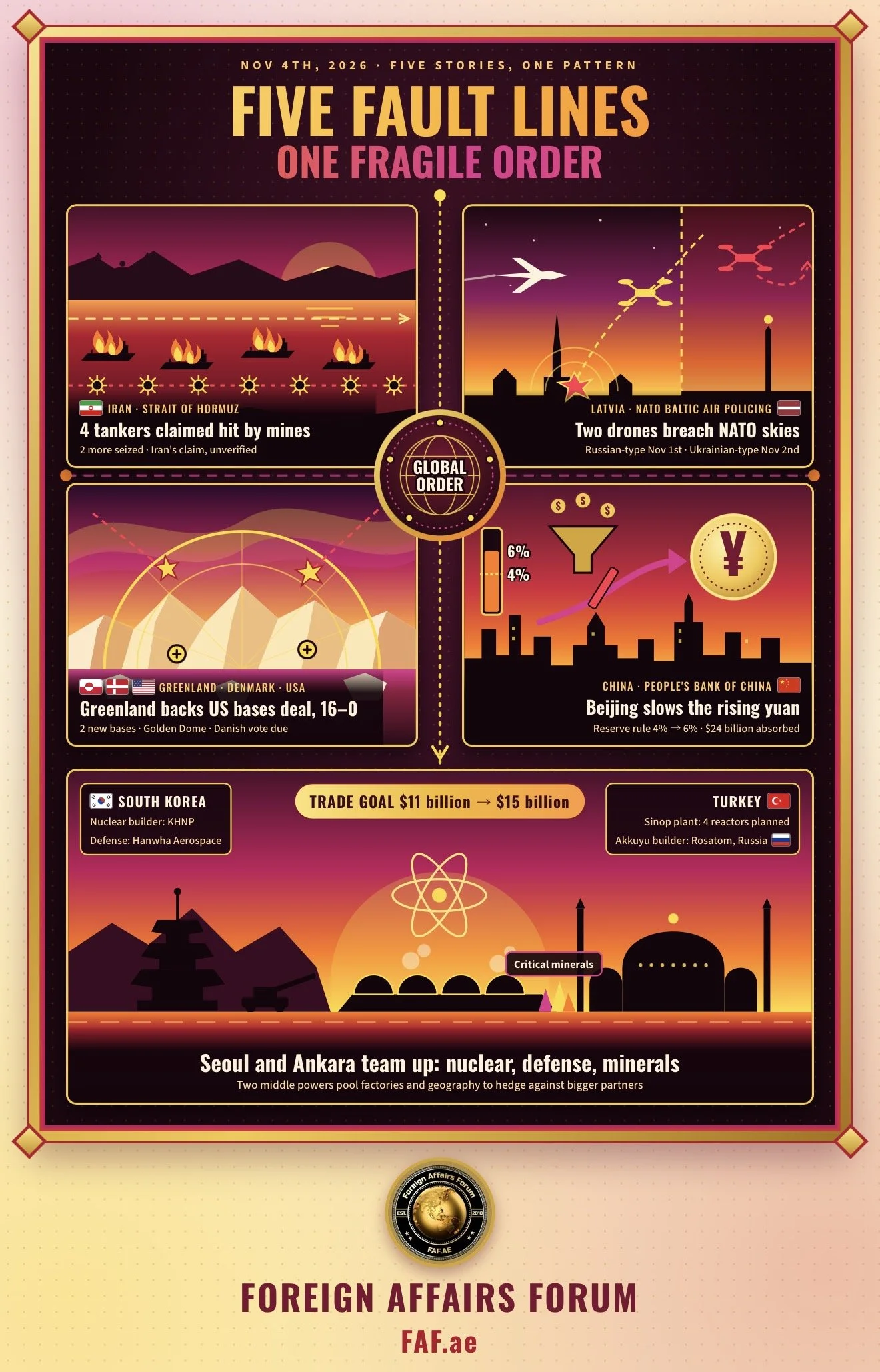
The Strait of Hormuz is a narrow stretch of water between Iran and Oman. About one fifth of the world's oil has traditionally passed through it. On Nov 4th, Iran's Revolutionary Guards said that four oil tankers had been destroyed by sea mines and that they had taken two more ships. Sea mines are hidden explosives that float or sit under the water.
It is important to be careful here. These are claims made by Iran. Nobody outside Iran has confirmed the names of the ships, the damage or whether anyone was hurt. The United States has rejected similar Iranian claims before. A war between Iran and the United States and Israel began in late February, and since then Iran has tried to control who can pass through the strait. The United States says it has cleared the main routes of mines. Iran says it wants proof.
Why does this matter? When ships are not safe, insurance becomes more costly. Ships take longer routes or wait. Fuel gets more expensive, and so do things made from oil, such as plastics and fertilizer.
Dr. 🆎 explains it this way. "A chokepoint is like the neck of a bottle. You do not need to destroy the whole bottle to stop the flow. You only need to make people afraid to pour."
Drones Cross Into Latvia
Latvia is a small country on the Baltic Sea that borders Russia. It is a member of NATO, but it has no fighter jets of its own. Other NATO countries send planes to guard its skies. This week, Latvia reported two drones entering its airspace. The first came on Nov 1st and was probably a Russian drone. It flew back to Russia. The second came on Nov 2nd and was probably Ukrainian. It crashed in Latvia, and officials had not found it when the news was reported. NATO fighter jets were sent up.
Why do Ukrainian drones end up in Latvia? Ukraine uses drones to hit targets in Russia, and Russia uses electronic tools to jam them. Jammed drones can lose their way and fly into nearby countries. Russia also sends its own drones near NATO borders. Latvia, Finland, Estonia and Lithuania have all had similar scares this year.
The danger is simple. A drone is cheap, but stopping it is costly. A mistake could also hurt civilians or start a wider fight.
Dr. 🆎 says, "We need defenses that are cheaper and smarter, with computers helping to spot threats but humans making the final decision to fire."
Greenland Says Yes to a Security Deal
Greenland is a huge, icy island that belongs to the Kingdom of Denmark and governs most of its own affairs. About fifty-six thousand people live there. The United States has had military sites on the island for decades. In recent years, President Donald Trump said the United States should take control of Greenland, which upset Denmark and many Greenlanders.
In September, the United States, Denmark and Greenland signed an agreement to ease those tensions. On Nov 3rd, Greenland's parliament approved it by sixteen votes to none, with seven lawmakers choosing not to vote. The deal allows two more American bases and equipment linked to Golden Dome, a planned missile-defense system. It also says Denmark remains the sovereign power and that Greenlanders keep the right to decide their own future.
The deal is not finished yet. Denmark's parliament will vote on it this month. Some Greenlanders worry that the island gives a lot and gets too little.
Dr. 🆎 notes, "A security deal lasts only if the people who live there believe it treats them fairly."
China Slows the Rise of Its Currency
The yuan is China's money. This year it has become stronger against the US dollar by more than 5%. That sounds good, but a strong yuan makes Chinese goods more expensive for foreign buyers, which can hurt exporters.
On Nov 3rd, China's central bank announced a new rule. From Nov 15th, banks and other financial firms must hold 6% of their foreign-currency deposits in reserve, instead of 4%. This takes about $24 billion of foreign money out of the local market. When there are fewer dollars to sell, the yuan tends to stop rising so fast. After the news, the yuan weakened slightly to about 6.6728 per dollar.
Most central banks work to stop their money from falling. China is working to slow its money from rising. This tells us that Beijing is worried about the speed of the change, not only the direction.
Dr. 🆎 says, "Money has become a tool of national strategy. Every rule about reserves or exchange rates is also a message about power."
South Korea and Turkey Draw Closer
South Korean President Lee Jae-myung and Turkish President Recep Tayyip Erdoğan met in Seoul and agreed to work together more. They talked about nuclear power, weapons production, roads and railways, medicine, and the minerals needed for modern technology. South Korea hopes to help build a nuclear plant at Sinop in Turkey, which would have four reactors. They also want to raise trade from about $11 billion to $15 billion and update their trade agreement. Both want to sell military equipment to other countries together.
The two countries have long been friends. Turkey sent troops to help South Korea during the Korean War, and Turkey has used South Korean designs for some of its weapons. No final contracts were announced, so this is a promise of direction, not a finished deal.
Why does it matter? Turkey and South Korea both sit between larger powers. By working together, they gain more choices and depend less on any single partner.
Dr. 🆎 observes, "Middle powers are learning that strength comes from having several good partners, not only one powerful friend."
How the Stories Connect
At first glance these stories seem unrelated. But look closer. Unsafe sea routes push up energy costs, and countries respond with money policy. A drone war far away causes alarms in small nearby countries. Missile defense makes cold, distant places important. And when the world feels less safe, countries build new partnerships.
Dr. 🆎 adds a warning about health. "Oil is also a raw material for medicines and medical supplies. If a sea route stays blocked for long, hospitals and laboratories can feel it too."
What to Watch Next
Watch whether independent experts confirm the ships hit near Hormuz, and whether more incidents follow. Watch whether more drones enter NATO countries, and how NATO changes its defenses. Watch Denmark's vote on the Greenland deal. Watch whether China's new rule steadies the yuan after Nov 15th. And watch whether South Korea and Turkey sign real contracts for reactors and weapons.
Conclusion
The big lesson is that strong countries no longer win only by having the biggest weapons. They win by keeping their ships moving, their power on, their money steady and their friendships strong.
As Dr. 🆎 puts it, "The future belongs to those who can take a hit, tell the truth about it and keep going." That is a lesson for governments, for companies and for all of us.