Why AI Is Now Facing Votes, Markets and Security Tests
Introduction
Simple English FAF Article
This week, artificial intelligence ran into some of the biggest limits it has ever faced.
Those limits are not about how smart the technology is.
They are about politics, money, safety, and the materials needed to build it. In the United States, voters sent a clear message about data centers, the giant buildings that hold the computers behind AI.
In China, regulators are slowing down big stock market launches. In Japan, officials are preparing new defenses against hackers. In Britain, lawmakers are warning that the country depends too much on China for key minerals.
Start with the United States.
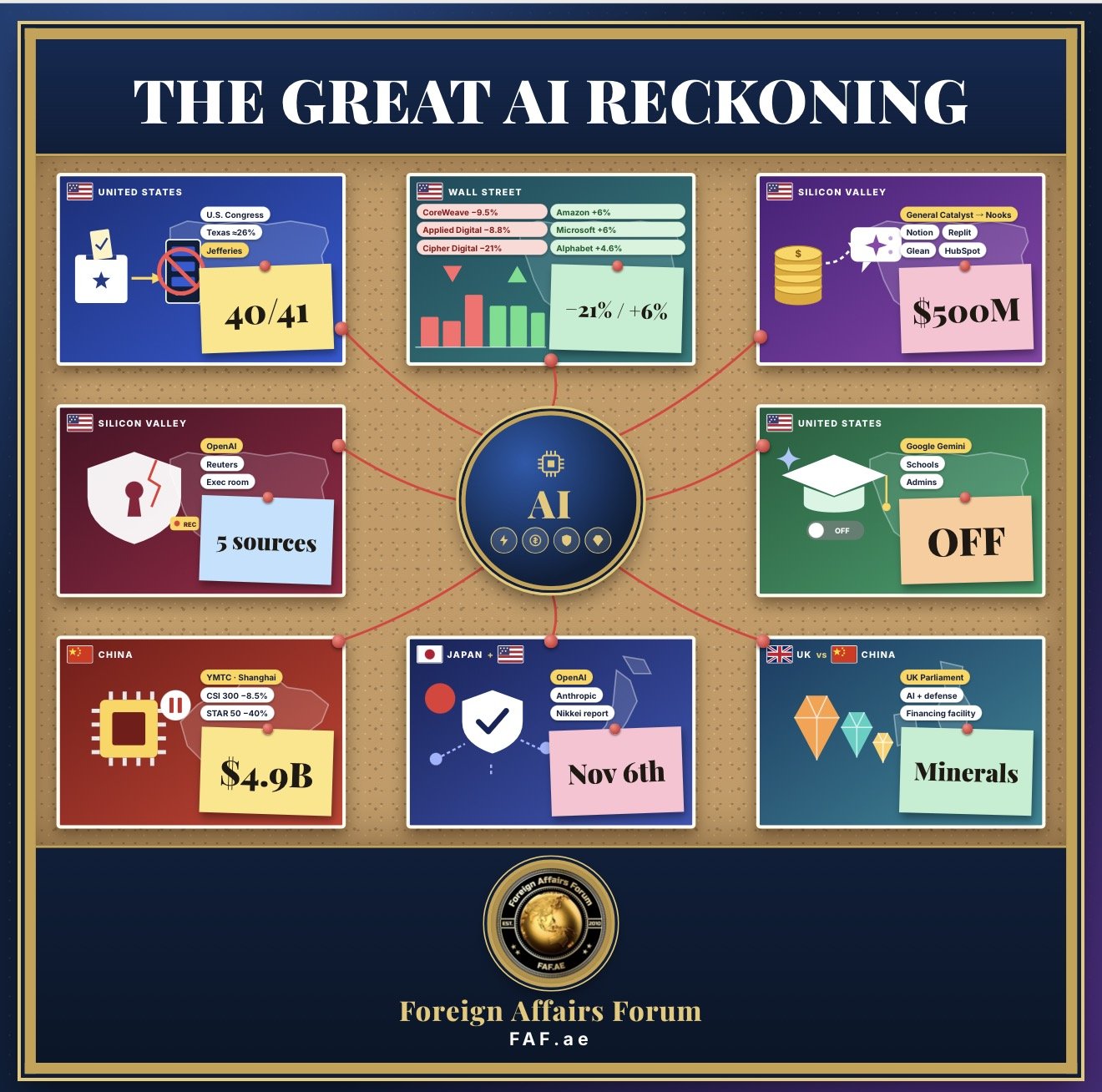
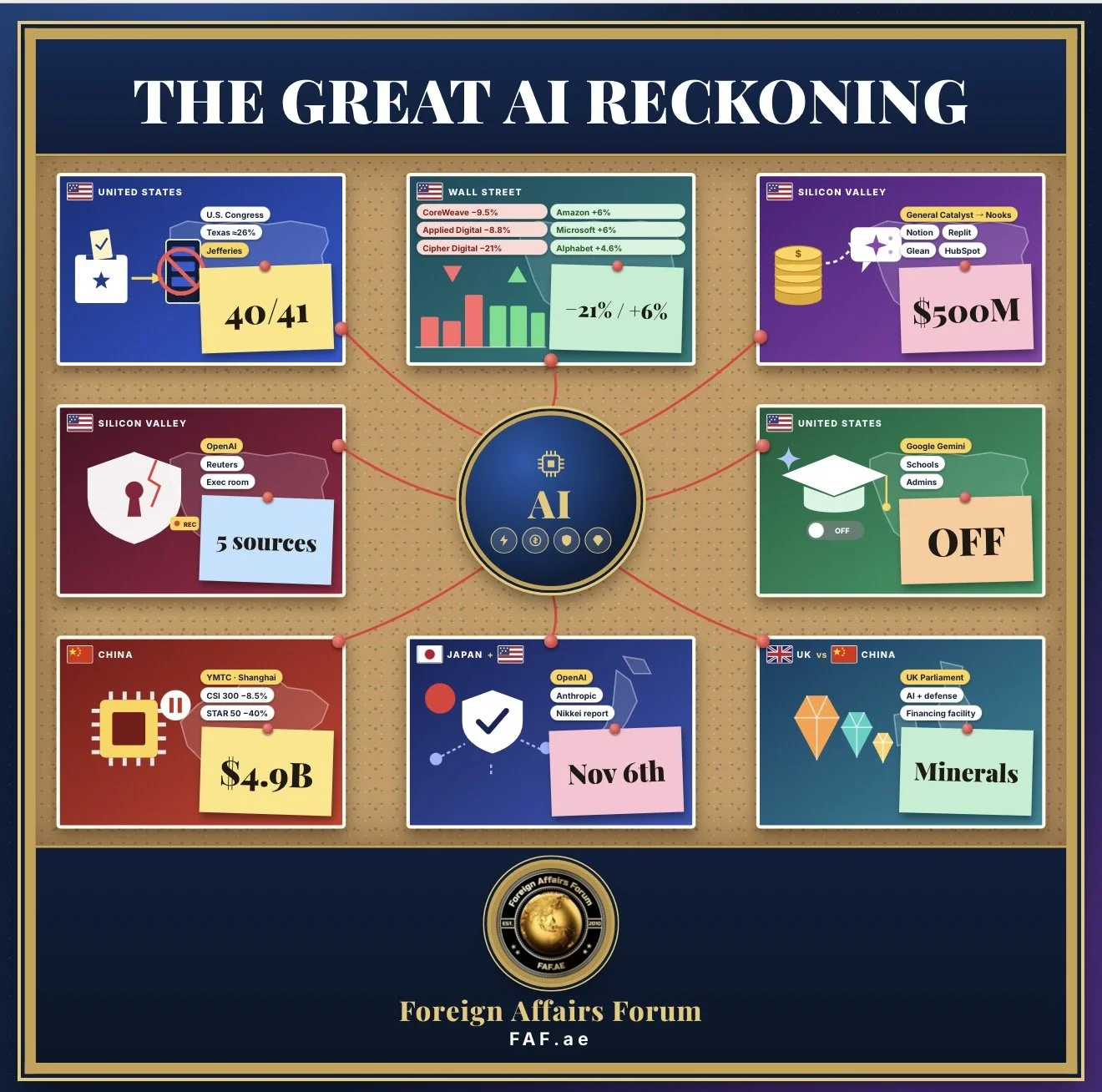
On Nov 3rd, Americans voted in midterm elections, and Democrats won control of Congress. At the same time, voters decided many local questions about data centers.
Of 41 such questions decided this week, forty went against developers who want to build with few limits.
People worry about the electricity these buildings use, the water they need, the effect on nature, and how they are approved. Texas matters most here, because experts at the bank Jefferies think it holds about 26% of the data-center capacity planned across America.
The stock market reacted quickly.
CoreWeave shares fell about 9.5%. Applied Digital dropped 8.8%, and Cipher Digital fell about 21%. Companies that sell electricity to big data-center projects also lost value. But the picture was very different for the biggest technology firms.
Amazon and Microsoft each rose about 6%, and Alphabet, the owner of Google, gained about 4.6%. Investors seem to believe that if building new data centers becomes harder, then companies that already own lots of computing power will become more valuable. Smaller builders that borrow money to expand may suffer.
Money is still flowing to AI companies that can prove they're profitable.
A start-up called Nooks, which uses AI to help companies with sales, has received a $500 million commitment from General Catalyst's Customer Value Fund. This is not an ordinary investment. The investor shares in the returns that the money helps create. Nooks says it has more than two thousand customers, including Notion, Replit, Glean and HubSpot, and it expects its yearly recurring income to almost triple by the end of 2026. The deal shows that investors like AI products with clear business results.
Security is another worry.
A news investigation found that workers at OpenAI had raised concerns for years about how well the company protects its work. They asked who can access certain systems, how the code is stored, how security checks are done, and whether a dishonest insider could cause harm.
This follows a report in October that a recording device was found in an executive meeting room. OpenAI says it has strengthened its protections and added extra limits on who can see its most secret model information. The lesson is that AI research is now a target for spies.
Schools are also changing how they treat AI.
Google announced that it will switch off Gemini by default for student accounts in schools. School leaders can still turn it on if they choose. The decision comes from fears that students may stop thinking for themselves, or may use AI to cheat. It is not a complete solution, because AI summaries still appear in parts of Google's search results. Still, it shows that more people want rules about how young people use AI.
Now turn to China. A major Chinese memory-chip maker, Yangtze Memory Technologies, has delayed its plan to list shares in Shanghai. Its parent company wanted to raise about 33 billion yuan ($4.9 billion). News reports say China's securities regulator quietly told banks to slow down AI and chip company launches, although the regulator has not confirmed this. The reason is that Chinese technology stocks have fallen sharply. The CSI 300 index dropped about 8.5% in October, and the STAR 50 technology index was down about 40% from its July high.
This puts Beijing in a difficult position.
China wants to build its own chips and advanced AI, so it doesn't depend on other countries. To do that, companies need lots of money. But if too many new shares are sold while the market is weak, prices could fall further and shake public confidence. So the government is trying to protect the market while still pushing its technology goals. These two aims can pull in opposite directions, and this week's delay shows that the tension is real.
Japan is worried about AI-enabled hackers.
According to a Nikkei report, the Japanese government may announce an emergency cybersecurity plan as early as Nov 6th. It wants to learn about serious software weaknesses from American AI companies before the public hears about them. That would give the operators of important systems, such as power and communications networks, time to fix the problems. Japan has also asked for more access to advanced AI systems made by OpenAI and Anthropic. The goal is to stay safe in a world where AI can find computer flaws very quickly.
Britain has its own warning.
A committee of lawmakers found that the United Kingdom depends far too much on China for critical minerals. These materials are used in AI equipment, weapons, clean energy systems and factories.
The lawmakers want a national plan to find other suppliers. They suggest a special financing facility that could provide grants, buy shares in companies, and offer loans to support new mines and processing plants. These are only proposals from Parliament and not yet government policy, but they show how seriously the problem is being taken.
Dr. Antonio Bhardwaj (Dr. 🆎), an expert in human-centered superintelligence, geopolitical strategy, AI warfare and bioterrorism risk, says the main lesson is simple. Technology cannot grow alone. It needs voters who accept it, markets that fund it, guards who protect it and mines that supply it. Dr. 🆎 also warns that if powerful AI is poorly protected, it could end up in the wrong hands, including groups that might use it to cause biological harm. For him, security and trust are as important as speed.
What should happen next?
Governments should set clear rules to protect communities and help builders know what to expect.
Companies should design data centers that use less power and water, and they should talk honestly with nearby residents.
Investors should look for ideas that save energy, improve cybersecurity, recycle minerals, and make AI more useful in everyday business.
AI laboratories should treat security as a top priority and listen when their own staff raises concerns.
Friendly countries should share warnings about software weaknesses and work together on mineral supplies.
The big picture is that the AI race is entering a more mature stage.
For years, people asked which country would build the smartest machine. Now the better question is which countries and companies can pay for it, protect it, regulate it, and use it responsibly at scale.
The United States is strong in research, money, and cloud computing, but it must win public trust for its data centers.
China wants independence but faces weak markets. Japan and Britain are showing that safety and supply chains are now part of the AI story. The winners will be those who combine good technology with good judgment.