America Votes Against the War: What a Democratic Congress Can, and Cannot, Do
Foreign Affairs Forum | Dr. Antonio Bhardwaj (Dr. 🆎)| Nov 5th, 2026
Executive Summary
The midterm elections of Nov 3rd have overturned one of the most durable assumptions in American political commentary, namely that voters decide on bread-and-butter questions and leave foreign affairs to the specialists.
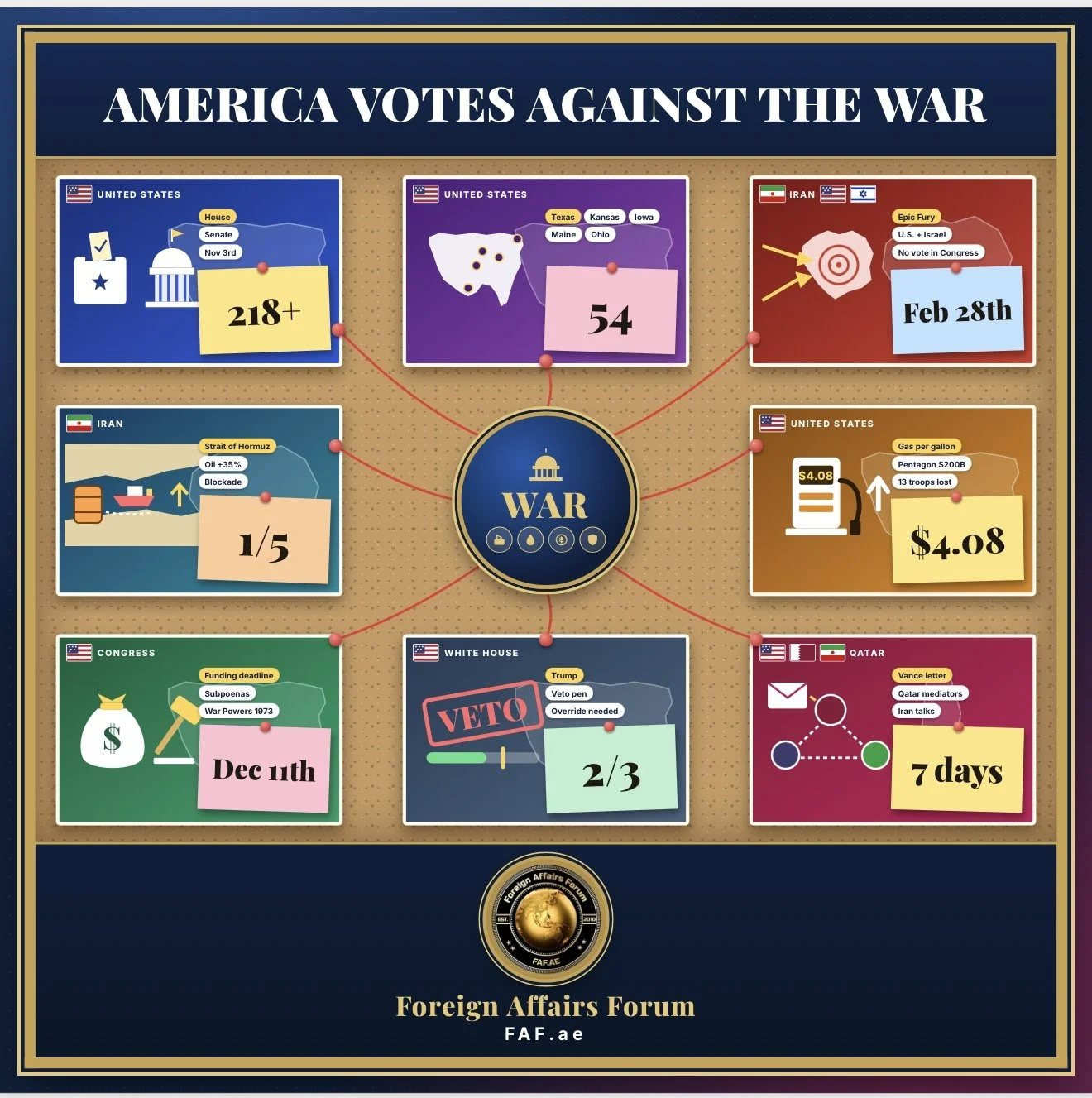
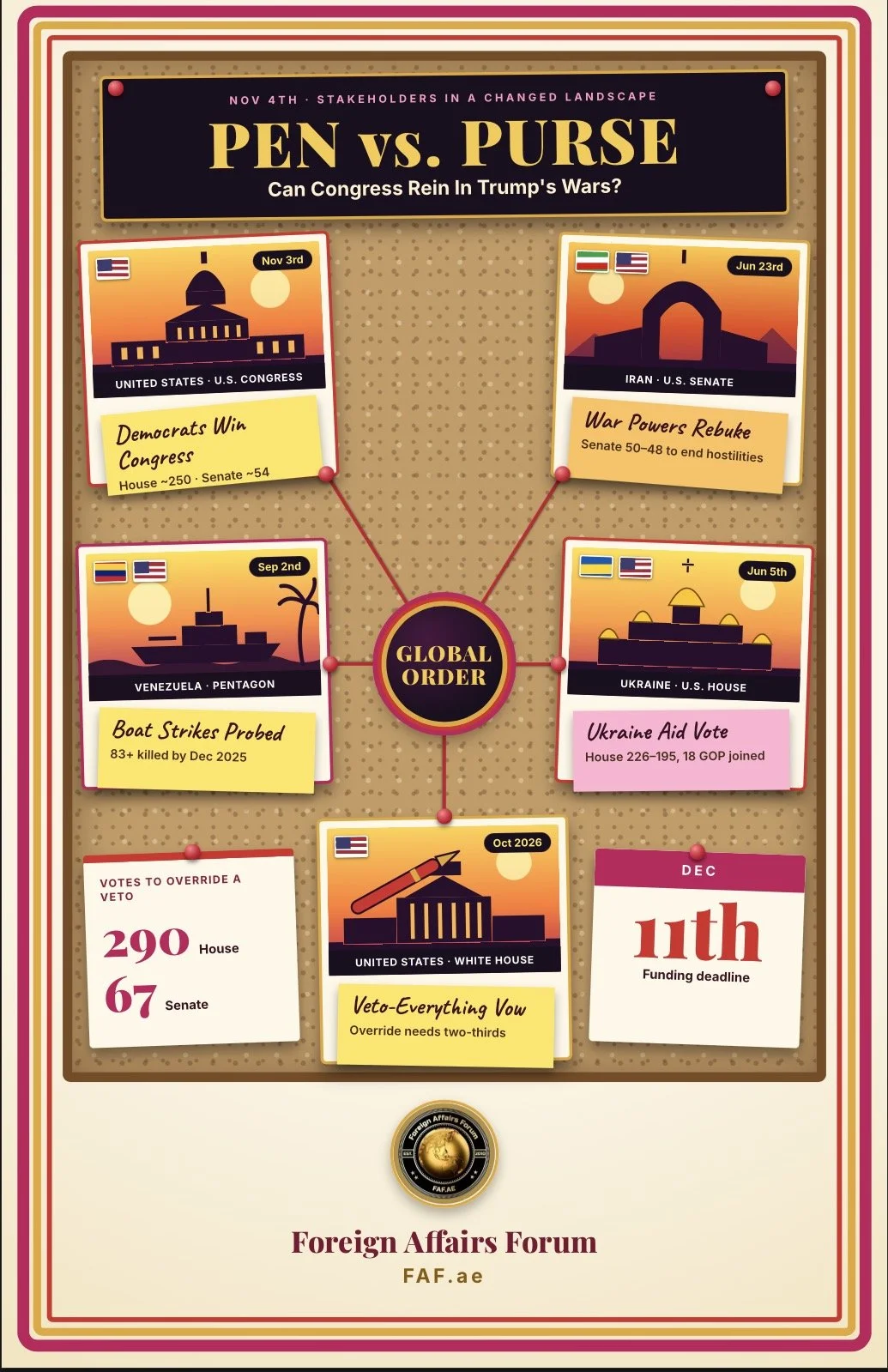
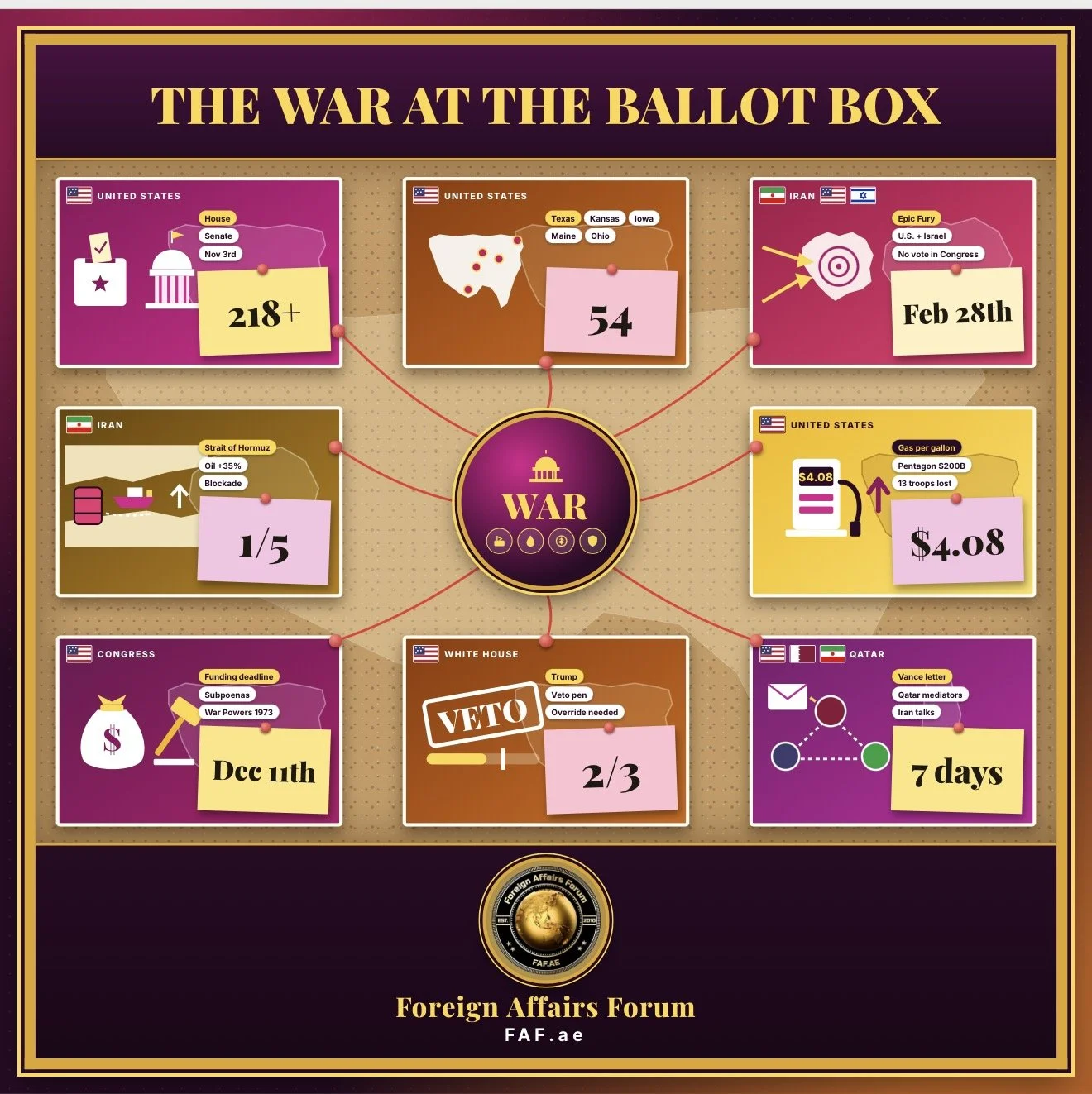
Democrats took the House by crossing the threshold of two hundred and eighteen seats, and by the Associated Press tallies they had reached at least fifty-four seats in the Senate, with several contests still too close to call. Victories in Texas, Kansas, Iowa, Maine, Ohio and North Carolina, several of them in territory Donald Trump carried comfortably in 2024, indicate that the swing was neither marginal nor regional.
Vice President J.D. Vance, assessing the wreckage, wrote that the reason his party lost was the war, and Trump himself has conceded that part of the explanation was Iran.
The war in question began on Feb 28th, when the United States and Israel attacked Iran without a prior vote of Congress. It has since closed or restricted the Strait of Hormuz, through which roughly a fifth of the world's oil passes, pushed American gasoline above $4 a gallon at its worst, cost the lives of at least 13 American service members by spring, and generated a Pentagon request for $200 billion in additional funding.
Public opinion hardened accordingly.
Roughly six in ten Americans told pollsters that the military action had gone too far, while only about a third approved of the president's handling of Iran. The election converted that diffuse discontent into institutional power.
Yet power and effect are different things. Democrats do not command the two-thirds majorities needed to override a veto, and Trump has already promised to veto everything.
Their real instruments are the purse, the subpoena, the confirmation process and the calendar, beginning with the government funding deadline of Dec 11th and the seating of the new Congress on Jan 3rd.
Dr. 🆎 argues that the central test of the coming two years is whether a divided Washington can restore democratic accountability over the use of force without endangering the troops already deployed, and whether it can do so in an age when artificial intelligence is compressing the time available for human judgment.
Introduction
Every generation of analysts rediscovers that foreign policy matters at the ballot box only when it arrives in the household budget or the casualty list.
The conflict with Iran has done both. It has raised the price of fuel, rattled markets and strained a military already stretched across several regions, and it has done so without the formal consent of the legislature that the Constitution charges with declaring war. In this sense the electoral verdict of Nov 3rd is less a surprise than a delayed accounting. Voters were asked to pay for a war they had never been invited to authorize, and they used the only instrument immediately available to them.
Dr. Antonio Bhardwaj (Dr. 🆎), a polymath with global expertise in superintelligence, specializing in human-centered approaches to geopolitical strategy, AI warfare and bioterrorism risk, has long maintained that wars are decided as much by the institutions that legitimize them as by the weapons that fight them. In his reading, a democracy that wages war without a durable domestic consensus is borrowing against its own strategic future, and the interest comes due at the next election. The events of this week, he suggests, are that bill arriving. This FAF article examines what has been presented and what can realistically be collected.
The analysis proceeds in stages. It first situates the verdict within the history of war and American elections and describes the present state of the conflict. It then examines the principal developments of the past week, separates established facts from contested claims, and traces the chain of cause and effect that connects a distant strait to a Kansas ballot box. It concludes with practical proposals for Congress, the White House and the allies who must live with the consequences.
Throughout, Dr. 🆎 offers a strategic interpretation that links the politics of war powers to the emerging risks of automated warfare and biological threat.
History and Current Status
American voters have punished incumbent parties over wars before, and the pattern is instructive.
In the 2006 midterms, disillusionment with the Iraq war helped hand Democrats both chambers of Congress, and the political scientists who studied that result concluded that casualties and a sense of strategic drift mattered more than the original merits of the invasion.
A generation earlier, the anguish over Vietnam produced a Congress determined to reclaim its constitutional role, culminating in the War Powers Resolution of 1973, which requires that military action cease within sixty days unless Congress authorizes it. That law has been honored more in the breach than in the observance by presidents of both parties, and its weakness is central to the present dilemma.
The current war began on Feb 28th, when American and Israeli forces struck Iran in an operation the administration named Epic Fury.
The president did not seek congressional approval beforehand. Within days oil prices rose by about 35% in a single week, the steepest weekly gain in four decades, and the Strait of Hormuz, the narrow passage that carries about a fifth of the world's oil, became a contested waterway.
Congress was slow to respond. In early March, Senate Republicans voted down the first war powers resolution. In May, House Republican leaders cancelled a vote on a similar measure that appeared to be on the verge of passing. In early June, the House did pass a resolution directing the president to end hostilities, and in late June Congress approved a largely symbolic measure directing the removal of American forces. The administration treated both as advisory.
Diplomacy followed an uneven rhythm.
A two-week truce in April briefly reopened Hormuz, and a further understanding in June appeared to pave the way for a lasting reopening, yet each arrangement frayed.
By the autumn the United States was blockading Iranian ports, Iran was restricting commercial traffic through the strait, and mediators in Qatar were carrying proposals between the parties.
Trump has said Washington has no immediate plans to resume large-scale attacks while insisting the country is locked and loaded if necessary.
Iran says it remains committed to talks through a seven-day roadmap delivered to the Qatari mediators, while its new Supreme Leader, Mojtaba Khamenei, has warned that renewed American strikes would bring much broader consequences. Vance is reported to have sent a letter to Iran's security chief in an effort to revive negotiations.
The economic and human costs have accumulated alongside the diplomacy.
Gasoline reached a national average of $4.08 a gallon this spring, nearly a dollar above its level when Joe Biden left office, and the International Energy Agency has reported that European gas storage is at its lowest level since 2013, a condition linked to the disruption of Gulf supplies.
At least 13 American service members had been killed and hundreds wounded by the spring, thousands of additional troops had been dispatched to the region, and the Pentagon had asked for $200 billion in new funding.
Republican strategists privately conceded as early as April that the party expected to lose the House and faced a realistic prospect of losing the Senate. A year earlier they had expected to hold both.
Key Developments
The first development is the scale and breadth of the Democratic victory.
Control of the House was secured by crossing two hundred and eighteen seats, and the Senate picture is more striking still. James Talarico defeated Ken Paxton in Texas by more than eleven points in a state Trump won by fourteen in 2024. Democrats captured a seat in Kansas that they had not held since 1932, prevailed in Iowa by about four points in a state Trump carried by fourteen, defeated Susan Collins in Maine by almost seven points, and won in Ohio and North Carolina, in the latter case by nearly twenty points. The Senate majority does not take effect until Jan 3rd, a delay that creates a lame-duck interval of unusual sensitivity.
The second development is the acknowledgment from within the governing party that the war was a decisive factor.
Vance's remark that everyone knows why the party lost is notable not only for its candor but for its source, since the vice president is widely reported to have opposed the war from its inception and is now tasked with reviving the diplomacy that might end it.
Trump, for his part, has conceded that part of the explanation was Iran, while telling interviewers that he does not regret the decision and would take it again. He has also said the war will end when he says it ends. The two statements together describe a party that accepts the political damage but not the strategic lesson.
The third development is the president's declared intention to obstruct.
He told a podcast audience before the election that he would veto everything, and nothing in the early reaction suggests a softening. Because Democrats lack the two-thirds majorities required to override, legislation compelling an end to the war would die at the White House unless a substantial number of Republicans join the effort. A handful of Republican votes did help pass a war powers measure in the House earlier this year, which suggests that the arithmetic of defection is not entirely hopeless, but it is far from sufficient on present numbers.
The fourth development concerns the instruments Democrats do hold.
Government funding expires on Dec 11th, which gives even the outgoing Congress leverage in negotiations over appropriations. Come January, Democratic chairs will lead every committee, acquiring the power to summon officials, demand documents and issue subpoenas.
Likely subjects include the conduct of the war, the strikes on vessels off South America, the dismantling of the United States Agency for International Development, and the dismissal of senior military officers by Defense Secretary Pete Hegseth.
Control of the Senate also brings leverage over ambassadors, cabinet officers and treaties, and the early 2027 appropriations cycle will test whether a divided Washington can function at all.
The fifth development is the widening of the foreign policy agenda beyond Iran.
Trump has largely halted direct American aid to Ukraine and waived sanctions on Russian energy and diesel, and a Democratic Congress is expected to try to restore support and block those waivers. Israel received $3.8 billion in military assistance in the most recent fiscal year, and nearly half of House Democrats voted this summer to cut it off, a division that will complicate any unified party position.
Trump has himself said the United States would reduce military aid to Israel at the end of the year while continuing arms sales. On trade, the Supreme Court struck down his sweeping tariffs by a six to three vote in February, and he reissued them at 15% under a different statute that lapses after one hundred and fifty days unless Congress extends it.
Latest Facts and Concerns
It is important to separate what is established from what is merely asserted. It is established that Democrats control the House and will control the Senate from Jan 3rd, that the war began without congressional authorization, that the strait remains a source of disruption, and that both the vice president and the president have linked the electoral outcome to the conflict. It is not established that the war was the sole cause of the result, since economic anxiety, tariffs, immigration enforcement and the ordinary penalty borne by a sitting president's party all contributed.
The incumbent party has lost House seats in 20 of the 22 midterms since 1938, so some of the swing would have occurred in any event, though not on this scale.
A first concern is the danger of escalation during the transition.
Analysts such as Trita Parsi have warned that the two months before the Senate changes hands may be the most perilous, because a president who has just been repudiated retains full authority over the military and may calculate that decisive action now is preferable to a constrained position later. Reports that Israeli leaders have signaled possible strikes in the coming days, and claims by Iran's Revolutionary Guard that tankers have struck mines and an American drone has been downed, remain unverified but illustrate how quickly the situation could deteriorate.
Dr. 🆎 stresses that rapid escalation is precisely where human judgment is most fragile and most necessary.
A second concern is the difficulty of using the power of the purse without harming the troops.
Cutting funds for a war while American forces remain in the field is, as one analyst put it, highly problematic, because it can be framed as placing lives at risk. Democrats must therefore find a way to impose accountability that does not leave soldiers without supplies.
Conditions on spending, reporting requirements, limits on the use of funds for new offensive operations and a requirement that the administration seek authorization within a defined period are all more defensible than an abrupt cutoff, but each invites a veto and a public relations battle that Republicans will be eager to fight on the ground of patriotism.
A third concern is the unity of the Democratic coalition itself.
The party is divided over Israel, with a large bloc favoring cutting military aid and a leadership wary of the electoral and diplomatic costs. It is divided over how far to press confrontation with the White House, with some members urging investigations and even impeachment over the conduct of the war, and others warning that overreach would hand Trump a martyr's narrative.
Republicans, in turn, will argue that the war was intended to confront a nuclear and missile threat and that premature withdrawal would reward Tehran. Those who share that view, such as Sen. Lindsey Graham, praised the president's early address on the conflict. A fair reading acknowledges that these are genuine strategic arguments and not mere partisan talking points.
A fourth concern, closer to the expertise of Dr. 🆎, is the technological and biological dimension that the political debate has barely touched.
A war conducted under extreme time pressure, with targeting, surveillance and logistics increasingly mediated by artificial intelligence, raises questions about accountability that existing law was never designed to answer.
Dr. 🆎 warns that when decisions are made at machine speed, the constitutional safeguard of deliberate legislative oversight is not an obstacle to effectiveness but a condition of legitimacy. He adds that prolonged conflict in a region with significant chemical and biological expertise, combined with a distracted and divided Washington, increases the risk that dangerous capabilities spread beyond the control of any state.
Cause-and-Effect Analysis
The causal chain begins with a strategic decision and ends, perhaps unexpectedly, at the grocery store.
The attack on Iran led to disruption in the Strait of Hormuz, the disruption pushed up the price of crude oil and then of gasoline, and the higher price of fuel entered every household budget as well as the cost of transporting food and goods. Voters who might never have formed a view on the strategic merits of the war formed one on the price of filling a tank. Economic grievance thus became the transmission mechanism by which a foreign policy decision acquired domestic political weight, and this explains why a conflict fought far from American shores penetrated races in Kansas and Iowa.
The second link runs from voter dissatisfaction to institutional power.
A rebuke at the polls is not merely symbolic when it changes who controls the committees, the calendar and the budget. Democratic chairs can force officials to testify under oath, and the testimony itself can reshape public opinion by exposing the gap between the administration's stated aims and the actual course of the conflict. Even without enacting a single law, a Congress that holds public hearings on strategy, cost and civilian harm alters the political price of continuing the war. The history of Iraq suggests that the cumulative effect of sustained scrutiny can be larger than any individual vote.
The third link runs from congressional leverage to the diplomacy with Tehran.
Negotiators across the table read American elections closely, and Iranian officials have already claimed that Americans said no to war at the ballot box. That reading is self-serving, but it contains a kernel of strategic truth. A president who cannot count on Congress to sustain a prolonged campaign has less credible leverage, and a weaker bargaining position may push Washington toward a settlement. Conversely, the same perception may tempt Tehran to wait out the clock, assuming that American resolve is weakening, which could prolong the stalemate and heighten the risk of miscalculation during the transition.
The fourth link, and the most troubling, runs from divided government to executive unilateralism.
When the legislature is hostile and the president feels unconstrained by its resolutions, the likely response is to rely more heavily on powers that require no congressional approval, including military action, emergency declarations and executive orders. The administration's disregard of the war powers resolutions that Congress has already passed illustrates the pattern.
Dr. 🆎 observes that this dynamic transforms a constitutional question into a test of institutional endurance, and that the long-term cost is not confined to one war. Each precedent of unchecked presidential war-making lowers the threshold for the next, and the consequences will be amplified if the tools of war become faster and more autonomous.
Future Steps
For Congress, the most productive strategy is one that combines pressure with responsibility.
Committees should begin early planning for comprehensive hearings in January that examine the strategic objectives of the war, the legal basis for its continuation, the costs borne by taxpayers and service members, and the regional consequences for energy markets and allies. In the meantime, congressional leaders should use the Dec 11th funding deadline to insist on transparency and on explicit reporting requirements. A narrowly drawn authorization with a sunset provision would restore the constitutional balance more credibly than a blunt prohibition, and it would give wavering Republicans a way to support constraints without appearing to abandon the troops.
For the White House, the sensible course is to treat the election as information rather than insult.
The diplomatic channel opened through Qatar and the letter reportedly sent by Vance represent an opportunity to convert military pressure into a durable arrangement, and the administration would be wise to pursue it with urgency. A settlement that reopens the strait, lowers energy prices and secures verifiable limits on Iran's nuclear and missile programs would address both the strategic objective and the political liability.
Dr. 🆎 argues that the most effective exit from an unpopular war is one that the president can describe as a victory, which requires offering Tehran a face-saving path in return for concrete commitments.
For Democrats, the discipline required is considerable.
The party must settle on a coherent position on Israel, on Ukraine and on the limits of the war powers it seeks to restore, rather than allowing the issues to fracture the coalition. It should resist the temptation to treat investigations as an end in themselves, focusing instead on the questions that matter most to the public: why the war began, what it is costing, and how it will end. Supporting a bipartisan effort on measures that command broad assent, including renewed assistance for Ukraine, a baseline of American troops in Europe and constraints on the sale of the heaviest munitions, would demonstrate governing seriousness rather than mere opposition.
For allies, the lesson is to prepare for a more constrained and more volatile American partner.
European governments, facing the lowest gas storage in over a decade, should accelerate energy diversification and joint stockpiling, while Gulf partners should expect congressional scrutiny of investment arrangements and arms sales. Asian partners should recognize that the congressional consensus on technology controls, including measures on chips and remote access to advanced systems, is likely to persist regardless of which party holds power. Allies will do better to engage Congress directly and early than to rely solely on the executive branch, because the next two years will be shaped as much by Capitol Hill as by the White House.
For the broader national security community, the war should prompt a serious institutional reckoning with the future of conflict.
Dr. 🆎 urges Congress to establish clear standards for the use of artificial intelligence in targeting and command decisions, including requirements for meaningful human control, independent testing and after-action review. He also calls for renewed investment in biosecurity, including surveillance of emerging threats, protection of sensitive research and international cooperation to prevent the diffusion of dangerous capabilities.
A distracted government, he warns, tends to cut such programs first, and the cost of neglect is seldom visible until it is catastrophic. Treating these questions as part of the war powers debate, and not as technical afterthoughts, would be a mark of strategic maturity.
Conclusion
The election of Nov 3rd has settled one question and opened several others. It has settled the proposition that American voters will hold their leaders accountable for the conduct of foreign wars, particularly when those wars strike at living standards and when they are launched without the visible consent of the legislature.
The verdict was delivered in places that Democrats had not carried for generations, and it was acknowledged, with varying degrees of reluctance, by the vice president and the president himself. Whatever other factors contributed, the war has been written into the political record as a cause.
What the election has not settled is what Washington will do next.
Democrats hold substantial but limited power, the president retains broad authority over the military and a veto pen he has promised to use, and the troops in the field cannot be treated as bargaining chips.
The most plausible outcome of the next two years is neither a swift end to the war nor an unchecked continuation, but a contested process of constraint, investigation and negotiation in which the balance of constitutional authority is renegotiated in real time.
Dr. 🆎 closes with a warning and a hope. The warning is that democracies which allow war to become the exclusive province of the executive, and which delegate ever more decisions to systems that move faster than human deliberation, will eventually lose the capacity to restrain themselves.
The hope is that this moment of electoral reckoning can be used to rebuild that capacity, so that decisions of war and peace are made by accountable human beings after genuine debate. If Congress can combine firmness with prudence, protect the troops while demanding answers, and pair its oversight with a credible path to peace, the verdict of Nov 3rd may come to be remembered not as the end of a war, but as the moment American democracy reasserted its authority over one.