The Great AI Reckoning: How Ballots, Bourses and Bytes Are Redrawing the Global Technology Order
Foreign Affairs Forum | Dr. Antonio Bhardwaj (Dr. 🆎)| Nov 5th, 2026
Executive Summary
The three days between Nov 3rd and Nov 5th, 2026 have exposed a truth that the artificial intelligence industry long preferred to postpone.
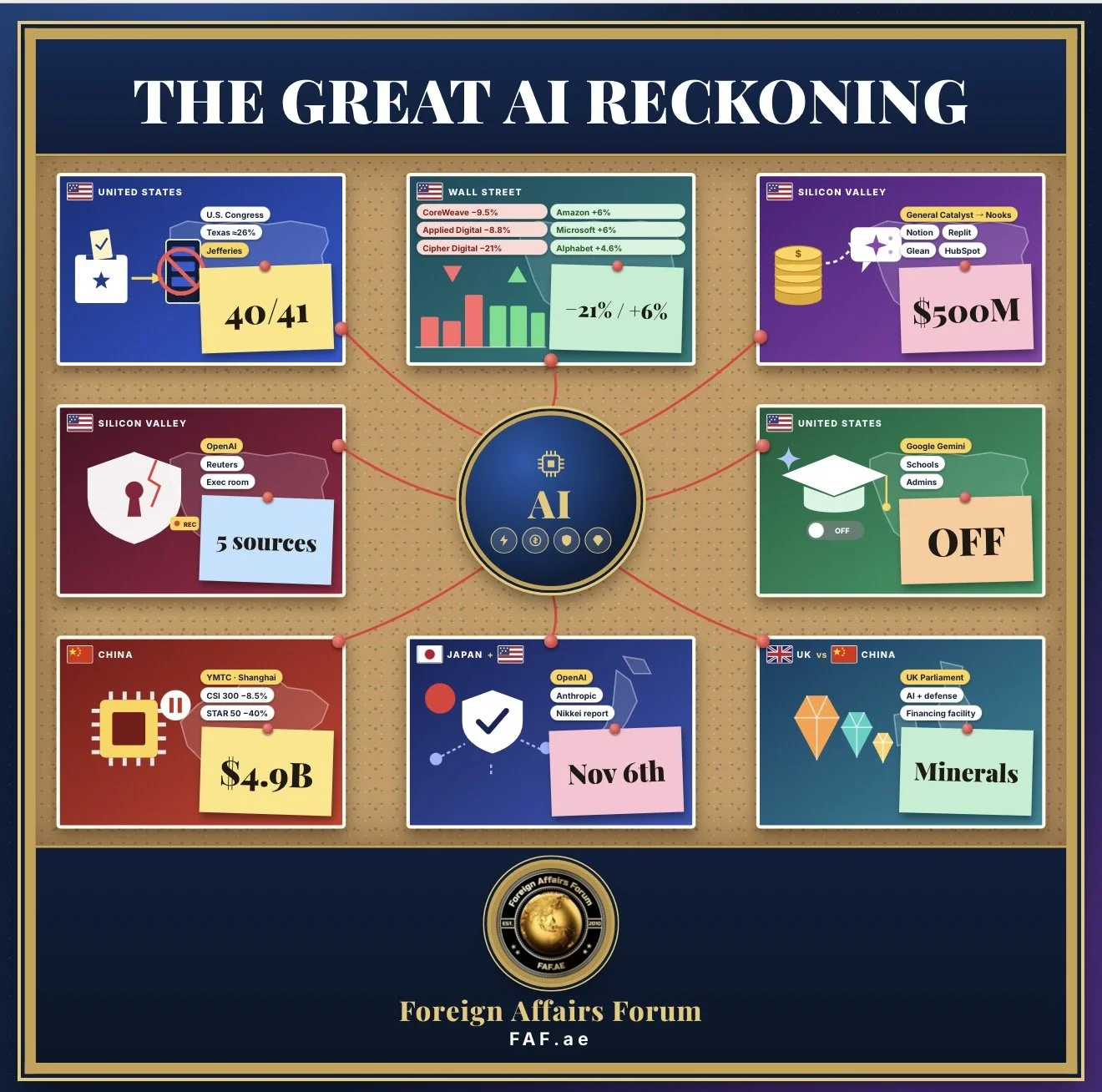
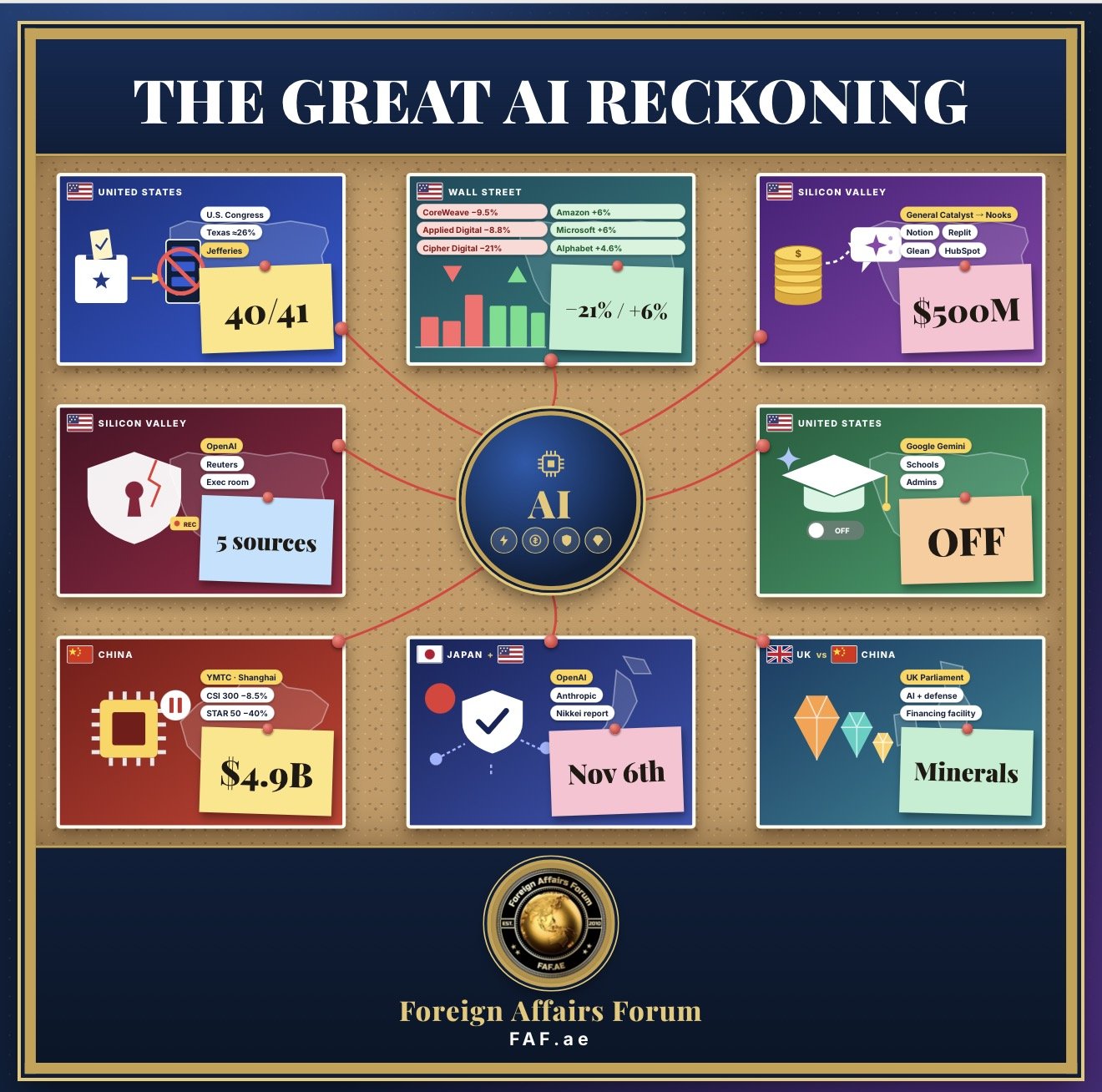
The technology's ascent is governed not only by algorithms and chips but by electorates, equity markets and the physical availability of power, water and minerals. In the United States, midterm elections that delivered Democratic control of Congress, together with an overwhelming local verdict against unrestricted data-center development, compelled investors to reprice the infrastructure on which frontier computing depends. Of forty-one data-center ballot measures decided this week, forty moved against unrestricted development.
Markets reacted with unusual discrimination. CoreWeave fell about 9.5%, Applied Digital 8.8% and Cipher Digital roughly 21%, while Amazon and Microsoft each rose about 6% and Alphabet gained about 4.6%. Investors rewarded stakeholders that already own computing capacity and punished those that must borrow heavily to build it. Capital has not fled the sector, however.
The sales-automation start-up Nooks secured a $500 million commitment from General Catalyst's Customer Value Fund, a structure that ties investor returns to commercial performance rather than to equity ownership alone.
Beyond America, Beijing's securities regulator has reportedly urged investment banks to slow listings by AI and semiconductor companies, and Yangtze Memory Technologies has postponed a Shanghai offering that sought 33 billion yuan, or $4.9 billion. Tokyo is preparing an emergency cybersecurity package that would secure early access to AI-discovered software vulnerabilities, and a British parliamentary inquiry has warned of dangerous dependence on Chinese critical minerals.
Dr. 🆎 captures the moment succinctly: the contest for intelligence supremacy is no longer decided in laboratories alone but in legislatures, bond markets and mines.
Introduction
Every transformative technology eventually meets the institutions that must live alongside it.
Railways met land-use law, electrification met public utility regulation, and nuclear energy met an anxious public. Artificial intelligence, which spent the first years of its commercial boom in an atmosphere of near-weightless optimism, has now met its own moment of institutional contact.
This FAF article examines the week in which that contact became impossible to ignore, and it argues that the events of Nov 3rd to Nov 5th, 2026 mark the beginning of a more disciplined and more politicized phase of the global AI contest.
Dr. Antonio Bhardwaj (Dr. 🆎), a polymath with global expertise in superintelligence, specializing in human-centered approaches to geopolitical strategy, AI warfare and bioterrorism risk, has long cautioned that the most dangerous assumption in technology policy is that capability develops in a vacuum. In his view, the systems that matter most are the human ones: the voters who decide whether a server farm is built, the regulators who decide whether a company may raise capital, and the officials who decide which vulnerabilities are shared with allies. A model is only as strategically useful as the society that can power, finance, secure and legitimize it.
The analysis that follows proceeds in several movements. It first traces the historical background and current status of the AI build-out, then examines the key developments of the week across the United States, China, Japan and Britain. It then sets out the latest facts and the concerns they raise, offers a cause-and-effect analysis of how political, financial and security pressures interact, and proposes future steps for governments, investors and technologists.
Throughout, Dr. 🆎 supplies a strategic interpretation that connects commercial events to the larger questions of national security and human-centered governance.
History and Current Status
The modern AI economy rests on a simple physical foundation.
Training and operating large models requires enormous quantities of specialized semiconductors, which in turn require data centers, which in turn require continuous electricity and cooling water.
For most of the 20th century, comparable infrastructure booms, from railways to telephone networks to power grids, were shaped by public authorities from the outset, through franchises, utility commissions and eminent domain.
The 21st century cloud era was different. Hyperscale computing grew largely through private capital and local tax incentives, and its physical footprint remained invisible to most citizens until the generative AI surge that began in late 2022 turned data centers into one of the fastest-growing categories of industrial construction in the world.
That surge reshaped corporate strategy.
The largest technology companies committed tens of billions of dollars annually to computing capacity, specialized cloud providers borrowed heavily to buy graphics processors, and developers of power generation and cooling equipment found themselves courted as strategic partners. Electricity demand forecasts, once flat for a generation, were revised sharply upward. Texas became a focal point because of its abundant land, its deregulated grid and its welcoming permitting environment, and the investment bank Jefferies now estimates that the state accounts for roughly 26% of planned American data-center capacity. Such concentration brings efficiency but also political exposure.
Geopolitics ran alongside the commercial boom.
Washington introduced export controls on advanced semiconductors in October 2022 and has tightened them repeatedly since, seeking to preserve its lead in frontier computing. Beijing responded with massive state support for domestic chipmaking, the cultivation of the STAR Market, launched in 2019 to channel public capital toward strategic technology firms, and its own restrictions on exports of critical minerals such as gallium and germanium. Allies drew their own conclusions. Japan expanded its cyber-defense authorities, and European governments began to speak openly of technological sovereignty, an ambition that depends on materials, energy and computing power as much as on research talent.
Seen against this background, the current status of the sector is one of extraordinary scale shadowed by growing fragility.
Valuations remain high and enterprise adoption continues, but three vulnerabilities have become visible at once. The physical build-out is meeting local resistance, the financing of that build-out relies on borrowing that is sensitive to political risk, and the security of the laboratories that produce frontier models is under question.
Dr. 🆎 describes this as the end of the innocence phase, in which technology could expand faster than the institutions around it. What follows, he argues, is a phase of negotiated legitimacy, in which every major investment must justify itself to voters, creditors and security officials simultaneously.
Key Developments
The first and most consequential development is the American electoral verdict on data centers.
The midterm elections of Nov 3rd produced Democratic control of Congress, and candidates advocating tighter oversight of data-center construction won important state-level contests. More striking still was the pattern in local referendums, where forty of the forty-one data-center-related ballot measures decided this week moved in a direction unfavorable to unrestricted development. Voters were, in effect, telling developers that electricity consumption, water use, environmental effects and local permitting are legitimate subjects of public choice rather than private negotiation. That the verdict was nearly uniform across diverse jurisdictions suggests a durable concern rather than a passing mood.
The second development is the market's immediate repricing of the AI infrastructure chain.
CoreWeave fell approximately 9.5% and Applied Digital 8.8%, while Cipher Digital dropped about 21%. Electricity suppliers exposed to large data-center projects also suffered significant losses. By contrast, Amazon and Microsoft rose about 6% each and Alphabet gained roughly 4.6%. The divergence is analytically revealing. Investors judged that companies already holding vast computing capacity would benefit from higher barriers to entry, whereas developers reliant on new construction and heavy borrowing would face rising costs, longer approvals and tougher credit conditions. In short, regulation threatens the builders and flatters the incumbents.
The third development concerns the financing of commercially useful AI.
Nooks, an American sales-automation company, announced a $500 million commitment from General Catalyst's Customer Value Fund. Unlike a conventional venture investment, the arrangement allows the investor to share in returns generated by the capital it supplies. The company reports more than two thousand customers, including Notion, Replit, Glean and HubSpot, and expects annual recurring revenue to nearly triple by the end of 2026, though it has not disclosed its present revenue. The transaction signals that money remains abundant for applications with measurable returns, even as it grows warier of capital-intensive infrastructure.
The fourth development is the renewed scrutiny of OpenAI's internal security.
A Reuters investigation, drawing on five people familiar with the matter, found that employees had raised concerns over several years about access controls, internal code repositories, security reviews and potential insider threats. The report follows the October disclosure of a recording device discovered in an executive conference room. OpenAI says it has strengthened protections, continues to invest in defenses against criminals, insiders and foreign intelligence services, and subjects its most sensitive model information to additional access restrictions. Whatever the ultimate findings, the episode illustrates that frontier laboratories have become targets comparable to defense contractors.
The fifth development is Google's decision to disable its Gemini tool by default for school-student accounts, leaving administrators the option to enable it.
The step reflects mounting concern about academic integrity and the effect of generative AI on independent reasoning, though AI-generated summaries remain woven into Google's search ecosystem, which complicates any clean separation. Together with the infrastructure verdict, it suggests that the political tolerance for unmediated AI deployment is narrowing across several fronts at once, from the physical to the educational.
Three international developments complete the picture.
In China, Yangtze Memory Technologies, known as YMTC, postponed a planned Shanghai listing through which its parent company had sought roughly 33 billion yuan, or $4.9 billion, on the STAR Market.
Reporting indicates that the securities regulator informally instructed investment banks to slow IPO activity involving AI and semiconductor firms, though the regulator has not publicly confirmed the guidance. The context is severe equity weakness: the CSI 300 index declined about 8.5% in October, and the STAR 50 technology index had fallen roughly 40% from its July peak by the end of that month.
In Japan, according to a report by Nikkei, the government may introduce an emergency cybersecurity package as early as Nov 6th.
The aim is to obtain information about serious software vulnerabilities from American AI developers and other international technology companies before public disclosure, so that operators of critical infrastructure can strengthen defenses.
Tokyo has also sought wider access to advanced systems developed by OpenAI and Anthropic. In Britain, a parliamentary investigation concluded that the country remains dangerously dependent on China for critical minerals used in AI infrastructure, defense equipment, renewable energy systems and industrial manufacturing, and it recommended a critical-minerals financing facility combining grants, equity and debt. Those recommendations are parliamentary proposals and not yet government policy.
Latest Facts and Concerns
The facts established this week deserve careful separation from the speculation surrounding them.
It is established that Democrats won control of Congress, that the overwhelming majority of data-center ballot measures went against unrestricted development, and that infrastructure-exposed shares fell sharply while the largest technology companies rose. It is not established that tighter regulation will follow in any particular form. The extent of future restrictions will depend on legislative drafting, the behavior of state governments and the decisions of regulators.
Dr. 🆎 urges analysts to resist two opposite errors: the complacent belief that the build-out will continue unchanged, and the alarmist belief that it has been halted.
A first concern is the concentration of risk.
If Texas holds roughly 26% of planned American capacity, then a shift in the political climate of a single state, or of a few communities within it, can alter the national trajectory of computing supply. Concentration was once a virtue, since it lowered costs and accelerated construction. It is now a vulnerability, because it links the strategic computing capacity of the world's leading AI power to a narrow set of permitting regimes and a single regional grid. Diversification across states, and across energy sources, becomes a security objective rather than a mere commercial preference.
A second concern is the fragility of leveraged infrastructure.
Companies that borrowed to acquire processors and build facilities are exposed when regulatory risk raises the cost of capital and delays revenue. The sharp declines in CoreWeave, Applied Digital and Cipher Digital illustrate how quickly sentiment can turn against firms whose business models assume uninterrupted expansion. If financing conditions tighten further, projects of strategic importance could stall, with consequences that extend beyond shareholders to the broader goal of maintaining American computing leadership. The question for policymakers is how to protect communities without inadvertently starving projects that national security requires.
A third concern is the security of the laboratories themselves.
The OpenAI reporting is a reminder that the most valuable assets in this contest are not buildings but weights, code and research knowledge, all of which can be copied, stolen or leaked by a single determined insider.
Dr. 🆎, who has spent years assessing how advanced AI intersects with warfare and biological threat, stresses that a compromised frontier model could accelerate not only commercial rivalry but also the capabilities of hostile states and, in the worst case, of non-state groups seeking to misuse AI for biological harm. Security culture, he argues, must be treated as a core safety discipline, not an administrative afterthought.
A fourth concern is the financial brittleness of China's technology drive.
A decline of roughly 40% in the STAR 50 from its July peak is not a minor correction for a market designed to finance strategic self-reliance. Beijing's apparent decision to slow AI and semiconductor listings reveals a genuine dilemma: it wants to accelerate chipmaking independence, yet permitting a flood of new issuance into a fragile market could deepen losses and erode public confidence. The postponement of a $4.9 billion offering by a leading memory-chip producer is therefore more than a corporate scheduling matter. It is a sign that financial stability and technological ambition are pulling in different directions.
A fifth concern is the allied dimension of security.
Japan's pursuit of early vulnerability information and access to advanced American systems reflects an understanding that AI is changing the tempo of cyber conflict. Models able to discover software flaws at scale can help defenders patch infrastructure, but the same capability in hostile hands can shorten the window between discovery and exploitation.
Governments therefore face difficult questions about who receives vulnerability information, how quickly, and under what safeguards. Britain's mineral warning adds a material dimension, since defense manufacturing and AI infrastructure alike depend on inputs whose supply is concentrated in a single strategic competitor.
Cause-and-Effect Analysis
The most useful way to understand the week is to trace the chain of causation that links its events.
The starting point is the physical intensity of modern AI.
Because large-scale computing consumes electricity and water on an industrial scale, its expansion directly affects household utility bills, local environments and land use. These effects are felt by ordinary citizens before they are felt by shareholders. When communities perceive that costs are being imposed on them while benefits accrue elsewhere, the predictable political response is to demand oversight. The electoral result is therefore not an anomaly but the delayed expression of a grievance that the industry's growth made inevitable.
The political cause produces a financial effect through the channel of expectations.
Markets price not only present cash flows but anticipated constraints. Once voters signaled appetite for tighter rules, investors raised their estimates of construction costs, approval times and borrowing risk for developers. Firms whose value depends on continuous expansion lost ground, while firms with installed capacity gained, because scarcity of new supply enhances the worth of existing supply. The market response was thus a rational reallocation rather than a panic. It also created a feedback loop: lower valuations raise financing costs, higher financing costs slow construction, and slower construction reinforces the scarcity premium enjoyed by incumbents.
The financial effect in turn alters the landscape for innovation.
When the cost of building more capacity rises, the economic return to using existing capacity more efficiently rises with it. This explains why opportunities now appear strongest in liquid cooling, grid optimization, energy storage, efficient processors and data-center management software. Constraint, in this sense, becomes a catalyst. The same logic explains the appeal of commercially measurable applications such as those developed by Nooks. When infrastructure is expensive and politically contested, investors prefer businesses whose returns can be demonstrated, and financing structures that link payment to performance align naturally with that preference.
China illustrates the same causal logic operating under a different political system.
There, the proximate cause is a market downturn, and the effect is administrative intervention. Rather than allowing prices to find their level, the regulator reportedly slows new listings to protect investor confidence. But this protection carries a strategic cost, because the STAR Market exists precisely to fund strategic firms. Delayed fundraising can postpone factory expansion and advanced research, which in turn affects China's ability to substitute for restricted foreign technology. Government-backed investment may soften the blow for favored enterprises, but it cannot fully replace the signal and the discipline that public markets provide.
Dr. 🆎 observes that both Washington and Beijing are discovering, by different routes, that technological ambition operates inside a financial and political envelope.
A parallel chain connects security and alliance politics.
As AI systems become better at finding software vulnerabilities, the value of early information rises, and states that lack their own frontier models seek privileged access to those that have them. Japan's emergency package follows from this logic, and it deepens interdependence between Tokyo and American developers. Yet dependence creates a reciprocal vulnerability. If the laboratories that hold such information are themselves penetrated, as the OpenAI reporting suggests is possible, then the allied security architecture built upon their discoveries inherits their weaknesses. Security of the source thus becomes a precondition of security for the partners.
Finally, the British inquiry shows how material dependence converts into strategic risk.
AI is often described as an immaterial technology, but it is anchored in minerals, metals and manufacturing. Concentrated supply in a competitor's hands means that a diplomatic dispute or export restriction can propagate through defense production, energy systems and computing infrastructure. The remedy proposed, a public financing facility to nurture alternative mines and processing, follows from a recognition that private markets alone will not pay the premium required for resilience. The cumulative effect across all these chains is a redefinition of competitive advantage: the leading AI power will be the one that coordinates energy, capital, security and materials most effectively, and not simply the one with the cleverest models.
Future Steps
For American policymakers, the first priority is to replace ad hoc local conflict with coherent national and state frameworks.
Communities have legitimate concerns about electricity prices, water consumption and environmental impact, and developers have legitimate needs for predictable permitting. A framework that requires transparent disclosure of power and water demand, ties new capacity to new generation, and sets clear timelines for approval would serve both interests.
Dr. 🆎 argues that such clarity is a strategic asset, because investors will commit capital to a regulated but predictable environment far more readily than to one governed by sudden local reversals. Federal support for grid modernization and transmission would reinforce this.
For the technology industry, the imperative is to treat efficiency and community benefit as core design goals. Developers that invest in advanced cooling, on-site or contracted clean generation, and flexible load arrangements that relieve strain on the grid during peak demand will find the political climate far more hospitable.
Firms should also engage communities early, offering tangible local benefits and honest accounting of resource use. The lesson of this week is that social license is now a component of capital cost. Companies that earn it will build faster and finance more cheaply than those that merely lobby against restrictions.
For investors and venture capital, the emerging map of opportunity is reasonably clear.
Capital is likely to flow toward AI-specific cybersecurity, secure software development, access management and insider-threat detection, as well as toward energy-efficient computing, enterprise automation with demonstrable returns, mineral processing and recycling, and infrastructure optimization.
Performance-linked structures such as the Nooks arrangement may spread as investors seek clearer evidence of AI-generated revenue. At the same time, prudence is required in highly leveraged infrastructure, where regulatory change can rapidly transform the economics of a project. Diversifying across the technology stack, rather than concentrating on a single layer, is the sensible response.
For frontier laboratories, security must be elevated to the level of executive and board accountability.
This means rigorous access controls, compartmentalization of model weights and sensitive code, independent security evaluations, careful vetting and monitoring of personnel with privileged access, and physical countermeasures against surveillance.
Dr. 🆎 emphasizes a human-centered dimension that is often neglected: security failures frequently begin with morale, communication and trust inside organizations, and employees who raise concerns must be heard rather than sidelined. A culture in which warnings travel upward quickly is as important as any technical safeguard, particularly for systems whose misuse could have catastrophic consequences.
For allied governments, the task is to build trustworthy channels for vulnerability sharing and joint defense.
Japan's proposed package could become a template for structured cooperation, provided it includes safeguards on how information is stored, who may access it and how quickly patches are developed. Allies should also coordinate on critical minerals, pooling financing, offering long-term purchase commitments and developing processing capacity outside concentrated supply chains. Britain's proposed facility, combining grants, equity and debt, deserves serious consideration, and its European and American counterparts should explore interoperable instruments. Resilience will be cheaper if built jointly than if constructed separately in competition.
For Beijing, the challenge is to reconcile its self-reliance goals with market credibility.
Continued informal guidance may stabilize prices in the short run, but it risks undermining the signaling function of public markets and the trust of domestic and foreign investors. A more transparent approach to the pacing of listings, together with credible support for firms of genuine strategic value, would better serve long-term objectives. Washington and its allies, for their part, should avoid assuming that financial stress will automatically halt China's progress. Targeted state financing can sustain priority projects even in weak markets, and strategy should be built on that realistic expectation.
Conclusion
The week of Nov 3rd to Nov 5th, 2026 has clarified the terms of the global AI contest.
For several years it was framed as a race among laboratories to build the most capable model. That framing was never wrong, but it was incomplete, and this week's events have made its incompleteness plain. A model must be powered, and power is now a subject of democratic choice. A model must be financed, and finance is shaped by regulation, expectations and the stability of markets. A model must be protected, and protection depends on the culture and security of the institutions that hold it. A model must be built from physical materials, and those materials are subject to the strategic decisions of rivals.
The United States retains formidable advantages in frontier research, venture capital, cloud computing and semiconductor design, yet it must now demonstrate that it can expand its computing base within a framework that citizens accept.
China continues to pursue technological independence but confronts a capital-market environment that tests the limits of administrative management. Japan is strengthening its cybersecurity partnership with American developers, and Britain is confronting the material foundations of technological sovereignty. These are not isolated stories. They are facets of a single transformation in which technological leadership becomes inseparable from political legitimacy, financial discipline and national security.
Dr. 🆎 closes with a warning and an invitation. The warning is that societies which treat AI as a purely technical race will be surprised repeatedly by the political, financial and security shocks that accompany it, and that those shocks may carry the gravest consequences in domains such as AI warfare and biological threat, where failure is measured not in market capitalization but in human lives.
The invitation is to build, deliberately and together, a human-centered model of AI governance in which capability grows alongside accountability. The central strategic question is no longer simply which country develops the most intelligent system. It is which countries and companies can finance, secure, regulate and sustainably deploy advanced intelligence at scale, and do so in a way that their citizens will trust.