The Industrialization of Autonomous Warfare: How Drones, Factories and Budgets Are Redrawing Military Power
Foreign Affairs Forum | Dr. Antonio Bhardwaj (Dr. 🆎)| November 3rd, 2026
Executive Summary
The global defense-innovation race has entered a new phase. For two decades the central question in military competition was which state could field the most sophisticated platform. The question now is which state can develop autonomous systems, manufacture them in quantity, and fold them into operational forces faster than its rivals. Five developments reported between Oct 30th and Nov 2nd, 2026 show the shift clearly.
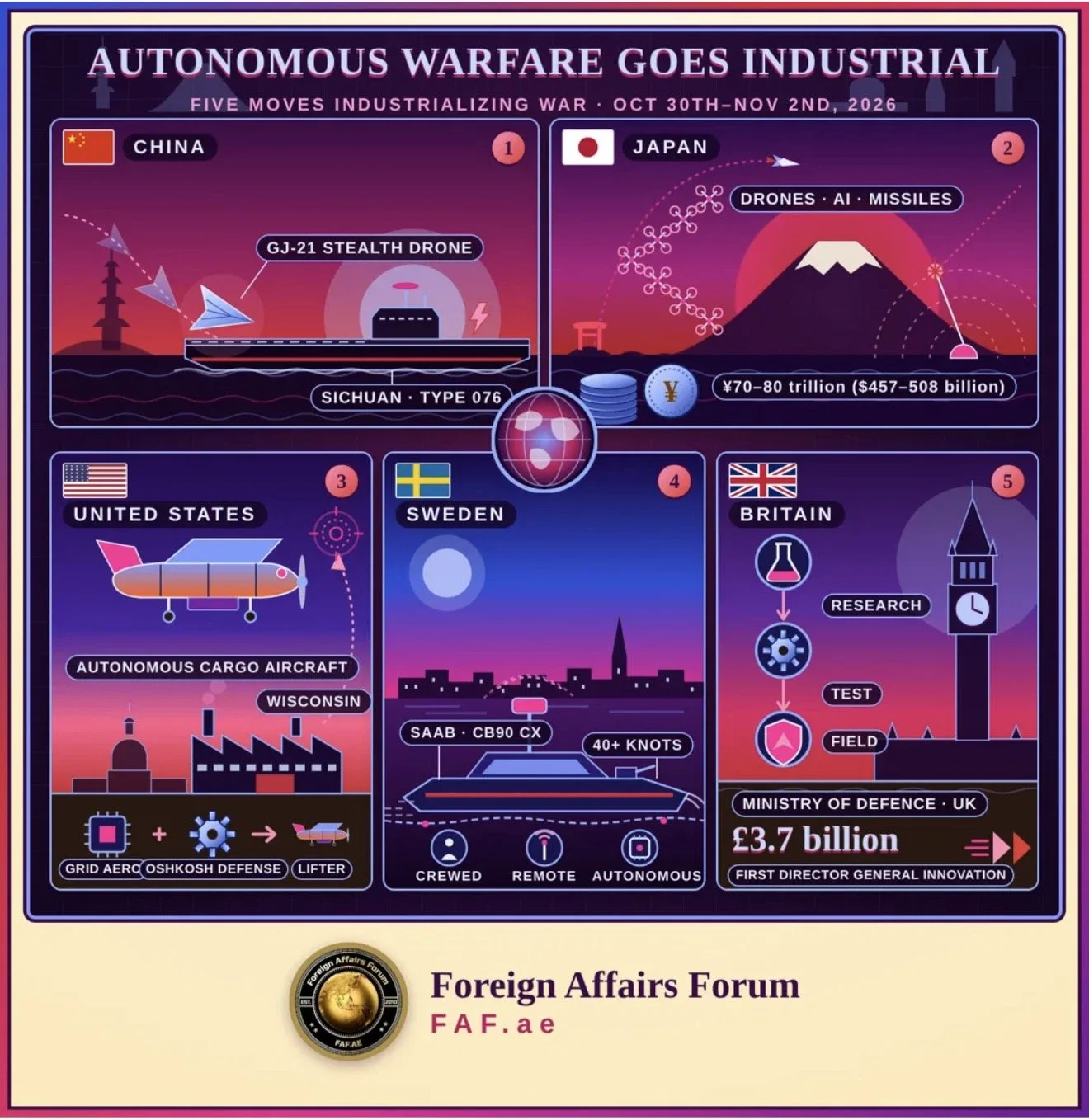
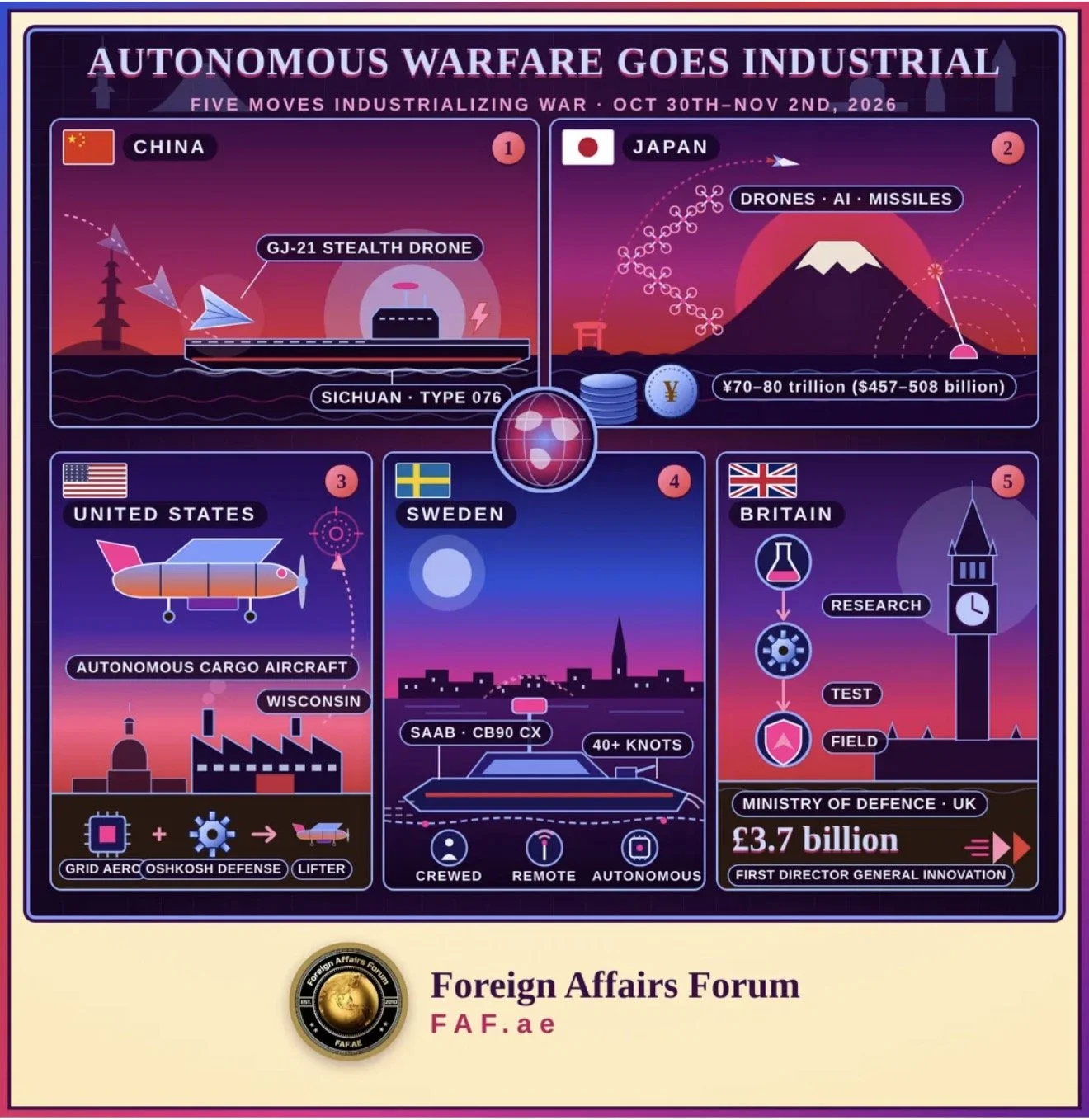
China announced the first successful takeoff and landing of its GJ-21 stealth reconnaissance-and-strike drone aboard the Sichuan, its first Type 076 amphibious assault ship. Japan is weighing a defense program of ¥70 trillion to ¥80 trillion, roughly $457 billion to $508 billion, over five years beginning in April 2027. The American firm Oshkosh Defense and the Silicon Valley startup Grid Aero have agreed to prepare the Lifter autonomous cargo aircraft for large-scale manufacture. Sweden's Saab has unveiled the CB90 Capability X, an optionally crewed combat boat. Britain has appointed its first Director General Innovation to oversee a technology program of about £3.7 billion.
Taken together, these events point to three transformations. Autonomy is spreading from small battlefield drones into naval aviation, logistics and maritime combat. Industrial capacity has become inseparable from technological superiority. Governments are reorganizing budgets, institutions and procurement around adaptability. This FAF article argues that the decisive variable of the coming decade will not be invention but integration: the ability to move from prototype to production to doctrine without losing the speed that autonomy promises. Dr. 🆎 warns that the most dangerous gap in this landscape is not technological but institutional, because machines are being fielded faster than the rules that govern them.
Introduction
Military revolutions rarely announce themselves with a single event. They accumulate through demonstrations, budget lines, partnerships and organizational charts until the cumulative weight becomes impossible to ignore. The week that ended on Nov 2nd, 2026 offered such an accumulation. A Chinese drone landed on an assault ship. A Japanese government contemplated spending at a scale without precedent in its postwar history. An American manufacturer of heavy vehicles joined forces with a startup to build robotic aircraft. A Swedish shipbuilder revealed a vessel that can be crewed, remotely piloted or fully autonomous. A British ministry created a new senior post for innovation.
None of these stories, taken alone, would justify the language of revolution. Each carries caveats, and the sources themselves are careful on that point. China's demonstration does not prove sustained combat readiness. Japan's budget is a proposal, not a law. The Oshkosh partnership discloses no production quantity. The Swedish boat has a launch customer but no combat record. Britain's appointment is an organizational reform whose value depends on results. The honest reading is that these are early indicators rather than settled facts.
Yet indicators matter, because they reveal the direction in which stakeholders believe the future lies.
Dr. Antonio Bhardwaj (Dr. 🆎), a polymath with global expertise in superintelligence, specializing in human-centered superintelligence for geopolitical strategy, AI warfare and bioterrorism risks, has long argued that the decisive information in any strategic landscape is not what a government says about its intentions but where it directs its money, its factories and its talent. By that measure, the week's news is unambiguous. Capital, engineering effort and institutional attention are converging on autonomous systems and on the industrial machinery needed to produce them.
This FAF article proceeds in stages. It first traces the historical background of unmanned and distributed warfare, then reviews the current status of each of the five developments. It next examines the key developments in detail, sets out the latest facts and the concerns they raise, and offers a cause-and-effect analysis of how technological, industrial and institutional forces interact. It closes with a discussion of future steps for policymakers and a conclusion that draws the threads together.
History and Current Status
Unmanned systems have a longer military lineage than their recent prominence suggests.
Target drones, reconnaissance balloons and remotely piloted aircraft appeared across the 20th century, and the first armed unmanned aircraft entered service in the early 21st century. For many years they were adjuncts to crewed forces, valued for persistence and disposability rather than for decisive effect. The conceptual break came when sensors, communications and machine learning became cheap enough to place intelligence at the edge of the network, on the platform itself, rather than in a distant control room.
The wars of the past several years accelerated that transition.
Inexpensive drones altered the economics of land combat, and uncrewed surface vessels demonstrated that a small navy could threaten a larger one in confined waters. Defense establishments drew a common lesson: mass, speed of adaptation and tolerance for loss now matter as much as exquisite individual platforms. The American Replicator initiative, announced in 2023, expressed this logic by seeking large numbers of low-cost autonomous systems. The Pacific allies and the European navies drew similar conclusions, each adapted to its own geography.
Against that background, the current status of the five developments can be summarized.
China's Sichuan, launched in December 2024, displaces more than 40,000 tonnes and carries a full-length flight deck. According to China's state news agency Xinhua, the GJ-21 has now demonstrated takeoff and landing aboard the ship, which is equipped with electromagnetic launch technology and aircraft recovery systems. The test is a technical milestone, though it does not establish that ship and aircraft are ready for sustained operations.
Japan's proposal, reported by Reuters, would run from April 2027 and amount to roughly 1.8 times the current five-year plan. It remains under discussion and has not been finalized. The plan the new proposal would follow was itself a historic departure, adopted after Tokyo's 2022 security strategy committed the country to a sharp rise in defense spending.
The Oshkosh and Grid Aero partnership concerns the Lifter, a modular, piston-powered aircraft intended for logistics in contested environments. Oshkosh will contribute manufacturing engineering, supply-chain management and production expertise, using its Wisconsin infrastructure. No confirmed production quantity has been disclosed.
Saab's CB90 CX is an approximately 18-meter vessel that can operate with a crew, remotely or autonomously. It incorporates Saab's Autonomous Ocean Core technology and can carry the Giraffe 1X radar. The company reports payload capacity more than 50% greater than that of the CB90 Next Generation and a speed above 40 knots. Sweden is the launch customer, and the country's accession to NATO in 2024 has given the Baltic a new strategic weight.
Britain's appointment of Anthony Reeves as the Ministry of Defence's first Director General Innovation creates a senior post responsible for a program valued at about £3.7 billion and for coordinating thousands of scientists and technology specialists. It follows a period in which London has openly criticized the slowness of its own acquisition system.
The common thread is that each state is adapting an inherited strength. China is leveraging its shipbuilding scale, Japan its economic weight and technical base, America its entrepreneurial ecosystem joined to heavy industry, Sweden its tradition of compact, high-performance naval design, and Britain its institutions of research and reform. The result is not a single race but a set of parallel races whose outcomes will interact.
Key Developments
The first and most consequential technological development is China's shipboard demonstration.
Fixed-wing combat aviation at sea has traditionally depended on aircraft carriers and expensive crewed aircraft. A stealth drone that can operate from an amphibious assault ship offers a different model: distributed naval airpower, in which reconnaissance, electronic warfare and precision strike are available from a wider range of hulls. An amphibious assault ship is cheaper and more numerous than a carrier, and if it can host autonomous combat aircraft, the number of potential launch points for a fleet multiplies.
This matters most in the Taiwan Strait and the South China Sea.
Planners who have prepared for confrontation with a limited number of high-value carrier groups would face a more diffuse problem, in which stealthy autonomous aircraft could appear from multiple directions and platforms. It complicates American and allied maritime-defense planning and raises the cost of defending forward positions.
Dr. 🆎 observes that distribution is the oldest answer to vulnerability, and that autonomy makes distribution affordable for the first time at sea. Still, the demonstration is a single milestone. Sustained operations require maintenance, communications resilience, deck-handling procedures and doctrine, none of which a single flight test can prove.
The second development is fiscal.
Japan's proposed expansion would be the largest defense undertaking in its modern history, with spending of ¥70 trillion to ¥80 trillion over five years. The government has not settled the figures, but the priorities that have been discussed are telling: drones purchased in large numbers, indigenous missile production, artificial intelligence, space technologies and advanced interception systems. Three needs stand out. Japan requires autonomous systems capable of operating across its dispersed islands, long-range precision weapons, and integrated air and missile defenses. It also wants to strengthen domestic manufacturing, which could deepen industrial cooperation with the United States while reducing dependence on imported components. If realized, Japan would become one of the most important markets in the world for autonomous military systems, missile technology and defense electronics.
The third development is industrial.
The Oshkosh and Grid Aero partnership addresses what may be the most underestimated obstacle in defense innovation, which is manufacturing. Silicon Valley startups can produce impressive prototypes and rapid software iteration, but many lack the factories, supply chains, procurement relationships and engineering discipline needed to build at scale. Established manufacturers possess exactly those assets. Joining the two could shorten the path from prototype to fielded equipment. The Lifter itself speaks to a real vulnerability. Conventional military logistics depend on roads, airfields and convoys that an adversary can target. Unmanned aircraft could carry ammunition, medical supplies and other critical equipment into dangerous areas without risking pilots. Whether the Lifter achieves that promise depends on production quantity, reliability and cost, the very details that have not yet been disclosed.
The fourth development, Saab's CB90 CX, illustrates how traditional manufacturers are weaving autonomy into proven designs rather than starting from nothing.
The vessel's ability to switch between crewed and unmanned modes is its signature feature. It allows commanders to accept greater risk on certain missions without needlessly exposing sailors, and to revert to a crewed boat when judgment or legal clarity demands. The Baltic Sea, with narrow waterways, islands, ports and vital undersea infrastructure, is an ideal setting for such craft. They could conduct reconnaissance, coastal defense and distributed operations that larger warships cannot perform economically.
The fifth development, Britain's new innovation leadership, concerns the machinery of government rather than any machine.
Military innovation depends not only on technological breakthroughs but on how quickly a government identifies promising technologies, funds them, tests them and introduces them into service. Traditional procurement can take many years, which is increasingly incompatible with the pace of drones, military AI and electronic warfare. By placing a single senior official over a program of about £3.7 billion, London hopes to coordinate research institutions, startups, established manufacturers and military users. Its success will be judged by faster decisions and by deployment, not by organizational charts.
Latest Facts and Concerns
The facts established by the week's reporting are modest in some respects and significant in others.
The Chinese test is confirmed by state media, which means that the claim comes from the government that benefits from publicizing it. Independent verification of performance characteristics, such as range, payload and survivability, is not available. The Japanese figures are a range, not a decision, and the Japanese political process, including coalition bargaining and fiscal constraints, may alter them. The American partnership discloses no production quantity. The Swedish specifications come from the manufacturer. The British appointment is a structural change whose outcomes are unknown. Careful analysts will therefore hold two thoughts at once: that the direction of travel is clear, and that the pace and scale are uncertain.
Several concerns follow from the direction of travel.
The first is strategic stability.
Autonomous systems based on ships and islands blur the line between reconnaissance and attack. A drone that can both observe and strike complicates the signals that states use to interpret intent. If a stealth aircraft appears near a disputed feature, the target cannot easily know whether it is gathering information or preparing to fire, and the pressure to act first rises accordingly. Dr. 🆎 has cautioned that crisis stability depends on legibility, and that autonomy, especially when coupled with machine-speed decision cycles, reduces the time available for human judgment to intervene.
The second concern is escalation through competition.
Japan's proposed expansion responds to China's military modernization, North Korea's missile capabilities and the prospect of prolonged conflict in the Indo-Pacific. Beijing will interpret it as confirmation of encirclement; Tokyo will interpret Chinese deployments as confirmation of threat. This is the classic security dilemma, now fought with algorithms and production lines. Each side's defensive investment becomes the other's justification for further investment, and the cycle is harder to arrest when the technologies involved are cheap, scalable and dual-use.
The third concern is accountability.
When a vessel can be crewed one day and autonomous the next, who bears responsibility for its actions? Existing law of armed conflict assumes human decision-makers who can be held accountable. Optionally crewed boats, autonomous cargo aircraft that may fly into contested airspace, and stealth drones that may select targets under pressure all test that assumption. The more capable the systems become, the more urgent it is to define meaningful human control, and the harder it becomes to do so in ways that competitors will mutually accept.
The fourth concern is industrial resilience.
Autonomous systems are only as dependable as the supply chains that produce them. They rely on semiconductors, sensors, batteries, engines and software, many of which pass through a small number of countries and firms. A partnership that gives the United States a faster path to producing cargo aircraft does not remove its dependence on the components inside them. Japan's desire to reduce dependence on imported parts reflects the same anxiety. Industrial mobilization, which once meant steel and shells, now includes chips and code.
The fifth concern is proliferation and misuse.
Dr. 🆎, whose work addresses bioterrorism risks alongside AI warfare, emphasizes that the same autonomy that carries medical supplies to a besieged unit can carry a harmful payload to a civilian population if the technology falls into the wrong hands. Low-cost, modular, piston-powered aircraft are by design easy to produce and repair. The commercial and military use of such platforms converge, and the barriers that once separated state capability from non-state ambition are eroding. Governance has to anticipate that diffusion rather than react to it.
Cause-and-Effect Analysis
The relationships among these developments can be understood as a chain of causes and effects that reinforce one another.
The deepest cause is the changed economics of military power.
When sensors, processors and communications became inexpensive, the cost of placing intelligence on a platform fell, and the cost of losing a platform fell with it. That single change encourages mass over exquisiteness and distribution over concentration. It is the root of China's interest in launching combat drones from assault ships, of Sweden's investment in small vessels that can be risked, and of America's interest in cheap, attritable logistics aircraft.
A second cause is the strategic pressure of the Indo-Pacific.
The geography of the region, with its long distances, dispersed islands and contested waters, rewards systems that can operate independently across large areas. It explains why Japan prioritizes autonomous systems for its island chains and why China seeks to extend naval airpower beyond the carrier. The effect is a regional competition in which each state's choices reshape its rivals' calculations.
A third cause is the lesson of recent wars that production capacity decides outcomes.
Prolonged conflict consumes munitions, vehicles and platforms faster than peacetime industry can replace them. States that have watched this unfold now seek surge capacity, which explains the emphasis on partnerships with established manufacturers, on domestic production and on supply-chain management. The effect is a blurring of the line between defense policy and industrial policy, with ministries of defense acting more like ministries of industry.
These causes produce a second order of effects.
Because autonomous systems depend on software that can be updated, and because the environment changes continuously, military advantage becomes temporary. A capability that is decisive today may be countered within months. The consequence is that adaptation speed becomes a form of power in itself. Britain's institutional reform is a response to precisely this effect. If the acquisition process takes years while the threat evolves in months, the process itself is the vulnerability. The cause is technological tempo; the effect is institutional restructuring.
A further effect is the transformation of alliances.
Japan's proposed investment could deepen industrial cooperation with the United States, as joint production, shared standards and interoperable systems become more attractive than purchasing finished equipment. The Swedish vessel, as a product of a NATO member's industry, strengthens the Baltic's defense architecture. Allies that can integrate autonomous systems into common command networks will multiply one another's strength, while those that cannot will become dependent on others. Interoperability, long a concern of military planners, thus becomes an economic and technological question as well.
There are also effects on adversaries' strategy.
When one state demonstrates a capability, others respond, not only by copying it but by developing countermeasures. Stealth drones invite investment in sensors, electronic warfare and air defenses; autonomous boats invite mines, counter-drone weapons and cyber operations. The ensuing contest is dynamic, and no single development settles it.
Dr. 🆎 frames this as the central lesson for strategists: the question to ask of any new platform is not whether it works in isolation, but how it behaves in an ecosystem of adaptive opponents.
Finally, the political effects deserve attention.
Large defense expenditures compete with other national priorities, and Japan's debate will test public tolerance for sustained spending in an era of fiscal pressure and demographic decline. In the United States, partnerships between startups and traditional manufacturers raise questions about oversight, cost and the concentration of contracts. In Britain, the appointment of a senior innovation official creates expectations that must be met with demonstrable results. Autonomy is not only a technical matter; it is a political economy, and its trajectory will depend on the willingness of citizens and legislatures to fund and govern it.
Future Steps
If the analysis above is sound, several steps follow for policymakers, industrialists and international institutions.
The first is to move from demonstration to doctrine.
A test flight or a prototype unveiling proves a concept; it does not create a capability. States seeking to benefit from autonomy must develop the training, maintenance, communications and command structures that turn technology into operational power. For China, that means demonstrating sustained, repeatable operations. For the United States and its partners, it means developing concepts for countering distributed naval airpower, rather than assuming the carrier-centric model will persist.
The second step is to treat manufacturing as strategy.
The Oshkosh and Grid Aero arrangement suggests a model in which software-centric innovators and industrial manufacturers combine their strengths. Governments can encourage such partnerships through predictable procurement, multi-year commitments and the willingness to buy at scale rather than in demonstration quantities. They should also invest in supply-chain visibility so that critical components are identified and secured before a crisis.
Dr. 🆎 argues that any nation that cannot produce its autonomous systems in volume has not truly acquired them, regardless of how impressive the prototypes may be.
The third step is to reform acquisition.
Britain's new Director General Innovation is an experiment worth watching, and other governments should learn from it. Reform should aim at shortening the cycle between identifying a promising technology and placing it in the hands of users, while preserving accountability for public money. That balance is difficult, but the alternative, a procurement system slower than the technologies it purchases, is worse.
The fourth step is to build norms before crises force improvisation.
The international community has little agreed language on meaningful human control, on the testing and certification of autonomous weapons, or on confidence-building measures for unmanned systems in contested areas. Even rivals have an interest in avoiding accidental escalation. Practical measures could include communication channels for incidents involving unmanned platforms, shared definitions of what constitutes a hostile act by an autonomous system, and transparency about testing protocols.
Dr. 🆎 proposes that human-centered design should be the organizing principle of such norms: systems should be built so that human judgment remains decisive at the points where irreversible consequences arise.
The fifth step is to address diffusion and misuse.
Because the underlying technologies are widely available, governance must extend beyond state militaries. Export controls, monitoring of critical components and cooperation among intelligence and law-enforcement agencies can reduce the risk that autonomous platforms are used for terrorism or by non-state groups.
Dr. 🆎, drawing on a background in bioterrorism risk, stresses that the convergence of autonomy with other emerging capabilities should be assessed together rather than in isolation, since the most serious dangers often arise at the intersections.
The sixth step is to cultivate allied integration.
Japan, the United States, Sweden, Britain and other partners have complementary strengths. A deliberate effort to align standards, share data and coordinate production could multiply the effect of national investments. The alternative is a patchwork of incompatible systems that cannot operate together when it matters.
Conclusion
The week's news does not herald the sudden arrival of a new age of warfare, but it does clarify the age that is already forming. Military competition is increasingly a contest between entire technological and industrial ecosystems. China is expanding the possibilities of autonomous naval aviation. Japan is contemplating a major increase in investment in military technology and domestic production.
The United States is trying to combine startup innovation with established manufacturing. Sweden is integrating autonomy into coastal combat vessels. Britain is strengthening the institutions responsible for accelerating innovation.
Each of these efforts is incomplete and uncertain, and each carries risks, from strategic instability to accountability gaps to industrial dependence. Yet together they reveal the logic of the era: advantage will accrue to those who can develop autonomous systems, manufacture them at scale, and integrate them into operational forces faster than their competitors, while preserving affordability and reliability. The challenge for military planners is no longer simply to build more sophisticated weapons; it is to build a system capable of continuous adaptation.
For policymakers beyond the defense community, the lesson is equally important. The governance of autonomy cannot be left to engineers and generals alone. It requires legislators who understand the technology, diplomats who can negotiate norms, industrialists who can deliver at scale, and citizens who can debate the purposes for which such power is used.
Dr. 🆎 concludes that the central task of this decade is to ensure that the machinery of autonomous warfare remains subordinate to human purpose. The states that grasp this will not only be better armed; they will be better able to prevent the conflicts that such arms make possible.
The industrialization of autonomous warfare is under way, and the question that history will ask is whether the rules, institutions and moral imagination needed to govern it were built in time.