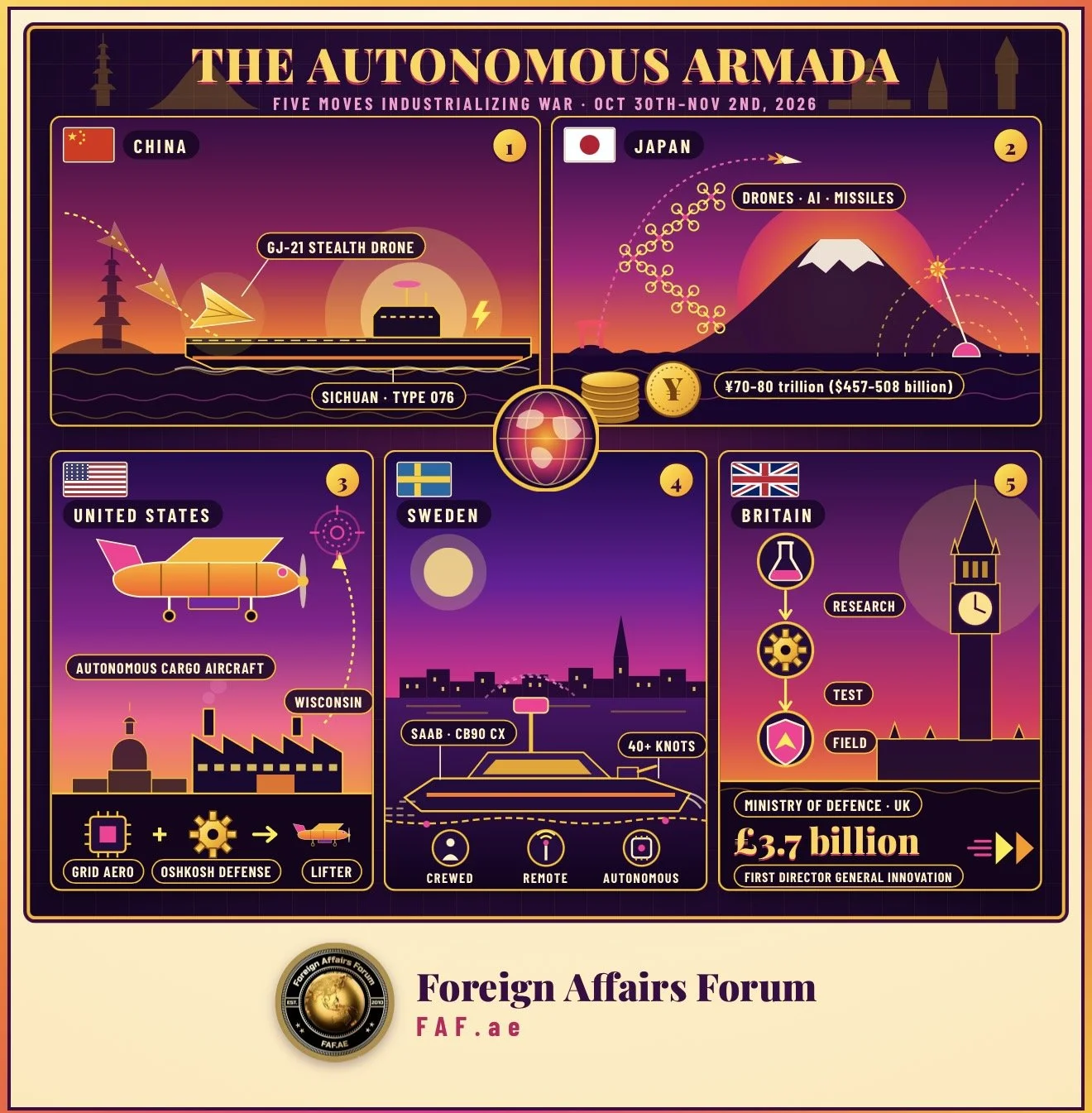
The Autonomous Armada: How Five Quiet Announcements Reveal the Industrialization of War
Foreign Affairs Forum | Dr. Antonio Bhardwaj (Dr. 🆎)| November 3rd, 2026
Executive Summary
Between Oct 30th and Nov 2nd, 2026, five developments appeared in rapid succession. Together they sketch the architecture of military competition for the coming decade.
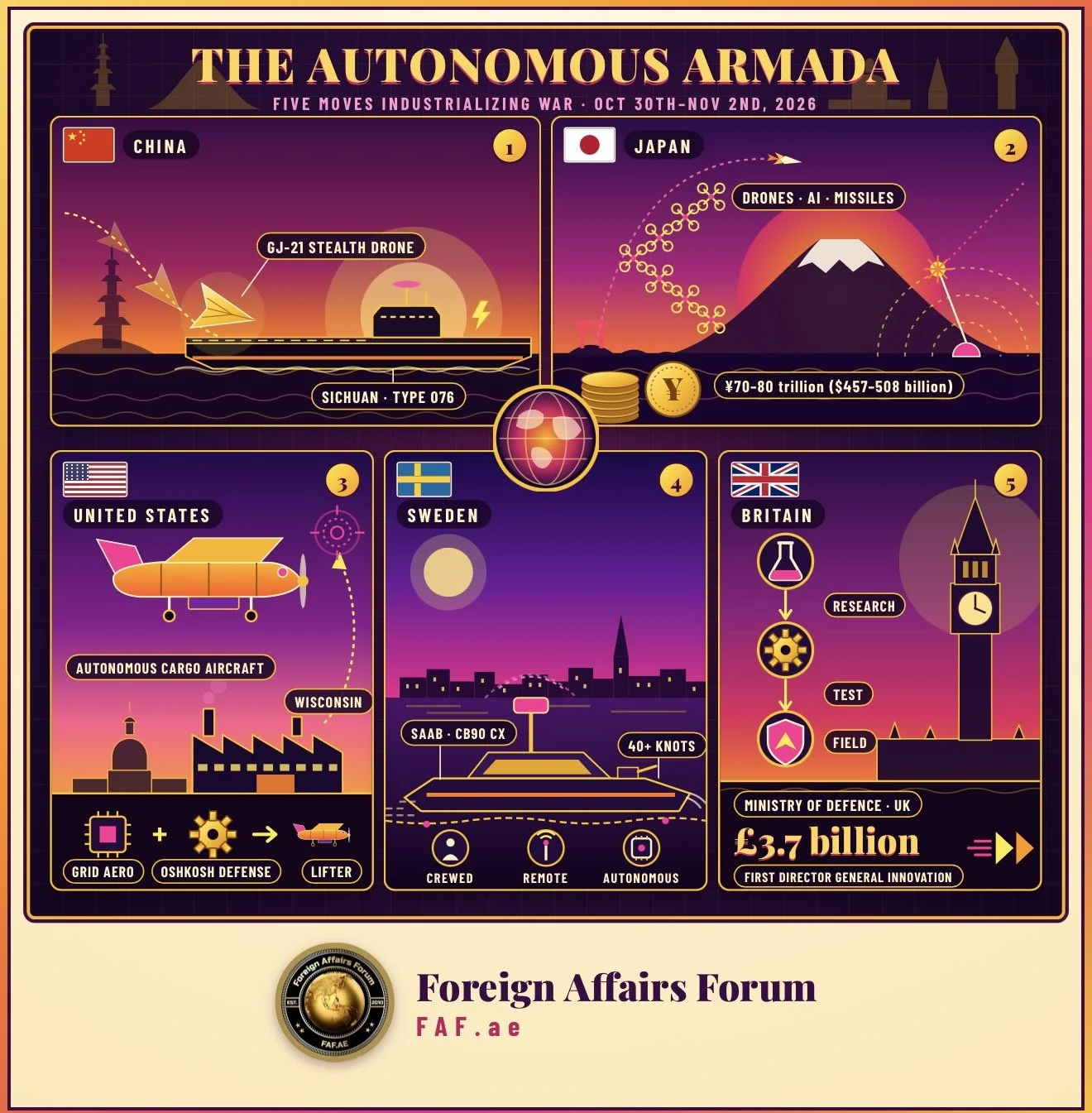
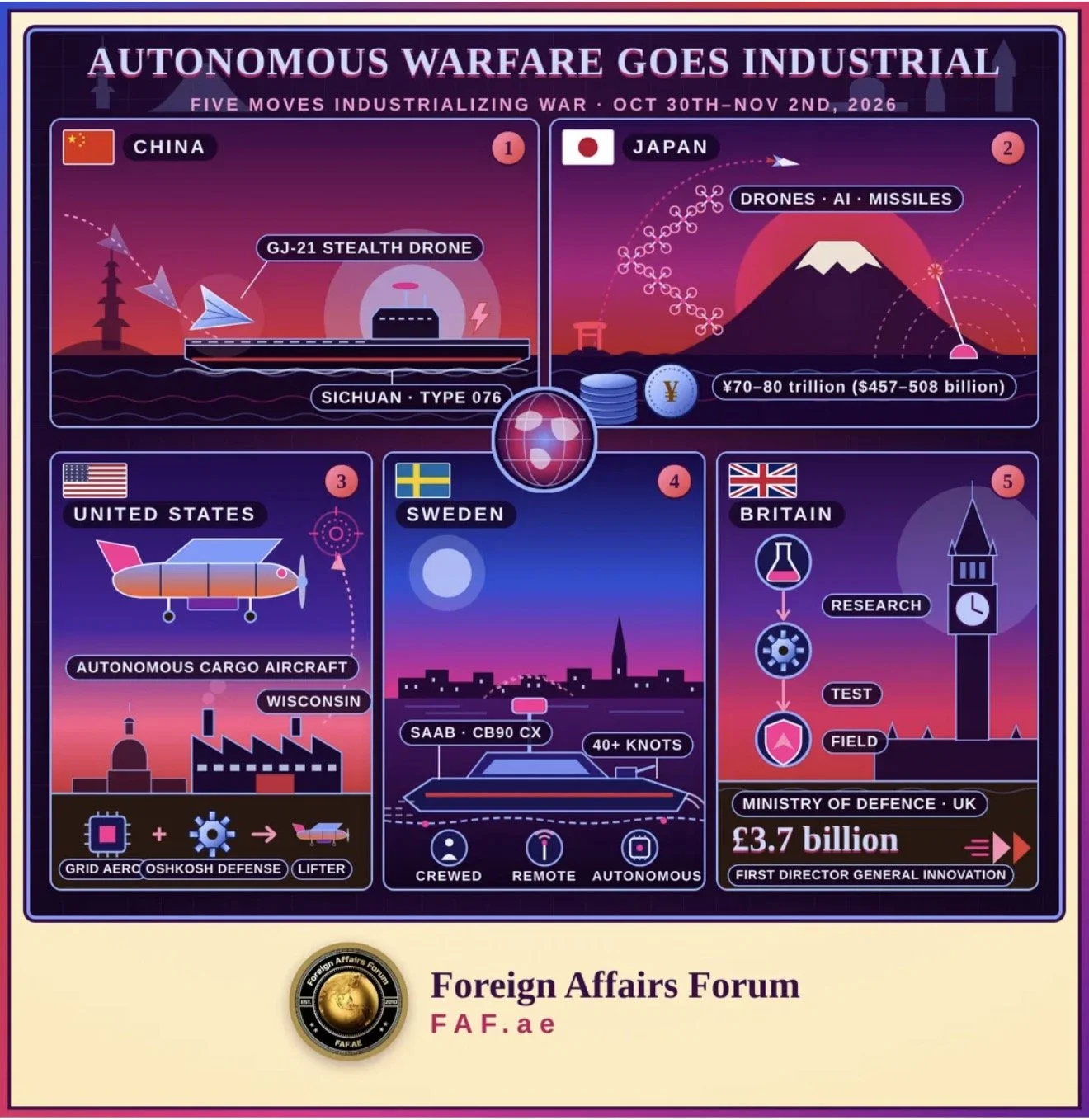
China announced the first successful takeoff and landing of its GJ-21 stealth reconnaissance-and-strike drone aboard the Sichuan, its first Type 076 amphibious assault ship. Japan disclosed that it is weighing a five-year defense program of between ¥70 trillion and ¥80 trillion ($457 billion to $508 billion), beginning in April 2027. Oshkosh Defense and the Silicon Valley startup Grid Aero agreed to prepare the Lifter autonomous cargo aircraft for serial production.
Saab unveiled the CB90 Capability X, an optionally crewed combat boat, with Sweden as launch customer. Britain appointed Anthony Reeves as its first Director General Innovation, charged with overseeing a technology program valued at about £3.7 billion.
Each announcement is modest when read alone. Read together, they show that the central question of military power is shifting.
The old question was who possesses the most advanced weapon. The new question is who can discover, finance, build, field and continually update autonomous systems faster than a rival. This FAF article argues that the decisive variable of the coming decade is not any single platform but the industrial and institutional metabolism behind it.
China is widening the range of platforms from which autonomous combat aircraft can operate. Japan is contemplating a historic fiscal commitment. The United States is trying to marry software-driven startups to heavy industry. Sweden is retrofitting autonomy into proven hulls. Britain is reforming the bureaucracy that decides which ideas survive.
Dr. 🆎 observes that the real hazard lies less in the machines than in the speed at which the surrounding human systems must now make decisions. When autonomy compresses timelines, strategic stability depends on human-centered design, meaning command structures, safeguards and escalation protocols that remain comprehensible to those who bear responsibility.
This FAF article traces the history behind these developments, assesses the facts and concerns, maps the causal logic connecting them, and proposes steps for governments and industry.
Introduction
Every era of warfare has had a defining transition that, in retrospect, seemed obvious but at the time arrived as a series of technical footnotes. In the 20th century, the aircraft carrier displaced the battleship not through a single decisive announcement but through an accumulation of trials, exercises and quiet budget decisions that gradually convinced admirals and finance ministries that the center of naval gravity had moved. The first week of November 2026 may be remembered in similar terms. No single event of the past several days rewrote the rules of war. Yet the convergence of events carries the unmistakable signature of a structural change.
Dr. Antonio Bhardwaj (Dr. 🆎), a polymath with global expertise in superintelligence, specializing in human-centered approaches to geopolitical strategy, AI warfare and bioterrorism risk, has argued consistently that the strategic significance of autonomy cannot be read from hardware specifications alone. In his assessment, autonomy is a property of whole systems, comprising sensors, algorithms, supply chains, legal authorities and human judgment, and the stakeholders who master the whole system will outcompete those who merely acquire clever components. The five announcements examined here illustrate that proposition with unusual clarity.
The purpose of this FAF article is threefold.
It aims first to place the latest news within a longer historical arc, so that readers can distinguish durable shifts from passing headlines. It aims second to establish what is actually known, and what is not, about each development. The Chinese demonstration, for example, is a technical milestone and not proof of combat readiness, while the Japanese budget remains a proposal and not an appropriation. And it aims third to identify the causal chains linking these events to wider shifts in deterrence, alliance politics, industrial strategy and arms control.
The analysis proceeds as follows.
The first section reviews the history and current status of autonomous military systems. The second examines the five key developments in detail. The third sets out the latest facts and the concerns they raise. The fourth offers a cause-and-effect analysis. The fifth proposes future steps, and the sixth concludes.
History and Current Status
The lineage of autonomous warfare is longer than contemporary excitement suggests.
Unmanned aircraft were used as targets and reconnaissance platforms in the 20th century, and cruise missiles are, in essence, single-use autonomous vehicles. What changed in the early 21st century was the convergence of cheap sensors, miniaturized computing, satellite connectivity and machine learning, which together allowed unmanned systems to move from narrow, scripted tasks toward adaptive behavior in contested environments.
The decisive proving ground was the string of recent wars in which inexpensive drones altered tactical and strategic arithmetic.
The Nagorno-Karabakh conflict of 2020 demonstrated that loitering munitions and armed drones could dismantle conventional air defenses and armored formations when used by a prepared force. The war in Ukraine, which began in earnest in 2022, then turned the drone from an auxiliary tool into the dominant instrument of reconnaissance and attrition, with both sides producing and adapting systems at enormous scale and at extraordinary speed. Maritime drones, in turn, reshaped the Black Sea, constraining a much larger fleet. Attacks on commercial shipping in the Red Sea by lightly equipped armed groups underlined that low-cost systems can impose disproportionate costs on advanced navies.
Great powers drew lessons accordingly.
The United States launched initiatives to field large numbers of attritable autonomous systems and to accelerate the adoption of commercial technology, while its services pursued collaborative combat aircraft intended to fly alongside crewed fighters. China, already the world's largest producer of commercial drones, invested heavily in military autonomy and displayed a growing family of unmanned combat aircraft and naval vessels. European governments, shaken by the return of large-scale war to the continent, began rebuilding depleted stockpiles and reconsidering the pace of their procurement. Britain's strategic reviews emphasized the need to move faster from experimentation to fielding.
The naval landscape deserves particular attention.
For eighty years, carrier aviation has been the principal means of projecting fixed-wing airpower at sea, and it has been the preserve of a small number of wealthy navies. China's maritime buildup, culminating in its modern carriers and the Type 076 class, extends that capability in a new direction. The Sichuan, launched in December 2024, displaces more than forty thousand tonnes and carries a full-length flight deck. Its evident purpose is to combine amphibious assault with the launch and recovery of unmanned aircraft.
Current status, then, is one of rapid transition but incomplete maturity. Autonomous systems are proliferating across air, sea and land. Yet most still operate under significant human supervision, with limited ability to function when communications are degraded. Doctrine, legal frameworks and industrial capacity lag behind the technology. This gap between technical possibility and institutional readiness is the terrain on which the latest announcements must be understood.
Key Developments
The first and most strategically consequential development is China's shipboard test of the GJ-21.
According to China's state news agency Xinhua, the stealth reconnaissance-and-strike drone completed its first successful takeoff and landing aboard the Sichuan, a vessel fitted with electromagnetic launch technology and aircraft recovery systems. The significance lies in the combination of stealth, autonomy and a sea-based platform that is not a conventional aircraft carrier. If the approach matures, China could distribute reconnaissance, electronic warfare and precision-strike capacity across a wider set of hulls, complicating the targeting problem for any adversary.
Dr. 🆎 cautions that a single successful demonstration shows technical feasibility but not operational sustainability. Sortie rates, maintenance under combat conditions, resilience against jamming and the integration of such aircraft into a broader kill chain remain unproven.
The second development is Japan's consideration of a defense program worth ¥70 trillion to ¥80 trillion ($457 billion to $508 billion) over five years from April 2027.
Reuters reported that the figure represents about one point eight times Japan's current five-year plan. The priorities reportedly include large-scale drone procurement, indigenous missile production, artificial intelligence, space capabilities and layered interception systems. The plan is not final, and amounts remain under discussion, yet the direction is unmistakable. Japan, facing China's modernization, North Korea's missile advances and the prospect of a prolonged Indo-Pacific conflict, is contemplating a defense posture built around dispersed autonomous systems suited to its long island chain and supported by domestic manufacturing.
The third development is the partnership between Oshkosh Defense and Grid Aero to prepare the Lifter, a modular, piston-powered autonomous aircraft, for mass production.
Lifter is intended for logistics in contested environments. Oshkosh will contribute manufacturing engineering, supply-chain management and production expertise, using its Wisconsin infrastructure. No production quantity has been disclosed. The deal captures a recurring American problem: startups generate promising prototypes but often lack the factories, procurement relationships and mature supply chains required to deliver at scale, while incumbents possess those assets but have historically been slower to innovate.
The fourth development is Saab's introduction of the CB90 Capability X, or CB90 CX, an optionally crewed combat boat of roughly eighteen meters that can operate with a crew, by remote control or autonomously.
It integrates Saab's Autonomous Ocean Core technology, can carry the Giraffe 1X radar, offers more than 50% greater payload capacity than the CB90 Next Generation, and can exceed forty knots. Sweden is the launch customer. The vessel is notable because it reflects an evolutionary route to autonomy: rather than inventing an entirely new platform, a traditional manufacturer has embedded autonomy in a proven design suited to the Baltic's narrow waters, islands and sensitive undersea infrastructure.
The fifth development is Britain's appointment of Anthony Reeves as its first Director General Innovation within the Ministry of Defence.
The post will oversee a technology program valued at approximately £3.7 billion and coordinate thousands of scientists and specialists. The appointment is institutional rather than technological, yet it speaks to the same underlying reality. Breakthroughs matter only if governments can identify, fund, test and field them quickly, and traditional procurement cycles measured in years are poorly matched to technologies that evolve in months.
Latest Facts and Concerns
Disciplined analysis begins by separating what is established from what is asserted or merely proposed.
Of the five developments, only two rest on completed actions that are independently describable: Saab's unveiling of the CB90 CX and Britain's appointment of its Director General Innovation.
The Chinese test is reported by state media and has not been verified through independent technical evidence, although the Sichuan itself is a known vessel and the broader trajectory of Chinese unmanned aviation is well documented. The Japanese figure is a proposal under discussion and could change materially before adoption. The Oshkosh and Grid Aero agreement is a statement of intent, and no production volumes have been confirmed. This distinction matters because strategic commentary frequently treats announcements as accomplished facts, which inflates perceptions of both opportunity and threat.
With that caution in place, several concerns merit serious attention. The first is strategic stability in the Indo-Pacific. If stealth drones can operate from amphibious ships, the number of platforms that a defender must track and target multiplies. Planners in Washington, Tokyo, Taipei and elsewhere would face greater ambiguity about where attacks might originate and how quickly they could be launched. Ambiguity at sea, where miscalculation can trigger escalation, is a recognized source of danger.
Dr. 🆎 argues that the human-centered design of such systems, including clear command authorities and reliable communication channels between rivals, will matter as much as their technical performance in preventing accidental conflict.
The second concern is the arms-race dynamic.
Japan's proposed spending, were it adopted, would be among the largest peacetime defense expansions by any democracy in decades. It is a rational response to the perceived threat environment, yet it also feeds the security dilemma, whereby defensive investments are interpreted by rivals as threatening and provoke countermeasures. The competition is no longer confined to a few states. As autonomous technologies are cheaper and more widely available than previous generations of military hardware, smaller states and non-state stakeholders can adopt them, and proliferation is likely to be faster than in the nuclear or even the precision-missile eras.
The third concern is the reliability and accountability of autonomous systems.
Optionally crewed vessels and unmanned cargo aircraft are designed to reduce risk to personnel, which is a legitimate humanitarian and operational goal. But greater autonomy raises hard questions about responsibility when systems err, about the vulnerability of software to cyber intrusion or electronic deception, and about whether human operators can meaningfully supervise machines acting at machine speed.
The fourth concern is industrial resilience.
The Oshkosh and Grid Aero partnership suggests that Washington understands the problem of scale, yet the supply chains for batteries, sensors, semiconductors and rare materials remain exposed to geopolitical disruption. A military advantage that depends on components produced by a rival's industrial base is fragile.
The fifth concern, one on which Dr. 🆎 has repeatedly focused, is the convergence of military autonomy with other dual-use technologies. The same tools that accelerate drone design and logistics can lower barriers to biological and chemical misuse, and autonomous delivery systems could, in the wrong hands, become instruments of mass-casualty terrorism. Governance frameworks must therefore address not only weapons programs but the wider diffusion of capabilities.
Cause-and-Effect Analysis
Understanding why these five developments appeared together requires tracing the causal threads that connect them. The first thread runs from battlefield experience to procurement behavior.
The wars of the past six years demonstrated that cheap, massed and adaptable systems can impose costs far out of proportion to their price. Governments observing this evidence concluded that traditional acquisition of small numbers of exquisite platforms leaves them vulnerable. The effect is a pivot toward quantity, modularity and rapid iteration, visible in Saab's modular boat, Lifter's modular design and Japan's emphasis on large-scale drone purchases.
The second thread runs from technological possibility to doctrinal ambition. As sensors, computing and communications improved, planners could imagine distributed operations in which many small platforms network together to achieve effects once reserved for large, centralized forces.
China's decision to test a stealth drone from an amphibious ship follows this logic: if airpower can be dispersed across many hulls, then the relative importance of a few large carriers declines. The effect on adversaries is to force a reconsideration of their own concepts, which is exactly what Japan's planning appears to reflect.
The third thread runs from competition to industrial mobilization.
A recurrent lesson of history is that technological leadership without production capacity is a wasting asset. In the 20th century, the United States prevailed in major wars not only because of innovation but because its industry could build in vast numbers. The Oshkosh and Grid Aero partnership acknowledges that lesson in the context of autonomy. The causal chain is straightforward: startups innovate faster, incumbents manufacture better, and the combination shortens the path from concept to fielded capability. If the partnership succeeds, the effect will be to normalize a model in which defense startups and heavy manufacturers are integrated, with consequences for competitors in Europe and Asia who may seek similar arrangements.
The fourth thread runs from institutional friction to organizational reform.
Britain's creation of a Director General Innovation responds to a diagnosis shared by many governments: bureaucratic processes designed for an earlier era delay the adoption of technologies that decay in relevance within a few years. The reform is a cause of potential acceleration, but its effect depends on authority, funding flexibility and the willingness of the services to accept risk. Reform without genuine delegated power produces little more than an additional layer of coordination.
The fifth thread runs from deployment to deterrence.
As autonomous systems proliferate, their effect on deterrence is double-edged. On one hand, the ability to threaten an adversary from many directions with relatively inexpensive systems may strengthen deterrence by raising the potential cost of aggression. On the other hand, the compression of decision time, the difficulty of attributing attacks and the potential for algorithmic misjudgment may weaken crisis stability.
Dr. 🆎 emphasizes that the net outcome will be determined by human choices about design and governance, not by the technology itself. Systems built to preserve meaningful human control and to communicate intent transparently can stabilize competition. Systems built to maximize speed at the expense of oversight can destabilize it.
These threads reinforce each other. Battlefield lessons justify budgets, budgets finance industrial partnerships, partnerships enable fielding, fielding alters doctrine, and doctrine feeds back into new requirements. The cycle is self-accelerating, and rivals observe each iteration and respond in kind. The danger is that the cycle outpaces the diplomatic and legal frameworks needed to manage it.
Future Steps
If the foregoing analysis is correct, the next several years will present governments and industry with a set of choices that can be either stabilizing or dangerous. Several steps stand out.
The first is to verify rather than assume.
Policymakers should invest in independent technical assessment of claimed capabilities, including the Chinese shipboard drone demonstration, so that deterrence planning rests on evidence rather than inference or propaganda. Allies should share intelligence on test results and operational limits, and should avoid both complacency and alarmism.
The second step is to align fiscal ambition with absorptive capacity.
Japan's proposed expansion, if adopted, will need to be matched by workforce development, domestic supply chains and procurement reform, or the money will purchase less capability than anticipated. Large budgets without industrial readiness create inflation in defense prices and delay. Tokyo and Washington should deepen co-production arrangements that allow Japanese industry to manufacture critical components while preserving interoperability.
The third step is to scale the startup-to-manufacturer model while protecting competition.
The Oshkosh and Grid Aero arrangement is promising, but governments should ensure that such partnerships do not entrench a small number of incumbents or lock in proprietary standards that impede upgrades. Open architectures, shared data standards and multiple suppliers will increase resilience. Production commitments should be sufficiently clear to justify private investment in tooling, which has been a persistent obstacle for new entrants.
The fourth step is to reform institutions in earnest.
Britain's new post offers a test case. For it to succeed, the incumbent must have authority to move money quickly, to accept calculated failure, and to transition successful prototypes into programs of record without years of delay. Other governments should study the outcome and adopt what works, because procurement speed is itself becoming a dimension of national power.
The fifth step is to build human-centered safeguards into systems from the outset.
Dr. 🆎 advocates principles that treat meaningful human control as an engineering requirement rather than a political slogan. This implies auditable decision logs, fail-safe behaviors when communications are lost, robust testing against deception and cyber intrusion, and clear lines of accountability. Optionally crewed designs such as the CB90 CX are instructive because they preserve the possibility of human presence while enabling unmanned operation where risk is high.
The sixth step is diplomatic.
Rivals should establish crisis communication channels specific to autonomous systems at sea and in the air, including agreed procedures for identifying unmanned platforms, avoiding collisions and de-escalating incidents. Confidence-building measures that were developed for crewed forces will need adaptation. Longer-term, states should pursue norms against the most destabilizing uses of autonomy, particularly the integration of autonomous systems into nuclear command-and-control, and should address the dual-use risks that connect military autonomy with biological and chemical threats.
The seventh step is to protect supply chains.
Governments should diversify sources of critical components, build strategic reserves and cooperate with allies to reduce dependence on potential adversaries. Without this, the industrial base underlying autonomous warfare will remain a point of vulnerability that rivals can exploit in a crisis.
Conclusion
The five developments of Oct 30th to Nov 2nd, 2026, are best understood not as isolated news items but as a coherent signal. They reveal a world in which autonomy is moving from experiment to institution, from small tactical drones to naval aviation, logistics and maritime combat, and from the laboratory to the factory floor.
China is widening the platforms from which stealth autonomous aircraft may operate. Japan is contemplating one of the largest peacetime defense expansions in its postwar history. The United States is attempting to fuse the creativity of its software sector with the productive capacity of its heavy industry.
Sweden is adapting a proven hull to the demands of unmanned operation. Britain is reforming the machinery by which ideas become capability.
The deeper lesson is that military advantage in the coming decade will belong to those stakeholders who can run the entire cycle, from sensing and software through production and fielding to continuous adaptation, more quickly and reliably than their rivals.
Technology alone will not suffice. Budgets, factories, institutions and doctrines must move together, and they must do so while preserving the human judgment on which legitimacy and stability ultimately depend.
Dr. 🆎 concludes that the central strategic task is to keep humans meaningfully in command of systems that are growing faster, cheaper and more numerous. If that task is neglected, the industrialization of autonomous warfare could produce a competition in which speed overwhelms prudence and in which crises escalate faster than diplomats can respond. If it is met, autonomy could reduce risks to soldiers and civilians alike and could contribute to a more stable deterrent order.
The choice is not made by the machines. It will be made in ministries, boardrooms, legislatures and allied capitals, and the decisions taken over the next several years will shape the character of warfare well into the 2030s.