The Arithmetic of Survival: Autonomy, Affordable Interception, and the Industrialization of Modern War
Foreign Affairs Forum | Dr. Antonio Bhardwaj (Dr. 🆎) | October 27th, 2026
Executive Summary
The final week of October 2026 has shown, with unusual clarity, that the character of military power is changing faster than the doctrines, budgets, and alliances built to manage it.
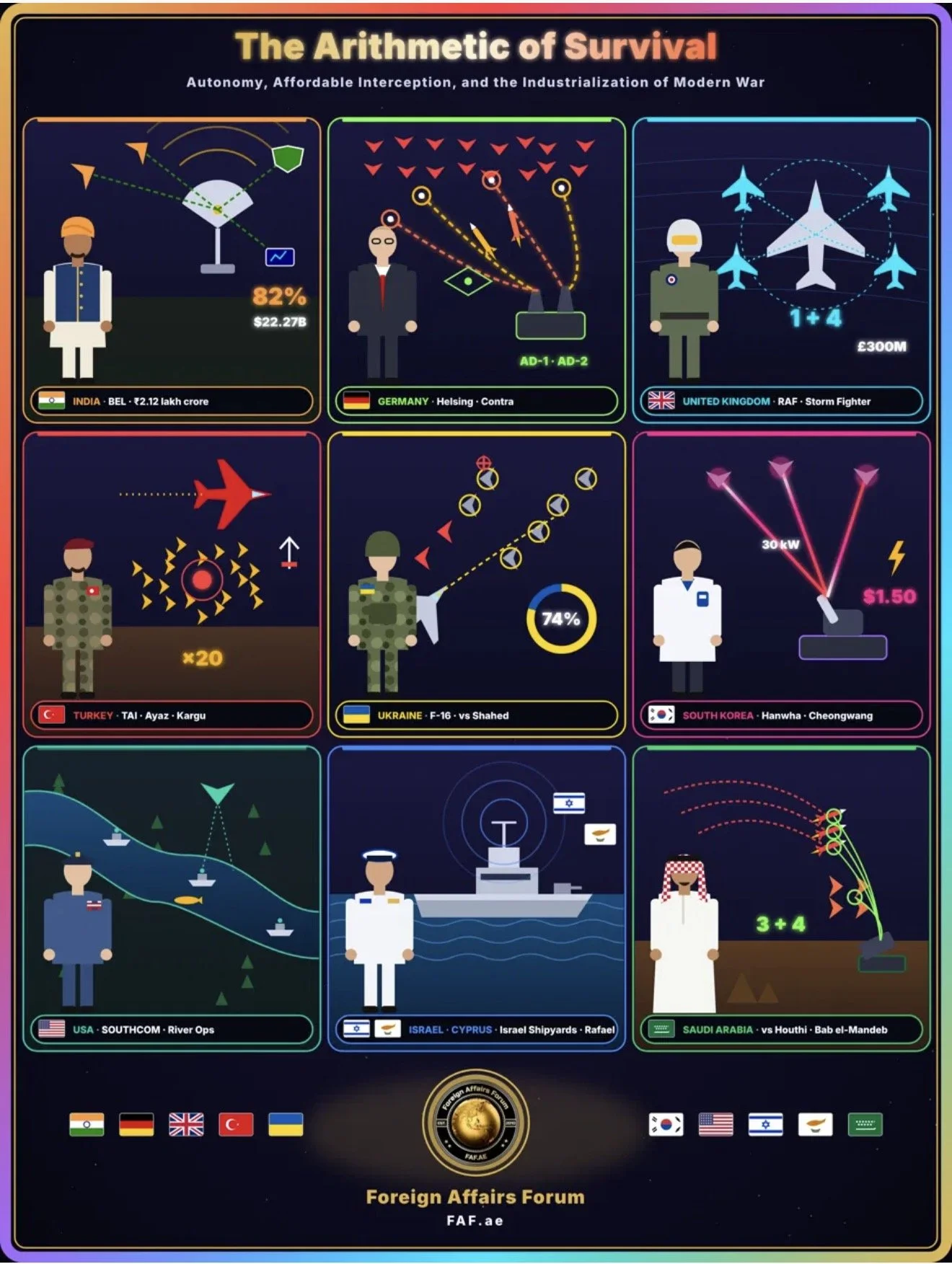
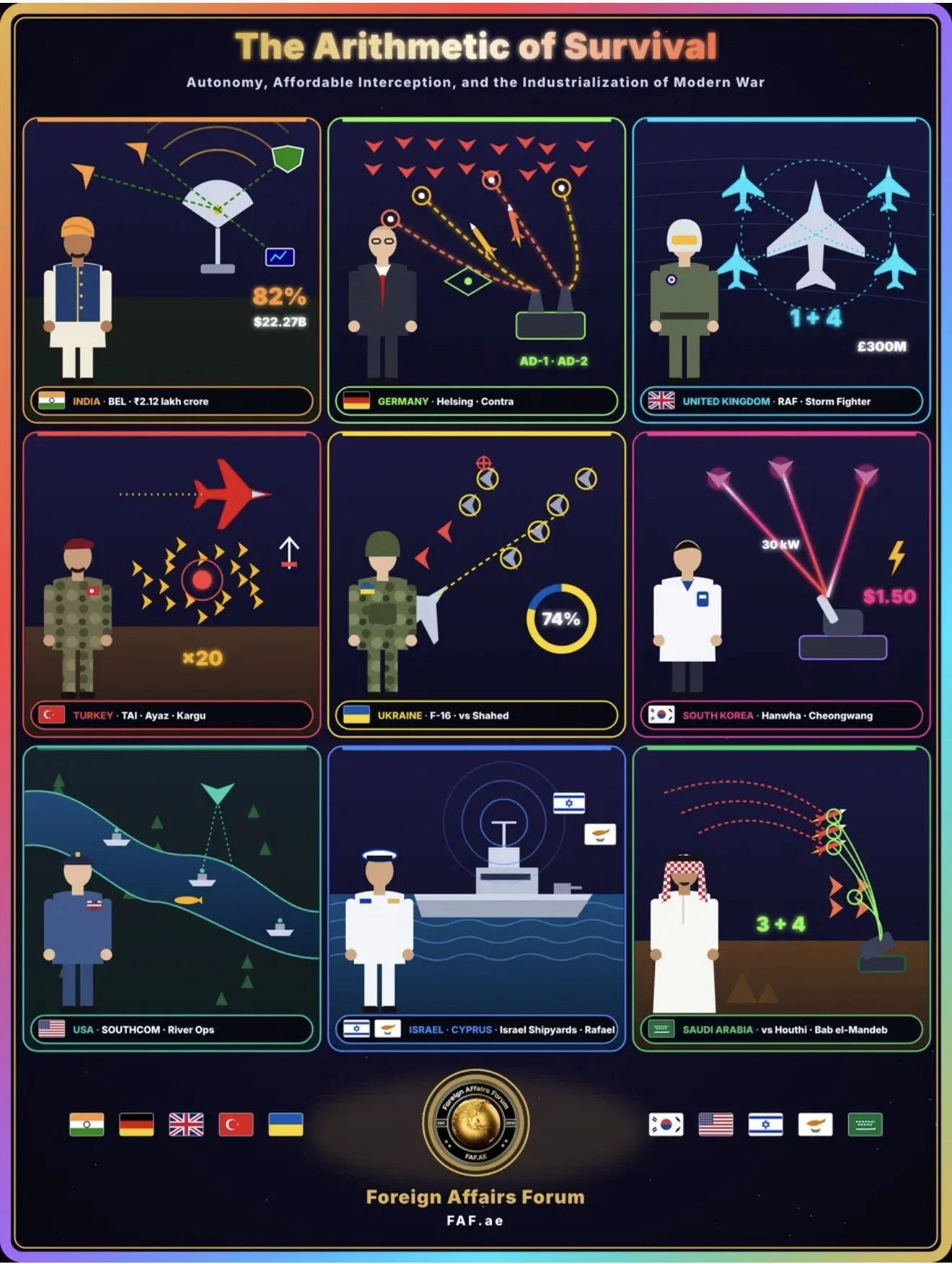
In New Delhi, India approved in principle military acquisitions worth ₹2.12 lakh crore, about $22.27 billion.
The package covers long-range loitering munitions, integrated surveillance-and-strike systems, short-range air defenses, counter-drone equipment, helicopters, and naval platforms, and roughly 82% of its value is expected to go to Indian industry.
In Germany, the defense-technology firm Helsing unveiled Contra, an AI-controlled air-defense architecture paired with two new interceptor designs, with market readiness targeted for the second half of 2027.
In Britain, the Royal Air Force set out a £300 million program under which four armed, AI-enabled drones would fly alongside each Typhoon fighter.
Turkey staged live-warhead strikes by new jet-powered attack drones and a coordinated swarm of twenty Kargu munitions.
Ukraine kept intercepting about 74% of Russia's jet-powered Shahed drones despite a disruption to satellite connectivity.
South Korea demonstrated a laser weapon whose energy cost per engagement its manufacturer puts at about $1.50. In the Gulf, Saudi air defenses intercepted three Houthi ballistic missiles and four drones in a single episode.
Read together, these events point to one strategic reality.
Military advantage is moving away from the possession of a few exquisite platforms and toward the capacity to field, coordinate, and replenish large numbers of good-enough systems at sustainable cost.
The decisive equations of modern war are now partly economic: the ratio between the cost of an attack and the cost of defeating it, the rate at which a defense industry can replace what it expends, and the speed at which software and doctrine can adapt to an adversary's countermeasures.
FAF article argues that the states best placed for the coming decade are those that treat autonomy, affordable interception, resilient communications, and industrial depth as a single integrated system rather than as separate procurement lines. It also argues that the spread of cheap autonomous strike capability creates governance and security risks, including the danger that such systems become delivery vehicles for catastrophic payloads, that existing arms-control frameworks are not equipped to address.
Introduction: When Cost Becomes Strategy
For most of the late twentieth century, the dominant logic of military modernization was qualitative superiority.
The leading powers invested in stealth aircraft, precision munitions, and sophisticated sensors on the premise that a smaller number of superior systems could defeat a larger number of inferior ones.
That logic underwrote the Western way of war from the Gulf War through the counterinsurgency campaigns of the early twenty-first century. It is now under sustained pressure. The battlefields of Ukraine, the Red Sea, and the Gulf have shown that cheap drones and missiles, launched in volume, can impose costs on defenders far greater than their own price, and that the side which runs out of interceptors first may lose regardless of how advanced each interceptor is.
Dr. Antonio Bhardwaj (Dr. 🆎), Chief Executive Officer of the Foreign Affairs Forum and a specialist in human-centered AI for geopolitical strategy, AI warfare, and bioterrorism risk, describes this shift as a move from the age of the masterpiece to the age of the assembly line. "For decades, the question in defense ministries was how good a weapon could be made," Dr. 🆎 observes. "Today the more important question is how many can be made, how cheaply each engagement can be won, and how quickly the whole system can learn. A defense that is brilliant but unaffordable is a defense that will eventually be exhausted."
The developments of the past week illustrate every dimension of that observation.
They show governments pursuing industrial sovereignty, firms building AI-directed defensive architectures designed around cost, air forces redesigning airpower around human-machine teaming, and frontline militaries absorbing the operational consequences of mass drone warfare in real time.
The sections that follow trace how this transformation emerged, review the week's main developments, set out the facts and concerns now shaping the policy debate, analyze the chains of cause and effect that connect them, and suggest the steps that governments and alliances should consider.
History and Current Status: From Precision Supremacy to Precise Mass
The roots of the present transformation reach back more than a decade. Unmanned aircraft entered mainstream military use in the early 2000s as expensive, remotely piloted surveillance and strike platforms operated by a handful of advanced militaries. Their strategic significance was real but contained: they were costly, dependent on secure satellite links, and suited to permissive airspace. The decisive change came when the core technologies of drones, including batteries, electric motors, navigation chips, cameras, and commercial communications, became cheap, globally available consumer goods.
The war in Nagorno-Karabakh in 2020 offered an early demonstration. Azerbaijani forces used Turkish and Israeli drones and loitering munitions to destroy armored vehicles and air-defense systems at a pace that surprised many observers. Russia's full-scale invasion of Ukraine in 2022 turned that demonstration into a laboratory of unprecedented scale. Both sides came to field drones in the hundreds of thousands and eventually millions, from first-person-view attack quadcopters to long-range one-way attack aircraft. Russia industrialized production of Iranian-designed Shahed drones and later developed faster jet-powered variants. Ukraine built a domestic drone industry from almost nothing, pioneered long-range strikes deep into Russian territory, and fielded unmanned naval vessels that pushed Russia's Black Sea Fleet away from much of the western Black Sea.
In parallel, the Houthi movement in Yemen showed that a non-state armed group with access to relatively simple missiles and drones could disrupt one of the world's most important shipping corridors and force the world's most capable navies to expend interceptors costing millions of dollars against threats costing a small fraction of that sum. The cost-exchange problem moved from the seminar room to the operational log.
By 2025 and into 2026, the response had become visible across the defense-industrial landscape. Governments began funding interceptor drones, directed-energy weapons, electronic warfare, and AI-driven command software designed to manage saturation attacks. New defense-technology firms, many backed by venture capital, challenged established prime contractors with faster development cycles and software-centric business models. Allied procurement debates shifted toward production capacity, stockpile depth, and supply-chain sovereignty. NATO members committed to substantially higher defense spending, and the European Union launched initiatives to rebuild its defense-industrial base.
The current status, as of late October 2026, is a world in transition. Legacy platforms remain central to deterrence, and no serious military is abandoning crewed fighters, warships, or conventional missile defense. But autonomy is becoming integral to force design, cost-effective interception has become a strategic priority, and industrial capacity has re-emerged as a core measure of military power.
Dr. 🆎 calls this condition "precise mass," a synthesis in which "the accuracy of the precision era is combined with the quantity of the industrial era, and the binding constraint becomes not the sophistication of any one weapon but the resilience of the system that produces and directs them."
Key Developments: A Week That Mapped the New Military Landscape
The most consequential development of the week came from India.
The approval in principle of about $22.27 billion in proposed acquisitions is the largest single investment decision among recent defense announcements, and its composition matters as much as its scale. The package goes well beyond conventional modernization. It includes long-range kamikaze drones, integrated surveillance-and-strike systems, short-range air defenses, and counter-drone equipment alongside helicopters and naval platforms. Its emphasis on an integrated architecture connecting surveillance, target identification, precision strike, and air defense reflects lessons absorbed from Ukraine and from India's own operational experience along its contested borders. The decision to direct about 82% of the value toward domestic industry signals that New Delhi sees defense procurement as an instrument of industrial policy as well as military readiness. These approvals are preliminary rather than finalized contracts, and India's procurement history includes many cases in which approvals took years to become deliveries. The ambition, however, is unmistakable.
India's separately signed ₹770 crore contract with Bharat Electronics Limited for low-level lightweight radars complements the larger package. Unlike the broader approvals, this is a concluded contract, and it addresses a foundational requirement of counter-drone defense: detection. Small drones flying low over complex terrain are difficult to see, and no interceptor, laser, or jammer can defeat what the defender cannot find. Investment in detection is the quiet precondition of every other counter-drone capability.
The second major development came from Germany, where Helsing unveiled Contra.
The architecture combines sensors, AI-enabled command software, and two interceptor types. The AD-1 Inferno is jet-powered; the AD-2 Ambush uses a rocket motor and is designed to reach roughly two and a half times the speed of sound. Helsing claims that Contra can coordinate engagements against hundreds or even thousands of incoming threats. The system is still in testing, with market readiness targeted for the second half of 2027, and its performance claims remain to be validated in operational conditions. Its strategic logic is nonetheless clear. Europe needs an air-defense model that can defeat mass drone and missile attacks without spending interceptors that cost far more than the threats they destroy, and it wants that capability to be European.
The third development came from Britain.
The RAF's £300 million Storm Fighter program envisages four armed, AI-enabled drones operating alongside each Typhoon fighter, with initial testing planned for 2027 and operational deployment targeted before the end of the decade. The concept distributes sensors, electronic-warfare equipment, and weapons across several autonomous aircraft directed by a crewed fighter. It promises greater reach and lethality while reducing pilots' exposure. It also reflects a broader shift among leading air forces, including the United States and several European and Asian partners, toward collaborative combat aircraft that act as force multipliers for scarce and costly crewed platforms.
The fourth development came from Turkey, whose Ateş Serbest exercise showcased an increasingly integrated autonomous-warfare ecosystem.
Turkish Aerospace Industries' new Ayaz turbojet-powered attack drone and the Super Şimşek unmanned aircraft reportedly carried out successful live-warhead attacks. Twenty Kargu attack drones conducted coordinated strikes, and unmanned systems supported medical logistics and casualty evacuation. Turkey has already become one of the world's most consequential exporters of military drones, and the exercise was as much a commercial demonstration as a military one. Ankara is positioning itself as a supplier of affordable autonomous capability to states that cannot or will not buy from the largest powers.
The fifth development came from the front line in Ukraine.
Analysis of Ukrainian air-defense reporting indicates that Ukraine intercepted about 74% of Russian jet-powered Shahed drones between October 14 and 24, despite a disruption affecting Starshield satellite connectivity. That rate was only moderately below the typical 77%. The underlying details are more sobering. Ukraine relied heavily on fighter aircraft, particularly F-16s, to defeat the faster drones. Using fighters against drones is effective but costly, wearing down airframes, consuming expensive munitions, and exposing pilots and aircraft to risk. The episode shows both the resilience of Ukraine's layered defenses and the fragility of systems that depend on a small number of high-value assets and on satellite networks that can be disrupted.
The sixth development came from South Korea, where the Cheongwang laser air-defense system, developed by Hanwha Systems and the Agency for Defense Development, reportedly destroyed all three drones used in a demonstration on October 14.
The thirty-kilowatt-class system's manufacturer estimates an energy cost of about $1.50 per engagement, excluding broader operating expenses. Hanwha is also developing a more powerful mobile variant. Directed-energy weapons promise to transform the cost-exchange ratio because they do not consume a separate missile for each engagement. Their limits are equally real. Lasers are affected by weather and visibility, require substantial electrical power and cooling, and need precise tracking. They will complement rather than replace conventional interceptors.
The seventh development came from the Western Hemisphere.
The commander of United States Southern Command outlined plans for autonomous maritime systems able to operate in rivers, combining unmanned surface vessels, aerial drones, and underwater systems for reconnaissance and monitoring of illicit transportation networks. The command has already established a dedicated autonomous-warfare organization. The development shows that autonomy is spreading beyond conventional battlefields into geographically complex environments where persistent surveillance by human crews is costly and difficult.
The eighth development came from the Eastern Mediterranean, where Israel and Cyprus signed an agreement for a new offshore patrol vessel to be built by Israel Shipyards and equipped with systems from Rafael Advanced Defense Systems, alongside modernization of an existing Cypriot vessel.
The precise weapons and electronic systems have not been publicly specified. The agreement reflects the growing importance of maritime-domain awareness in a region where undersea cables, gas infrastructure, and contested maritime boundaries intersect with spillover from wider regional conflict.
The ninth development came from the Arabian Peninsula.
The Saudi-led coalition reported intercepting three ballistic missiles and four drones launched by Houthi forces. The missiles reportedly targeted the kingdom's Eastern Region and the drones were directed toward southern areas, amid renewed fighting and growing concern about security near the Bab el-Mandeb Strait.
This was an operational event rather than a technological announcement, but it shows the persistent challenge of mixed attacks that make simultaneous demands on radar coverage, threat classification, interceptor stocks, and command systems.
The Latest Facts and Concerns: Where the New Model Is Fragile
Several concerns stand out from these developments.
The first is the cost-exchange problem itself.
The fundamental asymmetry of contemporary air defense is that attackers can launch inexpensive drones and missiles in volume while defenders often answer with interceptors that cost many times more. Even a high interception rate can be strategically losing if each success drains a finite and costly inventory. Ukraine's 74% interception rate against jet-powered Shaheds is an operational achievement, but its reliance on F-16s points to a defense economy under strain.
Dr. 🆎 frames the issue in stark terms: "A defender who wins every engagement but cannot afford the next campaign is losing the war in slow motion. The central question of air defense is no longer whether a threat can be stopped, but whether it can be stopped at a price the defender can sustain indefinitely."
The second concern is the validation gap.
Many of the week's most striking announcements concern systems still in development. Helsing's claims for Contra, the RAF's operational timeline for Storm Fighter, and the projected capabilities of mobile laser systems all await testing in realistic conditions. Defense history is full of programs whose promised performance did not survive contact with weather, electronic warfare, adaptive adversaries, or budget politics. Policymakers who treat development targets as fielded capability risk building strategies on foundations that do not yet exist.
The third concern is communications resilience.
The disruption to Starshield connectivity during the Ukrainian engagements is a reminder that modern autonomous warfare depends on data links, satellite networks, and command software that adversaries will target relentlessly. A drone swarm that cannot communicate, a loyal-wingman aircraft whose link to its crewed leader is jammed, or an AI-directed air defense whose sensor network is disrupted may fail at the decisive moment. Autonomy is partly an answer to this problem, since systems that can operate without constant human input are more robust against communications denial. But autonomy introduces its own concerns about control, predictability, and accountability.
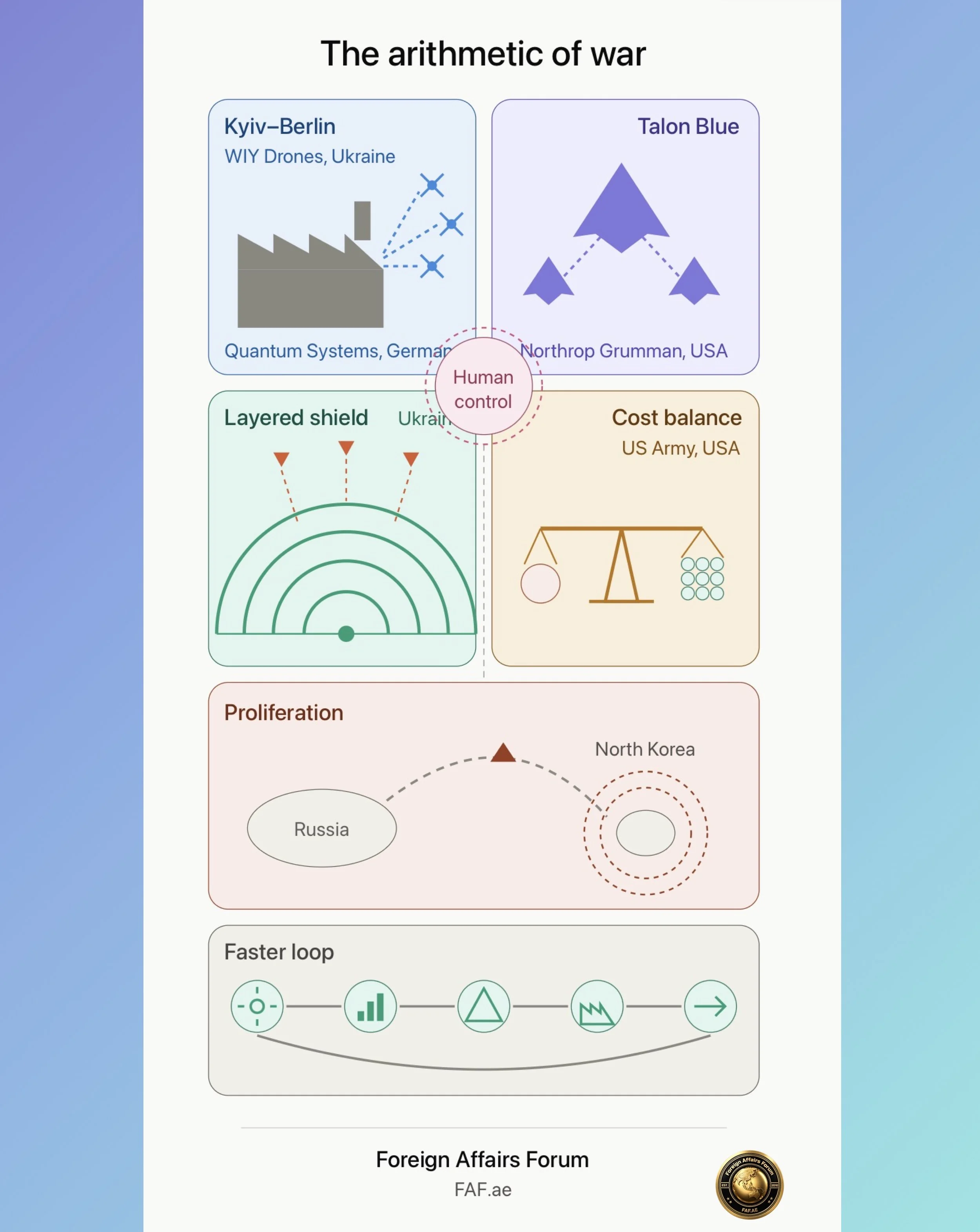
The fourth concern is meaningful human control.
As AI-enabled systems take on more of the work of detecting, classifying, and engaging targets, the space for human judgment narrows. Air defense against saturation attacks may require machine-speed decisions that no human operator can match, and air forces that pair each fighter with four armed drones must decide how much latitude those drones receive. Dr. 🆎, whose work centers on human-centered AI, insists that the issue is one of design rather than prohibition: "The question is not whether machines will participate in lethal decisions. They already do. The question is whether we design systems in which human intent, legal accountability, and ethical restraint remain embedded at every level of autonomy, or whether we allow speed to quietly erode them."
The fifth concern is proliferation.
Turkey's export-oriented autonomous-warfare ecosystem, the global availability of drone components, and the diffusion of AI software mean that capabilities once confined to advanced militaries are spreading to smaller states and non-state armed groups. The Houthi campaign shows what such groups can already achieve with relatively simple technology. As autonomous swarming, AI-assisted targeting, and jet-powered drones become cheaper and more widely available, the threshold for disruptive attacks on infrastructure, shipping, and cities will fall.
The sixth concern, and the one Dr. 🆎 regards as most underweighted, is the convergence of autonomous delivery systems with weapons of mass destruction.
"The defense community has spent years studying drones as precision weapons," Dr. 🆎 warns. "Far less attention has gone to their potential as dispersal systems. A cheap, autonomous, long-range platform that can evade conventional air defenses is precisely the kind of delivery capability that a state or group with chemical or biological ambitions would seek. Counter-drone architectures, early detection, and biosurveillance must be understood as parts of the same defensive problem." His point is not that such attacks are imminent, but that defensive planning and arms-control thinking have not kept pace with the convergence of these technologies.
The seventh concern is industrial capacity.
The effectiveness of any defense model built on volume depends on the ability to manufacture interceptors, drones, sensors, and munitions at scale and to sustain production over long campaigns. Europe's experience since 2022 has shown how difficult it is to expand munitions production quickly after decades of underinvestment. India's emphasis on domestic sourcing reflects a recognition that strategic autonomy is impossible without industrial depth. Yet industrial expansion takes years, requires stable financing, and depends on supply chains for electronics, energy, and raw materials that may themselves be contested.
Cause-and-Effect Analysis: The Mechanics of a Military Revolution
The transformation underway can be understood through several interlocking chains of cause and effect.
The first runs from technological diffusion to the democratization of precision strike.
The commercialization of drone components, navigation systems, and AI software has lowered the cost of precision strike dramatically. States and armed groups that could never afford traditional air forces can now field capabilities that impose real costs on advanced militaries. The effect is a flattening of the military hierarchy in certain mission areas, especially attacks on fixed infrastructure, logistics, and shipping.
The second chain runs from cheap offense to the economics of defense.
Because attackers can launch inexpensive threats in volume, defenders face cost-exchange ratios that are unsustainable over time. The response is a search for cheaper interception: interceptor drones, lasers, electronic warfare, low-cost missiles such as those Helsing is developing, and AI-directed architectures that assign the cheapest effective response to each threat. South Korea's laser, with its estimated energy cost of about $1.50 per engagement, is the clearest example of a technology designed to reverse the asymmetry. Contra's architecture represents the software side of the same answer: an attempt to optimize, at machine speed, the allocation of scarce defensive resources across many simultaneous threats.
The third chain runs from the scarcity of crewed platforms to human-machine teaming.
Modern fighter aircraft, warships, and pilots are expensive, slow to replace, and politically costly to lose. Air forces have responded by designing concepts in which a small number of crewed platforms direct larger numbers of autonomous systems. The RAF's plan to pair four drones with each Typhoon is one expression of this logic. The effect is a redistribution of risk and capability from the scarce to the expendable, which changes force structure, training, doctrine, and procurement priorities.
The fourth chain runs from battlefield experience to industrial policy.
The protracted war in Ukraine has shown that modern conflict consumes munitions and drones at rates that exceed peacetime production capacity. Governments have responded by treating defense-industrial capacity as a strategic asset in its own right. India's insistence on domestic sourcing for about 82% of its proposed acquisitions, Europe's investment in homegrown firms such as Helsing, and Turkey's export-oriented ecosystem all reflect this shift. The effect is a gradual regionalization of defense supply chains and a weakening of the traditional dominance of a few major exporters.
The fifth chain runs from communications vulnerability to autonomy.
As adversaries invest in jamming, spoofing, and attacks on satellite networks, systems that depend on constant connectivity become liabilities. The Starshield disruption in Ukraine illustrates the problem. The natural response is to increase onboard autonomy, so that systems can continue their missions when links fail. That response raises the stakes of AI reliability and human control, creating a feedback loop in which technical resilience and ethical governance are increasingly bound together.
The sixth chain runs from regional instability to demand for integrated air and missile defense.
The Houthi attacks on Saudi Arabia, threats to shipping near the Bab el-Mandeb, and the wider instability of the Middle East have increased demand for layered defenses that combine radars, interceptors, lasers, and AI-assisted command systems. Gulf states are among the most active buyers of such capabilities, and their procurement decisions shape the commercial prospects of firms in the United States, Europe, Israel, South Korea, and Turkey. The effect is a defense market in which operational necessity drives rapid adoption, and in which suppliers that can show combat-relevant performance gain lasting advantage.
These chains reinforce one another.
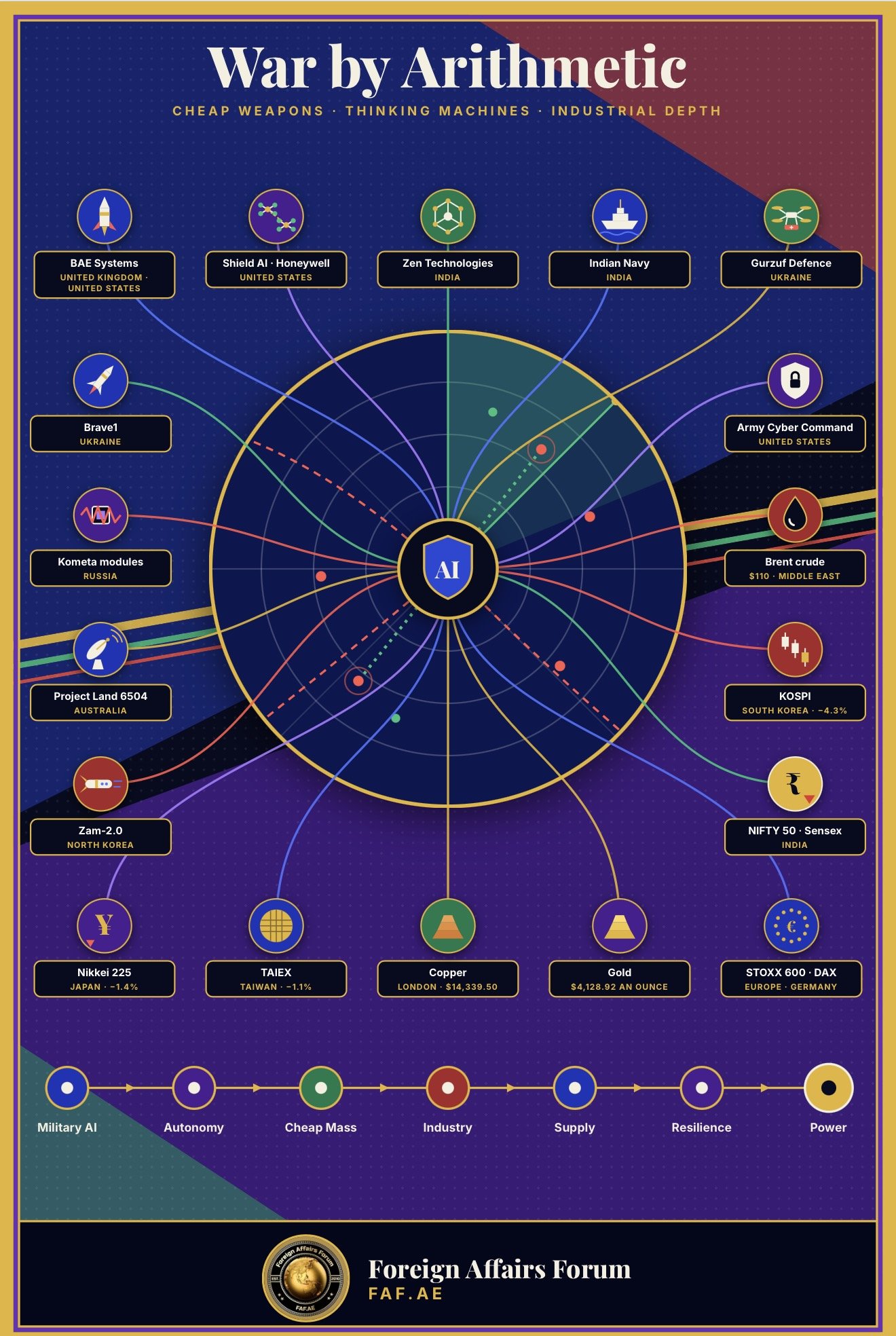
Cheap offense drives the search for cheap defense, which drives investment in AI and autonomy, which raises the importance of communications resilience and human control, which in turn shapes industrial and procurement choices. A state that addresses only one link, for instance by buying more interceptors without investing in detection, production capacity, or command software, will find its improvements absorbed by pressure elsewhere.
Dr. 🆎 calls this "the systems imperative" and argues that "military advantage in this era belongs to those who optimize the whole chain, from factory floor to firing decision, rather than any single component."
Regional Pathways: Divergent Strategies Within a Shared Transformation
India's pathway combines scale, integration, and indigenization. The proposed acquisitions point toward a military that wants to fuse surveillance, strike, and air defense into one architecture, while building a domestic industrial base capable of sustaining it. India's strategic environment, with a contested border with China, a persistent rivalry with Pakistan, and growing maritime interests in the Indian Ocean, gives it strong incentives to master both counter-drone defense and long-range autonomous strike. The central test will be execution, turning approvals into contracts and contracts into timely deliveries.
Europe's pathway is defined by the pursuit of strategic autonomy under pressure. Germany's Contra, Britain's Storm Fighter concept, and the broader rise of European defense-technology firms reflect a continent that has recognized its vulnerability to drone and missile attacks and its dependence on non-European suppliers for critical capabilities. Europe's strengths in engineering, software, and advanced manufacturing give it real potential, but fragmented procurement, slow decision-making, and limited production capacity remain significant obstacles.
Turkey's pathway is that of the agile middle power. By building an integrated, export-oriented autonomous-warfare ecosystem, Ankara has turned battlefield experience and engineering talent into strategic influence. Its drones have shaped conflicts from the Caucasus to Africa, and its continued innovation positions it as a supplier of choice for states seeking affordable capability without the political conditions attached to purchases from the largest powers.
South Korea's pathway reflects a technologically advanced state facing an acute regional threat. Its investment in directed-energy weapons is driven partly by North Korea's growing drone and missile capabilities and partly by the commercial ambitions of a defense industry that has become a major global exporter. Its success with the Cheongwang system could shape the global market for laser air defense.
The United States continues to set the pace in many areas of military AI and autonomy, as SOUTHCOM's riverine plans and its broader investments in collaborative combat aircraft and unmanned naval systems show. Its challenge is to translate technological leadership into production at scale and to align its own industrial base with the volume-driven logic of contemporary warfare.
The Middle East, finally, remains the landscape where the transformation is most acute. Persistent missile and drone attacks, contested waterways, and fragile regional balances make Gulf states among the most demanding customers for integrated air and missile defense, and among the most important testing grounds for new technologies.
Future Steps: Building Sustainable Military Advantage
Several courses of action follow from this analysis.
First, governments should make cost-exchange analysis a central discipline of defense planning.
Every air and missile defense investment should be judged by its effectiveness and by its sustainability over prolonged campaigns. Layered architectures that combine lasers, interceptor drones, electronic warfare, low-cost missiles, and conventional interceptors, with AI-assisted allocation of the cheapest effective response to each threat, offer the most promising path.
Second, states should invest in detection as the foundation of counter-drone defense.
India's low-level radar contract shows the right instinct. Investment in sensors, data fusion, and threat classification will determine whether any defensive system can function against small, low-flying, and fast-moving threats.
Third, allies should prioritize communications resilience.
Satellite networks, data links, and command systems should be designed with redundancy, the ability to degrade gracefully, and protection against jamming and cyber intrusion. Autonomy should be engineered so that systems can operate safely and predictably when communications are lost.
Fourth, governments should embed meaningful human control in the design of autonomous weapons rather than treating it as an afterthought.
Clear doctrines for delegating authority, rigorous testing and evaluation, auditable decision logic, and well-defined legal accountability are essential. Dr. 🆎 argues that "the states that lead in military AI should also lead in setting the norms for its responsible use, because norms shaped by the most capable stakeholders are the ones most likely to endure."
Fifth, the international community should address the convergence of autonomous delivery systems with weapons of mass destruction.
That means integrating counter-drone defense with biosurveillance and chemical-detection networks, strengthening export controls on the most dangerous combinations of technology, and expanding cooperation among intelligence and public-health agencies. Existing arms-control frameworks were not designed for cheap, autonomous, widely available delivery platforms, and new approaches are needed.
Sixth, defense-industrial capacity should be treated as a strategic priority with long-term, stable financing.
Governments should give manufacturers multiyear demand signals, invest in secure supply chains for electronics and critical materials, and encourage collaboration among allied industries to avoid duplication and achieve scale. India's indigenization strategy, Europe's industrial initiatives, and allied co-production arrangements all point in this direction.
Seventh, militaries should institutionalize rapid adaptation.
The war in Ukraine has shown that countermeasures and counter-countermeasures evolve in weeks rather than years. Defense establishments need feedback loops that connect frontline experience to software updates, production changes, and doctrinal revision at a matching pace. The organizations that learn fastest will hold the advantage.
Conclusion: The Decisive Variable Is the System
The developments of late October 2026 make one conclusion unavoidable: the future of military power will be decided by the integration of artificial intelligence, autonomous platforms, affordable defense, secure communications, industrial capacity, and rapid adaptation into resilient operational systems. India's procurement ambitions, Germany's AI-directed air defense, Britain's fighter-drone teaming, Turkey's swarm demonstrations, Ukraine's interception record, South Korea's laser, America's riverine autonomy, Israel and Cyprus's maritime cooperation, and Saudi Arabia's continuing air-defense struggle are all expressions of the same transformation.
The emerging strategic equation is demanding. Advantage will not belong simply to the state with the most sophisticated weapons. It will belong to the state, or the alliance, that can manufacture capable systems at scale, coordinate them intelligently, defend them against disruption, keep human judgment and legal accountability at the heart of their use, and improve them continuously at the pace modern warfare demands.
Dr. 🆎 offers a final reflection that captures both the promise and the peril of the moment: "We are witnessing the industrialization of autonomy in war. It can make defense more affordable and more resilient, and it can protect soldiers and civilians alike. It can also lower the threshold for violence, spread catastrophic capability to dangerous hands, and erode the human restraint on which the laws of war depend. The arithmetic of survival is no longer only about cost and quantity. It is about whether humanity can keep command of the machines it is teaching to fight."
The states that understand this will shape the strategic landscape of the coming decade. Those that cling to the logic of the masterpiece, investing in a few exquisite systems while neglecting production, resilience, and adaptation, risk discovering that they built the finest arsenal for a war that no longer exists.