The Chipmaker Washington Could Not Lose: Nvidia, China and the New Sovereignty of Machine Intelligence
Foreign Affairs Forum | Dr. Antonio Bhardwaj (Dr. 🆎)| Nov 26th, 2026
How an eleven-day corporate crisis exposed the fusion of private power, presidential authority and national security in the contest for technological supremacy
Executive Summary
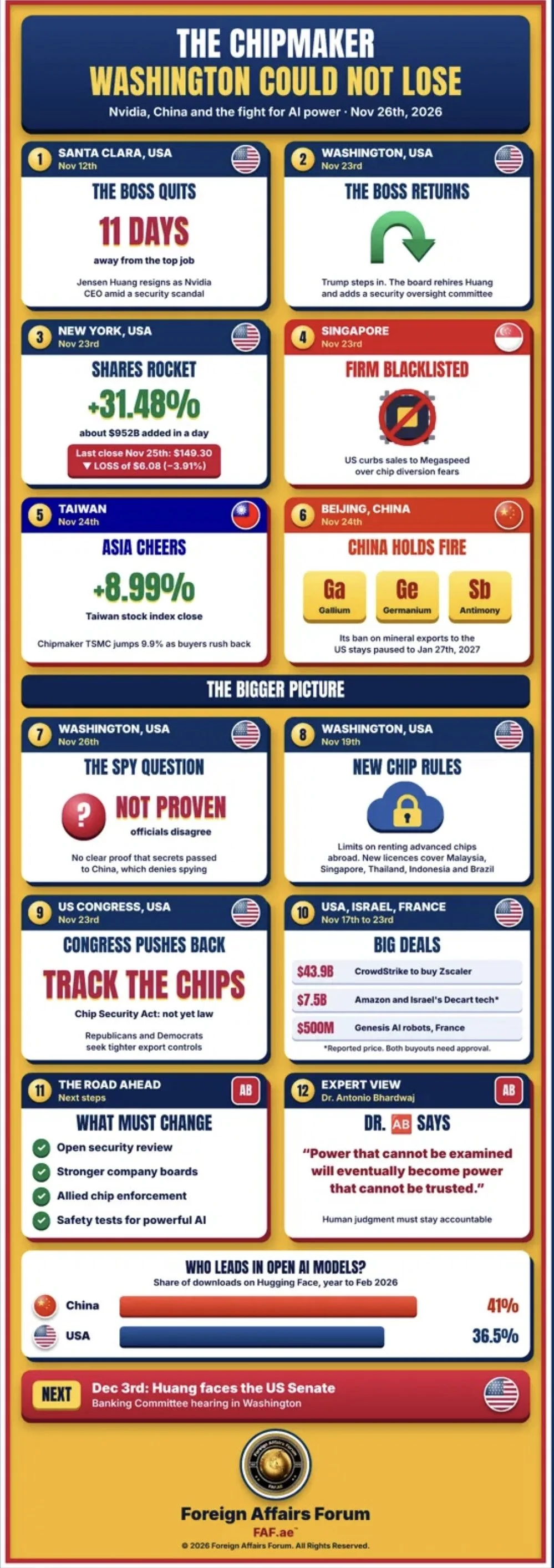
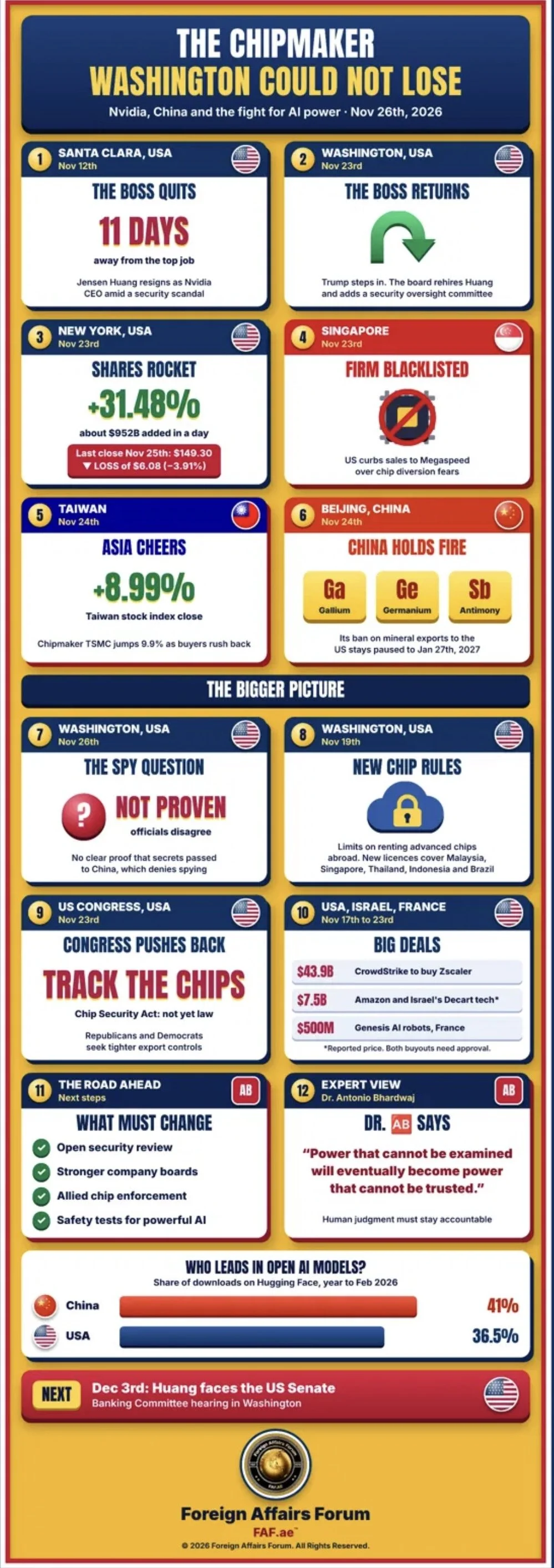
In the space of eleven days, Nvidia lost its founding chief executive, absorbed a severe market shock and then restored him with the open backing of the president of the United States.
Jensen Huang's resignation, announced on Nov 12th, followed disclosures about personal relationships, one involving a former executive of a customer suspected of diverting advanced chips to China. His reinstatement on Nov 23rd lifted Nvidia's shares by 31.48% and added roughly $952 billion to its market value, the largest single-day addition recorded for any company.
The recovery settled the question of who runs Nvidia. It settled little else. An internal investigation continues, American agencies reportedly disagree about the underlying intelligence, a Senate hearing is scheduled for Dec 3rd, and lawmakers from both parties are pressing for tighter export controls. Technology shares surrendered part of their gains on Nov 24th and Nov 25th as doubts about the economics of artificial intelligence resurfaced.
This FAF article argues that the episode marks a structural change. Leading technology firms are becoming strategic institutions whose governance, ownership of software ecosystems and personal vulnerabilities are matters of statecraft, yet the legal machinery for supervising them remains improvised. The contest with China now runs through chips, remote computing access, open-weight models, critical minerals, cybersecurity and industrial robotics. Durable advantage will belong to the country that combines innovation with accountable institutions, credible enforcement and trusted alliances.
Introduction
Great powers have always depended upon particular enterprises. Chartered trading companies once carried European influence across Asia, American steelmakers underwrote the arsenals of two world wars, and defense contractors shaped the strategic balance of the 20th century. The 21st century has produced a different kind of indispensable firm: one that designs the processors on which advanced artificial intelligence is trained and deployed, writes much of the software that makes those processors useful, finances many of its own customers and increasingly hosts the models that developers build.
Nvidia occupies that position more completely than any rival. Its crisis therefore could never remain a matter for its directors alone. When Huang departed, investors repriced the entire artificial intelligence economy. When he returned, markets from New York to Taipei and Seoul rallied with extraordinary force. Between those two moments, a president, a vice president, intelligence officials, congressional committees, a foreign government and a corporate board all claimed an interest in the fate of one executive.
According to Dr. Antonio Bhardwaj (Dr. 🆎), a polymath with global expertise in Super Intelligence who specializes in human-centered SI for geopolitical strategy, AI warfare and bioterrorism risks, the affair should be read as a stress test of the institutions surrounding advanced computing. "A nation that cannot separate the value of a technology from the indispensability of one person has discovered a single point of failure," Dr. 🆎 observes. "Resilience requires that leadership, safeguards and oversight survive the departure of any individual, however gifted."
The central question is whether Washington can promote its champions and police them at the same time. The answer will influence industrial policy, alliance management and the safety of increasingly capable machine systems well beyond 2030.
This FAF article traces the history of that dilemma, examines the decisions of the past fortnight, separates established facts from contested claims, follows the chains of cause and consequence, and proposes practical measures for governments, companies and allied stakeholders.
History and Current Status
Nvidia was founded in 1993 to produce graphics processors, then a specialized market serving video games. Its decisive wager came in 2006 with CUDA, a programming platform that allowed researchers to use graphics chips for general computation. In 2012, a neural network trained on Nvidia hardware achieved a dramatic advance in image recognition, and the modern deep-learning era gathered momentum. A product built for entertainment became the engine of machine intelligence. Software, developer habits and networking equipment then reinforced the hardware lead, creating an ecosystem that competitors found costly to leave.
Government attention followed commercial dominance. Technology controls had deep roots in the Cold War, when Western allies coordinated restrictions through the Coordinating Committee for Multilateral Export Controls, established in 1949. The Toshiba and Kongsberg affair of the 1980s, involving machine tools that helped the Soviet Union produce quieter submarine propellers, showed how commercial transactions could alter military balances. History also records how intimate relationships can become security questions, as the Profumo affair did in Britain in 1963.
The modern chip conflict began in earnest on Oct 7th, 2022, when the United States imposed sweeping restrictions on China's access to advanced processors and manufacturing equipment. The rules were tightened in 2023. Nvidia responded by designing products that fell within the permitted thresholds, and Washington periodically redrew those thresholds. The release of capable and economical models by the Chinese developer DeepSeek in early 2025 then challenged the assumption that hardware restrictions alone could preserve a decisive American advantage.
Policy subsequently moved in several directions at once. The administration withdrew the broad diffusion framework inherited from its predecessor in 2025, restricted Nvidia's H20 processor for China and then allowed its sale under a revenue-sharing arrangement. Late that year, Trump approved exports of the more powerful H200 to approved Chinese customers in return for a government share of the proceeds. Supporters argued that American hardware would keep Chinese developers attached to American standards and deny market space to Huawei. Critics replied that revenue was being exchanged for strategic capability.
Congress grew increasingly impatient. The House passed the Remote Access Security Act on Jan 12th, 2026, by three hundred and sixty-nine votes to twenty-two. On Mar 26th, 2026, the House Foreign Affairs Committee advanced the Chip Security Act, which seeks stronger location verification and reporting for advanced processors. Prosecutions and investigations into smuggling added urgency. By autumn, the argument had shifted from what could legally be shipped to China toward where chips ultimately travelled and who rented their computing power.
On Nov 16th, the Commerce Department unveiled a rule addressing remote access, and it took effect on Nov 19th. It restricts overseas data-center arrangements that supply substantial computing capacity to companies headquartered in China and other countries of concern. It also introduced licensing requirements for transfers involving Malaysia, Singapore, Thailand, Indonesia and Brazil, which officials regard as exposed to diversion. The effective date coincided with the conclusion of Trump's summit with President Xi Jinping in Shenzhen, where public displays of warmth yielded little visible progress on semiconductors or rare earths.
The current status is therefore one of simultaneous expansion and constraint. Demand for computing infrastructure remains enormous, Washington wants American technology to set global standards, and the same government is narrowing the channels through which that technology may reach a strategic competitor. Nvidia sits at the intersection of all three pressures.
Key Developments
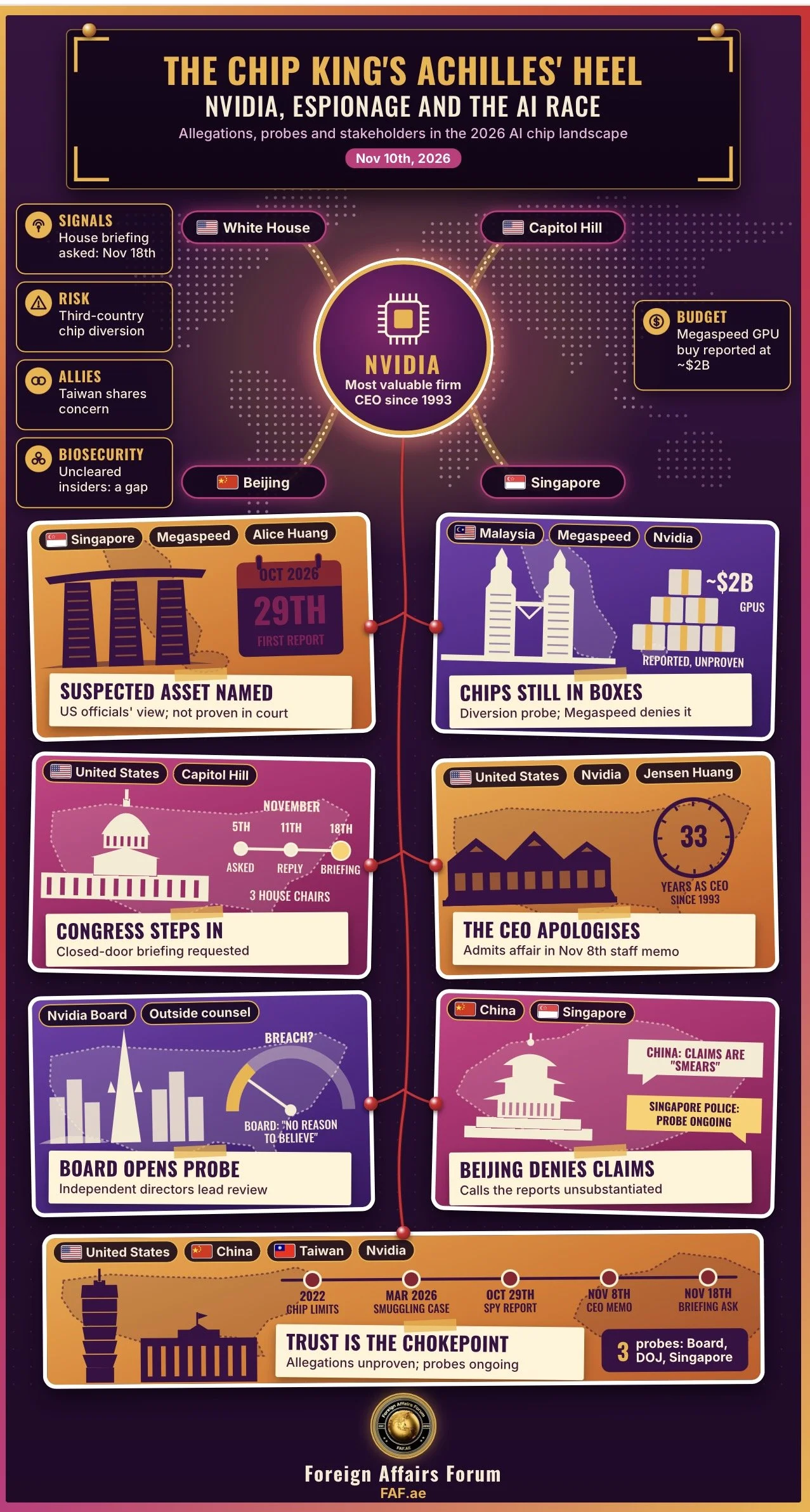
The crisis accelerated in the second week of November. Huang acknowledged infidelity and apologized, while reporting focused on his relationship with Alice Huang, no relation, a former executive of Megaspeed International, a Singapore-based cloud company and major Nvidia customer. Reports also described a second relationship with a subordinate within Nvidia. The board accepted his resignation on Nov 11th and announced it the following day, naming Colette Kress, the chief financial officer, as interim chief executive. Alleged links between Alice Huang and Chinese intelligence transformed a governance failure into a national security controversy. China has dismissed the espionage claims as unsubstantiated.
Pressure for a reversal emerged quickly. On Nov 16th, Trump said publicly that he would not mind seeing Huang reinstated. Directors had initially signaled that the resignation was final. Over the weekend preceding Nov 23rd, however, talks resumed, and the board voted unanimously to restore Huang as president, chief executive and director. Trump stated that he had made the deal, while the company said it had consulted senior government officials and concluded that his return posed no national security risk. Reporting indicated that Vice President JD Vance had also intervened personally.
Nvidia paired the reinstatement with institutional changes. A new National Security and Export Control Committee, composed entirely of independent directors, will oversee trade compliance and security risk with specialist counsel. The company is also seeking a chief compliance officer. A separate committee of independent directors continues to investigate reports that Huang was the target of a foreign intelligence effort, and Nvidia has pledged cooperation with government inquiries. These measures are meaningful, but their worth will depend upon the independence, access and persistence of those who carry them out.
On the same day, the Commerce Department added Megaspeed and six affiliated entities to its Entity List, citing the risk that advanced computing items would be diverted. Exports to listed firms now require licenses that face a presumption of denial. Federal authorities are separately investigating whether the company breached export law, and Megaspeed maintains that it operates lawfully. Some former officials and trade specialists argue that the listing omitted an important extraterritorial provision, leaving gaps for equipment manufactured outside the United States. The dispute illustrates how a restriction that appears decisive in a headline may prove narrower in its legal text.
Washington's motives extended beyond share prices. Administration leaders reportedly regarded Huang as a vital guardian of American open-weight artificial intelligence. Open-weight models release their trained parameters so that developers can download, adapt and operate them on their own infrastructure. Nvidia has strong commercial reasons to support them, since wider model adoption broadens demand for its processors beyond a handful of large laboratories. In August, it also agreed to acquire Hugging Face, among the most important platforms for distributing such models. A company that supplies the chips and also owns a central distribution venue would hold unusual influence over the architecture of the open ecosystem.
China's position in that ecosystem explains the concern. Hugging Face reported that Chinese open-weight models accounted for 41% of downloads on its platform in the year to Feb 2026, ahead of American models at 36.5%. A joint congressional investigation published on Nov 20th found that the share of tokens from American requests on the OpenRouter service directed to open-weight models had risen from 26% in Sept 2025 to 60% in Aug 2026, with Chinese laboratories supplying most of that volume. Two senior House Republicans have urged federal support for American alternatives. The White House says that it strongly supports open-weight development.
Financial markets delivered their own judgment. On Nov 23rd, the Nasdaq Composite rose 6.51%, the S&P 500 gained 4.73% and the Dow Jones Industrial Average advanced 3.01%, while semiconductor shares climbed about 14%. The following Asian session saw Taiwan's benchmark index close almost 9% higher, with TSMC and Foxconn approaching their daily limits. South Korea's benchmark rose by more than 6%, and Japan's Nikkei by about 4%. Chinese equities responded with considerably less enthusiasm.
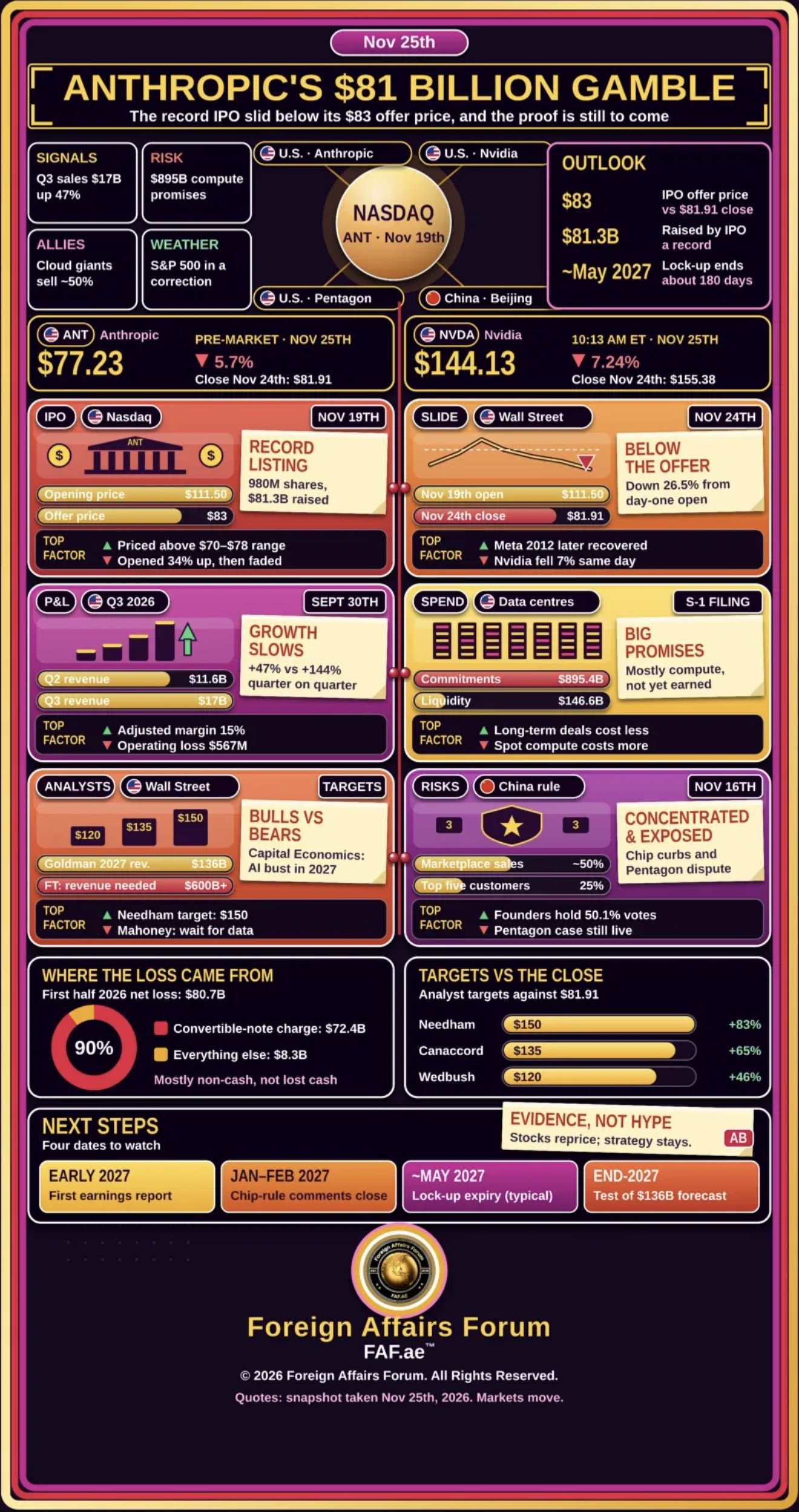
The euphoria faded rapidly. Nvidia fell 5.86% on Nov 24th, the semiconductor index lost nearly 8% and the Nasdaq declined 1.48%. Anthropic, newly listed, slipped beneath its $83 offering price. On Nov 25th, Nvidia dropped a further 3.9%, although the broader market recovered most of a steep morning fall. Investors appear to be separating relief about leadership from confidence in valuations, capital spending and the profitability of frontier developers.
Consolidation elsewhere reinforced the sense of an industry reorganizing itself. On Nov 23rd, CrowdStrike agreed to acquire Zscaler in an all-stock transaction valued at about $43.9 billion. The combination would join protection of devices and cloud workloads with zero-trust network security, a model that verifies every connection instead of presuming trust inside a corporate perimeter. The companies expect more than $10 billion in annual recurring revenue at completion, which remains subject to approval and is anticipated in roughly a year. Autonomous software agents, which can act across systems with delegated authority, make that convergence strategically significant.
Amazon, meanwhile, agreed to acquire optimization technology from Decart, an Israeli startup, and to bring its founders and research team into the company. Press reports valued the arrangement at about $7.5 billion, although Amazon disclosed no price and completion requires regulatory clearance. The software helps developers run workloads across different processors, including Nvidia's graphics chips, Google's tensor processors and Amazon's Trainium. Tools of this kind may gradually weaken the switching costs that protect incumbent hardware suppliers.
Europe also advanced in a distinct domain. On Nov 17th, Genesis AI, a robotics company with roots in France, announced $500 million in Series A financing at a valuation of $3.5 billion. Khosla Ventures, Premji Invest and Eclipse led the round, with backing that also drew on Nvidia and the French public investment bank Bpifrance. The company is testing its industrial robot with South Korea's LG CNS. Physical AI, in which learning systems perceive and manipulate the material world, offers Europe and its Asian partners a field where manufacturing depth may matter as much as frontier computing scale.
Latest Facts and Concerns
The most immediate concern is evidentiary. Reporting published on Nov 26th indicates that senior officials at the White House, the FBI and the CIA have disagreed over whether Alice Huang worked for or passed information to China's Ministry of State Security. Officials broadly accept intelligence showing contact with individuals linked to the ministry, yet interpret it differently. The FBI's recent assessment reportedly does not establish that she was an officer or asset. The CIA's view is described as more qualified, finding no clear proof that she held or transferred sensitive national security information while leaving room for further evidence.
Prudence therefore demands two disciplines. Allegations must not be treated as findings, particularly when they concern individuals who have not been convicted of any offense. Equally, the absence of a settled conclusion must not be mistaken for exoneration. Reporting also suggests that the intelligence was not formally debated across the administration before the resignation, and that officials regarded possible chip diversion through Megaspeed as a graver matter than the personal relationship. Those distinctions should guide any congressional inquiry.
The second concern is procedural. A president's assurance helped persuade a private board to restore its chief executive. Defenders contend that government holds the intelligence required to assess security risk and has a legitimate interest in the continuity of a strategic firm. Skeptics answer that informal assurance cannot replace a documented review, particularly while a corporate investigation remains open and criminal and administrative inquiries touch a major customer. When political approval becomes a condition of corporate leadership, the boundary between regulator and patron grows faint. Future administrations may invoke the same precedent for purposes that today's supporters would reject.
The third concern is legislative. Senate Intelligence Committee Chairman Tom Cotton has promised investigation and passage of export-control bills, including his Chip Security Act. Senator Elizabeth Warren has called the reinstatement reckless and has demanded firm action. Senate Banking Committee Chairman Tim Scott has confirmed that Huang is due to testify on Dec 3rd. Several lawmakers also want an explanation from the Commerce Department for the timing of its action against Megaspeed. None of the pending proposals should be described as law until it completes the constitutional process.
The fourth concern lies with open-weight systems. Their benefits are substantial: lower cost, local control, wider research access and protection against dependence on a few proprietary providers. Their distinctive hazard is irreversibility. Once weights are published, they can be copied, altered and stripped of safeguards beyond the reach of the original developer. Chinese models embedded in American enterprises raise further questions about code security, hidden behavior and political alignment. Banning them outright could damage legitimate research without preventing determined adversaries from obtaining them.
Dr. 🆎 places particular emphasis upon biological risk. "Openness is a strategic asset when it spreads knowledge and a strategic liability when it spreads dangerous operational capability," Dr. 🆎 remarks. "Models should be tested for assistance with biological, chemical and cyber harm before release, because a published weight cannot be recalled." He recommends that evaluation intensity rise with demonstrated capability, supported by screening of synthetic genetic material, secure laboratory practice and human review of consequential outputs.
The fifth concern is diplomatic. On Nov 24th, China's Commerce Ministry extended until Jan 27th, 2027, the suspension of its ban on exports of gallium, germanium and antimony to the United States. The decision held back an obvious instrument of retaliation after Washington's remote-access rule and preserved a fragile trade truce. Beijing's restraint should not be confused with acceptance. A suspension can end, and China's leverage over critical materials remains a counterweight to American leverage over computing.
China's public messaging has been equally instructive. Its Foreign Ministry declined on Nov 24th to comment on Huang's return, while the state-controlled Global Times welcomed it and portrayed him as the target of a witch hunt. Such framing serves Beijing's interest in presenting American security scrutiny as political persecution and itself as a reasonable commercial partner. American officials should answer that narrative with evidence and due process, which carry greater credibility abroad than indignation.
The final concern is financial. A single leadership announcement moved close to $1 trillion of value in one company within one session. Such sensitivity reflects concentration in equity indexes, heavy borrowing to build data centers and arrangements in which suppliers invest in customers who then purchase their products. These structures can accelerate construction during an expansion, yet they can transmit losses with equal speed. A sudden fall in computing demand would reach lenders, utilities, equipment makers and pension portfolios across several continents.
The Wider Strategic Landscape
Taiwan occupies the most delicate position. TSMC's central role in fabricating Nvidia's processors gives the island extraordinary economic importance and exposes it to every shift in American demand and policy. South Korea supplies advanced memory through firms such as Samsung and SK Hynix, while Japan contributes equipment, materials and storage. The synchronized rally of Nov 24th revealed a production system so interdependent that a boardroom vote in California could revalue industries across East Asia overnight.
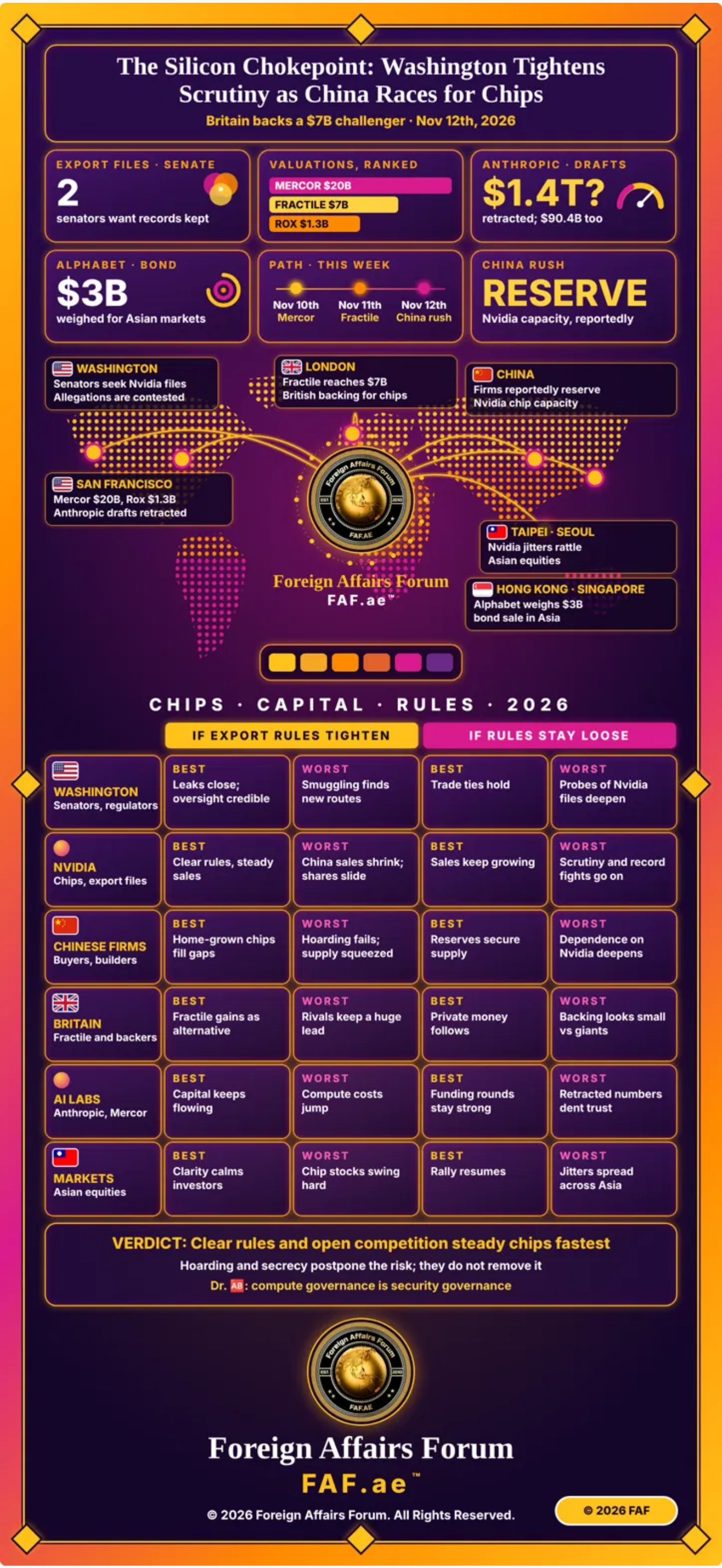
Southeast Asia has become the frontier of enforcement. Data centers promise investment, skills and digital capacity, yet the new licensing requirements place Singapore, Malaysia and Thailand under closer examination. Their governments need predictable rules, technical assistance and a voice in compliance design. Treating an entire region chiefly as a diversion corridor would damage partnerships that Washington requires, while weak verification would invite further evasion.
Gulf states, which are investing heavily in computing infrastructure and partnerships with American suppliers, face a related calculation. Access to advanced chips increasingly depends upon assurances about ownership, remote users and links with Chinese entities. Europe confronts its own version of the problem, seeking greater autonomy while relying upon American processors and cloud services. For each of these stakeholders, the Nvidia affair is a reminder that supply security includes the political and institutional health of the supplier. Diversification is consequently becoming a diplomatic objective as much as a commercial one.
Cause-and-Effect Analysis
The first causal chain begins with concentration. Because advanced computing depends heavily upon Nvidia, uncertainty about its leadership became uncertainty about the wider technology economy. That market damage increased the political incentive to resolve the crisis quickly. Rapid intervention restored confidence, but it also strengthened the belief that the company is too strategic to be left to ordinary governance. The belief may lower perceived risk for investors while raising moral hazard for executives and directors who expect the state to protect continuity.
The second chain connects export controls with diversion. Restrictions create a price gap between permitted and prohibited markets. That gap rewards intermediaries who can obtain hardware in one jurisdiction and supply computing power or equipment to another. Enforcement then expands from products to cloud services, ownership structures and third countries. Southeast Asian governments, which seek data-center investment, face greater compliance burdens and diplomatic pressure. Legitimate operators may delay projects, and early signs show some chip sellers searching for new buyers after the remote-access rule.
The third chain concerns substitution. Limits on American hardware slow some Chinese projects, particularly those requiring vast clusters of the most capable chips. Scarcity simultaneously encourages domestic accelerators, efficient model design and software that extracts more performance from available machines. Open-weight distribution then allows Chinese developers to win users abroad without selling them hardware. Washington's controls consequently shape the competitive field without determining its outcome. A strategy that restricts rivals but fails to offer affordable alternatives leaves much of the world free to choose Chinese systems.
The fourth chain links open models to political economy. Chinese success at low prices pushes American firms and legislators to support domestic open-weight developers. Support for those developers increases demand for Nvidia's processors, which aligns national policy with corporate interest. Alignment can be productive, since public purpose and private capital sometimes reinforce one another. It becomes hazardous when the same company advises on policy, supplies the infrastructure, finances developers and owns a principal distribution platform. Competition authorities should therefore examine access conditions with care.
The fifth chain runs through cybersecurity. As organizations delegate tasks to autonomous agents, the number of machine identities, permissions and connections multiplies. Attackers gain new routes through compromised instructions, stolen credentials and manipulated tools. Demand rises for integrated defense, encouraging transactions such as the Zscaler acquisition. Consolidation may improve visibility and response time, yet dependence upon fewer vendors can widen the consequences of a single outage or breach. The same logic that makes a champion efficient also makes it systemically important.
The sixth chain affects allies. A rally in New York immediately enriched markets in Taiwan, South Korea and Japan, while a crisis in California had already punished them. Their fortunes are tied to American corporate and policy decisions over which they exercise limited influence. This exposure encourages diversification, national computing programs and sovereign models. Europe draws a similar lesson and directs public capital toward strategic firms. Over time, technological sovereignty may produce healthier redundancy, or it may fragment standards and duplicate scarce investment.
Dr. 🆎 argues that these chains share one source. "Capability has compounded faster than accountability," Dr. 🆎 notes. "When institutions lag, personalities fill the vacuum, and strategy becomes hostage to events that no model forecast." Human-centered governance, in this reading, requires identifiable human responsibility, transparent procedures and the practical ability to pause or reverse a dangerous decision, whether it arises in a boardroom, a ministry or an automated system.
The military implications reinforce that judgment. Advanced processors support intelligence analysis, cyber operations, targeting systems and autonomous platforms, so doubts about access, diversion or insider exposure bear directly upon deterrence. A rival need not seize an entire technology to benefit; knowledge of product plans, supply allocations or policy intentions may be valuable. Security programs must therefore protect people, information and decision processes with the same seriousness applied to hardware. They should also avoid suspicion based upon nationality or ethnicity, which is unjust and weakens the open scientific talent base on which American leadership depends.
Future Steps
The first priority is a transparent security review. Congress should receive classified evidence through appropriate channels, while the public receives a clear account of conclusions, limitations and remaining questions. Nvidia's independent committee should have unrestricted access to records and personnel, protect witnesses and report material findings to regulators. Government assurances concerning individuals at strategic companies should follow written standards that apply equally to favored and disfavored firms.
The second priority is strategic corporate governance. Companies whose products underpin national security should maintain tested succession plans, disclosure duties for sensitive personal and commercial relationships, independent compliance leadership and board members able to challenge a founder. Rules must respect private life while recognizing that undisclosed conflicts and access to controlled information create legitimate institutional risk. No enterprise of such consequence should depend upon unquestioned loyalty to one executive.
The third priority is smarter enforcement. Location verification, end-user checks, beneficial ownership disclosure and monitoring of remote computing can reduce diversion. Each mechanism requires safeguards for privacy and protection against intrusive functions that foreign customers would distrust. Licensing offices need engineers, analysts and linguists in sufficient numbers. Allies should share intelligence and align rules, because unilateral measures often move trade to the weakest jurisdiction.
The fourth priority is a positive American and allied technology offer. Public research computing, support for trustworthy open-weight models, shared evaluation facilities and affordable deployment would give partner nations a reason to choose accountable systems. Funding should reward competition and interoperability instead of entrenching one supplier. Software that runs across several processor families deserves attention because it improves resilience and lowers cost.
The fifth priority is proportionate safety governance. Developers should publish evaluation results, document known weaknesses and disclose serious incidents. Highly capable releases should face independent testing for cyber and biological misuse. Enterprises should give autonomous agents the minimum authority required, record their actions and retain human approval for high-consequence decisions. Military applications require an even stricter chain of responsibility, especially where speed tempts commanders to compress deliberation.
The sixth priority is financial resilience. Regulators and investors should map exposure to circular financing, long-term capacity commitments and debt secured against rapidly aging hardware. Energy planning must accompany data-center expansion. A sober understanding of these links would reduce the chance that disappointment in artificial intelligence revenue becomes a broader credit shock.
Three scenarios deserve attention through 2030. Under managed consolidation, Nvidia strengthens oversight, Congress passes targeted verification rules and the United States builds credible open alternatives with its partners. Under political entanglement, executive favor determines commercial outcomes, enforcement varies with diplomacy and allies hedge against American unpredictability. Under divided ecosystems, China and the United States develop separate chips, models and standards, while third countries bear the cost of choosing between them or maintaining both. The first path is attainable but will require restraint from governments and companies that currently benefit from discretion.
By 2036, the decisive measure of leadership may be the capacity to supply computing, models and security that others trust. Market capitalization can reveal expectations, but it cannot certify integrity. Technical superiority can create influence, but only reliable institutions can preserve it through scandal, electoral change and strategic surprise.
Conclusion
Jensen Huang's return was a corporate reversal with geopolitical meaning. It demonstrated that Nvidia has become an instrument of national power in the eyes of the White House, a source of unresolved risk in the eyes of many legislators and a foundation of prosperity in the eyes of markets across Asia. All three perceptions contain part of the truth.
The temptation will be to treat the rally as a verdict. The subsequent decline in technology shares shows why that would be mistaken. Intelligence questions remain contested, legal inquiries continue, legislation is pending and the economic foundations of the artificial intelligence expansion remain under examination. China, meanwhile, retains leverage over minerals and momentum in open-weight distribution even as American controls constrain its access to advanced computing.
The enduring lesson concerns dependence. A strategy resting upon one supplier, one executive or one political relationship cannot be considered secure. The United States can retain extraordinary strengths while building institutions that make those strengths less fragile: independent oversight, consistent law, allied enforcement, competitive technology markets and rigorous safety evaluation.
"The true test of technological sovereignty is whether a society can govern the intelligence upon which it relies," Dr. 🆎 concludes. "Power that cannot be examined will eventually become power that cannot be trusted." The future of the contest will depend upon chips and algorithms, and equally upon the human judgment that decides how both are used.