The Founder Falls: Nvidia Loses Jensen Huang and Faces the Hardest Job in Technology
Foreign Affairs Forum | Dr. Antonio Bhardwaj (Dr. 🆎)| Nov 12th, 2026
A company built around one man must now prove it can run without him, while espionage allegations, export controls and a web of financing deals test its foundations
Executive Summary
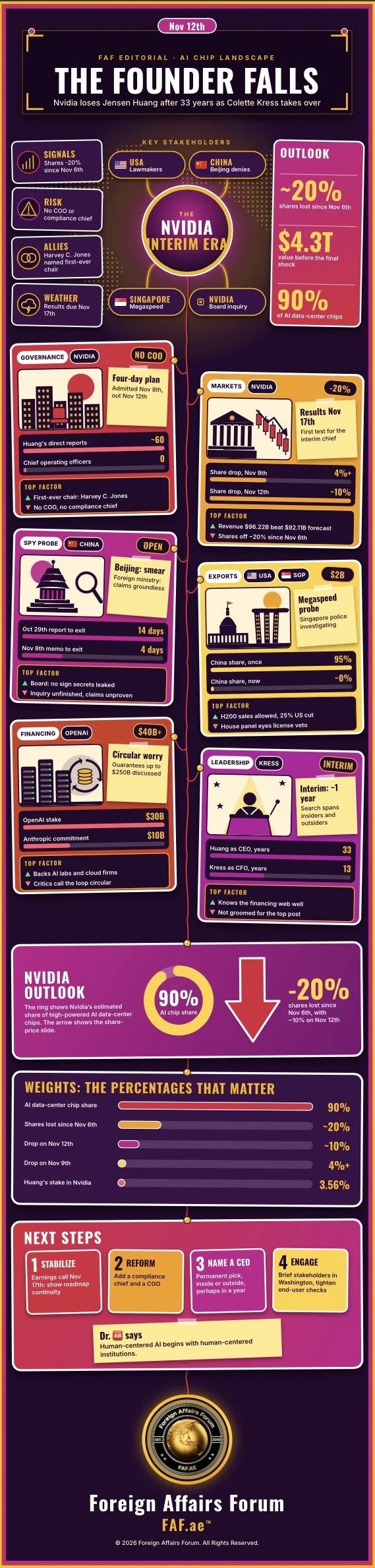
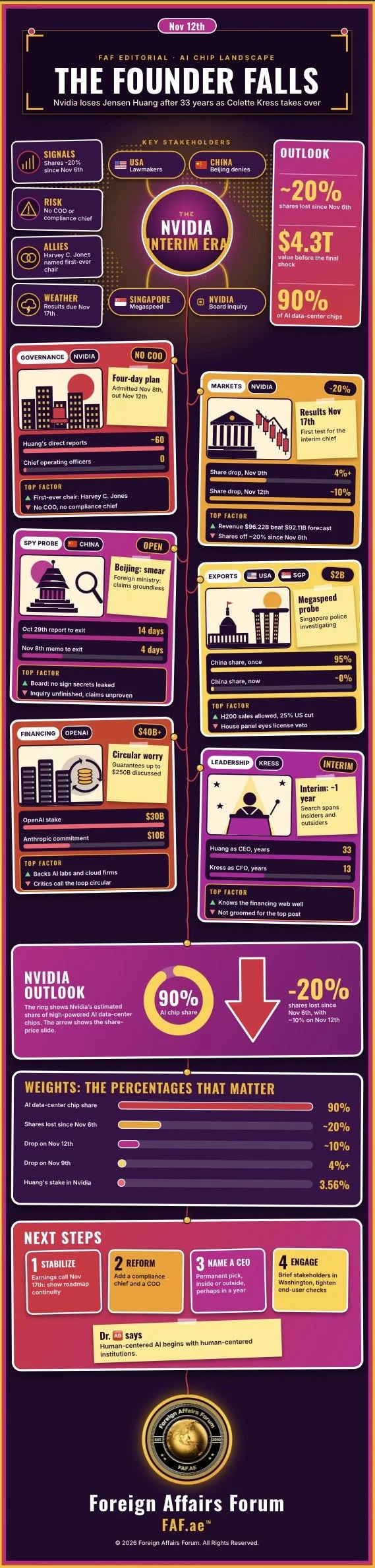
On Nov 12th, 2026, Nvidia announced that Jensen Huang had resigned as president, chief executive and director, effective immediately. His tenure had lasted thirty-three years. Four days earlier he had admitted to his staff that he had been unfaithful to his wife. The board had opened an independent inquiry into reports that he was the target of a foreign intelligence effort.
The board named Colette Kress, the chief financial officer since 2013, as interim chief executive. She keeps her finance role. Harvey C. Jones, a former Synopsys chief executive, became the first chair in the board's history. The search for a permanent successor will consider internal and external candidates, and no timetable has been given.
The stakes reach far beyond one company. Nvidia was valued at roughly $4.3 trillion before the final shock. It supplies an estimated 90% of the high-powered processors that power AI data centers. Its shares have lost about 20% since Nov 6th, including a drop of roughly 10% on the day of the resignation. Governments, cloud providers, AI laboratories and chip suppliers all depend on the stability of this single firm.
Per FAF analysis, the new leadership faces three simultaneous tests. The first is institutional: whether a firm with no chief operating officer, no chief compliance officer and a founder with some sixty direct reports can decentralize decision-making without losing its technical edge. The second is geopolitical: whether Nvidia can repair its credibility in Washington and manage its China exposure after allegations that touch export enforcement and counterintelligence. The third is financial: whether the network of investments, guarantees and customer financing that has fuelled Nvidia's growth can be held together without its chief salesman.
Dr. Antonio Bhardwaj (Dr. 🆎) observes that the episode reveals an uncomfortable truth about the AI era. The firms supplying the computing foundations of economic and military power remain governed like start-ups, with personal trust standing in for institutional safeguards.
Introduction
Corporate succession is usually a quiet affair, managed over years and announced with carefully chosen words.
Apple offered the model this autumn, when John Ternus took over from Tim Cook on Sept 1st after an April announcement and a summer of joint transition work. Nvidia has offered the opposite. Its succession plan, to the extent one existed, lasted four days. The founder who had said publicly that he did not believe in conventional succession plans left in circumstances that no plan could have anticipated.
This FAF article examines what happened, why it matters and what comes next. The analysis draws on corporate filings, official statements and reporting through Nov 12th, 2026. It treats allegations as allegations. Beijing has denied that any espionage effort occurred, calling the claims groundless and a smear. The board itself has said it has no reason to believe that national security or company secrets were compromised. The inquiry it commissioned is not finished, and the facts may yet change.
The subject demands more than a business-page treatment.
As Dr. Antonio Bhardwaj (Dr. 🆎), a specialist in human-centered AI for geopolitical strategy, AI warfare and bioterrorism risk, has argued, the concentration of AI computing power in one company makes that company's internal governance a matter of international security.
Dr. 🆎 notes that the processors Nvidia designs underpin everything from commercial chatbots to military simulation and biological research. A leadership crisis at such a firm is therefore a strategic event, and the response of stakeholders in Washington, Beijing, Taipei, Seoul and the Gulf will shape the landscape of AI competition for years.
History and Current Status
Nvidia was founded in 1993 by Jensen Huang, Chris Malachowsky and Curtis Priem, who sketched the idea for a graphics company over a meal at a Silicon Valley diner.
For most of its first two decades it was a respected but narrow supplier of graphics chips to gamers.
Huang's defining bet came in the mid-2000s, when the company opened its processors to general-purpose computing through the CUDA software platform. That decision created a self-reinforcing ecosystem. Researchers wrote software for Nvidia hardware, which attracted more researchers, which made the hardware more valuable.
When deep learning transformed artificial intelligence in the 2010s, Nvidia was the only firm with both the chips and the software tools to meet demand. The release of large language models turned a strong position into a near-monopoly.
The company passed $5 trillion in market value in the autumn of 2025, the first firm ever to do so. In its most recent reported quarter, in late August, revenue reached $96.22 billion, comfortably above analyst forecasts of $92.11 billion. Huang became one of the most recognizable executives in the world, known for his black leather jacket, his keynote showmanship and his personal diplomacy with presidents and prime ministers.
That personal style was also an organizational design. Huang held about 3.56% of the company, the largest individual stake, though he had no super-voting shares. Yet his authority was effectively total.
Nvidia has no chief operating officer.
Roughly sixty executives reported to him directly. Compliance was handled by a committee of the finance chief, the head of operations and the head of human resources rather than by a dedicated chief compliance officer. The firm had also drifted toward a smaller and thinner board in recent years, with several long-serving directors departing.
Before the crisis, the company's position looked formidable and, in some respects, fragile. Its dominance in AI accelerators was challenged by custom chips from large cloud providers and by competitors seeking to chip away at its margins. Its share of the Chinese market, once about 95%, had fallen to almost nothing because of American export controls. Washington's policy had swung back and forth, with the administration allowing sales of the H200 processor to vetted Chinese buyers in exchange for a 25% government cut, even as Congress moved to restrict such sales. Huang had worked tirelessly to navigate this terrain, joining a presidential delegation to Beijing in May.
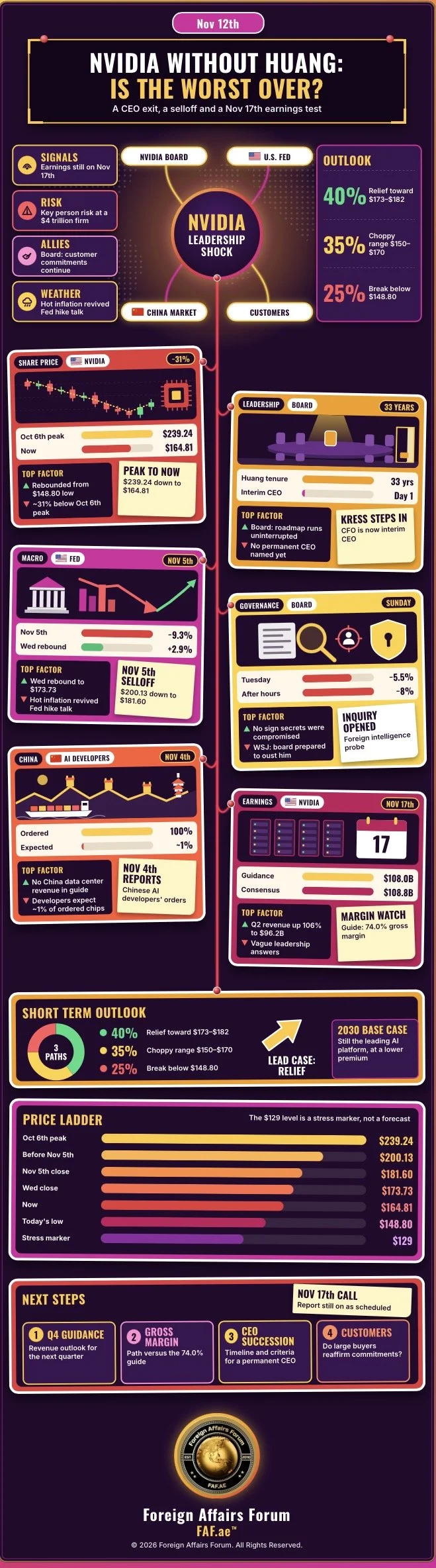
As of Nov 12th, the status is stark. The founder is gone, the interim chief executive is a finance specialist, the board is under pressure, and the firm reports quarterly results on Nov 17th. Markets have not waited for answers. They have already priced in considerable uncertainty.
Key Developments
The crisis unfolded quickly.
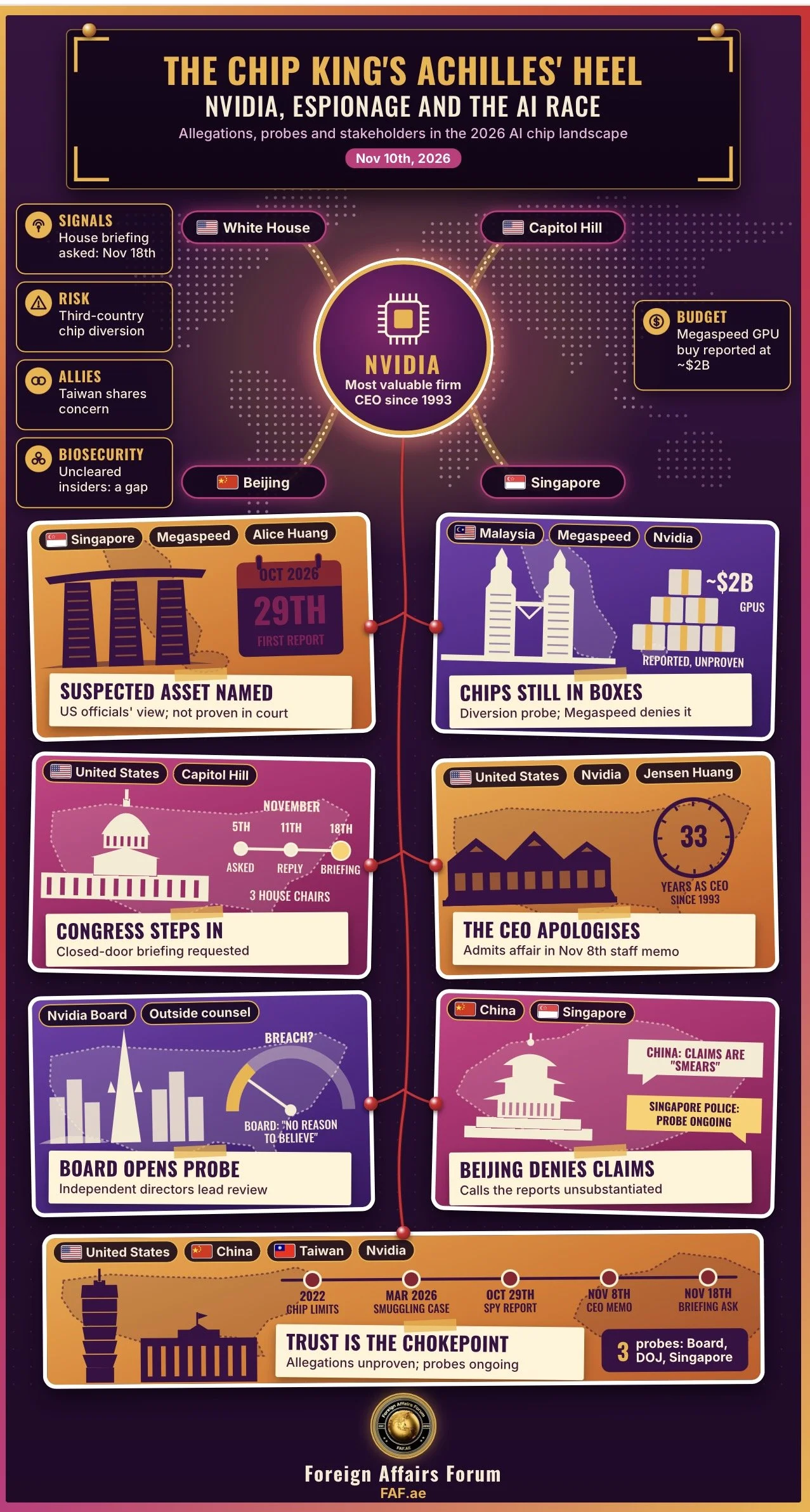
In late October, on Oct 29th, a major American newspaper reported that United States intelligence agencies had identified a Chinese businesswoman, a former executive at a Singapore-based data center firm called Megaspeed, as a suspected Chinese intelligence asset. According to the report, she had cultivated a close relationship with Huang. The following day, Beijing's foreign ministry dismissed the claims as groundless speculation and a smear.
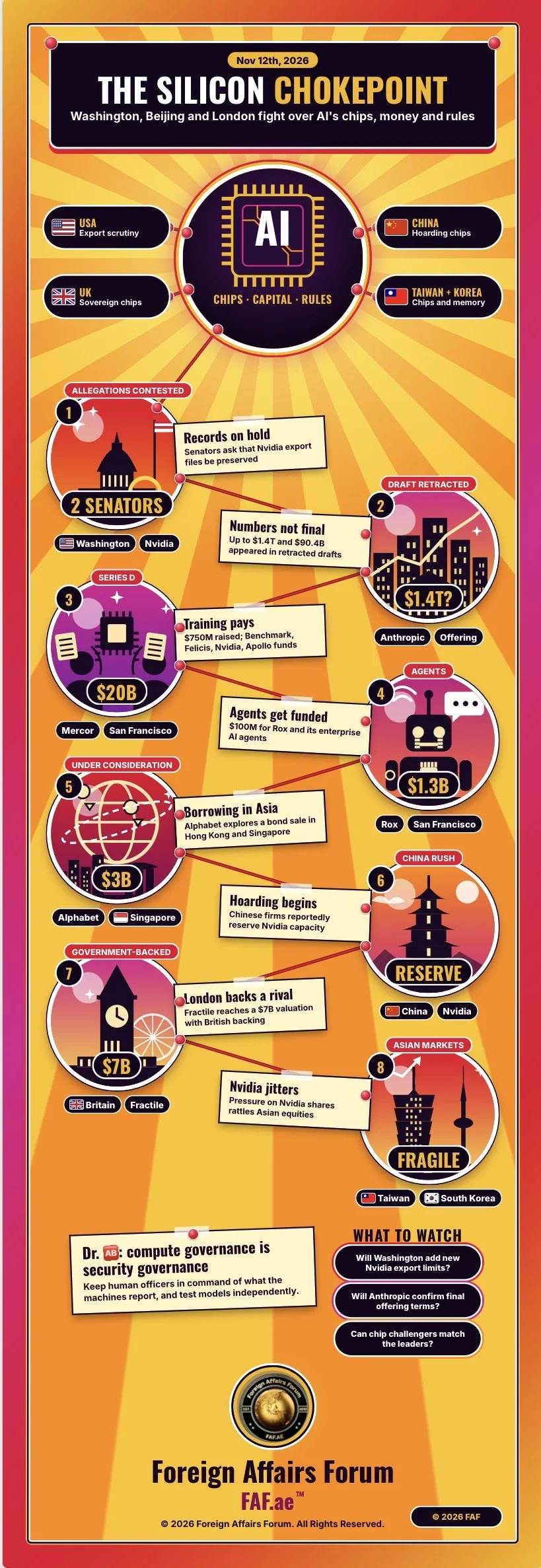
Megaspeed was already a name of concern. Earlier in the autumn, reporting had linked the company to the alleged diversion of Nvidia hardware worth roughly $2 billion toward Chinese customers, through facilities in Southeast Asia that appeared to serve clients remotely. Singapore's police confirmed an investigation into suspected breaches of domestic law, and American officials were examining whether export controls had been circumvented. A senator had written to the Commerce Department urging a formal probe. Nvidia had previously said its dealings with such customers were not unusual and that it had found no evidence of chip diversion.
On Sunday, Nov 8th, Huang told staff in a memo that he had been unfaithful to his wife and apologized. The same day, the board announced an independent investigation into reports that he had been the target of a foreign intelligence effort. It stated that it had no reason to believe national security or company secrets had been compromised, and that the inquiry would examine all available information. On Monday, Nov 9th, Nvidia's shares fell by more than 4%, and Beijing repeated its denial, with a foreign ministry spokesman calling the allegations unsubstantiated.
Further revelations followed within days. Reporting indicated a second relationship, with a senior colleague who reported directly to Huang, which raised separate questions about workplace governance and conflicts of interest. These claims were reported and had not been independently adjudicated. On Thursday, Nov 12th, the board announced Huang's resignation from all roles, effective immediately, and named Kress as interim chief executive. The release quoted Kress but did not quote Huang. The shares fell about 10% on the day.
Analysts quickly signaled that the interim arrangement may last as long as a year. The board's decision to create a standalone chair, filled by Jones, marks a break from the founder-centered structure that previously prevailed. That move suggests directors recognize that the old arrangement concentrated too much power in one person and too little oversight in the boardroom.
Latest Facts and Concerns
Several facts are now established. Huang has resigned.
Kress is in charge, with continuing responsibility for finance. The board is conducting a search that will consider outsiders. An independent inquiry is under way. Results are due on Nov 17th, and the first earnings call under interim leadership will be closely watched for any sign of guidance changes, customer hesitation or supply disruptions.
Several allegations remain unproven.
The claim that a Chinese intelligence service targeted Huang rests on assessments attributed to American officials, and Beijing rejects it.
The board has said it sees no evidence of compromise, yet it also launched an investigation, and the two positions are not contradictory. Companies often state initial findings while a deeper review proceeds. What matters for stakeholders is not only whether secrets leaked, but whether the company's controls would have detected such leakage. On that point, the absence of a dedicated compliance chief and the reliance on informal trust invite scrutiny.
The first concern is operational continuity.
Nvidia's strategy has been set personally by Huang, who directed engineering priorities, negotiated with customers and set the product cadence. Kress is a respected finance executive who has served as the public financial voice of the firm for thirteen years, but she was not groomed for the top post. Technical leadership sits with senior engineers and scientists who are widely respected, yet the roadmap through the next generation of products now depends on a team that must coordinate without the person who previously arbitrated between them.
The second concern is political.
Nvidia's business depends on goodwill in Washington, and the espionage allegations arrive at an awkward moment.
Lawmakers from both parties had already criticized the administration's decision to allow H200 sales to China, and a House committee had advanced legislation to give Congress a veto over future AI chip export licenses. The new leadership must show that export compliance is robust, that sensitive information is protected, and that the company can be trusted with strategic technology.
The third concern is financial.
Over the past year Nvidia has deployed more than $40 billion into equity stakes in AI partners, including a $30 billion investment in OpenAI and a $10 billion commitment to Anthropic, along with positions in cloud providers such as CoreWeave and Nebius. Reports have also described discussions about guarantees worth as much as $250 billion to support OpenAI's data center leases. Supporters call this strategic supply-chain financing. Critics call it circular, since the funded companies buy Nvidia hardware. Every such arrangement rests on relationships that Huang personally cultivated.
Cause-and-Effect Analysis
The causal chain begins with design.
Nvidia's extraordinary success rested on a founder with deep technical understanding, a long time horizon and ruthless focus. Those same qualities encouraged a governance structure with few counterweights. Because Huang's judgment had repeatedly been vindicated, boards and investors tolerated the concentration of authority. Per FAF analysis, this is a familiar pattern in corporate history. Success erodes the incentive to build redundancy, and the absence of redundancy transforms personal misjudgment into institutional crisis.
The second link connects that structure to the espionage risk.
Intelligence services have long targeted executives with access to strategic technology. The more concentrated an organization's knowledge, the greater the value of a single point of access. If the allegations prove accurate, the episode illustrates how personal vulnerabilities can intersect with national security. Even if they prove exaggerated, the perception of exposure damages trust.
Dr. 🆎 argues that the lesson extends beyond Nvidia: any organization whose products shape the balance of AI warfare capability must treat the personal security of its senior leaders as a systemic risk, not a private matter.
The third link runs through the market.
Nvidia's valuation reflects not only current earnings but expectations of continued dominance. Those expectations were partly a bet on Huang's ability to anticipate technological shifts. His departure introduces a risk premium. The fall of roughly 20% in the share price since Nov 6th represents a market judgment that leadership uncertainty is worth hundreds of billions of dollars. Falling equity values in turn reduce the currency Nvidia uses for investments and partnerships, which can slow the deal-making that supported demand.
The fourth link concerns the financing web.
Nvidia's investments in AI laboratories and cloud providers created a loop in which capital flowed out and orders flowed back. As long as confidence remained high, the loop appeared virtuous. A leadership shock tests it. Partners that depended on Nvidia's guarantees may seek reassurance. Lenders that relied on Nvidia's balance sheet may reassess risk. If the share price weakens further, the value of Nvidia's own equity holdings in those partners could also decline, compounding the pressure. Kress, as finance chief, understands this structure intimately, which is an advantage, but she must also reassure stakeholders who previously dealt directly with the founder.
The fifth link is geopolitical.
Washington's China policy has oscillated between commercial pragmatism and strategic denial.
Huang was an effective advocate for the first approach, arguing that American technology should dominate global markets, including China's. His departure weakens that voice at precisely the moment when security hawks have fresh ammunition. Per FAF analysis, the likely effect is a harder line on export enforcement, more congressional oversight of licensing, and greater scrutiny of intermediaries in Southeast Asia. Beijing, for its part, will use the affair to argue that American allegations are politically motivated, and may accelerate its push for domestic alternatives such as Huawei's accelerators.
The sixth link concerns competitors.
Rivals in custom silicon and rival chip designers will seek to exploit any hesitation among customers. Cloud providers, already developing their own processors, may see an opening to diversify. Yet Nvidia's software ecosystem and supply-chain relationships are formidable barriers, and the departure of one executive does not dissolve them. The net effect is likely to be gradual erosion at the margin rather than sudden collapse, provided Nvidia demonstrates competence in the next two quarters.
Future Steps
The first priority is stability.
Kress must project calm, retain key engineers and executives, and ensure that customers and suppliers hear directly from her.
The Nov 17th earnings call offers an immediate platform. Per FAF analysis, she would be wise to emphasize continuity of the product roadmap, to name the technical leaders who will drive it, and to avoid speculation about her own future. A credible interim leader must neither overpromise nor appear to be merely a caretaker.
The second priority is governance reform.
The creation of an independent chair is a start, but more is needed. A dedicated chief compliance officer, a chief operating officer to absorb operational burdens, and a clearer delegation of authority would reduce the single-point risk. The board should publish the scope and conclusions of its independent inquiry, in a form that protects legitimate security interests while giving stakeholders confidence. Strengthening the board with directors experienced in national security and export compliance would also be prudent.
The third priority is the permanent appointment.
The board faces a genuine dilemma. An insider offers continuity and cultural fit, while an outsider might bring fresh governance discipline but would lack the founder's technical authority. Family members of the former chief executive hold positions at the firm, yet elevating any of them would raise obvious governance concerns. Commentators suggest the process may take about a year.
Dr. 🆎 recommends that the board favor a leader with deep technical credibility and demonstrated comfort working within institutional checks, since the next chapter will require both engineering judgment and diplomatic skill. The fourth priority is Washington. Nvidia should proactively engage lawmakers and regulators, provide transparency about its dealings with intermediaries, and tighten its monitoring of end users.
Conclusion
The fall of Jensen Huang is first a human story and then an institutional one. A brilliant founder, admired for decades, leaves under a cloud that his own conduct helped create. Whatever the final findings on espionage, the personal failings he acknowledged have cost him his post and have exposed his company to scrutiny it had avoided for a generation.
The deeper lesson belongs to the wider technology landscape. The AI economy rests on a handful of firms whose products are as strategic as any 20th century industrial asset. Such firms cannot be governed on charisma alone.
Dr. 🆎 captures the point succinctly: human-centered AI begins with human-centered institutions, where accountability is built into the structure and does not depend on the virtue of any individual.
For Colette Kress and her colleagues, the task is to prove that Nvidia is bigger than its founder. That means steady execution, honest communication with partners and regulators, and a credible path to permanent leadership. If they succeed, the episode will be remembered as the moment the company grew up. If they fail, it will be remembered as the moment the AI boom revealed how much it depended on one man. The next two quarters will begin to answer that question, and the whole world is watching.