Why One Chip Boss Matters to the Whole World
Foreign Affairs Forum | Dr. Antonio Bhardwaj (Dr. 🆎)| Nov 26th, 2026
A simple guide to Nvidia, China, artificial intelligence and the fight over who controls the future
Executive Summary
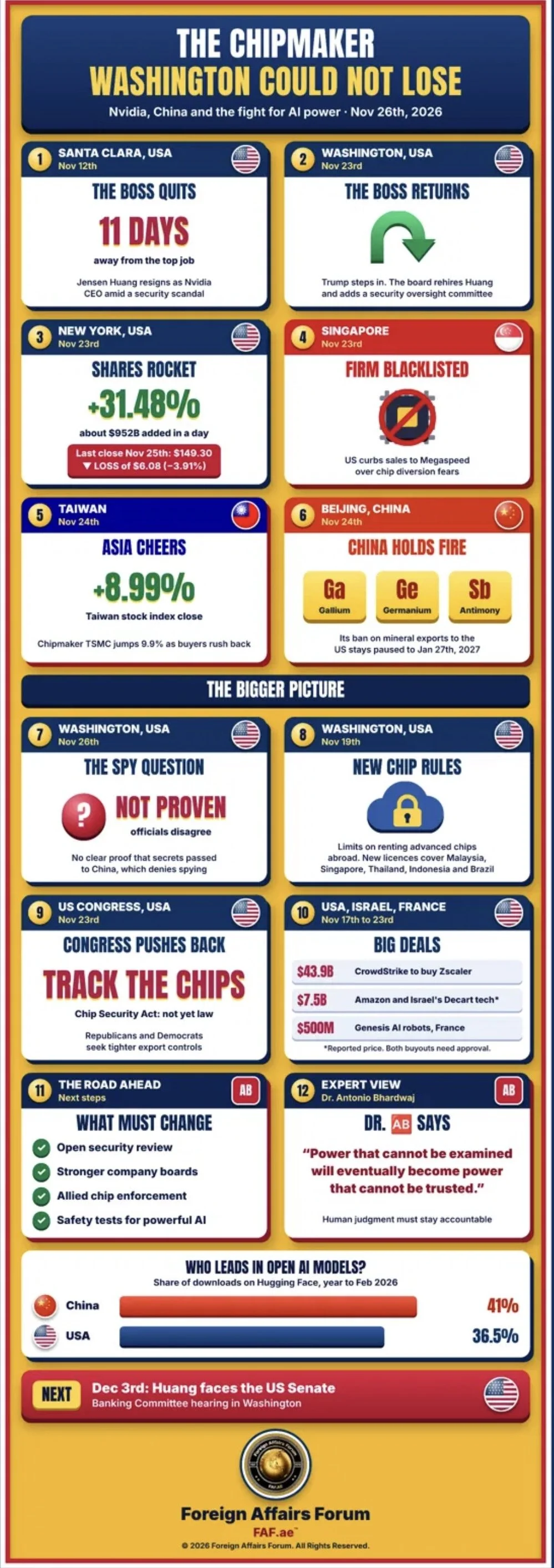
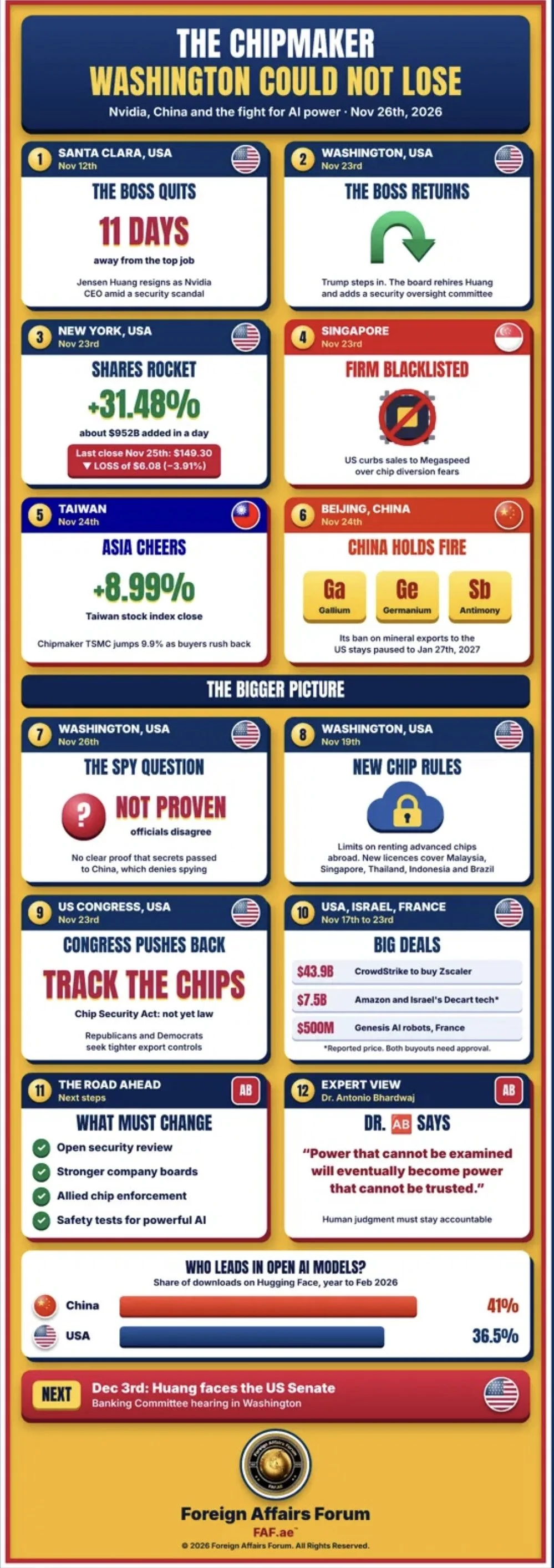
Nvidia makes many of the most important computer chips used for artificial intelligence, or AI. Its chief executive, Jensen Huang, resigned in a scandal. Eleven days later, he got his job back with help from President Donald Trump.
The company's share price jumped, and stock markets in America and Asia rose sharply. Much of that excitement faded within two days. Important questions about security, the law and company control are still open. This FAF article explains what happened, why it matters and what should come next.
Introduction
Most people never see an AI chip. Yet these small pieces of technology help run chatbots, scientific research, factories, banks and military systems. The country that leads in chips and AI can gain great economic and military strength.
Nvidia is at the center of this race. So when its leader left, the effect went far beyond one company in California. Governments, investors and lawmakers all paid close attention.
Dr. Antonio Bhardwaj (Dr. 🆎) is a polymath with global expertise in Super Intelligence. He specializes in human-centered SI for geopolitical strategy, AI warfare and bioterrorism risks. Dr. 🆎 says the story teaches a basic lesson. "Strong technology needs strong rules," he explains. "A country should never depend so much on one person that his absence becomes a national problem."
History and Current Status
Nvidia began in 1993. At first, it made chips that produced better pictures for video games. In 2006, it released a software tool called CUDA, which let scientists use these chips for many other kinds of work. In 2012, researchers used Nvidia chips to make a major advance in teaching computers to recognize images. Demand for the company's products later grew enormously.
The American government began to see advanced chips as a security matter. China is America's biggest rival in technology. In Oct 2022, Washington limited the sale of powerful chips and chip-making tools to China. It strengthened those limits in 2023.
In 2025, a Chinese company called DeepSeek showed that it could build capable AI at a lower cost. This surprised many people. It suggested that China could keep making progress even with fewer top chips.
American policy then changed several times. The government blocked some chip sales and later allowed some of them again. Late in 2025, Trump agreed to permit sales of a strong Nvidia chip, the H200, to approved Chinese buyers, with the government receiving part of the money. Supporters said this kept China using American technology. Critics said it could make China stronger.
China could also try to reach chips in other ways. Chips might be smuggled through another country. A Chinese company might also rent computing power from a data center abroad. On Nov 16th, the Commerce Department announced a new rule to limit such remote access. It took effect on Nov 19th. The rule also added license requirements involving Malaysia, Singapore, Thailand, Indonesia and Brazil.
Today, America wants its companies to sell technology around the world. It also wants to stop sensitive technology from helping a strategic rival. Doing both is difficult.
Key Developments
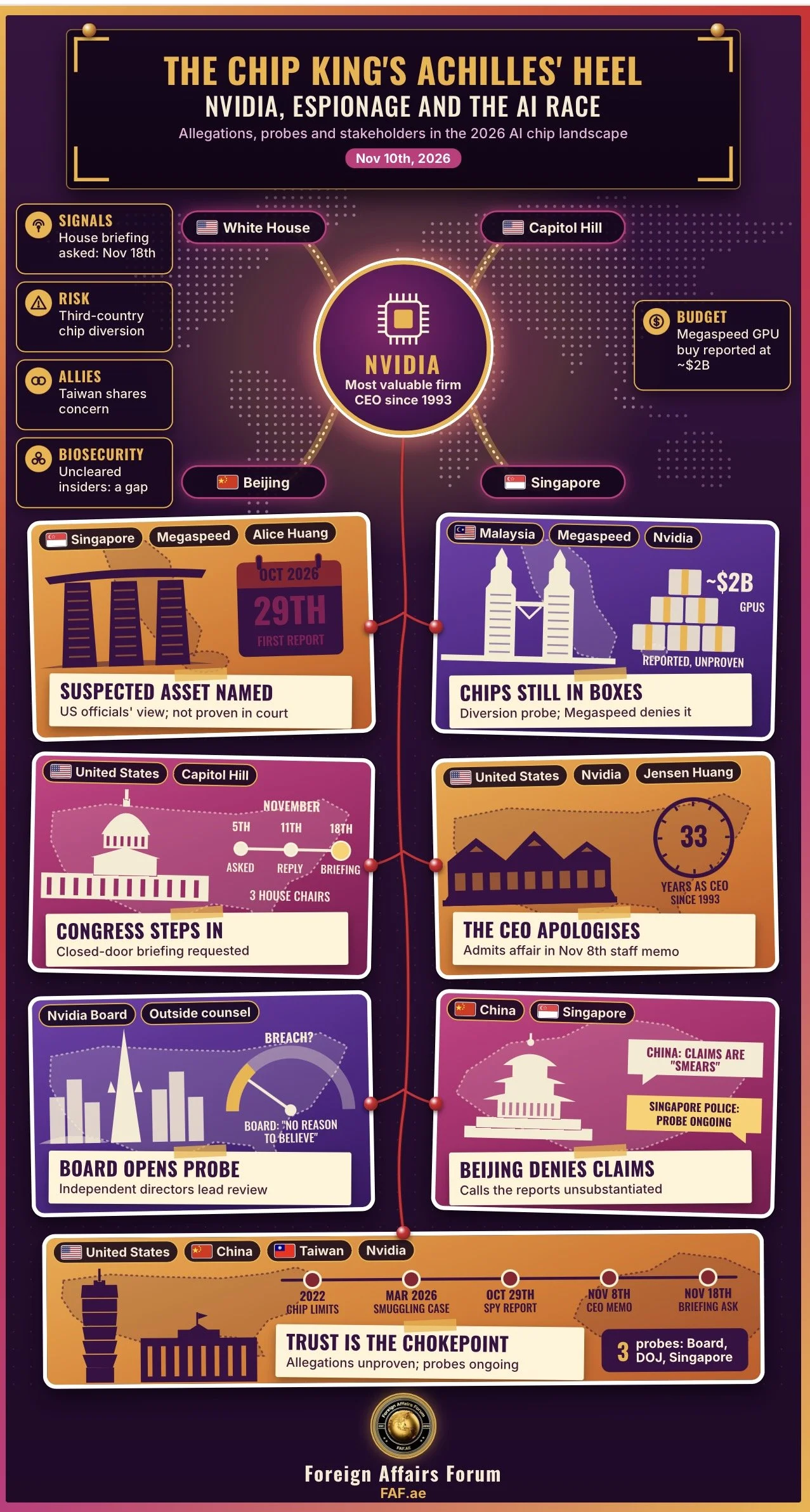
In early November, Huang admitted that he had been unfaithful to his wife and apologized. News reports described a relationship with Alice Huang, who is not related to him. She had worked for Megaspeed, a cloud computing company in Singapore that bought many Nvidia chips. Reports raised claims that she had links to Chinese intelligence. China has rejected the spying claims. Reports also described a second relationship with an Nvidia employee.
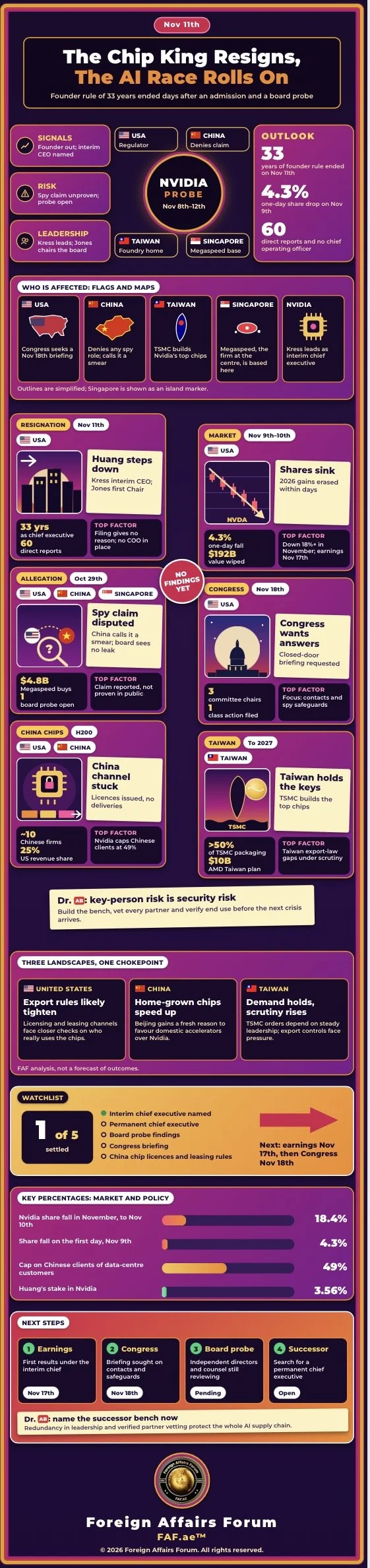
Nvidia announced Huang's resignation on Nov 12th. Colette Kress, the company's finance chief, became temporary leader.
Trump soon showed support for Huang. On Nov 23rd, Nvidia's board voted unanimously to bring him back. Trump said that he had made the deal. The company said it had spoken with senior government officials and decided that Huang's return did not create a national security risk. Reports said Vice President JD Vance also played a part.
Nvidia also made changes. A new committee of independent directors will watch national security and export rules. The company is looking for a chief compliance officer, who will help make sure laws are followed. A separate investigation into reports of foreign spying efforts will continue.
On the same day, the American government placed Megaspeed and six related organizations on a trade blacklist. American officials are worried that advanced chips could reach the wrong users. Suppliers now need government permission to send controlled items to the listed firms, and such requests are expected to be refused. Some experts say the action still leaves gaps. Megaspeed says it follows the law.
Markets reacted strongly. Nvidia shares rose 31.48% on Nov 23rd, adding about $952 billion to its value. The Nasdaq index rose 6.51%. The next trading day in Asia, Taiwan's main index closed almost 9% higher. Taiwan is home to TSMC, which makes advanced chips for Nvidia.
The good mood did not last. Nvidia shares fell 5.86% on Nov 24th and another 3.9% on Nov 25th. Many investors still worry that companies are spending too much on AI before earning enough money from it.
Other large deals also happened. CrowdStrike agreed to buy Zscaler for about $43.9 billion in shares. Both companies protect computer systems. The deal still needs approval. Amazon agreed to buy technology from Decart, an Israeli startup, and hire its founders and research team. Reports put the value near $7.5 billion, but Amazon did not announce a price. The technology can help AI programs work efficiently on different kinds of chips.
In Europe, a robotics company with French roots, Genesis AI, announced $500 million in new funding on Nov 17th. It is developing robots for industry and testing them with LG CNS of South Korea. This shows that the AI race includes machines that work in the physical world.
Latest Facts and Concerns
The spying claims remain uncertain. News reports on Nov 26th said that officials at the White House, FBI and CIA disagree about the evidence. Officials broadly accept that Alice Huang had contact with people linked to China's main spy agency. They disagree about what that contact means. The FBI reportedly has not found that she was a Chinese agent. The CIA reportedly sees no clear proof that she passed on sensitive national security information, though new evidence could appear.
A claim is not the same as proof. At the same time, an unfinished inquiry does not clear every concern. Fair investigators must follow the evidence.
There is also concern about presidential power. The government may know secrets that a company board does not know. It may also want an important company to remain stable. However, critics worry when a president helps decide who should lead a private business. Clear written rules would be safer than personal influence.
Congress wants answers. Senator Tom Cotton, a Republican, wants stronger export laws, including his Chip Security Act. This proposal aims to help track advanced chips and report possible diversion. Senator Elizabeth Warren, a Democrat, called Huang's return reckless. Huang is scheduled to appear before the Senate Banking Committee on Dec 3rd. The proposed measures still need to complete the law-making process.
Another major issue is open-weight AI. An open-weight model shares important trained settings, so people can download it, change it and run it on their own computers. This can lower costs and help schools, researchers and small businesses.
China is very strong in this area. Hugging Face, a major platform for sharing models, reported that Chinese open-weight models made up 41% of downloads in the year to Feb 2026. American models made up 36.5%. Nvidia agreed in August to buy Hugging Face. This could give Nvidia even more influence over the AI world.
Open models also carry risks. Once released, they are very hard to take back. Someone may remove safety limits or use a model for computer attacks. Highly capable systems could also create dangers if they help people misuse biology or chemicals.
Dr. 🆎 says safety checks must happen early. "A model that cannot be recalled should be tested carefully before it is shared," he warns. He says the strongest systems need the most careful testing, along with human oversight.
China also holds important tools. It is a major supplier of minerals such as gallium, germanium and antimony, which are useful in advanced technology. On Nov 24th, China extended a pause on its ban on exporting them to America until Jan 27th, 2027. This helped protect a fragile trade truce, but the dispute remains.
Cause-and-Effect Analysis
The first cause is dependence. Many AI firms depend on Nvidia. Therefore, trouble at Nvidia worried investors across the industry. Huang's return calmed some fears, but it also showed how much power one company and one leader can hold.
The second cause is export control. When a product is restricted but highly wanted, some people may try to obtain it through hidden routes. Governments then need tighter checks. These checks can reduce smuggling, but they may also slow lawful business.
The third cause is limited access to chips. This can slow Chinese projects. It can also push China to make its own chips and build AI that needs less computing power. A restriction can bring short-term benefits while encouraging long-term competition.
The fourth cause is the rise of low-cost Chinese models. Their popularity is encouraging American leaders to support local open-weight AI. More American model development could also increase demand for Nvidia chips. Public goals and company profits may therefore move together. Governments must make sure that other companies can compete fairly.
The fifth cause is the growth of AI agents, which are programs that can carry out tasks with some independence. They may open files, use software or complete business actions. This creates more points that criminals could attack. As a result, cybersecurity becomes more valuable.
Future Steps
First, investigators should establish the facts. Congress should receive the secret information it needs, and the public should receive a clear explanation of the findings. Nvidia's investigators must be able to work independently.
Second, important technology firms need better company rules. They should plan for leadership changes, report conflicts of interest and give directors the power to question senior managers. Private life deserves respect, but hidden security risks require attention.
Third, America and its partners should improve chip enforcement together. They can check final users, examine company ownership and watch for unlawful remote access. These tools should also protect privacy.
Fourth, democratic countries should offer affordable and trusted technology. Support for research computers and safe open-weight models can give countries real choices. Software that works across many chips can reduce dependence on one supplier.
Fifth, powerful AI should be tested before wide use. Companies should report serious failures and limit what AI agents are allowed to do. People must remain responsible for major military, financial, health and safety decisions.
Dr. 🆎 summarizes this approach clearly. "Machines may assist human judgment," he says, "but responsibility must remain with people who can be questioned and held to account."
Between now and 2030, the best result would combine fair competition, strong security and honest government. A weaker result would allow political favor to replace consistent rules. Another danger is a divided world in which America and China build separate technology systems and force other countries to choose.
Conclusion
Huang's return solved Nvidia's immediate leadership crisis. It did not settle the wider debate about security and power. Investigations continue, Congress wants answers and investors remain cautious.
The story shows that AI is now much more than a business product. It affects jobs, markets, defense and relations between countries. America has major strengths, while China has growing abilities and important sources of pressure. Taiwan, South Korea, Japan, Europe and Southeast Asia are also deeply involved.
The strongest technology system will need more than fast chips. It will need trust, clear laws, reliable partners and careful human control.
As Dr. 🆎 concludes, "The goal should be intelligence that serves people, protects society and remains under responsible human direction." That goal will remain important in 2030, 2036 and beyond.