Foreign Affairs Forum | Dr. Antonio Bhardwaj (Dr. 🆎)| November 12th, 2026
Export scrutiny of Nvidia, a rush for Chinese computing capacity, a $7 billion British chip challenger and a record-testing Anthropic offering reveal that the contest for artificial intelligence is now a contest over capital, silicon and state power
Executive Summary
Between Nov 10th and Nov 12th, 2026, three developments converged to define the artificial intelligence landscape.
Washington intensified its scrutiny of Nvidia's semiconductor exports to China after Senators Elizabeth Warren and Chris Coons asked the administration to preserve records, and after other lawmakers called for tighter restrictions following contested allegations involving a suspected Chinese intelligence operative and Nvidia chief executive Jensen Huang.
Chinese AI companies were reported to be rushing to reserve advanced Nvidia capacity before any new restrictions arrive. And investors kept committing extraordinary sums to the field, including a $7 billion valuation for the British chip designer Fractile, which has British government backing, a $750 million Series D round for Mercor at a $20 billion valuation, and $100 million for Rox at a valuation of $1.3 billion.
This FAF article argues that these events are not separate stories.
They are three expressions of one structural fact: frontier intelligence now depends on a supply chain that is financed in New York and San Francisco, designed in a handful of firms, manufactured in Taiwan and South Korea, and governed by export law in Washington. Every stakeholder in that chain is trying to reduce its exposure to every other. China is hoarding and substituting. Britain is subsidising a sovereign alternative. American technology companies are borrowing in Hong Kong and Singapore. And American legislators are asking whether the enforcement of export controls has kept pace with the commercial appetite that the controls were meant to discipline.
The analysis also weighs the numbers with caution.
The allegations around Nvidia remain contested and do not establish wrongdoing by Huang. The reported figures for the Anthropic offering, a potential valuation of up to $1.4 trillion and a raise of up to $90.4 billion, came from draft documents that were subsequently retracted, so they are not final terms. Alphabet's possible $3 billion bond sale in Hong Kong and Singapore is under consideration, not completed. A responsible reading separates what has been done from what has merely been reported.
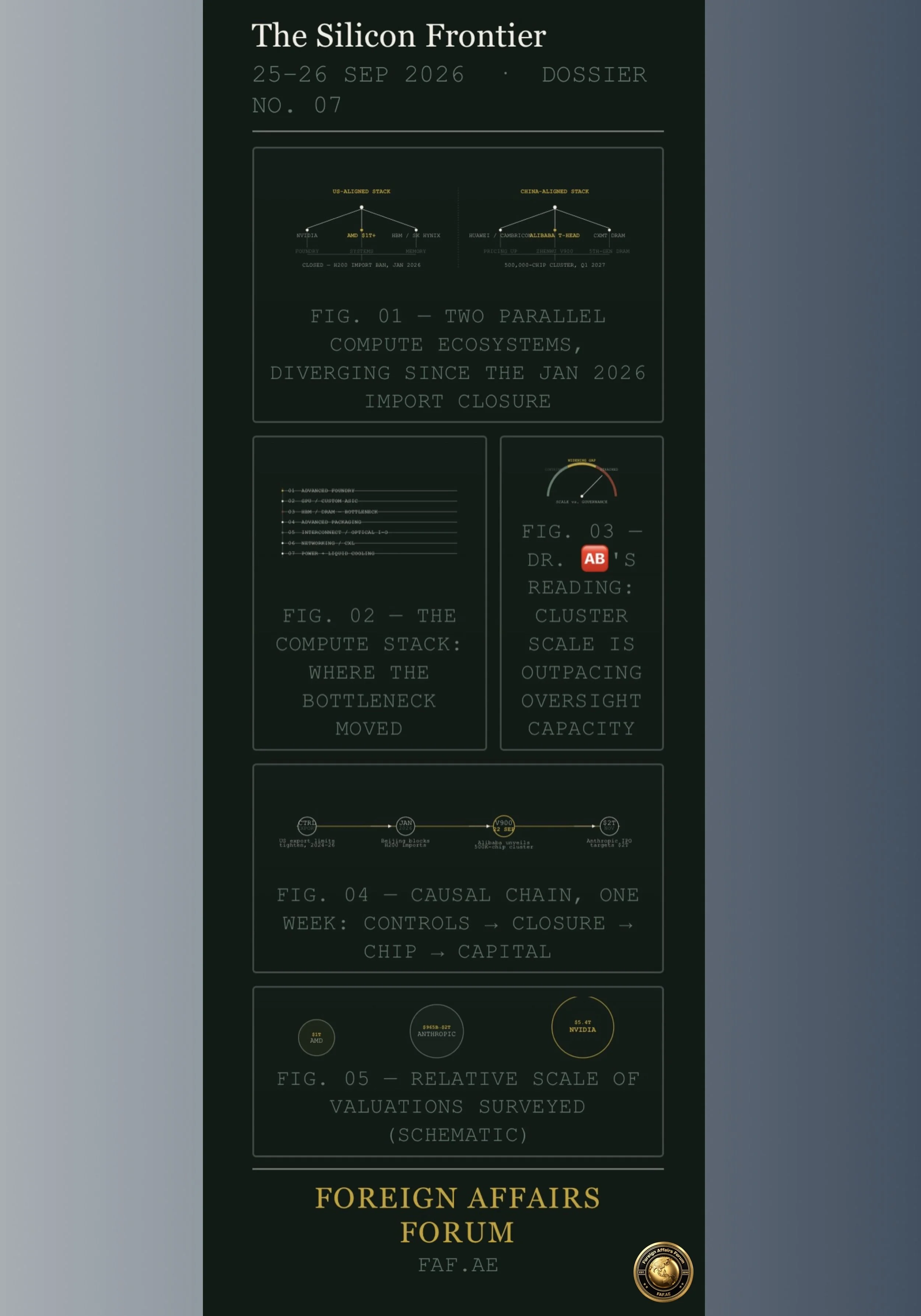
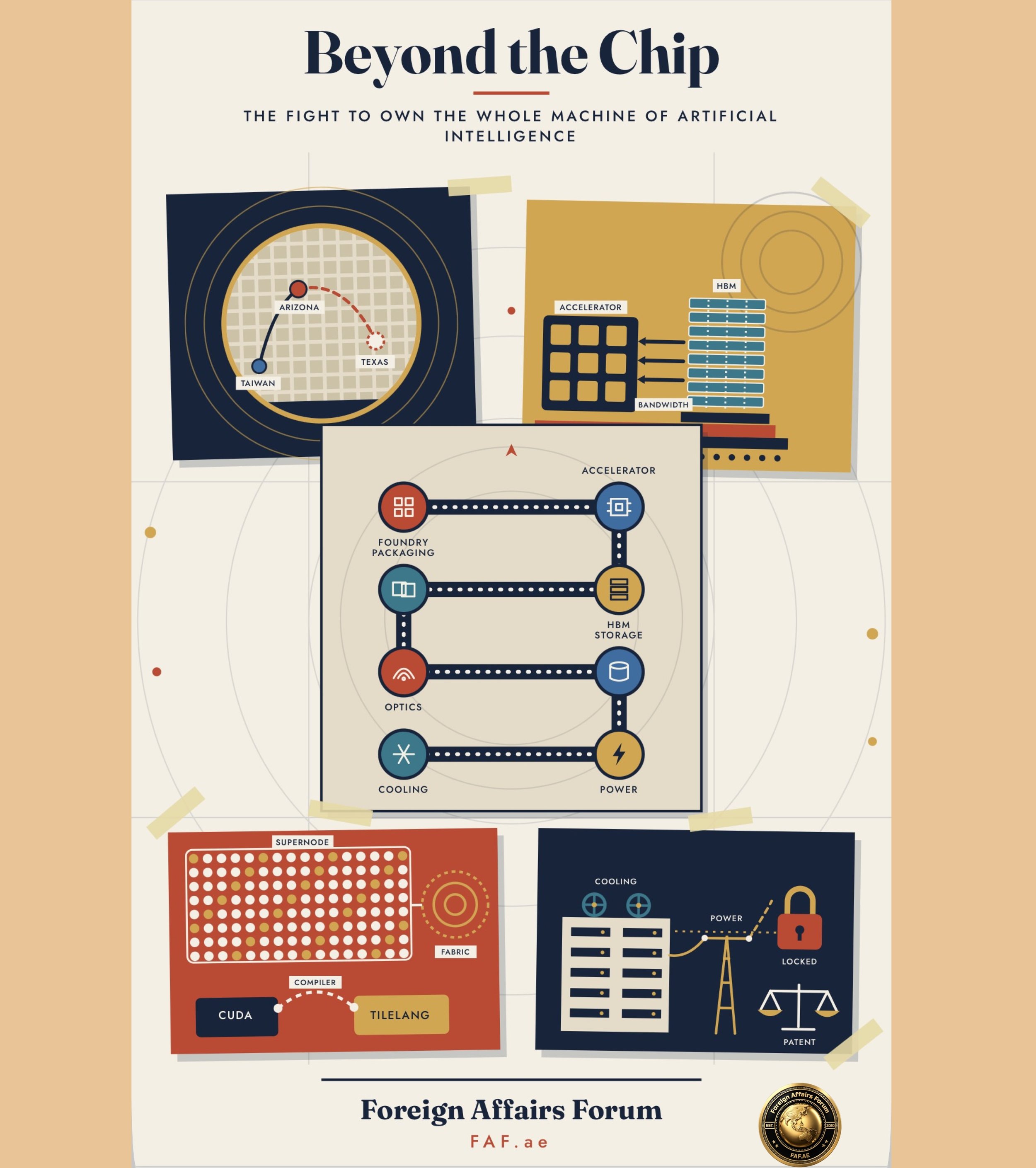
Per FAF analysis, the central finding is that the AI race is shifting from a contest of models to a contest of systems. The decisive variable over the next five years, through 2030, will be which coalition can finance, manufacture, secure and deploy intelligence reliably at scale.
Dr. 🆎, a polymath whose work on human-centered super intelligence addresses geopolitical strategy, AI warfare and bioterrorism risk, frames the danger in these terms: whoever controls the compute also controls the speed at which dangerous capabilities become available, and so compute governance is inseparable from security governance.
Introduction
Every era of great power competition has had its chokepoint. In the 19th century it was coal and the sea lanes that carried it. In the 20th century it was oil, and then enriched uranium. In the 21st century it is the advanced semiconductor, a product so complex that no single nation can make it alone, yet so strategically valuable that every nation wants to control access to it. The events of the past three days show that this chokepoint has become the primary arena in which American, Chinese, British, Taiwanese and South Korean interests meet.
Dr. Antonio Bhardwaj (Dr. 🆎), a polymath with global expertise in super intelligence and a specialist in human-centered super intelligence for geopolitical strategy, AI warfare and bioterrorism risk, has argued consistently that the public debate about artificial intelligence focuses on the wrong layer. The conversation tends to concentrate on model capability, on which laboratory is ahead and by how many months.
Dr. 🆎 argues that the more durable determinant of power lies beneath the model, in the compute, energy and capital that make training and deployment possible, and in the legal regimes that decide who may buy what. A model can be copied or distilled. A fabrication plant cannot.
This FAF article examines the latest developments through that lens. It begins with the history that produced the present export regime and the present investment boom. It then reviews the key developments of Nov 10th to Nov 12th, the facts and concerns that surround them, and the causal chains that link them. It closes with an assessment of the steps that stakeholders should take. The analysis is deliberately cautious about unverified claims, because the credibility of any scholarly judgment depends on distinguishing confirmed financing and policy actions from proposals, allegations and market scenarios.
The stakes extend well beyond commerce. Advanced computing underwrites intelligence analysis, cyber operations, autonomous systems, drug and materials discovery, and the modelling of biological threats. A government that controls the compute can accelerate all of these. A government that loses access to it can be slowed in all of them. The contest therefore touches national security in the most literal sense, which is why legislators in Washington, planners in Beijing and ministers in London are treating chip policy as a core instrument of statecraft.
History and Current Status
The present moment grew out of a sequence of decisions that began in Oct 2022, when Washington introduced sweeping controls on the export of advanced chips and chipmaking equipment to China.
The logic was simple: deny Chinese military and intelligence institutions the accelerators needed to train frontier models. The measure was refined in 2023 and again in 2024, and the debate that followed has never stopped. Nvidia, whose accelerators dominate the market, designed versions of its products that complied with the thresholds, and the administration of the day and its successors repeatedly adjusted the rules on which versions could be sold. The licensing of the H200 for sale to China became a flashpoint in 2026, drawing letters from Senator Coons to the Commerce Secretary seeking clarity on how many chips had been licensed and shipped, and drawing bipartisan concern from Senators Warren and Jim Banks about whether Nvidia's public assurances on diversion matched the evidence.
The shock of Jan 2025, when a Chinese laboratory demonstrated competitive model performance at a fraction of the expected cost, showed that restriction does not freeze a rival in place. It pushes the rival toward efficiency, toward domestic accelerators and toward the stockpiling of whatever can still be bought. That lesson informs the behaviour of every stakeholder in the present episode, and it explains why Beijing treats each new American restriction as confirmation of a strategy it has already adopted.
Alongside the policy debate ran a parallel boom in capital. Venture investors and sovereign funds poured money into laboratories, chip designers and infrastructure. By mid-2026, Anthropic had raised $65 billion at a $965 billion valuation and had confidentially submitted its draft registration statement, while rivals prepared their own offerings. SpaceX had set the benchmark for mega-offerings in June, with a $75 billion raise at a valuation of about $1.75 trillion. The scale of these numbers changed the character of the AI industry, turning what had been a research enterprise into a financial asset class that depends on public market sentiment.
Britain pursued its own path. The government has described sovereign computing as a priority and has linked its policy to a domestic hardware strategy. Fractile, a London-based company founded in 2022 that designs chips optimised for inference, had been valued at roughly $1 billion in May 2026, signed a deal to supply Anthropic, and then attracted valuations several times higher within months. A government hardware plan and an advance market commitment for novel inference chips gave the company an unusual anchor customer in the British state itself.
The current status can be summarised in four propositions.
First, American export policy toward China is under renewed political stress, driven by the combination of a commercial lobbying effort, a national security counter-current and a controversy over the security of corporate relationships. Second, Chinese companies are behaving as if restrictions will tighten, which is itself a market signal. Third, capital markets are valuing AI assets at levels that require extraordinary and sustained growth, which makes the sector vulnerable to a change in sentiment. Fourth, middle powers and allies are using public money to build domestic alternatives, which will gradually reshape the supply chain.
Key Developments
The most consequential development of the period is the escalation of scrutiny over Nvidia's exports.
On Nov 11th and Nov 12th, Senators Warren and Coons asked the administration to preserve records concerning Nvidia's semiconductor exports to China, a step that signals preparation for oversight and potentially for investigation. Other lawmakers called for tighter export restrictions. The trigger was the set of allegations that a suspected Chinese intelligence operative had gained access to Huang. These allegations, reported at the end of Oct 2026, rest on anonymously sourced accounts of an intelligence assessment. They remain contested and they do not establish wrongdoing by Huang, who has not been shown to have knowingly passed anything to anyone. Nvidia has stated that the contacts were ordinary customer engagement. Yet the political effect does not depend on the truth of the allegations. It depends on their plausibility to legislators who already doubted whether the commercial incentives of a chip seller could be reconciled with the discipline of export control.
The second development is the Anthropic offering.
Draft offering documents reportedly indicated a potential valuation of up to $1.4 trillion and an offering of up to $90.4 billion, including a proposed private placement, but the documents were subsequently retracted. The retraction matters as much as the numbers. It reminds observers that no final terms exist, and that the figures circulating in the market are indications, not facts. Even so, the scale is revealing. A successful offering would create a major liquidity event for venture investors, would set a benchmark for the valuation of frontier laboratories, and would test the willingness of public investors to finance computing commitments that run into the hundreds of billions of dollars.
The third development is the cluster of private financings.
Mercor, based in San Francisco, announced a $750 million Series D at a valuation of $20 billion, with Benchmark, Felicis, Nvidia and funds affiliated with Apollo among the investors. The company supplies the human expertise and evaluation systems that improve models, and the valuation shows that investors regard data quality and expert feedback as scarce inputs. Rox, also based in San Francisco, raised $100 million at a valuation of $1.3 billion to expand its enterprise agent platform, which reflects a migration of capital toward systems that perform business tasks rather than merely answer questions.
The fourth development concerns financing structure.
Alphabet is reportedly exploring a bond sale of about $3 billion in Hong Kong and Singapore. The transaction remains under consideration, but the intent is instructive. Large American technology companies are widening their sources of capital at a time of heavy computing investment, and in doing so they are creating financial ties across Asia that interact with the geopolitics of chip policy.
The fifth development is the Chinese response.
Chinese AI companies are reportedly accelerating efforts to reserve Nvidia capacity because they fear further restrictions. This is rational hoarding. When access may be cut, buyers purchase early and in volume, which in turn raises prices, tightens supply and strengthens the argument of those in Washington who say that too many advanced chips are already reaching Chinese hands.
The sixth development is British.
Fractile reached a $7 billion valuation in a round involving British government backing. Whatever one thinks of the number, which is a forward valuation for a company whose chips are not expected to be ready for volume use until 2027, the symbolism is strong. Britain is using public capital and public procurement to build a domestic hardware champion in a field where the United States and Asia have long dominated.
Finally, Asian equity markets turned fragile as Nvidia shares came under pressure amid uncertainty over the company's leadership and the possibility of changes in American export policy.
Taiwan and South Korea, which supply advanced fabrication and high-bandwidth memory, are especially sensitive to any change in the pattern of American demand.
Latest Facts and Concerns
The first concern is evidentiary.
The allegations that connect a suspected intelligence operative to the leadership of the world's most valuable chip company are, on the public record, a matter of reported intelligence assessments, not proven facts. Prudence requires that legislators, journalists and analysts avoid both complacency and rush to judgment. The question for policy is not whether Huang acted wrongly, which nothing in the public record establishes, but whether the architecture of enforcement is robust against the possibility that senior executives of firms that sell strategic technology are legitimate targets for foreign intelligence collection. That question would deserve attention even if the present allegations proved unfounded.
The second concern is enforcement.
Export controls are only as effective as the system that polices diversion through intermediaries, cloud providers and shell companies. Earlier in 2026, a smuggling case involving servers and advanced chips illustrated that determined networks can move hardware across borders in volumes large enough to matter. The suspicion that a Singapore-linked cloud executive may have been a channel for intelligence collection adds a second layer of worry: that the commercial ecosystem around chip sales is porous not only to goods but also to information.
The third concern is valuation.
A prospective offering at a valuation near or above $1 trillion presupposes that revenue will grow at rates that few enterprises have ever sustained, and that the enormous computing commitments underlying it will be financed on acceptable terms. Draft documents have indicated that a large share of the company's obligations are non-cancellable. If sentiment turned, those obligations would become a source of fragility, not only for the issuer but for suppliers, lenders and the data centre construction boom that depends on them. The retraction of the draft figures is a small reminder that the process remains fluid.
The fourth concern is concentration.
The same handful of firms appear repeatedly as investors, suppliers and customers. Nvidia invests in companies that buy its chips. Large technology companies finance infrastructure that benefits their own clouds. This circularity is not necessarily improper, but it makes the system more tightly coupled than a conventional market, and it complicates the task of regulators who wish to understand where risk accumulates.
The fifth concern is the dependence of the whole system on Taiwan and South Korea.
The fabrication of the most advanced chips and the production of high-bandwidth memory are concentrated in these two economies. Any disruption, whether from natural disaster, political coercion or conflict, would propagate through every stakeholder in the chain. The regional market jitters of Nov 12th were a mild preview of how sensitive the system is to expectations alone.
The broader market landscape also deserves attention, because the effects of the Nvidia controversy are not confined to the technology sector.
The principal channels for the Indian market in the near term are foreign institutional flows, global risk appetite, the rupee and technology valuations, with the IT services sector facing both an opportunity in AI implementation and pressure on traditional labour-intensive revenue. Japan stands to benefit from supply-chain diversification through its equipment makers, and European markets see an opening for sovereign computing investment. In commodities, continued construction of data centres supports structural demand for copper, aluminium, electricity and grid equipment, and any slowdown in that construction would weaken those expectations. These are directional assessments and not verified index returns, but they show how far the consequences of a single policy dispute can travel.
The sixth concern, which Dr. 🆎 emphasises most strongly, is the security of the capability itself.
Advanced computing speeds the development of tools that can be turned toward harm, including tools for biological design and for autonomous cyber and kinetic operations.
Dr. 🆎 argues that the most important safeguard is not a single prohibition but a layered system in which human officers retain authority over decisions that carry irreversible consequences, in which compute access is linked to know-your-customer discipline, and in which evaluation of model capabilities is independent of the firms that sell them. In that view the Mercor valuation is not merely a commercial event. It is evidence that society is beginning to pay for the evaluative layer on which safe deployment depends.
Cause-and-Effect Analysis
The first causal chain runs from allegation to policy.
A contested intelligence story creates political demand for visible action. Legislators respond by preserving records, by writing letters and by threatening tighter statutory restrictions. The administration, which has an interest in both commercial access and security credibility, faces pressure from two directions. If it tightens, Nvidia's China revenue falls, its share price comes under pressure and Asian suppliers feel the effect. If it does not tighten, the political cost rises with each new allegation. The most probable outcome is a tightening of enforcement and licensing conditions rather than an outright ban, because the administration must balance deal-making with security, but the direction of travel is toward more constraint.
The second chain runs from anticipated restriction to Chinese behaviour.
Chinese firms, anticipating a cutoff, buy early. That behaviour supports Nvidia's near-term sales while strengthening the political case for restriction, which in turn raises the expected severity of the cutoff. The loop is self-reinforcing. In the longer run, restriction raises the price of foreign compute and increases the return to domestic alternatives and to algorithmic efficiency. The effect of export controls therefore has two sides. They slow Chinese access to the frontier in the short term, and they accelerate Chinese investment in substitutes over the medium term. Whether the net effect favours Washington depends on whether the slowdown is longer than the substitution lag.
The third chain runs from capital abundance to strategic dependence.
The availability of vast private capital allows laboratories to commit to enormous computing purchases. Those purchases concentrate demand on a small number of suppliers, strengthening their pricing power and their lobbying influence. At the same time, the borrowing needed to sustain the boom, including international bond issues such as the reported Alphabet transaction, creates cross-border financial links. If market sentiment weakens, the same links transmit stress across jurisdictions. Capital abundance thus increases both capacity and fragility.
The fourth chain runs from dependence to sovereign alternatives.
A middle power that sees its economy exposed to decisions made in Washington and Silicon Valley has an incentive to build domestic capability. Britain's support for Fractile is one expression of that incentive. The effect, over time, is a more diversified supply chain, which reduces the leverage that any one government can exert through export controls. For Washington, this is a mixed outcome. Allied alternatives reduce concentration risk and strengthen the coalition, but they also weaken the monopoly on which some forms of American leverage depend. The balance will depend on whether alternatives are designed to interoperate with American standards and share American security practices.
The fifth chain runs from valuation to governance.
If frontier laboratories become publicly listed companies valued at close to $1 trillion or more, they acquire obligations to shareholders that may conflict with caution. Quarterly expectations can pressure management to release products faster, to reduce spending on safety evaluation and to accept contracts that carry security risk. Public listing also brings disclosure, which is valuable for oversight. The net effect on safety is therefore ambiguous, and it will depend on the strength of governance structures and on the willingness of regulators to treat advanced AI as critical infrastructure.
The sixth chain runs from computing to security capability, and it is here that the analysis of Dr. 🆎 is most relevant.
Compute accelerates the discovery process in every domain where models can be applied. In biology, that includes both defensive work such as vaccine design and the identification of threats, and offensive potential in the form of lower barriers to dangerous knowledge. In military affairs, it includes faster targeting cycles and more capable autonomous systems. The risk is that capability diffuses faster than the governance that should accompany it. Export controls, compute monitoring and independent evaluation are all attempts to slow diffusion or to detect misuse, and each is imperfect. The cause-and-effect lesson is that no single instrument suffices, and that the combination must be designed as a system.
A further effect deserves attention: the relationship between market sentiment and policy. Asian equity weakness following the Nvidia controversy shows that policy uncertainty has an immediate price. Governments watch these prices.
A sharp fall in a chip stock can soften a policy stance, while a rally can embolden it. This feedback loop means that financial markets are now an actor in the formation of technology policy, not merely a mirror of it. Stakeholders who understand this can plan accordingly, and stakeholders who ignore it risk being surprised by the speed with which a rumour becomes a regulatory fact.
Future Steps
For Washington, the first step is to separate the question of Huang's personal conduct from the question of system design.
The allegations should be investigated by the appropriate authorities on the basis of evidence, and the preservation of records requested by Senators Warren and Coons is a sensible precaution.
At the same time, the executive branch should publish clearer data on licensing and shipment, so that oversight does not depend on letters and leaks. A transparent ledger of licensed, shipped and verified end-use of advanced chips would reduce the room for contradiction between corporate statements and official testimony, and would give legislators confidence that enforcement is real. The administration should also strengthen the monitoring of intermediaries and cloud providers, since diversion and information leakage both pass through them.
For the technology industry, the first step is to treat security of senior personnel and commercial relationships as a core corporate function.
Firms that sell strategic technology should assume that they are targets of foreign intelligence services, should offer defensive briefings to executives, and should adopt customer verification practices that exceed the legal minimum. Nvidia in particular has an interest in demonstrating that its compliance system can withstand scrutiny, because the commercial cost of suspicion can exceed the revenue of any individual market.
For investors, the lesson is to price policy risk explicitly.
A valuation that assumes uninterrupted access to Chinese demand, or uninterrupted growth in computing purchases, is a valuation that depends on political decisions that are moving the other way. The retraction of the draft Anthropic figures should encourage caution about treating indicative numbers as settled. Investors should also examine the circularity of financing relationships and the share of obligations that cannot be cancelled.
For allies and middle powers, the step is to build alternatives in a way that complements and does not duplicate.
Britain's support for Fractile is more likely to be productive if it is paired with open standards, shared evaluation facilities and joint procurement with partners in Europe and Asia. An ecosystem of allied chip designers that interoperate and share security practices would give the coalition more resilience than a single dominant supplier, and would reduce the incentive for Chinese actors to exploit any weakness. Taiwan, South Korea and Japan should be treated as partners whose stability is a shared interest, with contingency planning for supply disruptions.
For the security community, the step is to build the human layer of governance.
Dr. 🆎 argues that three measures should be treated as priorities.
First, human officers must retain real authority over decisions involving lethal force, critical infrastructure and biological research, with the technical competence to judge what automated systems report.
Second, independent evaluation of model capabilities, including capabilities relevant to biological and cyber misuse, should be funded and trusted, which is why the valuation of specialist training and assessment firms matters.
Third, compute governance should be integrated with biosecurity and cyber policy, so that decisions about who may buy accelerators take account of the downstream risk. These measures are less dramatic than a ban, but they are more likely to work.
For China, the likely path is continued hoarding, accelerated domestic substitution and investment in more efficient models. Beijing's self-reliance strategy will gain support from every new restriction.
The risk for Chinese firms is that the cost of infrastructure rises while the quality of available chips lags. The risk for Washington is that restrictions that are too blunt will speed the creation of a parallel ecosystem that is harder to monitor and that has no interest in American standards.
Finally, for all stakeholders, the step is to prepare for volatility.
The combination of political risk, extreme valuations and concentrated supply makes the sector prone to sudden repricing. Contingency plans that assume smooth growth will fail. Plans that allow for a sharp correction, a supply interruption or a policy reversal will hold.
Conclusion
The defining story of Nov 12th is the convergence of financial capital, advanced semiconductors, geopolitical competition and national security oversight. Washington is asking whether the discipline of export control has kept pace with the appetite of the market.
Beijing is buying time and building substitutes. London is spending public money to create a challenger. Investors in San Francisco and beyond are betting that the rewards will justify valuations that few industries have ever supported. Each of these stakeholders is rational, and the sum of their rational behaviour is a system under strain.
The United States remains the leading centre of frontier innovation and venture financing, and its advantage rests on the openness of its capital markets, the depth of its research base and its alliances.
Those advantages are not self-sustaining. They depend on enforcement that is credible, on markets that are transparent enough to price risk and on partnerships that keep supply chains diversified. China's strategy is to narrow the gap through hoarding and substitution. Britain's strategy is to create a niche where it can lead. Asian manufacturing economies hold the system's physical foundations and will bear much of the cost if it falters.
Per FAF analysis, the next stage of the AI race will be determined not simply by who builds the most capable model, but by who can finance, manufacture, secure and deploy intelligence reliably at scale. That formulation shifts attention from laboratories to systems, and from spectacle to governance. It also places a duty on policymakers to treat the whole chain, from the capital that funds it to the human officers who supervise it, as strategic infrastructure.
Dr. 🆎 offers a final warning that deserves to be taken seriously. The speed of capability growth leaves little time to design institutions after the fact. The decisions made in this season, on export enforcement, on public listing of frontier laboratories, on sovereign chip programmes and on independent evaluation, will shape the security landscape for the rest of this decade.
The task is to ensure that human judgment remains in command of systems that are growing more powerful, and that the competition for the silicon chokepoint produces resilience, not recklessness.