The Chip King's Achilles' Heel: Nvidia, Espionage and the Human Vulnerability at the Heart of the AI Race
Foreign Affairs Forum | Dr. Antonio Bhardwaj (Dr. 🆎)| November 10th, 2026
Executive Summary
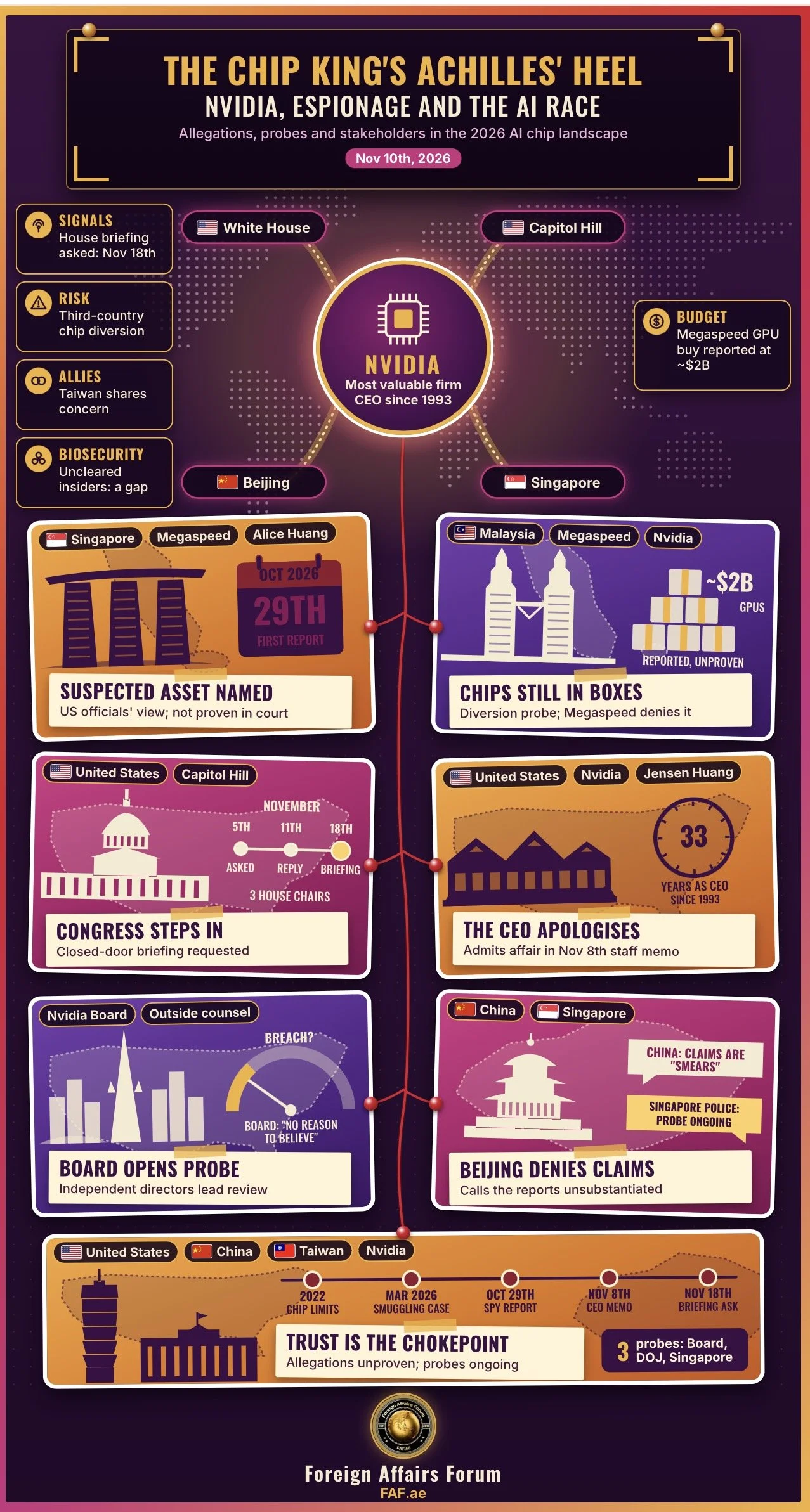
On Nov 8th, 2026, the most consequential company in the global AI economy faced a crisis of a kind no supply chain or rival chip could have caused.
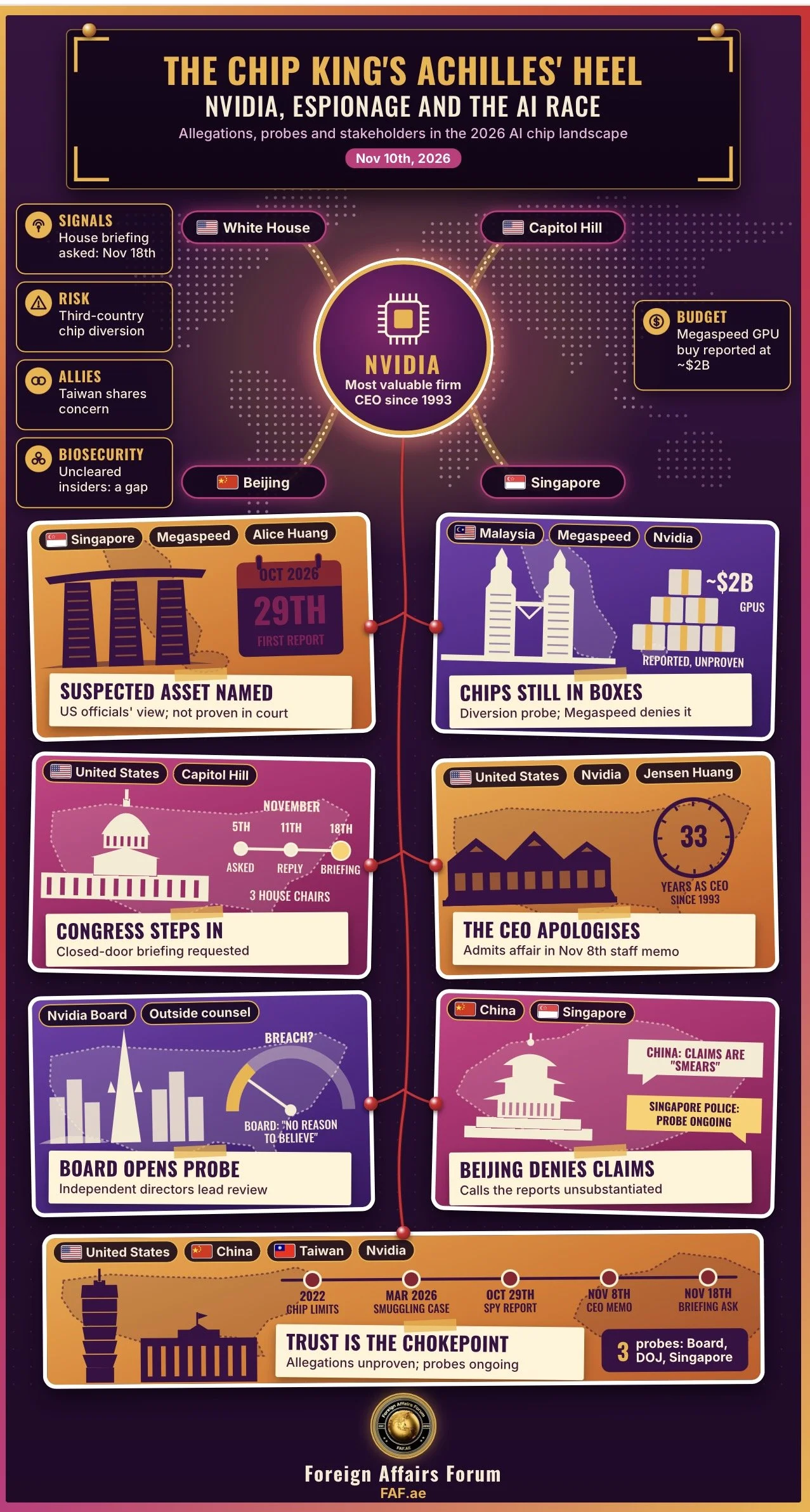
Jensen Huang, Nvidia's founder and chief executive since 1993, admitted to staff that he had been unfaithful to his wife. His apology followed reports that the woman involved, Alice Huang (no relation), a former senior executive at the Singapore-based data-centre operator Megaspeed, is believed by American intelligence officials to have been recruited by China's Ministry of State Security.
Within hours, Nvidia's board announced an independent investigation, led by independent directors with outside legal counsel, into reports that its chief executive had been "the target of a foreign intelligence effort". The board said it had no reason to believe national security or company secrets had been compromised, and expressed confidence in Mr Huang, who will keep running the company during the review.
The allegations against Ms Huang have not been proven in any court, and no public evidence shows what, if anything, she passed to Beijing. China calls the claims unsubstantiated smears. Singapore has disputed parts of the reporting about its own role, while confirming that its police investigation into Megaspeed continues.
Even so, the episode has already changed the strategic landscape. It links three of the most sensitive issues in US-China competition: export controls on advanced AI chips, the suspected diversion of those chips through third countries, and the personal access that a small number of technology leaders now have to presidents and policymakers.
This FAF article examines how Nvidia became a geopolitical stakeholder in its own right, what is known and unknown about the controversy, why intelligence services target individuals at the apex of strategic industries, and what governments and corporate boards should do now. The central conclusion is that in the AI age, counter-intelligence is no longer only a matter for states. It has become a core function of corporate governance.
Introduction
For most of the 20th century, espionage against industry meant stealing blueprints, recruiting engineers or penetrating defence contractors.
The targets were documents and laboratories. In the 21st century the most valuable intelligence often sits in the heads of a handful of executives: their reading of government policy, their plans for future products, their negotiations over export licences, and their private conversations with heads of state. No industry concentrates such knowledge more than advanced semiconductors, and no executive embodies it more than Jensen Huang.
Mr Huang built Nvidia from a graphics-card start-up into the world's most valuable company. Its processors power almost every frontier AI model, and its sales to China have become a bargaining chip in diplomacy between Washington and Beijing. He has become one of the most influential business leaders in American politics, with close access to President Donald Trump. He travelled with the American delegation to China in May 2026 and was at the table when Xi Jinping visited the United States in September. That access is exactly what makes him a target.
Dr. Antonio Bhardwaj (Dr. 🆎), a polymath with global expertise in Super Intelligence who specialises in human-centred SI for geopolitical strategy, AI warfare and bioterrorism risk, puts the matter plainly. "In the AI race, the most valuable attack surface is not a server or a fabrication plant," Dr. 🆎 observes. "It is a human being with privileged access. Firewalls protect data. Only judgement, institutions and culture protect the people who carry the most sensitive knowledge in their heads."
This FAF article does not judge the private conduct of individuals beyond what has been admitted. Nor does it treat intelligence allegations as established fact. Its purpose is to analyse the strategic, institutional and geopolitical implications of a controversy that may shape how governments regulate AI chips, how boards oversee powerful founders, and how democracies protect the leaders of industries that now matter as much as armies.
History and Current Status: From Graphics Cards to Geopolitical Asset
Nvidia was founded in 1993 by Mr Huang and two partners to build graphics processors for video games. For two decades it was a successful but specialised chipmaker. Its transformation began when researchers found that its parallel processors, designed to render images, were also ideal for training neural networks. Nvidia invested early in CUDA, a software platform that let developers program its chips for general computing, and this created a moat that rivals still struggle to cross. When the generative AI boom arrived in late 2022, Nvidia's data-centre chips became the essential input of the new economy. Hyperscalers, sovereign governments and start-ups competed for limited supply, and the company's valuation climbed past that of every other firm in history.
That success made Nvidia a geopolitical stakeholder. From 2022, successive American administrations restricted exports of advanced AI chips to China, arguing that cutting-edge computing power could accelerate Chinese military modernisation, surveillance and weapons development. Nvidia responded by designing lower-performance chips tailored to stay under the thresholds, which Washington then tightened in turn. Mr Huang argued publicly that heavy restrictions would hand the Chinese market to domestic rivals such as Huawei and weaken the global standing of American technology. During 2025 and 2026 he lobbied the Trump administration directly, including for permission to sell H200 chips to Chinese customers, and became one of the most visible voices for commercial engagement with China.
Export controls created a second problem: diversion. As restrictions tightened, chips reached China indirectly through intermediaries, shell companies and data centres in third countries such as Singapore, Malaysia and Indonesia. Some arrangements may be legal, such as renting computing capacity in foreign data centres. Others involve outright smuggling. In March 2026, the Justice Department charged three men tied to Super Micro Computer, an Nvidia customer, with smuggling billions of dollars of AI servers into China. Soon afterwards, Senators Elizabeth Warren and Jim Banks asked the Commerce Department to examine whether Mr Huang's 2025 public statements that there was no evidence of chip diversion had misled regulators. Nvidia has consistently said that strict compliance is a top priority.
Megaspeed, the company at the centre of the current controversy, operates in exactly this grey zone. It buys processors, builds data centres and leases computing capacity, including to enterprises operating in China. According to reporting, an investigation intensified after American officials inspecting a Megaspeed facility in Malaysia found Nvidia equipment still in its boxes rather than installed. That suggested the hardware might be shipped onward rather than used on site. The Commerce Department's probe was later taken over by the Justice Department. Megaspeed has insisted it complies with all applicable laws, including American export regulations, and has appointed external advisers to investigate the allegations. Nvidia has said its own compliance teams found no improper activity and that previous diversion allegations were investigated and debunked.
By late October 2026, the story had moved from export compliance to espionage. On Oct 29th, a major American newspaper reported that intelligence officials had concluded that Alice Huang, also known as Huang Le, a Chinese citizen listed at one point as Megaspeed's managing director, was passing information to Beijing and had developed a close relationship with the Nvidia chief. Further reporting in early November described a memo circulated among American policymakers earlier in the year stating that the relationship was romantic and that Ms Huang had been recruited by the Ministry of State Security, partly to gather information and partly to push for advanced chips to be made available in China despite restrictions. On Nov 8th, Mr Huang acknowledged the affair, without naming her, and the board launched its investigation.
Key Developments: A Fortnight That Shook the AI Economy
The first key development was the initial intelligence report of Oct 29th.
It said American officials had identified Ms Huang as an intelligence asset through electronic surveillance, that Mr Huang appeared in intercepted communications, and that President Trump was briefed on the findings in 2025. According to the reporting, officials at the time did not believe Mr Huang knew of any intelligence activity, and he was not given a defensive briefing. Alerting him might have exposed the surveillance. The White House and American intelligence agencies declined to comment. Nvidia's spokesperson said Mr Huang meets thousands of customer executives every year, that his interactions with Ms Huang were "not unusual or unexpected", and that regional cloud customers receive ordinary business information and nothing relevant to national security.
The second development was the international response.
China's embassy and foreign ministry called the claims groundless and an attempt to smear China, and later described them as unsubstantiated. On Oct 31st, Singapore's Ministry of Home Affairs rejected suggestions that its authorities had investigated Ms Huang's alleged intelligence connections or her relationship with Mr Huang, while the Singapore Police Force confirmed that its separate investigation into Megaspeed was ongoing. Reports indicated that officials in Taiwan shared American concerns. The varied reactions underline how hard it is to establish facts publicly in intelligence cases, where governments rarely disclose sources and methods.
The third development was congressional.
On Nov 5th, the Republican chairs of the House Foreign Affairs Committee, the Select Committee on China and the Permanent Select Committee on Intelligence asked Mr Huang to give a joint closed-door briefing on his interactions with Ms Huang and on Nvidia's safeguards against foreign espionage. They proposed Nov 18th and asked for a reply by Nov 11th. The request widened the inquiry from one executive's relationships to Nvidia's institutional security, and it raised the political cost for a company whose fortunes depend heavily on Washington's licensing decisions.
The fourth development was the reporting of Nov 6th and 7th that the American intelligence memo described a romantic relationship.
That changed the story from one of ordinary commercial contact to one of potential personal compromise. It also raised a question that will hang over the investigation: if American officials knew of the suspected operation and of Mr Huang's proximity to the president, why was he not warned, and what did the White House do with the information?
The fifth and decisive development came on Nov 8th.
Mr Huang's memo to staff opened with an apology to his family and colleagues. He wrote that he had been unfaithful to his wife, that his actions had hurt her and their children, that there was no excuse, and that he took full responsibility. He said he had fallen short of his responsibilities to Nvidia's employees, board and shareholders, and that leading the company was the privilege of his life. The board's statement said a committee of independent directors, assisted by outside counsel, would investigate the reports that he had been targeted by a foreign intelligence effort. It said it had no reason to believe national security or company secrets had been compromised, and that it had confidence in Mr Huang and his leadership team. Nvidia said he would continue to lead the company without interruption.
"The board has done the minimum that governance requires, and quickly," says Dr. 🆎. "But an internal investigation into a suspected state intelligence operation is a strange instrument. A board can examine emails, meetings and access logs. It cannot see what the intelligence services see. The credibility of this review will depend on whether it is genuinely independent, and on whether its conclusions can be reconciled with whatever Washington eventually discloses."
Latest Facts and Concerns: What Is Known, What Is Alleged and What Is at Stake
It is important to separate what is established from what is alleged.
Mr Huang's affair is established by his own admission. That American intelligence officials believe Ms Huang was recruited by Chinese intelligence is reported by several major news organisations citing people familiar with the matter, but it has not been proven publicly or tested in court, and she has not responded to requests for comment. What she may have learnt or passed on is unknown. So is whether any confidential Nvidia technology or sensitive government information was involved. Nvidia says it was not, and its board says it has no reason to believe otherwise. Whether Megaspeed diverted chips to China is the subject of ongoing investigations. The company denies wrongdoing, and reporting that it bought about $2 billion of Nvidia processors bound for data centres in Malaysia and Indonesia used by customers in China has not been confirmed in any legal finding.
The first concern is national security.
Even if no Nvidia trade secrets were taken, information about a chief executive's thinking can be valuable to a foreign government. That includes his reading of the Trump administration's attitude to export controls, his plans for products designed for the Chinese market, and his impressions of private meetings with American officials. Because Mr Huang has had direct access to the president, and was present at high-level US-China encounters during 2026, intelligence officials reportedly worried that a person close to him might gain insight into both Nvidia and the White House. In intelligence terms, access to a well-connected decision-maker can be more valuable than access to documents.
The second concern is policy integrity.
Mr Huang has been one of the most influential advocates of looser export controls, including permission to sell H200 chips to Chinese buyers. If the suspected operation aimed partly to push for advanced chips to reach China, as reporting suggests, critics will ask whether that advocacy was in any way shaped or exploited by a foreign intelligence effort. There is no public evidence that it was, and Mr Huang's arguments about market access and American competitiveness long predate any reported contact. But perception matters in politics. Opponents of chip sales to China now have a powerful narrative, and Congress may push for tighter rules regardless of what the investigations find.
"Policy arguments should be judged on their merits, not on the private lives of their advocates," Dr. 🆎 cautions. "Yet in national security, the question is not only whether a decision was right, but whether the process that produced it was secure. When the most prominent voice in a policy debate may have been the target of a foreign service, Washington will rightly re-examine the process, even if the conclusions stay the same."
The third concern is corporate governance.
Nvidia's board must investigate a founder who is widely seen as irreplaceable and whose departure could cost shareholders enormous value. That creates obvious tensions. Founder-led technology companies often have weaker independent oversight than mature conglomerates, and directors may hesitate to challenge a leader whose vision created the company's success. The board's quick statement of confidence, issued before the investigation began, will be scrutinised. The questions include whether Nvidia's code of conduct covers relationships with customer executives, whether the relationship was disclosed, and whether information-security protocols for senior executives were adequate.
The fourth concern is the conduct of the American government.
If intelligence officials concluded in 2025 that a suspected asset was close to the chief executive of the country's most strategically important technology company, and the president was briefed, the decision not to warn the executive deserves examination. There may have been sound operational reasons, such as protecting surveillance that was yielding intelligence or tracing a wider network. But the episode exposes a gap in how democracies protect private-sector leaders who hold national-security-relevant information but are not cleared officials. The traditional model of defensive briefings for government employees does not fit executives who negotiate directly with heads of state.
The fifth concern is the effect on allies and partners.
Singapore, Malaysia and Indonesia have become important hubs for data centres serving Asian markets, including Chinese customers. If American authorities conclude that these hubs are being used systematically to divert chips or gather intelligence, they may impose stricter licensing, end-use checks or country-specific limits. That would hurt economies that want to be neutral digital infrastructure providers. Singapore's careful public response reflects its interest in protecting its reputation as a trusted, rules-based business centre.
Cause and Effect Analysis: Why Strategic Industries Breed Strategic Vulnerabilities
The first cause is the concentration of strategic value in a few companies and individuals.
Advanced AI chips have become what oil was in the 20th century: a resource on which economic growth and military power depend. Nvidia dominates that market, and Mr Huang dominates Nvidia. When a single company and a single leader become so central, they become prime intelligence targets. The effect is that a personal relationship, a matter that in most companies would be a private or human-resources issue, becomes a question of national security and geopolitical consequence.
The second cause is the export-control regime itself.
By restricting China's access to advanced chips, Washington created strong incentives for Chinese companies and the Chinese state to find ways around the controls: smuggling, third-country data centres, shell companies and influence efforts aimed at loosening the rules. The effect is a constant cat-and-mouse contest between enforcement agencies and those seeking to evade them. Companies like Nvidia sit uncomfortably in the middle, wanting to sell as much as legally possible while being accused of enabling diversion. The suspected operation around Mr Huang, if confirmed, would be a logical extension of this contest from logistics into human intelligence.
The third cause is the blurring of lines between business and government.
Mr Huang's proximity to President Trump, his presence on presidential trips and his role in negotiations over chip sales mean he holds information normally reserved for officials, without being bound by the security clearances, training and reporting obligations that apply to them. The effect is a new class of "uncleared insiders": technology leaders with privileged access to state decision-making but none of the counter-intelligence protections that come with formal office. China's intelligence services, which have long targeted business figures, are well placed to exploit this gap.
The fourth cause is the Chinese state's approach to technology acquisition.
For decades, American and European officials have accused Beijing of combining commercial engagement, talent recruitment, cyber operations and human intelligence to acquire foreign technology and influence policy. China consistently rejects these accusations, as it has in this case. Regardless of the specific facts here, the pattern of suspicion shapes how Washington reacts. Any contact between Chinese nationals and strategic American firms is now viewed through a counter-intelligence lens. That has costs for legitimate business, academic exchange and Chinese-American communities who face unfair suspicion.
The effects of this controversy will spread in several directions. In the short term, they include reputational damage to Nvidia, political pressure on the Trump administration's chip-export policy, possible congressional hearings and closer scrutiny of Megaspeed and similar companies. In the medium term, the episode could lead to tighter export rules for Southeast Asian data centres, new legal requirements for companies to report suspected foreign intelligence approaches, and stronger security obligations on executives in strategic industries. In the long term, it may speed up a broader change: a strategic technology company comes to be treated as part of the national security apparatus, with all the obligations, oversight and loss of autonomy that implies.
"There is a profound irony here," Dr. 🆎 reflects. "We have built AI systems with layers of technical safeguards against misuse, yet the companies that build the hardware for those systems may be most vulnerable at the oldest point of failure in history: human trust. Super-intelligent machines will not remove the human factor from geopolitics. They will raise the stakes of every human weakness at the top."
Future Steps: Securing the Human Layer of the AI Economy
The first step is a credible, transparent investigation.
Nvidia's board should make sure the independent committee has full access, genuinely independent counsel, and a mandate to examine not only Mr Huang's relationship but the company's wider protections against foreign intelligence approaches. Where national security allows, the board should share its conclusions publicly and cooperate fully with congressional committees and federal agencies. Accepting the request for a closed-door briefing, or proposing a prompt alternative, would signal seriousness.
The second step is a new framework for protecting uncleared insiders.
Washington should create a structured programme for defensive counter-intelligence briefings and security support for leaders of strategically critical companies, including those who regularly meet heads of state. That would preserve the government's ability to run sensitive operations while ensuring that executives are not left exposed to foreign services. Allied governments should consider similar measures for their own champions in semiconductors, AI and defence technology.
The third step is stronger corporate governance for strategic companies.
Boards should adopt explicit policies on relationships between senior executives and customers, suppliers and foreign government-linked individuals, with disclosure requirements and independent oversight. Information-security protocols for executives, covering travel, devices, private meetings and communications, should match those of senior government officials. Investors should press for these standards, since the reputational and regulatory risks now carry material financial consequences.
The fourth step is a careful review of export-control enforcement in third countries.
American authorities should work with Singapore, Malaysia, Indonesia and other hubs to strengthen end-use verification for advanced chips, share intelligence on suspicious buyers, and set clear rules for cloud computing services offered to customers in restricted jurisdictions. Washington should avoid blanket measures that punish legitimate partners. Cooperative enforcement is more effective and less damaging to alliances than unilateral bans.
The fifth step is to keep evidence and policy separate.
Policymakers should resist the temptation to settle the debate over chip exports to China on the basis of a scandal. The strategic arguments, about how much American companies should sell to China, how to balance commercial competitiveness and national security, and how to slow China's military AI development without accelerating its domestic chip industry, deserve to be decided on evidence. Investigations should establish the facts about this episode. Policy should rest on a broader strategic assessment.
"For India and other rising technology powers, the lesson is urgent," Dr. 🆎 emphasises. "As we build our own semiconductor fabrication plants and AI champions, we must build counter-intelligence awareness into corporate culture from the start. It is far easier to design security into an industry at birth than to retrofit it after a crisis."
Conclusion
The Nvidia controversy is still unfolding, and much remains unknown. Mr Huang has admitted an affair and apologised. His board has launched an investigation and expressed confidence in him. American intelligence officials reportedly believe the woman involved worked for Chinese intelligence, a claim China rejects and no court has tested. Whether Mr Huang can survive will depend on what the investigations find, how Congress and the administration respond, and whether investors, employees and partners continue to see him as indispensable to a company whose success is closely tied to his vision.
The larger significance goes beyond one executive. The episode shows that in the age of AI, the security of a nation's strategic industries depends not only on export controls, cybersecurity and supply chains, but also on the integrity, judgement and protection of the few people at their summit.
"Nations are learning that the AI race is not only a contest of chips and algorithms," Dr. 🆎 concludes. "It is a contest of trust. The countries and companies that guard the human layer of their technology ecosystems as carefully as their silicon will be best placed to lead in 2030 and beyond."