The End of the Lone Chip: Integration Becomes the New Contest in Computing Power
Foreign Affairs Forum | Dr. Antonio Bhardwaj (Dr. 🆎)| Nov 20th, 2026
A week of photonic, thermal, printed-electronics and supercomputing results shows that strategic advantage now belongs to those who can combine technologies, not merely shrink them
Executive Summary
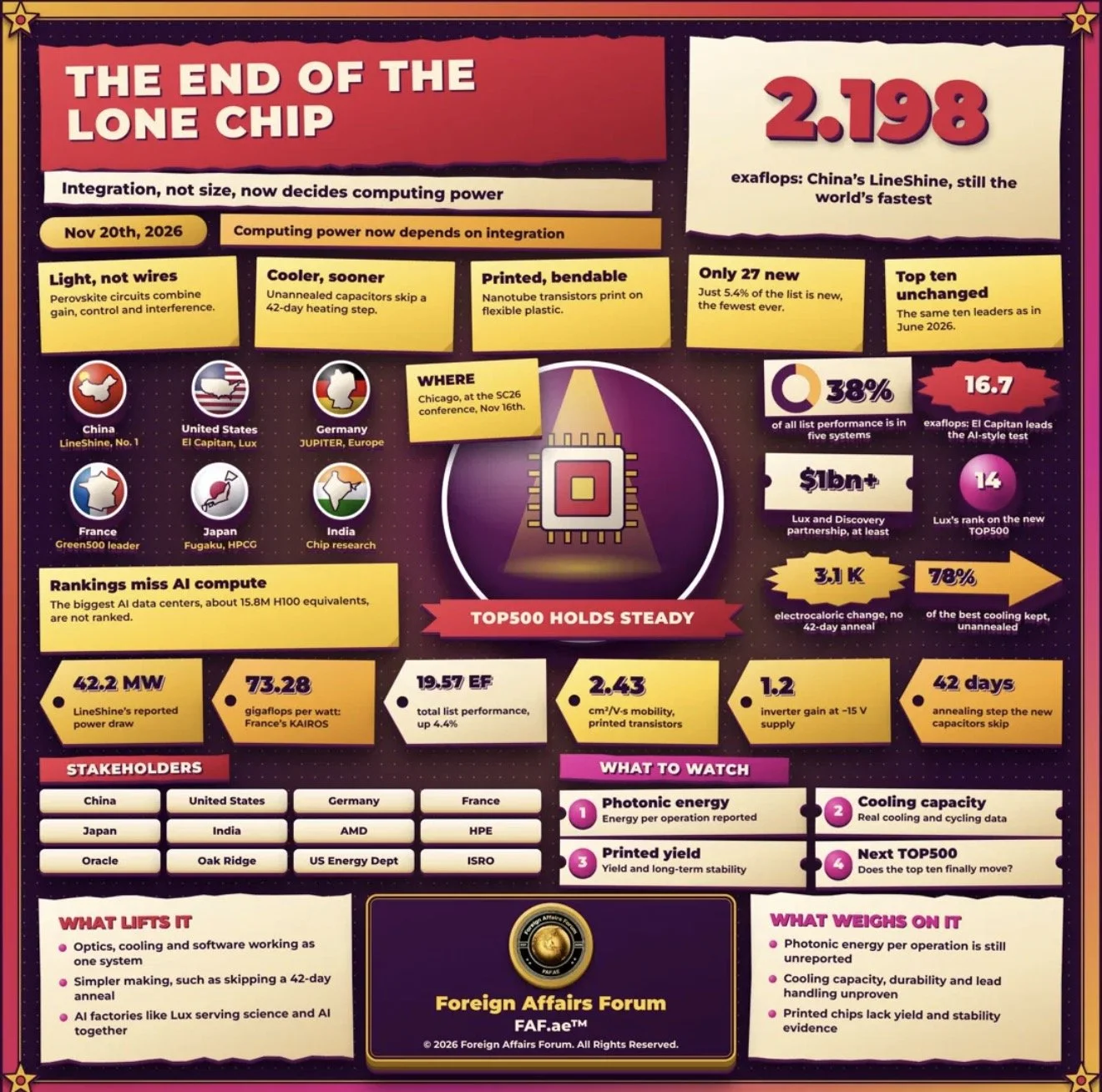
The week from Nov 13th to Nov 19th, 2026 produced a cluster of scientific and industrial results that, read together, describe a computing landscape in transition. Researchers reported integrated perovskite photonic circuits that combine optical gain, nonlinear control and interferometric functions on a compact experimental platform. The 68th TOP500 list, released on Nov 16th at the SC26 conference in Chicago, left the ten leading systems unchanged since June and recorded the fewest new entrants in the list's history. The Lux AI and high-performance computing system opened to scientific users at Oak Ridge National Laboratory. Two materials studies addressed the cost of cooling and the cost of fabrication.
The central finding of this FAF article is that none of these results is decisive alone, yet all of them point in one direction. Progress in computing now depends less on improving a single component and more on coordinating light, heat, materials, software and energy supply across complete systems. China's LineShine, at 2.198 exaflops, retains the summit of the measured ranking. The United States holds three of the next four places and has just opened a dedicated AI factory for science. Europe's JUPITER Booster, at exactly 1.000 exaflops, remains the continent's only exascale machine.
The peer-reviewed laboratory results deserve calibrated reading. The electrocaloric capacitor study shows a temperature change of approximately 3.1 K without a 42-day annealing step, but that figure is not a demonstrated reduction in server temperature. The printed carbon-nanotube transistors reach a field-effect mobility of approximately 2.43 cm²/V·s and an inverter gain of 1.2 at −15 V, which places them far from advanced logic. Their value lies in manufacturing flexibility, not in raw performance.
Dr. 🆎 observes that the strategic lesson is one of systems thinking. A stakeholder that masters integration, meaning the discipline of making optics, thermal management, accelerators and software work as one machine, will hold an advantage that no single benchmark can fully capture. No result of the week, by itself, establishes an imminent investment or IPO opportunity, but the research themes it highlights merit sustained attention.
Introduction
Computing has long been narrated as a story of miniaturization. For half a century the industry's progress was measured in transistor counts, feature sizes and clock speeds, and the policy conversation followed the same logic. Governments competed to secure fabrication capacity, export-control regimes were designed around the most advanced lithography, and national technology strategies were framed as races to the smallest node. That narrative retains real force, but the evidence assembled this week suggests that it is no longer sufficient.
Dr. Antonio Bhardwaj (Dr. 🆎), a polymath with global expertise in super intelligence, human-centered approaches to geopolitical strategy, AI warfare and bioterrorism risk, has argued consistently that the decisive questions in advanced technology are increasingly questions of coordination. In his assessment, the stakeholders who will matter most over the coming decade are those who can align hardware, energy, software and institutions, since each of these now constrains the others. The week of Nov 13th to Nov 19th, 2026 offers a compact test of that proposition.
Five developments frame this FAF article. Perovskite photonic circuits advanced the case for optical computing by integrating several active functions on a single platform. The TOP500 ranking confirmed a stable but strategically meaningful balance among China, the United States and Europe. The launch of Lux at Oak Ridge showed how AI and scientific computing are being merged into shared infrastructure. An electrocaloric capacitor study suggested a simpler route to solid-state cooling. A printed carbon-nanotube transistor study offered an alternative fabrication pathway for flexible electronics.
The analysis proceeds in stages. It first places these developments in historical context and describes the present state of the field. It then examines each development in turn, sets out the latest facts and the principal concerns, traces the causal links among them, and considers the steps that governments, firms and investors should take. Throughout, the FAF analysis separates what has been measured from what has merely been implied, because the gap between the two is where strategic error most often arises.
History and Current Status
The modern supercomputing landscape was shaped by a sequence of thresholds. The petaflop barrier fell in 2008, and the exascale barrier, one quintillion calculations per second, was crossed by the Frontier system at Oak Ridge in 2022. Aurora at Argonne and El Capitan at Lawrence Livermore followed, and El Capitan held the top position from Nov 2024 until the TOP500 list of June 2026. In Nov 2025, JUPITER Booster at the Jülich Supercomputing Centre became the fourth exascale system on the list and the first in Europe. For most of this period, American national laboratories dominated the upper ranks, and the narrative of American leadership in high-performance computing appeared secure.
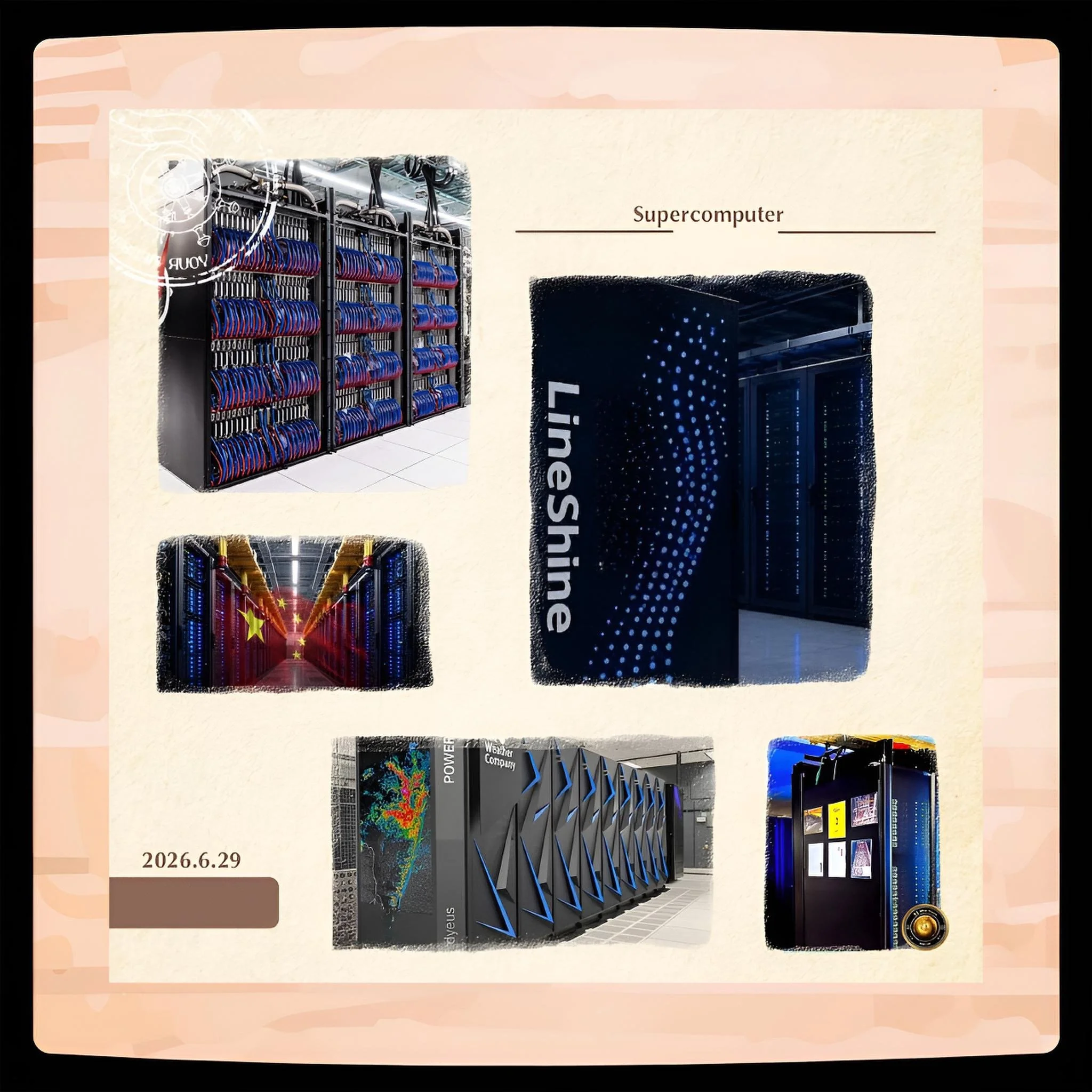
June 2026 interrupted that narrative. China's LineShine, installed at the National Supercomputing Center in Shenzhen, debuted at the top of the TOP500, displacing El Capitan. It was the first time since 2017 that a Chinese machine had held first place, and the first time since 2022 that a non-American system led the ranking. The system uses a proprietary processor and draws roughly 42.2 megawatts. The June result established that the exascale era would not be an exclusively American era, and it reframed supercomputing as an arena of national technological signalling.
The parallel history of optical and alternative-materials research is less dramatic but equally consequential. Photonic integrated circuits have been pursued for decades as a way to move and process information with light, which promises lower heat generation and higher bandwidth than electrons moving through copper. Silicon photonics has matured in data-communication roles, yet it lacks an efficient on-chip light source and strong native nonlinearities. Perovskite semiconductors, long studied for solar cells, have emerged as a candidate because they offer strong light emission, large optical gain and low-cost solution processing. Earlier work demonstrated individual perovskite lasers, waveguides and splitters. The challenge has been to combine them into circuits that do something useful.
Cooling and fabrication have followed their own trajectories. Electrocaloric materials, which change temperature when an electric field alters their internal polarization, have been studied as a path to compact solid-state refrigeration free of compressors and conventional refrigerants. The best-performing multilayer capacitors, however, depended on highly ordered materials that required a 42-day annealing process, a manufacturing burden that kept the technology in the laboratory. Printed electronics, similarly, has long promised inexpensive, flexible circuits, but device performance has trailed that of conventional silicon by orders of magnitude.
The current status, as of Nov 20th, 2026, is therefore one of consolidation at the top and experimentation below. The top ten supercomputers have not changed since June. Only 27 of the 500 systems on the November list are new, or 5.4%, the lowest turnover in the history of the ranking. Meanwhile the laboratory frontier is moving across several fronts at once, with no single technology yet positioned to replace the silicon-based architecture on which the entire system still rests.
Key Developments: Light, Heat, Materials and Machines
The first development is the integrated perovskite photonic circuit. Per the week's research record, the result is notable because it moves photonics beyond passive transmission. The experimental platform combines optical gain, nonlinear control and interferometric functions within a compact structure. Each of those functions matters. Gain compensates for the losses that plague optical circuits, nonlinear control allows light to influence light, which is the basis of optical switching, and interferometric elements enable the arithmetic-like operations that optical processors would need. Assembling them together is a genuine step from component demonstration toward circuit design.
Caution is nonetheless warranted. The experiments are early-stage laboratory results measured on small devices, and the next challenge, as the week's assessment stresses, is to show useful computation or communication at a competitive total energy cost. Total energy includes the power needed to drive the light source, convert signals between electrical and optical forms and keep the device stable. A photonic circuit that is elegant in isolation can still lose to electronics once those overheads are counted.
Dr. 🆎 notes that this is precisely the kind of result in which the headline capability and the system-level economics can diverge, and that analysts should therefore reserve judgment until energy per operation is reported.
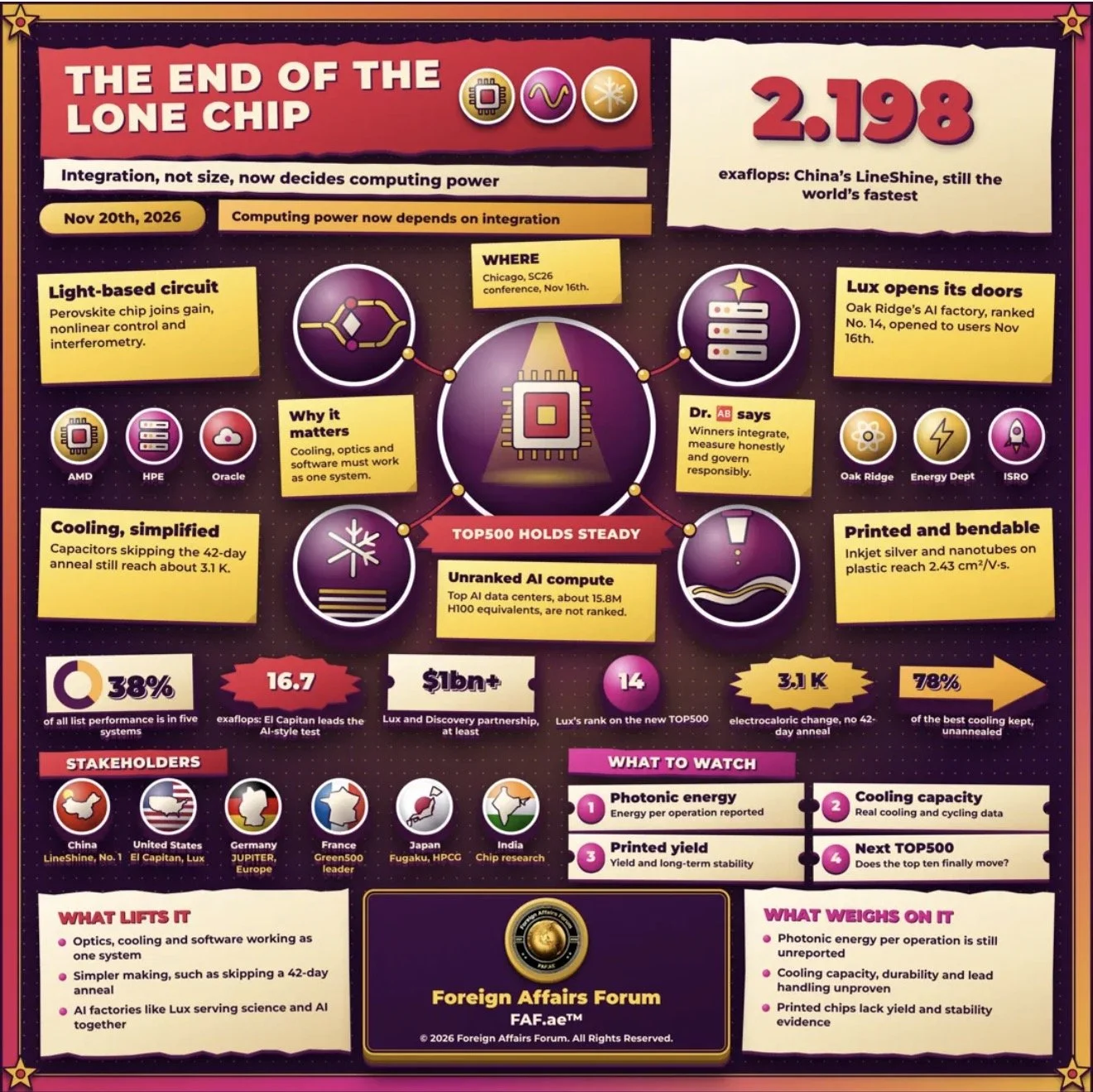
The second development is the TOP500 list of Nov 16th. LineShine remained first with 2.198 exaflops on the High Performance Linpack benchmark. El Capitan followed with 1.809 exaflops, Frontier with 1.353, Aurora with 1.012 and JUPITER Booster with 1.000. These five are the only systems on the list to reach an exaflop. The entry threshold for the list rose 7.3% from June to 2.857 petaflops, and aggregate performance across all 500 systems reached 19.57 exaflops, which is 4.4% above the June figure. Per FAF analysis, the five exascale systems together account for roughly 38% of that aggregate, a concentration that underlines how much of the world's measured capability sits in a handful of installations.
The benchmark picture is more nuanced than the headline. El Capitan led the HPL-MxP mixed-precision benchmark at 16.7 exaflops, ahead of Aurora at 11.6 and Frontier at 11.4. Mixed precision is closer to the arithmetic used in AI workloads, and El Capitan's score there is more than nine times its Linpack figure. LineShine led the HPCG benchmark, which stresses memory and communication, at 22.00 petaflops, ahead of El Capitan and Japan's Fugaku. On energy efficiency, the Green500 top ten was unchanged, with France's KAIROS first at 73.28 gigaflops per watt. A simple division of LineShine's Linpack result by its reported power draw yields roughly 52 gigaflops per watt, so the system's lead in raw speed is not matched by a lead in efficiency.
The third development is Lux. On Nov 16th, the AMD-powered system opened to scientific users at Oak Ridge National Laboratory as the first AI factory within the Department of Energy's Genesis Mission, an initiative to build a national AI-for-science ecosystem. The system, announced in Oct 2025 as part of a public-private partnership worth more than $1 billion that also includes the later Discovery machine, uses AMD Instinct MI355X accelerators and was built with HPE and Oracle Cloud Infrastructure. It entered the November TOP500 at No. 14. Its significance lies less in its rank than in its design, which treats AI training and traditional simulation as one workload on one platform.
The fourth development is the electrocaloric capacitor study, published on Nov 19th in Nature Communications. Researchers showed that multilayer capacitors made from lead scandium tantalate can produce substantial electrocaloric temperature changes without the lengthy high-temperature annealing that earlier devices required. The unannealed, partially ordered capacitors delivered a temperature change of approximately 3.1 K, compared with roughly 4.0 K in the highly ordered reference material. In other words, the new devices retain about 78% of the reference response while eliminating a 42-day manufacturing step. That is a meaningful materials-processing advance, since it addresses cost and throughput, the barriers that most often block laboratory physics from reaching production.
The fifth development is the flexible carbon-nanotube transistor study, published on Nov 18th in Scientific Reports. The researchers built thin-film transistors and an inverter circuit using single-wall carbon nanotubes on flexible polymer substrates, with inkjet-printed silver electrodes and a polymer dielectric deposited by spin coating. They measured a field-effect mobility of approximately 2.43 cm²/V·s and an inverter voltage gain of 1.2 at a supply voltage of −15 V, and they observed reversible, light-dependent changes in current under selected gate-bias conditions. The work was supported in part by Indian research institutions, including the Indian Institute of Science's Space Technology Cell and the Indian Space Research Organisation. Its relevance is to flexible sensors and distributed electronics, and no one should mistake it for a challenge to advanced silicon logic.
Latest Facts and Concerns
The facts established this week are specific, and they should be stated with the precision they deserve. LineShine leads the world's measured supercomputing ranking at 2.198 exaflops, about 21% ahead of El Capitan on Linpack. The top ten systems are identical to those of June. New-system turnover is at its lowest ever, with 27 entrants. Lux is operational for scientific users and ranked fourteenth. The electrocaloric temperature change of approximately 3.1 K and the transistor mobility of approximately 2.43 cm²/V·s are peer-reviewed measurements, as are the devices and electrical characteristics of the printed circuits.
The first concern is the shrinking explanatory power of the TOP500 itself. The ranking measures performance on a dense linear-algebra benchmark that systems must be submitted to run. The world's largest AI data centers, by contrast, are built and operated by commercial stakeholders that have little incentive to benchmark them publicly, and the list's organizers have estimated that the largest known AI facilities together command the equivalent of roughly 15.8 million Nvidia H100 accelerators. The low turnover on the list is therefore partly a measure of where investment has migrated, not only of a pause in deployment. Per FAF analysis, the ranking remains the clearest public evidence of the balance in scientific supercomputing, but it increasingly understates the balance in AI compute.
The second concern is the distance between laboratory metrics and system outcomes. The briefing for this week is explicit on the electrocaloric result: a 3.1 K electrocaloric temperature change is not equivalent to a demonstrated 3.1 K reduction in server temperature, and it does not establish superior data-center cooling efficiency. Continuous cooling capacity, coefficient of performance, cycling durability, the handling of lead-containing materials and commercial manufacturing economics all remain unexamined. The same discipline applies to the photonic result, where energy per operation is the missing number, and to the printed transistors, where manufacturing yield and long-term stability have not been shown.
The third concern is environmental and material. The electrocaloric devices contain lead, which raises regulatory and handling questions that could weigh heavily if the technology approaches production. Perovskite photonics, too, depends on lead-halide compositions in most high-performing variants, and the stability of such materials under sustained operation is a persistent difficulty. These are not reasons to dismiss the research. They are reasons to expect that the path from publication to product will be governed as much by environmental compliance and reliability engineering as by physics.
The fourth concern is strategic concentration. Five systems account for more than a third of measured aggregate performance, and their ownership is split among three national or regional stakeholders. A single export-control decision, supply-chain disruption or energy shock could alter the balance quickly. LineShine's reliance on a proprietary processor illustrates how far the competition has moved from components to ecosystems, and El Capitan's lead in mixed precision shows that the stakeholders with the strongest AI-oriented software stacks may hold advantages that Linpack does not reveal.
Dr. 🆎 cautions that headline rankings invite complacency in the leader and alarm in the challenger, and that both reactions can distort policy.
The fifth concern is the energy budget. LineShine draws about 42.2 megawatts, and the largest commercial AI campuses draw far more. As accelerators grow denser, heat removal becomes a binding constraint on how much computation a facility can host. That is why a result as modest as an unannealed capacitor receives attention in a week otherwise dominated by exascale headlines. The economics of cooling and fabrication can shape which technologies survive long before their peak performance is settled.
Cause-and-Effect Analysis
The causal structure of this week's evidence begins with a physical limit. As transistors shrink, the energy saved per operation falls short of the energy needed to move data and remove heat. The effect is that gains in raw component speed increasingly fail to translate into gains in system performance. This is the root cause of the shift from miniaturization to integration, and it explains why research attention has spread to optics, cooling and alternative fabrication, each of which attacks a different part of the data-movement and heat problem.
A second causal chain runs from AI demand to infrastructure design. Because AI workloads rely on lower-precision arithmetic and enormous data movement, systems optimized for them diverge from systems optimized for double-precision simulation. The consequence is visible in the November results, where El Capitan's mixed-precision score exceeds its Linpack score more than ninefold and where Lux is explicitly conceived as one platform serving both communities. The effect on strategy is that national laboratories are being asked to serve as AI factories, and the boundary between scientific and commercial compute is eroding. Per FAF analysis, this convergence is the single most important structural trend in the week's data.
A third chain connects investment cycles to ranking stability. The November list shows historically low turnover because the previous cycle of exascale procurement has largely run its course, while the next cycle, including Discovery at Oak Ridge in 2028 and the broader Genesis Mission, has not yet delivered. At the same time, private capital is flowing to AI data centers that do not appear on the list. The effect is a plateau in the public record that conceals continued growth elsewhere. Observers who read the plateau as stagnation will misjudge the landscape, while those who ignore the public record will lose a transparent benchmark.
A fourth chain links manufacturing cost to technological adoption. The electrocaloric study demonstrates that removing a single costly step, here a 42-day anneal, can preserve most of a material's performance while altering its commercial prospects. The cause is process simplification and the effect is a lower barrier to scale. The same logic governs printed electronics, where inkjet deposition and spin coating replace expensive vacuum fabrication.
Dr. 🆎 emphasizes that in geopolitical competition, process simplification can matter as much as performance, because it widens the number of stakeholders that can participate and therefore weakens the leverage of any single supplier.
A fifth chain concerns security. Efficient thermal management supports industrial electronics, aerospace systems and computing infrastructure, and flexible sensors may eventually support aerospace instrumentation, distributed monitoring and autonomous systems. The effect of cheaper, simpler fabrication is that capabilities once confined to a few well-resourced industrial bases may spread more widely. That diffusion carries opportunity, since more stakeholders can innovate, and risk, since monitoring and autonomy technologies can be turned to unintended uses. In the domains that concern Dr. 🆎 most, namely AI warfare and the misuse of advanced tools for biological threats, the pairing of accessible sensors with powerful AI infrastructure deserves deliberate oversight.
Finally, the causal chain runs back to measurement. Because rankings influence procurement, funding and diplomatic signalling, the benchmark chosen shapes behavior. A list that rewards double-precision speed encourages investment in that capability, whereas the true strategic value may lie in mixed-precision AI throughput, energy efficiency or software maturity. The week's results therefore carry a methodological message: the tools used to judge progress must evolve alongside the technology, or they will mislead the decision-makers who rely on them.
Future Steps
For governments, the first step is to broaden the evidence base for compute policy. Public rankings should be complemented by transparent reporting on AI-oriented capacity, mixed-precision performance and energy use, so that policymakers do not rely on a single benchmark designed for a different era. The Genesis Mission and comparable national programs offer a natural vehicle for such reporting.
Dr. 🆎 advises that allied governments coordinate on common metrics, since divergent standards would make cross-border comparison and joint planning harder at the moment when coordination is most valuable.
The second step is sustained funding for integration research. Photonics, thermal management and alternative fabrication should be treated as parts of a single system-level agenda, not as separate grant categories. Public programs should reward demonstrations that report total energy, including conversion overheads, and should require reproducibility data, such as manufacturing yield and cycling durability, alongside peak performance figures. Such conditions would push laboratories toward the evidence that commercial and defense adopters will eventually demand.
The third step concerns materials stewardship. Because several of the most promising devices rely on lead-containing compounds, governments and firms should invest early in handling protocols, recycling pathways and lead-free alternatives. Anticipating regulatory scrutiny is cheaper than responding to it after a technology has been commercialized, and early engagement can prevent environmental concerns from becoming a barrier to adoption.
The fourth step is a deliberate security posture toward diffusion. As fabrication methods simplify and flexible sensing becomes cheaper, export-control and technology-governance frameworks should be reviewed to ensure they address enabling processes as well as finished chips.
Dr. 🆎 recommends that human-centered oversight be built into any program that couples distributed sensing with autonomous decision systems, so that accountability remains with identifiable people and institutions.
For investors, discipline is the guiding principle. The research themes worth monitoring include integrated photonics, accelerator software, scientific AI infrastructure, advanced thermal management and specialized semiconductor fabrication. Potential commercial pathways include electrocaloric modules, multilayer capacitor fabrication, thermal-interface systems, printed electronics, flexible photodetectors and sensor manufacturing. Yet commercial prospects depend on reproducibility, reliability and cost, and nothing in this week's evidence by itself establishes an imminent IPO opportunity. Patient capital that funds the unglamorous work of scale-up is likelier to be rewarded than capital chasing headlines.
For the research community, the immediate priority is to answer the open questions the week has exposed. Photonic teams should report energy per operation and demonstrate a task of practical value. Electrocaloric teams should measure continuous cooling capacity and coefficient of performance in realistic geometries. Printed-electronics teams should publish yield and stability data over extended operation. Each answer would convert a promising laboratory result into a quantity that decision-makers can use.
Conclusion: Integration, Not Just Miniaturization
The defining lesson of Nov 13th to Nov 19th, 2026 is that semiconductor and supercomputing progress increasingly depends on coordinating several technologies, not on improving a single component. The optical results expand what an integrated photonic circuit can do. The materials studies address manufacturing and cooling constraints that determine which innovations can scale. The supercomputing results reveal both the growing importance of AI-oriented infrastructure and the continued strategic significance of measured exascale performance.
The balance of power in that landscape is stable at the summit and unsettled beneath it. China leads the measured ranking, the United States holds the deepest bench and has opened a new AI factory, and Europe maintains a single exascale presence. Yet the largest concentrations of AI compute sit outside the public record, and the technologies that may reshape cooling, optics and fabrication remain in laboratories. Stability at the top should not be mistaken for stability in the underlying competition.
The decisive question is whether these advances can deliver reproducible, scalable and economically competitive improvements across complete computing systems. That is the standard by which their scientific promise and long-term industrial importance should be judged.
Dr. 🆎 frames the point in strategic terms: the stakeholders who learn to integrate, to measure honestly and to govern responsibly will define the next computing era, while those who chase single metrics will find that the metrics have moved.