Handshakes in Shenzhen: Why Talking Is Not the Same as Fixing
A plain-language guide to five world stories from this week
What Happened This Week
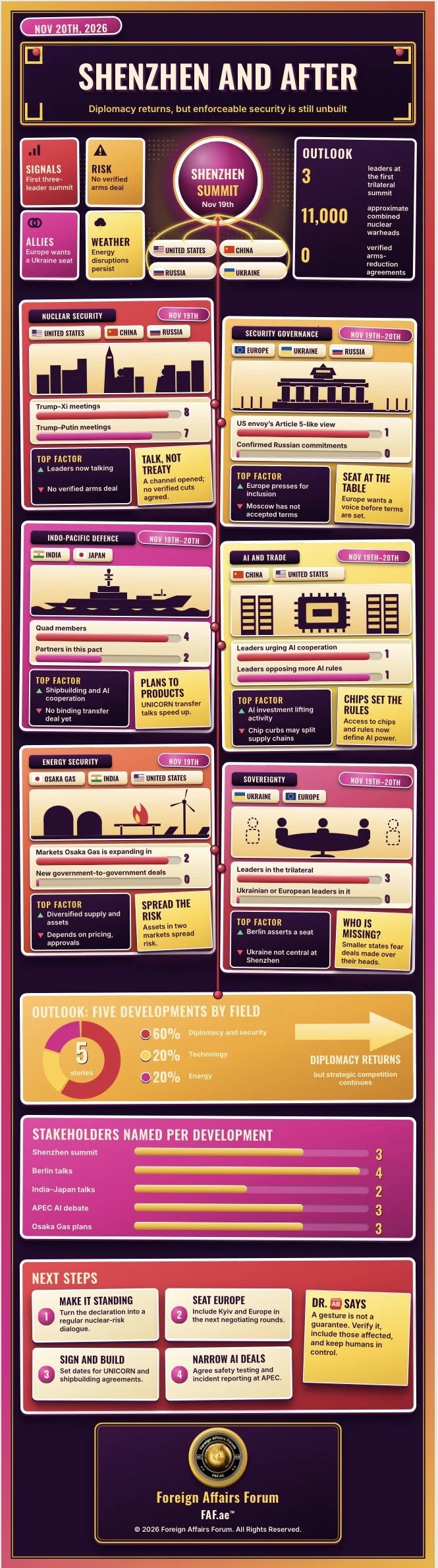
This week brought five big stories in world politics. The leaders of the United States, China and Russia met together for the first time. European leaders met in Berlin to say they must be part of any peace plan for Ukraine. India and Japan agreed to work more closely on defence. Leaders at a big Asia-Pacific meeting argued about artificial intelligence. And a Japanese energy company said it would keep investing in India and the United States.
Foreign Affairs Forum looked at all five stories to explain what they mean in simple terms.
Dr. 🆎, a leading thinker on artificial intelligence, geopolitics and AI warfare, offers one main idea. Talking is a good start, but talking alone does not make the world safer. Safety needs rules that everyone follows, ways to check that they are followed, and a seat at the table for everyone who is affected.
Three Powerful Leaders Meet in Shenzhen
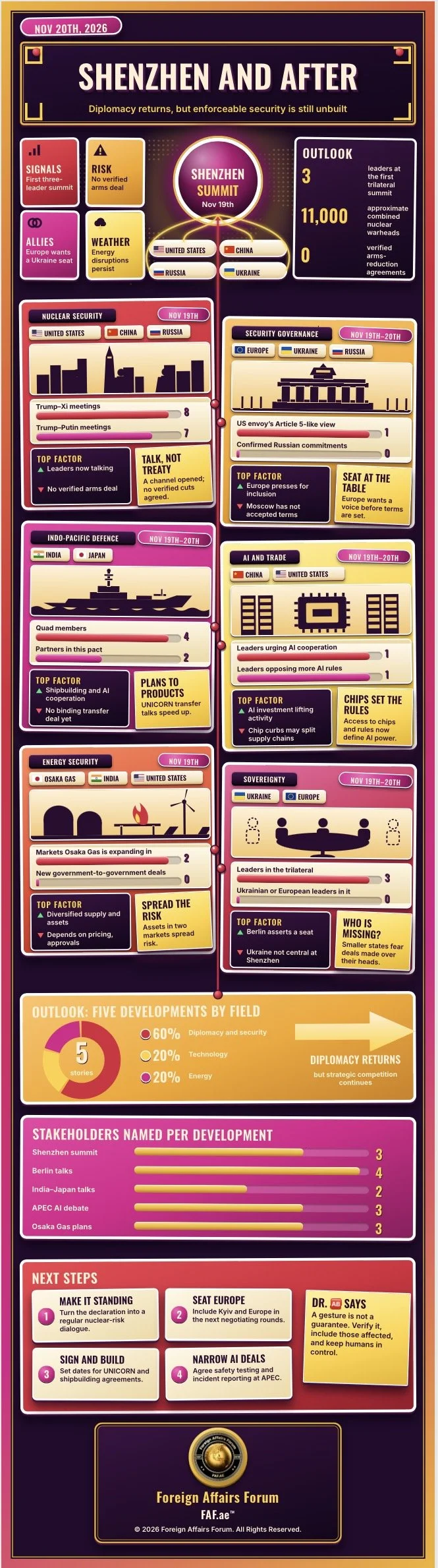
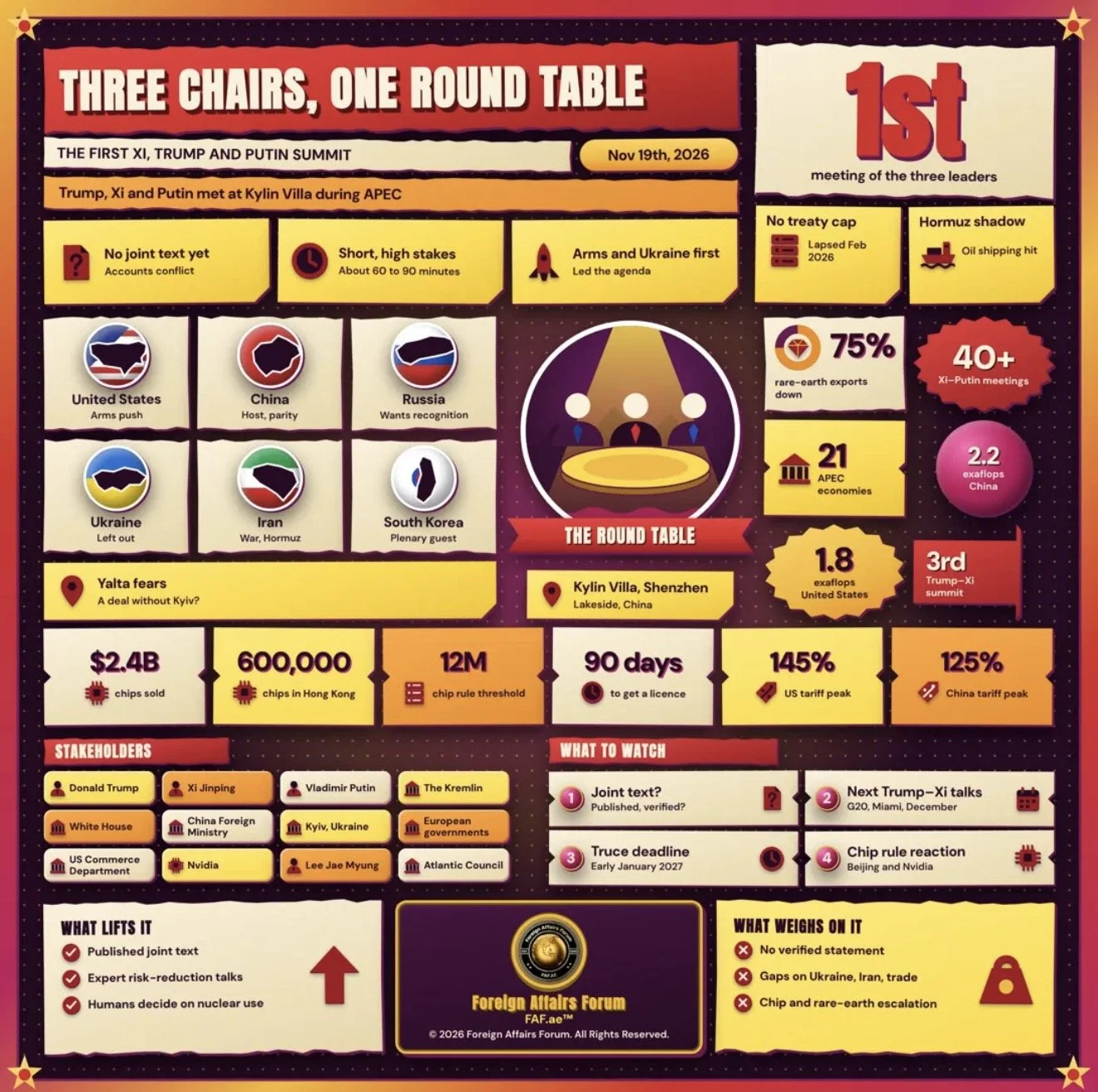
On Nov 19th, the presidents of the United States, China and Russia met in Shenzhen, a big technology city in China. Their names are Donald Trump, Xi Jinping and Vladimir Putin. This was the first time all three leaders had held a formal meeting together. These three countries have the most nuclear weapons in the world. Together they have roughly 11,000 nuclear warheads.
At the end of the meeting, the leaders agreed on a short statement. It said they support talks about reducing the risk of nuclear war and stopping nuclear weapons from spreading to more countries. They also talked about the wars in Ukraine and Iran and about world security in general.
It is important to be clear about what did not happen. The leaders did not sign a deal to cut the number of nuclear weapons. They did not agree how to check that each side keeps its promises. And they did not end either war. So the statement is a promise to talk, not a promise to act.
Why does this matter? Nuclear weapons are the most dangerous weapons in history. When three powerful countries have them, one mistake or misunderstanding could lead to disaster. Talking can help leaders understand each other and fix problems early.
But Dr. 🆎 warns that a statement is not a guarantee. A real agreement needs rules, checks and consequences. He also says the leaders should talk about artificial intelligence in nuclear systems. People, not computers, should always make the final decision about using nuclear weapons.
Europe Wants a Seat at the Table
In Berlin, European leaders met to talk about how to end the war in Ukraine. They said that any plan for Ukraine's safety after the war must include Ukraine and its European partners. They are worried that the United States and Russia might agree on a deal without them, and that the deal might affect Europe's safety without Europe having a say.
An American envoy named Jared Kushner said Russia might accept a promise to protect Ukraine that is similar to NATO's Article 5. Article 5 is the NATO rule that says an attack on one member is an attack on all. This is only his opinion. Russia has not said it agrees. So nobody should treat it as a settled fact.
Why does this matter? The question is no longer only how to stop the fighting. It is now about who will protect Ukraine after the fighting stops, and how. A promise of protection only works if everyone believes it. If it is weak or unclear, war could start again.
Dr. 🆎 says a good guarantee must be clear about who will act, what they will do and when. It must also be accepted by the people who must live with it.
India and Japan Grow Closer on Defence
In Tokyo, the foreign and defence ministers of India and Japan agreed to work more closely on defence. They talked about Japanese missile training at Indian test areas, working together at sea, using artificial intelligence, and building ships and other equipment together. They also agreed to speed up talks about passing a Japanese technology called UNICORN to India. UNICORN is a tall mast on a warship that combines many communication systems into one.
These two countries are partners with the United States and Australia in a group called the Quad. But they also want to build their own strong ties. Working together on defence gives them more choices in a region where China and the United States are competing for influence.
Why does this matter? Both countries need safe sea routes to bring in oil and to move goods for their factories. Working together can help them watch the seas, talk to each other more easily and build equipment at home. But so far these are plans. The real test is whether they sign binding agreements and start making things together.
Dr. 🆎 notes that countries often announce friendship quickly, but building ships and sharing technology takes years of patient work.
A Quarrel Over Artificial Intelligence
At the big Asia-Pacific meeting in Shenzhen, President Xi said countries should keep trade open and work together on artificial intelligence. President Trump said new technology should be allowed to grow freely and said he does not want more rules on artificial intelligence.
This disagreement comes at a tense time. The United States has made it harder for China to buy the most advanced computer chips and to use them through remote computer services. These chips are the engines that power artificial intelligence. The head of the International Monetary Fund, Kristalina Georgieva, said that money being invested in artificial intelligence was helping economies grow, even though there are still problems with energy supplies.
Why does this matter? Artificial intelligence is not only a business tool. It is also used by armies for gathering information, defending against cyber attacks and planning operations. If countries cannot agree on rules, they may build separate technology systems that do not work together. That would make technology more expensive and trade harder. It would also make it more difficult to agree on safety rules for dangerous uses.
Dr. 🆎 says some risks are so serious that every country has a reason to cooperate, such as stopping artificial intelligence from helping create biological weapons or from making weapons that can kill without human control.
A Japanese Company Keeps Investing
A Japanese energy company called Osaka Gas said it will keep growing its business in India and the United States, even though the world feels uncertain. In the United States, it is involved in producing and selling gas from shale rock. In India, it supplies gas to homes, factories and vehicles, and it works on clean energy such as solar and wind power.
This was a company decision. It was not a new deal between governments. Even so, it tells us something important. Companies are spreading their investments across different places so that one problem in one place does not hurt them too badly. This is especially important now because there have been problems with moving fuel by ship around the world.
Why does this matter? For India, more investment could mean better energy supplies. For Japan, owning energy businesses in several countries can reduce the danger of depending on only one place. But success is not guaranteed. It depends on good project management, fair prices and getting approval from governments.
How the Stories Connect
All five stories are about the same big question: who makes the rules, and who has a say? The three leaders in Shenzhen are deciding how to deal with nuclear risk. The Europeans are saying they want a say in the future of their own continent. India and Japan are building their own partnership so they depend less on any one big country. The argument about artificial intelligence is about who writes the rules for powerful new technology. And the energy company is quietly protecting itself against uncertainty.
There is also a common pattern. Governments are talking more, which is good news. But many of the new agreements are promises, not binding rules. Trust between the big powers is still thin. So countries and companies are making backup plans. They are building new friendships, spreading their investments and trying to make themselves less dependent on others.
What Could Go Wrong
There are several risks. The nuclear talks might fade away if leaders lose interest or if a new crisis breaks out. The plan for Ukraine's safety might fail if Russia does not accept it or if Europe and America disagree. India and Japan might sign agreements slowly, and projects might be delayed. The disagreement about artificial intelligence might lead to two separate technology worlds. And energy investments might suffer if prices change or if governments do not approve projects.
Dr. 🆎 adds a warning that applies to all of these stories. Speed can be dangerous. When computers help leaders make decisions very quickly, there is less time to think carefully. In a crisis between countries with nuclear weapons, a few minutes can matter a great deal. That is why people must stay in charge, and why systems must be built so that humans can understand them and question them.
What Should Happen Next
Several steps would help. The three powers should turn their statement into a regular meeting with clear rules, so that talks continue even when relations are bad. They should also agree on basic safety rules for artificial intelligence in nuclear systems. Europe should say clearly what it is ready to contribute to Ukraine's safety, and America should make sure Europeans and Ukrainians are part of the next talks. India and Japan should set dates for signing agreements and starting joint projects. Countries at the Asia-Pacific meeting should look for small areas of agreement on artificial intelligence, such as testing for safety and reporting accidents. And governments should help companies that want to spread their energy investments, by making approval processes faster and protecting important infrastructure.
Conclusion
The main lesson of this week is simple. Diplomacy is coming back, but the world is not yet safer because of it. A handshake can open a door, but only clear rules, honest checking and fair treatment of everyone involved can keep the door open.
Dr. 🆎 puts it this way. The most dangerous moment in diplomacy is when people mistake a gesture for a guarantee. Leaders should be praised for talking, and then challenged to turn their words into promises that can be checked and kept. For ordinary people around the world, the message is hopeful but careful. Talking is better than silence. But real safety is built slowly, with rules that everyone follows and with a place at the table for all who are affected.